[This is an entry to the Adversarial Collaboration Contest by TracingWoodgrains and Michael Pershan (a k-12 math teacher), on advanced students in the education system]
“What do America’s brightest students hear? Every year, across the nation, students who should be moved ahead at their natural pace of learning are told to stay put. Thousands of students are told to lower their expectations, and put their dreams on hold. Whatever they want to do, their teachers say, it can wait.” – A Nation Deceived, p.3
“There is an apparent preference among donors for studying the needs and supporting the welfare of the weak, the vicious, and the incompetent, and a negative disregard of the highly intelligent, leaving them to ‘shift for themselves.'” – Hollingworth, 1926
1. Eager to Learn and Underachieving
Pretend you’re a teacher. With 25 students, who gets your attention during class?
There’s the kid who ask for it, whose hand is constantly up. There’s also the quiet kid in the corner who never says a word, but has been lost in math since October, who will fail if you don’t do something. There’s the student in the middle of the pack, flowing along. Finally, there’s the kid who finishes everything quickly. She’s looking around and wondering, what am I supposed to do now?
In a survey of teachers from 2008, just 23% reported that advanced students were a top priority for them, while 63% reported giving struggling students in their classes the most attention. A 2005 study found the same trend in middle schools, where struggling students receive the bulk of instructional modification and special arrangements. This was true even while 73% agreed that advanced students were too often bored and under-challenged in school. While teachers, it seems, are sympathetic to the smart bored kid, that’s just not a priority for them.
This isn’t to blame teachers who are under all sorts of pressure to carry low-performing students over the threshold and who, in any event, are only trying to do what’s best for their kids. Which is the most urgent concern? If you don’t equip a kid with the skills they need, next year’s class might be a disaster for them. Or maybe they’ll fail out of school. And behavior problems? Often those begin with academic struggles. Gifted children, on the other hand — they’re on the way to becoming gifted adults. They can take care of themselves, for a minute, the logic goes. More often than not, the teacher will encourage the early finisher to go read a book, or start homework, or do anything at all while the teacher works to help the quiet, lost kid in the corner.
If the kids are just a little bored, that’s nothing strange. It’s hard to find someone who wasn’t bored in school sometimes. For many top students, already poised for achievement, this turns out just fine. And yet, there are persistent stories of how the lack of challenge can turn into something more serious.
One version of the story goes like this: from a young age, a student finds the work in school easy. It doesn’t take long for them to expect school to be easy for them — it becomes a point of pride. Over years of floating through school, an identity takes hold. Then, one day, maybe after years of schooling, something finally becomes challenging for the student… but there’s nothing nice about this challenge. The challenge is now a threat. The student begins to find school challenging, and their world falls apart. They feel isolated and misunderstood at school. They lash out. They hate it, and they can’t wait to get out.
When we asked Reddit users and blog readers to describe their experience of school, we heard versions of this story:
- Miserable waste of time, was almost never offered opportunities to learn. Largely ignored teachers and read books during class. I felt like it was a profound injustice that I was punished for doing so. I now have kids of my own and will be home-schooling them.
- I was bored. The pace was too slow and work was not interesting. Being forced by law to get up early and go somewhere to learn things I already know means permanent and firm dislike.
- I went to local public schools for kindergarten through high school, and the experience wasn’t good. Academically, the classes were slow and poorly taught. Even the AP classes were taught at the speed of the slowest student, which made the experience excruciating. The honors and regular classes were even worse: I was consistently one or more grades ahead of the rest of the class in every non-AP class except honors math. I learned not to bother studying or doing homework even in the AP classes which probably wasn’t great for my work ethic.
The stories of student pain and underachievement in school get more intense as we consider cases of extremely precocious children. The pressures on the student increase, and without help a student often experiences isolation from their peers and a whole other host of difficult feelings. Miraca Gross studied students like these in Australia and found that precocious students were often suffering in silence. Speaking particularly about precocious students who underachieve, she writes:
The majority of the extremely gifted young people in my study state frankly that for substantial periods in their school careers they have deliberately concealed their abilities or significantly moderate their scholastic achievement in an attempt to reduce their classmates’ and teachers’ resentment of them. In almost every case, the parents of children retained in the regular classroom with age peers report that the drive to achieve, the delight in intellectual exploration, and the joyful seeking after new knowledge, which characterized their children in the early years, has seriously diminished or disappeared completely. These children display disturbingly low levels of motivation and social self-esteem. They are also more likely to report social rejection by their classmates and state that they frequently underachieve in attempts to gain acceptance by age peers and teachers. Unfortunately, rather than investigating the cause of this, the schools attended by these children have tended to view their decreased motivation, with the attendant drop in academic attainment, as indicators that the child has “leveled out” and is no longer gifted.
What do we make of these stories? How common are such experiences?
From the literature on “gifted underachievement” we get partial confirmation — underachievement is a real phenomenon, supported by numerous case studies. According to a survey of various school practitioners, underachievement is the top concern when it comes to gifted students. By definition, advanced students are only a small percent of each student body, so few are affected in any given place, but on a national scale it becomes a more serious problem.
This is not just a problem for the affluent. It has persistent impacts on Black students, poor students, and students who are learning English, who are less often recommended for gifted programs or special accommodations. Here’s one way this manifests itself: in one study, 44% of poor students identified as gifted in reading in 1st Grade were no longer academically exceptional by 5th Grade. For higher-income families, only 31% of 1st Graders experience this slide.
The lack of attention to this group extends to the research. It’s difficult to pin down the number of students impacted. While underachievement is a real phenomenon, current research doesn’t tell us very much about the factors contributing to gifted underachievement. What studies have been done tend to focus almost entirely on things like whether students with ADHD or unsupportive families underachieve, rather than looking at controllable factors like the sort of teaching students experience in school.
Schools are the institutions in charge of educating kids. Those who rush into school, eager to learn, should not walk out feeling rebuffed and ignored. This is doubly true for talented kids from at-risk populations, who may not have the support structure outside of school to ensure their success if school has no time for them. It’s clear, though, that we cannot degrade the experience of other students to help those who already have an academic leg up. Is there a feasible approach to address this problem without making things worse?
We have good reason to think that personalized attention makes a huge difference to a student’s learning. Research suggests that tutoring that supplements a student’s coursework is a very effective educational intervention. Benjamin Bloom caught people’s attention with the idea of a 2 standard deviation effect in the 1980s. More recent research has lowered that sky-high estimate to more realistic numbers, and a meta-analysis found an effect size of 0.36, still a powerful impact, enough to take a student from the 50th percentile of achievement to the 64th.
If supplemental tutoring works, the dream goes, what if we replaced classroom work entirely with tutoring? Can’t we just do that for gifted underachievers and precocious students? We have tantalizing success stories of this kind in the education for precocious children. In a famous case, John Stuart Mill‘s father decided that the philosophy of utilitarianism needed an advocate, and planned a demanding course for him. Mill didn’t underachieve: he learned Greek at age 3, Latin at age 8, and flourished as a philosopher. László Polgár declared he had discovered the secret of raising “geniuses” and went about showing it by tutoring his daughters in chess from the age of 3. It’s hard to argue with his results: two grandmasters and an international master, one of whom became the 8th ranked chess player in the world and the only woman ever to take a game off the reigning world champion.
Though this sort of tutoring seems like a dream come true for underachieving gifted students, in practice it’s a non-starter in schools. (It lives on in homeschooling, to an extent). In a world where schools are struggling to help every kid learn to read, the ethics of only assigning tutors to gifted students is dubious and almost certainly a political impossibility. The cost of assigning a tutor to every child, meanwhile, would do something special to property taxes. This simple answer, then, can lead to a clearer understanding of the complexity of educational questions: It’s possible to focus on simple practices that work while disregarding nonacademic concerns and political feasibility.
To be useful, educational ideas should be effective, politically feasible, and economical. If tutoring for gifted underachievers isn’t workable, might there be some other way to approximate the benefits of personal, human attention? Here are three of the most common tools that advocates for gifted education propose:
- Grouping students of the same age in classes according to their abilities, i.e. tracking (National Association for Gifted Children)
- Accelerating students through the curriculum according to their readiness, ignoring age or grade level (A Nation Deceived)
- Using personalization software to replace a human tutor (How Khan Academy Will Help Find The Next Einstein)
What follows is an evaluation of how promising each of these tools is, both in theory and in practice.
Our favorite one-stop reading on gifted education research: this.
Our favorite one-stop reading on tutoring: this.
2. Ability Grouping (a.k.a Tracking)
The case for placing students of similar abilities together in a classroom seems like it ought to be as simple as the case for tutoring. Teachers will be more effective if their students have similar pacing needs. So, group kids who need more time in one class and those who need less time in another. It’s not tutoring, but it should be the next best thing.
Things in education research are rarely that simple, though.
Bob Slavin, a psychologist who studies education, is one of the most-cited education researchers around. He seems like a compulsively busy fellow. He writes, he runs research centers, he designs programs for schools. (He blogs.) A journalist from The Guardian once asked Slavin for his likes and dislikes, and in case you were wondering he likes work and dislikes complacency.
In the late ’80s and early ’90s, Slavin performed a series of meta-analyses of the existing literature on tracking and between-class ability grouping. Overall, he found no significant benefits from ability grouping, even for “top track” students across elementary, middle, and high schools.
But the other surprising finding of Slavin’s was that nobody was academically hurt by ability grouping — not even the lowest track students. Slavin argued that when you consider all the non-academic concerns, the scales weigh in favor of detracking, i.e. avoiding ability grouping.
What are those non-academic concerns? In the conclusion of his review of the evidence from elementary schools, he writes:
“Ability grouping plans in all forms are repugnant to many educators, who feel uncomfortable making decisions about elementary-aged students that could have long-term effects on their self-esteem and life chances. In desegregated schools, the possibility that ability grouping may create racially identifiable groups or classes is of great concern.” (p.327)
That’s Slavin’s view. So, where is the debate?
One thing that is decidedly not up for debate in the literature is that Slavin’s non-academic concerns are real. Opponents and defenders of tracking alike agree that low-track classes are often chaotic, poorly taught environments where bad behavior is endemic, and that this is a major problem. Tom Loveless is a contemporary defender of tracking, and writes that “even under the best of conditions, low tracks are difficult classrooms. The low tracks that focus on academics often try to remediate through dull, repetitious seatwork.” Jeannie Oakes made a name for herself by carefully documenting the lousiness of a lot of low track classes.
Some tracked schools seem to have done better with their low tracks. Gamoran, an opponent of tracking, speaks highly of how some Catholic schools handle lower tracks. Gutierrez identifies several tracked schools with strong commitments to helping students across the school advance in mathematics, and concludes that “tracking is not the pivotal policy on which student advancement in mathematics depends.” Making these experiences better is an important goal. These difficult dynamics are a genuine and widespread issue, though, and educators are rightly concerned about them.
Slavin’s concerns about exacerbating racism in schools are relatively uncontroversial as well. It’s not so much that race is a factor in track placement. Using a large nationally representative sample and controlling for prior achievement, Lucas and Gamoran found that race wasn’t a factor in track placement. (Though Dauber et al, found that race was a factor in track placement in Baltimore schools, so maybe sometimes racism is a factor in placement.)
But because of existing achievement gaps between e.g. Black and white students, there’s the potential in a racially mixed school that ability groups will effectively sort Black students into the lowest track and expose them to a lot of dynamics that are difficult to quantitatively measure but frequently discussed in education. A school where being Black is associated with poor performance and misbehavior will, according to many educators and researchers, lead to lower expectations and academic self-esteem for all Black students.
(Good news for people who like bad news: school segregation is getting worse, so the interaction between tracking and race is getting better.)
The main controversy surrounds Slavin’s claims about the academic impact of ability grouping. His meta-analyses were part of an extended back-and-forth with Chen-Lin & James Kulik, who wrote several competing analyses on the ability grouping literature. Slavin and the Kuliks each criticized the other’s methodology, but the core point the Kuliks made was that ability grouping did have positive effects on gifted students as long as curriculum was enhanced or accelerated to match, and that this typically did happen in dedicated gifted and talented programs. The Kuliks pointed out that both they and Slavin largely agreed on the data both analyzed, but that Slavin excluded studies of gifted programs from his research while the Kuliks made those studies a focus.
Tom Loveless, senior fellow at the Brookings Institution, summarized one important aspect of their dispute, which is that their debate centers more on values than their read of the extant evidence:
Slavin and Kulik are more sharply opposed on the tracking issue than their other points of agreement would imply. Slavin states that he is philosophically opposed to tracking, regarding it as inegalitarian and anti-democratic. Unless schools can demonstrate that tracking helps someone, Slavin reasons, they should quit using it. Kulik’s position is that since tracking benefits high achieving students and harms no one, its abolition would be a mistake (p.17)
Betts notes the studies the Kuliks and Slavin reviewed in their meta-analyses had some flaws, with relatively small N and non–nationally representative data. Using more nationally representative samples, a number of researchers (Hoffer, Gamoran and Mare, Argys, Rees and Brewer) came to the conclusion that conventional tracking benefits students in the high tracks and hurts those in the low tracks. But it’s really hard to control for the right factors in these definitely non-experimental studies, and Betts and Shkolnik raise questions about the results of these papers. And there was also a recent big meta-meta-analysis that found no benefits for between-class grouping, echoing Slavin, but that did find benefits for special grouping for gifted students, echoing the Kuliks.
Just to mess with everybody, Figlio and Page argue that by attracting stronger students to the school (because parents seek tracking) students in low-tracks benefit, secondarily.
So, in summary, what should we make of all this? Betts, an economist, says in a review of the literature that when it comes to the average impact of tracking or the distribution of achievement “this literature does not provide compelling evidence.” Loveless doesn’t disagree, but notes that for high achievers, the situation is clearer:
“The evidence does not support the charge that tracking is inherently harmful, and there is no clear evidence that abandoning tracking for heterogeneously grouped classes would provide a better education for any student. This being said, tracking’s ardent defenders cannot call on a wealth of research to support their position either. The evidence does not support the claim that tracking benefits most students or that heterogeneous grouping depresses achievement. High achieving students are the exception. For them, tracked classes with an accelerated or enriched curriculum are superior to heterogeneously grouped classes.” (p.22)
At the end of the day, all academic impacts of tracking are mediated by teaching and the curriculum. If a teacher doesn’t change what they teach or how they teach it, no grouping decision will help or hurt a student academically in a significant way. Tracking only could benefit gifted students if it came with some sort of curricular modification.
This is a conclusion with wide-reaching support. Even Slavin, who so staunchly opposed conventional ability grouping, was extremely impressed by something called the Joplin Plan, which involves three core features:
- Grouping students based on reading ability, regardless of grade level
- Regular testing and regrouping of students on the basis of the tests
- A different curriculum for each group of students
Slavin, the Kuliks, and everyone else seemed to agree that students in the plan — at all ability levels — tended to get 2-3 months ahead of students in typical programs over a year of instruction. The Joplin plan involves ability grouping — the good kind of ability grouping.
So in 1986, when the Baltimore School Superintendent turned to Bob Slavin to design a program that would improve the city’s most dysfunctional schools, guess how Slavin grouped students?
Slavin worked with research scientist Nancy Madden (they’re married) to design Success for All for Baltimore, and it’s a prominent program in the school improvement world, implemented in thousands of schools and spreading. Those three features of the Joplin plan — assessment, regrouping along the lines of ability and targeted teaching — are core features of their program.
Success for All isn’t the only example of a successful curriculum implementing these ideas. Direct Instruction was created by Siegfried Engelmann and Wesley Becker in the 1960s, and it also groups students according to their current levels in reading and math while frequently reassessing and regrouping. DI has a strong body of research supporting its efficacy (for one, it was the winner of the famous-in-education Follow Through experiment), but fell largely out of favor outside of remedial classrooms. In early 2018, a new meta-analysis spanning 50 years of research reinvigorated conversation around Direct Instruction. It found an average effect size of 0.51 to 0.66 in English and math over 328 studies (p<0.001), — strong evidence that the program works.
While its effect on student performance is rarely disputed, the program remains controversial. Historian of education Jack Schneider writes: “Direct Instruction works, and I’d never send my kids to a school that uses it. The program narrows the aims of education and leaves little room for creativity, spontaneity and play in the classroom. Although test scores may go up, the improvement is not without a cost.” Ed Realist worries that its pedagogy is unsavory, has not been shown to work for older students, that wealthier parents are voting with their feet against the curriculum, and that DI could exacerbate gaps between students. Supporters, by contrast, paint the picture of a robust, effective system that has been ignored and disregarded.
Success for All and Direct Instruction are not simple programs for schools to adopt. Implementing them amounts to a major organizational change, and pushes at the extremely resilient notion that children in school should be grouped by their ages. Comprehensive ability grouping programs such as these seem to work, but in practice they are rarely used.
Our favorite one-stop source for reading on ability grouping: here, or maybe here to get a broader picture of the controversy.
3. Acceleration
Forget the comprehensive approach, then. Does it work to simply move an individual student (e.g. an underchallenged and frustrated student) through the curriculum at whatever pace seems to make sense?
There are a few different ways schools can help some students access the curriculum more quickly. A kid can skip a full grade, or several grades in extreme cases. They can stay in their grade for some classes, but join higher grade levels for some parts of the day. They might be assigned to two classes in one year (e.g. Algebra 1 and Geometry). Or, in some cases, a young student might start school at an even younger age than is typical.
If a child is ready for a higher level within a subject and studies it instead of the lower level, it’s almost a given that they’ll learn more. The real research questions are (a) from an academic standpoint whether accelerated children do tend to be ready, or if they do poorly in classes post-acceleration) and (b) whether acceleration exposes students to non-academic harm (e.g. stress, demotivation, loss of love for subject, poor self-esteem).
The Study of Mathematically Precocious Youth (SMPY) is an ongoing longitudinal study examining thousands of mathematically gifted students. In one SMPY study, researchers compared the professional STEM accomplishments of mathematically gifted students who skipped a grade to those who remained at grade level. They found that, controlling for a student’s academic profile in a pretty sophisticated way, students who skipped a grade tended to be ahead of the non-skippers in terms of degrees earned, publications, citations accrued, and patents received. From this work it seems skipping a grade in the SMPY cohort did nothing to hurt a kid’s learning or enthusiasm for their passions.
Acceleration has been one of the focuses of SMPY studies. A 1993 piece about SMPY findings reported “there is no evidence that acceleration harms willing students either academically or psychosocially.” This is supported by various meta-analyses, going back to the 1984 Kulik & Kulik paper and confirmed by more recent work such as a 2011 analysis of existing studies. Beyond the “does no harm” findings, these meta-analyses also report academic benefits to students.
It can be confusing, when reading these studies, to keep track of just how gifted the students happen to be. For example, SMPY has studied five cohorts so far, ranging from students who assessed in the top 3% to those who assessed in the top 0.01%. As we consider students farther away from the mean of achievement, the need for acceleration becomes more acute.
Lots of teachers encounter “1 in 100” students every year, but the education of “off the charts” students is necessarily more a matter of feel than policy. Still, there are success stories to learn from, and they show a remarkable sensitivity to both the academic and social well-being of the student.
Terence Tao is a famous success story of this kind. He surprised his parents by discovering how to read before turning two, and as a child he started climbing through math at a blistering rate. He was identified as profoundly gifted from a young age, and his education was carefully tracked by Miraca Gross as part of her longitudinal study of profoundly gifted children:
His parents investigated a number of local schools, seeking one with a principal who would have the necessary flexibility and open-mindedness to accept Terry within the program structure they had in mind. …
This set the pattern for the ‘integrated,’ multi-grade acceleration program which his parents had envisaged and which was adopted, after much thought and discussion, by the school. By early 1982, when Terry was 6 years 6 months old, he was attending grades 3, 4, 6 and 7 for different subjects. On his way through school, he was able to work and socialize with children at each grade level and, because he was progressing at his own pace in each subject, without formal “grade-skipping,” gaps in his subject knowledge were avoided.“
His education continued in much the same fashion, culminating in a Ph.D. by the age of 21 and a remarkable and balanced life since. He has since given his own advice on gifted education.
Given the success of acceleration, are we accelerating enough? On the one hand, it appears that acceleration is a widely used tool for giving gifted students what they need. When looking at the top 1 in 10000 students in terms of mathematical ability as identified by the SMPY, nearly half of the group skipped grades, and almost all of them had some form of acceleration, whether that meant advanced classes, early college placement, or other tools. About two-thirds reported being satisfied with their acceleration, rating it favorably across many categories:
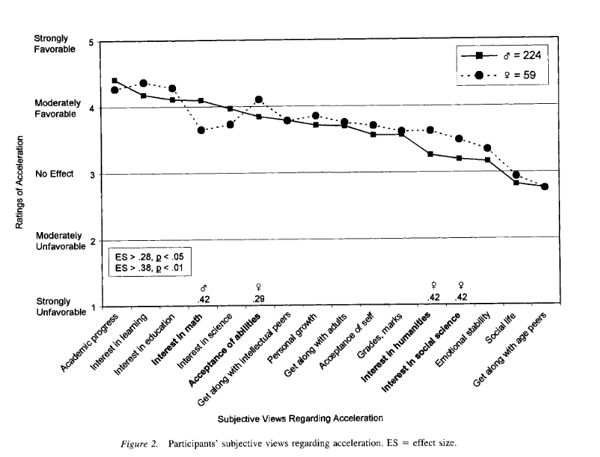
The dissatisfied third of those 1 in 10000 students, for the most part, reported wishing they had been offered more acceleration. And advocates for gifted education strongly endorse the notion that acceleration is under-used. A Nation Deceived is premised on this idea — though besides for “more” the report doesn’t get specific concerning how many students ought to be accelerated, and the report mostly makes a cultural argument in favor of acceleration, citing stories like Martin Luther King Jr. graduating high school at 15.
We wanted to know more about how educators think about acceleration, so we surveyed (via twitter) twenty-one teachers, academic coaches, tutors and administrators. The survey prompted educators to respond to the following scenario:
In your school there is currently a 1st Grader who does math above grade level, e.g. he performs long division in his head. His parents initiated contact with the teacher after hearing their child complain that math at school was boring. They’re concerned that he isn’t being challenged. The classroom teacher knows that he is above grade-level in math, and is trying to meet his needs in class. The parents, however, do not think the current situation is working. The teacher reports that the student is difficult to engage during math class, and that sometimes he misbehaves during math.
From their responses, it certainly seems that acceleration was on the table, but almost always the last option after a number of in-class or non-classroom options (e.g. after school clubs) were explored. That acceleration in math should be a “break in case of emergency” response is also the line offered by the National Council of Teachers in Math: tracking is morally indefensible, acceleration should be viewed with suspicion but can sometimes be appropriate.
In many ways, mainstream education is living in Bob Slavin’s world. He was a leading opponent of tracking, but was impressed by certain forms of ability grouping. He took the research on ability grouping that actually works (through assessment, frequent regrouping, and curricular modification) and used it to create a program for failing schools. He expresses suspicion about acceleration of gifted students in general, but agrees that at times it is a useful and necessary tool. If you broach the conversation about acceleration with your child’s teachers, you might hear some version of Bob Slavin’s take.
There is more to say about where this skepticism comes from. But it’s important to note that just because a student could be accelerated doesn’t always mean that they should. While some gifted students fit the profile we sketched above — frustrated with school, bored and underchallenged, and finding it hard to connect to peers — many equally capable students are happy in their school lives. (We heard some, but not many, happy stories from online commenters.) If a child is happy and successful without acceleration, they are likely to remain happy and successful regardless of whether they are accelerated, and if they don’t want to accelerate, it should not be forced on them. At least some of the suspicion towards acceleration comes from parents who inappropriately push schools to accelerate their happy, satisfied children.
Acceleration is also not the only option. There is much more to learn than is taught in regular courses. Even in a normal class, a well-designed curriculum or an experienced teacher can create “extensions” to the main activity, so that students who are ready for more have something valuable to engage with. Enhancement or exposure to new, similar topics can serve students as well. A student who has jumped ahead in arithmetic may be entranced by a glance at Pascal’s triangle and number theory. One who is fascinated by English might find similar joy in learning Spanish or Chinese. Both of these, alongside acceleration, follow a simple principle: if a child wants to learn more and is able to do so, let them learn more. Overall, the balance of evidence suggests that acceleration is a practical and resource-effective way to help gifted, underchallenged students flourish in schools.
Our favorite one-stop source for reading on acceleration: here.
4. Educational Goals in Conflict
Through acceleration, tutoring, or ability grouping, some kids could learn more. Why aren’t schools aggressively pursuing that? Shouldn’t they be working to teach kids as much as possible? Isn’t that what a school supposed to do? That educators are skeptical of ability grouping or acceleration can be maddening from the perspective of learning maximization: Why are schools leaving learning on the table?
Here’s something we don’t talk about nearly enough: schools are simply not in the learning-maximization business. It turns out that parents, taxpayers and politicians call on schools to perform many jobs. At times, there are trade-offs between the educational goals schools are asked to pursue, and educators are forced to make tough choices.
Historian David Labaree has one way of thinking about these conflicting educational goals, which he expands on at length in Someone Has to Fail. For Labaree, there are three competing educational goals that are responsible for creating system-wide tensions:
- democratic equality (“education as a mechanism for producing capable citizens”)
- social efficiency (“education as a mechanism for developing productive workers”)
- social mobility (“education as a way for individuals to reinforce or improve their social position”)
As Labaree tells it, these goals end up in tension all the time. A lot of things that seem like gross ineptitude or organizational dysfunction are really the result of the mutual exclusivity of these goals:
These educational goals represent the contradictions embedded in any liberal democracy, contradictions that cannot be resolved without removing either the society’s liberalism or its democracy … We ask it to promote social equality, but we want it to do so in a way that doesn’t threaten individual liberty or private interests. We ask it to promote individual opportunity, but we want it to do so in a way that doesn’t threaten the integrity of the nation or the inefficiency of the economy. As a result, the educational system is an abject failure in achieving any one of its primary social goals … The apparent dysfunctional outcomes of the school system, therefore, are not necessarily the result of bad planning, bad administration, or bad teaching; they are an expression of the contradictions in the liberal democratic mind.
Ability grouping and acceleration fit nicely within the tensions Labaree exposes. These learning-maximizing approaches could find support from those who see education as a national investment in our defense or economy. Of course, the strongest demand for acceleration in schools can come from parents, who want schools to give their children every possible opportunity to be upwardly mobile. (“We want to make sure they can go to a good college.”)
Those act as forces in favor of ability grouping and acceleration. But schools also know that they are held responsible for producing equitable outcomes for a citizenry that sees each other as equals. A program that raises achievement for top students without harming others has an appeal an economist could love, but within schools this can count as a problem.
The way this plays out in practice is that many schools are inundated with requests to accelerate a kid. Parents — especially financially well-off, well-connected parents — can typically find ways to apply pressure to schools in hopes of helping their children reach some level of distinction. They’ll sometimes do this even when it wouldn’t benefit a child’s education (it would be educationally inefficient), or when it would exacerbate inequality (by e.g. letting anyone with a rich, pushy parent take Algebra 1 early).
In short, from a school’s standpoint those are two problems with acceleration. First, parents will push for it even when it’s not academically or socially appropriate. Second, it can exacerbate inequalities. That could explain where the culture of skepticism within education comes from.
This is meant entirely in terms of explaining the dynamic. The way this plays out can be incredibly painful. Systems designed to moderate parental demand can keep a kid in a depressing and frustrating situation:
My older son wanted to move up to a more advanced math course for next year. He took two final exams for next year’s course in February and answered all but 1/2 of one question on each. So roughly 90% on both and his request to skip the course was denied. (source)
Districts sometimes have extensive policies that can be incredibly painful to navigate when trying to get a student who truly needs acceleration out of a bad classroom situation. We heard from one educator who had a very young student expressing suicidal ideations. It was all getting exacerbated by the classroom situation — the kid said he felt his teachers and peers hated him because he loved math. The parents and the educator tried to find a better classroom for the child, and were met with all the Labaree-ian layers of resistance. Off the record, the educator advised the parents to get out of dodge and into a local private school that would be more responsive to his needs.
A happy ending: the 4th Grader moved to a private school where he was placed in an 8th Grade Honors class. He likes math class now. He seems happier, he’s growing interested in street art and social justice work.
But without a doubt, there are some unhappy endings out there.
5. Personalization Software
“Ours is an age of science fiction,” Bryan Caplan writes in The Case Against Education. “Almost everyone in rich countries — and about half of the earth’s population — can access machines that answer virtually any question and teach virtually any subject … The Internet provides not just stream-of-consciousness enlightenment, but outstanding formal coursework.”
The dream of using the Internet to replace brick-and-mortar classrooms is a dream that is entirely in sync with the times. This is reflected in the enormous enthusiasm directed towards online learning and personalization software. Bill Gates, Elon Musk, and Mark Zuckerberg have all invested heavily in personalization and teaching software. And the industry as a whole is flush with funding, raising some 8 billion dollars of venture capital in 2017, while reaching 17.7 billion in revenue.
Finally — a way out of the school system and its knot of compromises! If schools are institutions whose goals are in tension with learning-maximization… then let’s stay away from schools and their tensions and give the children the unfettered learning they want. Let’s create the ideal tutor as a piece of software.
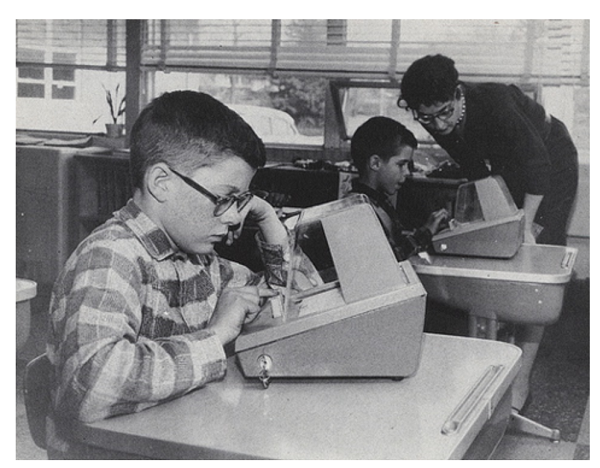
This dream isn’t just in sync with our times — it has a long history. This history is particularly well-documented by historian Larry Cuban (author of Teachers and Machines and Tinkering Toward Utopia) and by Audrey Watters (she’s writing a book about it). Watters’ talk “The History of The Future of Education” is as good a representative as any of the major thesis: that the dream is larger than any particular piece of technology. Motion pictures, radio, television, each of these was at times promoted as an educational innovation, able one day to free students from lockstep movement through school and into a personalized education. From Thomas Edison to B.F. Skinner, tech advocates have long envisioned the future that (at least according to Caplan) we’re living in now.
Then again, tech advocates in the past also thought they were living in the age of personalized learning. In 1965, a classroom that used a program called Individually Prescribed Instruction was described this way:
Each pupil sets his own pace. He is listening to records and completing workbooks. When he has completed a unit of work, he is tested, the test is corrected immediately, and if he gets a grade of 85% or better he moves on. If not, the teacher offers a series of alternative activities to correct the weakness, including individual tutoring.
For comparison, here is the NYTimes in 2017, and the headline is A New Kind of Classroom:
Students work at their own pace through worksheets, online lessons and in small group discussions with teachers. They get frequent updates on skills they have learned and those they need to acquire.
The similarity between modern day and historical personalization rhetoric doesn’t settle the matter — in a lot of ways, clearly the Internet is different — but personalization software seems to have arrived at a lot of familiar, very human frustrations.
Anyone who has gone online to learn has, at some point, come face to face with this dilemma: On the internet, you can study almost all human knowledge, but usually you don’t. In a world with virtually every MIT course fully online for free, a world with Khan Academy and Coursera and countless other tools to aid learning, why has the heralded learning revolution not yet arrived?
In a way, the revolution has arrived — it just hasn’t improved things much. Rocketship Schools, a California charter using online learning for about half of its instruction, has had solid results. Lately, though, they’ve moved away from some of their bigger bets on personalization and rediscovered teachers, saying “We’ve seen success with models that get online learning into classrooms where the best teachers are.” School of One was a widely hyped high school model in NYC that was preparing to scale up its offerings… until a fuller picture of the results came in and it was pilloried. Online charter schools, meanwhile, seem to actively depress learning.
Part of the problem is that it’s hard to get solid research on the efficacy of various ed tech products. Many tools, particularly those sold directly to schools or used by online charters, are proprietary and stuck behind paywalls, selectively presenting their best data and limited demos. The ed tech sector in general seems to deliver mixed results to students.
Why is it so hard to make effective teaching software?
For one, teaching is complex. A good human teacher does a lot of complicated things — gets to know their students, responds to the class’ moods and needs, asks “just right” questions, monitors progress, clarifies in real time as a look of confusion dawns on the class, etc., etc. — and it’s simply hard to get a computer to do that.
Maybe, theoretically, a piece of software could be designed that does these things. But in practice, many software designers don’t even try. It’s easier and cheaper to make pedagogical compromises, such as providing instruction entirely through videos. Yes, there are some thoughtful tools made by groups like those at Explorable Explanations, such as this lesson on the Prisoner’s Dilemma. But building high-quality tools well-adapted for a digital environment is difficult and time-consuming, and for prospective designers, destinations like Google or Blizzard tend to be more glamorous than working with schools. In practice, humans currently have a lot of advantages over computers in teaching.
Even if we overcame all the design issues, though, would students be motivated to stick with the program? Studies of online charters point to student engagement as the core challenge. When you put a kid in front of a computer screen, they jump to game websites, YouTube, SlateStarCodex, Google Images — anything other than their assigned learning. Many educational games that try to fix this resort to the “chocolate covered broccoli” tactic, trying to put gamelike mechanics that have nothing to do with learning around increasingly elaborate worksheets.
To be fair, student engagement is also the core challenge of conventional schools. But that’s precisely what the much-maligned structures of school are attempting to confront. The intensely social environment helps children identify as students and internalize a set of social expectations that are supportive of learning. The law compels school attendance, and schools compel class attendance. .And, once a child is in the classroom, their interactions with actual, live human instructors can set high academic expectations that a child will genuinely strive to meet.
The conventional story is that school is incredibly demotivating, but compared to their online counterparts schools are shockingly good at motivation. MOOCs like those on Coursera have an average completion rate of 15 percent — public schools do much better than this. Popular language app Duolingo’s self-reported numbers from 2013 would put their language completion rate at somewhere around 1%. If all a user has to rely on is their daily whim to continue a course, the most focused and conscientious may succeed, but those are the ones who already do well in schools. That’s a big part of why people lock themselves into multi-year commitments full of careful carrots and sticks to get through the learning process. Writers such as Caplan think that people are revealing their true interests when they skip learning to fart around on the web, but we might as well see a commitment to attend school as equally revealing. People need social institutions to help do things we’d truly like to do. As such, even as computers become better teachers, the motivational advantage of schools seems likely to persist.
How might tech-based learning tools address these factors, so they might stand a chance at holding students’ attention long enough to teach them? Art of Problem Solving, an organization promoting advanced math opportunities to children, makes a good case study. It’s found a balance worth examining. First, it provides accessible gamelike online tools that center on a careful sequence of thought-provoking problems. Second, it offers scheduled online classes with the promise of a fast pace, challenging content, and a peer group of similarly passionate students taught by subject matter experts. The online classes are more expensive offerings, but they preserve the human touch.
What does that balance mean for students? If they’re in the conscientious, self-motivated crowd that wants to learn everything yesterday, they can gorge themselves on software designed to be compelling. No barriers keep them from progressing. Software can always point to a next step, a harder problem. On the other hand, if they want to lock a motivational structure around themselves and keep the social benefits of school in a more challenging setting, they can.
Not every successful tool need look identical, but that core idea is worth repeating: software should enable the passion and self-pacing of eager kids, but should not rely on that to replace the power of social, human motivational structures. Yes, sometimes even the same structures used in “regular” schools.
Online learning, then, fits squarely within the history of attempts to automate teaching. Over and again we make the same mistakes and forget the lessons of history: that teaching is more complex than our machines have ever been, that motivation is largely social, and that schools will have a hard time distinguishing between altrustic designers and opportunistic profit-seekers.
For those in the market for online learning there are a lot of mediocre tools available, and many truly bad ones. Right now, there’s nothing that seems ready to serve as a full-on replacement for school without consistent, careful human guidance.
That said, depending on your passions, there are some excellent resources for learning out there. Especially if a student has a caring mentor or a passionate peer group, they can learn a lot online. As educators and designers create more tools that respect both the power and limitations of machines, that potential can grow. But it’s not quite science fiction.
Our algorithm has determined that you should watch the following two videos: here and here to balance realism and idealism
6. Practical Advice
Education is complex and resists easy generalizations. That said, here are some generalizations.
On navigating school for your child:
- The brightest students do not thrive equally in every setting. Even the best students achieve more with teachers than on their own. Unless tutoring or some other private arrangement is possible, this means that a school is the best place to be for learning.
- But school right now doesn’t work for all kids. One fix: if a child wants to be accelerated and seems academically prepared for it, acceleration will usually help them.
- Most schools aren’t in the business of maximizing learning for every student, and in particular they tend to be skeptical of acceleration.
- Therefore: If your kid needs more than what school is offering, be prepared to be a nudge.
- But if you think your kid needs to be challenged more and your kid is perfectly happy in school, try really hard not to be a nudge.
- Don’t fight to move your child to a class that covers the exact same material at the exact same pace but has the word “Honors” next to it. That sort of ability grouping makes no educational difference.
- Prioritize free, open online tools. Don’t expect online tools to do the work for you or your child. Expect more distraction and less progress if online learning time is unstructured or unsupervised.
For educators:
- If you are an elementary teacher or administrator and your school is looking to try new things, consider cross-grade ability grouping by subject, especially in math and reading.
- Gifted kids are usually not equally talented in all fields. Consider options to accelerate to different levels in each subject based on demonstrated skill in that subject.
- A lot comes easily to smart kids, and sometimes they never get the chance to learn to struggle. Find something they think is hard, academic or not, so they are able to handle more important challenges later.
- If a child is bored in your class and knows the material, they probably shouldn’t be in your class.
For tech designers and users:
- If you’re making online tools, make the learning the most interesting part of them. Don’t rely on chocolate-covered broccoli or assume that just presenting the material is enough. Take the problem of motivation seriously.
- Look for passionate groups with robust communities, whether online or offline. Don’t overlook the social aspect of learning.
And for advocates of educational reform, in general:
- People almost only talk about educational efficacy. But don’t be fooled — educational debates are only sometimes about what works, and frequently about what we value.
One last thing: if you’re an educator or a parent or just somebody who spends time around children, take their feelings seriously, OK? If a kid is miserable, that’s absolutely a problem that has to be solved, no matter what district policy happens to be.
Acknowledgments: Thanks to /u/Reddit4Play from reddit, JohnBuridan from the SSC community, blogger Education Realist, and many others who read drafts and offered ideas along the way.