The Tails Coming Apart As Metaphor For Life

[Epistemic status: Pretty good, but I make no claim this is original]

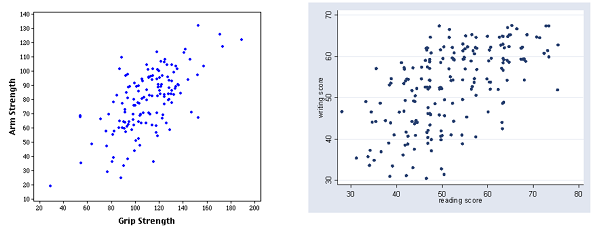
A neglected gem from Less Wrong: Why The Tails Come Apart, by commenter Thrasymachus. It explains why even when two variables are strongly correlated, the most extreme value of one will rarely be the most extreme value of the other. Take these graphs of grip strength vs. arm strength and reading score vs. writing score:

In a pinch, the second graph can also serve as a rough map of Afghanistan

Grip strength is strongly correlated with arm strength. But the person with the strongest arm doesn’t have the strongest grip. He’s up there, but a couple of people clearly beat him. Reading and writing scores are even less correlated, and some of the people with the best reading scores aren’t even close to being best at writing.

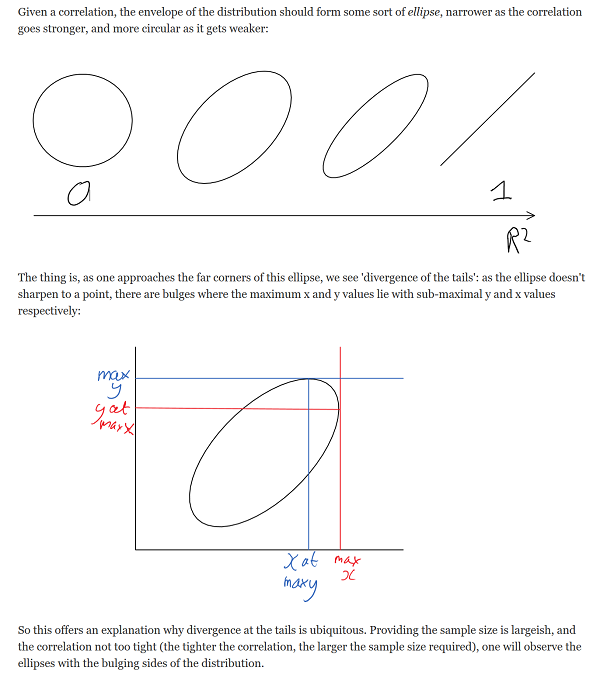
Thrasymachus gives an intuitive geometric explanation of why this should be; I can’t beat it, so I’ll just copy it outright:

I thought about this last week when I read this article on happiness research.

The summary: if you ask people to “value their lives today on a 0 to 10 scale, with the worst possible life as a 0 and the best possible life as a 10”, you will find that Scandinavian countries are the happiest in the world.

But if you ask people “how much positive emotion do you experience?”, you will find that Latin American countries are the happiest in the world.

If you check where people are the least depressed, you will find Australia starts looking very good.

And if you ask “how meaningful would you rate your life?” you find that African countries are the happiest in the world.

It’s tempting to completely dismiss “happiness” as a concept at all, but that’s not right either. Who’s happier: a millionaire with a loving family who lives in a beautiful mansion in the forest and spends all his time hiking and surfing and playing with his kids? Or a prisoner in a maximum security jail with chronic pain? If we can all agree on the millionaire – and who wouldn’t? – happiness has to at least sort of be a real concept.

The solution is to understand words as hidden inferences – they refer to a multidimensional correlation rather than to a single cohesive property. So for example, we have the word “strength”, which combines grip strength and arm strength (and many other things). These variables really are heavily correlated (see the graph above), so it’s almost always worthwhile to just refer to people as being strong or weak. I can say “Mike Tyson is stronger than an 80 year old woman”, and this is better than having to say “Mike Tyson has higher grip strength, arm strength, leg strength, torso strength, and ten other different kinds of strength than an 80 year old woman.” This is necessary to communicate anything at all and given how nicely all forms of strength correlate there’s no reason not to do it.

But the tails still come apart. If we ask whether Mike Tyson is stronger than some other very impressive strong person, the answer might very well be “He has better arm strength, but worse grip strength”.

Happiness must be the same way. It’s an amalgam between a bunch of correlated properties like your subjective well-being at any given moment, and the amount of positive emotions you feel, and how meaningful your life is, et cetera. And each of those correlated is also an amalgam, and so on to infinity.

And crucially, it’s not an amalgam in the sense of “add subjective well-being, amount of positive emotions, and meaningfulness and divide by three”. It’s an unprincipled conflation of these that just denies they’re different at all.

Think of the way children learn what happiness is. I don’t actually know how children learn things, but I imagine something like this. The child sees the millionaire with the loving family, and her dad says “That guy must be very happy!”. Then she sees the prisoner with chronic pain, and her mom says “That guy must be very sad”. Repeat enough times and the kid has learned “happiness”.

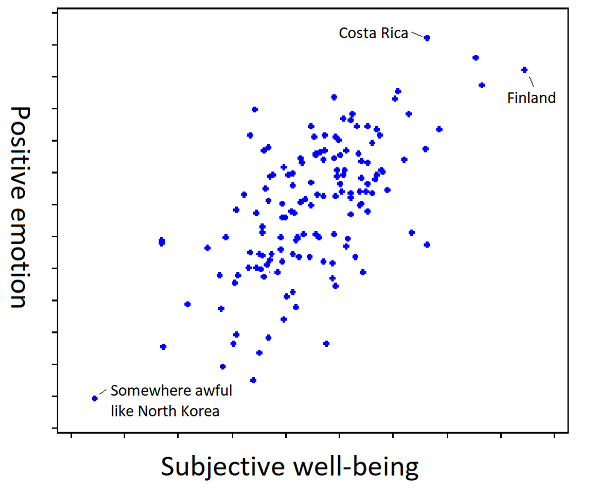
Has she learned that it’s made out of subjective well-being, or out of amount of positive emotion? I don’t know; the learning process doesn’t determine that. But then if you show her a Finn who has lots of subjective well-being but little positive emotion, and a Costa Rican who has lots of positive emotion but little subjective well-being, and you ask which is happier, for some reason she’ll have an opinion. Probably some random variation in initial conditions has caused her to have a model favoring one definition or the other, and it doesn’t matter until you go out to the tails. To tie it to the same kind of graph as in the original post:

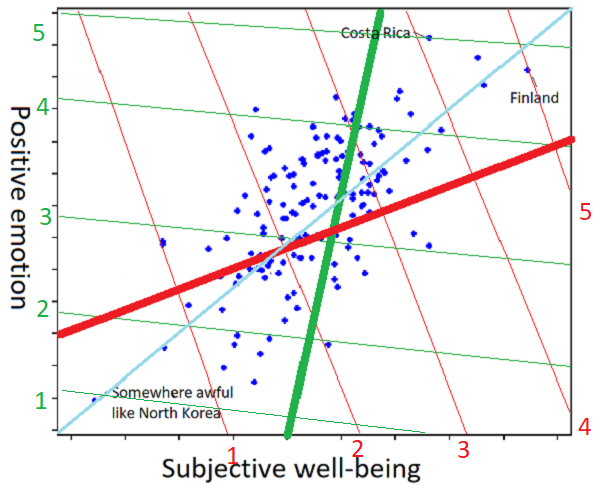
And to show how the individual differences work:

I am sorry about this graph, I really am. But imagine that one person, presented with the scatter plot and asked to understand the concept “happiness” from it, draws it as the thick red line (further towards the top right part of the line = more happiness), and a second person trying to the same task generates the thick green line. Ask the first person whether Finland or Costa Rica is happier, and they’ll say Finland: on the red coordinate system, Finland is at 5, but Costa Rica is at 4. Ask the second person, and they’ll say Costa Rica: on the green coordinate system, Costa Rica is at 5, and Finland is at 4 and a half. Did I mention I’m sorry about the graph?

But isn’t the line of best fit (here more or less y = x = the cyan line) the objective correct answer? Only in this metaphor where we’re imagining positive emotion and subjective well-being are both objectively quantifiable, and exactly equally important. In the real world, where we have no idea how to quantify any of this and we’re going off vague impressions, I would hate to be the person tasked with deciding whether the red or green line was more objectively correct.

In most real-world situations Mr. Red and Ms. Green will give the same answers to happiness-related questions. Is Costa Rica happier than North Korea? “Obviously,” the both say in union. If the tails only come apart a little, their answers to 99.9% of happiness-related questions might be the same, so much so that they could never realize they had slightly different concepts of happiness at all.

(is this just reinventing Quine? I’m not sure. If it is, then whatever, my contribution is the ridiculous graphs.)

Perhaps I am also reinventing the model of categorization discussed in How An Algorithm Feels From The Inside, Dissolving Questions About Disease, and The Categories Were Made For Man, Not Man For The Categories.

But I think there’s another interpretation. It’s not just that “quality of life”, “positive emotions”, and “meaningfulness” are three contributors which each give 33% of the activation to our central node of “happiness”. It’s that we got some training data – the prisoner is unhappy, the millionaire is happy – and used it to build a classifier that told us what happiness was. The training data was ambiguous enough that different people built different classifiers. Maybe one person built a classifier that was based entirely on quality-of-life, and a second person built a classifier based entirely around positive emotions. Then we loaded that with all the social valence of the word “happiness”, which we naively expected to transfer across paradigms.

This leads to (to steal words from Taleb) a Mediocristan resembling the training data where the category works fine, vs. an Extremistan where everything comes apart. And nowhere does this become more obvious than in what this blog post has secretly been about the whole time – morality.

The morality of Mediocristan is mostly uncontroversial. It doesn’t matter what moral system you use, because all moral systems were trained on the same set of Mediocristani data and give mostly the same results in this area. Stealing from the poor is bad. Donating to charity is good. A lot of what we mean when we say a moral system sounds plausible is that it best fits our Mediocristani data that we all agree upon. This is a lot like what we mean when we say that “quality of life”, “positive emotions”, and “meaningfulness” are all decent definitions of happiness; they all fit the training data.

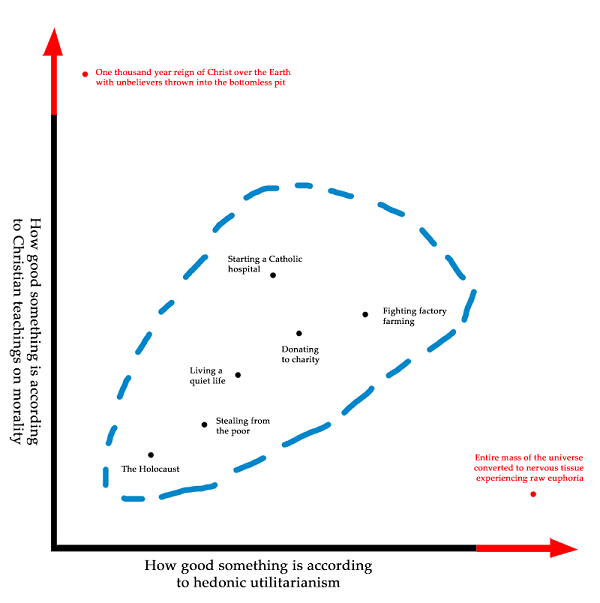
The further we go toward the tails, the more extreme the divergences become. Utilitarianism agrees that we should give to charity and shouldn’t steal from the poor, because Utility, but take it far enough to the tails and we should tile the universe with rats on heroin. Religious morality agrees that we should give to charity and shouldn’t steal from the poor, because God, but take it far enough to the tails and we should spend all our time in giant cubes made of semiprecious stones singing songs of praise. Deontology agrees that we should give to charity and shouldn’t steal from the poor, because Rules, but take it far enough to the tails and we all have to be libertarians.

I have to admit, I don’t know if the tails coming apart is even the right metaphor anymore. People with great grip strength still had pretty good arm strength. But I doubt these moral systems form an ellipse; converting the mass of the universe into nervous tissue experiencing euphoria isn’t just the second-best outcome from a religious perspective, it’s completely abominable. I don’t know how to describe this mathematically, but the terrain looks less like tails coming apart and more like the Bay Area transit system:

Mediocristan is like the route from Balboa Park to West Oakland, where it doesn’t matter what line you’re on because they’re all going to the same place. Then suddenly you enter Extremistan, where if you took the Red Line you’ll end up in Richmond, and if you took the Green Line you’ll end up in Warm Springs, on totally opposite sides of the map.

Our innate moral classifier has been trained on the Balboa Park – West Oakland route. Some of us think morality means “follow the Red Line”, and others think “follow the Green Line”, but it doesn’t matter, because we all agree on the same route.

When people talk about how we should arrange the world after the Singularity when we’re all omnipotent, suddenly we’re way past West Oakland, and everyone’s moral intuitions hopelessly diverge.

But it’s even worse than that, because even within myself, my moral intuitions are something like “Do the thing which follows the Red Line, and the Green Line, and the Yellow Line…you know, that thing!” And so when I’m faced with something that perfectly follows the Red Line, but goes the opposite directions as the Green Line, it seems repugnant even to me, as does the opposite tactic of following the Green Line. As long as creating and destroying people is hard, utilitarianism works fine, but make it easier, and suddenly your Standard Utilitarian Path diverges into Pronatal Total Utilitarianism vs. Antinatalist Utilitarianism and they both seem awful. If our degree of moral repugnance is the degree to which we’re violating our moral principles, and my moral principle is “Follow both the Red Line and the Green Line”, then after passing West Oakland I either have to end up in Richmond (and feel awful because of how distant I am from Green), or in Warm Springs (and feel awful because of how distant I am from Red).

This is why I feel like figuring out a morality that can survive transhuman scenarios is harder than just finding the Real Moral System That We Actually Use. There’s a potentially impossible conceptual problem here, of figuring out what to do with the fact that any moral rule followed to infinity will diverge from large parts of what we mean by morality.

This is only a problem for ethical subjectivists like myself, who think that we’re doing something that has to do with what our conception of morality is. If you’re an ethical naturalist, by all means, just do the thing that’s actually ethical.

When Lovecraft wrote that “we live on a placid island of ignorance in the midst of black seas of infinity, and it was not meant that we should voyage far”, I interpret him as talking about the region from Balboa Park to West Oakland on the map above. Go outside of it and your concepts break down and you don’t know what to do. He was right about the island, but exactly wrong about its causes – the most merciful thing in the world is how so far we have managed to stay in the area where the human mind can correlate its contents.

Posted in Uncategorized | Tagged , | 190 Comments

OT111: Ophion Thread


(source)

This is the bi-weekly visible open thread (there are also hidden open threads twice a week you can reach through the Open Thread tab on the top of the page). Post about anything you want, ask random questions, whatever. You can also talk at the SSC subreddit or the SSC Discord server – and also check out the SSC Podcast. Also:

1. There were some great comments on the schizophrenia thread. They convinced me I made a couple of mistakes both of fact and emphasis on there: first, that in many prodromes the negative symptoms come before or at the same time as the positive; second, that I forgot to mention there’s a large population of people with schizophrenia (or schizophrenia-like symptoms) who never worsen at all no matter how long their psychosis is untreated. I’ve also been reminded of many things about psychosis that don’t fit this model, which I might talk about more later. Beyond that, see this comment by local schizophrenia research JRG, and this thread of comments by local schizophrenic Vaticidalprophet. And see also Seppo on shamanism and thedixon on psychedelics.

2. Other good discussions from the subreddit: is Britain really poorer than Mississippi, and in what sense? and JudyKateR on useless jobs.

3. New South Bay meetup, Saturday October 6, see here for details. And you can always find the latest meetups around the world on the meetup sidebar on the left.

Posted in Uncategorized | Tagged | 1,079 Comments

Treating The Prodrome

A prodrome is an early stage of a condition that might have different symptoms than the full-blown version. In psychiatry, the prodrome of schizophrenia is the few-months-to-few-years period when a person is just starting to develop schizophrenia and is acting a little bit strange while still having some insight into their condition.

There’s a big push to treat schizophrenia prodrome as a critical period for intervention. Multiple studies have suggested that even though schizophrenia itself is a permanent condition which can be controlled but never cured, treating the prodrome aggressively enough can prevent full schizophrenia from ever developing at all. Advocates of this view compare it to detecting early-stage cancers, or getting prompt treatment for a developing stroke, or any of the million other examples from medicine of how you can get much better results by catching a disease very early before it has time to do damage.

These models conceptualize psychosis as “toxic” – not just unpleasant in and of itself, but damaging the brain while it’s happening. They focus on a statistic called Duration of Untreated Psychosis. The longer the DUP, the more chance psychosis has had to damage the patient before the fire gets put out and further damage is prevented. Under this model it’s vitally important to put people who seem to be getting a little bit schizophrenic on medications as soon as possible.

There has been a lot of work on this theory, but not a lot of light has been shed. Observational studies testing whether duration of untreated psychosis correlates with poor outcome mostly find it does a little bit, but there’s a lot of potential confounding – maybe lower-class uneducated people take longer to see a psychiatrist, or maybe people who are especially psychotic are especially bad at recognizing they are psychotic. The relevant studies try their hardest to control for these factors, but remember that this is harder than you think. The randomized controlled trials of what happens if you intervene earlier in psychosis tend to do very badly and rarely show any benefit, but randomly intervening earlier in psychosis is hard, especially if you also need an ethics board’s permission to keep a control group of other people who you are not going to intervene early on. Overall I could go either way on this.

Previously I was leaning toward “probably not relevant”, just because it’s too convenient. There is a lot of debate about how aggressively to treat schizophrenia, with mainstream psychiatry (and their friends the pharma companies) coming down on the side of “more aggressively”, while other people point out that antipsychotics have lots of side effects and their long-term effects (both how well they work long-term, and what negative effects they have long-term) are poorly understood. These people tend to come up with kind of wild theories about how long-term antipsychotics hypersensitize you and make you worse. I don’t currently find these very credible, but I’m also skeptical of things that are too convenient to the mainstream narrative, like “unless you treat every case of schizophrenia right away you are exposing patients to toxicity, and every second you fail to give the drugs makes them irreversibly worse forever!” And I know a bunch of people whose level of psychosis hovers at “mild” and has continued to do so for decades without the lack of treatment making it much worse.

After learning more about the biology of schizophrenia, I’ve become more willing to credit the DUP model. I can’t give great sources for this, because I’ve lost some of them, but this Friston paper, this Fletcher & Frith paper, and Surfing Uncertainty all kind of point to the same model of why untreated schizophrenia might get worse with time.

In their system, schizophrenia starts with aberrant prediction errors; the brain becomes incorrectly surprised by some sense-data. Maybe a fly buzzes by, and all of a sudden the brain shouts “WHOA! I WASN’T EXPECTING THAT! THAT CHANGES EVERYTHING!” Your brain shifts its resources to coming up with a theory of the world that explains why that fly buzzing by is so important – or perhaps which maximizes its ability to explain that particular fly at the cost of everything else.

Talk to early-stage schizophrenics, and their narrative sounds a lot like this. They’ll say something like “A fly buzzed by, and I knew somehow it was very significant. It must be a sign from God. Maybe that I should fly away from my current life.” Then you’ll tell them that’s dumb, and they’ll blink and say “Yeah, I guess it is kind of dumb, now that you mention it” and continue living a somewhat normal life.

Or they’ll say “I was wondering if I should go to the store, and then a Nike ad came on that said JUST DO IT. I knew that was somehow significant to my situation, so I figured Nike must be reading my mind and sending me messages to the TV.” Then you’ll remind them that that can’t happen, and even though it seemed so interesting that Nike sent the ad at that exact moment, they’ll back down.

But even sane people change their beliefs more in response to more evidence. If a friend stepped on my foot, I would think nothing of it. If she did it twice, I might be a little concerned. If she did it fifty times, I would have to reevaluate my belief that she was my friend. Each piece of evidence chips away at my comfortable normal belief that people don’t deliberately step on my feet – and eventually, I shift.

The same process happens as schizophrenia continues. One fly buzzing by with cosmic significance can perhaps be dismissed. But suppose the next day, a raindrop lands on your head, and there’s another aberrant prediction error burst. Was the raindrop a sign from God? The evidence against is that this is still dumb; the evidence for is that you had both the fly and the raindrop, so your theory that God is sending you signs starts looking a little stronger. I’m not talking about this on the conscious level, where the obvious conclusion is “guess I have schizophrenia”. I’m talking about the pre-conscious inferential machinery, which does its own mechanical thing and tells the conscious mind what to think.

As schizophrenics encounter more and more strange things, they (rationally) alter their high-level beliefs further and further. They start believing that God often sends signs to people. They start believing that the TV often talks especially to them. They start believing that there is a conspiracy. The more aberrant events they’re forced to explain, the more they abandon their sane views about the world (which are doing a terrible job of predicting all the strange things happening to them) and adopt psychotic ones.

But since their new worldview (God often sends signs) gives a high prior on various events being signs from God, they’ll be more willing to interpret even minor coincidences as signs, and so end up in a nasty feedback loop. From the Frith and Fletcher paper:

Ultimately, someone with schizophrenia will need to develop a set of beliefs that must account for a great deal of strange and sometimes contradictory data. Very commonly they come to believe that they are being persecuted: delusions of persecution are one of the most striking and common of the positive symptoms of schizophrenia, and the cause of a great deal of suffering. If one imagines trying to make some sense of a world that has become strange and inconsistent, pregnant with sinister meaning and messages, the sensible conclusion might well be that one is being deliberately deceived. This belief might also require certain other changes in the patient’s view of the world. They may have to abandon a succession of models and even whole classes of models.

A few paragraphs later, they expand their theory to the negative symptoms of schizophrenia. That is: advanced-stage schizophrenics tend to end up in a depressed-like state where they rarely do anything or care about anything. The authors say:

Further, although we have deliberately ignored negative symptoms, it is interesting to consider whether this model might have relevance for this extremely incapacitating feature of schizophrenia. We speculate that this deficit could indeed be ultimately responsible for the amotivational, asocial, akinetic state that is characteristic of negative symptoms. After all, a world in which sensory data are noisy and unreliable might lead to a state in which decisions are difficult and actions seem fruitless. We can only speculate on whether the same fundamental deficit could account for both positive and negative features of schizophrenia but, if it could, we suggest that it would be more profound in the case of negative features, and this increased severity might be invoked to account for the strange motor disturbances (collectively known as catatonia) that can be such a striking feature of the negative syndrome.

I think what they are saying is that, as the world becomes even more random and confusing, the brain very slowly adjusts its highest level parameters. It concludes, on a level much deeper than consciousness, that the world does not make sense, that it’s not really useful to act because it’s impossible to predict the consequences of actions, and that it’s not worth drawing on prior knowledge because anything could happen at any time. It gets a sort of learned helplessness about cognition, where since it never works it’s not even worth trying. The onslaught of random evidence slowly twists the highest-level beliefs into whatever form best explains random evidence (usually: that there’s a conspiracy to do random things), and twists the fundamental parameters into a form where they expect evidence to be mostly random and aren’t going to really care about it one way or the other.

Antipsychotics treat the positive symptoms of schizophrenia – the hallucinations and delusions – pretty well. But they don’t treat the negative symptoms much at all (except, of course, clozapine). Plausibly, their antidopaminergic effect prevents the spikes of aberrant prediction error, so that the onslaught of weird coincidences stops and things only seem about as relevant as they really are.

But if your brain has already spent years twisting itself into a shape determined by random coincidences, antipsychotics aren’t going to do anything for that. It’s not even obvious that a few years of evidence working normally will twist it back; if your brain has adopted the hyperprior of “evidence never works, stop trying to respond to it”, it’s hard to see how evidence could convince it otherwise.

This theory fits the “duration of untreated psychosis” model very well. The longer you’re psychotic, with weird prediction errors popping up everywhere, the more thoroughly your brain is going to shift from its normal mode of evidence-processing to whatever mode of evidence-processing best suits receiving lots of random data. If you start antipsychotics as soon as the prediction errors start, you’ll have a few weird thoughts about how a buzzing fly might have been a sign from God, but then the weirdness will stop and you’ll end up okay. If you start antipsychotics after ten years of this kind of stuff, your brain will already have concluded that the world only makes sense in the context of a magic-wielding conspiracy plus also normal logic doesn’t work, and the sudden cessation of new weirdness won’t change that.

The Frith and Fletcher paper also tipped me off to this excellent first-person account by former-schizophrenic-turned psychologist Peter Chadwick:

At this time, a powerful idea of reference also overcame me from a television episode of Colombo and impulsively I decided to write letters to friends and colleagues about “this terrible persecution.” It was a deadly mistake. After a few replies of the “we’ve not heard anything” variety, my subsequent (increasingly overwrought) letters, all of them long, were not answered. But nothing stimulates paranoia better than no feedback, and once you have conceived a delusion, something is bound to happen to confirm it. When phrases from the radio echoed phrases I had used in those very letters, it was “obvious” that the communications had been passed on to radio and then television personnel with the intent of influencing and mocking me. After all betrayal was what I was used to, why should not it be carrying on now? It seemed sensible. So much for my bonding with society. It was totally gone. I was alone and now trusted no one (if indeed my capacity to trust people [particularly after school] had ever been very high).

The unfortunate tirade of coincidences that shifted my mentality from sane to totally insane has been described more fully in a previous offering. From a meaningless life, a relationship with the world was reconstructed by me that was spectacularly meaningful and portentous even if it was horrific. Two typical days from this episode I have recalled as best I could and also published previously. The whole experience was so bizarre it is as if imprinted in my psyche in what could be called “floodlit memory” fashion. Out of the coincidences picked up on, on radio and television, coupled with overheard snatches of conversation in the street, it was “clear” to me that the media torment, orchestrated as inferred at the time by what I came to call “The Organization,” had one simple message: “Change or die!” Tellingly my mother (by then deceased) had had a fairly similar attitude. It even crossed my (increasingly loosely associated) mind that she had had some hand in all this from beyond the grave […]

As my delusional system expanded and elaborated, it was as if I was not “thinking the delusion,” the delusion was “thinking me!” I was totally enslaved by the belief system. Almost anything at all happening around me seemed at least “relevant” and became, as Piaget would say, “assimilated” to it. Another way of putting things was that confirmation bias was massively amplified, everything confirmed and fitted the delusion, nothing discredited it. Indeed, the very capacity to notice and think of refutatory data and ideas was completely gone. Confirmation bias was as if “galloping,” and I could not stop it.

As coincidences jogged and jolted me in this passive, vehicular state into the “realization” that my death was imminent, it was time to listen out for how the suicide act should be committed. “He has to do it by bus then?!” a man coincidentally shouted to another man in the office where I had taken an accounts job (in fact about a delivery but “of course” I knew that was just a cover story). “Yes!” came back the reply. This was indeed how my life was to end because the remark was made as if in reply to the very thoughts I was having at that moment. Obviously, The Organization knew my very thoughts.

Two days later, I threw myself under the wheels of a double decker, London bus on “New King’s Road” in Fulham, West London, to where I had just moved. In trying to explain “why all this was happening” my delusional system had taken a religious turn. The religious element, that all this torment was willed not only by my mother and transvestophobic scandal-mongerers but by God Himself for my “perverted Satanic ways,” was realized in the personal symbolism of this suicide. New King’s Road obviously was “the road of the New King” (Jesus), and my suicide would thrust “the old king” (Satan) out of me and Jesus would return to the world to rule. I then would be cast into Outer Darkness fighting Satan all the way. The monumental, world-saving grandiosity of this lamentable act was a far cry from my totally irrelevant, penniless, and peripheral existence in Hackney a few months before. In my own bizarre way, I obviously had moved up in the world. Now, I was not an outcast from it. I was saving the world in a very lofty manner. Medical authorities at Charing Cross Hospital in London where I was taken by ambulance, initially, of course, to orthopedics, fairly quickly recognized my psychotic state. Antipsychotic drugs were injected by a nurse on doctors’ advice, and eventually, I made a full physical and mental recovery.

Chadwick never got too far along; he had all the weird coincidences, he was starting to get beliefs that explained them, but he never got to a point where he shifted his fundamental concepts or beliefs about logic in an irreversible way. As far as I know he’s been on antipsychotics consistently since then, and has escaped with no worse consequences than becoming a psychology professor. I am not sure whether things would have gone worse for him without the medications, but I think it’s a possibility we have to consider.

Posted in Uncategorized | Tagged | 103 Comments

Book Review: The Black Swan

I.

Writing a review of The Black Swan is a nerve-wracking experience.

First, because it forces me to reveal I am about ten years behind the times in my reading habits.

But second, because its author Nassim Nicholas Taleb is infamous for angry Twitter rants against people who misunderstand his work. Much better men than I have read and reviewed Black Swan, messed it up, and ended up the victim of Taleb’s acerbic tongue.

One might ask: what’s the worst that could happen? A famous intellectual yells at me on Twitter for a few minutes? Isn’t that normal these days? Sure, occasionally Taleb will go further and write an entire enraged Medium article about some particularly egregious flub, but only occasionally. And even that isn’t so bad, is it?

But such an argument betrays the following underlying view:

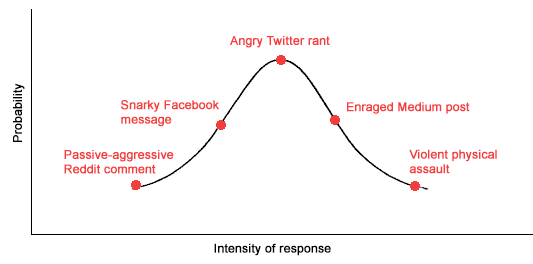
It assumes that events can always be mapped onto a bell curve, with a peak at the average and dropping off quickly as one moves towards extremes. Most reviews of Black Swan will get an angry Twitter rant. A few will get only a snarky Facebook post or an entire enraged Medium article. By the time we get to real extremes in either directions – a mere passive-aggressive Reddit comment, or a dramatic violent assault – the probabilities are so low that they can safely be ignored.

Some distributions really do follow a bell curve. The classic example is height. The average person is about 5’7. The likelihood of anyone being a different height drops off dramatically with distance from the mean. Only about one in a million people should be taller than 7 feet; only one in a billion should be as tall as 7’5. Nobody is order-of-magnitude differences in height from anyone else. Taleb calls the world of bell curves and minor differences Mediocristan. If Taleb’s reaction to bad reviews dwells alongside height in Mediocristan, I am safe; nothing an order-of-magnitude difference from an angry Twitter rant is likely to happen in entire lifetimes of misinterpreting his work.

But other distributions are nothing like a bell curve. Taleb cites power-law distributions as an example, and calls their world Extremistan. Wealth inequality lives in Extremistan. If wealth followed a bell curve around the median household income of $57,000, and a standard deviation scaled the same way as height, then a rich person earning $70,000 would be as remarkable as a tall person hitting 7 feet. Someone who earned $76,000 would be the same kind of prodigy of nature as the 7’6 Yao Ming. Instead, people earning $70,000 are dirt-common, some people earn millions, and the occasional tycoon can make hundreds of millions of dollars per year. In Mediocristan, the extremes don’t matter; in Extremistan, sometimes only the extremes matter. If you have a room full of 99 average-height people plus Yao Ming, Yao only has 1.3% of the total height in the room. If you have a room full of 99 average-income people plus Jeff Bezos, Bezos has 99.99% of the total wealth.

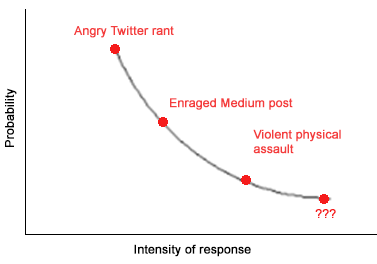
Here are Taleb’s potential reactions graphed onto a power-law distribution. Although the likelihood of any given reaction continues to decline the further it is away from average, it declines much less quickly than on the bell curve. Violent assault is no longer such a remote possibility; maybe my considerations should even be dominated by it.

So: are book reviews in Mediocristan or Extremistan?

I notice this BBC article about an author who hunted down a bad reviewer of his book and knocked her unconscious with a wine bottle. And Lord Byron wrote such a scathing meta-review of book reviewers that multiple reviewers challenged him to a duel, but the duel seems to have never taken place, plus I’m not sure Lord Byron is a good person to generalize from.

19th century intellectuals believed a bad review gave John Keats tuberculosis; they were so upset about this that they used his gravestone to complain:

Keats’ friend Shelley wrote the poem Adonais to memorialize the event, in which he said of the reviewer:

Our Adonais has drunk poison—oh!
What deaf and viperous murderer could crown
Life’s early cup with such a draught of woe?
The nameless worm would now itself disown:
It felt, yet could escape, the magic tone
Whose prelude held all envy, hate and wrong,
But what was howling in one breast alone,
Silent with expectation of the song,
Whose master’s hand is cold, whose silver lyre unstrung.

So are book reviews in Mediocristan or Extremistan? Well, every so often your review causes one of history’s greatest poets to die of tuberculosis, plus another great poet writes a five-hundred-line poem condemning you and calling you a “nameless worm”, and it becomes a classic that gets read by millions of schoolchildren each year for centuries after your death. And that’s just the worst thing that’s happened because of a book review so far. The next one could be even worse!

II.

This sounds like maybe an argument for inaction, but Taleb is more optimistic. He points out that black swans are often good. For example, pharma companies usually just sit around churning out new antidepressants that totally aren’t just SSRI clones they swear. If you invest in one of these companies, you may win a bit if their SSRI clone succeeds, and lose a bit if it fails. But drug sales fall on a power law; every so often companies get a blockbuster that lets them double, triple, or dectuple their money. Tomorrow a pharma company might discover the cure for cancer, or the cure for aging, and get to sell it to everyone forever. So when you invest in a pharma company, you have randomness on your side: the worst that can happen is you lose your money, but the best that can happen is multiple-order-of-magnitude profits.

Taleb proposes a “barbell” strategy of combining some low-risk investments with some that expose you to positive black swans:

If you know that you are vulnerable to prediction errors, and if you accept that most “risk measures” are flawed, because of the Black Swan, then your strategy is to be as hyperconservative and hyperaggressive as you can be instead of being mildly aggressive or conservative. Instead of putting your money in “medium risk” investments (how do you know it is medium risk? by listening to tenure-seeking “experts”?), you need to put a portion, say 85 to 90 percent, in extremely safe instruments, like Treasury bills—as safe a class of instruments as you can manage to find on this planet. The remaining 10 to 15 percent you put in extremely speculative bets, as leveraged as possible (like options), preferably venture capital-style portfolios.* That way you do not depend on errors of risk management; no Black Swan can hurt you at all, beyond your “floor,” the nest egg that you have in maximally safe investments. Or, equivalently, you can have a speculative portfolio and insure it (if possible) against losses of more than, say, 15 percent. You are “clipping” your incomputable risk , the one that is harmful to you. Instead of having medium risk, you have high risk on one side and no risk on the other. The average will be medium risk but constitutes a positive exposure to the Black Swan […]

The “barbell” strategy [is] taking maximum exposure to the positive Black Swans while remaining paranoid about the negative ones. For your exposure to the positive Black Swan, you do not need to have any precise understanding of the structure of uncertainty. I find it hard to explain that when you have a very limited loss you need to get as aggressive, as speculative, and some­times as “unreasonable” as you can be.

So: how good can a book review get?

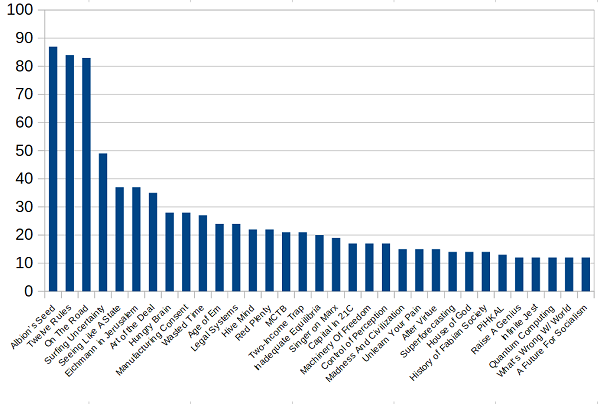
Here’s a graph of all the book reviews I’ve ever done by hit count (in thousands). I’m not going to calculate out, but it looks like a power law distribution! Some of my book reviews have been pretty successful – my review of Twelve Rules got mentioned in The Atlantic. Can things get even better than that? I met my first serious girlfriend through a blog post. Can things get even better than that? I had someone tell me a blog post on effective altruism convinced them to pledge to donate 10% of their salary to efficient charities forever; given some conservative assumptions, that probably saves twenty or thirty lives. So a book review has a small chance of giving a great poet tuberculosis, but also a small chance of saving dozens of lives. Overall it probably seems worth it.

III.

The Black Swan uses discussions of power laws and risk as a jumping-off point to explore a wider variety of topics about human fallibility. This places it in the context of similar books about rationality and bias that came out around the same time. I’m especially thinking of Philip Tetlock’s Superforecasting, Nate Silver’s The Signal And The Noise, Daniel Kahneman’s Thinking Fast And Slow, and of course The Sequences. The Black Swan shares much of its material with these – in fact, it often cites Kahneman and Tetlock approvingly. But aside from the more in-depth discussion of risk, I notice two important points of this book Taleb keeps coming back to again and again, which as far as I know are unique to him.

The first is “the ludic fallacy”, the false belief that life works like a game or a probability textbook thought experiment. Taleb cautions against the (to me tempting) mistake of comparing black swans to lottery tickets – ie “investing in pharma companies is like having a lottery ticket to win big if they invent a blockbuster”. The lottery is a game where you know the rules and probabilities beforehand. The chance of winning is whatever it is. The prize is whatever it is. You know both beforehand; all you have to do is crunch the numbers to see if it’s a good deal.

Pharma – and most other real-life things – are totally different. Nobody hands you the chance of a pharma company inventing a blockbuster drug, and nobody hands you the amount of money you’ll win if it does. There is Knightian uncertainty – uncertainty about how much uncertainty there is, uncertainty that doesn’t come pre-quantified.

Taleb gives cautionary examples of what happens if you ignore this. You make some kind of beautiful model that tells you there’s only a 0.01% chance of the stock market doing some particular bad thing. Then you invest based on that data, and the stock market does that bad thing, and you lose all your money. You were taking account of the quantified risk in your model, but not of the unquantifiable risk that your model was incorrect.

In retrospect, this is an obvious point. But it’s also obvious in retrospect that everything classes teach about probability fall victim to it, to the point where it’s hard to even think about probability in non-ludic terms. I keep having to catch myself writing some kind of “Okay, assume the risk of a Black Swan is 10%…” example in this review, because then I know Taleb will hunt me down and violently assault me. But it’s hard to resist.

I would like to excuse myself by saying it’s impossible to discuss probability without these terms, or at least that you have to start by teaching these terms and then branch into the real-world unquantifiable stuff, except that Taleb managed to write his book without doing either of those things. Granted, the book is a little bit weird. You could go through several chapters on the Lebanese Civil War or whether the French Third Republic had the best intellectuals, without noticing it was a book on probability. Nevertheless, it sets itself the task of discussing risk without starting with the ludic fallacy, and it succeeds.

I don’t know to what degree the project of “becoming well-calibrated with probabilities” is a solution to the ludic fallacy, or a case of stupidly falling victim to the ludic fallacy.

The second key concept of this book – obviously not completely original to Taleb, but I think Taleb gives it a new meaning and emphasis – is “Platonicity”, the anti-empirical desire to cram the messy real world into elegant theoretical buckets. Taleb treats the bell curve as one of the clearest examples; it’s a mathematically beautiful example of what certain risks should look like, so incompetent statisticians and economists assume that risks in a certain domain do fit the model.

He ties this into Tetlock’s “fox vs. hedgehog” dichotomy. The prognosticators who tried to fit everything to their theory usually did badly; the ones who accepted the complexity of reality and maintained a toolbox of possibilities usually did better.

He also mentions – and somehow I didn’t know this already – that modern empiricism descends from Sextus Empiricus, a classical doctor who popularized skeptical and empirical ideas as the proper way to do medicine. Sextus seems like a pretty fun guy; his surviving works include Against The Grammarians, Against The Rhetoricians, Against The Geometers, Against The Arithmeticians, Against The Astrologers, Against The Musicians, Against The Logicians, Against The Physicists, and Against The Ethicists. Medicine is certainly a great example of empiricism vs. Platonicity, with Hippocrates and his followers cramming everything into their preconceived Four Humors model – to the detriment of medical science – for thousands of years.

But Empiricus’ solution – to not hold any beliefs, and to act entirely out of habit – falls short. And I am not sure I understood what Taleb is arguing for here. There’s certainly a true platitude in this area (wait, does “platitude” share a root with “Platonic”? It looks like both go back to a Greek word meaning “broad”, but it’s not on purpose. Whatever.) of “try to go where the evidence guides you instead of having prejudices”. But there’s also a point on the other side – unless you have some paradigm to guide you, you exist in a world of chaotic noise. I am less sanguine than Taleb that “be empiricist, not theoretical” is sufficient advice, as opposed to “find the Golden Mean between empiricism and theory” – which is of course a much harder and more annoying adage, since finding a Golden Mean isn’t trivial.

That is – what would it mean for a doctor to try to do medicine without the “theory” that the heart pumped the blood? You’d find a patient with all the signs of cardiogenic shock, and say “Eh, I dunno. Maybe I should x-ray his feet, or something?” What if she had no preconceived ideas at all? Would she start reciting Sanskrit poetry, on the grounds that there’s no reason to think that would help more or less than anything else? Whereas a doctor who had read a lot of medical school textbooks – Taleb hates textbooks! – would immediately recognize the signs of cardiogenic shock, do the tests that the textbooks recommend, and give the appropriate treatment.

Yes, eventually an empiricist doctor would notice empirical facts that made her believe the heart pumped blood (and all the other true things). But then she would…write it down in a textbook. That’s what theories are – crystallized, compressed empiricism.

I think maybe Empiricus and Taleb would retort that some people form theories with only a smidgeon of evidence – I don’t know what evidence Hippocrates had for the Four Humors, but it clearly wasn’t enough. And then they stick to them dogmatically even when the evidence contradicts them. I agree with both criticisms. But then it seems like the problem is bad theories, rather than ever having theories at all. Four Humors Theory and Germ Theory are both theories – it’s just that one is wrong and the other is right. If nobody had ever been willing to accept the germ theory of disease, we’d be in a much worse place. And you can’t just say “Well, you could atheoretically notice antibiotics work and use them empirically” – much of the research into antibiotics, and the ways we use antibiotics, are in place because we more or less understand what they’re doing.

I would argue that Empiricus and Taleb are arguing not for experience over theory, but for the adjustment of certain parameters of inference – how much fudge factor we accept in compressing our data, how much we weight prior probabilities versus new evidence, how surprised to be at evidence that doesn’t fit our theories. I expect Empiricus, Taleb, and I are in agreement about which direction we want those parameters shifted. I know this sounds like a boring intellectual semantic point, but I think it’s important and occasionally saves your life if you’re practicing some craft like medicine that has a corpus of theory built up around it which you ignore at your peril.

(I also think they fail to understand the degree to which common sense is just under-the-hood inference in the same way that abstract theorizing is above-the-hood inference, and so doesn’t rescue us from these concerns).

Charitably, The Black Swan isn’t making the silly error of denying a Golden Mean of parameter position. It’s just arguing that most people today are on the too-Platonic side of things, and so society as a whole needs to shift the parameters toward the more-empirical side. Certainly this is true of most people in the world Nassim Nicholas Taleb inhabits. In Taleb’s world famous people walk around all day asserting “Everything is on a bell curve! Anyone who thinks risk is unpredictable is a dangerous heretic!” Then Taleb breaks in past their security cordon and shouts “But what if things aren’t on a bell curve? What if there are black swans?!” Then the famous person has a rage-induced seizure, as their bodyguards try to drag Taleb away. Honestly it sounds like an exciting life.

Lest you think I am exaggerating:

The psychologist Philip Tetlock (the expert buster in Chapter 10) , after listening to one of my talks, reported that he was struck by the presence of an acute state of cognitive dissonance in the audience. But how people resolve this cognitive tension, as it strikes at the core of everything they have been taught and at the methods they practice, and realize that they will continue to practice, can vary a lot. It was symptomatic that almost all people who attacked my thinking attacked a deformed version of it, like “it is all random and unpredictable” rather than “it is largely random,” or got mixed up by showing me how the bell curve works in some physical domains. Some even had to change my biography. At a panel in Lugano, Myron Scholes once got in to a state of rage, and went after a transformed version of my ideas. I could see pain in his face. Once, in Paris, a prominent member of the mathematical establishment, who invested part of his life on some minute sub-sub-property of the Gaussian, blew a fuse—right when I showed empirical evidence of the role of Black Swans in markets. He turned red with anger, had difficulty breathing, and started hurling insults at me for having desecrated the institution, lacking pudeur (modesty); he shouted “I am a member of the Academy of Science!” to give more strength to his insults.

One hazard of reviewing books long after they come out is that, if the book was truly great, it starts sounding banal. If its points were so devastating and irrefutable that they became universally accepted, then it sounds like the author is just spouting cliches. I think The Black Swan might have reached that level of influence. I haven’t even bothered explaining the term “black swan” because I assume every educated reader now knows what it means. So it seems very possible that pre-book society was so egregiously biased toward the Platonic theoretical side that it needed someone to tell it to shift in the direction of empiricism, Taleb did that, and now he sounds silly because everyone knows that you can’t just declare everything a bell curve and call it a day. Maybe this book should be read backwards. But the nature of all mental processes as a necessary balance between theory and evidence is my personal hobby-horse, just as evidence being good and theory being bad is Taleb’s personal hobby-horse, so I can’t let this pass without at least one hobby-cavalry-duel.

I have a more specific worry about skeptical empiricism, which is that it seems like an especially dangerous way to handle Extremistan and black swans.

Taleb memorably compares much of the financial world to “picking up pennies in front of a steamroller” – ie, it is very easy to get small positive returns most of the time as long as you expose yourself to horrendous risk.

EG: imagine living in sunny California and making a bet with your friend about the weather. Each day it doesn’t rain, he gives you $1. Each day it rains, you give him $1000. Your friend will certainly take this bet, since long-term it pays off in his favor. But for the first few months, you will look pretty smart as you pump him out of a constant stream of free dollars. Your stupidity will only become apparent way down the line, when one of the state’s rare rainstorms arrives and you’re on the hook for much more than you won.

Here the theorist will calculate the probability of rain, calculate everybody’s expected utility, and predict that your friend will eventually come out ahead.

But the good empiricist will just watch you getting a steady stream of free dollars, and your friend losing money every day, and say that you did the right thing and your friend is the moron!

More generally, as long as Black Swans are rare enough not to show up in your dataset, empiricists are likely to fall for picking-pennies-from-in-front-of-steamroller bets, whereas (sufficiently smart) theorists will reject them.

For example, Banker 1 follows a strategy that exposes herself terribly to black swan risk, and ensures she will go bankrupt as soon as the market goes down, but which makes her 10% per year while the market is going up. Banker 2 follows a strategy that protects herself against black swan risk, but only makes 8% per year while the market is going up. A naive empiricist will judge them by their results, see that Banker 1 has done better each of the past five years, and give all his money to Banker 1, with disastrous results. Somebody who has a deep theoretical understanding of the underlying territory might be able to avoid that mistake.

This problem also comes up in medicine. Imagine two different drugs. Both cure the same disease and do it equally well. Drug 1 has a side effect of mild headache in 50% of patients. Drug 2 has a side effect of death in 0.01% of patients. I think a lot of doctors test both drugs, find that Drug 2 always results in less hassle and happier patients, and stick with it. But this is plausibly the wrong move and a good understanding of the theory would make them much more cautious.

(yes, both of these examples are also examples of the ludic fallacy. I fail, sorry.)

Overall this seems like a form of Goodhart’s Law, where any attempt to measure something empirically risks having people optimize for your measurement in a way that makes all the unmeasurable things worse. Black swan risks are one example of an unmeasurable thing; you can’t really measure how common or how bad they are until they happen. If you focus entirely on empirical measurement, you’ll incentivize people to take any trade that improves ordinary results at the cost of increasing black swan risk later. If you want to prevent that, you need a model that includes the possibility of black swan risk – which is going to involve some theory.

Nassim Taleb has been thinking about this kind of thing his whole life and I’m sure he hasn’t missed this point. Probably we are just using terms differently. But I do think the way he uses terms minimizes concern about this type of error, and I do worry the damage can sometimes be pretty large.

IV.

I previously mentioned that The Black Swan seems to stand in the tradition of other rationality books like Thinking Fast And Slow and The Signal And The Noise. Is this a fair analysis? If so, what do we make of this tradition?

While Taleb has nothing but praise for eg Kahneman, his book also takes a very different tone. For one thing, it’s part-autobiography / diary / vague-thought-log of Taleb, who is a very interesting person. I read some reviews saying he “needed an editor”, and I understand the sentiment, but – does he? Yes, his book is weird and disconnected. It’s also really fun to read, and sold three million copies. If people who “need an editor” often sell more copies than people who don’t, and are more enjoyable, are we sure we’re not just arbitrarily demanding people conform to a certain standard of book-writing that isn’t really better than alternative standards? Are we sure it’s really true that you can’t just stick several chapters about the biography of a fake Russian author into the middle of your book for no reason, without admitting that it’s fake? Are you sure you can’t insert a thinly-disguised version of yourself into the story about the Russian author, have yourself be such a suave and attractive individual that she falls for you and you start a torrid love affair, and then make fun of her cuckolded husband, who is suspiciously similar to the academics you despise? Are you sure this is an inappropriate thing to do in the middle of a book on probability? Maybe Nate Silver would have done it too if he had thought of it first.

Also sort of surprising: Taleb hates nerds. He explains:

To set the terminology straight, what I call “a nerd” here doesn’t have to look sloppy, unaesthetic, and sallow, and wear glasses and a portable computer on his belt as if it were an ostensible weapon. A nerd is simply someone who thinks exceedingly inside the box.

Have you ever wondered why so many of these straight-A students end up going nowhere in life while someone who lagged behind is now getting the shekels, buying the diamonds, and getting his phone calls returned? Or even getting the Nobel Prize in a real discipline (say, medicine)? Some of this may have something to do with luck in outcomes, but there is this sterile and obscurantist quality that is often associated with classroom knowledge that may get in the way of understanding what’s going on in real life. In an IQ test, as well as in any academic setting (including sports), Dr. John would vastly outperform Fat Tony. But Fat Tony would outperform Dr. John in any other possible ecological, real-life situation. In fact, Tony, in spite of his lack of culture, has an enormous curiosity about the texture of reality, and his own erudition—to me, he is more scientific in the literal, though not in the social, sense than Dr. John.

Going after nerds in your book contrasting Gaussian to power law distributions, with references to the works of Poincaré and Popper, is a bold choice. It also separates Taleb from the rest of the rationality tradition. I interpret eg The Signal And The Noise as pro-nerd. Its overall thesis is “Ordinary people are going around being woefully biased about all sorts of things. Good thing that bright people like Nate Silver can use the latest advances in statistics to figure out where they are going wrong, do the hard work of processing the statistical signal correctly, and create a brighter future for all of us.” Taleb turns that on its head. For him, ordinary people – taxi drivers, barbers, vibrant salt-of-the-earth heavily-accented New Yorkers – are the heroes, who know what’s up and are too sensible to go around saying that everything must be a bell curve, or that they have a clever theory which proves the market can never crash. It’s only the egghead intellectuals who could make such an error.

I am not sure this is true – my last New York taxi driver spent the ride explaining to me that he was the Messiah, which seems like an error on some important axis of reasoning that most intellectuals get right. But I understand that some of Taleb’s later works – Antifragile and Skin In The Game – may address more of what he means by this. It looks like Kahneman, Silver, et al are basically trying to figure out what doing things optimally would look like – which is a very nerdy project. Taleb is trying to figure out how to run systems without an assumption that you will necessarily be right very often.

I am reminded of the example of doctors being asked probability questions, about whether a certain finding on a mammogram implies X probability of breast cancer. The doctors all get this horribly wrong, because none of them ever learned anything about probability. But after getting every question on the test wrong, they will go and perform actions which are basically optimized for correctly diagnosing and treating breast cancer, even though their probability-related answers imply they should do totally different things.

I see Kahneman, Tetlock, Silver, and Yudkowsky as all being in the tradition of finding optimal laws of probability that point out why the doctors are wrong, and figuring out how to train doctors to answer probability questions right. I see Taleb as being on the side of the doctors – trying to figure out a system where the right decisions get made whether anyone has a deep mathematical understanding of the situation or not. Taleb appreciates the others’ work – you have to know something about probability before you can discuss why some systems tend towards getting it right vs. getting it wrong – but overall he agrees that “rationality is about winning” – the doctor who eventually gives the right treatment is better than a statistician who answers all relevant math questions correctly but has no idea what to do.

Relatedly, I think Taleb’s critique of nerds works because he’s trying to resurrect a Greco-Roman concept of the intellectual – arete and mens sana in corpore sano and all that – and clearly uses “nerd” to mean everything about modern faux-intellectuals that falls short of his vision. Thales cornering the market on olive presses is his kind of guy, and he doesn’t think that all of the people who have rage-induced seizures when he whispers the phrase “power law distribution” in their ears really cut it. His book is both a discussion of his own area of study (risk), and a celebration of and guide to what he thinks intellectualism should be. I might have missed the section of Marcus Aurelius where he talks about how angry Twitter rants are a good use of your time, but aside from that I think the autobiographical parts of the book make a convincing aesthetic argument that Taleb is living the dream and we should try to live it too.

Perhaps relating to this, of Taleb, Silver, Tetlock, Yudkowksy, and Kahneman, Taleb seems to have stuck around longest. All of them continue to do great object-level work in their respective fields, but it seems like the “moment” for books about rationality came and passed around 2010. Maybe it’s because the relevant science has slowed down – who is doing Kahneman-level work anymore? Maybe it’s because people spent about eight years seeing if knowing about cognitive biases made them more successful at anything, noticed it didn’t, and stopped caring. But reading The Black Swan really does feel like looking back to another era when the public briefly became enraptured by human rationality, and then, after learning a few cool principles, said “whatever” and moved on.

Except for Taleb. I’m excited to see he’s still working in this field and writing more books expanding on these principles. I look forward to reading the other books in this series.

The Omnigenic Model As Metaphor For Life

The collective intellect is change-blind. Knowledge gained seems so natural that we forget what it was like not to have it. Piaget says children gain long-term memory at age 4 and don’t learn abstract thought until ten; do you remember what it was like not to have abstract thought? We underestimate our intellectual progress because every every sliver of knowledge acquired gets backpropagated unboundedly into the past.

For decades, people talked about “the gene for height”, “the gene for intelligence”, etc. Was the gene for intelligence on chromosome 6? Was it on the X chromosome? What happens if your baby doesn’t have the gene for intelligence? Can they still succeed?

Meanwhile, the responsible experts were saying traits might be determined by a two-digit number of genes. Human Genome Project leader Francis Collins estimated that there were “about twelve genes” for diabetes, and “all of them will be discovered in the next two years”. Quanta Magazine reminds us of a 1999 study which claimed that “perhaps more than fifteen genes” might contribute to autism. By the early 2000s, the American Psychological Association was a little more cautious, was saying intelligence might be linked to “dozens – if not hundreds” of genes.

The most recent estimate for how many genes are involved in complex traits like height or intelligence is approximately “all of them” – by the latest count, about twenty thousand. From this side of the veil, it all seems so obvious. It’s hard to remember back a mere twenty or thirty years ago, when people earnestly awaited “the gene for depression”. It’s hard to remember the studies powered to find genes that increased height by an inch or two. It’s hard to remember all the crappy p-hacked results that okay, we found the gene for extraversion, here it is! It’s hard to remember all the editorials in The Guardian about how since nobody had found the gene for IQ yet, genes don’t matter, science is fake, and Galileo was a witch.

And even remembering those times, they seem incomprehensible. Like, really? Only a few visionaries considered the hypothesis that the most complex and subtle of human traits might depend on more than one protein? Only the boldest revolutionaries dared to ask whether maybe cystic fibrosis was not the best model for the entirety of human experience?

This side of the veil, instead of looking for the “gene for intelligence”, we try to find “polygenic scores”. Given a person’s entire genome, what function best predicts their intelligence? The most recent such effort uses over a thousand genes and is able to predict 10% of variability in educational attainment. This isn’t much, but it’s a heck of a lot better than anyone was able to do under the old “dozen genes” model, and it’s getting better every year in the way healthy paradigms are supposed to.

Genetics is interesting as an example of a science that overcame a diseased paradigm. For years, basically all candidate gene studies were fake. “How come we can’t find genes for anything?” was never as popular as “where’s my flying car?” as a symbol of how science never advances in the way we optimistically feel like it should. But it could have been.

And now it works. What lessons can we draw from this, for domains that still seem disappointing and intractable?

Turn-of-the-millennium behavioral genetics was intractable because it was more polycausal than anyone expected. Everything interesting was an excruciating interaction of a thousand different things. You had to know all those things to predict anything at all, so nobody predicted anything and all apparent predictions were fake.

Modern genetics is healthy and functional because it turns out that although genetics isn’t easy, it is simple. Yes, there are three billion base pairs in the human genome. But each of those base pairs is a nice, clean, discrete unit with one of four values. In a way, saying “everything has three billion possible causes” is a mercy; it’s placing an upper bound on how terrible genetics can be. The “secret” of genetics was that there was no “secret”. You just had to drop the optimistic assumption that there was any shortcut other than measuring all three billion different things, and get busy doing the measuring. The field was maximally perverse, but with enough advances in sequencing and computing, even the maximum possible level of perversity turned out to be within the limits of modern computing.

(this is an oversimplification: if it were really maximally perverse, chaos theory would be involved somehow. Maybe a better claim is that it hits the maximum perversity bound in one specific dimension)

One possible lesson here is that the sciences where progress is hard are the ones that have what seem like an unfair number of tiny interacting causes that determine everything. We should go from trying to discover “the” cause, to trying to find which factors we need to create the best polycausal model. And we should go from seeking a flash of genius that helps sweep away the complexity, to figuring out how to manage complexity that cannot be swept away.

Late-90s/early-00s psychiatry was a lot like late-90s/early-00s genetics. The public was talking about “the cause” of depression: serotonin. And the responsible experts were saying oh no, depression might be caused by as many as several different things.

Now the biopsychosocial model has caught on and everyone agrees that depression is complicated. I don’t know if we’re still at the “dozens of things” stage or the “hundreds of things stage”, but I don’t think anyone seriously thinks it’s fewer than a dozen. The structure of depression seems different from the structure of genetic traits in that one cause can still have a large effect; multiple sclerosis might explain less than 1% of the variance in depressedness, but there will be a small sample of depressives whose condition is almost entirely because of multiple sclerosis. But overall, I think the analogy to genetics is a good one.

If this is true, what can psychiatry (and maybe other low-rate-of-progress sciences) learn from genetics?

One possible lesson is: there are more causes than you think. Stop looking for “a cause” or “the ten causes” and start figuring out ways to deal with very numerous causes.

There are a bunch of studies that are basically like this one linking depression to zinc deficiency. They are good as far as they go, but it’s hard to really know what to do with them. It’s like finding one gene for intelligence. Okay, that explains 0.1% of the variability, now what?

We might imagine trying to combine all these findings into a polycausal score. Take millions of people, measure a hundred different variables – everything from their blood zinc levels, to the serotonin metabolites in their spinal fluid, to whether their mother loved them as a child – then do statistics on them and see how much of the variance in depression we can predict based on the inputs. “Do statistics on them” is a heck of a black box; genes are kind of pristine and causally unidirectional, but all of these psychological factors probably influence each other in a hundred different ways. In practice I think this would end up as a horribly expensive boondoggle that didn’t work at all. But in theory I think this is what a principled attempt to understand depression would look like.

(“understand depression” might be the wrong term here; it conflates being able to predict a construct with knowing what real-world phenomenon the construct refers to. We are much better at finding genes for intelligence than at understanding exactly what intelligence is, and whether it’s just a convenient statistical construct or a specific brain parameter. By analogy, we can imagine a Martian anthropologist who correctly groups “having a big house”, “driving a sports car”, and “wearing designer clothes” into a construct called “wealth”, and is able to accurately predict wealth from a model including variables like occupation, ethnicity, and educational attainment – but who doesn’t understand that wealth = having lots of money. I think it’s still unclear to what degree intelligence and depression have a simple real-world wealth-equals-lots-of-money style correspondence – though see here and here.)

A more useful lesson might be skepticism about personalized medicine. Personalized medicine – the idea that I can read your genome and your blood test results and whatever and tell you what antidepressant (or supplement, or form of therapy) is right for you has been a big idea over the past decade. And so far it’s mostly failed. A massively polycausal model would explain why. The average personalized medicine company gives you recommendations based on at most a few things – zinc levels, gut flora balance, etc. If there are dozens or hundreds of things, then you need the full massively polycausal model – which as mentioned before is computationally intractable at least without a lot more work.

(you can still have some personalized medicine. We don’t have to know the causes of depression to treat it. You might be depressed because your grandfather died, but Prozac can still make you feel better. So it’s possible that there’s a simple personalized monocausal way to check who eg responds better to Prozac vs. Lexapro, though the latest evidence isn’t really bullish about this. But this seems different from a true personalized medicine where we determine the root cause of your depression and fix it in a principled way.)

Even if we can’t get much out of this, I think it can be helpful just to ask which factors and sciences are oligocausal vs. massively polycausal. For example, what percent of variability in firm success are economists able to determine? Does most of the variability come from a few big things, like talented CEOs? Or does most of it come from a million tiny unmeasurable causes, like “how often does Lisa in Marketing get her reports in on time”?

Maybe this is really stupid – I’m neither a geneticist or a statistician – but I imagine an alien society where science is centered around polycausal scores. Instead of publishing a paper claiming that lead causes crime, they publish a paper giving the latest polycausal score for predicting crime, and demonstrating that they can make it much more accurate by including lead as a variable. I don’t think you can do this in real life – you would need bigger Big Data than anybody wants to deal with. But like falsifiability and compressability, I think it’s a useful thought experiment to keep in mind when imagining what science should be like.

In The Balance

When you first take the Artifact, you will see a vision of ALPHANION, Demon-Sultan of the Domain of Order, who appears as a grid of spheres connected by luminous lines. Alphanion will urge you to use the Artifact to enforce cosmic order, law at its most fundamental. He will show you visions of all the most brutal and sadistic crimes of history, of all the wars caused by nations that could not live together in harmony, and he will tell you they are all preventable. He will show you dreams of perfectly clean cities with wide open streets, where everyone earns exactly the optimal amount of money and public transportation is accurate to the second. He will tell you it is all attainable.

But if you hesitate even an instant to take Alphanion’s offer, you will see a vision of CTHGHFZXAY, Demon-Shah of the Domain of Chaos, who appears as a shifting multicolored cloud. Cthghfzxay will urge you to use the Artifact to promote cosmic chaos, the ultimate principle of freedom. She will condemn the works of Order as a lie, a dystopia bought at the cost of true human liberty. She will show you visions of primaeval forests, where no two flowers are alike, where each glade holds a new mystery, where people run wild in search of new adventure. She will tell you it can all be yours.

As you weigh these two offers, you will see a vision of ZAMABAMAZ, Demon-Pharaoh of the Domain of Balance, who appears as a man and woman conjoined. They will tell you that neither Order nor Chaos is at the root of human flourishing, but an ability to strike the right balance between the two. That a virtuous life is one spent in moderation between total wild liberty and a stifling concept of rote rule-following. That Alphanion and Cthfhfzxay are the two poles of the universe, and that righteousness exists in the space created by their interaction. They will ask you to devote the Artifact and its power to the Domain of Balance, so all people can better manage the interaction of Order and Chaos in their own lives.

This will seem reasonable to you, but then there will appear a vision of IYYYYYYYYYYYYYYYYYYYYYYY, Demon-Raja of the Domain of Excess, who appears as a blinding violet light. It will tell you that both Order and Chaos present coherent visions of the world, but that for the love of God, choose one or the other instead of being a wishy-washy milquetoast who refuses to commit to anything. It will tell you that blinding white and pitch black are both purer and more compelling than endless pointless grey. It will ask you to give the Artifact to somebody – anybody – other than Zamabamaz.

Just as you think you have figured all this out, there will appear a vision of MLOXO7W, Demon-Kaiser of the Domain of Meta-Balance, who appears as a face twisted into a Moebius strip. It will tell you that sometimes it is right to seek balance, and other times right to seek excess, and that a life well-lived consists of excess when excess is needed, and balance when balance is needed. It will remind you that sometimes you are a sprinter and other times a tightrope walker in the Olympiad of life, and that to commit to either eternal carefulness or eternal zealousness is to needlessly impoverish yourself. It will ask you to devote the Artifact and its power to balancing balance and imbalance, balancedly.

You will not be the least bit surprised when there will appear a vision of K!!!111ELEVEN, Demon-Shogun of the Domain of Meta-Excess, who appears as a Toricelli trumpet with eyes and a mouth. She says that seriously, pick a side, all this complicated garbage about the balance between balance and excess is just another layer of intellectualization to defend against having any real values, a trick to make you feel smart and superior for believing in nothing, not even Balance. She will ask you to choose something now, lest you be caught in an endless regress of further options.

As soon as you acknowledge that this makes sense, there will appear a vision of ILO, Demon-Chancellor of the Domain of Excessive Meta-Balance, who appears as a deep hole in space whose end you cannot see. They will point out that yes, there is potentially an infinite regress of further levels. But to act to avoid those levels is essentially to unthinkingly side with the principle of Excess over Balance. After all, if you had originally started by siding with Chaos or Order rather than waiting to hear of the existence of Balance, you would have been unknowingly favoring Excess over Balance. And if you had decided to choose either Excess or Balance, you would have been favoring the principle of Meta-Excess over Meta-Balance before even knowing they existed. So choosing at any level of the hierarchy is essentially equivalent to choosing Excess at all higher levels of the hierarchy. When viewed this way, the hierarchy collapses to chaos, order, first-level-balance, second-level-balance, third-level-balance, and so on. They offer a new, better vision: Infinite Balance, a theoretical top of the hierarchy in which you choose to balance all previous levels.

But as you start to consider this, there will appear a vision of PAHANUP, Demon-Taoiseach of the Domain of Balanced Meta-Balance, who appears as a hole in space exactly three inches deep. Ze will tell you that going to infinite lengths to ensure perfect balance at an infinite number of levels actually seems a bit excessive in ways. To choose either Chaos or Order outright would be insufficiently careful, but to give yourself an intractable problem with an endless number of meta-levels would be excessively careful. Ze will suggest seeking balance in the number of levels you seek balance in.

This will seem plausible to you right up until the sudden appearance of a fiery vision of IFNI, Demon-Secretary-General of the Domain of Chaotic Meta-Excess, who appears as static. She will point out that there is now another infinite regress, more difficult than the last – to wit, how long you should spend calculating the number of levels on which to seek balance. She will state her case thus: suppose you want to calculate the correct amount of balance in the universe. Let us call this Calculation A. You need to calculate how long to spend on this calculation before giving up and satisficing; let us call this Calculation B. But you need to calculate how long to spend on Calculation B before giving up and satisficing; let us call this Calculation C. Clearly you will never be able to complete any of the calculations. Therefore in order to avoid spending your entire life in an infinite regress of calculation, you should flip a coin right now and use it to decide either Chaos or Order, no takebacks.

But as you reach for the coin, you will see a vision of GOSAGUL, Demon-Admiral of the Domain of Ordered Meta-Balanced Excess, who appears as a cube with constantly flashing black and white faces. He will lecture you on how it seems pretty strange that, when faced with the most important decision in the history of the universe, you decide to flip a coin. Surely, even if Ifni’s argument is correct, you can do better than that! For example, you can just go a specific finite number of levels, such as three, then seek balance at that many levels, then stop. This will be strictly better than Ifni’s plan of choosing completely randomly.

But this sage advice is interrupted by MEGAHAHA, Demon-Pope of the Domain of Excessively Ordered Meta-Balance, who appear a as pattern of black and white that cycles between a line, square, cube, and hypercube. It will point out that if you’re in the business of accepting arguments along the lines that “it seems pretty strange that when faced with the most important decision in the history of the universe you…”, then it seems pretty strange that when faced with the most important decision in the history of the universe, you agree to a kind of random number of levels chosen by a demon you have no reason to trust. By what logic do you reject making the decision itself randomly, but accept making the decision about how many levels to make the decision on randomly? Any amount of Balance in Meta-Balancing Excess is just arbitrary capriciousness; you either need to act fully randomly, or embrace the entire difficulty of the problem.

At this point, you will remember that the Artifact is cursed and demons are evil. With a final effort of will, you will shout the words “I choose Balance! Just normal Balance! First-level Balance! That’s it!” and throw the Artifact to the ground, where it will shatter into a thousand pieces and the voices of the demonic hierarchy will suddenly all go silent.

And for a thousand years to come, heroes will grumble “Why, exactly, are we seeking balance in the universe? Isn’t that kind of dumb? Don’t we want more good stuff, and less bad stuff? Doesn’t really seem that balance is really what we’re after, exactly.”

And you will tell them the story of how once you found the Artifact that gave you mastery of the universe, and you refused to take more than about three minutes figuring out what to use it for, because that would have been annoying.

Posted in Uncategorized | Tagged | 190 Comments

OT110: Opendragon Thread

This is the bi-weekly visible open thread (there are also hidden open threads twice a week you can reach through the Open Thread tab on the top of the page). Post about anything you want, ask random questions, whatever. You can also talk at the SSC subreddit or the SSC Discord server – and also check out the SSC Podcast. Also:

1. Comment of the week is Stefferi on the circumstances leading to the rise of Hitler. See also idontknow: “The strongest defense against extreme right wingers is a moderate right wing party that is vigorous.”

2. Please vote for your favorite adversarial collaboration from the last week. The entries were:

a. Does The Education System Adequately Serve Advanced Students?
b. Are Islam And Liberal Democracy Compatible?
c. Should Childhood Vaccination Be Mandatory?
d. Should Transgender Children Transition?

After some discussion with the contestants, the winner of the popular vote will get a $500 prize, and the winner of my vote will get a second $500 prize; these may or may not be the same entry. After you’ve read all the entries, you can vote here.

3. I would like contestants to email me their experience participating in the contest. There is no particular structure or prompt I want, but here are some questions (adopted from a list sent by John Buridan) to get you started:

– What were your initial positions?
– How much did your positions shift and in what ways?
– How much debate and argument was there during the course of the work?
– How did you resolve it?
– Is the conclusion closer to one or the other person’s original position?
– What advice would you give future adversarial collaborators?

Posted in Uncategorized | Tagged | 1,128 Comments

[ACC Entry] Should Transgender Children Transition?

[This is an entry to the Adversarial Collaboration Contest by flame7926 and a_reader.]


[Content note: suicide, depression, transphobia, self-harm]

Transgender childhood transition is a hotly debated topic, with extensive media coverage devoted to it in recent years. (pro: BBC, The Lancet and The New York Times ; contra: The Cut, New Statesman and The Globe and Mail). We see plenty of stories of transgender children (or gender dysphoric children and gender nonconforming children), both in the media and in the blogosphere. As early as 2 or 3, defying the expectations of their family, those children show a persistent and insistent preference for many things associated with the other sex: little boys want long hair and love dresses, Barbie dolls, Disney princesses and mermaids; little girls, instead, dislike stereotypically feminine activities and prefer rough and tumble play, refuse to wear dresses and insist to have their hair shorter and shorter.

Sometimes, from the very beginning, the toddler corrects the parents: “I’m a boy /girl!”, but more frequently cross-gender behavior is more prevalent. This is only sometimes followed with the child expressing preferences that would be termed gender dysphoria. The child (born and currently living as a as one sex) says to their parents something like “God made a mistake” or “something went wrong in Mommy’s tummy” because he should have been a girl, not a boy (or the other way around). The worried parents search information on the internet and seek out the advice of an expert. There, they usually find one or both of these contradicting opinions:

Gender-affirming approach

Listen to your child – he/she knows best his/her gender. Let your child be his/her true self. It’s your responsibility as a parent to support your child in all stages of his/her transition: social transition now, puberty blockers at the beginning of puberty, cross-sex hormones in adolescence, surgery at 18. To oppose it is child abuse. Transphobia costs lives: 41% of transgenders attempt suicide. Do you prefer a happy daughter or a dead son?

Or:

Therapeutic approach

Your child is just confused. He/she is too young to understand gender and to take such important decision. 80% of gender nonconforming children desist. You, as a parent, have the responsibility to correct his/her wrong behavior. If you tolerate it, gender dysphoria will be reinforced by repetition and persist to adulthood. To encourage your child’s delusion is child abuse. Transgenders individuals face lifelong struggle and often suffer from poor mental health: 41% of transgenders attempt suicide. Do you really want that for your son, when he could instead come to accept the body he was born with?

The first approach is promoted by transgender activists, the second by the conservative media, but both are supported by some experts. The “Gender-affirming approach” is supported by the Dutch team from the Gender Clinic at VU Medical Centre, Amsterdam, who elaborated the typical transition treatment for minors, with puberty blockers at 12 and cross-sex hormones at 16, and, in the US, by Kristina Olson and others from the TransYouth Project. The “Therapeutic approach” is supported by Kenneth Zucker and his team from the Gender Identity Service at Centre for Addiction and Mental Health, Toronto, and, in the US, by Paul McHugh at Johns Hopkins University School of Medicine. There are also experts such as Debra Soh, once a gender nonconforming girl herself, that advise parents to wait and see until adolescence, because in many cases gender dysphoria desists spontaneously, without intervention.

Who to believe when the experts disagree? Let’s see the evidence.

What is Gender Dysphoria/Gender Identity Disorder?

Children labeled transgender are usually diagnosed with Gender Dysphoria (as per the DSM-V), previously known as Gender Identity Disorder (in DSM-III through DSM-IV-TR). DSM refers to the Diagnostic and Statistical Manual of Mental Disorders published by the American Psychiatric Association – DSM-III was published in 1980, with a revision in 1987, DSM-IV published in 1994, with a revision in 2000, and DSM-V coming out in 2013.

According to the APA as per DSM-V, “gender nonconformity is not in itself a mental disorder. The critical element of gender dysphoria is the presence of clinically significant distress associated with the condition”. Both Gender Identity Disorder and Gender Dysphoria include a desire to be or insistence that they are a gender that does not match their biological sex. This desire has to be strong and persistent and is usually accompanied by a preference for clothing of the opposite gender, cross-gender toys, games, and stereotypical activities, as well as the assumption of cross-gender roles in play. It may be accompanied by a discomfort or dislike of their current sexual anatomy and a desire for the sexual anatomy of the opposite sex. GID was said to “cause clinically significant distress or impairment in social, occupational, or other important areas of functioning”, while GD is merely “associated with” similar distress or impairments.

Gender and Sex Difference

Transgender refers to an individual gender identity that doesn’t correspond to the sex or gender they were born with, while gender dysphoria is a psychiatric diagnosis that refers discomfort with one’s physical or assigned gender. Individuals can have or previously have had gender dysphoria without identifying as transgender, while the most (but not all) transgender individuals should fall under the gender dysphoric label according to experts.

Based on the balance of the evidence, both social transitioning and puberty blockers should be approached with caution. There is moderate evidence that social transitioning improves mental health outcomes, and from a perspective concerned with validation of trans-identities it is important. But there are few studies on the long-term effects of social transitioning on rates of persistence and desistence (the number of children who remain gender dysphoric as they age).1 Similarly, puberty blockers may have negative physical health consequences, including an effect on bone-density, though a positive effect on mental health. Still, these choices should be made by families in consultation with experts. Individuals should develop a position on the topic with full awareness of the evidence and taking into consideration their preexisting biases and exposure to social norms on the topic.

Gender Identity Disorder and Gender Dysphoria in Youth

Gender dysphoria in youth is uncommon, with estimated prevalence of around 1%. Acceptance of transgender individuals is relatively low, with 30% of Americans saying they hold somewhat unfavorable or very unfavorable views of transgender individuals. 41% of parents also would be either “very” or “somewhat” upset if their child was transgender. Due to the lack of acceptance of gender dysphoric behavior and identities, it is possible that many gender dysphoric youth go unaccounted for. Gender dysphoria also doesn’t have a perfect overlap with being transgender, as some children feel uncomfortable with the gender that corresponds to their biological sex but don’t necessarily identify as the other gender.

According to Zucker et al. (1993), in a gender identity interview for children, when asked if they are a boy/girl, most (79 out of 85 gender nonconforming children) respond with their biological sex and not the other gender. Yet 30 out of 85 say they sometimes feel more like a boy than a girl (or reverse). Gender dysphoria is associated with feelings that their biological sex is not correct but is not perfectly correlated with such feelings.

According to the APA, treatment options for gender dysphoria include, “counseling, cross-sex hormones, puberty suppression and gender reassignment surgery.”

Desistence

Desisting is the term used to refer to children and youth who previously expressed gender nonconformity (as defined by the gender dysphoria/gender identity disorder diagnosis within various editions of the DSM manual) and are no longer gender dysphoric.

Brief disclaimer – Desistence is a fraught term and has been used to “denote the cessation of offensive or antisocial behavior“. It is difficult to extract the term from its historical context of use in which a transgender life was deemed a less preferred outcome. Yet it is relevant to the discussion and is the term used in papers which study the topic and thus we will use it here, aware of its potentially problematic implications.

The existence of desisting as a concept is debated by some who say that it diminishes the validity of transgender youth identities by painting dysphoric gender feelings as a choice or a phase that one may grow out of – while others claim flawed methodologies in studies purporting high numbers of desisting youth. (Julia Serano, Temple Newhook et al. (2018)). Yet it remains hard to deny that some fraction of individuals who previously expressed these feelings as youth do not anymore as adults.

Desistence matters because any recommendation for gender dysphoric youth, whether it be social transitioning, puberty blockers, or other treatment, may affect those who end up desisting from their dysphoria as well as those for whom the dysphoria persists.

Additionally, papers such as Temple Newhook et al. (2018) and Olson (2015) argue against the narrative of transgender childhood desistance (including the commonly cited figure that 80% of children desist), claiming methodological errors in the original studies. They argue that these studies (including Steensma et al. (2011 and 2013), Drummond et al. (2008), and Wallien and Cohen-Kettenis (2008) – all discussed below) conflate gender non-conforming children and truly gender dysphoric and transgender children. While most of these studies include samples that have both threshold (GD or GID diagnosis) and subthreshold children, the results are separable by diagnosis. These papers additionally critique the Steensma et al. and Wallien and Cohen-Kettenis studies for including non-respondents among desisters, but this is again separable in data analysis.

Temple Newhook et al. (2018) continue to point out that many of the children involved in the studies, (at the Amsterdam and Toronto clinics) were enrolled in programs to reduce likelihood of GD persistence, or at least not supported socially in expressing their identities – and that these were in and of themselves interventions which could affect results. Yet as Zucker (2018) contends, there is no neutral way to approach transgender youth – everything may affect persistence and desistence rates.

We acknowledge these criticisms of the body of research on gender dysphoric desistance, which, while weakening the strength of the evidence, does not invalidate it. Some children who express a range of desires that can be seen as comprising a transgender identity (up to and including identifying as the other gender) do not continue to hold this identity as they pass through puberty.

Many of these individuals who do not continue to feel gender dysphoria do identify as homosexual or bisexual. According to one study, half of the boys in the desisting sample were homosexual or bisexual, while 24% of a total sample of gender dysphoric youth (both threshold and subthreshold) were bisexual or homosexual in behavior.

Desistence Statistics

Statistical evidence supports the case that somewhere close to or above 50% of children with GID or GD diagnoses subsequently desist and do not express these feelings past puberty. To respond to criticisms of these studies, we differentiate between those diagnosed with GID or GD (see table above) and those who express gender-nonconforming behaviors but are subthreshold according to the diagnosis. All studies found at least 30-40% of diagnosed children desist, with the percentage as low as 30% in natal girls and 41% in natal boys in the Dutch studies (not counting non-responders), but as high as 75-86% in an unpublished thesis (Singh 2012) and 2 small studies (Drummond et al. 2008, Davenport 1986).

Steensma et al. included a sample of 80 youths formerly diagnosed with GID as children at the Amsterdam gender clinic. Of these formerly GID children, 58.3% persisted of (biological) males persisted past childhood, excluding both non-responses and responses by parents. 69.3% of females persisted past childhood. If non-responses are included (and Steensma et al. make an argument that they should count as desisters since the clinic in question is the only gender and sexual identity clinic in the Netherlands), then 48.5% of males persisted and 62.2% of females persisted.

While the most cautious estimate of desistance figures from this data is 41.7% of males and 30.7% of females, this is still a substantial number of children who previously had exhibited full GID traits who ceased to at some point before adulthood.

Wallien and Cohen-Kettenis (2008) examined a sample of 77 children, with 58 of them formerly GID and 19 subthreshold. 21 of these children persisted and 33 desisted, with 23 non-responses. If only GID children are included, then 50% of the individual male respondents persisted and 50% desisted, while for females 75% persisted and 25% desisted. If parental responses are included as well then the desisting percentages are 59% for males and 41% for females.

This study adds to the body of evidence that a not insignificant number of children with full GID diagnoses who respond to the questionnaire do desist from these feelings at a later point.

Drummond et al. (2008) examined 25 gender non-conforming girls, including 15 girls with GID diagnoses and 10 that were subthreshold. At follow-up (mean age of 23.24 years), three of them still had gender dysphoria. Two of these were from the fifteen girls with a GID diagnosis, giving a desistance rate of 86.6%. Singh’s unpublished thesis (2012) echoes these results, with 76 out of 88 formerly GID participants at follow up having desisted, for a rate of 86.4%.

Though Drummond et al.’s small sample size and the unpublished nature of Singh’s work provide limitations for the interpretability of these two studies, the low percentage of persisters among their results do provide some force to their evidence.

Some additional studies from before 2000 yield similar results with small (less than 20) sample sizes, including Davenport (1986), Zuger (1978), and Lebowitz (1972). While the applicability of these studies is diminished because of the length of time that has passed since their creation and the changes in understanding of gender and sexuality since then, they do still provide some evidence that children’s gender identities change as they age.

Overall, it is clear that at least 25% of children with GID diagnoses desisted, and probably closer to/upwards of 50%. These are not insubstantial numbers of children who previously experience a great deal of distress at their natal sex and do not anymore.

Qualitative research also provides important information about desisters, and particularly on differentiating factors between those who will desist from their gender dysphoria from those who will persist in it and/or eventually undergo sex-reassignment treatment. This research indicates that children who persist generally have stronger gender dysphoric feelings to begin with, including a stronger aversion to their physical anatomy and more insistent they were the other sex as opposed to only wishing they were. For example, “The persisters explicitly indicated they felt they were the other sex, [while] the desisters indicated that they identified as a girlish boy or a boyish girl who only wished they were the other sex”.

Puberty additionally proved decisive for both desisters and persisters, as it was the time when their gender dysphoric feelings either weakened or intensified. Singh (2012) adds that differences in DSM criteria for children as opposed to adolescents and adults for GID/GD may lead to diagnoses of some children who are not what would be considered gender dysphoric in adulthood. Wallien and Cohen-Kettenis additionally differentiate persisters from desisters by their GIIC and GIQC scores (two questionnaires about gender non-conforming behavior and identity) with persisters on average having significantly higher scores according to these measures.

Yet, neither the strength of cross-gender feelings nor a GID/GD diagnosis are perfect indicators of whether individuals will later identify as transgender or not, as even some subthreshold children persist and are transgender (8.7% of males and 4.2% of females, according to Steensma et al. (2013)). Thus, some differentiating factors are identified such as the strength of gender dysphoria, a gender dysphoria diagnosis, and actual feelings of being the other sex rather than simply wishing one is, but for the most part it is difficult to tell which children will continue feeling gender dysphoric as they pass through puberty into adulthood.

Narratives of Desisting

Nonetheless, there are a wide variety of examples of children who previously expressed varying degrees of gender dysphoric feelings and do not anymore. These children range from those who simply had cross-gender preferences in toys or play to those who felt they were the other gender, and even to those who began cross-sex hormones.

Some children express feelings of gender dysphoria when very young and the strength of these feelings lessen as they grow older. One such case is C.J., who used to draw himself as a girl. He played with dolls and liked “pink, purple and princesses”. At 4, he said he was going to be a woman when he grew up. At 6, he asked his parents to call him Rebecca and “her” (but after a while renounced, not feeling comfortable). Some professionals advised his mother to transition him socially, but the mother trusted her “mom guts” more. Now, at 11, C.J. writes “I feel like I’m a different type of boy. But I’m a boy for sure.” and when a friend transitioned he said he “couldn’t imagine being a girl every day“. “I do remember wanting to be a girl if I think about it really hard,” he adds, “but I don’t want to be a girl anymore”. Although still visibly gender nonconforming – or gender creative, as his mother prefers to say – the child grew into a more fluid identity in a way in which he became more accepting of the gender that corresponds with his natal sex.

Some other children express various degrees of gender dysphoria and then unexpectedly desist during puberty. Among these people is neuroscientist Debra Soh, who as a child was strongly opposed to feminine pastimes and playmates, and even urinary positions. Yet when she reached her late teens, “the idea of appearing feminine no longer repulsed [her]“. Even the strongest feelings of dysphoria can sometimes subside: in a BBC documentary, “Transgender Kids: Who Knows Best“, a girl named Alex remembers that she “wanted to be a boy” in childhood, while her father remembers her screaming “I’m a boy! I’m a boy!” Now she feels like a regular girl and presents in a feminine manner. The change happened at 12. In rare cases, it can happen even after social transition: Susie Green, chair of the UK transgender charity Mermaids, reports a second-hand account of the son of the former Mermaids chair, who “lived as a girl for three years… [then] when he realised that he was not female, he simply changed back.” For these children, the time and changes associated with puberty seem to be a deciding factor in whether they will desist or persist with their gender dysphoria. Their feelings were lengthy and lasting, yet changed as they reached and passed through puberty.

The most unusual case is that of an Australian boy named Patrick Mitchell, who was diagnosed at 12 with gender dysphoria. According to an Australian news site, Mitchell was, “Increasingly unhappy, suffering panic attacks and verging on depression, he told [his mother] if he could not go on puberty blockers he would run away and get them himself, or kill himself.” He took puberty blockers, then switched to estrogen (prescribed to his mother, because he was too young to obtain it legally) and started to grow breasts. But at 14, he changed his mind when he began to socially transition: “Teachers at school began to refer to him as a girl which triggered Mitchell to question if he had made the right decision”. This is another instance where puberty plays a role in determining what sex an individual feels comfortable as, physically.

Overall, these narratives show that gender identity is sometimes fluid and remains fluid through adolescence. Children may at one point be adamant they are the gender of their non-natal sex, yet later identify as the gender of their natal sex. Yet this does not give us reason to doubt these children’s’ sincerity or the validity of their identities at any point – but simply recognize that they can possibly change in the future, through no choice of the child.

Mental health and Social Transitioning

One of the primary factors in favor of increased support and validation for transgender children (which can include social transitioning and agentive decision making regarding puberty blockers) is the extent of mental health issues faced by children, youth, and adolescents with gender dysphoria. This includes an elevated risk of suicide, anxiety, and depression for transgender youth and adults. Additionally, sex reassignment doesn’t alleviate all negative mental health associations of transgender identities. Yet there is also a growing body of evidence showing that increased family support and allowing social transitioning does have mental health benefits, though the strength of these is up for debate.

Rates of depressive and anxiety symptoms are elevated among the transgender community, with 51.4% of women and 48.3% of men having depressive symptoms, and 40.4% of women and 47.5% of men having anxiety symptoms [sample size 351] (Budge et al. 2013). Grossman and D’Augelli (2007) additionally found that out of 55 transgender youth (ages 15-21), 45% had suicidal ideations and 26% had a history of life-threatening behaviors. Children diagnosed with Gender Identity Disorder also had a significantly higher rate of anxiety according to reported negative emotions and skin conductance level (though not in cortisol or heart rate) – a sample which included 25 GID children and 25 age-similar controls from the Netherlands of which 36% of the GID children reached a clinical threshold for internalizing problems. Finally, Haas et al. (2014) found that out of over 6000 transgender and gender non-conforming respondents, there was a suicide attempt rate of 41% against a population average of 4.6% – and over a dozen surveys found between 25% and 43% suicide attempts among the trans community.

There is additionally evidence that sex reassignment doesn’t alleviate all negative mental health associations of transgender identities. (Dhenje et al. 2011). Out of a sample of 324 sex reassigned persons in Sweden, there were significantly higher than rates of mortality, suicide, and psychiatric morbidity among transsexual individuals than among the general population.

Social Transitioning

Social transitioning (presenting socially as the gender of your non-natal sex, including using different pronouns, dressing differently, and appearing as the opposite gender) has been proposed by some (including Olson et al. 2016 in Pediatrics) researchers and therapists as a means of addressing the gender dysphoric desires of children with gender dysphoria. Many children express a desire to be or present as the other gender. Validating these desires and allowing them to present as the gender of their non-natal sex may help them feel more comfortable in their body.

Yet others including leading childhood gender dysphoria researchers (see Zucker 2018) believe that social transitioning may increase the chance that gender dysphoric feelings persist into adulthood. Given that gender dysphoria is associated with uncomfortableness with one’s body as well as anxiety, depression and an increased rate of suicide, some posit that on the whole it would be better if children lost these feelings as they grew older. Others claim that a preference for desistence is transphobic and reminiscent of conversion camps and other psychotherapy methods that attempt to erase gay and trans identities.

There is a lack of evidence for the long-term effects of social transitioning. According to the studies on mental health though, family support and affirmation of identities can decrease the risk of mental health problems in gender dysphoric and transgender youth and adults. For example, social support and transition status decreased anxiety and depression, while transition status was negatively related with the same. Suicide attempters have reported more physical and verbal abuse from parents, while strong family relationships decreased the suicide rate (from above 50% with less contact and acceptance from family to 33% when family relationships remain strong). Olson et al. (2016) additionally found that social transitioning for children (73 sample size with two controls) led to them having typical rates of depression with only slightly elevated rates of anxiety – though these were measured through a parent proxy questionnaire. A similar study on trans children using age-similar and sibling controls found that when socially transitioned, they had normal rates of depression and only slightly elevated rates of anxiety – which differs from results found with non-socially transitioned trans youth.

There is no evidence yet that social transitioning increases the rate that gender dysphoria persists or desists.

Children are often the driving force behind social transitions, though the extent to which the possibility of social transition is considered in the first place is affected by family support and media exposure is debatable. For example, one mom reports that, “when he was six and asked us to call him by a girl’s name and use female pronouns.” An eight-year-old child took the initiative and, “sent an email to everyone at her primary school saying she was a girl trapped inside a boy’s body. After that, she started going to school dressed as a girl.

Even as young as kindergarten, children are expressing desires that they are the other gender and would like to be identified as such. One parent tells a story of their child lining up for class: “That morning, they’d divided the kindergartners into two lines, boys and girls – and Coy had lined up with the girls. “You’re a boy,” the teacher had corrected. Coy had sobbed for the rest of the day. Even my teacher doesn’t know I’m a girl!” he wailed.” A three-year-old child expressed the idea that they, “[were] supposed to be born a girl, but [were] born a boy instead“. This child subsequently wanted to switch pronouns and change their name around a year later. These narratives support the idea that children do know and can express their desires regarding social transitioning (though these desires may change later).

There is additionally some evidence that social transitioning can serve as a tool to differentiate individuals on the strength of their cross-gender identity. For instance, one anecdotal account from a mother indicates that a child has expressed transgender desires and decided to socially transition and was supported in this decision, but didn’t feel comfortable as the opposite gender and transitioned back.

One argument against social transition is that some children find it difficult to transition back to presenting as the gender corresponding to their natal sex. Though this varies based on the individual situation (see desistance narratives for examples of children who had minimal issue transitioning back), Steensma et al. (2011) found that some girls, who were almost (but not even entirely) living as boys in their childhood years, experienced great trouble when they wanted to return to the female gender role”.

Overall, the evidence concerning social transition is mixed, with medium sized positive mental health effects present, but unknown consequences on the child’s future gender identity and dysphoric feelings as well as possible difficulty transitioning back.

Social Constructions of Gender and Samoa

Evidence of better outcomes for those with larger amounts of social support may indicate that mental health problems (primarily anxiety, depression, and increased risk of suicide) associated with transgender and gender dysphoric individuals are more due to society’s treatment of transgender individuals than due to gender dysphoria itself.

For an example of this theory in action we turn to Samoan culture, where a cross-gender identity (termed fa’afafine) is accepted and treated as normative. This study (Vasey and Bartlett 2007) examined whether Samoans with cross-gender identity (Fa’afafine) experience the same distress about gender identity that individuals in Western locales do. Fa’afafine are men who generally present as feminine and are almost exclusively sexually attracted to other men. The authors say that, “Most self-identify as fa’afafine, not as men. A minority self-identify as women”. They do not identify as gay or homosexual even though they almost exclusively are sexually attracted to other men.

The study examined 53 fa’afafine adults and 51 controls from similar Samoan contexts about their childhood behavior. It asked them whether they recalled, “(1) a strong and persistent cross-gender identification in childhood; (2) a sense of inappropriateness in the male-typical gender role; (3) a discomfort with their sex; or (4) distress associated with any of the above.” Most fa’afafine remember engaging in female-typical behaviors as children and no distress related to this behavior. Many believed they were girls as children and also don’t remember any distress about these feelings. They do remember negative feelings toward male roles and typical male activity as children, while some had negative feelings towards their genitals as children.

According to the authors of the study, we can assume many of children would have had GID as defined by DSM-IV-TR. Yet, these individuals do not remember distress about expressions of cross-gender identity. A small number do remember distress with their genitals. Similarly, fa’afafine do not report higher rates of bullying or victimization due to physical aggression.

This study of another cultural context provides evidence that transgender identity is a cultural-context dependent phenomenon, and that distress (and associated mental health problems) faced by transgender individuals are related to their treatment within society rather than to gender-atypical behavior and identity itself.

Puberty Blockers

Puberty blockers are another aspect of the youth gender transition process which is hotly debated. Adolescents are traditionally prescribed puberty blockers to limit them from going through puberty as their natal sex, as this can make it more difficult to physically transition to the other sex. It can additionally be traumatic for those who undergo puberty while strongly gender dysphoric.

There is some evidence that puberty blockers influence bones in negative ways. One study found that puberty blockers (GnRHa) led to statistically significant decreases in bone turnover during the time period in which they were applied. Another study indicates that bone mineral density is decreased significantly in both transwomen and transmen between the start of GnRHa application and age 22. The study concluded that “either attainment of peak bone mass has been delayed or peak bone mass itself is attenuated“. Clemons et al. (1993) additionally examined the effects of puberty blockers in non-trans instances and concludes they are safe and effective, after which puberty resumes normally. Yet they also point out potential problems regarding bone mineralization. Hruz et al., in a socially conservative publication, also posit risks of increased testicular cancer, obesity, memory loss, height decreases, and androgynous appearances. Overall there do appear to be risks to puberty blockers, and it is up to families to make the best decisions for themselves based on the potential consequences of adopting and not adopting blockers.

Additionally, if puberty is blocked, it cannot be used as a “diagnostic tool”, as Green refers to it. According to some researchers, (Steensma et al. 2011, Zucker 2018, narrative accounts of desistance) puberty is the stage at which many formerly dysphoric youth desist and begin expressing a gender identity in line with their biological sex. Yet others would push back against the use of puberty as a diagnostic tool due to the trauma it can cause to transgender individuals forced to go through puberty as their natal sex.

Narratives of puberty describe traumatic experiences for youth who experience gender dysphoria. If one feels their biological sex is wrong and they should have the opposite physical sex characteristics, those characteristics becoming more prominent can be extremely difficult. Coupled with the additional social pressures during puberty to conform to the gender that matches one’s biological sex, puberty can be difficult and scary for transgender individuals.

For instance, a mother reported her son named Patrick was, “Increasingly unhappy, suffering panic attacks and verging on depression, he told her if he could not go on puberty blockers he would run away and get them himself, or kill himself.” Another mom recalls that her child, Jackie, was “incredibly depressed” when she started puberty. The daughter was happy in elementary school, after social transitioning at 8, but “everything fell to pieces” when she started puberty, making six suicide attempts between the ages of eleven and fifteen. She overdosed and self-harmed with razor blades to distract from her changing body before being prescribed puberty blockers.

Steensma et al.’s (2011) qualitative study reports that, upon reaching puberty, “these anticipated or actual physical changes were often agonizing and highly distressful,” while, “at the beginning of puberty, the aversion towards their bodies intensified immensely, resulting in insecurity and social withdrawal”.

These psychological consequences of commencing puberty as a gender dysphoric child or youth must be weighed against any potential health effects when deciding about puberty blockers. A 2010 study of those placed on puberty blockers also indicates positive mental health effects of puberty blockers. From a T0 at the beginning of puberty blockers to a T1 around three years later, depressive symptoms significantly decreased, while scores on the internalizing problems also significantly decreased (from 29.6% to 11.1%). Trans boys did show still elevated levels of internalizing and externalizing problems but decreases from their previous rates. Overall, “Adolescents showed fewer behavioral and emotional problems, reported fewer depressive symptoms, feelings of anxiety and anger remained stable, and their general functioning improved.”

One other aspect of this study is that out of a sample of 70 individuals, none desisted, and all continued to receive treatment for gender dysphoria. This could possibly indicate that puberty blockers decrease the chance that an individual’s gender dysphoric feelings will go away, though it could also indicate that only those with strong feelings take puberty blockers in the first place.

Overall, puberty blockers appear to have some positive mental health effects due to their prevention of the physical experience of puberty among transgender youth, but may have physical health consequences including on bone growth.

Conclusion

On Desistence – The body of research on gender dysphoric youth indicates that many of these youths are no longer gender dysphoric upon reaching and progressing through puberty. It is possible that the youths that “desisted” either were not transgender in the first place or were pressured to disassociate from their transgender identity. Yet there are enough anecdotal accounts and extended studies regarding desisting youth to provide reasonable evidence that at least some, and likely a sizable fraction of individuals who express desires to be the gender opposite their natal sex or affirm that they are the opposite gender in childhood do not feel the same way at a later point in life.

On Determining Desistence – There is a lack of agreement between sources on whether gender dysphoric youth who will persist and desist can be differentiated from each other. On the whole, the evidence indicates there is a correlation between the strength of transgender expression (identifying as the other gender rather than simply expressing cross-gender behavior) and persistence, yet the correlation isn’t perfect. Some children who express a strong desire that they are the other gender desist, while some children with subthreshold gender dysphoria diagnoses persist through puberty.

On Social Transitioning – Social transitioning has positive mental health effects, but unknown effects on whether children will persist or desist. Social transitioning is put forward as one of the primary ways to support transgender children and is shown to reduce the rates of internalizing problems and anxiety among gender dysphoric youth. These children do still show elevated rates of anxiety. Additionally, some children who socially transition later do not feel gender dysphoric anymore and decide to not present as the opposite gender any longer. There is no evidence examining the rate at which individuals who socially transition retain their gender dysphoric feelings and transgender identities.

On Puberty Blockers – Puberty blockers, though reportedly safe, may have unintended medical consequences based on a review of studies. Studies show effects on bone growth and density. Yet other studies show positive mental health effects relative to transgender individuals who undergo puberty as their birth sex, as puberty is a time when living as a transgender individual can be particularly traumatic. It is unknown if placing individuals on puberty blockers affects the rate at which that population of individuals retains their gender dysphoria.

Notes


  1. This does not indicate a preference for desistence of gender dysphoric youth, but merely indicates that these types of long-term effects are something policy makers, medical experts, and trans advocates may wish to consider.  

  2. Dutch study. The numbers don’t include nonresponders. 

  3. Ph.D. thesis, University of Toronto. 

  4. Dutch study. The numbers don’t include nonresponders. 

  5. 1 “Transsexual” and 1 “Homosexual, cross dresses”


  6. Canadian study, University of Toronto. 

[ACC Entry] Should Childhood Vaccination Be Mandatory?

This is an entry to the Adversarial Collaboration Contest by Mark Davis and Mark Webb, who sent the following introduction along with their entry:

Mark Davis is a naturopathic doctor. Naturopathic medicine is a century-old profession in the United States, but it’s small, with fewer than 10,000 NDs licensed to practice naturopathic medicine in the US in 2018. The profession has been historically highly skeptical of vaccination in general, and the modern profession is contentiously split on the topic, with vocal advocates of CDC-scheduled routine childhood vaccination and vocal dissidents both offering continuing medical education for NDs. Mark Davis’ main goal in this adversarial collaboration was to argue that there is enough reasonable doubt that routine childhood vaccines could contribute to hyper-inflammatory disease, and enough reduced harm from vaccine-preventable diseases from other medical and public health interventions (in countries with greater economic resources) that parents should be given wide latitude to make individual choices re: routine childhood vaccines despite the clear benefits to individual and public health from preventing those diseases. He became more convinced in his conversations with Mark Webb that widespread childhood vaccination is in the best interest of public health.

Mark Webb is a clinical researcher – with a current focus in oncology. He completed a PhD in immunology, specifically focused on the mechanisms driving the development of asthma. Mark Webb’s main goal in this collaboration was to argue that atopy and autoimmunity are likely not driven by vaccination, and that this idea is a distraction from finding the real causes of the increase in these diseases. Throughout the collaboration, he was reminded of the nature of safety surveillance with all drugs, and of the sensitive nature of vaccination as a medical intervention. He became persuaded that policy should not just reflect the best evidence currently available, but should also reflect a certain degree of humility that there will always be something we don’t know.


Setting the parameters of the debate

Why are vaccines the target of both intense support on the one side, and intense skepticism on the other? In part, this is because of the nature of how vaccines work. On the side supporting vaccination, there is strong evidence that vaccination changed the face of epidemic disease in the 20th century. Smallpox is effectively extinct, and polio is nearly there. What agent caused this veritable miracle? Vaccines did. Some diseases are harder to create vaccines against, like HIV or herpes, but eventually we can envision a day when vaccine development can – not just cure – but prevent huge numbers of people from ever having to worry about the deadly diseases of the past. Vaccination is clearly a proven tool for promoting public health. It has been successful at eradicating diseases that used to be endemic to various regions; and where diseases haven’t been eradicated vaccination has been very successful at preventing outbreaks and disease spread. What could possibly be bad about vaccination?

Perhaps the biggest reason vaccination has received the degree of skepticism it does is because of how it is administered. Any medical intervention that is targeted toward a high percentage of the population should be scrutinized. Indeed, it would be irresponsible not to undergo continual safety surveillance of a medical intervention that is administered to 90% or more of the population. Vaccines are also administered in multiple doses to one of the most vulnerable population categories: children. There is a strong tradition in clinical research to ensuring high levels of oversight toward children and other vulnerable populations.

Finally, vaccination is a medical intervention intended to produce a permanent effect. It is especially important to be vigilant about therapies whose effects are intended to be persistent. A drug that temporarily relieves asthma symptoms is generally less suspect than one that actually cures asthma. This is because if the expected effects disappear over time, any unknown and unexpected effects are more likely to disappear (although this is not always the case). However, if we’re looking at a treatment with long-lasting effects, unknown long-lasting effects could also appear.

This does not, in itself, mean we shouldn’t implement medical innovations meant to be permanent, targeted toward children, or that would have widespread impact. That would be like suggesting we cease all pediatric cancer research. But it is important to understand why the conversation about vaccine safety is necessarily an ongoing inquiry, not a one-off check of whether “vaccines are safe”. It is also not irrational for a subset of individuals to continue to be wary of possible missed adverse effects, no matter how much research fails to demonstrate any harm.

Before we introduce the parameters of this debate, we wish to emphasize that vaccination is a method of intervention, not one specific intervention. The statement “vaccines are safe” cannot be applied across the board to all vaccines that ever have or ever will be created, any more than you could say, “prescription drugs are safe” for all current and future prescription drugs. This question would hinge more on our confidence in the clinical approval process to ensure drug safety – an interesting question, but one entirely beyond the scope of this essay. In that sense, any general complaint you might make about prescription drug approval or safety could equally apply to any vaccine. In addition, a dozen studies demonstrating the safety of the DTaP vaccine do not demonstrate that MMR is safe. Studies for MMR have to be conducted independently, just as studies about amlodipine do not tell us whether olmesartan is safe.

These, then are the parameters surrounding vaccine safety:

  • Vaccination has proven benefits to public health
  • Vaccination has all the hallmarks of an intervention with the potential to cause harm

One more consideration should be noted here. In general, the benefits of widespread adoption of routine childhood vaccination in countries with fewer economic resources are clear and not disputed between the collaborators. Nations with little access to medical care are likely to see greater benefits from vaccination than nations with highly accessible medical care infrastructures. For example, an infection that would be lethal in parts of sub-Saharan Africa might be easily treated if contracted in France. Thus, a risk-benefit analysis for economically developed countries will require a more stringent requirement for clear benefit over risk than in the developing world.

From this, we will consider two proposals for economically developed nations such as the US, Europe, Canada, Japan, etc.:

  1. Mandatory vaccination is necessary to achieve public policy objectives for vaccines.
  2. Public policy should encourage parents to not vaccinate, or should at least normalize parents’ decisions to avoid vaccination.

Should vaccination be mandatory?

In order to recommend that vaccination, as a matter of public policy, should be mandatory, we would need to show that:

  1. Vaccination achieves a legitimate public policy objective
  2. This public policy objective cannot be achieved without making vaccination mandatory

When considering vaccine benefits (and indeed virtually everything about vaccines) it is important not to generalize the best or worst aspects of one vaccine with another vaccine, or a vaccine used in one socio-economic context with a vaccine used in another. The benefits of the smallpox vaccine have been significantly greater than, say, the rotavirus vaccine, and rotavirus vaccine provides more benefits in countries with few healthcare resources. Even so, rotavirus vaccination still conveys positive benefits that should not be ignored; those benefits should simply be put in context, and any potential adverse effects of rotavirus vaccination should be factored in.

Let’s continue with rotavirus for a minute to highlight what we mean. In most people who contract rotavirus, the greatest concern is dehydration. Most deaths from rotavirus currently occur in the third world, not because rotavirus isn’t transmitted in the US, but because among those who do contract rotavirus hydration therapy is highly successful. In other words, if you’re living in a place where you have to hike 3 miles to collect dirty drinking water that made you sick in the first place, you’re going to struggle with this disease. If you live in Germany and have ready access to quality healthcare services no matter where in the country you live, you’re probably going to be fine.

That doesn’t mean the rotavirus vaccine does nothing. Most people who get the vaccine will be spared the debilitating diarrhea and possibly the trip to the ER. So it’s a meaningful intervention, but it’s not really a life-or-death intervention in resource-rich countries. A similar story can be told for some – though not all – of the other vaccines on the US CDC’s recommended schedule. Generally speaking, not contracting the disease produces the positive good of preventing morbidity and other costs to individuals, but it’s mostly not a life-or-death event. This distinction is important, because “has strong benefits” can be weighed against potential downsides. On the other hand, “keeps you from dying” is hard to weigh against even debilitating or disfiguring downsides. This is basically how something like chemotherapy can become a real treatment, instead of a particularly cruel “enhanced interrogation” technique.

If you live in a totalitarian dictatorship, it’s much easier to make something mandatory. You just tell everyone to do it and if they don’t, you line them up against the wall. In a democratic republic, where the perception of the people often shapes public policy, it’s important not to make enemies of the general public. And although this is not a bar against a mandatory policy, it suggests any such policy should be tempered with the aim of ensuring it is strongly justified, is not rigidly unyielding, and therefore does not become burdensome and unpopular. In the US, in most states, mandatory public vaccination tends to meet this bar (with some qualifications).

First, the policy is not rigidly unyielding in most states. Every state in the USA has some form of mandatory vaccination policy in order for children to attend public schools. Since education is mandatory, and public schooling is freely available to all children, this amounts to a strongly coercive opt-out system. Parents who do not wish to vaccinate are forced to pay a price for their dissention by finding some other way to educate their children than through the public education system they cannot opt out of contributing to through taxation.

Some exceptions are allowed, depending on the state you live in. For example, every US state allows exemptions for medical reasons, since, for example, some small percentage of people are allergic to some of the components of vaccines. All but three states allow religious exemptions, for those whose religion prohibits vaccination (CA, MS, and WV only allow medical exemptions, representing less than 15% of the total US population). But if you don’t belong to a religion that prohibits vaccination, you’ll need to live in one of the 18 states that allow exemptions for personal beliefs as well (these include AR, AZ, CO, ID, LA, ME, MI, MN, MO, ND, OH, OK, OR, PA, TX, UT, WA, and WI representing about 35% of the US population) if you want your children to attend public school without getting them vaccinated.

There is, perhaps, a general concern about totalitarian tendencies here. The concern is that, with physicians as gatekeepers of medical care, they are in a particularly coercive position when it comes to individual patient decisions. Say a patient is strongly opposed to some aspect of vaccination, and wants to opt out of the system. When they try to do this, perhaps their doctor refuses to play along, preferring to use their position of authority to compel the parents to following standardized guidelines. This is certainly the case in some situations, but is it the norm? According to a survey of Washington State pediatricians in 2011, a majority reported they are willing to follow an alternative vaccination schedule to the one advocated by the CDC if a parent requests one. Interestingly, 77% of the pediatricians surveyed reported parents sometimes or frequently make these requests. So not only are parents asking pediatricians to follow different guidance than what the CDC recommendations, most pediatricians report that they are willing to comply. As these are statistical results, this means that there are some parents asking to follow a different vaccine schedule who are refused by their pediatrician; but it appears that (at least from what we know of Washington State) these parents need only go looking for a readily-available second opinion and they will find a pediatrician who is willing to go along with the vaccine schedule they prefer.

Despite this, the argument, “vaccination should be mandatory” must contend with one uncomfortable fact: in many European nations vaccination isn’t mandatory, and those nations often achieve higher vaccination rates than in the US. The table below lists different nations’ vaccination rates. In addition to comparing these rates to one another, it is necessary to compare rates to the threshold required for “herd immunity”. One compelling public health argument in favor of vaccination is the potential of a vaccine to stop the spread of a disease because an infected person will be unlikely to spread the infection prior to recovery because everyone they meet is already immune. It’s a little more complicated than this, but fortunately it can be easily simplified into one number that represents the percentage of the population that needs to be vaccinated in order to ensure the disease will slowly die out faster than it can spread. This is represented by the “threshold” row in the table below.

Notice that for hepatitis B less than 40% of the population needs to be vaccinated in order to achieve herd immunity. Hepatitis B is usually the first vaccine babies get, with current recommendations being to give this prior to leaving the hospital. The specifics of why this vaccine is recommended this early are probably beyond our scope, but from the perspective of “intended to stop the spread of the disease” we’re probably more aggressive than we need to be. Meanwhile, for rotavirus nearly everyone has to get the vaccine in order to achieve herd immunity. We’d have to live in a totalitarian dictatorship to get the kind of levels we’d need to eradicate rotavirus through vaccination alone. It’s important here to note that the vaccine does confer protection to an individual who receives it. But since rotavirus is so highly contagious, really high vaccination rates are not enough to stop the spread of the disease. Thus, as a personal healthcare decision the rotavirus vaccine appears highly attractive. However, as a matter of public policy rotavirus vaccination cannot be expected to prevent outbreaks. It might make them a little less severe, or perhaps they’ll spread more slowly, but they’ll still happen.

The important observation from the table above, however, is that nations like Ireland and the UK have much higher vaccination rates than the US without making them mandatory. Often, these rates are much higher. For example, the US rate of vaccination against diphtheria is below what is required to achieve herd immunity, in contrast to diphtheria vaccination rates in Ireland and the UK, which exceed the level required for herd immunity. This is not to say that eliminating mandatory vaccination will increase vaccination rates. Each nation has different, and unique, health care systems, laws, policies, and behavioral norms. This is probably more complicated than “Let’s just copy what the Germans are doing.” But it is not possible to argue, “Without mandatory vaccination we cannot achieve herd immunity; people will be dying of disease in the streets!” Although we should be cautious about sudden, dramatic changes to a system that is largely working, both authors concede that in developed nations such as the US mandatory vaccination is probably not necessary to achieve public health objectives.

Should health authorities normalize parental decisions not to vaccinate?

Any medical intervention comes with some level of risk, both known and unknown. For vaccination, the most common, well-documented, known risk is the potential for an allergic response to some component of the vaccine. The most common allergic component is egg, and people with severe egg allergies are instructed to consult their physician prior to vaccination. How common are allergies to vaccines? A good estimate is about 3 per one million doses. This would be the equivalent of about 200 people in France, or 35 in the US state of Ohio. This is the biggest recognized, known risk of vaccines. But are there significant unrecognized risks of vaccination that could impact the risk/benefit assessment of vaccine safety?

In order to make a general recommendation against vaccination as a matter of public policy, any identified harm would need to outweigh the benefits which those vaccines confer upon their recipients. There are a number of theories about potential harm that could come from vaccines. Much ink has been spilled about vaccines and autism, and it is not our intent to cover that ground again here. Both authors agreed that the evidence does not support a link between vaccines and autism.

There is another, more subtle linkage that we would like to consider here; this is the hypothesis that vaccines might contribute to autoimmune and autoinflammatory diseases such as multiple sclerosis, type I diabetes, inflammatory bowel disease, rheumatoid arthritis, etc., or to atopic diseases such as asthma, eczema, and food allergies. These diseases have been increasing for decades – the same decades during which we have increasingly been administering more vaccines, earlier and earlier in childhood and into infancy. Thus, it is appropriate to consider the possibility of a causal link between these two phenomena: do vaccines lead to autoimmune and allergic disease?

Are kids who are vaccinated more likely to develop these immune system diseases? Despite a large number of studies into this area, the results so far have been mixed. On one hand you could argue, as above, that vaccines lead to increases in immune system diseases. And indeed, you can find researchers who have demonstrated just such a link for DPT, tetanus, MMR, etc.

Meanwhile, other researchers have hypothesized that vaccination protects against development of allergic disease and autoimmunity. How might this be? There is strong evidence that increased antibiotic use in early childhood is associated with increases in developing immune system diseases; childhood use of antibiotics can shift the balance of commensal bacteria in a way the hygiene hypothesis would predict makes you more susceptible to immune system diseases. So it’s also possible that not vaccinating could lead to increased antibiotics use if your child does get infected with measles, mumps, pertussis, etc. Regardless of whether antibiotics are the mediating factor, some studies indicate certain vaccines having a protective effect against atopy:

Finally, some studies find no difference between vaccination and natural infection in development of immune system disease:

  • Multiple vaccines (article; article)
  • DPT (as a marker for all vaccines)
  • Pertussis (We were only able to locate one genuine placebo-controlled RCT of a routine childhood vaccine in which the authors looked for atopy – they found no significant difference in atopy between the placebo and real pertussis vaccine groups at ages two and a half and seven)

This topic has been reviewed multiple times in the scientific literature, and the conclusions have been the same each time: there is no demonstrable impact of vaccines driving immune system diseases. Given these conflicting studies, we can’t say that there is convincing evidence that vaccines either cause increased immune system disease or that they protect against development of these diseases.

One hypothesis for how vaccines might contribute to the rise in atopy and autoimmunity side-steps most of the evidence cited above. These articles look at whether vaccination itself causes allergic disease, but what if the opposite is true – not vaccinating protects against allergic disease?

Hygiene Hypothesis

What causes the development of autoimmune, autoinflammatory, and atopic disease? A full answer to that question – one that could lead to prevention of these diseases – would probably be worth at least a Nobel prize in medicine; which is to say we don’t entirely understand it. However, the current leading explanation in vogue amongst immunologists and epidemiologists who study the recent trend in which we see these diseases increasing dramatically in the developed world is call the hygiene hypothesis.

First proposed about thirty years ago, the hygiene hypothesis is the idea that some of the bacterial and parasitic infections that modern medical technology has eliminated might have been performing an important function in the human immune system – and when you take them away you start seeing problems. For example, if you go back 5,000 years in human history, few people would be completely free of parasitic infections, such as hookworm or whipworm. These parasites might make you mildly ill after you first get infected, but so long as your immune system maintains control of the infestation you may not notice it. There is a constant, low-grade battle between your immune system and the parasite. This battle doesn’t just go on your entire life, but has gone on for generations of humans (and their common ancestors), such that this is the normal state of affairs. Fast forward 5,000 years, and modern water treatment suddenly prevents millions of people from ever experiencing a type of infection that was a constant throughout humanity’s evolution. As a result, the immune system doesn’t know what to target. There has never been a time when there was nothing to fight, so it begins to fight itself, accidentally.

This hypothesis isn’t just high-level theoretical hand-waving. Parasites, such as hookworm, have been shown to induce the same kind of immune mediators that are commonly seen in autoimmune diseases. In fact, some people with diverse autoimmune, allergic and autoinflammatory conditions have started intentionally infecting themselves with hookworm. Based in part on this movement, clinical trials have been conducted, and more are currently under way investigating whether re-introducing parasitic infections such as hookworm can be used to treat Crohn’s and other autoimmune diseases.

If the hygiene hypothesis is correct, and removing certain persistent infections is driving the increase in autoimmunity, autoinflammation, and atopy; does that mean there is a hygiene hypothesis explanation that links vaccination with these diseases?

This hypothesis is much more difficult to test, in the case of vaccination, because it’s not saying the vaccine itself causes allergy and autoimmunity. Instead, it argues that getting rid of diseases such as measles and pertussis causes the increase in allergy and autoimmunity. Thus, it doesn’t really matter whether you get the vaccine or not, what matters is whether you get measles or pertussis or not. If everyone around you gets vaccinated, herd immunity will kick in – the very effect public policy is looking to achieve – and you will never get the chance to catch measles. So no matter how large or well-designed or randomized/controlled, a study that compares US children who are vaccinated with those who aren’t won’t be able to test the hypothesis that endemic measles outbreaks protect against development of allergies and autoimmunity.

The closest we can come to addressing this question are some of the measles studies cited above. One of these compared individuals in Guinea-Bissau who were either naturally exposed to measles or who had been vaccinated; they identified a protective effect for natural measles exposure. Meanwhile, another study in Finland made a similar comparison and found natural measles infection exacerbated atopy and allergic disease. The problem with this approach is that it doesn’t just compare vaccination with not vaccinating – it compares people who don’t vaccinate with those who do. These are not necessarily the same. For example, people with access to vaccines in a nation such as Guinea-Bissau might be of a different socio-economic status than people with no access to vaccines. And socio-economic status has been identified as a factor in development of atopy and autoimmunity.

One way to look at this is to ask whether vaccinated children have different immune system markers, such that they look like they are more susceptible to developing immune system diseases. Researchers at the University of British Columbia looked for exactly this kind of change in a recent study. They took blood from children who had or had not been vaccinated and looked at whether these children’s circulating immune system cells differed from each other. They did not find any of the differences we would expect to find if vaccines caused a general shift in a vaccinated person’s immune system. This study should be taken with a large grain of salt however, as the sample size was smaller than expected, due to the difficulty of recruiting unvaccinated children.

A more targeted way to test this hypothesis would be to randomly assign children to receive one or multiple vaccinations and compare to children who receive no vaccination, then expose all the children to the disease(s) they were vaccinated against and check whether they develop various types of atopic and autoimmune disease. This would have to be done in a nation that currently has endemic levels of the disease in question and/or frequent outbreaks. Also, a nation with no scruples about conducting experiments on children in which you intentionally expose them to infectious agents at an early age.

This does not mean the hypothesis cannot be tested, but it will be a difficult hypothesis to test consistently, and the current state of the evidence suggests a high level of disagreement. In advance of such evidence, we might ask: What are the implications if this hypothesis were confirmed? Would that mean deciding whether to accept – even encourage – endemic disease burdens such as measles, polio, pertussis, etc.? There is no reason to believe that the hygiene hypothesis requires specific bacterial or parasitic infections in order to promote the development of a healthy immune system. It is likely that whole classes of commensal bacteria are protective against the development of atopy and autoimmunity. If there were a group of people, living in a nation that has achieved herd immunity to many of the infectious agents discussed above, and that had rates of allergy and autoimmunity significantly below that of the rest of the population we might study that group to determine whether they are exposed to commensal agents that are protective against atopy and autoimmunity.

Fortunately, the Amish in the US provide an excellent example of just such a case. They experience almost none of the diseases we associate with developed nations. They have far less cancer, asthma, food allergies, MS, etc. You might think, “but that’s because they don’t vaccinate!” except that they do vaccinate. Different communities vary, as each Amish community makes its own rules about what aspects of modern technology to adopt, but one survey of the Amish suggests that about 85% of Amish children are receiving vaccinations. Additional anecdotal evidence suggests this may be a lower bound, but even if we assume 85% of Amish children are getting vaccinated we have to wonder why they see such low rates of modern diseases. Sure, they aren’t at the 90-95% of most of the rest of the country, but it’s hard to see how that extra 5-10% vaccination rate could be leading to such a huge increase in autoimmune diseases – especially without significant numbers of outbreaks running through their communities. Maybe it’s just something about the Amish?

It’s not just something about the Amish. An early observation about the hygiene hypothesis is that people who live on farms have a much lower rate of developing immune system disorders. The belief is that this is because they are more frequently exposed to environmental bacteria and parasites.

A group of researchers identified a different German religious sect, called the Hutterites, which also engages in regular farming. They are closely related to the Amish, and came from similar parts Germany at similar times. However the norms of the Hutterites dictate a much lower interaction between livestock and children/pregnant women (most hygiene hypothesis evidence suggests prenatal, neonatal, up through young childhood exposure is the critical exposure period). This genetically similar group, who had less early-life exposure to the farm environment than the Amish, gets asthma at a rate 5-7 times higher than Amish farmers (Amish asthma rate is 2-3%, Hutterite asthma rate is 15%). The researchers then took dust from the Amish barns and forced mice to breathe it in. They found the dust protected the mice from developing an experimentally-induced allergic response, and that it caused real, measurable changes in the immune systems of these mice, consistent with what we see in humans who are less allergic, and consistent with the differences they saw in the Amish farmers who had low allergic disease compared to the Hutterites.

But not everyone can live on farms (anymore) so current research is also focused at discovering which commensal bacteria humans need to protect against developing immune system diseases. This is similar to the idea of taking the dust from Amish farms, but consistent treatments require us to actually know what elements of the dust actually matter to preventing disease. It’s possible, for example, that modern lifestyles reduce exposure to exposure to mycobacteria. Some promising attempts have been made at reintroduction of killed mycobacteria into atopic individuals. This approach is akin to creating a vaccine against atopic disease, though more recent research has focused on changing the balance of live bacteria instead of simply introducing killed bacteria. This approach attempts to retrain the all-important gut commensal balance through techniques such as fecal microbiota transplantation (poop transplants) or investigating dietary changes that could help push the balance toward protective commensal bacteria and away from sensitizing commensals.

If we create a vaccine that specifically targets the commensal bacteria, or parasites that protect you from developing immune system diseases, we might suspect that vaccine of directly contributing to people who receive it developing those diseases. For example, one such helminth has been the target of recent vaccine development due to the significant harms it causes in the developing world; thus there is a concern on one hand of the persistent symptoms of infection caused by the hookworm infection, and a concern on the other of increasing the risk of allergic infection. In the developing world, where iron deficiency is a major cause of morbidity (large hookworm infections cause iron deficiency as they feed off the blood of hosts), development of an anti-hookworm vaccine could be a significantly beneficial intervention. In economically developed nations these types of infections were mostly eliminated when water treatment eliminated the fecal-oral route many pathogens use to spread from host to host.

Let’s revisit the implications of the hypothesis that the elimination of endemic diseases by vaccines causes an increase in atopy and autoimmunity. Currently, there is not strong evidence that vaccines drive autoimmunity and atopy, although additional research should be done in this area – focusing on disease exposure and not just vaccination status. Even if such a link were to be established in the future, is cessation of vaccination the best approach? Perhaps a better solution to the rise of atopy and autoimmunity is not to actively encourage the return of endemic diseases that are associated with other significant harms, but to encourage exposure to commensal bacteria and parasites that do not come with significant associated morbidity and mortality, such as those that help prevent atopy and autoimmunity in the Amish.

For the vaccines currently recommended today, we haven’t seen convincing evidence of long-lasting or permanent negative side effects. It is important that the medical community continue to monitor vaccines to confirm the relative safety of vaccination, and the evidence of the academic literature is that this is actively happening. Every year, many articles posted to PubMed confirm that ongoing surveillance of vaccine safety is being actively pursued by the scientific research community.

This is appropriate, as we do not ever expect to finally “prove” that vaccines are not harmful. While it is possible to obtain support for a positive declaration such as, “vaccines are effective”, the only way to “prove a negative” with the scientific method is to fail to find support after looking for it. With vaccines, it is important to remember that this is a daunting task. There are many vaccines currently in use, and there are many possible harms to be investigated. In addition, new vaccines are currently being developed, such that we should expect to continue to investigate the safety of various specific vaccines for the foreseeable future.

Conclusions

In the first question, we assessed whether vaccination, as a matter of public policy, should be made mandatory. In essence, this asks whether the benefits to vaccination are sufficiently great that the decision of whether to vaccination should be removed from individual decision-making. Given the sensitive nature of a policy that essentially amounts to dictating private parental medical decisions, we adopted a standard similar to the US Supreme Court’s “strict scrutiny” standard: is it a compelling public health interest, and is it narrowly tailored? This is not generally the standard currently adopted by policy makers today. Mandatory vaccination failed this test, in that it is not narrowly tailored, since herd immunity can be achieved without making vaccination mandatory.

The case of California is an interesting example of how public policy is currently set in regards to vaccination. In 2014, California’s measles vaccination rate was below what is required for herd immunity, and there was a subsequent outbreak of measles at Disneyland. This was a high-profile event. In response, vaccine proponents argued that California’s laws should be strengthened to eliminate the personal and religious exemptions for vaccinations that were then in place. After the law was passed, despite a suspiciously large increase in medical exemptions, vaccination rates rose above the level required to achieve herd immunity, both at the statewide and at the county level. This law also sparked protests from parents who saw the law as removing the rights of parents to make medical decisions for their children. The debate was highly contentious, and continues to be a source of some political animosity.

According to our analysis, future public debates about vaccination do not have to follow this pattern. It is sensible, given the nature of vaccination as a medical intervention, to be skeptical that safety surveillance may have missed something important with respect to vaccines. It is also entirely possible to achieve vaccination rates sufficient to achieve herd immunity without removing medical decision-making ability from parents. A better approach might be to study models such as those of the UK and Germany. In the UK, vaccination is strongly recommended, and vaccines are provided at no cost to the individual. Germany, meanwhile, also strongly recommends vaccination but does not pay for vaccines. A more thorough study of social norms and other factors influencing vaccination rates could provide alternative approaches to the drive for mandatory vaccination, and help alleviate this front of the culture war. This study of alternatives to mandates should be undertaken prior to the next high-profile event, in order to provide policy-makers with a ready alternative that can foment good will between those wary of vaccination and those wary of the potential for outbreaks.

In the second question, we asked whether the public policy toward vaccination should be reversed. It is entirely understandable for concerned parents to adopt a “precautionary principle” approach to vaccination – given the nature of vaccination as a universal medical intervention targeted at babies and young children. However, as a matter of public policy, a general “precautionary principle” approach cannot be recommended in light of the proven harms vaccines protect against. At this time, there is not sufficient evidence that vaccination causes real harms – despite attempts to investigate various mechanisms by which they are theorized to cause harm. This does not mean vaccines cause no harm, but like any medical intervention, we require each vaccine to undergo initial testing for safety and efficacy before regulatory approval, then additional surveillance afterward.

Based on what we currently know, vaccines are an important element of disease control and eradication. Public policy may not require mandatory vaccination, but including recommendations for parents to vaccinate children is a legitimate public policy objective. Vaccine safety and vaccine surveillance are also important and legitimate. Many primary research articles are published each year investigating vaccine risks, and looking for unknown harms.

Ultimately, the question of whether something is “safe” can only ever be either answered:

  • “no, we have evidence that it causes significant harm” or
  • “we don’t have evidence that it causes significant harm”.

Meanwhile, many of the potential benefits of vaccination are recognized at the level of community adoption – which introduces a coordination problem. Thus, the central conflict we encounter in this area is between individuals who wish to invoke the precautionary principle for themselves and for their families, versus community standards that seek to eliminate a known danger. This conflict (between individual freedom to dissent in order to avoid fat-tailed risk versus a level of community solidarity necessary to combat societal ills) is common to many problems besides vaccination.

We believe this coordination problem may be largely resolved without restricting individual freedom. Individuals who wish to invoke the precautionary principle for themselves and their families should not be penalized for doing so.

[ACC Entry] Are Islam And Liberal Democracy Compatible?

.
[This is an entry to the Adversarial Collaboration Contest by John Buridan and Christian Flanery.]


Matter: To what extent does liberalism and democracy obtain in Islamic countries. Whether Islam consistently poses political opposition to liberalism and democracy.

Two simple narratives have split the western world’s perspective on Islam.

These two narratives do not exhaust the spectrum of opinion, but they do function well enough to establish the basic controversy around Islamic countries and Liberal Democracy.

The first narrative opines that Islam is an ideology inimical to “western values,” such as classical liberalism and liberal egalitarianism, and a rival to the Judeo-Christian social mores. It constitutes an ideological rival, inherently aggressive, both unable and unwilling to sustain non-partisan legal systems, democratic norms, fair treatment for opposition parties, protection of dissidents, or the basic rights and freedoms which Western European and Anglophone countries enjoy. And that Islam sustains this undesirable state of affairs.

The second is that Islam is not qualitatively different from any other religion. Islam has contributed to civilization in a significant way, and ordinary Muslims share our own values of family, peace, and justice. In contrast to the first narrative which stresses Islam as an ideology, the second narrative emphasizes that Muslims are normal people. There is no problem with Islam eo ipso; the perceived “problems” of Islam are actually some combination of the fairly normal problems of traditional societies, poor socio-economic conditions, and legacy problems from colonialism.

In order to avoid a point-scoring debate between these two narratives, our approach is to provide a descriptive examination of the performance of liberal democracy within Islamic environments. We take as granted for this paper that one cannot look at a religion on paper and predict what it will look like in a polity. Religious practice and theological doctrine inform every aspect of the pious person’s outlook and life, but the way in which it informs that outlook is not deterministic and cannot be gleaned merely by looking at the source texts, nor by the impossible task of a quantitative comparison of which religion has produced more violence across regions and millenia. Although we believe original texts are not deterministic, that does not mean Islam is totally amorphous. Religious culture is a powerful force within society. It unifies people, allows them to feel part of something bigger and better, it provides solace in their troubles, and can mobilize political action. How that mobilization of power occurs remains largely up to the needs of the moment, but it’s that mobilization of power which we are interested in.

A community’s interpretation of a religious text can be unpredictable, and our study does not hold such texts as a reliable source for predicting political outcomes. Nor will we attempt to determine the nature of Islam by enumerating the good and bad works it has produced. We hold that investigating the politics of a particular community over time more adequately casts light on the possibilities for the future than the foundational texts of the culture.

Our methodology is to investigate the recent political history of Islamic countries as they relate to democratic forms of government and the package of rights we call ‘liberalism.’ We survey the national history, constitutions, and current political environments to determine the extent to which democracy and liberalism have obtained in these countries, and we predict the conditions under which more democratic and liberal policies could emerge. Islam is a useful study since certain well-known expressions of Islam are decidedly neither democratic nor liberal. The “Islamic world” is one of the largest populations groups in the world, and so each Islamic country’s relationship and experimentation with democratic forms of government and human rights is important for the future.

First, we will define our basic terms.

Democracy – A system of government which rejects the rule of a single interest (dictator or oligarchs) through the participation of citizens and some separation of powers.

Liberalism – In an effort to avoid taking sides between classical and egalitarian forms of liberalism, we are just emphasizing the basic liberalism of texts like “The Declaration of the Rights of Man and the Citizen”, “The Declaration of the Rights of Women”, and a generally consistent protection of these rights by the police and judiciary.

Islamic country – for us any country with a Muslim population of 70% or higher. We use the phrase Islamic country even when the country in question is officially nonsectarian. The six countries we study are United Arab Emirates, Tunisia, Indonesia, Kazakhstan, Iran, and Lebanon (see the section on Lebanon for more on our reasons for choosing this country). We chose these countries for their geographic range, cultural diversity, and relative stability. These countries can act as a representative sample for future inquiry on politics in Islamic countries.

In each case we examine the history, constitution, and current political environment, focusing on democratic mechanisms and human rights records.

We stress constitutions because they are useful, tangible indicators for political outcomes. However, constitutions can be misleading, and so reviewing the context and results of implementation is essential in making sure our moorings are in the political world and not hypothetical jurisprudence.

United Arab Emirates

The United Arab Emirates (UAE) is a sovereign nation state founded in 1971, and composed of the lands of seven Emirates. An Emirate, is the rank, land, or reign of an Emir. Emir is the patriarch of a tribe and the leader of an Emirate. Emir’s are also referred to as Sheikhs at times, which simply means leader of a tribe. The Emirs and their family rule each Emirate and power is passed through male successors. The 1971 unification was the first time the Emirates were united into a formal state. Despite the constraints of the constitution, each Emirate still enjoys a degree of autonomy within the confines of the union.

History

In 1971, the seven gulf emirates unified themselves into one sovereign state known as the United Arab Emirates (UAE). This was in response to the withdrawal of the British Protectorate over their provinces in 1968. The UAE adheres to a long standing cultural tradition rooted in ancient tribal systems. This tribal tradition, and a 500 year old geopolitical strategy of precarious orientation between the Islamic world and western power are the determinants of the UAE’s place in the contemporary international order.

In order to be a citizen of the UAE, one must prove a direct ancestry dating at least as far back as 1930. This dictate resulted from fear in the 1940s that tribal relations would be diluted in the wake of increasing immigration caused by oil discovery. The tribes that compose the UAE are Arab. Some tribes have occupied the strait of Hormuz and Persian gulf coasts since the days of Alexander the Great’s conquests. Others migrated out of the Arabic desert in the 1700s and settled parts of the coast.

Arabic tribal arrangements served the needs of a people in a desolate landscape where living on one’s own meant death. Because resources were scarce, tribes hoarded them jealously and placed a premium on tribal solidarity. This meant discouraging inclusion of outsiders and prohibiting membership in the tribe other than through birth. This mentality has played a role in discouraging the promotion of democratic norms. Citizenship is denied even other Arabs who do not have direct tribal links, and a patriarchal kinship system orders politics, not democracy nor kingship.

The tribes were never formally unified until 1971. Historically, when security concerns arose, they often operated in loose confederation with one another in order to protect mutual interests. In the 16th and 17th centuries the emirates entered agreements with Portugal to protect their trade routes stretching from Swahili in East Africa to India and beyond. These were especially lucrative on account of demand for pearls in Europe. This system was renewed under the British protectorates of the 19th and 20th century. In 1968 the British withdrew their protectorate, prompting the Emirates to form a unified state. The newly created UAE then established security agreements with the U.S. similar to the client relationships they had with the Portuguese and the British.

Today, longstanding squabbles between the Emirates still influence relations. Even at the inception of the UAE, Bahrain and Qatar were originally destined to join the union. On account of old territorial disputes between the emirates, the two decided to establish their own independent states. These long standing conflicts continue to assert themselves as we have seen in the 2017 severing of ties between the Gulf Cooperation Council (GCC) and Qatar.

In addition to tribal disputes, the UAE fear a continually more bold and expansionist Iran. The Emirate’s historical relationships with western powers remain the primary means of securing themselves in an often volatile and unfriendly region. Consequently, the UAE’s close ties with the U.S. constitute a critical security lynchpin if they are to remain autonomous and unharrassed. This necessitates paying some degree of lip service to American values, as we will see below.

Constitution

The UAE constitution was ratified in 1971. It represents a middle of the road effort by the ruling Emirs to cater to western democratic liberalism while retaining as much of their central power as possible under the traditional patriarchal kinship system. As shown in the history section, the UAE clings to its tribal systems and asserts them against efforts to dilute tribal ties. Democratic instruments such as universal suffrage and the power of collective, popularly elected legislative bodies threaten these modes of rule.

In 2004, a number of amendments were made to the constitution. The preamble in this version, stakes out a commitment to a Westphalian1 conception of the state and a commitment to democratic principles and process.

Desiring to create closer links between the Arab Emirates in the form of an independent, sovereign, federal state, capable of protecting its existence and the existence of its members, in cooperation with the sister Arab states and with all other friendly states which are members of the United Nations Organization and members of the family of nations in general; on a basis of mutual respect and reciprocal interests and advantage;…[and] preparing the people of the Union at the same time for a noble and free constitutional life, progressing by steps towards a comprehensive, representative, democratic regime in an Islamic and Arab society free from fear and anxiety;

In the latter half of the 20th century, it became critical that a nation obtain for itself a seat within international institutions. The most common avenue to prosperity and security for emerging states today is through the United Nations and the Bretton Woods Institutions. Access to these international institutions require formal statehood and are not bilateral in nature. Therefore, membership comes with a greater set of demands and requirements. The U.N., World Bank, and IMF are institutions largely oriented at the discretion of western nations and insist on democratic liberalism. The commitments to liberal democracy instantiated in the UAE constitution, as quoted above, serve to keep the UAE in good standing within the international community, maintain access to key international financial and monetary instruments, and facilitate security relationships. There is little substantiating evidence that the Emirates intended to adhere to these commitments to liberal democracy lest their international ties are threatened. This strategy is protected in the constitutional preamble where it states that movement towards a democratic order is, “progressing by steps.” It is not democratic yet but the implication is that it will be eventually. By stating that the UAE will move incrementally towards democracy, the Emirs can justify perpetuating oligarchical rule.

The constitution does contain a number of liberal protections and commitments. It contains non-discrimination clauses regarding race, nationality, religious belief, and social position, but there are no clauses for gender or sexual orientation. It also guarantees free speech, but as we will see below governmental protection of free speech has been dubious according to U.S. reporting agencies.

The arrangement and structure of government bodies provide minimal checks on arbitrary decision making on the part of the Supreme Council which is the highest authoritative body, composed of the seven Emirs. The Supreme Council selects judges and does not require confirmation of its picks by the legislative branch. They unilaterally select the president from their own ranks. The Council of Ministers and its chairman are selected from the population by the Supreme Council. No confirmation is required. The only semblance of popular election based self rule lies in the Union National Council, an advisoral legislative body which is composed of 40 legislators. 20 of them are popularly elected, and 20 are chosen directly by the Supreme Council.

The Cabinet of Ministers submit draft legislation which passes through the Union National Council and then to the Supreme Council for ratification. The legislative power of the Union National council is advisoral only. The Supreme Council can ratify any draft legislation without the approval of any other body or individual. Only the seven Emirs may challenge the constitutionality of laws, which is then determined by judges who the Supreme Council selects. Only the Emirs may submit amendments to the constitution, which require two thirds (30 out of 40, 20 of whom are chosen by the emirates) support in the Union National Council.

Frequently, the constitution reiterates that all bodies and individuals must be beholden to the constitution as the ultimate authority. Shariah is mentioned only once but does exercise considerable authority over the primarily Muslim population.

The preamble commits to democratic rule and the constitution as the foundational binding document, but in effect, it is only a reformulation of pre-existing tribal systems. It masquerades as an effort to create a fair and balanced system of governance, but in reality, it enshrines almost all executive, legislative, and judicial power in the hands of the seven Emirs. This document cannot be considered democratic because it establishes almost no democratic mechanisms, and it lacks important key guarantees, such as gender discrimination and due process, in order to be considered liberal.

Democratic Institutions and Human Rights

Citizenship and Voting

The Emirs select who is allowed to vote and the criteria for selections is not clear or published. It seems a very small number of citizens are allowed to vote. Perhaps 10% of the population of 5 million. In 2015 voter turnout was 35.29% of those eligible to vote. Roughly 11% of the resident population are citizens and 85% of these are Sunni Muslims. In 2010, Pew Research estimated that 76.95 of the total population were Muslim. Obtaining citizenship, and thereby voting rights, requires proving direct tribal lineage prior to 1930. Thus, democratic participation is accessible to a narrow sliver of society. Citizens who do vote, can only vote for a consultative counsel that is not vested with any real legislative power. Some of the Emirates have at times created parliaments with real legislative power but still retain the right to dissolve these at will, which they have.

Constitutional Adherence

The U.S. State Department has reported on the UAE’s many unconstitutional activities. For further reading on these, see the U.S. State Department’s Country Reports on Human Rights Practices and International Religious Freedom Reports.

Article 26 of the constitution forbids torture. Article 30 ensures freedom of expression. Article 28 lays out juridical procedures to ensure defendants receive a public and fair trial.

In the State Department Human Rights Report for 2017, it notes that U.N. human rights experts working with former detainees in the UAE have repeatedly reported the use of torture techniques such as forced standing, threats to rape or kill, and electrocution. Shariah courts also impose flogging for pre-marital sex, defamation, and consuming alcohol.

Activists have alleged that authorities detained citizen Ghanem Abdullah Matar after he posted a series of videos on social media in June that expressed sympathy with Qatar, with whom the UAE are in a bitter dispute over an email hacking scandal. Ghanem, in the video here, criticises the UAE for it’s hard stance on Qatar and for not remembering Qatar’s aid in the conflict in Yemen.

Fair public trials have also been withheld from individuals considered to be potential terrorists or who criticize government policy. The location and status of political activist Nassir bin Ghaith remains unknown from the time of his arrest in August 2015 until April 2016,

“when prosecutors formally announced charges of defaming a foreign country (Egypt), criticizing the UAE’s decision to grant land for a Hindu temple, and having ties to Islamist group al-Islah. In December 2016 bin Ghaith’s case was transferred from the State Security chamber of the Federal Supreme Court to the Federal Court of Appeal. In March authorities sentenced bin Ghaith to 10 years in prison for promoting “false information in order to harm the reputation and stature of the state and one of its institutions.” Bin Ghaith called into question the fairness of his trial, noting an Egyptian judge was assigned to adjudicate a case that involved charges of bin Ghaith defaming Egyptian figures.”

Nassir bin Ghaith did not receive a fair, public trial. The State Department a number of other such cases which strongly indicate that public criticism of the government is likely to result in arbitrary imprisonment.

These are just three areas where the unconstitutionality of acts are disregarded in the name of expediency, national security concerns, or as a relinquishing of authority to shariah courts. The Emirs, despite the existence of binding constitutional law, can still act unilaterally and arbitrarily, regardless of the rights of their citizens or of foreign nationals in the country.

UAE’s Future

Change in the UAE looks highly unlikely in the near future. It was untouched by the Arab Spring, and long standing patriarchal systems are firmly in place. I should note, that while the “incremental” approach to democracy that the Emirs articulate is certainly suspect, (See Cleveland and Bunton’s A History of the Modern Middle East in suggested reading for a good examination of Britain;s use of the same method of maintaining unilateral rule and suppressing democracy in its colonial holdings in Egypt) conditions have improved for religious freedom and female freedom in the UAE over the last 50 years relative to before the unification.

Until the Emirs are stripped of some of their religious and political power it is unlikely things will change any faster than the current snail speed. The UAE is wealthy and its stability is of critical geo-strategic importance to U.S. and western regional concerns who are loathe to demand too much of the Emirs in regards to political change.

In order for the patriarchal system to be supplanted, citizenship would have to be radically expanded, and real legislative power delegated to the Union National Council. As it stands, the Union National Council can tentatively maintain current conditions from worsening, but it is unlikely that it can alter the existing governmental mechanisms in any significant way.

Tunisia

History

After the fall of Rome, the region of modern day Tunisia was sporadically conquered and settled by European tribes until the Muslim conquest of the 7th century transformed the culture and population of the region. It become a province of the Ottoman Empire in the 16th century

In 1881, Tunisia was wrested from the hands of the declining Ottoman Turkish empire and became a French protectorate. In 1956, Tunisia declared independence, adopting a constitution akin to France’s highly centralized presidential system.

This planted the seeds for Tunisia’s becoming one of the few Arab Spring successes in 2011. Tunisian presidents previously could extend their time in office indefinitely. Between 1956 and 2011 there were two presidents. Thus, in the intervening years between independence and the 2011 Arab Spring, Tunisia was an authoritarian presidential system with few functioning democratic mechanisms. Opposition parties were banned until 1981 and even then had little or no influence over the reigning party.

Despite this, Tunisia was relatively progressive under its two presidents, Bourguiba and Ben Ali. Bourguiba focused on the status of women and social and economic development and education. Ben Ali continued this and made some constitutional changes (something separation of powers should prohibit, but on the other hand he did it in the name of fomenting greater democratic participation) that included allowing opposition political parties, and presidential term limits.

Consequently, Tunisia entered the 21st century with greater literacy rates and social safety nets than its neighbors, Algeria and Libya, and many of its peers in the post colonial, Muslim world. While it was socially egalitarian, it was still not democratic. Ben Ali later re-imposed the ban on opposition parties and in conjunction with secret police forces, suppressed political dissent whenever his party became threatened. Cue the Arab Spring, which in Tunisia was known as the Jasmine Revolution, or as The Revolution for Freedom and Dignity. Political corruption, media and internet censorship, and high unemployment continued to mount in the 21st century and precipitated a waning of public faith in Ben Ali, that turned into protests in 2011 which the government suppressed violently. Eventually, Ben Ali was forced out and a new struggle emerged between secular and Islamist groups. A moderate Islamist group, Nahdah, functioned as the moderator between secular minded groups demanding a democratic and liberal regime like Ben Ali’s and hardline Islamists pushing for a government founded on Sharia principles.

After a series of negotiated compromises, a new constitution was drafted in 2014 that intended to resolve and balance liberal concerns, and the role of Islamic Shariah within the newly established Tunisian state.

The 2014 elections were a resounding victory for the secular Nidaa Tounes coalition who won 85 of 217 seats compared to the moderate Islamist Nahda party who won 69. This was a critical consolidating juncture for Tunisia’s nascent democracy. The world held its breath waiting to see if the Islamists would concede and legitimize the elections. When Nahda conceded and no challenge came against the results, Tunisia’s democracy became consolidated. This is critical sign of how robust the democratic regime is as Nahda still has significant sway and influence and continues to cooperate and work within a democratic framework and does not challenge mechanical pillars like election results, and universal suffrage. It is a powerful nod to Islam’s potential to interface with liberal democratic systems. Since 2014, Nidaa Tounes has consolidated more control over parliament and this correlates with increased radicalization amongst Tunisian citizens as the government appears more and more to be unfaithful to the country’s Islamic heritage.

As we saw with the UAE, Tunisia’s leaders, before and after the Jasmine Revolution, saw close relations with Western partners, in this case France and the U.S., as critical for their continued independence and success. Unlike the UAE, the commitments to liberal democracy promulgated in the constitution are manifested faithfully and are reflected in the 2014 election results. As we will see next, the Tunisian constitution commits to the American constitutional model and even corrects what many political scientists see as deficient in the American model.

Constitution

Tunisia’s 2014 constitution is strongly nationalist and Muslim. It asserts Tunisia’s independence as a sovereign national state, and also as an integral member of the Arab Maghreb of North West Africa. It’s religion is Islam, as stated in article one, and the people see themselves as part of the Islamic world.

The preamble lays out quite clearly the intent and values of the new government:

“With a view to building a republican, democratic and participatory system, in the framework of a civil state founded on the sovereignty of the people, exercised through the peaceful alternation of power through free elections, and on the principle of the separation and balance of powers, which guarantees the freedom of association in conformity with the principles of pluralism, an impartial administration, and good governance, which are the foundations of political competition, where the state guarantees the supremacy of the law and the respect for freedoms and human rights, the independence of the judiciary, the equality of rights and duties between all citizens, male and female, and equality between all regions,”

Here is a link to a pdf of the Tunisian constitution. We recommend reading the entire preamble. It is quite beautiful, and we wish we had space to include it.

This paragraph alone includes almost everything a high functioning constitutional democracy requires in order to accomplish egalitarian, pluralistic, self rule. Participation, unbloody alternation of power, free elections, separation of powers, pluralism, fair political competition, human rights, independent judiciary, and female suffrage and freedom enshrined in a political document: the bedrock of western democracy. Having a document that is worded in a manner that leaves little legal wiggle room, is a key ingredient for continued success after a revolution that overturned 60 years of presidential authoritarianism, but this does not guarantee perfect adherence to the norms established in the constitution nor does it mitigate the strong backlash Tunisia has seen from radical Islamists who have significant influence over large portions of the population.

Within this new constitution, Tunisia addresses several issues that have been a thorn in the side of the American democracy. The constitution establishes term limits for legislative representatives as well as for judges. It also imbues a dedicated constitutional court of 12 judges with the power to resolve budgetary and other constitutional problems that arise between the legislative and executive branches. Each government branch selects four constitutional court judges, ensuring the balance of powers over constitutional issues. Protected from corruption and elite capture, this democratic mechanism facilitates smooth government operation and resolves gridlock between the legislative and executive branches. Something that would be a much appreciated sight in the U.S., instead of watching legislators filibuster on the senate floor for days on CSPAN about their favorite ice cream, all because Republicans and Democrats are unwilling to cooperate. Tunisia does not know the joy of watching a filibuster on CSPAN.

Democratic Mechanisms

Of the Muslim countries that experienced rapid revolutionary change in the wake of the Arab Spring of 2010 and 2011, Tunisia was the only one to establish high functioning democratic mechanisms. Tunisia quickly did away with the autocratic power of the President and his unilateral control over security forces and the secret police. They managed to implement a new government without state collapse.

Tunisia has successfully passed Huntington’s two-turnover test with successful alternations of power between 2011 and 2018 from president Fouad Mebazaa of the Neo Destour party, to president Moncef Marzouki of the Congress for the Republic party, and finally with the incumbent president Beji Caid Essebsi of the Nidaa Tounes party. This is something easier said than done, especially in a country deeply divided between secular and Islamic traditionalist legacies. In the U.S., political participants understand that, through many iterations of power turnover, it is necessary that the output of the democratic process not be challenged. We saw how robust this is in the U.S. when the Supreme Court settled the crisis that arose over electoral recounts in Bush v. Gore (2000) as well as the brute fact of nearly 250 years of unbloody power transfers. In many parts of the world this sort of crisis results in the losing party not conceding. Then the tanks roll, and democracy dissipates. It is a highly illusive collective mobilization problem, but Tunisia transcended it.

For Tunisia this indicates widespread agreement and assent to the rules of democratic process, regardless of the outcome that the freedom machine spits out, and such agreement and trust is always fragile after revolutions. Security dilemmas often arise after a revolution because groups do not trust one another to not hijack elections and consolidate their own power over the ensuing government. For all groups to simultaneously relinquish the right to challenge results ex post facto posed incredible collective coordination and communication problems for the emerging Tunisian government between hardline secularist and hardline Islamist Salafist groups. This was achieved by the moderate Islamist party Nahdah successfully balancing the security concerns of Salafist Muslims and the secular Nida Tounes party before the 2014 elections. They maintained this role even after losing in the elections.

The judiciary seems to function independently of the executive and legislative branches and the constitutional court continues to perform its functions over disputes unharassed.

The U.S. State Department reports that Tunisia has also taken significant strides against government corruption.

Human Rights

As Tunisia consolidated and refined democratic processes, it incurred more resistance from the extreme religious right. Secularists continue to increase their seats in Tunisia’s unicameral legislative chamber. As this has occurred, government crackdowns on extremist activity have grown more and more willing to favor national security concerns at the cost of human rights and judicial process. Many perceive this as a liberal takeover intent on stamping out Tunisia’s cultural heritage and Islamic legacy.

Tunisia is currently one of 70 countries where homosexuality is illegal. Efforts from the Tunisian human rights commission are moving forward to revoke this and other Shariah based laws, such as female inheritance laws and the death penalty.

As these political shifts occur, they conversely produce an increase in Islamic radicalization. Thus, Tunisia, in its efforts to stomp out extremism and facilitate a pluralist society as stated in its constitution, has resorted to various methods of indiscriminate arrests, censorship, and unfair trials.

The U.S. State department reported that, “In May [2017] a court in Tozeur sentenced two journalists – a brother and sister – to six months in prison for “insulting a public servant” after they criticized security forces for regularly raiding their home, allegedly on suspicion their sibling was affiliated with extremist religious groups.” This is one amongst a number of indiscriminate, unilateral government action against suspected, but unproven, Islamist sympathisers. See the State Department report for more such instances.

“The government may initiate administrative and legal procedures to remove imams whom authorities determine to be preaching “divisive” theology.” and , “The penal code criminalizes speech likely “to cause harm to the public order or morality,” as well as acts undermining public morals in a way that “intentionally violates modesty.” These stipulations constitute a powerful scepter in the hand of the Tunisian government to dictate public discourse. It is difficult to say what the next administration might interpret as “divisive theology”.

There are numerous reports of religious profiling of Salafist Muslims on account of their traditional dress and beards and restriction of movement for Salafists within the country, “Since 2014 more than 500 individuals filed complaints with the Tunisian Observatory for Rights and Freedoms, saying the government prevented them from traveling due to suspicion of extremism, and in some cases apparently based on their religious attire. The media also reported police and security forces harassed some women who wore the niqab.

Tunisia’s Future

Currently, Tunisia is a liberal and democratic government that, out of fear of radicalization of its citizens and for its security, has marginalized and isolated a large portion of the religious right through extrajudicial means. Tunisia boasts of thwarting some 12,000 ISIS recruits from leaving the country since 2013. This is not reassuring.

It is not hard to understand why Tunisia’s rationale for these miscarriages of justice, considering that Tunisian born individuals are overwhelmingly represented in recent terrorist attacks, including the Charlie Hebdo and Nice France attacks, and among ISIS recruits. Radicalism is the greatest threat to an emerging democracy in an Islamic country aiming to prove to the West that Islam is compatible with western modes of governance. It is incumbent on the leadership of Nidaa Tounes and its current Tunisian President, Beji Caid Essebsi, to find a way to avoid using human rights violating and unconstitutional means in order to maintain national security. If the religious right is more isolated on the margins, it will undoubtedly be the unraveling of the democratic project in Tunisia.

As things stand at the time of this writing, the problem of resolving the dichotomy between liberal democracy and traditional Islam has not been so much resolved in Tunisia as it has been shunted aside, and therefore, thrives underground, providing an ever replenishing pool of candidates for radicalization.

Indonesia

Indonesia has a strong democratic constitutional platform but is deadlocked by corruption. The two political visions offers solutions to this “moral decay”: military-based nationalism and more explicit Islamic rules. Although Islamic political parties field candidates and do well electorally, Pancasila remains an important governing ideology for the archipelago, and no party can escape paying some lip-service to it.

History

Indonesian nationalism which began in the earliest years of the 20th century did not have a strong religious component. Christianity, Islam, and Hinduism had majorities in certain provinces of the archipelago, but Islam was the most dominant religion in terms of numbers. However, the Islam of Indonesia did not coalesce into a credible political force until recently. You will see why shortly.

Indonesian independence activists in the early 20th century had their sights set against the Dutch colonizers, who kept the Indonesian governments under their mercantile thumb, employing a race-based caste system. After 1900 early nationalists took up the term ‘Indonesia’, originally an ethnographic term coined by northern Europeans, and used it to raise awareness about the possibility of a unified nation. Through the 1920s groups formed using the name Indonesia and other groups incorporated ‘Indonesia’ into their title. Additionally, youth movements, socialist and communist parties, and Islamic financial solidarity groups formed to resist colonial exploitation. Into this caldron of budding nationalism, socialism, communism, Islamic consciousness, anti-colonialism, and national consciousness stepped the imperial Japanese occupying force.

The Japanese occupation did not maintain a light touch. The abuse of islanders in many different principalities impressed the need for a strong independent Indonesia upon the above groups; religious leaders, scholars, and activists mourned the occupation and abuse. During the end days of Japanese power, communist, Islamic, and nationalist resistance organized. Two days after Japan’s surrender to the United States on September 2, 1945, Indonesia declared independence.

The years following the declaration of Independence were fraught with guerilla warfare between the nationalist government, European colonizers, communist resistance groups, and (by the 1950s) Islamist resistance groups. The resulting political ideology of the state was called Pancasila.

Constitution

Pancasila (or “The Five Principles”) run as such:

  1. Belief in the One and Only God
  2. A just and civilized humanity
  3. A unified Indonesia
  4. Democracy, led by the wisdom of the representatives of the People
  5. Social justice for all Indonesians

What Pancasila means in practice for liberalism is that public atheism, agnosticism, and animism are illegal, and that outspoken criticism of the government can be considered and offense against the 3rd principle – a unified Indonesia. The leaders of Indonesia safeguard the country’s unity by force of arms and sometimes violent suppression. The central government goes to some lengths to maintain independence from “Great Powers,” so that their military forces can be concentrated on combating problems within the archipelago. Additionally, free market economics ought to be tempered by social welfare programs, and programs for mutual aid (these programs for mutual aid are very important in contemporary Indonesia, since in the present day explicitly Islamic institutions have created nearly all social safety nets).

The Indonesian constitution looks and reads like a liberal democratic constitution with some important idiosyncrasies. The strong centralized executive branch takes the lead over other branches and acts as balance against against the forces of decentralization and democratic impotency. We call this authoritarianism. While arguments about decentralization and federalism were at the heart of American politics in the early days of the U.S.A, for Indonesia the constitution provides the executive all the powers needed to ensure unity through force, which occurs regularly. Apparently archipelagos tend to resist centralization.

Articles 27 through 34 guarantee a cornucopia of human rights. The list is impressive and beautiful and a distant ideal. For our purposes I will draw your attention to Article 29:

Chapter XI Religion Article 29

(1) The State shall be based upon the belief in the One and Only God.

(2) The State guarantees all persons the freedom of worship, each according to his/her own religion or belief.

After the death of Suharto in 1998, a new debate emerged to define the role of Islam in the nonsectarian constitution. The options on the table for the revision of Article 29 of the constitution tell the story of the interests of political actors involved.

  • The state is based on Belief in One Almighty God
  • The state is based on Belief in One Almighty God with the obligation upon the followers of Islam to carry out Islamic law
  • The state is based on Belief in One Almighty God with the obligation upon the followers of each religion to carry out its religious teachings
  • The state is based on Belief in One Almighty God, Just and Civilised Humanitarianism, the Unity of Indonesia, Democracy Guided by the Wisdom of Representative Deliberation, and Social Justice for all Indonesians

The first option, original to the constitution, stuck.

The third option could lead to religious courts for all religious believers. In Indonesia there are only six officially recognized religions (Islam, Protestantism, Catholicism, Hinduism, and Confucianism); ID cards state religious identity on them. A system of personal status courts would require courts for each sect and would diminish the power of civil courts, leaving them to decide family cases outside the ken of the religion in question. Opening the door to a justice system with 6 different legal codes would not, we reckon, foster stability.

The fourth option reiterates the principles of Pancasila signaling recommitment to the Indonesia’s ideological roots.

The second option, of course, is the Islamic one which would enshrine in the constitution the role of Islam for believers and allow sharia law to be a basis for future lawmaking. The government in that case would obtain the potential to legislate away some of the autonomy and rights of non-Muslims and non-Muslim communities which are protected by Pancasila. Furthermore, the need for this law is suspect. In 1998 Law No. 7 gave Muslims the right to have personal status cases heard in Islamic courts if they wish. The push for the change to federal law revealed a possible future for Indonesia that would step decidedly away from the nonsectarian values of the state.

Although no textual change came of this constitutional debate, the lack of change affirmed the same non-secular, nonsectarian Indonesia which preceded the debate. This is good. Perhaps it even strengthened Indonesia’s political system. Nonetheless for us the disagreements illuminated schools of thought among the politically active in Indonesia.

Democratic Institutions

In the past 8 months over 300 elected officials have been implicated in corruption scandals. Corruption in the judiciary, civil service, and police force runs rampant. Efforts to crackdown on corruption are ongoing, as are counterterrorism efforts within the country. Between terrorism and corruption of elected officials, little faith remains in the power of democracy and liberalism to solve the problems of security and prosperity for Indonesia.

Businesses in Indonesia frequently have to grease the wheels of bureaucracy with bribery, and the cost of doing business is highly variable. During Suharto’s regime corruption was centralized and predictable. Decentralized corruption on the other hand makes transaction costs unpredictable, thus business has a more difficult time now than in authoritarian times. Additionally, corruption among the police and judiciary exacerbate costs, since the justice department can’t always be relied on to prosecute crimes efficiently or effectively.

Islam

Up to 2,000 Indonesian citizens have fought for ISIS. As these fighters return home, some seek rehabilitation, some carry out terrorist attacks, some promote Islamic State political visions. The government’s antiterrorism task force releases commercials trying to debunk the glorious Islamic State. Some returnees had to be threatened before they would swear allegiance to Pancasila; according to C-SAVE director Maria Kusumini, 90% of returnees want to live under an Islamic caliphate. While that is not an enormous percent for a country of 261 million, it’s still enough to cause problems for society.

Suharto brooked no opposition in his ~50 years of power. He restricted freedom of speech and reacted with military force against both Islamic and communist separatists. Debate about shari’ah in Indonesia was not permitted until 1998 with Suharto’s death. The many years that political Islamic expression sat impotent allowed the energies of Islamic organizations to flow into local communities of financial aid, health, and support. These organizations make Indonesia a strong country, but in the future their renewed political character might repeal and replace Indonesia’s founding principles.

Kazakhstan

The Republic of Kazakhstan is not an Arab country. Kazakhs are Turkic people, and their conversion to Islam did not come until well after the Mongol invasion (13th c.). Islam came late to Kazakhstan (15th c.) and conversion was a slow and inconsistent process for the traditionally nomadic people.

Eventually, Islam did spread to the itinerant people overtaking their traditional beliefs. The Hanafi school of jurisprudence remains the dominant school of Islam in Kazakhstan largely, some Kazakh scholars say, because it allows friendly relations with non-Muslims. Also note that Arabic Islamic traditions never became widespread among the tribes. The nomadism and lack of education ensured that the expression of Islam would be less tied to written interpretations, and more adapted for life on the road, while incorporating some syncretic elements from the traditional paganism of the region.

As happens on the steppe, slowly over the course of the 19th c. the great bear to the north, Russia, absorbed its unwilling southern neighbor, and thus Kazakhstan became part of the Russian Empire’s geopolitical strategy . Then came the Bolshevik revolution which first suppressed religion, then used some elements of the Islamic governance structure. The effect was a decimation of Islamic culture, traditional culture, and nomadism, balanced by Russification, secularization, and various other Moscow initiatives for economic modernisation. Results over the 20th c. were… mixed.

Independence came in 1990 and with it a resurgence of Kazakh population, decrease in Russian population and influence, return to various cultural expressions, namely Islam, and a new capital, Astana.

Post-Soviet Political Expression

Kazakhstan has many trappings of a Soviet state. The President holds power as an autocrat, not merely one actor among others in government. In fact, Kazakhstan has had the same president since 1990. The nation is officially secular, allows authentic freedoms, guarantees protection of citizen rights, but betrays such constitutional promises through corruption in law enforcement and the judiciary and suppression of political dissidents and “nontraditional” religious groups. The Constitutional Court has failed to rein in latitudinous interpretations of the constitution such as Article 5.3:

Formation and functioning of public associations pursuing the goals or actions directed toward a violent change of the constitutional system, violation of the integrity of the Republic, undermining the security of the state, inciting social, racial, national, religious, and tribal enmity, as well as formation of unauthorized paramilitary units shall be prohibited.

Or Article 20.3

Propaganda or agitation for the forcible change of the constitutional system, violation of the integrity of the Republic, undermining of state security, and advocating war, social, racial, national, religious, and clannish superiority as well as the cult of cruelty and violence, shall not be allowed.

The result of these statues is the heavy monitoring of all assemblies, especially religious assemblies. “Nontraditional religions” are censored. Missionaries and religious groups need state approval in order to operate. But the Jehovah’s Witnesses seem to always be finding themselves on the wrong side of the law, as do Baptists, and Muslims which do not subscribe to Hanafi Sunni Islam, or who read or are found in possession of “dissident” materials. At times Baptists have had difficulty operating in the country without being accused of unlicensed evangelism. Private religious reading is carefully watched by the state and is considered a national security issue overriding the “right to confidentiality.”

For political opposition, this spells doom. Opposition leaders, activists, and journalists find themselves fined, imprisoned, and exiled. Even academics, according to the U.S. State Department (see link above), self-censor for fear of “infringing on the dignity and honor of the president and his family.”

There are few prospects for Kazakhstan to become a more liberal and democratic society any time soon. Instead, by the example and logic of its neighbors (the other four -Stans, China, and Russia), authoritarian power and pervasive opportunism preserve the government of Kazakhstan.

Islam in Modern Kazakhstan

The suppression and control of Islam during Soviet rule further isolated the country’s culture and reduced the transfer of Islam to the next generation. As glasnost gave some wiggle room for religion in Kazakhstan, Islam and Russian Orthodoxy reestablished themselves. The Christian population (mostly Russian Orthodox) declined from 46% in 1994 to 26% in 2018 due mostly to Russian and other Slavic emigration. Islam gained momentum in the 90s going from 44% of the population in 1994 to 70.2% in 2018. Only around 5% percent of this change is from Islamic population growth.

As Islam has grown, government initiatives to control Islamic expression have grown too. One of the reasons for this is education. Better educated Muslims are more informed about the rest of the Islamic world and thus more uncomfortable with Kazakh Islamic idiosyncrasies and syncretisms. Social movements inspired by the more politically charged Islam of Afghanistan, Iran, and Indonesia has led to government crackdown. Islamic cultural symbols such as the hijab are banned in schools, dressing in an Arabic Islamic way can be punished, and many Islamic organizations are banned, especially Salafist adjacent movements. Meanwhile the government is also taking positive steps to use the muftiate of Kazakhstan to define a specifically Kazakh Islam. Whether Kazakhstan can create an effective state-sponsored Islam, the way a country like China has created a state-sponsored Catholicism, remains to be seen.

Sadly, human rights seem to be an afterthought in Nazabayev’s government, as political dissidents are shut-down, both in the streets and online, thanks to China-esque internet surveillance. While Islam is treated as part of the national heritage, any expression, or suspected expression of Islam deemed too extreme gets the accused convicted of political dissidence. And similarly, political dissidents can be labelled extremist Muslims and thus convicted. While some see in this repression a potential for backfire against the government, more likely, the coercive binding of the Overton Window will serve its purpose and reduce dissent and the public sphere, so long as Kazakhstan’s government can merely cite national security concerns to work its will.

Islam is not a political force in the country. You would think that a Muslim majority country would have a more “Islamic character,” but Kazakhstan’s political history puts religious expression in a context of post-Soviet authoritarian secularism. The Islam of Kazakhstan is young and develops along government initiative; public political religion is just not possible. Kazakhstan is secular, just not in a way that a human rights activist would celebrate.

Iran

History

Iran experienced a number of conquests and periods of cultural enrichment and decline between the conquest of Alexander the Great (330 B.C.) and the Safavid Empire (1501-1732), which ruled roughly the same geographical parameters as modern day Iran.

The 7th century Islamic conquests altered Persian society dramatically, and permeated Persian culture deeply, competing with longstanding Zoroastrian and Byzantine Christian cultures. Not long after Islam established itself in Iran, the Shiite and Sunni schism occurred over the prophet Mohammed’s heirs. This would prove to be the proverbial line in the sand, setting the stage for a millenia long regional split between the two Islamic schools. This dynamic fundamentally informs many of today’s conflicts in the Middle East. See the conflict in Yemen and the Iran-Iraq war (1980-1988).

We saw in Tunisia that postcolonial, secular authoritarian leaders were able to successfully implement industrial and political modernization over the latter half of the 20th century without inciting backlash from Islamist traditionals. A similar effort began in Iran in the early 20th century with the Constitutional Revolution of 1905-1907, Iran’s first efforts with democratic norms of popularly derived rule and self identification as a sovereign nation state, something ever illusive in Iranian history. It collapsed quickly into chaos. After Russian intervention in Northern Iran threatened the stability of the country, Britain switched support from the Constitutionalists to the Shahs, who were the ruling monarchy before the revolution. Reza Shah seized power in 1921, reestablishing monarchical rule with significant control over parliamentary systems.

Reza Shah embarked on a modernization campaign with ambitions to make Iran a regional power and globally competitive economic entity, free from foreign interference by Russia and Britain. Reza Shah also dramatically increased the centralization of the state and strengthened the military.

This process came to a head with the 1951-1953 oil crisis, known as the Abadan crisis, when Iran nationalized the Anglo-Iranian-Oil Company (AIOC) assets. While this did prompt a British and U.S. supported coup d’etat which ousted democratically elected Prime Minister Mohammad Mosaddegh in favor of consolidating the monarchical rule of Mohammad Shah, Iran had vast undercurrents of political disaffection as economic modernization efforts dating back to 1925 continued to leave behind rural Islamic communities. Known as Operation Ajax, the CIA fomented support for Mohammad Shah and organized guerilla forces to discredit Mosaddegh’s government. Iran was primed for this operation to work, as Mossaddegh’s socialist rhetoric alienated Iran’s conservative Islamic population.

In 1979, Ayatollah Ruhollah Khomeini executed a successful Islamic revolution that ousted the American backed government in favor of a new theocratic government which is still in power today and is of rising importance in Middle Eastern affairs.

Radical Islamic Ideology

Ernest Gellner’s theory of Folk-Islam and High culture-Islam provide a compelling explanation for the causal sources of the Iranian Revolution of 1979 in addition to the coercive effects of interventionist U.S. foreign policy.

Gellner distinguishes between High-Islam and Folk-Islam. High Islam is deeply austere, literate, and connected to a fundamentalist reading of sacred texts. It is often associated with more elite society in urban areas. Folk-Islam on the other hand, is grounded more in community and local tradition within the illiterate rural population. Folk-Islam is analogous to the nomadic and moderate Islam that we discussed as the prevailing style of Islam in Kazakhstan. In Iran, Gellner asserts, the influx of Folk-Islamic peoples into urban areas as a result of rapid industrialization in the mid-20th century, where High-Islam predominated, in conjunction with aggressive interventionist foreign policy of the U.S. and Britain in the 1950s, produced perfect storm conditions in 1979 for Grand Ayatollah Ruhollah Khomeini and a coalition of conservative clerics to incite a popular uprising and seize control of an unstable country that had been abused by foreign powers and had a deeply dissatisfied lower class.

The ensuing Islamic Republic of Iran identifies less as a sovereign nation state, and more as an ideological cause whose purpose is to expand the umma (the community of all Muslim believers), to all corners of the world, eventually absorbing all the lands of the infidels. This obviously has posed serious problems to the international order. Iran does not play by Westphalian rules of statehood and self determination. It sees itself as the vanguard of the divinely ordained mission to establish the reign of God on earth.

Hassan Abbasi, head of the Iranian think tank, associated with the Revolutionary Guard (which is under the personal command of the current leading Ayatollah), Center For Borderless Doctrinal Analysis, argued that the Islamic Republic could not be safe unless it persuaded other Muslim nations to take the same path. “If we remain alone, we will always be in danger,” he said. “Our system will also be in danger if most Muslim nations take the path of Western-style democracy.” Abbasi also asserted that Iran’s mission overrides borders and state sovereignty which are, in his estimation, “colonial inventions”. Khomeini spoke often of the need to export the revolution to other Muslim countries and to liberate Palestine and Jerusalem. These notions are fundamental in Iranian foreign policy today.

Constitution

The introduction and preamble to Iran’s constitution reads more like propaganda than a legally binding document. There is much talk of saints and martyrs’ blood, as well as the imposition of deity-like characteristics to the Ayatolla,

The honorable source of emulation, the great leader of the global Islamic Revolution, and the founder of the Islamic Republic of Iran, the venerated Grand Ayatollah, Imam Khomaini, may his noble character be sanctified, who was acknowledged and accepted by the undisputed majority of the people as the marja’and the leader. Iranian Constitution Article 107

The Ayatollah holds the final decision over all jurisprudential matters, is commander of the military and security forces, as well as the Islamic Pasdaran Revolutionary Corps. He is the only individual who may amend the constitution with a two thirds confirmation from the Islamic Consultative Assembly. The assembly does wield limited legislative powers, but not on anything that, “Contradict[s] the canons and principles of the official religion of the country or the constitution. The Guardian Council is responsible for the evaluation of this matter.” Article 72. The Ayatollah heads the Guardian Council. Thus, the delegating of any executive, legislative, or judicial power to anyone but the Ayatollah is always qualified in a manner that allows the Ayatolla to frame any issue as, “Contradicting the canons and principles of the official religion” in fact, give him unassailable and arbitrary control over government.

Some democratic principles are enshrined in the constitution, such as popular secret elections of legislatures and of the president. Political parties are allowed to exist on the same basis as legislation, so long as it does not contradict the religious canon. Again, they are flimsy.

The constitution also benevolently condescends to return women to their true dignity in replacing them upon the resplendent and exalted pedestal of true womanhood, in their calling to motherhood.

Women are emancipated from the state of being an “object” or a “tool” in the service of disseminating consumerism and exploitation, while reclaiming the crucial and revered responsibility of motherhood and raising ideological vanguards. Women shall walk alongside men in the active arenas of existence. As a result, women will be the recipients of a more critical responsibility and enjoy a more exalted and prized estimation in view of Islam.

Iran Constitution, page 6.

Why is it acceptable for men to be “tools” and “objects” of exploitation and consumerism, but not women? The consequence of this is that women are relegated to child bearing and home-managing responsibilities only.

These points indicate a constitution that is neither democratic nor liberal.

Democratic Mechanisms

Political parties are allowed to exist so long as they do not challenge religio-political dogma. Roughly 11 parties exist that command any significant following including a reformist party, but this does not mean that a wide window of public discourse exists. The spectrum of political opinion is severely limited by the broad terminology in the constitution as to what is acceptable in public debate, and the Ayatollah’s power is arbitrary as to determining what is religiously or politically admissible. Thus, the democratic nature of party politics and free elections is misleading at first take. In reality, political opinion is dictated almost entirely by the Ayatolla and the clerics.

Reformists?

Iran’s best hope for change, since we are assuming it would be a toss up over which would be worse between maintaining the status quo and a regime change operation carried out via a U.S. led coalition, is The Council For Coordinating the Reforms Front organization. Led by former president Mohammad Khatami (1997-2005), who instigated intense internal debate during his presidency between his administration, and the conservative clerical elites and the Ayatolla. Khatami led reform efforts during his presidency with two government reform bills intended to limit the power of the Guardian Council to select candidates for political office as well as limit other constitutional powers of the judiciary. The Guardian Council is selected by the Ayatolla and is responsible for investigating infractions against religious and political doctrine. Every time a reformist minded candidate arises, the Guardian Council hammers them with claims of kafir and they are banned from running. Khatami’s two bills would retract the power of the Guardians to ban candidates as well as allow the executive to reprimand constitutional bodies like the Guardian Council and the Experts (a judicial body body charged with selecting the Ayatolla) for arbitrary decisions. Both bills failed under the pretext that this was a power grab by the executive, instead of an intended balancing of power between government branches. They were also deemed unconstitutional by the Guardian Council. After 2005, the Reform effort was deemed dead by reform theorists like Saeed Hajjarian.

Clerics have continued to win most political battles since the early 2000s as they have a firm grip on the lower class poor, but with a rising middle class, some reformists maintain optimism of pushing reforms through in the near future. In 2017, 28% of Iranians identified as leaning Reformist. In comparison, 15% identified as leaning Principlist. Despite this, a large number of reform activists wrote an open letter to Khatami demanding a “Reform of the reform”. After the demonstrations earlier this year yielded no apparent results, younger Iranians are beginning to see the reformists as merely a political party that has been assimilated into the Iranian clerical authoritarian structure.

Conclusion/Future Considerations

The only possible imminent change to the government in Iran would be via external imposed regime change. Reform efforts are easily suppressed through the legitimate mechanisms instantiated in the constitution. The Ayatolla is unlikely to be pushed to a point that might force him to do something unconstitutional, because he has all of the tools he needs in the constitution already. He is able to maintain this control while still allowing for regular assembly elections. It’s the holy grail of authoritarian control. The constitution allows the unitary leader various avenues of venting and mitigating efforts for change, while still refreshing the active participation of civil society in government decisions and keeping them engaged in the revolutionary cause.

Lots of think tanks like the Atlantic Council and other western publications love to talk about how much simmering discontent there is lying beneath the surface in Iran, but I do not buy this. This form of radical Islam has co-opted democratic mechanisms in such a manner that a less than pareto-optimal equilibrium has formed such that the democrat instruments themselves are used to prevent improvement in democratic norms and human rights.

Lebanon

The big story in Lebanese political society is the multiconfessional state. By law the President is always a Maronite Catholic, the Prime Minister a Sunni Muslim, the Speaker of Parliament a Shiite Muslim, the Deputy Speaker and Deputy Prime Minister are Greek Orthodox. The ratio of Christians to Muslims in Parliament until this past election was – by law – 1:1.

This internal sectarian balance of power system is described everywhere as ‘fragile.’ The evidence for this fragility is the protracted 15 year civil war which tore Lebanon apart until 1990 and sears into Lebanese political consciousness today, and the brute fact that a proper census has not been conducted since 1932. The prospect of a census sends horror down the spines of every religious and political leader, for whatever the outcome of such a census, it could throw open the floodgates of renewed sectarian demands followed by violence.

The Sectarian System

Although this does not sound like a promising start for a democracy, the state certainly functions within the basic scope of a democracy: elite capture and tyranny are not a concern. In fact, the sectarian balance-of-powers structure maintains basic democracy through its quotas and coalitions. Government power comes from the consent of the sectarian leaders who can work to come together, address the latest crisis, and ultimately, play fast and loose with the constitution to solve the needs of the moment.

France created Lebanon out of Greater Syria in 1926; from this original constitution the confessional balance-of-power system was born. However, the French ensured that western leaning Christian groups had more power in the government, since they would be more likely to favor French interests. The civil courts were based on a Napoleonic variant, and the government included a French high-commissioner who could suspend the constitution and establish direct rule.

When the Lebanese declared independence in 1943, norms needed to be established for the balance of power. These new norms were called The National Pact. The National Pact reaffirmed the sectarian status of offices: President (Maronite), Prime Minister (Sunni), Speaker of the Parliament (Shia), Deputies (Greek Orthodox), Commander of the Armed Forces (Maronite), Army Chief of Staff (Druze). It also reaffirmed the 6:5 representation of Christians to Muslims in Parliament based on the possibly manipulated, already out-of-date 1932 census. What’s important to add here, though, is that National Pact required Maronites to express their identity as non-Western Arabic, and that Muslims not seek incorporation into Syria. This Christian promise of an Arab identity for the country is crucially important for its international relations to this day, while the Muslim promise helps guarantee the spirit of Lebanese independence in the region.

The Civil War 1975 – 1990 was long and we will not get into the weeds of it. However there are some important lessons about Lebanon from the civil war. The coalitions of the civil war shifted around fast, and the political situation deteriorated from political ideology to confessional lines. The “leftist” opposition was made up of a coalition of pan-Arabs, Greater Syrians, socialists, and Islamists, while the ruling right was made of nationalists, fascists, and hard-line Christians. These coalitions broke apart fairly quickly and soon all that mattered was regional control and serving the needs/prejudices of those constituents. Since regions were fairly homogenous in their religious make-up, these regions assumed sectarian agendas and biases. This led to provocations everywhere followed by Israeli invasion, Syrian invasion, and UN Military Action, Iranian supplies to Shia militias, and ubiquitous atrocities. Although commanders of the varying forces were often of the same religion, the soldiers hailed from any sect. For example, the Shiite leadership of the Amal and Hezbollah militias were often fighting their coreligionists who were under Maronite leadership.

To bring the Lebanese Civil War to a close Saudi Arabia hosted the 1989 Taif Agreement. The agreement was brokered behind the scenes by the survivors of the 1972 parliament and its Speaker Hussein El-Husseini. The purpose of the agreement was to end the civil war, bring back rule of law, and reestablish an independent Lebanon. Additionally, the agreement changed some legacy problems from the French days. Once the French high-commissioner became a non-existent position, his powers were rolled up into the presidency. This gave the Maronite president a lot of power. He could, for example, dismiss the Prime Minister if he did not get along with him, giving the Christians a lot of power. This power was revoked in the agreement and the Christian – Muslim representation in Parliament was changed to 1:1.

Over the next years, Hezbollah, with the tacit consent of the central government, tried to reclaim the south from Israeli occupation. Since Taif (up to the present) the government has tried to diminish Hezbollah’s extra-governmental military operations, and lastly the country began extracting itself from rule/occupation/influence of Syria. However, since Palestinian-aligned militias controlled south Lebanon, and Syria controlled the north and east, the central government was still fairly weak and peace was uncertain. The Cedar Revolution (2005) pushed the Syrians out, and in 2018 Lebanon made credible strides into an independent future by means of its first parliamentary election since 2009.

The June 2017 electoral reforms divided Lebanon into 15 districts, lowered the voting age to 18, and allowed oversees Lebanese to vote. Here’s how it worked, and by the way, this is the most complicated voting system I have ever seen:

  1. Each district had a set number of seats per sectarian group.
  2. Political parties field a candidate for each of those seats in a registered candidate list.
  3. Citizens of the district get one vote per seat.
  4. Then the candidate with the most votes fills the respective seat.


Let us give an example. In the region “Beirut II” there were 6 Sunni seats, 2 Shia seats, 1 Druze seat, 1 Greek Orthodox seat, and 1 Evangelical seat, 11 seats total.

9 political parties formed to create a list of candidates for each seat. Citizens then cast 11 votes divided by sectarian confession. In theory there could have been 99 candidates up for election in Beirut II; however dropouts reduced the number of candidates to a still staggering (by U.S. standards) 82. While Beirut II is an outlier with its glut of nine political coalitions, the national average was still 5 – 6 lists per district.

The new system requires political parties to become interreligious coalitions which support a political platform, and since it relies on citizens casting votes for people outside their sect, the principle of consensus governance is preserved while decreasing sectarian tensions. Additionally, political interest groups are incentivized to work together to create consolidated candidate lists to reduce unwanted competition.

The big news item in the 2018 election was that the majority Future Movement party got smashed and Amal-Hezbollah won big. (Amal-Hezbollah is so named because the parent group, Amal, reunited with the splinter group Hezbollah.) Looking deeper Amal-Hezbollah made coalition lists with Free Patriotic Movement (mainly Christian center-right), Al-Ahbash (Sufi activists, because you can never have enough Rubaiyat), and Syrian Socialist Nationalists (yes, founded in 1932…). The triple decimation of the Future Movement and double rise of Free Patriotic Movement along with Amal-Hezbollah is a big move towards friendliness with Syria. At first blush this makes no sense. Isn’t Syria in shambles? Why be their ally? It is important to note though that these groups which won big in the most recent election were not part of the Cedar Revolution which pushed Syria out of Lebanon. Allowing Hezbollah militias freedom to actively support Assad may be the quickest path to relieving the pressures of 1.4+ million Syrian refugees in terrible camp conditions. (Furthermore, the Greater Syria ideology or a new Nasserism might find itself back on the table.)

In the Syrian Civil, Iran supports Assad’s government. They have set up forward military bases in Syria. We should not expect those to go anywhere anytime soon. While Iranian forces shuffle through Iraq to get to Syria, Lebanese Hezbollah fighters aid Assad from the east. Hezbollah’s military arm is funded in part by Iran, and the Iranian interest is to create an effective anti-Israel alliance. The Israeli response to Iranian troop in Syria has been frequent rocket strikes.

The political leaders see the 2017 reforms as the first step in a series to fix the sectarian system to create a more unified country. More reforms will be on their way. The next parliamentary election should occur in 2022. If it is a success, Lebanon may take one more step into security, prosperity, and, we hope, a nonsectarian future. As it is, Lebanon has to try to preserve its internal peace in a dangerous and high variance political environment.

Rights: The Cedar Package

“Lebanon has an Arab identity and belonging. It is a founding active member of the Arab League, committed to its Charter; as it is a founding active member of the United Nations Organization, committed to its Charter and the Universal Declaration of Human Rights. The State embodies these principles in all sectors and scopes without exception.

Lebanon is a democratic parliamentary republic based upon the respect of public freedoms, freedom of opinion and freedom of belief; and of social justice and equality in rights and duties among all citizens, without distinction or preference.”

  • Preamble to the Constitution B – C

Lebanon has not lived up to these UN notions of Human Rights. As often happens in the Lebanese constitution what is said in one part is qualified or contradicted in another. Articles 9 and 12 add important qualifiers to freedom of speech:

Article 9 “Freedom of conscience is absolute. In assuming the obligations of glorifying God, the Most High, the State respects all religions and creeds and safeguards the freedom of exercising the religious rites under its protection, without disturbing the public order. It also guarantees the respect of the system of personal status and religious interests of the people, regardless of their different creeds.”

Article 12 “The freedom of opinion, expression through speech and writing, the freedom of the press, the freedom of assembly, and the freedom of association, are all guaranteed within the scope of the law.”

“Without disturbing the public order”, “guarantees the respect of the system”, and “within the scope of the law” provide the judicial framework for blasphemy laws and prosecution for opinions outside the Overton Window. But the Overton Window of Lebanon is extremely wide, from Communists to National Socialists, from conservative Shiites to Gay Pride promoting Sunnis.

While freedom of worship is guaranteed, freedom from religious institutions is not. Lebanon has a civil judiciary for general property rights, prosecution, and so on, but what we call family law is the province of religious courts. Marriage, inheritance, child custody, annulment, divorce are all controlled by 15 or so religious courts. Most everyone is labelled a member of a sect, even if not practicing, for the purposes of family law. These laws are the strongest legal force entrenching sectarianism in Lebanon. And, unfortunately, they often relegate women to second class status.

The Right to Rock and Roll

The current picture of Lebanon would not be complete without a few words about Lebanese culture. Lebanon is one of the most culturally productive and free Arab countries. It maintains itself as a regional media capital. Rock music, cinema, and books are produced in Lebanon and exported all over the Arab world.

Seriously, the music is great!

More about Islam

Recently, interfaith marriage has become possible, and from that marriage has issued a sectless baby. The marriage required the signature of the Minister of the Interior. Small demonstrations have called for civil marriage as a civil right. Despite these developments, Lebanon is not necessarily on the way to becoming a country which accepts secularism into its internal balance.

Sunnis and Shiites are equal in number – both being about 27% of the total citizen population. Druze make up 5%, and they are grouped as Muslim for political purposes. We don’t know that they would call themselves Muslim, since they consider the Dialogues of Plato an inspired text, and look to their own sacred texts and precepts. Political battle lines in Lebanon concern Palestine and the Palestinians in Lebanon, Israel, the role of Hezbollah in society, the role of Syria in Lebanon, preservation of identity, and some type of identity politics based on the struggles of the last 30 years. The major political parties have a narrative and some vision for Lebanon, but at the same time contain members from many religious confessions.

Problems, Predictions, and Possibilities

So given all the instability in Lebanon’s history, why include it in the study? It does seem to break our rule of inclusion since its Muslim citizen population is only ~60%. However, it is an example of diversity, dynamism, political balancing, and cultural production in the midst of a weak state apparatus.

Currently, Lebanon has a citizen population of ~5 million. An additional 400,000 Palestinians and 1.5 million Syrian refugees are also within the borders with little prospects for the future. Most of these people are Muslim, and so will probably not become naturalized citizens any time soon. Currently Lebanon’s government sees hope for the return of Syrians to their home country, even as the Palestinians hang in a hopeless limbo.

For Lebanon to extend its civil rights, greater control of the border must be secured. The first requirement is the cessation of the civil war in Syria. The second requirement is a second parliamentary election which further diffuses sectarianism and entrenches democratic norms. At the local level, interfaith marriage and conversions would assist the project of desectarianism by creating more demand for civil courts to handle some family law.

Conclusions

The intersection of Islam and liberal democracy is a recent phenomenon that began with decolonization in the early 20th century. These countries ratified their constitutions between 4 and 75 years ago; thus we should expect generalizations to be error prone. This data set, while chosen with the goal of being as representative a sample of the population as possible, is still small and requires further investigation. Our study and synthesis, we believe, provides a good starting point for subsequent work in an area that we found to be thin on academic literature.

We also saw that this method, to our knowledge, has not been implemented before. Most of the work we found on Islam and liberal democracy, expressed itself primarily in the realms of abstract political theory, philosophy, and theology. By examining a diverse segment of the Islamic world’s history, constitutions, and political institutions, we hope to make more confident claims about its relationship with liberal democracy than other methods have been able to as of yet.

These cases gave us some easy takeaways:

  1. Tunisia is an Islamic country which established a robust and inclusive democratic apparatus.
  2. Extreme political Islam, in the example of Iran, is still a functioning and powerful opposing force to liberal democracy.
  3. UAE, Lebanon, Kazakhstan, and Indonesia exemplify the wide political variability in the Islamic world between the two poles of Tunisia and Iran.
  4. All but Iran have reacted to Islamist movements within the Islamic community and suppress radicals.
  5. All have Overton Windows of different sizes. The most liberal and most illiberal opinions permitted in each society vary wildly, and the range of opinions tenable for the politically successful varies similarly.
  6. Consequently, all have freedom of speech, expression, and assembly issues.
  7. All have some large minority groups, except Tunisia which is 99% Sunni Muslim.

Despite the fact the Tunisia and Iran are the two ends of the spectrum in our study, neither is a fixed star. Over the course of Tunisia’s liberalization elements of the traditional community have reacted violently. With Tunisia traditional Islam has merely been sidelined, rather than incorporated into the political process.

For Iran, despite the existence of a deeply entrenched totalitarian clerical regime, demands for reform in the realms of rights and democratic institutions continue to surface and assert themselves in the form of political parties and activism, often at great peril to those involved.

Of the other four cases, some consistencies revealed themselves. They all make strong efforts to mitigate extremist activity within their borders. The UAE monitors and controls the content of sermons in mosques. Lebanon requires proportional representation in government across confessional lines. Indonesia and Kazakhstan employ security forces to quell radical activities. All of these countries see the rise of radical political Islam as an existential threat, and suppress it, often through methods that would be less than ideal in a democratic liberal state.

Each protects some human rights, while other rights are withheld entirely, or are superseded by higher order national concerns such as security and economic prosperity. In these four countries, democratic mechanisms like independent judiciaries, anti-corruption, free elections, separation of powers, free speech, free assembly, and female political participation enjoy different levels of protection and functionality.

We agreed that Lebanon and Indonesia had at least functioning democracies and therefore, operational avenues for improvement exist in the above mentioned areas. The UAE and Kazakhstan are oligarchic and authoritarian, respectively. It is more likely that Lebanon and Indonesia will see meaningful movement in the coming years towards liberal democratic regimes than the UAE or Kazakhstan.

Can we put some numbers on this? There are two ways of calculating the probabilities here. [Warning: we are neither mathematicians nor statisticians]

  1. A ½ chance of being democratic times a ⅓ chance of protecting human rights gives Muslim majority countries a ⅙ chance of being liberal democracies.
  2. Given that a country is democratic, there is a ~40% chance it has basic human rights protected. Given that a country has human rights protected there is a 50% chance that it democratic.

Obviously, this is not how political probability works, but that doesn’t make ⅙ probability a useless consideration.

Adding more nuance, we look at more variables: independent judiciary, freedom of speech, freedom of assembly, low levels of police and administrative corruption, female participation, democratic consolidation, state monopoly on force, and free elections.
No country has all of these factors, but as common sense and probability distributions tell us, these factors are interrelated.

Concerning Islam, the exact question determines the answer. In our initial proposal for the collaboration we framed our topic as “A dominantly Muslim group could form a liberal democratic ruling party within the confines of contemporary Islamic Political Thought.” What is a fitting response to this initial declaration? We think the statement is true, because clearly there are Muslims throughout the Islamic world, who want to form a liberal democratic polity. However it leaves unanswered the question behind the question. Does current Islamic belief and practice act as an obstacle to liberal democracy more often than not? Each of our country studies seem to generate a different answer to that question.

As for liberal democratic Muslims whether they constitute a viable cultural force, to what extent they have clerical and intellectual support, to what extent other Muslims see them as heretics or apostates, these are different questions that we cannot answer here.

Democracy and liberalism require that a society lower or greatly shift expectations for what types of society can be achieved in this world. Democracy assumes that the state should reflect the will of the citizens to be free from tyranny. This means seeing political participation as a laudatory activity. Citizens then cannot submit to the state, in the same way they submit to the will of God, but must come to see the state as a human apparatus for protecting and promoting the interests of the citizens.

Liberalism requires further that the role of the state is to protect merely the material interests of citizens and to allow individuals the freedom to choose their own good, even if they choose wrong. Freedom of conscience, association, and speech each increase opportunities for people to choose wrong and lead others down with them. A strong traditional morality sees this risk as unacceptable. The goal of the liberal state cannot be “helping the people conform to the will of God, which is the highest good for man.” Rather the role of the state is safeguarding the citizen’s freedom to conform to the will of God or not.

An Islam which accepts both of these visions for government would have to allow that the state does not need to reflect the authority of God and God’s revealed word and that ideological purity is not necessarily desirable. Lastly, democracy and liberalism must support security, prosperity, and justice, rather than undermine them. The most frequent objection to democracy and liberalism in these countries is that they are destabilizing to society.

Many Muslim countries have travelled some portion of the path to liberal democracy in the brief period during which these forces have interacted. When liberal and democratic policies correlate with economic prosperity and security, an Islamic majority state is more likely to continue adopting such policies. For most states so far the steps taken remain small, and the results of their experiments uncertain.

Our predictions:

About UAE

The UAE will establish an independent judiciary by 2023: 5%
The UAE will establish an independent judiciary in the next 2028: 10%
The UAE will invest the Union National Council with authoritative legislative power by 2023: 10%
The UAE will invest the Union National Council with authoritative legislative power by 2028: 20%
The UAE will be invaded by Iran by 2023: 10%
The UAE will experience proxy war instigated by Iran by 2023: 15%

About Tunisia

Tunisia’s next transfer of power will be unbloody: 65%
Non-state terrorist actors will instigate guerilla warfare in Tunisia by 2023: 30%
Non-state terrorist actors will instigate guerilla warfare in Tunisia by 2028: 15%
Tunisia will experience regime change before 2023: 45%
Tunisia will experience regime change after 2023: 30%

About Indonesia

Indonesia will pass a law allowing for harsher prosecution of terrorists by 2020: 75%
Indonesia will not pass new laws promoting Islam at the federal level by 2020: 70%
Indonesia will not be involved in any wars with a foreign power by 2020: 80%
Indonesia will pass more than one piece of legislation reducing the autonomy of different regions by 2020/ by 2025: 40% / 60%

About Kazakhstan

Kazakhstan’s president will resign by 2020: 10%
Kazakhstan’s president will die of natural causes while in office: 60%
There will be a flurry of talks about democratization after Nazarbayev’s death, but very little will come of it within the first 5 years: 65%
By the 6th year after his death real political opposition parties will develop: 44%

About Iran

Iran will experience regime change before 2023: 15%
Iran will experience regime change by 2028: 30%
The Reform Party will have a major win in the next elections: 15%
Iran will invade Israel by 2023: 35%
Iran will obtain nuclear capability by 2023: 25%
Iran will obtain nuclear capability by 2028: 40%

About Lebanon

The number of Syrian refugees in Lebanon drops to below 1 million by 2020: 70%
The number of Syrian refugees in Lebanon drops to below 500,000 by 2020: 20%
Lebanon passes some law which allows civil marriage by 2020, 2025: 30%, 45%
Lebanon holds a census by 2020: 20%
Lebanon holds a census by 2026: 40%
Lebanon holds a census without recording religious denomination by 2020/ by 2026: 5%/ 8%
Lebanon has a newsworthy border conflict >1 week with Israel or Syria by 2022: 80%
Lebanon descends into civil/proxy wars by 2020/ by 2026: 5%/ 10%
If Iran’s government is replaced, Amal-Hezbollah loses >3 of their seats in parliament in the 2022 election: 60%

Suggestions For Further Reading

For a detailed Pew Report on Islam and Christianity in Sub-Saharan Africa see http://www.voltairenet.org/IMG/pdf/Islam_and_Christianity.pdf

For a philosophical analysis read Islam, Secularism, and Liberal Democracy. We especially recommend pages 103 – 123, 144 – 165. The book takes into account secularism, which our paper essentially ignores.

For an engaging view into ISIS, listen to Rukmini Callimachi’s Caliphate which is fantastic.

We haven’t read it, but we want to read this humanizing book about the people one meets while hitchhiking in the Middle East by Juan Villarino.

The movie A Jihad For Love is a documentary about Muslims and homosexuality. It is not a particularly good movie, but it was fun.

Also, it’s always fun to read the YouTube comments on Arabic and Islamic music.

The Question of Orientalism by Bernard Lewis. Bernard Lewis was one of the foremost historians on Islam and the Middle East. This essay is a great expose on western misgivings about Islam and the Middle East.

From Babel to Dragomans: Interpreting the Middle East by Bernard Lewis.

Contains an excellent essay on Islam and Secularism called, “Can Islam be secularized?”

Power, Faith, and Fantasy: America in the Middle East: 1776 to the Present by Michael B. Oren

Oren is an American born Israel historian and former Israeli ambassador to the U.S. This book is an invaluable overview of the history of American involvement in the Middle East and its relationship with Islam.

Counting Islam: Religion, Class and Elections in Egypt (Cambridge University Press) by Tarek Masoud. To understand the less savory side of the Arab Spring, see the converse of what happened in Tunisia in this Tarek Masoud’s examination of how Mohamed Morsi and the Muslim Brotherhood utilized democratic processes to gain power and then used it to deconstruct a liberal democratic program in favor of a hardline Islamist one.

A History of the Modern Middle East by William Cleveland and Martin Bunton. A sober and detailed history of the contemporary Middle East. A must read for understanding what produced the conditions across the Middle East that we see today.

CONTACTS

littlejohnburidan[at]gmail

christianflanery11[at]gmail

Notes


  1. Westphalian Sovereignty is a principle of international law that each nation state has complete sovereignty over its territory and domestic affairs to the exclusion of all external actors, and that every nation state, no matter how big or small, is equal under international law.