Powerless Placebos

The most important study on the placebo effect is Hróbjartsson and Gøtzsche’s Is The Placebo Powerless?, updated three years later by a systematic review and seven years later with a Cochrane review. All three looked at studies comparing a real drug, a placebo drug, and no drug (by the third, over 200 such studies) – and, in general, found little benefit of the placebo drug over no drug at all. There were some possible minor placebo effects in a few isolated conditions – mostly pain – but overall H&G concluded that the placebo effect was clinically insignificant. Despite a few half-hearted tries, no one has been able to produce much evidence they’re wrong. This is kind of surprising, since everyone has been obsessing over placebos and saying they’re super-important for the past fifty years.

What happened? Probably placebo effects rode on the coattails of a more important issue, regression to the mean. That is, most sick people get better eventually. This is true both for diseases like colds that naturally go away, and for diseases like depression that come in episodes which remit for a few months or years until the next relapse. People go to the doctor during times of extreme crisis, when they’re most sick. So no matter what happens, most of them will probably get better pretty quickly.

In the very old days, nobody thought of this, so all their experiments were hopelessly confounded. Then people started adding placebo groups, this successfully controlled for not just placebo effect but regression to the mean, and so people noticed their studies were much better. They called the whole thing “placebo effect” when in fact there was no way to tell without further study how much was real placebo effect and how much was just regression to the mean. If we believe H&G, it’s pretty much all just regression to the mean, and placebo was a big red herring.

The rare exceptions are pain and a few other minor conditions. From H&G #3:

We found an effect on pain, SMD -0.28 (95% CI -0.36 to -0.19)); nausea, SMD -0.25 (-0.46 to -0.04)), asthma (-0.35 (-0.70 to -0.01)), and phobia (SMD -0.63 (95% CI -1.17 to -0.08)). The effect on pain was very variable, also among trials with low risk of bias. Four similarly-designed acupuncture trials conducted by an overlapping group of authors reported large effects (SMD -0.68 (-0.85 to -0.50)) whereas three other pain trials reported low or no effect (SMD -0.13 (-0.28 to 0.03)). The pooled effect on nausea was small, but consistent. The effects on phobia and asthma were very uncertain due to high risk of bias.

So the acupuncture trials seem to do pretty well. This probably isn’t because acupuncture works – some experiments have found sham acupuncture works equally well. It could be because acupuncture researchers have flexible research ethics. But Kamper & Williams speculate that acupuncture does well because it’s an optimized placebo. Normal placebos are just some boring little pill that researchers give because it’s the same shape as whatever they really want to give. Acupuncture – assuming that it doesn’t work – has been tailored over thousands of years to be as effective a pain-relieving placebo as possible. Maybe there’s some deep psychological reason why having needles in your skin intuitively feels like the sort of thing that should alleviate pain.

I want to add my own experience here, which is that occasionally I see extraordinary and obvious cases of the placebo effect. I once had a patient who was shaking from head to toe with anxiety tell me she felt completely better the moment she swallowed a pill, before there was any chance she could have absorbed the minutest fraction of it. You’re going to tell me “Oh, sure, but anxiety’s just in your head anyway” – but anxiety was one of the medical conditions that H&G included in their analysis. Plausibly they studied chronic anxiety, and pills are less good chronically than they are at aborting a specific anxiety attack the first time you take them. Or maybe her anxiety was somehow related to a phobia, one of the conditions H&G find some evidence in support of a placebo for. (Really? Phobia but not anxiety? Whatever.)

Surfing Uncertainty had the the best explanation of the placebo effect I’ve seen. Perceiving the world directly at every moment is too computationally intensive, so instead the brain guesses what the the world is like and uses perception to check and correct its guesses. In a high-bandwidth system like vision, guesses are corrected very quickly and you end up very accurate (except for weird things like ignoring when the word “the” is twice in a row, like it’s been several times in this paragraph already without you noticing). In a low-bandwidth system like pain perception, the original guess plays a pretty big role, with real perception only modulating it to a limited degree (consider phantom limb pain, where the brain guesses that an arm that isn’t there hurts, and nothing can convince it otherwise). Well, if you just saw a truck run over your foot, you have a pretty strong guess that you’re having foot pain. And if you just got a bunch of morphine, you have a pretty strong guess that your pain is better. The real sense-data can modulate it in a Bayesian way, but the sense-data is so noisy that it won’t be weighted highly enough to replace the guess completely.

If this is true, placebo should be strongest in subjective perceptions of conditions sent to the brain through low-bandwidth relays. That covers H&G’s pain and nausea. It doesn’t cover asthma and phobias quite as well, though I wonder if “asthma” is measured as subjective sensation of breathing difficulty.

What about depression? My gut would have told me depressed people respond very well to the placebo effect, but H&G say no.

I think that depressed mood may respond well to the placebo effect on a temporary basis – after all, mood seems noisy and low-bandwidth and hard to be sure of in the same way pain and nausea are. But most studies of depression use tests like the HAM-D, which measure the clinical syndrome of depression – things like sleep disturbance, appetite disturbance, and motor disturbance. These seem a lot less susceptible to subjective changes in the way the brain perceives things, so probably HAM-D based studies will show less placebo effect than just asking patients to subjectively assess their mood.

The Invention Of Moral Narrative

H/T Robin Hanson: Aeon’s The Good Guy / Bad Guy Myth. “Pop culture today is obsessed with the battle between good and evil. Traditional folktales never were. What changed?”

The article claims almost every modern epic – superhero movies, Star Wars, Harry Potter, Lord of the Rings, etc – shares a similar plot. There are some good guys. There are some bad guys. They fight. The good guys win. The end.

The good guys are usually scrappy amateurs; the bad guys usually well-organized professionals with typical fascist precision. The good guys usually demonstrate a respect for human life and the bonds of friendship; the bad guys betray their citizens and their underlings with equal abandon. They gain their good guy or bad guy status by either following the universal law, or breaking it.

This is not exactly a scintillatingly original observation, except that the article claims you’ll almost never find an example of this before 1700. Take the Iliad. Neither the Greeks nor Trojans are especially good nor villainous. The Trojans lose some points for kidnapping a woman, but the Greeks lose some points for killing and enslaving an entire city. Neither side is scrappier or more professional than the other. Neither seems to treat civilians better or demonstrate more loyalty. Exciting things happen, but telling the story of how Good triumphed over Evil was definitely not on Homer’s mind. Nor was it on the mind of the authors of Mahabharata, the Norse sagas, Jack and the Beanstalk, et cetera.

Where ancient works do have good-vs-evil overtones, it’s usually because we’re reading more modern adaptations. Robin Hood doesn’t rob from the rich to give to the poor until much later versions of the story; King Arthur’s knights don’t start out as especially good people and don’t really fight a unified team of evildoers; the virtuous-Arthur-vs-evil-Mordred theme doesn’t really dominate until Victorian retellings. Disney’s Hercules, which reimagines Hades from perfectly-reasonable-underworld-god to classic-cartoon-villain is a striking late-20th-century example (I forgot that it ended with Hercules punching Hades so hard that he falls into the River Styx and gets pulled under by his own damned souls, not the most Hellenic of conclusions).

The article concludes this is because of nationalism. Nation-states wanted their soldiers to imagine themselves as fighting on the side of good, against innately-evil cartoon-villain enemies. This was so compelling a vision that it shaped culture from then on:

Good guy/bad guy narratives might not possess any moral sophistication, but they do promote social stability, and they’re useful for getting people to sign up for armies and fight in wars with other nations. Their values feel like morality, and the association with folklore and mythology lends them a patina of legitimacy, but still, they don’t arise from a moral vision. They are rooted instead in a political vision, which is why they don’t help us deliberate, or think more deeply about the meanings of our actions. Like the original Grimm stories, they’re a political tool designed to bind nations together.

When I talked with Andrea Pitzer, the author of One Long Night: A Global History of Concentration Camps (2017), about the rise of the idea that people on opposite sides of conflicts have different moral qualities, she told me: ‘Three inventions collided to make concentration camps possible: barbed wire, automatic weapons, and the belief that whole categories of people should be locked up.’ When we read, watch and tell stories of good guys warring against bad guys, we are essentially persuading ourselves that our opponents would not be fighting us, indeed they would not be on the other team at all, if they had any loyalty or valued human life. In short, we are rehearsing the idea that moral qualities belong to categories of people rather than individuals. It is the Grimms’ and von Herder’s vision taken to its logical nationalist conclusion that implies that ‘categories of people should be locked up’.

Watching Wonder Woman at the end of the 2017 movie give a speech about preemptively forgiving ‘humanity’ for all the inevitable offences of the Second World War, I was reminded yet again that stories of good guys and bad guys actively make a virtue of letting the home team in a conflict get away with any expedient atrocity.

What are we to think of this?

A quick check of the article’s claims finds them kind of lacking. Robin Hood started stealing from the rich to give to the poor as early as the 1592 edition of his tale. And doesn’t the Bible contains lots of good vs. evil? The author sweeps this under the rug by saying that the Israelites don’t seem much more virtuous than the Canaanites, but one could argue that they’re just not more 2018-virtuous; maybe 1000 BC-virtue was worshipping God and smashing idols. What about Armageddon? Ragnarok? Zoroastrianism? The Mayan Hero Twins? The very existence of Crusades seems to point to “all the good people get together and fight all the bad people, in the name of Goodness” being a recognizable suggestion. [EDIT: @scholars_stage lists some more here].

Are there any differences between the way ancients and moderns looked at this? Maybe modern stories seem more likely to have two clear sides (eg made up of multiple different people) separated by moral character. Villains (as opposed to monsters, or beings that are evil by their very nature) seem more modern. So does the idea of heroes as necessarily scrappy, and villains as necessarily well-organized. And just eyeballing it, modern stories seem to use this plot a lot more, and to have less deviation from the formula.

But even if that’s true, the rise of nation-states seems like a uniquely bad explanation for the rise of these narratives. The past stories seem much more conducive to blind nationalism than our own. The amorality of the warriors in the Iliad manifested as total loyalty: Hector fought for Troy not because Troy was in the right, but because he was a Trojan. Achilles fought for Greece not because he believed in the Greek cause, but because that was his side and he was sticking to it. The whole point of the Mahabharata is the whole ‘theirs not to question why, theirs not to reason why, theirs but to do and die’ philosophy that makes for effective nationalist soldiering. In Jack and the Beanstalk, we root for Jack because he’s human and we are Team Human. Jack can steal and kill whatever and whoever he wants and we’ll excuse him. What more could a nationalist want?

In contrast, the whole point of modern good-vs-evil is that you should choose sides based on principle rather than loyalty. The article gets this exactly right in pointing out the literary motif of virtuous betrayal. We are expected to celebrate Darth Vader or Severus Snape virtuously betraying their dark overlords to help the good guys. In Avatar, the main character decides his entire species is wrong and joins weird aliens to try to kill them, and this is good. Compare to ancient myths, where Hector defecting to Greece because the abduction of Helen was morally wrong is just totally unthinkable. This is a super-anti-nationalist way of thinking.

I suppose nationalists could make the very dangerous bargain of telling their soldiers to always fight for the good guys, then get really good propaganda to make sure they look like the good guys. And maybe this would make them fight harder than if they were just doing the old fight-for-your-own-side thing? But honestly, Achilles seems to have been fighting really hard. Is this whole convoluted process really easier than just telling people from the start to fight for their own side and not betray it?

Also do we really want to claim that concentration camps worked because the Nazis believed you should take principled positions based on moral values, instead of unquestioningly supporting your in-group? Really?

If nationalism didn’t drive the (possibly) increasing prevalence of good-vs-evil stories, what did?

One theory: the broad democratization process marked by the shift from sword-based aristocratic armies to gun-based popular armies. Old stories celebrated warrior virtues – strength, loyalty, bravery. The new stories celebrate populist virtue – compassion, altruism, protecting Democracy. The new nation-states would have liked to maintain the warrior virtues, it just wasn’t an option for them in the face of having to suddenly win the loyalty of a bunch of people they hadn’t cared about before.

A second theory: this is just part of widening moral circles of concern. Pre-1700s, people were still at the point where slavery seemed like an okay idea. Maybe we didn’t have the whole Care/Harm foundation down all that well. Once we got that, through whatever process of moral progress we got it from, having heroes who shared it started seeming more compelling.

A third theory: properly-written good-vs-evil stories are just better, in a memetic sense, but it took a long time to get the formula right. Coca-Cola is better than yak’s milk, but you’ve got to invent it before you can enjoy it – and just having a vague cola-ish mix of spices in water doesn’t count. But once you invent it, it spreads everywhere, and people throw out whatever they were doing before.

I realize this is pretty unsophisticated-sounding, but I’m basing this off of my continuing confusion over the rise of Christianity. Christianity came out of nowhere and had spread to 10% – 20% of the Roman population by the time Constantine made it official. And then it spread to Germany, England, Ireland, Scandinavia, Eastern Europe, Armenia, and Russia, mostly peacefully. Missionaries would come to the tribe of Hrothvalg The Bloody, they would politely ask him to ditch the War God and the Death God and so on in favor of Jesus and meekness, and as often as not he would just say yes. This is pretty astonishing even if you use colonialism as an excuse to dismiss the Christianization of the Americas, half of Africa, and a good bit of East Asia.

I’ve looked around for anyone who has a decent explanation of this, and as far as I can tell Christianity was just really appealing. People worshipped Thor or Zeus or whoever because that was what people in their ethnic group did, plus Thor/Zeus would smite them if they didn’t. Faced with the idea of a God who was actually good, and could promise them eternity in Heaven, and who was against bad things, and never raped anybody and turned them into animals, everyone just agreed this was a better deal. I know this is a horrendously naive-sounding theory, but it’s the only one I’ve got.

And there seems to be a deep connection between Greek paganism and the narrative structure of the Iliad, and a deep connection between Christianity and the narrative structure of (eg) Harry Potter. Achilles fights for Greece because he’s Greek, and the pagan worships Zeus because he (the pagan) is Greek, and that’s all there is to it. But Harry Potter fights for Dumbledore and against Voldemort because the one is good and the other evil, and the Christian worships God and resists the Devil because the one is good and the other evil. Achilles and Hector wear their impressiveness on their sleeves, much like Zeus. Harry Potter is a seemingly ordinary and really quite weak guy who just happens to be fated to save everything through destiny, parentage, and the power of love/sacrifice, much like Jesus.

(this isn’t a joke – one could describe Luke Skywalker or Frodo Baggins the same way)

Maybe this good-vs-evil thing is just really attractive, and naturally replaces whatever was there before – but it’s just really hard to get exactly right. There was a 1500 year lag time between when people got the magic formula for religion (Zoroastrianism wasn’t good enough!) and when they got the magic formula for stories. Wasn’t the high-grade Colombian ultra-purified version of the good-vs-evil fantasy plot invented by Tolkien and CS Lewis sitting around in Oxford specifically trying to figure out how to translate Christianity into narrative form? Maybe this was more of an innovation than it seemed. Maybe they actually did the same thing that St. Paul or whoever did and created a totally new memetic species capable of overwhelming everything that came before.

If this is so, maybe the next question is whether there’s anything else waiting to be good-vs-evil-ified, what form that will take, and what will happen afterwards.

Posted in Uncategorized | Tagged , | 600 Comments

Highlights From The Comments On Conflict Vs. Mistake

I.

Thanks to everyone who commented on the posts about conflict and mistake theory.

aciddc writes:

I’m a leftist (and I guess a Marxist in the same sense I guess I’m a Darwinist despite knowing evolutionary theory has passed him by) fan of this blog. I’ve thought about this “conflict theory vs. mistake theory” dichotomy a lot, though I’ve been thinking of it as what distinguishes “leftists” from “liberals.”

I went through the list of “conflict theory says X, mistake theory says Y” nodding my head and hoping that you and everybody else reading it had the same impression as me -that both theories are important and valuable frameworks through which to view the world. There are definitely common interests that everybody in America shares, and there are definitely some pretty significant conflicts of interests as well.

The reason that I do identify as a leftist and sometimes feel like an evangelist for conflict theory is that I get the impression that most people don’t even have conflict theory in their mental framework. Leftists all understand what the “we’re all in this together” liberal viewpoint is, while even incredibly smart and on it liberals like yourself can go for a long time without even thinking about the “politics is the clash of interest groups with conflicts of interest” leftist viewpoint.

I’m starting with this one, before I get to all the criticism and objections, to insist that there is some core worth saving here. To everyone who says this was obvious, I can only plead that you listen to all the people saying it wasn’t obvious to them at all. There are probably a lot of things wrong with how I described it, and the remaining comments will go over a lot of them, but I can only make the excuse that I’m groping towards something useful without any of the people who claim to already understand it perfectly helping me at all.

HeelBearCub writes:

First off, I think Scott’s post is a good post that seems to make good points and takes steps on the path to true knowledge. But, as I read it I kept thinking about Indian wise men describing the elephant. Or rather, I pictured two amateur carpenters arguing about how wood is joined together, one being a “nail” theorist and the other a “screw” theorist. Now obviously, you build using wood or nails, but structures out in the real world are not built exclusively using one or the other. This seems to me to be a recurring failure of thinking on Scott’s part, honestly. The tendency to naturally think in binary terms (even while knowing this is incorrect).

The goal of those posts wasn’t to present a perfect understanding and tell people that was it, but to gesture at a concept that needed refining.

By analogy, should we ever talk about the left vs. right axis in politics? Isn’t that just a “dichotomy”? After all, almost nobody is 100% leftist on everything or 100% rightist on everything.

What about introverts and extraverts? There’s no 100% introvert or 100% extravert. Everyone is a combination of introverted in some situations and extraverted in others. That doesn’t mean we should never use these terms, or that psychologists are being too binary and dichotomizing. It means we establish the terms so that everyone knows what we’re talking about, and then discuss where everybody is on the axis in between them.

I tried to exaggerate conflict and mistake theory equally, making it obvious I was presenting caricature versions to be filled in later. I think I was at least equally unfair to mistake theorists – presenting them as believing there’s no such thing as selfishness, as thinking that surely tobacco companies just deny their products cause cancer because their CEOs have an genuinely different interpretation of health statistics. The point isn’t “mistake theory is good and normal and conflict theory is bad”. The point is that both look ridiculous at the extremes and everyone combines them in some (different) proportion in reality.

II.

Tumblr user unknought writes:

Principal-agent problems, rent-seeking, and aligning incentives are things that socialists do talk about. Like, a lot. But even if they weren’t, it’s totally bizarre to represent these as mistake theory concepts. All three of these are concepts which are used to describe ways in which we don’t all want the same things, and how agents in positions of power whose goals don’t align with the common good can fuck things up for the rest of us. If conflict theory means anything, it means that.

On my hospital analogy for why mistake theorists like free speech:

So like, if you learned that your doctor’s recommendation was influenced by Pfizer owning the hospital and restricting doctors’ choices and suppressing information about their medication…wouldn’t that be an excellent reason not to be a mistake theorist in this case? Like, this is literally an example of where you can’t trust expert opinion because things are being controlled by a powerful entity whose interests do not align with the common good. This is about as clear-cut an example of conflict theory getting it right as can be imagined.

They quote another Tumblr user who I’m not sure I have permission link directly, responding to my analogy of the shill scientist with a PowerPoint:

In this scenario, even the strawman conflict theorist acknowledges that the people who believe the powerpoint are mistaken, and could be won over through reason and debate, thus undercutting the narrative scott is presenting in which strawmen ‘conflict theorists’ are generally uninterested in debate…the whole tendency to caricature opponents as anti-rational also plays in to his assumption that conflict theorists would be anti-intellectual, which ignores that in the context of a conflict, having intelligent people working on your side to win the conflict is obviously desirable…

even if i do think scott amounts to the hypothetical “Elite shill” with a powerpoint saying yellowstone will erupt, proving his claims wrong on a technical level is still my first and most important priority if i want him to not be a successful shill. simply accusing him of being a shill, and pointing out the $1,627,000 which MIRI (which scott is affiliated with) has received from Peter Thiel would be useless if i couldn’t also demonstrate to people that he was incorrect. the insinuation that viewing a particular disagreement as a conflict of interest presupposes any possibility of engaging on a factual level is ludicrous. even if i think the “conflict theorist”/”mistake theorist” is just a cheap rhetorical trick to sell people on anti-democratic ideology, i still need to demonstrate that it’s not reflective of material reality.

(one correction: I am not affiliated with MIRI. I spent a few weeks doing a minor writing job for them five years ago; I have had no formal relationship since then besides donating money)

The three comments above all seem right to me, and seem like the best examples of how my intuitive concepts of “conflict theorist” and “mistake theorist” fail to be captured by the ways I described them.

How fatal is this objection? A lot of things aren’t accurately captured by the words we use to describe them. Consider again the analogy of the political spectrum. Someone might say “You say Republicans are conservative, but they don’t want to conserve the traditional public school system.” Or “You say libertarians freedom, but what about freedom from powerful corporations?” Yeah, okay, you got me there, sometimes words are not perfect 100% handles for complex concepts. There’s got to be a balance between having simple words that mean exactly what they say, and accurately tracking the weird subtleties of how people really associate.

A lot of this discussion is conflating “conflict vs. mistake” with “protester vs. wonk” and “Marxist vs. neoliberal”. Sometimes they’re being conflated by me, where I say something is conflict theorist when I mean Marxist, or vice versa. Other times they’re being conflated by the commenters, who say “You say X is conflict theorist, but Marxists don’t actually believe X!” Well, maybe that’s because Marxists aren’t 100% stereotypical conflict theorist. The word “libertarian” can shed light on Ron Paul, even though he supports government intervention in some areas.

Obviously this idea isn’t useful if it totally fails to correspond to existing politics. But I think there are more subtle (read: dangerously susceptible to just being overfitting) ways of understanding this that make sense of these contradictions. For example, conflict theorists can certainly engage in intellectual debate if it helps them win. That doesn’t mean there’s not a difference between people who choose their side based on intellectual debate, and people who engage in intellectual debate if it helps their side. Also, it’s unclear whether a conflict theorist thinks intellectual debate is better than equally persuasive propaganda, whereas a good mistake theorist definitely should.

Likewise, any mistake theorist who didn’t acknowledge that there are lots of self-interested parties would be an extraordinary idiot. The mistake theorist calls these “special interests”, which I suppose is a pretty-loaded term suggesting they’re a few weird exceptions to the rule of supporting the general interest. The question can’t be whether special interests exist – obviously they do. It can’t even be whether they’ve seized control of the government – I think this is something of a consensus position right now. Maybe it’s something like “Is there anything other than special interests?”

In a book review a while ago, I talked about figure-ground inversions:

An example of what I mean, taken from politics: some people think of government as another name for the things we do together, like providing food to the hungry, or ensuring that old people have the health care they need. These people know that some politicians are corrupt, and sometimes the money actually goes to whoever’s best at demanding pork, and the regulations sometimes favor whichever giant corporation has the best lobbyists. But this is viewed as a weird disease of the body politic, something that can be abstracted away as noise in the system.

And then there are other people who think of government as a giant pork-distribution system, where obviously representatives and bureaucrats, incentivized in every way to support the forces that provide them with campaign funding and personal prestige, will take those incentives. Obviously they’ll use the government to crush their enemies. Sometimes this system also involves the hungry getting food and the elderly getting medical care, as an epiphenomenon of its pork-distribution role, but this isn’t particularly important and can be abstracted away as noise.

I think I can go back and forth between these two models when I need to, but it’s a weird switch of perspective, where the parts you view as noise in one model resolve into the essence of the other and vice versa.

I think any difference between mistake and conflict theorists on this issue has to be of the figure-ground inversion type. This doesn’t have to be about the number of people who are vs. aren’t special interests. It can be about the amount of each person’s soul devoted to their special interest as rich/poor/white/black/rural/urban, vs. the amount of each person’s soul devoted to loving truth and doing good. Framed this way, it sounds like we’re pretty much screwed, except that free rider problems might be working in our favor here.

A related difference: because mistake theorists think there’s some stable ground other than conflict, they picture themselves as potentially neutral referees (even better: Geneva Convention delegates) looking for ways to circumvent the conflict. Conflict theorists just want to win it.

Some examples of circumventing conflicts: free religion, free speech, federalism, reliance on scientific consensus. Free religion because instead of pushing for any one religion to win, you just create a system that defuses the threat of religious violence. Free speech for the same reason. Federalism because instead of saying that any one side wins, you just tell Side A to do it their way over there, and Side B to do it their way over there (even better: polycentric law). Reliance on scientific consensus, because instead of arguing over whether to have school vouchers or not, everyone just agrees to have unbiased scientists do a study and trust their findings.

I notice Jacobite’s describes itself as “the post-political magazine”. Politics is about having conflict. Mistake-theorists would love to become post-political, in the sense of circumventing all conflicts. Conflicts actually happening as conflicts is a failure, deadweight loss. This wouldn’t mean that nobody has different interests. It would mean that those different interests play out in some formalized way that doesn’t look conflict-y. Think of the Patchwork / charter city / seasteading dream, where there are lots of different polities and people vote with their feet for which one they prefer. Protests, bring-out-the-vote efforts, arguments – all have become obsolete. These ideas don’t deny the existence of conflict – they just represent a desire to avoid it rather than win it. Conflict theorists could theoretically want to avoid conflict, especially if they think they’d lose. But most of the ones I’ve met think that avoiding conflict is a better deal for the enemy than for them, and so would rather just have it and see what happens.

I think this is why I think of public choice theory and its relatives as basically more mistake-y. It’s not just that they sometimes say government doesn’t work, get seized on by libertarians, and so get a bad reputation among Marxists. It’s that they take this god’s eye perspective of trying to micromanage the rules of political conflicts instead of winning them.

III.

Some other good comments:

Fluffy Buffalo comments:

What struck me in your post was that the examples you gave for conflict theories all came from the Marxist perspective. While (cultural) Marxists may be the most obvious, unabashed conflict theorists these days, the behavior of the American right wing looks like they have their fair share of conflict theorists, and Republican tax and health care policy often smells more of an undeclared class warfare than of careful consideration of the pros and cons.

It’s definitely true that there’s a lot of right wing conflict theory and that my post mostly ignored this. They continue:

This looks not like a fundamental question of what the world is really like, and more like a multi-player game theory problem, in particular a multi-player prisoner’s dilemma. It’s all fine and dandy – in fact, it’s probably the most constructive, helpful thing to do – to play “mistake theory” if everyone else is playing the same game, but if you have a sufficiently strong faction playing “conflict theory” (refusing to compromise, because everyone else is the devil), they have more success than they should. “Conflict theory” is like a bad Nash equilibrium, a self-fulfilling prophecy – if everyone behaves according to the diagnosis “It’s power-hungry, uncompromising people on the other side who cause the problem”, there will be no lack of power-hungry, uncompromising people on all sides, causing all sorts of problems.

David Friedman makes the really bizarre topsy-turvy argument that conflict theorists should be people who want minor tweaks to the existing system, and mistake theorists people who want to get rid of it entirely:

A lot of whether you believe in mistake theory or conflict theory depends on how many mistakes you think there are, which comes down to how badly you think existing systems work. If you believe that government decisions are very far from optimal, that FDA regulation has little positive effect on how good drugs are, a huge negative effect on what drugs are developed and how expensive they are, and believe it not only from observation (Peltzman’s old article, for instance) but as what you would expect from the incentive structure, then you see the main problem as persuading the 99.9% of people who are worse off as a result. If you think government decisions are close to optimal, on the other hand, then all that is left to change is how they weight payoffs to different people, which is a conflict issue.

I guess this reinforces the point from above: taking some of these terms literally, or trying to reason with them, gets very different results from looking at how they operate on political coalitions.

From Jan Samohýl:

I really enjoyed the post, the two worldviews are interesting. But as many people have noted, things are often not so clear-cut. I would like to point out some interesting connections.

I think of myself being a more conflict-theorist, probably being on the left. But in many cases, I look at the world as mistake-theorist, having quite liberal views. To me, it’s somehow related to the idea “expect the worst (conflict), hope for the best (mistake)”. I am a big fan of direct democracy (which I see as a way to peacefully resolve innate conflict), and less of a fan of resolving politics through debate (which implicitly assumes the debaters are honest). To me, direct democracy is related to trust, as it is understood in computer security, for example. In computer security, trust is not given, it is earned and can be revoked at any time. You can only trust somebody who you don’t have to trust. In computer security, we assume worst intentions (conflict), not the best ones (mistake). And so I believe direct democracy is needed as a baseline, because the politicians are not to be trusted (principal agent problem).

This is another weird topsy-turvy thing. I was thinking in terms where mistake theorists are afraid of direct democracy because any random demagogue can sabotage it, and trust more in “post-political” systems like the ones mentioned in Part I above.

From Nootropic Cormorant:

A Marxist reader of your blog reporting in! I feel that this way of analyzing things is harmful (a charitable mistake) because ironically it conflict-theorizes the debate so that suspected conflict-theorists are automatically seen as beyond object-level discussion leaving you with no options but to act like one yourself. I would question whether this distinction is even relevant to people and ideologies rather than to situations and debates. Many of the commentariat have identified themselves as mistake-theorists, but I have to wonder whether this is because they abstain from the sin of conflict-reasoning or because it bothers them when the outgroup does it. This is some conflict-theorizing on my part. Also the willingness to discuss policy issues, aka the reformism vs. revolutionism axis, should not be conflated with this as one can go along it in a purely mistake-theorizing framework.

From Ben Wave:

I count myself as a Marxist, as someone who adores your blog, and as someone who primarily uses what you’ve deemed mistake theory as my lens on the world. It’s naive to expect that everyone else would or should have the same terminal values as I do, or that everyone should agree on the relative role of government in bringing those values about. So I don’t. I don’t share the view of some of my comrades who celebrate death and misfortune upon the rich. I do share their desire to take power from the powerful, and create a world in which the weak have more power. I desire this independently of a desire to increase living standards/lifetimes/happiness over all, and I desire this for three reasons – the first is that I see high levels of inequality as an existential threat to society. The second is that I would not consider the current distribution fair, if I was to be incarnated into a human chosen at random. The third is that the more unequal society is, the less the ethical premise of capitalism (that it is right to reward those who fill market needs because they are equivalent to human needs and desires) is valid. Which I feel is important seeing as it is the dominant method by which we decide what gets done by the ensemble of human endeavour. As regards the conflict view, yes many comrades use that. I see it as largely unhelpful, but I’m sympathetic to their situation. Marginalised people are often harmed or killed by inequality (medical, prison and law-enforcement, unsafe conditions of work or home life), so conflict is the reality that some of them face. I find it more productive to try and cooperate with my opposites who like cooperation than to fight against my opposites who do not. Hopefully the coalition of those willing to negotiate can improve conditions globally. Gather with those who share your terminal values. Gain power through that unity, and use that power in negotiation. Stay open to new information to best pursue your goals. I guess that’s the dream.

I find this interesting except that I can’t figure out why marginalized people being harmed by inequality, bad medical care, bad working conditions, etc makes conflict “the reality” for them. Surely it means bad things are the reality, and we’re back to the original question of whether bad things are mostly due to conflict or mistake?

From bosun_of_industry:

You position these in opposition or at least orthogonal to each other but I think that’s missing both how often they are layered and/or modal. Moreover, the Marxist portion of this essay is red herring carried forward from the Jacobite article and does it a disservice because it lends it a uniformity to any given actor’s approach. Instead, a common split is people approaching policy issues as mistake theory when within-group and as conflict out-group. There’s distinct strategic reasons for this sort of behavior, especially within a winner takes all political system. Similarly there’s a strong history of making a public show of conflict theorizing while acting as a mistake theorist in private amongst politicians and activists alike and for similar reasons.

From Alkatyn:

To go up a meta level, maybe conflict theorists are mistake theorists who have applied the same methodology to “how do we get our ideas implemented” and decided based on the empirical evidence that emotional appeals and group action are more effective than policy analysis.

The effective altruists have a lot of discussion on what the most effective way to push their preferred policies are, and usually they settle on some combination of appealing to academics and founding think-tank style organizations. I have noticed this working very well so far. This piece on how neoliberalism caught on is a really interesting example of doing this right and effectively. I suppose the conflict theory answer would be that this only works for policies that elites are already predisposed to like or at least not resist.

From John Schilling:

One thing that seems to be getting lost in a number of places here, so I’ll just address it this once. Mistake Theory doesn’t require denying that Rich Plutocrats are genuinely trying to further enrich themselves at the expense of the poor and that the Poor are trying to tear down the rich out of spite righteously take back what is theirs. More broadly, it does not require denying that people will selfishly pursue their selfish interests to the detriment of others or of the whole of humanity, does not simplify to “if we are all rationalist altruists the right answer would be…” Mistake Theory would hold that in almost all real conflicts, the best outcome for everyone is a negotiated solution and that the relevant facts (including the balance of power between competing interest groups) makes the range of plausibly negotiated agreement reasonably narrow. So failing to sit down and quietly negotiate that agreement, instead escalating to pointless conflict, is usually a Mistake and often an Easy Mistake. Figuring out what to do about people who persist in making that Easy Mistake, is the sort of problem that often leads to Hard Mistakes and sometimes to solutions that look like Easy Conflict.

Butlerian writes:

I think that the conflict/mistake distinction is being vastly overblown here. Scott is proposing some sort of fundamentally different personality type / rhetorical diachotomy between agents. I think these differences in behaviour can be explained in a much more proximate way, instead simply being answers of “Yes” or “No” to the question: “Do you believe that shills are amongst us RIGHT NOW”? If I am in a discussion where my answer to that question is “No”, I will discuss in a mistake-theorist manner: belief that other participants are arguing in good faith, and personaly arguing in good faith, and sticking to truth-searching, and at least trying to be open to the possibility of changing my mind. If I am in a discussion where my answer to that question is “Yes”, I will discuss in a conflict-theorist manner: having no genuine interest in the merits of suspect participant’s arguments, reading them only with an eye to finding errors / weak-man-able faultlines, and refusing to allow myself to change my mind even in the face of apparently convincing evidence because I strongly auspect that the evidence is the contaminated product of Yudkowsky’s Clever Arguer. I would think that this is obvious. When Marxists / feminists / Nazis are in their safe-space forums, and are happy that everyone in the discussion is a like-minded Marxist / feminist / Nazi who genuinely shares their endgoal of a well-functioning communist / non-cis-hetero-patriachal/ white ethnostate society, they will have amongat themselves truth-seeking mistake-theoretical diacussions. It is only when they go out into enemy territory and find themselves surrounded by perfidious capitalist / misogynist / Judeobolshevik agents that they switch to conflict-theoretical mode.

This reduction to “belief in shills” as the most important difference between the theories is interesting.

Aside from the people who wear it on their sleeves, like PR people and lobbyists, I find myself practically never believing anyone is a “shill” in the strong sense – ie they don’t believe the arguments they’re making, but they make them anyway for some personal advantage. Even when people do very shill-ish stuff – like put out a biased paper for a think tank that promotes its agenda – I assume the think tank probably just recruited people who already believed in their agenda, and let their personal bias do the rest.

In fact, the idea of “shill” is really complicated here. People accuse me of being biased or selfish all the time if I make arguments that seem to benefit rich people, or Jews, or white people, or any other category I’m a member of. But by far the most important thing that affects my finances and social status right now is any threat to the guild-based nature of the medical profession. And I’ve consistently argued in favor of things like letting psychologists prescribe, even though this will cost me money and status way more directly than anything that happens regarding class or race. If people were interpreting shilling in its most literal sense, they would get surprised that I’m not writing 100% about how great medical guilds are, finally assume I was insane or some vanishingly rare moral saint, and everything about race or class would be so irrelevant to this calculation that it would never come up.

The fact that nobody thinks this way has to be tied into some sort of answer to the class warfare free rider problem. Nobody is a first-level shill literally pushing their own self-interest, but weird class-consciousness/ideology style forces give people biases (mostly based on race or class) that they push at least somewhat honestly. I think this is at least sort of in accord with some forms of orthodox Marxism.

But this sounds a lot like…mistake theory. If people push their policies because they’re biased into thinking that’s the morally correct thing to do, then surely solving their biases and convincing them otherwise could change their policy preferences. Is there anyone who doesn’t believe this model? If so, what exactly are we talking about?

And from christhenottopher:

All this talk about how Marxists don’t frequent this blog and you go and make a post arguing for a Hegelian dialectic. Yes, yes of course this blog has always been on the side of Thesis. And certainly we must always beware the great enemy Antithesis. But let’s end the essay by arguing that what we really need is Synthesis! The professor in college who taught me what dialectical reasoning was warned the class that once we understood this, we’d see dialectics everywhere. And once again he was proven right.

This had BETTER NOT BE TRUE. If all of this time all this incomprehensible stuff about dialectics was just basic “start understanding a concept by giving binary examples of opposite sides, then correct it and make it more sophisticated later”, I am going to be SO ANGRY.

OT94: Isotopen Thread

This is the bi-weekly visible open thread (there are also hidden open threads twice a week you can reach through the Open Thread tab on the top of the page). Post about anything you want, ask random questions, whatever. You can also talk at the SSC subreddit or the SSC Discord server. Also:

1. Some other people have been doing their own analyses of the survey results. See this post on top blog recommendations, this one on politics, personality, and religion, and these collected findings. I don’t necessarily endorse all of these analyses and there’s some good pushback and additions in the comments.

2. Comment of the week is the really good (and really long) debate between algorithmic bias researcher Ilya Shpitser and algorithmic bias article writer Chris Stucchio. It starts here and continues for several hundred comments – go down to here if you want to start at the point where it gets interesting. Can I convince Ilya and Chris to do an adversarial collaboration explaining what everyone agrees on in this area and what’s still controversial? If not, does anyone else who’s at least kind of an expert on this want to do it? Also a fun comment – this comment on how Karl Marx believed a weird pseudoscientific theory linking national character to soil quality.

3. I wrote an article for the new Less Wrong site – A Less Wrong Crypto Autopsy.

4. GiveWell wants you to know that they’re hiring for some open positions. They do very well-respected effective altruism work. Some positions are based in the San Francisco Bay Area, others are more open to people doing them remotely.

Posted in Uncategorized | Tagged | 1,071 Comments

SSC Survey Data On Models Of Political Conflict

There were a lot of good comments on yesterday’s conflict vs. mistake post. Some were very appropriate challenges: for example, doesn’t public choice theory itself assume conflict between special interests? And didn’t Marxism start off with a dry incentive-based explanation for why capitalists have to do what they do and how the incentive landscape needs to change? I want to explore these questions further – but first, some data from the SSC survey showing that the distinction does capture something real and important.

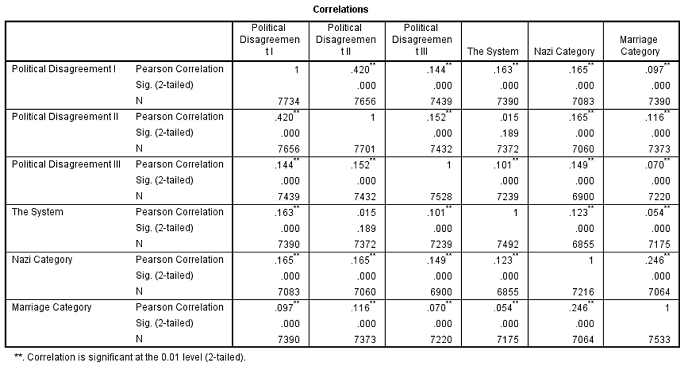
No questions really matched the conflict/mistake theory distinction, but one of the closest was POLITICAL DISAGREEMENT I: “Which of these plays a bigger role in explaining why some people are wrong about politics – intellectual failure, or moral failure?” This isn’t quite the way I would frame it now – but it’ll do for our purposes.

About 80% of blog readers selected intellectual failure, compared to only 60% of Mechanical Turk users. I have some reservations about the accuracy of the Turk survey, but this matches my predictions. I would expect SSC readers to be selected for mistake theory more than for any particular political position.

Percent Of People, By Political Affilitation, Who Think Intellectual Failure Explains Bad Politics
Alt-right: 65%
Conservative: 72%
Liberal: 81%
Libertarian: 87%
Marxist: 62%
Neoreactionary: 77%
Social democratic: 74%

Marxists were most likely to believe their opponents were guilty of moral failure, and libertarians most likely to believe intellectual failure, with everyone else somewhere in between. There was much less distinction between right and left compared to internal division between different subgroups of rightists and leftists.

There were a few other questions that I thought might tap into the same underlying attitude:

POLITICAL DISAGREEMENT II
Which of these best describes your opinion of people with different political beliefs than you, but still within the normal range? EG Democrats if you are a Republican, Tories if you are Labour, etc.

0. They might be right about some things, I can’t be sure of my position.
1. They seem pretty wrong, but they make understandable mistakes and are probably mostly decent people
2. They seem pretty wrong, and their mistakes seem incomprehensible, but some of them might be okay, I guess
3. Inexcusably stupid or downright evil

POLITICAL DISAGREEMENT III
Which of these best describes your opinion of extremists with different political beliefs than you, outside the normal range? E.g. fascists, Stalinists, etc.

0. They might be right about some things, I can’t be sure of my position.
1. They seem pretty wrong, but they make understandable mistakes and are probably mostly decent people
2. They seem pretty wrong, and their mistakes seem incomprehensible, but some of them might be okay, I guess
3. Inexcusably stupid or downright evil

THE SYSTEM
The current economic and political system…

0. Is a good start that needs to be fine-tuned
1. Is fundamentally bad and needs to be destroyed

Aside from these sorts of questions, there were also two categorization questions that I thought might get at the same underlying attitude. These asked respondents to choose between two categorization systems for three ambiguous situations. One system categorized them based on what principle was applied, the other based on which side won. These were:

NAZI CATEGORY
Consider three situations.

A) Nazis beat up some minorities.
B) Nazis hold a peaceful demonstration, nobody stops them, it goes well, and they get a lot of publicity.
C) Some concerned citizens beat up the Nazis.

Of these three possibilities, which two seem most similar?

0. A and C, because people resort to violence.
1. A and B, because the Nazis win.

MARRIAGE CATEGORY
Consider three situations.

A) In a country where homosexuality is illegal, a government clerk participates in civil disobedience and marries gay people anyway.
B) In a country where homosexuality is legal, a government clerk follows the law and marries gay people.
C) In a country where homosexuality is legal, a government clerk participates in civil disobedience and refuses to marry gay people.

Of these three possibilities, which two seem most similar?

0. A and C, because people are participating in civil disobedience.
1. A and B, because gay people get to marry.

I assigned numbers to all of these such that lower numbers represented mistake-theory answers and higher ones represented conflict-theory answers. Correlations were generally positive and significant, but unremarkable:

(for a sense of how high to expect correlations to be – the one between feminism and support for gay marriage was 0.45, between life satisfaction and social skills was 0.3, and between reported IQ and financial success, 0.15)

Perhaps this is bad and wrong of me, but I combined all of them into one measure of average tendency to give the conflict-theory rather than mistake-theory answer to these questions, ranging from 0 (most mistake theorist) to 1 (most conflict theorist). The ranking by political affiliation is pretty much the same as before:

Combined Conflict Theory Measure By Political Affiliation, Ad Hoc Measurement
Alt-right: 0.43
Conservative: 0.30
Liberal: 0.26
Libertarian: 0.27
Marxist: 0.54
Neoreactionary: 0.34
Social democratic: 0.35

A different method of combining them without the two categorization questions (which I worried might have been contaminated by object-level political ideology) was broadly similar.

I also tried a factor analysis (which I am very bad at, don’t trust me here) and got two factors, one of which looked like conflict theoriness, and the other of which looked like a categorization factor determining how people answered the last two category-related questions. The ranking by political affiliation for the conflict theoriness factor was:

Combined Conflict Theory Measure By Political Affiliation, Factor Analysis Measurement
Alt-right: 0.45
Conservative: 0.05
Liberal: -0.12
Libertarian: -0.07
Marxist: 0.30
Neoreactionary: 0.04
Social democratic: 0.15

Although Marxists and alt-righters have switched places, overall this seems like the same general picture.

Some other demographic variables that did or didn’t affect level of conflict theorist responses (similar whether I used the hacked-together average or the factor analysis results, all significant at such low p-values that I really don’t want to get into more fights in the comments over significance thresholds, replicate it yourself if you don’t believe me):

1. Autism did not affect any of these questions at all, totally contrary to my pre-registered predictions.

2. People in worse financial situations were very slightly more conflict theorist , r = 0.06.

3. Respondents who thought they were more moral people were more conflict theorist, r = 0.12.

4. More neurotic and extraverted people were slightly more conflict theorist (r = 0.10); no other Big Five traits really mattered.

5. No race or gender seemed much more conflict theorist than any other, but sample sizes were low.

Overall this broadly confirmed my original suspicion that Marxists and the alt-right differ from liberals on some dimension of conflict vs. mistake theory, but it didn’t shed a lot of light into the exact structure of the difference or what other factors might go into it.

If you want to double-check these results or analyze them further, you can download the data as .xlsx or .csv. Some people have complained of weird problems in the csv format and I recommend the xlsx if at all possible. I have removed the data of a few people who did not want their answers to be public, so you may not get exactly the same numbers I did, but they should be pretty close.

Conflict Vs. Mistake

Jacobite – which is apparently still a real magazine and not a one-off gag making fun of Jacobin – summarizes their article Under-Theorizing Government as “You’ll never hear the terms ‘principal-agent problem,’ ‘rent-seeking,’ or ‘aligning incentives’ from socialists. That’s because they expect ideology to solve all practical considerations of governance.”

There have been some really weird and poorly-informed socialist critiques of public choice theory lately, and this article generalizes from those to a claim that Marxists just don’t like considering the hard technical question of how to design a good government. This would explain why their own governments so often fail. Also why, whenever existing governments are bad, Marxists immediately jump to the conclusion that they must be run by evil people who want them to be bad on purpose.

In trying to think of how a Marxist might respond to this attack, I thought of commenter no_bear_so_low’s conflict vs. mistake dichotomy (itself related to the three perspectives of sociology). To massively oversimplify:

Mistake theorists treat politics as science, engineering, or medicine. The State is diseased. We’re all doctors, standing around arguing over the best diagnosis and cure. Some of us have good ideas, others have bad ideas that wouldn’t help, or that would cause too many side effects.

Conflict theorists treat politics as war. Different blocs with different interests are forever fighting to determine whether the State exists to enrich the Elites or to help the People.

Mistake theorists view debate as essential. We all bring different forms of expertise to the table, and once we all understand the whole situation, we can use wisdom-of-crowds to converge on the treatment plan that best fits the need of our mutual patient, the State. Who wins on any particular issue is less important creating an environment where truth can generally prevail over the long term.

Conflict theorists view debate as having a minor clarifying role at best. You can “debate” with your boss over whether or not you get a raise, but only with the shared understanding that you’re naturally on opposite sides, and the “winner” will be based less on objective moral principles than on how much power each of you has. If your boss appeals too many times to objective moral principles, he’s probably offering you a crappy deal.

Mistake theorists treat different sides as symmetrical. There’s the side that wants to increase the interest rate, and the side that wants to decrease it. Both sides have about the same number of people. Both sides include some trustworthy experts and some loudmouth trolls. Both sides are equally motivated by trying to get a good economy. The only interesting difference is which one turns out (after all the statistics have been double-checked and all the relevant points have been debated) to be right about the matter at hand.

Conflict theorists treat the asymmetry of sides as their first and most important principle. The Elites are few in number, but have lots of money and influence. The People are many but poor – yet their spirit is indomitable and their hearts are true. The Elites’ strategy will always be to sow dissent and confusion; the People’s strategy must be to remain united. Politics is won or lost by how well each side plays its respective hand.

Mistake theorists love worrying about the complicated and paradoxical effects of social engineering. Did you know that anti-drug programs in school actually increase drug use? Did you know that many studies find raising the minimum wage hurts the poor? Did you know that executing criminals actually costs more money than imprisoning them for life? This is why we can’t trust our intuitions about policy, and we need to have lots of research and debate, and eventually trust what the scientific authorities tell us.

Conflict theorists think this is more often a convenient excuse than a real problem. The Elites get giant yachts, and the People are starving to death on the streets. And as soon as somebody says that maybe we should take a little bit of the Elites’ money to feed the People, some Elite shill comes around with a glossy PowerPoint presentation explaining why actually this would cause the Yellowstone supervolcano to erupt and kill everybody. And just enough People believe this that nobody ever gets around to achieving economic justice, and the Elites buy even bigger yachts, and the People keep starving.

Mistake theorists think you can save the world by increasing intelligence. You make technocrats smart enough to determine the best policy. You make politicians smart enough to choose the right technocrats and implement their advice effectively. And you make voters smart enough to recognize the smartest politicians and sweep them into office.

Conflict theorists think you can save the world by increasing passion. The rich and powerful win because they already work together effectively; the poor and powerless will win only once they unite and stand up for themselves. You want activists tirelessly informing everybody of the important causes that they need to fight for. You want community organizers forming labor unions or youth groups. You want protesters ready on short notice whenever the enemy tries to pull a fast one. And you want voters show up every time, and who know which candidates are really fighting for the people vs. just astroturfed shills.

For a mistake theorist, passion is inadequate or even suspect. Wrong people can be just as loud as right people, sometimes louder. If two doctors are debating the right diagnosis in a difficult case, and the patient’s crazy aunt hires someone to shout “IT’S LUPUS!” really loud in front of their office all day, that’s not exactly helping matters. If a group of pro-lupus protesters block the entry to the hospital and refuse to let any of the staff in until the doctors agree to diagnose lupus, that’s a disaster. All that passion does is use pressure or even threats to introduce bias into the important work of debate and analysis.

For a conflict theorist, intelligence is inadequate or even suspect. It doesn’t take a supergenius to know that poor farm laborers working twelve hour days in the scorching heat deserve more than a $9/hour minimum wage when the CEO makes $9 million. The supergenius is the guy with the PowerPoint presentation saying this will make the Yellowstone supervolcano erupt.

Mistake theorists think that free speech and open debate are vital, the most important things. Imagine if your doctor said you needed a medication from Pfizer – but later you learned that Pfizer owned the hospital, and fired doctors who prescribed other companies’ drugs, and that the local medical school refused to teach anything about non-Pfizer medications, and studies claiming Pfizer medications had side effects were ruthlessly suppressed. It would be a total farce, and you’d get out of that hospital as soon as possible into one that allowed all viewpoints.

Conflict theorists think of free speech and open debate about the same way a 1950s Bircher would treat avowed Soviet agents coming into neighborhoods and trying to convince people of the merits of Communism. Or the way the average infantryman would think of enemy planes dropping pamphlets saying “YOU CANNOT WIN, SURRENDER NOW”. Anybody who says it’s good to let the enemy walk in and promote enemy ideas is probably an enemy agent.

Mistake theorists think it’s silly to complain about George Soros, or the Koch brothers. The important thing is to evaluate the arguments; it doesn’t matter who developed them.

Conflict theorists think that stopping George Soros / the Koch brothers is the most important thing in the world. Also, they’re going to send me angry messages saying I’m totally unfair to equate righteous crusaders for the People like George Soros / the Koch brothers with evil selfish arch-Elites like the Koch brothers / George Soros.

Mistake theorists think racism is a cognitive bias. White racists have mistakenly inferred that black people are dumber or more criminal. Mistake theorists find narratives about racism useful because they’re a sort of ur-mistake that helps explain how people could make otherwise inexplicable mistakes, like electing Donald Trump or opposing [preferred policy].

Conflict theorists think racism is a conflict between races. White racists aren’t suffering from a cognitive bias, and they’re not mistaken about anything: they’re correct that white supremacy puts them on top, and hoping to stay there. Conflict theorists find narratives about racism useful because they help explain otherwise inexplicable alliances, like why working-class white people have allied with rich white capitalists.

When mistake theorists criticize democracy, it’s because it gives too much power to the average person – who isn’t very smart, and who tends to do things like vote against carbon taxes because they don’t believe in global warming. They fantasize about a technocracy in which informed experts can pursue policy insulated from the vagaries of the electorate.

When conflict theorists criticize democracy, it’s because it doesn’t give enough power to the average person – special interests can buy elections, or convince representatives to betray campaign promises in exchange for cash. They fantasize about a Revolution in which their side rises up, destroys the power of the other side, and wins once and for all.

Mistake theorists think a Revolution is stupid. After the proletariat (or the True Patriotic Americans, or whoever) have seized power, they’re still faced with the same set of policy problems we have today, and no additional options. Communism is intellectually bankrupt since it has no good policy prescriptions for a communist state. If it did have good policy prescriptions for a communist state, we could test and implement those policies now, without a revolution. Karl Marx could have saved everyone a lot of trouble by being Bernie Sanders instead.

Conflict theorists think a technocracy is stupid. Whatever the right policy package is, the powerful will never let anyone implement it. Either they’ll bribe the technocrats to parrot their own preferences, or they’ll prevent their recommendations from carrying any force. The only way around this is to organize the powerless to defeat the powerful by force – after which a technocracy will be unnecessary. Bernie Sanders could have saved himself a lot of trouble by realizing everything was rigged against him from the start and becoming Karl Marx.

Mistake theorists naturally think conflict theorists are making a mistake. On the object level, they’re not smart enough to realize that new trade deals are for the good of all, or that smashing the state would actually lead to mass famine and disaster. But on the more fundamental level, the conflict theorists don’t understand the Principle of Charity, or Hanlon’s Razor of “never attribute to malice what can be better explained by stupidity”. They’re stuck at some kind of troglodyte first-square-of-the-glowing-brain-meme level where they think forming mobs and smashing things can solve incredibly complicated social engineering problems. The correct response is to teach them Philosophy 101.

(This is the Jacobite article above. It accuses Marxists of just not understanding the relevant theories. It’s saying that there’s all this great academic work about how to design a government, and Marxists are too stupid to look into it. It’s so easy to picture one doctor savaging another: “Did you even bother to study Ingerstein’s latest paper on neuroimmunology before you inflicted your idiotic opinions about this case on us?”)

Conflict theorists naturally think mistake theorists are the enemy in their conflict. On the object level, maybe they’re directly working for the Koch Brothers or the American Enterprise Institute or whoever. But on the more fundamental level, they’ve become part of a class that’s more interested in protecting its own privileges than in helping the poor or working for the good of all. The best that can be said about the best of them is that they’re trying to protect their own neutrality, unaware that in the struggle between the powerful and the powerless neutrality always favors the powerful. The correct response is to crush them.

What would the conflict theorist argument against the Jacobite piece look like? Take a second to actually think about this. Is it similar to what I’m writing right now – an explanation of conflict vs. mistake theory, and a defense of how conflict theory actually describes the world better than mistake theory does?

No. It’s the Baffler’s article saying that public choice theory is racist, and if you believe it you’re a white supremacist. If this wasn’t your guess, you still don’t understand that conflict theorists aren’t mistake theorists who just have a different theory about what the mistake is. They’re not going to respond to your criticism by politely explaining why you’re incorrect.

Is this uncharitable? I’m not sure. There’s a meta-level problem in trying to understand the position “don’t try to understand other positions and engage with them on their own terms” and engage with it on its own terms. If you succeed, you’ve failed, and if you fail, you’ve succeeded. I am pretty sure it would be wrong to “steelman” conflict theory into a nice cooperative explanation of how we all need to join together, realize that conflict theory is objectively the correct way to think, and then use this insight to help cure our mutual patient, the State.

So if this model has any explanatory power, what do we do with it?

Consider a further distinction between easy and hard mistake theorists. Easy mistake theorists think that all our problems come from very stupid people making very simple mistakes; dumb people deny the evidence about global warming; smart people don’t. Hard mistake theorists think that the questions involved are really complicated and require more evidence than we’ve been able to collect so far – the weird morass of conflicting minimum wage studies is a good example here. Obviously some questions are easier than others, but the disposition to view questions as hard or easy in general seems to separate into different people and schools of thought.

(Maybe there’s a further distinction between easy and hard conflict theorists. Easy conflict theorists think that all our problems come from cartoon-villain caricatures wanting very evil things; bad people want to kill brown people and steal their oil, good people want world peace and tolerance. Hard conflict theorists think that our problems come from clashes between differing but comprehensible worldviews – for example, people who want to lift people out of poverty through spreading modern efficient egalitarian industrial civilization, versus people who want to preserve traditional cultures with all their thorns and prickles. Obviously some moral conflicts are more black-and-white than others, but again, some people seem more inclined than others to use one of these models.)

This blog has formerly been Hard Mistake Theory Central, except that I think I previously treated conflict theorists as making an Easy Mistake. I think I was really doing the “I guess you don’t understand Philosophy 101 and realize everyone has to be charitable to each other” thing. This was wrong of me. I don’t know how excusable it was and I’m interested in seeing how many comments here are “This is super obvious” vs. “I never thought about this consciously and I think I’ve just been misunderstanding other people as behaving inexplicably badly my whole life”. But people have previously noticed that this blog is good at attracting representation from all across the political spectrum except Marxists. Maybe that’s related to treating every position except theirs with respect, and appreciating conflict theory better would fix that. I don’t know. It could be worth a shot.

Right now I think conflict theory is probably a less helpful way of viewing the world in general than mistake theory. But obviously both can be true in parts and reality can be way more complicated than either. Maybe some future posts on this, which would have to explore issues like normative vs. descriptive, where tribalism fits in here, and “the myth of the rational voter”. But overall I’m less sure of myself than before and think this deserves more treatment as a hard case that needs to be argued in more specific situations. Certainly “everyone in government is already a good person, and just has to be convinced of the right facts” is looking less plausible these days. At the very least, if I want to convince other people to my position here, I actually have to convince them – instead of using the classic Easy Mistake Theorist tactic of “smh that people still believe this stuff in the Year Of Our Lord 2018” repeated over and over again.

Posted in Uncategorized | Tagged | 1,022 Comments

Links 1/18: Helink Of Troy

Did you know: the world’s largest Hindu temple is in the city of Robbinsville, New Jersey.

Among Antarctica’s few rivers is the Alph, so named because it runs through caverns down to a sunless sea.

Norway joins Portugal in decriminalizing all recreational drugs. I look forward to years of biased studies exaggerating the effects of this on both sides.

More on monopolies of older orphan medications: the cost of periodic paralysis cure Daranide went from pocket change to $109,500/year.

A really detailed article on how Google is using computer vision technology to provide unprecedented level of detail in Google Maps. Also: automatic identification of urban interestingness, principles of effective cartography, and the nth-level foundational work for self-driving cars.

How would you like to have your legal case judged by a guy called Justice Force Crater? Bonus: he disappeared mysteriously and was never found.

Guillermo del Toro says he saw a real UFO and it was “horribly designed”.

Jacobite: AI Bias Doesn’t Mean What Journalists Say It Means. Lots of people I know have been playing a giant game of chicken hoping someone else would write this article first so they didn’t have to – and it looks like Chris Stucchio and Lisa Mahapatra lost.

To Unlock The Brain’s Mysteries, Puree It. By blending a brain in a way that preserves cell nuclei, you can see how many nuclei there are per cc of brain soup and so get a more accurate count of number of brain cells.

The forgotten history of the African-American community’s pro-eugenics movement.

Alice Maz recounts her days as a Minecraft simulated tycoon. Highly recommended.

Related: Eighty common scams in the Runescape MMORPG economy. Although apparently a lot of Runescape players are clueless twelve-year-olds, and saying “Give me 1000 coins and I’ll give you a cool item” and then not giving them the item makes you some kind of wildly successful criminal mastermind.

AI researcher Rodney Brooks makes specific dated predictions on the future of AI. Too bad he doesn’t give confidence levels and so there won’t be a fair way to judge him.

The brief postal correspondence between Charles Darwin and Karl Marx. Spoiler: Marx was an embarassing-level Darwin fanboy and sent him a copy of Das Kapital along with glowing praise. Darwin politely answered that Marx’s work was “in the long run sure to add to the happiness of Mankind” but never actually read it.

Highlights of Wikipedia’s List Of US Medical Associations include the American Radium Society, Flying Doctors of America, and World Doctors Orchestra. Also, which of these would it make you most nervous to learn your doctor wasn’t in – American Board Of Legal Medicine, Physicians Committee For Responsible Medicine, or Physicians For Life?

Sean Carroll on Twitter: “Does one eventually reach an age where one stops having the anxiety dream about not being allowed to graduate from high school because one signed up for a math class then never attended it?” Reposting here because I’d never heard anyone mention this as a common dream before, but I absolutely have it (though not necessarily math class). Any theories why this happens?

Does a higher minimum wage decrease criminal recidivism? (h/t Marginal Revolution)

The US flag is probably partly based on the flag of the British East India Company, which appealed to the colonists as an model of British colonies enjoying partial independence.

You’ve probably heard that memo writer James Damore has sued Google for discrimination against conservative white men. It seems like a complicated case: political discrimination is generally legal but might not be in California (see here), and discriminating against white men seems hard to distinguish from affirmative action and various societywide diversity campaigns universal enough that I assume someone would have noticed before now if they were illegal. Some people are suggesting it’s more of a publicity stunt (possibly externally funded like Peter Thiel’s support of Hulk Hogan?) to embarrass Google and raise awareness. Which it’s doing – read the the whole 161 page lawsuit here if you want a look at the salacious accusations, which one commenter summarized as “industry-wide blacklists, cash bonuses for condemning wrongthink, calls to summarily fire white men accused of bad behavior, calls for ‘unfair’ (the exact word used) treatment of white men, openly booing the presence of white men, employees using company mailing lists to plot violent antifa actions” etc. Related: this profile of Damore’s (female, Indian-American) attorney. Also: apparently Mencius Moldbug having lunch with a Google employee “triggered a silent alarm, alerting security personnel to escort him off the premises”. Also: a commenter suggests an inside story in which the Damore memo was allowed to blow up because of office politics among top Google leadership.

Bloomberg: The Most Awful Transit Center In America Could Get Unimaginably Worse. They’re talking about Penn Station, a “debacle” which “embodies a particular kind of American failure”. And the unimaginable worseness is that the tunnels under the Hudson are decaying and might need to be closed, which would throw New York’s transportation grid into chaos.

Also Bloomberg: Study: Lobbying Doesn’t Help Companies Or Their Shareholders. This is well within a large body of work finding that money doesn’t really matter in politics, but if true it means both that popular wisdom is so wrong we should be thrown into near-Cartesian doubt about everything, and that corporations are idiots and throw away money for no reason. I put this alongside the “medical care doesn’t improve health outcomes” papers in “well, either this is false or everything else is”. Still give it a 50-50 chance of being true, though.

For the past forty years, every time new works were about to come into the public domain, Congress altered extended copyright law to keep them private. Now with the growing power of open access movements, there doesn’t seem to be any political will for this and works from 1923 will finally enter the public domain next year, followed by one year’s worth of works every year thereafter. Biggest potential loser is Disney, since Mickey Mouse would become public domain in 2024. H/T MR.

Van Bavel, Feldman-Hall & Mende-Siedlecki’s paper on ethics includes (first paragraph) a description of how a real-life trolley problem happened in Los Angeles in 2003 – transportation officials chose to switch tracks, saving dozens of lives. H/T Siberian Fox.

A Medium article by some Google AI scientists and a professor critiques that “AI can analyze your face to tell if you’re gay or not” paper from a few months ago. They find that the AI was most likely just looking at a couple of non-physiological features – glasses, makeup, facial hair style, tanning. Then they show you can get pretty accurate gay/straight classifications just by doing this manually to an image database. [This link previously was more condemnatory, but commenters have pointed out the original study specifically admitted this might be true]

Cambridge University’s Center for the Study of Existential Risk has created a Civilization 5 mod that adds superintelligent AI dynamics to the endgame.

The newest addition to GiveWell’s top charities is No Lean Season, which gives poor rural Bangladeshis enough money to pay for a bus ticket to work in the city during the season without as much farm work.

Primatologists: Bonobos prefer jerks.

NYT: As Labor Pool Shrinks, Prison Time Is Less Of A Hiring Hurdle. Included as a sort of nod to market optimism, where if there’s enough demand all of these problems like discrimination against former convicts will solve themselves. Of course, it would be nice if we didn’t have to wait for economic booms.

In the early 1900s, Sears sold over 70,000 build your own house kits, including some for really impressive mansions.

New research suggests the Sicilian Mafia originated from a sudden increase in the demand for lemons after they were found to cure scurvy; the resulting need to control lemon theft created an entire new dimension of underworld economics. Insert your own “market for lemons” or “lemon-stealing whore” joke here.

Chris Dillow of Stumbling And Mumbling joins the Hereditarian Left.

New entry to the linking perception and cognition research program: acuity of color vision correlates highly with IQ. And of course Michael Woodley is using this to try to demonstrate dysgenic effects.

New study finds more evidence that small class size improves test scores. Especially interesting: in addition to improving them the normal way by students doing better, it improves them because when public school class sizes are smaller, high-SES parents are more likely to send their kids to public schools. But there’s an effect even beyond this.

Larry Sharpe is the new (black, raised in poverty) face of the Libertarian Party. Key insane quote: “In the short run, Republicans will break, we’ll get a bunch. In the long run, we’ll absorb the Democratic Party. The Democratic Party will go away in 30 years. It won’t exist. It’ll be the Libertarian Party.”

Posted in Uncategorized | Tagged | 821 Comments

Practically-A-Book Review: Luna Whitepaper

They say money can’t buy love. But that was the bad old days of fiat money. Now there are dozens of love-based cryptocurrencies – LoveCoin, CupidCoin, Erosium, Nubilo – with market caps in the mid nine-figures. The 17-year-old genius behind CupidCoin just bought the state of Tennessee. You think I’m joking, but can you be sure? How weird is “too weird to be true” these days, and how confident are you in your answer?

Case in point: Luna, which bills itself as blockchain-optimized dating. They caught my attention by hiring Aella, previously featured on this blog for her adventures taking LSD megadoses weekly for a year. They kept it with their cutesy story about how the name “Luna” comes from founder Andre Ornish’s first word – adorable, until you consider that any baby whose first word is in Latin is definitely possessed. And they maintained it because – well, goodness knows we need new dating sites now that OKCupid has devolved into an off-brand Tinder clone. So let’s look through the white paper and see what they’ve got.

Most dating sites suffer from attention imbalance: men scrounge around for anyone willing to acknowledge their existence; women get inundated with countless desperate messages they don’t want. Luna solves this by making attention a commodity tradeable on the free market. Users who want to catch someone else’s attention can bid the local cryptocurrency, Stars, to get their message to the top of another user’s queue; all Stars spent in this way go to the user receiving the message. Stars can be bought with dollars and vice versa, so popular users can actually earn money reading all the messages sent to them.

This system has some pretty powerful advantages. Market forces are the known solution to the problem of connecting resources to their highest-value use. So if you treat user attention as a resource you can trust the market to allocate it optimally – in this case, to the guy who’s just realized he’s your soulmate, rather than the guy who’s spamming everyone with five dick pics.

But everywhere this solution is tried, it runs up against its one great weakness – rich people with mild preferences can outbid poor people with strong ones. I can’t predict how this particular market will clear, but this doesn’t necessarily have to be a big problem here. If the market rate for a certain user’s messages were $1, then even the poorest person could afford to send a message to a potential soulmate. And even a well-off person might hesitate to send out a hundred messages a day, every day. And if he didn’t? Well, getting paid $100/day to read messages on a dating site doesn’t sound like the worst outcome. Also, really good information about preferences in exchange for a biased system that favors the wealthy has been the deal Capitalism has been offering since Adam Smith first put quill to paper; it seems kind of weird to back out now.

A more practical issue: how long before someone finds a photo of a supermodel, limits their profile to “I AM A NYMPHOMANIAC”, and watches everyone trip over themselves to send paid messages? Luna alludes to vague plans to “verify” profiles, which could mean anything from “you have to Photoshop a picture halfway convincingly” to “you have to get an actual pretty girl to help with your scam”. Neither of these seem like too high a bar. Better is their offer to provide data, including how often users respond to messages and how often users meet with other users:

When choosing to attach Stars to his message, Bob should receive information such as the number of unread messages in Alice’s queue, an internally calculated reply quality indicator, and confirmation on whether Alice’s account is verified.

I’m still skeptical. I have bots pretending to be pretty women try to friend me on Facebook something like once a week, even though I have no idea what their endgame is or how this results in them making money. If Luna gives a real incentive for the scam, they’re going to have to beat Facebook pretty handily if they want to succeed here.

More promising than any individual claim they make about how they’re going to fix things, is their claim that they’re incentivized to fix them. OKCupid famously wrote about Why You Should Never Pay For Online Dating, the answer being that it incentivizes dating sites to keep you single – after all, the longer you’re single, the longer you’ll keeping spending money on dating sites. Even if that sounds a little cartoon-villainish, at the very least it doesn’t incentivize sites to do a good job matching you up. Luna claims that their model gives them a profit only when it succeeds:

At Luna, we intend to structure the token economy in such a way that our system is rewarded when users achieve their goals, thus aligning our own incentives with those of our users and ensuring that all data, AI, and machine learning technology will be used to actually connect people…the approach consists of two parts:

1. Fees which comprise Luna’s revenue only occur in the case of successful communication. As described in 3.1, when a user receives and reads a message boosted with Stars, they also receive the Stars used to boost that message. Luna intends to take a small fee for this transaction, but only if the recipient responds to the message within a window of a number of days yet to be determined. If the recipient does not respond, or only responds after more than this number of days, this fee will be re-paid to the sender. The number of Stars transferred to the recipient, however, will remain the same, whether they respond to the message or not. In this way Luna’s financial incentives will be aligned with users’ goals at Stage IV in the exchanging of messages.

2. Possibility of tipping in case of successful offline dates. Another way to provide incentive for Luna to help achieve its users’ goals is to allow users to tip the platform after the achievement of Stage V in the completion of a successful date. As described in 3.2.4, we intend to make feedback polls available after dates. Once users have rated their experience, Luna will then allow them to choose whether to leave a tip of their choice in the form of Stars. As this is a voluntary option, it should have no effect on user feedback. Tipping a platform is an infeasible idea in the context of currently existing dating apps; however, the free and direct-to-user benefits of Luna may register to users as something more resembling the mechanisms of Wikipedia: a free, friendly, and user-contributed service, rather than a platform like Match.com, which can feel exploitative. A tipping option may thus encourage a feeling of alliance with Luna in the user.

In this way, rather than recreating disparities which exist between the goals of current dating platforms and their users, Luna’s financial incentives and user goals will coincide.

I can imagine all sorts of horrible misalignments between maximizing-number-of-responded-to-messages and maximizing user satisfaction, but for now I’ll just admit this seems nice and I appreciate the effort.

Luna’s last major promise is to use cutting-edge machine-learning techniques to come up with a good match algorithm:

Despite significant technological advances in information processing, storage, and retrieval, online dating has yet to optimally integrate machine learning for the user’s benefit. A typical ML task for online dating might be to predict the level of compatibility between two users from a given set of input data, thus predicting for example whether one user is likely to respond to another user’s message […]

Luna may adopt a collaborative filtering algorithm developed by Dr. Kang Zhao. In addition, Luna may use advanced NLP techniques in conjunction with IBM Watson to integrate additional information from the contents of messages sent in-app, as well as from social media sources such as Twitter, if users choose to provide that information.

They’re right that this seems like a perfect use case for machine learning techniques, and that this possibility has been woefully underexplored. With all due respect to OKCupid’s excellent match algorithm (my girlfriend played with it one day and found that her two highest matches in the entire world were me and her ex), there’s a lot of room for improvement here. I find the idea of letting users link their social media accounts to provide more data really fascinating, and this reassures me that the attempts at incentive-alignment above really do have them thinking about how they can do better.

One part of the white paper I still don’t understand: why is it on a blockchain? They write:

For us to ever find out [how to design a match algorithm that really increases human happiness], we are going to require an open data ecosystem around computer dating. Blockchain is an integral part of that – it’s what pays the bills to do the science and, in the case of Luna, it nicely and accurately solves one of the key problems in the computer dating arena: cut-and-paste messages spammed over huge numbers of people, resulting in an ever-lower number of good quality genuinely interested messages, hidden in an ever larger sea of dating spam. Just getting rid of that dynamic once and for all would be a great result, but I think that Luna offers far, far more.

By establishing the decentralized paradigm in dating, Luna helps to remake dating culture. Luna is not a service or a place, like Tinder or a bar. Luna is a method, and a method which can be continually improved using techniques like A/B testing, until it is genuinely producing better lives for people. Because blockchain techniques allow for sophisticated tools to be developed to align economic interests between (say) search algorithm designers and individual users, or between users and other users who don’t like spam (i.e. everybody), the possibility exists to not only solve the questionable agency of the current generation of dating app providers, but to create positive agency to do something really, really new. We could pay the best people in the world to design algorithms to match other people, and make them happy.

I don’t know what they mean by “open data ecosystem”. I assume they’re not going to let everybody see all the data – I don’t necessarily want my parents to be able to know who I just sent a message to. But if not, how does “open data” help other people design match engines? Why is their crypto token more efficient than paying for Second Life in Linden Dollars, or any of the other silly token currencies that have existed forever on the Internet?

So what is blockchain doing for them? The null hypothesis might be: the same thing it does for Long Island Blockchain Tea and half a million other scams. I have hopes that Luna isn’t a scam. It employs some people I know and trust. The incentives and economics of their product seem very well-thought-through – so much so that if it’s a scam somebody else ought to be doing the same thing for real. And they’re promoting GiveWell and other effective charities in a way that suggests they want a lot of the money to go to altruism anyway. These are…signs. But I’ve been told you can’t be too paranoid in this area these days.

But I really do hope Luna isn’t a scam. Because if it’s real, it represents everything good about Silicon Valley. Some people use Intellect to wrest a secret from Nature: an elegant reduction of the chaos of human interaction into comprehensible and exploitable principles. To test their prize they build a Sampo, a machine churning out a hundred varieties of human happiness – from loving marriages to ecstatic sex to just sitting on the couch cuddling on rainy days. They give it to the public gratis. In the process they all get super rich and donate the money to curing malaria, good compounding upon good. Also, the whole thing is done in a weird and pointlessly-complicated format that adds nothing except a giant middle finger aimed at government regulators. What could be more beautiful than this?

One last thought on the blockchain issue: whenever I study intentional communities, I’m struck by how little the community’s principles matter, compared to the brute fact of it being an intentional community. An anarchist commune may have some spectacularly brilliant collaborative dispute-solving mechanism, but none of that matters, because the people involved will be the sorts of people who would join an anarchist commune, ie ridiculous and completely ungovernable.

So the most interesting and distinguishing feature of Luna, at least to start with, might not be the tokens, or the incentives, or the machine learning. It might be that it’s a place you can go to meet the sort of people who want to date on the blockchain. I could make a lot of cheap jokes here, but whatever weird hyperplanes through categoryspace further the difficult and desperate project of human-seeking-human are good and worthwhile in my book. I hope that lots of libertarian women find lots of security-conscious men and make lots of beautiful, high-price-volatility babies.

Posted in Uncategorized | Tagged | 519 Comments

Bundles Of Joy

[Content warning: Discussion of child-rearing, may invoke mild feelings of social pressure to have children]

On December’s survey, I asked readers who had children whether they were happy with that decision. Here are the results, from 1 (very unhappy) to 5 (very happy):

The mean was 4.43, and the median 5. People are really happy to have kids!

This was equally true regardless of gender. The male average (4.43, n = 1768) and female average (4.49, n = 177) were indistinguishable.

To double-check this, I compared the self-reported life satisfaction of people with and without kids. People with kids were much more satisfied – but also did much better on lots of other variables like financial situation, romantic satisfaction, etc. So probably at least some of the effect was because people with kids tend to be older people in stable relationships who have their life more figured out, and maybe also more religious.

In order to compare apples to apples, I limited the comparison to married atheist men 25 or older. There was no longer a consistent trend for people with at least one child to be more satisfied. But there was a trend for increasing satisfaction with increasing number of children:

NUMBER OF CHILDREN : AVERAGE LIFE SATISFACTION ON 1-10 SCALE (total n = 1491):
0: 7.06
1: 7.09
2: 7.24
3: 7.31
4+: 7.43

This doesn’t make a lot of sense to me, since I would expect the biggest life change to be going from zero children to one child. Probably some residual confounders remain in the analysis – and commenter “meh” points out that people who are happiest with their existing children will be most likely to have more. But at the very least, people with children don’t seem to be less happy.

These results broadly match existing research, which usually finds that parents report being very happy to have children, but that this is not reflected in life satisfaction numbers. The main difference is that existing research usually claims parents have lower life satisfaction than non-parents. But this is different in different countries, either for cultural or for policy reasons. The survey respondents form a culturally unusual group and are of a higher socioeconomic status; they may be more similar to countries like Norway (where parents are happier) than to countries like the United States (where they are less happy).

(also, we should at least consider the Caplanian perspective that people more informed about genetics will be happier parents, since they’ll be less neurotic about the effect of their parenting styles.)

The View From Hell blog argues that the discrepancy between the direct question (“Are you happy to have kids?”) and the indirect one (“How happy are you?”, compared across parents vs. childless people) is pure self-deception; children suck, but parents refuse to admit it. I haven’t looked in depth at the study they cite, which purports to show that the more you prime parents with descriptions of the burdens of parenthood, the more great they insist everything is. But I wonder about the philosophical foundations we should be using here. There’s happiness, and there’s happiness: I am happy to be giving money to charity and making the world a better place, but I don’t think my self-reported life satisfaction would be noticeably higher after a big donation. It might even be lower if it cut into my luxury consumption. The wanting/liking/approving trichotomy may also be relevant.

People were happier with their decision to have children if they were (all results are binomial correlations and highly significant even after correction): more gender-conforming (0.14), had fewer thoughts about maybe being transgender (0.20), were more right-wing (0.10), considered themselves more moral people (0.15), were less autistic (0.12), were less extraverted (0.10), were more emotionally stable (0.15), and were more agreeable (0.13). All of these effects were very small compared to the generally high level of happiness at having children, no matter who you were and what your personality was like.

I included this survey question because I’m considering whether or not to have kids. Even though the survey only reinforced the (confusing) results of past research, I still find it helpful. After all, a lot of the survey-takers here are pretty skeptical of other aspects of traditional lifestyles: monogamy, gender norms, religion, etc. It’s impressive how strongly approval of parenting survives even in this weird a population; I consider this a new and exciting fact beyond the ones established by previous studies.

As always, if you want to double-check these results or analyze them further, you can download the data as an .xlsx file. I have removed the data of a few people who did not want their answers to be public, so you may not get exactly the same numbers I did, but they should be pretty close.

Maybe The Real Superintelligent AI Is Extremely Smart Computers

I.

By Ted Chiang, on Buzzfeed: The Real Danger To Civilization Isn’t AI: It’s Runaway Capitalism. Chiang’s science fiction is great and I highly recommend it. This article, not so much.

The gist seems to be: hypothetical superintelligent AIs sound a lot like modern capitalism. Both optimize relentlessly for their chosen goal (paperclips, money), while ignoring the whole complexity of human value.

It’s a good point, and I would have gone on to explain the more general idea of an optimization process. Evolution optimizes relentlessly for reproductive fitness, capitalism optimizes relentlessly for money, politics optimizes relentlessly for electability. Humans are sort of an optimization process, but such a weird edge case that “non-human optimizers” is a natural category to people more used to the human variety. Both future superintelligences and modern corporations are types of non-human optimizers, so they’ll naturally be similar in ways – though not so many ways that taking the comparison too far won’t carry you off a cliff. And one of those ways will be that even though they both know humans have complex values, they won’t care. Facebook “knows” that people enjoy meaningful offline relationships; after all, it’s made entirely of human subunits who know that. It’s just not incentivized to do anything with that knowledge. Future superintelligences will likely be in a similar position – see section 4.1 here.

But Chiang argues the analogy proves that AI fears are absurd. This is a really weird thing to do with an analogy. Science has always been a fertile source of metaphors. The Pentagon budget is a black hole. The rise of ISIS will start a chain reaction. Social responsibility is in our corporate DNA. But until now, nobody has tried to use scientific metaphor as evidence in scientific debates. For a long time astronomers were unsure whether black holes really existed. But nobody thought the argument that “the REAL black hole is the Pentagon budget!” deserved to be invited to the discussion.

Actually this is worse than that, because the analogy is based on real similarities of mechanism. “People say in the future we might have fusion power plants. But look at all these ways fusion power plants resemble stars! Obviously stars are the real fusion power plants. And so by this, we can know that the future will never contain fusion power.” Huh?

II.

Still, Chiang pursues this angle relentlessly. Though he doesn’t use the word, he bases his argument around the psychological concept of projection, where people trying to avoid thinking about their own attributes unconsciously attribute them to others:

Billionaires like Bill Gates and Elon Musk assume that a superintelligent AI will stop at nothing to achieve its goals because that’s the attitude they adopted…It’s no surprise that Silicon Valley capitalists don’t want to think about capitalism ending. What’s unexpected is that the way they envision the world ending is through a form of unchecked capitalism, disguised as a superintelligent AI. They have unconsciously created a devil in their own image, a boogeyman whose excesses are precisely their own.

Which brings us back to the importance of insight. Sometimes insight arises spontaneously, but many times it doesn’t. People often get carried away in pursuit of some goal, and they may not realize it until it’s pointed out to them, either by their friends and family or by their therapists. Listening to wake-up calls of this sort is considered a sign of mental health.

In my own psychiatric practice, I am always very reluctant to assume a patient is projecting unless I know them very well. I’ve written more about the dangers of defense mechanism narratives here, but the short version is that amateur therapists inevitably end up using them to trivialize or psychologize a patient’s real concerns. I can’t tell you how many morons hear a patient say “I think my husband hates our kids”, give some kind of galaxy-brain level interpretation like “Maybe what’s really going on is you unconsciously hate your kids, but it’s more comfortable for you to imagine this of your husband”, and then get absolutely shocked when the husband turns out to be abusing the kids.

Accusing an entire region of California of projection is a novel psychoanalytic manuever, and I’m not sure Chiang and Buzzfeed give it the caution it deserves. The problem isn’t that they don’t have a plausible-sounding argument. The problem is that this sort of hunting-for-resemblances is a known bug in the human brain. You can do it to anything, and it will always generate a plausible-sounding argument.

Don’t believe me? What about black holes? Scientists say they exist, but I think these scientists are just creating “a devil in their own image, a boogeyman whose excesses are precisely their own.” Think about it. Superstar physicists like Einstein help university STEM departments suck up all the resources that should go to the humanities and arts. So of course when Einstein tries to imagine outer space, he thinks of super-stars that suck up all the resources from surrounding areas!

And chain reactions! You know what was a chain reaction? Enrico Fermi discovered some stuff about atoms. Then Leo Szilard wrote a letter to President Roosevelt saying it might have military applications. Then Roosevelt set up a project to develop military applications. One thing led to another, and a couple of Japanese cities got vaporized and the rest of the world teetered on the brink of total annhilation. Of course nuclear physicists became obsessed with the idea of chain reactions: they were living in one. They expected that subatomic particles would behave the same way they did – start out working on innocent little atomic collisions, have everything snowball out of control, and end up culpable for a nuclear explosion.

Watson and Crick worked together pretty closely on the discovery of DNA. So they started imagining organic molecules doing the same thing they did – two of them, intertwining. Just as they published papers which became the inspiration for an entire body of knowledge, so DNA was full of letters that caused the existence of an entire body. Epigenetics is relevant but generally ignored for the sake of keeping things simple, so it represents Rosalind Franklin.

I could go on all day like this. In fact, I have: this was the central narrative of my novel Unsong, where the world runs on “the kabbalistic method” and correspondences between unlike domains are the royal road to knowledge. You know who else wrote a story about a world that ran on kabbalah? Ted Chiang. This is not a coincidence because nothing is ever a coincidence.

III.

But Chiang’s comparison isn’t even good kabbalah. The correspondences don’t really correspond; the match-ups don’t really match.

He bases his metaphor on the idea that worries about AI risk comes from Silicon Valley. They don’t. The tech community got interested later. The original version of the theory comes from Nick Bostrom, a professor at Oxford, and Eliezer Yudkowsky, who at the time I think was living in Chicago. It was pushed to public notice by leading AI scientists all around the world. And before it was endorsed by Silicon Valley tycoons, it was endorsed by philosophers like David Chalmers and scientists like Stephen Hawking.

(Hawking, by the way, discovered that information could escape black holes despite a bunch of science saying they should be completely inert. This seems suspiciously similar to how he himself is completely paralyzed, but manages to convey information to the outside world via an artificial speaking device. More projection?)

Forcing the argument to rely on “well, also lots of people in Silicon Valley think this too” makes it hopelessly weak.

Consider: lots of Hollywood celebrities speak out about global warming. And we’re gradually finding out that some pretty awful things go on in Hollywood. Does that mean “The Real Problem Isn’t Global Warming, It’s Hollywood Harassment”? Does that license some author to write (while scientists facepalm worldwide) that because he doesn’t feel like carbon dioxide should be able to warm the climate, any claims to the contrary must be Hollywood celebrities projecting their own moral inadequacies? (possible angle: celebrities’ utterances emit carbon dioxide, and create a stifling climate for women in the entertainment industry)

If this sounds like a straw man to you, I challenge you to come up with any way it differs from what Chiang is doing with AI risk. You take a scientific controversy over whether there’s a major global risk. You ignore the science and focus instead on a subregion of California that seems unusually concerned with it. You point out some bad behavior of that subregion of California. You kabbalistically connect it to the risk in question. Then you conclude that people worried about the risk are just peddling science fiction.

(wait, of course Chiang interprets this as people peddling science fiction. He’s a science fiction writer! More projection!)

If the Hollywood example sounds more blatant or less plausible than the AI example, I maintain it’s only because we’re already convinced global warming is real and dangerous. That gives it the same kind of legitimacy as self-service gas stations, and grants it extra resistance against sophistry. That’s all. That’s the whole difference.

This isn’t how risk assessment works. This isn’t how good truth-seeking works. Whether or not you believe in AI risk, you should be disappointed that this is how we deal with issues that could be catastrophic to get wrong.

Posted in Uncategorized | Tagged , | 362 Comments