Where The Falling Einstein Meets The Rising Mouse

Eliezer Yudkowsky argues that forecasters err in expecting artificial intelligence progress to look like this:
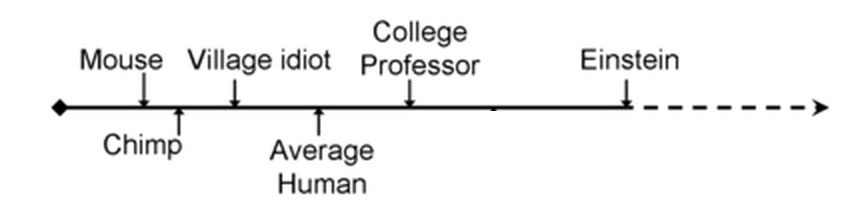
…when in fact it will probably look like this:

That is, we naturally think there’s a pretty big intellectual difference between mice and chimps, and a pretty big intellectual difference between normal people and Einstein, and implicitly treat these as about equal in degree. But in any objective terms we choose – amount of evolutionary work it took to generate the difference, number of neurons, measurable difference in brain structure, performance on various tasks, etc – the gap between mice and chimps is immense, and the difference between an average Joe and Einstein trivial in comparison. So we should be wary of timelines where AI reaches mouse level in 2020, chimp level in 2030, Joe-level in 2040, and Einstein level in 2050. If AI reaches the mouse level in 2020 and chimp level in 2030, for all we know it could reach Joe level on January 1st, 2040 and Einstein level on January 2nd of the same year. This would be pretty disorienting and (if the AI is poorly aligned) dangerous.

I found this argument really convincing when I first heard it, and I thought the data backed it up. For example, in my Superintelligence FAQ, I wrote:

In 1997, the best computer Go program in the world, Handtalk, won NT$250,000 for performing a previously impossible feat – beating an 11 year old child (with an 11-stone handicap penalizing the child and favoring the computer!) As late as September 2015, no computer had ever beaten any professional Go player in a fair game. Then in March 2016, a Go program beat 18-time world champion Lee Sedol 4-1 in a five game match. Go programs had gone from “dumber than heavily-handicapped children” to “smarter than any human in the world” in twenty years, and “from never won a professional game” to “overwhelming world champion” in six months.

But Katja Grace takes a broader perspective and finds the opposite. For example, she finds that chess programs improved gradually from “beating the worst human players” to “beating the best human players” over fifty years or so, ie the entire amount of time computers have existed:

AlphaGo represented a pretty big leap in Go ability, but before that, Go engines improved pretty gradually too (see the original AI Impacts post for discussion of the Go ranking system on the vertical axis):
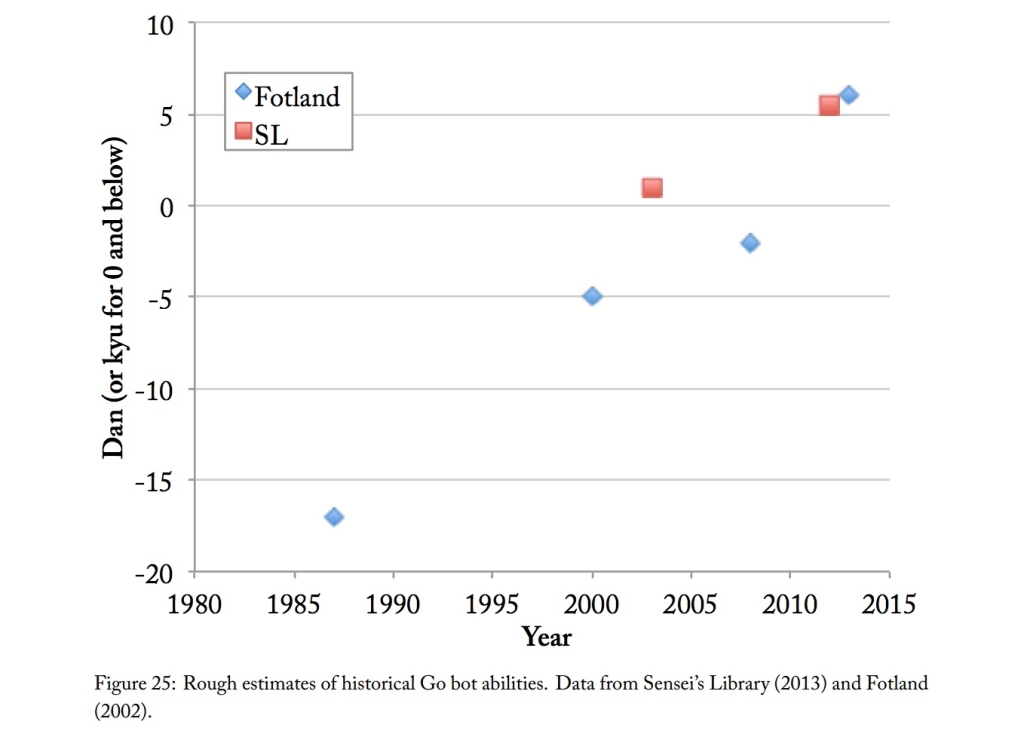
There’s a lot more on Katja’s page, overall very convincing. In field after field, computers have taken decades to go from the mediocre-human level to the genius-human level. So how can one reconcile the common-sense force of Eliezer’s argument with the empirical force of Katja’s contrary data?

Theory 1: Mutational Load

Katja has her own theory:

The brains of humans are nearly identical, by comparison to the brains of other animals or to other possible brains that could exist. This might suggest that the engineering effort required to move across the human range of intelligences is quite small, compared to the engineering effort required to move from very sub-human to human-level intelligence…However, we should not be surprised to find meaningful variation in the cognitive performance regardless of the difficulty of improving the human brain. This makes it difficult to infer much from the observed variations.

Why should we not be surprised? De novo deleterious mutations are introduced into the genome with each generation, and the prevalence of such mutations is determined by the balance of mutation rates and negative selection. If de novo mutations significantly impact cognitive performance, then there must necessarily be significant selection for higher intelligence–and hence behaviorally relevant differences in intelligence. This balance is determined entirely by the mutation rate, the strength of selection for intelligence, and the negative impact of the average mutation.

You can often make a machine worse by breaking a random piece, but this does not mean that the machine was easy to design or that you can make the machine better by adding a random piece. Similarly, levels of variation of cognitive performance in humans may tell us very little about the difficulty of making a human-level intelligence smarter.

I’m usually a fan of using mutational load to explain stuff. But here I worry there’s too much left unexplained. Sure, the explanation for variation in human intelligence is whatever it is. And there’s however much mutational load there is. But that doesn’t address the fundamental disparity: isn’t the difference between a mouse and Joe Average still immeasurably greater than the difference between Joe Average and Einstein?

Theory 2: Purpose-Built Hardware

Mice can’t play chess (citation needed). So talking about “playing chess at the mouse level” might require more philosophical groundwork than we’ve been giving it so far.

Might the worst human chess players play chess pretty close to as badly as is even possible? I’ve certainly seen people who don’t even seem to be looking one move ahead very well, which is sort of like an upper bound for chess badness. Even though the human brain is the most complex object in the known universe, noble in reason, infinite in faculties, like an angel in apprehension, etc, etc, it seems like maybe not 100% of that capacity is being used in a guy who gets fools-mated on his second move.

We can compare to human prowess at mental arithmetic. We know that, below the hood, the brain is solving really complicated differential equations in milliseconds every time it catches a ball. Above the hood, most people can’t multiply two two-digit numbers in their head. Likewise, in principle the brain has 2.5 petabytes worth of memory storage; in practice I can’t always remember my sixteen-digit credit card number.

Imagine a kid who has an amazing $5000 gaming computer, but her parents have locked it so she can only play Minecraft. She needs a calculator for her homework, but she can’t access the one on her computer, so she builds one out of Minecraft blocks. The gaming computer can have as many gigahertz as you want; she’s still only going to be able to do calculations at a couple of measly operations per second. Maybe our brains are so purpose-built for swinging through trees or whatever that it takes an equivalent amount of emulation to get them to play chess competently.

In that case, mice just wouldn’t have the emulated more-general-purpose computer. People who are bad at chess would be able to emulate a chess-playing computer very laboriously and inefficiently. And people who are good at chess would be able to bring some significant fraction of their full most-complex-object-in-the-known-universe powers to bear. There are some anecdotal reports from chessmasters that suggest something like this – descriptions of just “seeing” patterns on the chessboard as complex objects, in the same way that the dots on a pointillist painting naturally resolve into a tree or a French lady or whatever.

This would also make sense in the context of calculation prodigies – those kids who can multiply ten digit numbers in their heads really easily. Everybody has to have the capacity to do this. But some people are better at accessing that capacity than others.

But it doesn’t make sense in the context of self-driving cars! If there was ever a task that used our purpose-built, no-emulation-needed native architecture, it would be driving: recognizing objects in a field and coordinating movements to and away from them. But my impression of self-driving car progress is that it’s been stalled for a while at a level better than the worst human drivers, but worse than the best human drivers. It’ll have preventable accidents every so often – not as many as a drunk person or an untrained kid would, but more than we would expect of a competent adult. This suggests a really wide range of human ability even in native-architecture-suited tasks.

Theory 3: Widely Varying Sub-Abilities

I think self-driving cars are already much better than humans at certain tasks – estimating differences, having split-second reflexes, not getting lost. But they’re also much worse than humans at others – I think adapting to weird conditions, like ice on the road or animals running out onto the street. So maybe it’s not that computers spend much time in a general “human-level range”, so much as being superhuman on some tasks, and subhuman on other tasks, and generally averaging out to somewhere inside natural human variation.

In the same way, long after Deep Blue beat Kasparov there were parts of chess that humans could do better than computers, “anti-computer” strategies that humans could play to maximize their advantage, and human + computer “cyborg” teams that could do better than either kind of player alone.

This sort of thing is no doubt true. But I still find it surprising that the average of “way superhuman on some things” and “way subhuman on other things” averages within the range of human variability so often. This seems as surprising as ever.

Theory 1.1: Humans Are Light-Years Beyond Every Other Animal, So Even A Tiny Range Of Human Variation Is Relatively Large

Or maybe the first graph representing the naive perspective is right, Eliezer’s graph representing a more reasonable perspective is wrong, and the range of human variability is immense. Maybe the difference between Einstein and Joe Average is the same (or bigger than!) the difference between Joe Average and a mouse.

That is, imagine a Zoological IQ in which mice score 10, chimps score 20, and Einstein scores 200. Now we can apply Katja’s insight: that humans can have very wide variation in their abilities thanks to mutational load. But because Einstein is so far beyond lower animals, there’s a wide range for humans to be worse than Einstein in which they’re still better than chimps. Maybe Joe Average scores 100, and the village idiot scores 50. This preserves our intuition that even the village idiot is vastly smarter than a chimp, let alone a mouse. But it also means that most of computational progress will occur within the human range. If it takes you five years from starting your project, to being as smart as a chimp, then even granting linear progress it could still take you fifty more before you’re smarter than Einstein.

This seems to explain all the data very well. It’s just shocking that humans are so far beyond any other animal, and their internal variation so important.

Maybe the closest real thing we have to zoological IQ is encephalization quotient, a measure that relates brain size to body size in various complicated ways that sometimes predict how smart the animal is. We find that mice have an EQ of 0.5, chimps of 2.5, and humans of 7.5.

I don’t know whether to think about this in relative terms (chimps are a factor of five smarter than mice, but humans only a factor of three greater than chimps, so the mouse-chimp difference is bigger than the chimp-human difference) or in absolute terms (chimps are 2 units bigger than mice, but humans are five units bigger than chimps, so the chimp-human difference is bigger than the mouse-chimp difference).

Brain size variation within humans is surprisingly large. Just within a sample of 46 adult European-American men, it ranged from 1050 to 1500 cm^3m; there are further differences by race and gender. The difference from the largest to smallest brain is about the same as the difference between the smallest brain and a chimp (275 – 500 cm^3); since chimps weight a bit less than humans, we should probably give them some bonus points. Overall, using brain size as some kind of very weak Fermi calculation proxy measure for intelligence (see here), it looks like maybe the difference between Einstein and the village idiot equals the difference between the idiot and the chimp?

But most mutations that decrease brain function will do so in ways other than decreasing brain size; they will just make brains less efficient per unit mass. So probably looking at variation in brain size underestimates the amount of variation in intelligence. Is it underestimating it enough that the Einstein – Joe difference ends up equivalent to the Joe – mouse difference? I don’t know. But so far I don’t have anything to say it isn’t, except a feeling along the lines of “that can’t possibly be true, can it?”

But why not? Look at all the animals in the world, and the majority of the variation in size is within the group “whales”. The absolute size difference between a bacterium and an elephant is less than the size difference between Balaenoptera musculus brevicauda and Balaenoptera musculus musculus – ie the Indian Ocean Blue Whale and the Atlantic Ocean Blue Whale. Once evolution finds a niche where greater size is possible and desirable, and figures out how to make animals scalable, it can go from the horse-like ancestor of whales to actual whales in a couple million years. Maybe what whales are to size, humans are to brainpower.

Stephen Hsu calculates that a certain kind of genetic engineering, carried to its logical conclusion, could create humans “a hundred standard deviations above average” in intelligence, ie IQ 1000 or so. This sounds absurd on the face of it, like a nutritional supplement so good at helping you grow big and strong that you ended up five light years tall, with a grip strength that could crush whole star systems. But if we assume he’s just straightforwardly right, and that Nature did something of about this level to chimps – then there might be enough space for the intra-human variation to be as big as the mouse-chimp-Joe variation.

How does this relate to our original concern – how fast we expect AI to progress?

The good news is that linear progress in AI would take a long time to cross the newly-vast expanse of the human level in domains like “common sense”, “scientific planning”, and “political acumen”, the same way it took a long time to cross it in chess.

The bad news is that if evolution was able to make humans so many orders of magnitude more intelligent in so short a time, then intelligence really is easy to scale up. Once you’ve got a certain level of general intelligence, you can just crank it up arbitrarily far by adding more inputs. Consider by analogy the hydrogen bomb – it’s very hard to invent, but once you’ve invented it you can make a much bigger hydrogen bomb just by adding more hydrogen.

This doesn’t match existing AI progress, where it takes a lot of work to make a better chess engine or self-driving car. Maybe it will match future AI progress, after some critical mass is reached. Or maybe it’s totally on the wrong track. I’m just having trouble thinking of any other explanation for why the human level could be so big.


Posted in Uncategorized | Tagged , | 275 Comments

Is It Possible To Have Coherent Principles Around Free Speech Norms?

I.

One factor that must underlie people’s distrust of non-governmental free speech norms is that they’re so underspecified. The First Amendment is a comparatively simple, bright-line concept – the police can’t arrest you for saying the President sucks. Sure, we need a zillion Supreme Court cases to iron out the details, but it makes sense in principle. By contrast, social norms about free speech risk collapsing into the incoherent Doctrine Of The Preferred First Speaker, where it’s okay for me to say that the President sucks, but not okay for you to say that I suck for saying that. This is dumb, and I don’t know if free speech supporters have articulated a meaningful alternative. I want to sketch out some possibilities for what that sort of alternative would look like.

The philosophical question here is separating out the acts of having an opinion, signaling a propensity, and committing a speech act.

Having an opinion is the sort of thing free speech norms ought to exist to protect. The opinion ought to enter the marketplace of ideas, compete with other opinions on its merit, and either win or lose based on people’s considered rational judgment.

But this can’t be separated from signaling a propensity for action. Suppose Alice has the opinion “hand hygiene doesn’t matter”. The truly virtuous action is to show her (and concerned third parties) studies that prove that dangerous infections are transmissible by unwashed hands. But while you’re doing that, it’s fair to not want to eat at her restaurant. And it’s pro-social to tell other people not to eat at her restaurant either, and not to hire her as a nurse – and if she’s already a nurse, maybe to get her fired. Even though reasonable free speech norms demand that we fight bad ideas through counterargument rather than social punishment, in this case they should permit a campaign to get Alice fired.

One solution here might be to give people the burden of demonstrating that their controversial opinions won’t lead to dangerous actions. For example, if Alice is a nurse, she might say “I don’t believe hand hygiene matters, and I’m going to try to convince the hospital administration to remove their rule mandating handwashing – but until I succeed, I’ll follow the rules and wash my hands just like everyone else.” If I trusted Alice, this would allay my concerns, and I would go back to wanting to debate with her instead of wanting her fired. See also Be Nice, At Least Until You Can Coordinate Meanness.

Some signaling of propensities can’t be so easily fixed. If Carol thinks that “Hitler should have finished the job”, I feel like this tells me a lot about Carol besides just her moral ranking of various World-War-II-related alternate histories. If she was a schoolteacher, then even if she promised not to kill any Jews in class, or even to spread any anti-Semitic propaganda in class, it would be hard for me not to wonder what else was wrong with her, and whether she could really disguise every single repugnant aspect of her personality. On the other hand, if we try to get the school board to fire her, we’re implicitly endorsing the principle “Get someone fired if you know of a belief of theirs that suggests they’re an otherwise repugnant person” – and isn’t this the same principle that led people to campaign against atheist schoolteachers, pro-gay schoolteachers, communist schoolteachers, etc? See also Not Just A Mere Political Issue. I think I bite the bullet on this one and say that if the schoolteacher credibly promises not to be repugnant in any way in front of the kids, you let her keep teaching until she slips up.

And both having opinions and signaling propensities are hard to separate from commiting speech acts. The archetypal example is telling an assassin “I’ll give you $10,000 if you kill Bob” – a form of speech, but tantamount to murder. Repeated harassment – the kind where you scream insults at someone every time they leave the house – falls in the same category: the active ingredient isn’t the information being conveyed by what insults you choose, it’s that they face being screamed at and made to live in fear. And yeah, the archetypical example of this is starting a campaign to email someone’s embarassing secrets to their boss to get them fired.

We can’t just ban speech acts. Everything is a speech act. Me saying “Donald Trump is wrong on immigration” lowers Donald Trump’s status – that’s a speech act. Me saying “You’re wrong about free speech” might trigger you and make you feel awful until you write a 10,000 word essay responding to me – that’s a speech act too. Telling an offensive joke is definitely a speech act, but do we want to ban all jokes that anyone anywhere might be offended by? Let’s face it; a lot of speech is criticism, sometimes really harsh criticism, and the line between “criticism”, “insult”, and “harassment” is vague and debatable (see eg all of Twitter). Everyone has a different set of speech acts they consider beyond the pale, with no real way of sorting it out. So what speech acts do we permit as unavoidable parts of the process of social interaction, which ones do we punish, and how do we punish them?

II.

A sample problem: a while ago, I read an article which took a sensitive social problem, approached it with inexcusably terrible statistics that mis-estimated its incidence by seven orders of magnitude, and then used it to mock the people who suffered from it and tell them they were stupid. I complained about this, and the author was really confrontational to me and said things like that I “needed to see a psychiatrist”. I ended up writing a couple of really angry blog posts, which not only corrected the statistics but also prominently named the author, accused him of being a bad person, and recommended that nobody ever trust him or take him seriously again.

One view: although the author was wrong, we’re all wrong sometimes. I’ve been wrong before, probably in ways that other people considered inexcusable, and I would rather be politely corrected than excoriated in public, dragged through the mud, and accused of being a defective human being. By my article, I contributed to a world where we don’t just debate each other’s points, but launch personal attacks against people in the hopes that they are so ashamed and miserable that they never participate in the discussion again. I have committed crimes against Reason, and I should humbly apologize and try to do better next time.

A second view: the author was either deliberately deceitful or criminally stupid; either way he really was inexcusably bad. If I just quietly correct his statistical error, only a fraction of his readership will see my correction, and meanwhile he’ll go on to do it a second time, a third time, and so on forever. Although there are many good people who should be approached as equals in the marketplace of ideas, there are also defectors against that marketplace who deserve to be ruthlessly crushed, and I was doing a public service by crushing one of them.

And a third view: by being needlessly cruel in his article, the author had already forfeited the protection of “the marketplace of ideas”. Just as if someone tries to shoot you, you can shoot back without worrying so much about the moral principle of nonviolence, so it’s always proper to fight fire with fire. Although I wouldn’t be justified in smacking down someone who had merely failed egregiously, someone who fails egregiously while breaking good discussion norms is another matter.

The second and third views get kind of scary when universalized. The second amounts to “if you decide someone’s a really bad person, feel free to crush them.” No doubt some evangelicals honestly think that gay rights crusaders are bad people; does this justify personal attacks against them?

The third seems to demand a more specific trigger (violation of a norm), but since nobody agrees where the norms are, it’s more likely to just lead to cascades where everyone ends up at different levels of the punishing/meta-punishing/meta-meta-punishing ladder and everyone thinks everyone else started it.

(an example: Alice writes a blog post excoriating Bob’s opinion on tax reforming, calling him a “total idiot” who “should be laughed out of the room”. Bob feels so offended that he tries to turn everyone against Alice, pointing out every bad thing she’s ever done to anyone who will listen. Carol considers this a “sexist harassment campaign” and sends a dossier of all of Bob’s messages to his boss, trying to get him fired. Dan decides this proves Carol is anti-free speech, and tells the listeners of his radio show to “give Carol a piece of their mind”, leading to her getting hundreds of harassing and threatening email messages. Eric snitches on Dan to the police. How many of these people are in the wrong?)

But I can’t fully bite the bullet and accept the first view either; some people are so odious that an alarm needs to be spread. I’m not proud of my behavior in the specific situation mentioned, but I won’t completely give up the right to do something similar if the information arises. I’m going to try as hard as I can to err on the side of not doing that (I stick by my decision not to name the Reason columnist involved in the sandwich incident, although I guess everyone already knows) but sometimes the line will need to be crossed.

III.

I think the most important consideration is that it be crossed in a way that doesn’t create a giant negative-sum war-of-all-against-all. That is, Democrats try to get Republicans fired for the crime of supporting Republicanism, Republicans try to get Democrats fired for the crime of supporting Democratism, and the end result is a lot of people getting fired but the overall Republican/Democrat balance staying unchanged.

That suggests a heuristic very much like Be Nice, At Least Until You Can Coordinate Meanness again: don’t try to destroy people in order to enforce social norms that only exist in your head. If people violate a real social norm, that the majority of the community agrees upon, and that they should have known – that’s one thing. If you idiosyncratically believe something is wrong, or you’re part of a subculure that believes something is wrong even though there are opposite subcultures that don’t agree – then trying to enforce your idiosyncratic rules by punishing anyone who breaks them is a bad idea.

And one corollary of this is that it shouldn’t be arbitrary. Ten million people tell sexist jokes every day. If you pick one of them, apply maximum punishment to him, and let the other 9.99 million off scot-free, he’s going to think it’s unfair – and he’ll be right. This is directly linked to the fact that there isn’t actually that much of a social norm against telling sexist jokes. My guess is that almost everyone who posts child pornography on Twitter gets in trouble for it, and that’s because there really is a strong anti-child pornography norm.

(this is also how I feel about the war on drugs. One in a thousand marijuana users gets arrested, partly because there isn’t enough political will to punish all marijuana users, partly because nobody really thinks marijuana use is that wrong. But this ends out unfair to the arrested marijuana user, not just because he’s in jail for the same thing a thousand other people did without consequence, but because he probably wouldn’t have done it he’d really expected to be punished, and society was giving him every reason to think he wouldn’t be.)

This set of norms is self-correcting: if someone does something you don’t like, but there’s not a social norm against it, then your next step should be to create a social norm against it. If you can convince 51% of the community that it’s wrong, then the community can unite against it and you can punish it next time. If you can’t convince 51% of the community that it’s wrong, then you should try harder, not play vigilante and try to enforce your unpopular rules yourself.

If you absolutely can’t tolerate something, but you also can’t manage to convince your community that it’s wrong and should be punished, you should work on finding methods that isolate you from the problem, including building a better community somewhere else. I think some of this collapses into a kind of Archipelago solution. Whatever the global norms may be, there ought to be communities catering to people who want more restrictions than normal, and other communities catering to people who want fewer. These communities should have really explicit rules, so that everybody knows what they’re getting into. People should be free to self-select into and out of those communities, and those self-selections should be honored. Safe spaces, 4chan, and this blog are three very different kinds of intentional communities with unusual but locally-well-defined free speech norms, they’re all good for the people who use them, and as long as they keep to themselves I don’t think outsiders have any right to criticize their existence.

IV.

I don’t know if this position is coherent. My guess is there’s a lot of places it doesn’t match my intuition, and a lot of other places where it’s so fuzzy it could justify or condemn anything at all.

But I think trying to hammer out something like this is important. Free speech norms aren’t about free speech. They quickly bleed over into these really fundamental questions, like – what is a culture? What is it we’re trying to do when we get together and have a society? Are we allowed to want different things from a culture? If so, how do we balance everyone else’s demands? Do we just live in some kind of postmodern globalized atomized culture, or are cultures these things inexorably linked to specific value systems that we’ve got to keep moored to those systems at all costs? How much are we allowed to use shaming to punish people who don’t conform to our culture? How angry are we allowed to be when other people use shaming to punish people we like who don’t conform to theirs?

Trying to get a model of these things that doesn’t immediately contradict itself on everything is potentially a good first step to trying to get a model of these things that’s right and/or liveable.

Gender Imbalances Are Mostly Not Due To Offensive Attitudes

[This post has mostly been replaced/supplanted with a more thorough analysis in Contra Grant On Exaggerated Differences]

I.

One idea that kept coming up in the comments to the thread on signal-boosting-as-doxxing: it’s permissible to take emergency action against offensive male libertarians, because we really need to improve the gender balance in libertarianism.

The implied assumption is that women flock to movements full of respectful feminists, and shun the ones without them. If women aren’t in libertarianism, that’s because it’s tolerating too many sexists.

Since the assumption is implicit, nobody has defended it, and maybe nobody really believes it in its explicit form. But it underlies enough of this discourse that it’s still worth challenging.

Donald Trump is not a poster child for respectful inclusiveness. He is on record saying that he likes to “grab women by the pussy” in what sure sounds like a nonconsenual manner. His sophistication on gender issues is generally somewhere around the level of australopithecine, distantly aspiring towards Neanderthaldom as some shining mountaintop goal.

But Trump voters were more gender-balanced than libertarians: about 47% female, 53% male. Among Trump’s key demographic of white people, he actually won the female vote, beating Clinton among white women by 53% to 43%.

The Catholic Church also isn’t a poster child for feminism. Catholic.com, which has such an authoritative-sounding domain name that I assume it’s written personally by the Pope, says that:

Women are more natural caregivers for children, and men more naturally work outside the home. Yet women can and do work outside the home and men do act as caregivers for children (changing diapers, feeding babies their bottles, burping them, walking with them when they are crying at night-men do all these things, just as women do). Their roles tend to be focused in one area (caregiving for women and working outside the home for men), but one can fill in for the other whenever needed.

Add in their consistent opposition to abortion, birth control, sexual liberation, et cetera, and it should be at least a little surprising that women outnumber men among churchgoing Catholics by about 20%.

Reddit as a whole is about 30% female. But the r/libertarian and r/neoliberal subreddits are 5.5% and 4.5% female respectively. Is this because they’re hostile to women? Seems unlikely. The r/mensrights and r/KotakuInAction (ie Gamergate) subreddit are frequently considered especially offensive, and both of them hover around 10% female. Believe that offensiveness is the sole determinant of gender balance, and you’re forced to conclude that adopting Gamergate’s gender-related norms would double libertarianism’s female population.

See enough of this stuff, and you come to the conclusion that the percent of women in a movement isn’t just a function of how carefully it purges all of its insufficiently pro-feminist members.

II.

So what is it a function of?

Richard Lippa’s Gender Differences In Personality And Interests is a pretty good source for this sort of thing. It notes that one of the largest gender differences recorded – larger even than the things we tend to think of as hard-and-fast obvious gender differences like physical aggressiveness or attitudes toward casual sex – is what Lippa calls “interest in things vs. people”. He writes:

For the people–things dimension of interests, the results in Table 1 are clear, strong, and unambiguous. Men tend to be much more thing-oriented and much less people-oriented than women (mean d = 1.18, a ‘very large’ difference, according to Hyde (2005) verbal designations

He notes that a d of 1.18 is “very large”, but I worry that the less statistically savvy won’t appreciate quite how large it is. All I can say is that I spent several years believing that the d statistic was a scale from 0 to 1, because I’d never seen a d go outside that range before. Daniel Lakens wrote a great piece about a study that found a d = 1.96, where he argued we should dismiss it almost out of hand, because non-tautological effects are almost never that large and so clearly somebody made a mistake in the study (spoiler: they did). Lippa’s finding isn’t quite at that level, but it’s getting up there.

This strikes me as sort of similar to the systematizing-empathizing distinction, where men and women also score pretty differently (d = 0.5). I admit I don’t have great proof that these are related concepts, but it seems intuitive to me that systems are a sort of “thing”, and that the kind of people who are interested in analyzing formal systems all the time usually aren’t super people-oriented.

(am I using “kind of people” here as a dog-whistle for autism? Give me more credit than that; I’m actually trying to dog-whistle “NMDA receptor hypofunction.”)

There seems to be a similar gender difference in tendency to use utilitarianism – see eg Friesdorf et al’s meta-analysis. Without me being able to explain exactly what I mean, I hope you share my intuition that utilitiarianism is an unusually thing-oriented and systematizing moral system, and that this gestures at the same large but hard-to-explain difference as the other two results.

These are probably upstream of more noticeable differences in political attitudes. A less-empathizing/more-systematizing personality would make people more interested in the politics of effective institutions than in the politics of provisioning social welfare. And a less utilitiarian and more traditional-morality-focused personality would make people more interested in using government power to enforce social norms. Eagly et al look at gender differences in political attitudes and find exactly this:

The most commonly noted difference is that women are more likely than men to endorse policies that support the provision of social services for deserving and disadvantaged groups (Goertzel,
1983; Schlesinger & Heldman, 2001; Shapiro & Mahajan, 1986), including housing, child care, educational opportunity, and financial support in the form of welfare…Women also advocate more restriction of many behaviors that are traditionally considered immoral (e.g., casual sex; Oliver & Hyde, 1993; consumption of pornography, Seltzer et al., 1997)…Women can thus be regarded as more liberal than men in social compassion and more conservative in traditional morality.

“More liberal in social compassion and more conservative in traditional morality” sounds like a pretty good description of “not libertarian”.

I’m not sure there’s a lot of mystery left to explain here. You can eliminate every single shred of sexism in the libertarian movement, make it so feminist that it makes Ursula K. LeGuin books look like Margaret Atwood books – and it will still never get anywhere near the gender balance of those weird evangelical sects who talk about women have to be subservient because Eve was made from Adam’s rib.

III.

A strong counterargument:

What if all this stuff about sexism driving away women is all a big hoax? And so after we make women feel safer, stamp out prejudice, enforce common decency, and encourage everyone to treat each other with compassion – darn it, we created a better world for nothing! If the goal is “eliminate malignant sexism” – and surely it should be – why be so upset about one argument for eliminating malignant sexism which might not be entirely accurate?

First, because I’m a heartless thing-oriented systematizer, and I despise bad arguments on principle, and I don’t care if you people-oriented empathizers think they serve a prosocial community-building function.

But second, because this gives fuzzy-empathizing-humanities types a giant hammer with which to beat all sciency-systematizing-utilitarian types forever.

I’m not the sort of New Atheist who believes in some kind of apocalyptic battle where the defenders of rationality and civilization face off against some fantastic coalition of postmodernism / hippyism / gender studies / crystal-healing / evangelicalism / cultural Marxism / Islam / Donald Trump. But STEM ideals conflicting with humanities-focused ideals isn’t a total fiction. There really are some differences in values between the average Silicon Valley programmer and the average Oberlin literature professor. A humanities/empathizing/intuitive vs. sciency/systematizing/utilitarian distinction isn’t a perfectly natural category, nor the only axis on which people differ. But I’m hoping you share my intuition that it’s at least a vague cluster, and at least one axis of difference.

And however different postmodernists, evangelicals, Islamists, Muslims, crystal-healers, and Trump supporters might be, there actually is one thing they have in common: all these groups have great gender balance. You’ll never find a Wiccan circle or a gender studies class that accidentally ended up as 100% male.

And computer scientists, mathematicians, economists, utilitarians, libertarians, movement atheists, skeptics, transhumanists, cryptocurrency enthusiasts, et cetera – are an equally sundry non-coalition. But they also have something in common: a serious skew towards men.

And if you accept the implict assumption that good opinions = gender balance and sexism = gender imbalance, then forever and always the crystal healers and Trump supporters will have a clear badge of being good people and responsible citizens, and the utilitarians and economists will be, on a collective level, sexist jerks. And it sure seems like this is a point in favor of the crystal healers and Trump supporters if you’re trying to figure out who to trust.

A community made up of sexist jerks has a moral obligation to stop being sexist and jerkish right away, both because it’s the right thing to do, and because it’s tactically advantageous to be able to recruit women to the cause. If sexist jerkishness can be measured by gender balance, the appropriate response is “keep dialing up the level of cracking-down-on-sexism until gender balance approaches parity.” But if this is your philosophy, and gender balance doesn’t respond at all to these crackdowns, then level-of-cracking-down quickly rises to infinity.

So we end up with sciency/systematizing/utilitarian fields and movements turning into circular firing chambers. If “it’s permissible to take emergency action against offensive male libertarians, because we really need to improve the gender balance in libertarianism”, then the state of emergency quickly becomes permanent, as more and more extreme measures fail to effect any improvement. Yes, there will be people trying to get you fired over making sexist jokes on Twitter. But don’t worry – there will also be people trying to get you fired over if you’re too interested in BDSM, or if you find the word dongle amusing. And if the people trying to get the other people fired overstep their social status just a tiny bit, then the backlash will get them fired (“circular firing chamber” wasn’t intended as a pun, but maybe it should have been).

At the same time, everyone on the humanities/empathizing/intuitive side of the divide gets a knockdown argument against any sciency/systematizing/utilitarian challenge: “Oh, those sexists? Come back when you’ve taken off your fedora, dudebros.” And this sort of thing works. And since so many of us implicitly accept the poor-gender-balance = sexist jerks narrative, we can’t even fight back. The best we can do is “Yes, our side is full of repellent people with terrible values, and your side is full of lovely tolerant accepting people who successfully build inclusive communities for everyone, but, uh, we make some good points anyway. Wait, come back! Why aren’t you reading my double-blind randomized study showing that I’m right?”

I think a better response is to point out that there’s never been any study or informal survey suggesting that sciency/systematizing/utilitarian people are any more sexist than anyone else (if you find one, tell me). No person or community is perfect, but to claim some special evil for libertarians, economists, utilitarians etc is a weird hypothesis I’ve never seen anyone try to explain, let alone prove. When 20% of high school kids taking the AP Computer Science test are women, and 20% of college students majoring in CS are women, and then 20% of people in the tech industry are women, maybe “demographics are a thing” is a better hypothesis than “the tech industry is uniquely full of gross sexist nerds”.

This isn’t to deny the experiences of women who feel more frequently harassed in these communities. But it does seem s more likely to be a result of gender balance than a cause of it. That is, if we dectuple the male-to-female ratio while holding the sexual-harasser-ness of each man constant, then each woman faces ten times more sexual harassment.

This might mean that there’s a duty for sciency/systematizing/utilitarian people to work ten times harder to fight harassment than anyone else. I think that might be happening. When I first entered medicine, I was shocked at the lackadaisacal attitude people there took to casually sexist speech, compared to an environment in Silicon Valley which I’ve heard people describe as “Stalinist”. But medicine is a people-oriented/empathizing profession; 90% of nurses are women; so are 57% of psychiatry residents. The potential-harasser:potential-victim ratio keeps people safer without the same permanent state of emergency.

So yes, let’s try to build a better world. But let’s do it because it’s a good thing to do, not because we expect it to single-handedly normalize gender ratios.

Posted in Uncategorized | Tagged , | Comments Off on Gender Imbalances Are Mostly Not Due To Offensive Attitudes

Book Review: Raise A Genius!

I.

A few months ago, I learned about Laszlo Polgar, the man who trained all three of his daughters to be chess grandmasters. He claimed he could make any child a genius just by teaching them using his special methods. I was pretty upset because, although he had a book called Raise A Genius, it was hard to find and only available in Hungarian and Esperanto.

Many SSC readers contributed money to get the book translated, and Esperanto translator Gordon Tishler stepped up to do the job. Thanks to everyone involved. You can find his full translation here: Raise A Genius!

I was hoping that this book would explain Lazslo Polgar’s secrets for raising gifted children. It does so only in very broad strokes. Nor does he seem to be holding much back. But it looks more like he doesn’t really have secrets, per se. The main things he does differently from everyone else are the things he’s talked about in every interview and documentary: he starts young (around the time the child is three), focuses near-obsessively on a single subject, and never stops. Polgar:

The first characteristic of genius education – I could say the most important novelty distinguishing it from contemporary instruction – and its necessary precondition, is early specialization directed at one concrete field. It is indeed true what Homer said, “A person cannot be experienced or first in everything.” Because of this parents should choose a specific field at their discretion. It is only important that by the age of 3-4 some physical or mental field should be chosen, and the child can set out on their voyage.

He has a couple more things to say, but they’re more like vague principles than like specific details. The rest of the book is his opinions on the meaning of genius, his gripes about the Hungarian government, the ways public schooling destroys children’s natural creativity, and various related subjects.

And maybe this stuff deserves some attention. He spends a long time responding to people who say it’s inhumane or immoral to educate children the way he does it, and certainly those claims need a response. A lot of his pedagogical philosophy and personal philosophy of life come out in the way he answers these questions, and given how few specifics he gives, maybe understanding his broader worldview is the way to go. And although a lot of people talk about how public school destroys children’s minds, it’s always good to hear it from the mouth of somebody who’s put his money where his mouth is and done a better job.

But what can we glean from this book in terms of how one can educate a child in the Polgar method?

The closest Raise A Genius comes to anything like a specific prescription is Polgar’s description of what a day might be like in some kind of imaginary Polgar genius school:

In genius education it is necessary that the pedagogue (whether the parents or professional teachers or tutors) stay in direct, constant and intensive contact with the child. Because of this we imagine groups of only 10-15 members. In practice an intensive collaborative contact between the child and an adult must be formed, in which the child does not feel “subordinate.” Think how advantageous it would be if the child already understands at the age of 10 that they know a great deal, that they are a person of the same value as an adult, and that in their life there is at least one field they master as well or better than adults.

As for the curriculum, it would be:

– 4 hours of specialist study (for us, chess)
– 1 hour of a foreign language. Esperanto in the first year, English in the second, and another chosen at will in the third. At the stage of beginning, that is, intensive language instruction, it is necessary to increase the study hours to 3 – in place of the specialist study – for 3 months. In summer, study trips to other countries.
– 1 hour of general study (native language, natural science and social studies)
– 1 hour of computing
– 1 hour of moral, psychological, and pedagogical studies (humor lessons as well, with 20 minutes every hour for joke telling)
– 1 hour of gymnastics, freely chosen, which can be accomplished individually outside school. The division of study hours can of course be treated elastically.

All of this cries out for more explanation (in particular, the humor lessons sound fascinating), but the only part he really explains is the foreign language. He quotes Frantishek Marek: “Learning foreign languages in early childhood is very important, because without that a person cannot later express themself spontaneously, rapidly, and appropriately”, and I think suggests (though I might be misunderstanding) that languages are one of the easiest things to teach young children, and so a good way to get them into the spirit of learning things. He also thinks languages are nice because they have a defined end-goal (speaking fluently) and obvious progress along the way, so children feel good about learning them. He argues Esperanto is perfect for this: as a logical constructed language, it’s very easy to learn, and it convinces children that learning is fast and easy. Then with their Esperanto knowledge they’ll be much better able to pick up other languages later on. I’m not really sure what to think of this – language learning might be more important if you grow up speaking Hungarian rather than English, and Polgar seems so enthusiastic an Esperantist that it’s hard to picture him recommending it for purely rational reasons – but he’s quite insistent on it.

This idea that children should learn things they find exciting and enjoyable – and where they keep making measurable progress – recurs throughout the book. Often it’s in the context of a kind of counterintuitive point, where someone asks him “Won’t kids hate having to learn so much?” and Polgar answers that kids may hate public school, where they sit around a lot and never feel like they’re really mastering anything, but won’t hate intensive genius education, where they actually feel like people are trying to make them good at things:

In conditions of intensive instruction a child will soon feel knowledgeable, perceive independence, achieve success, and shortly become capable of independently applying their knowledge. Let us take an example from language learning. Let us suppose that someone visits a class for interpreters at a school for geniuses, where they are occupied for 5-6 hours with a first foreign language, Esperanto if possible. (Why precisely with this language I will clarify below.) After some months they are already corresponding with children in other countries, they participate in meetings in and outside of their country – and longer-lasting – where they experience serious successes, and they converse fluently in the language they have learned by then. Is this a nice feeling for a child? Yes, it is nice. Is it useful for the child? Yes, it is useful. Is it useful for society? It is useful. In the following year one can do the same with another foreign language – let us say English – and in the year after that another.

The same is valid for any field of life. In this way a child really enjoys what they are doing, and they see that it makes sense. In contemporary schools students do not understand why they are learning. But in genius-education schools the children know that after a few months they will speak Esperanto, in the following year English, in the following year German, etc. Or in the field of chess; in the first year they play at level 3, after the third year at level 1, after five years as a master candidate, after 6-7 years as a master, after 8-10 years as an international master, and after the 15th year as a grandmaster. So the child sees the goal and meaning of their work.

And:

One thing is certain: one can never achieve serious pedagogical results, especially at a high level, through coercion. One can teach chess only by means of love and the love of the game. If I may advise: one should make sure that before everything the father or mother should not diminish the child’s habit of chess playing by too much severity. We should make sure not to always win against the child; we should let them win sometimes so that they feel that they also are capable of thinking. In this way we should bring them to a feeling of success.

So how does one go about ensuring that a child loves education?

At the start it is most important to awake interest. We should make the child aware that who learns this knows this. And chess is learnable. If we educate the child such that they can be a partner, can accept, create, and initiate, then we can always entrust them with more independent tasks. We should get the child to love what they do – to such a degree that they do it almost obsessively. The Hungarian psychologist Tamas Vekerdy warns of the same thing, that infants more easily master things that awake and draw their interest, their attention. And even at the beginning, the child should feel joy. We should not be angry, if they jump around here and there during a chess game; indeed, it is a known fact in psychology that even though a child might frolic aimlessly because of their age-appropriate character, their thoughts can still stay on the task. We should not tell them everything; we should try to get the child themself to say something! We should not ourselves make all the moves; we should try to get the child themself to make the moves! This is the so-called Socratic method, and the essence of instruction in problem-solving – projected onto chess.

Of course great success is not achievable without motivation. At the age of 5-6, if the activity is sufficiently interesting, success can also function as a strong incentive. Stimulation, encouragement, and instilling passion and trust are very important. If the parents and tutors tell the child that they are foolish and bad, the child will probably truly believe this. But the opposite also applies: if we say that they are clever and skillful, they will believe that as well. They often truly believe that, and try harder to actually become so. I consider it a basic principle that success is extraordinarily important. When I began the experiment, I thought that although I would not let my daughters avoid failure, they would nevertheless need to grow up accompanied by success. The proportion of failure to success should be 1 to 10.

Likewise:

The experience of success or failure, as Adler demonstrates, greatly influences the self-confidence – or uncertainty – of the child. According to P. Michel as well, the experience of success, the admiration of others, and the recognition of teachers, significantly stimulates further action, increases the trust of the child in their knowledge and ability to a high degree.

According to Frank, failure, suffering, and fearfulness decrease achievement. Following a number of successive failures, even a damaging inhibitory complex can be created. With an increase in stress, action becomes more superficial and behavior less calm. Similarly, in the opinion of M. Juck, success experienced in one area increases (and failure decreases) the level of aspiration in other areas. Helm’s experiments prove that experience of success decreases the time necessary for solving later tasks, and increases the elasticity and ideational richness of the mind, while following failure there can be hindrances, rigidity, and relative ideational poverty in thinking, and problem-solving time increases.

Likewise:

One should have great patience. We should let the child arrive at a sense of success, but we should not handicap ourselves (we should not give up major pieces or an advantage in pawns), because in that case the structure of the game changes. Preferably the parents or teachers should provide a temporal handicap, or weave intentional mistakes into the game, so that the child can use them for themself. During the game the tutor should organize their position on the board intentionally as is appropriate for the student and the development of the child at their age.

And:

To awaken the child’s interest. The child should like what they are occupied with, that is, be interested in it. One must little by little accustom them to the work and create in them the unification of work and play. It is important as well that the child become accustomed to learning and working. Particular training is necessary for the workload. I call well-organized and age-appropriate work active rest. A child’s workload should be such that they experience it as active rest. Students, for example, who must attend lectures which they then enjoy, feel more rested afterwards than before. And if the speaker lectures inexpertly, they almost fall asleep from boredom and fatigue after half an hour.

There’s a lot of this, always exhorting people to make sure children enjoy being intensively educated, but always giving only vague gestures on how to do it. I suspect Polgar was a naturally gifted teacher, and his daughters naturally curious students, and that he never really encountered problems in this regard and doesn’t expect other people to either. Some of this seems apparent in his section on play:

I think of play as a very important phenomenon, perhaps more important than do many of those psychologists who put it on a pedestal.

But play is not the opposite of work. Play is very important for a child, but in play there is an element of work. One should not separate these two factors in a child’s value system; if for example a child hears at an impressionable age, “Play, son, don’t work!” this can later result in him feeling that work is alien. On the contrary, it is my opinion that a child does not like only play: for them it is also enjoyable to acquire information and solve problems. A child’s work can also be enjoyable; so can learning, if it is sufficiently motivating, and if it means a constant supply of problems to solve that are appropriate for the level of the child’s needs.

A child does not need play separate from work, but meaningful action. Children already enjoy doing meaningful things in infancy. They like solving problems during play, even pleasurable play. The more meaningful and information-rich the problems they solve during their activities, the greater is their enjoyment and sense of success. In the end it is most important at this age to awaken enjoyment and good feelings in them.

Regarding my daughters, it is my experience that learning presents them with more enjoyment than a sterile game. I have the feeling that play deprived of information often plays only a surrogate role, of surrogate action, of surrogate satisfaction.

This is proven also by the fact that when we examine the biographies of exceptionally capable children, we find that they played much less than their peers. The profound and lengthy research of L. M. Turman in California in 1920 uncovered many differences between the play of unusually capable children and their peers. As expected, play that demanded mental action was much more interesting to the talented children. They played alone somewhat more often, compared to the control group. Susanna Millar writes in her book Psychology of Play that sometimes unusually capable children who lack peers at the same intellectual level can have difficulties in play with others. Thus I generally do not rigidly separate learning from play, or work from hobbies at an adult level.

From my point of view, workloads could be measurably increased by appropriate methods. I agree with the pedagogical tendency to ask for intensive instruction. The essence of intensive instruction lies really in using goal-directed workloads, age-appropriateness, the holding of
interest, and the lived experience of achievement and success. The American G Doman thinks the same. In his analogy: as the different muscles of the body can be developed and strengthened only by regular training, so also the capabilities of the brain can only grow by means of daily training. The lack of structured logical thought and learning causes a decrease in intelligence, just as un-exercised body parts atrophy. Doman knows, on the basis of three decades of practical experience, that the brain grows most rapidly between the ages of 1 and 6, and it almost “effortlessly” assimilates knowledge. The ability to learn by play decreases after 6 years of age, when assimilation of information becomes more difficult mental work.

More on peers:

The contemporary psychological and pedagogical literature emphasizes in one sense the importance of the peer group. But in my pedagogical concept it receives a slightly different emphasis. According to me, it is not primarily important for a child to have suitable companions of the same age, but preferably to have spiritually (mentally) appropriate partners, friends worthy of the level of their intellectual capabilities. If the social relationships of a child are exclusively or for the most part limited to groups of the same age, this will slow the progress of an exceptionally capable child.

[Some say that children should not spend too long with adults, but this] is disadvantageous only if the intellectual level is too different, and if the relationship between child and adult is not suitable, for example, if the adult imposes everything on the child so they take away their independence and initiative. But if they try to correctly develop these traits in the child, it is not damaging, but on the contrary is useful. About this I do not want to say that a child should always be in the company of adults. One must find the right proportion of being with adults and peers. I believe that passing their time in the company of those who have a similar level of intellect and similar interests and sense this well in these interactions is decisive.

Zsuzsa is a concrete example: if at the age of 13 she had played chess only with 13-year-olds, who were weaker than her in many categories, this would have been less than useful for her. And for her opponents it would not have been nice to be “knocked out” in every match. Zsuzsa herself would not have profited, because she needed playing partners at a similar level, and those were
found only among adults.

However, this was not a cause for concern, as the age difference itself did not prevent friendly relationships with others, and having good friends and colleagues at the same time. And friendship often flowed from work relationships. Thus one’s work is at the same time a hobby.

On curriculum design:

Of course, one should make everything appropriate to the stage! With regard to the content of instructional materials and also the duration of instruction, one should start from the traits of the age of the child, and tailor the tasks for the optimum ability of the child. At first we should only play chess for half an hour; after some time a bit more. After a week we can extend the duration. At first we should solve only simple problems, and with the passing of time we should always progress to more complicated ones. One should get the child to play a great deal, but always with suitable partners, who have a generally similar playing ability. On some occasions they can be weaker, on some stronger, so that the child experiences what winning and losing are like. But one must certainly find the right proportion. In childhood they should play rapidly, so they should play many blitz matches and those with a short time limit.

[…]

In this case age-appropriateness is also very important. First one should learn the movements of the king. We practiced this for several days, and later we play “king against king.” The task is this: one king must reach the opponent’s baseline, that is, one must go to the other side of the board. Whoever does this first wins. If some king can stand next the other, then the game ends without a decision. When we had learned this well, we added the next piece, the pawn. In this game the goal was the same: to get to the other side. After several days we added the rook, then the knight.

After 3-4 weeks we arrived at the queen. Understanding the queen’s mate followed later. Possessing this knowledge, we played great pawn battles during the following weeks. That is, only the pawns and the two kings were on the board. After a pawn changed to a queen we played until mate. The children really liked this. During this we started learning the knight’s moves. This is most difficult for children, but not truly a problem, although one must carefully practice this.

Later we became acquainted with the simplest mating moves. First I collected around 1,000 one-move mate diagrams; later I found two-, three-, and four-move mate diagrams and posed them as problems. Only after this did we begin playing real chess. The time we spent getting there lasted about 3-4 months. We should not begrudge the time for this! In this way we assimilate (very deeply and solidly) not only rudimentary knowledge, but the children become accustomed to the carefully considered and foundational game, work. Possessing solid knowledge, they simply and easily learned the later tasks. The possessed resolution, and self-confidence, and arrived at success. They experienced the knowledge and enjoyment of its use.

On grades and competition:

If the instruction is good, one has no need of giving grades. In addition, this truly makes no sense in chess. I would rather arrange various in- and inter-class contests. It is worth sending children to foreign competitions only if we feel that they will do well there. Competition only makes sense when it is evident that it will develop those who are capable of it, and can inspire greater accomplishments on the basis of the results. We should never drive students to failure.

And on the end goal:

An important function of genius education is instilling the capability for self-education. It starts with establishing in the child independent interests. Little by little we can instill in them self-education, independence, and creative work. The pedagogical co-worker cannot always stay at their side. So one of the most important educational tasks is to teach self-education. The latter contributes to, among other things, the child liking what they do, and in their life work is not separate from hobbies.

And unrelated to child-rearing, but very related to a previous discussion on this blog:

The fact is that today a newborn baby, being Jewish, has a much greater chance, by the statistics of Nobel prizes, at this prize, than if they are born in a non-Jewish family. This seems to many to be genetically determined. I have a completely different opinion. I conclude that social “heredity” and the response to one’s own Jewishness causes this phenomenon. I accept – this is indeed a fact – what Endre Czeizel also mentioned on Hungarian Radio (1989-05-23), that the proportion of Jews among Nobel prize-winners is 30%…, and if one is born Jewish, they have a hundred times greater chance of a Nobel prize than an average non-Jew. And most of the Hungarian Nobel prize-winners were Jews. Among chess world champions their proportion reaches – to my knowledge – more than 50%: Lasker, Steinitz, Tal, Botvinnik, Smyslov, Kasparov and Fischer are half Jewish. However, I claim that this is also socially determined.

To mention a few factors: The first essential point is that Jewish families – partly because of strong traditions – are relatively stable, and they are always very concerned with education. Another reason comes from the minority status of Jews and from the frequent persecutions throughout their history. How do these factors contribute to the development of the mind? From a negative side in this way, that because of the always disadvantageous situation of the Jews they always had to appear in almost everything doubly more capable than others. Because of the frequent persecution they knew that at any time they might have to leave their homes, dwellings, and even homelands, and begin lives elsewhere. So what is fixed in Jewish tradition? “Learn, my son, because (1) only thus can you succeed in life, and (2) if you must flee, no one can take knowledge away from you, so you can take it with you anywhere.” Jews could not take their houses with them, so they customarily preferred to buy no houses or unportable things, but gold
and diamonds and trinkets, so that during persecutions they could pocket them and run away. And their knowledge bore fruit everywhere.

On the other hand, Jews are always on the periphery, and this awakens stresses in them; they become “eternal adolescents.” Adolescents do not know whether they are children or adults, and their uncertainty comes from this. Similarly, Jews most often do not know to what degree they are – for example – Hungarian, or Jewish, or both. This situation is difficult to clarify to themselves. Because of it they constantly live with internal conflict. This makes them develop with open minds, a habit of problem-solving, and also develops their adaptability. (This can also cause certain negative qualities, for example over-sensitivity, loudness, aggression, extremism, being critical of oneself and others, a very strong ambition for accomplishments, over-driven activity, etc.)

II.

I want to emphasize a second time that I’ve left out most of the book, which is Polgar’s philosophical and moral reflections on why genius is important / why it’s ethical to try to raise children to be geniuses. If you’ve got any concerns in those areas, please look a little deeper into the source text and you’ll find them answered. At length. Twenty times. Interspersed with enthusiastic infodumps about how great Esperanto is.

In contrast, I said above that there wasn’t much specific pedagogical advice. I wrote that before quote-mining it to write a review; after doing so I realize there’s more than I thought. It’s just very broad, and not too different from what you’d expect a smart and up-to-date educator to say at your local slightly-hippy-ish private school.

I think the main reason I keep feeling like Polgar’s not describing his system enough – even though he describes it at some length – is a mismatch between his astounding results, and his excellent-but-not-that-different-from-common-sense educational advice. Surely there are schools that try to make children love learning and feel a sense of accomplishment in their work (don’t be snarky here, I’m as depressed as anyone by the education system but there are so many different private schools with wacky philosophies that I’m sure at least one of them has hit the target). But none of them have all their students grow up to be world-class chess grandmasters or the interdisciplinary equivalent. Why not?

Appealing to genetics can only take us so far. Both Polgar parents are undoubtedly geniuses. But a lot of wacky private schools get a steady supply of students with really smart parents. There’s got to be something more.

My guess is that the “start really early” and “concentrate on one subject” parts do more of the heavy lifting than I’d previously thought. I also think the one-to-one instruction (well, two-to-three instruction) that the Polgar parents were able to give their kids was probably very important, based on the disproportionate number of child prodigies who were home-schooled by their parents (I don’t know if the low teacher:student ratio or the parent-child relationship itself is important). And I suspect Polgar himself was just a naturally gifted educator who was able to effortlessly instill passion for a subject. Get those four things right – early start, single-subject focus, 1:1 home schooling, and a great parent/teacher – and the rest is just common-sense advice. Common-sense advice that lots of educators fail miserably at, admittedly. But common sense advice nonetheless.

This should be encouraging for people who want to repeat the Polgars’ experiment. You probably don’t need an education degree, let alone training in some secretive arcane Polgar Education Technique, to make it happen. You just need a monomaniacal focus, a lot of free time, and hard-to-define talent.

I think I have a lead on how to get this last one. Polgar talks about how he devised his system by reading the biographies of former child geniuses like John Stuart Mill. It might be useful to repeat this project, if only to see whether someone else can absorb some of the same implicit lessons Polgar did, and gain the same breadth of knowledge he had. This would be my next step from here if I wanted to try to learn more about education.

One concluding quote from Polgar:

There is no magic even in chess instruction, so I want to “warn” those who are expecting to discover miracles. The main pedagogical method and explanations of basic psychological ideas can be found naturally in pedagogical, psychological and technical chess textbooks.

There’s a word for someone who successfully performs miracles, writes a book called Perform Miracles!, and then “warns” those who are “expecting to discover miracles”. That word is “tease”. But Polgar gives us enough of a sketch to at least start out on the road he went on, and hopefully enough further leads to go the rest of the way.

OT81: Open Djed

This is the bi-weekly visible open thread. Post about anything you want, ask random questions, whatever. You can also talk at the SSC subreddit, the SSC Discord server, or the Cafe Chesscourt forum. Also:

1. There’s now a Meetup tab on the top of the blog, with a list of times and places for all of the in-person SSC meetups going on around the world. Take a look – and if you’re a meetup organizer, make sure the times and places for your meetups are up to date.

2. Highlighting some good comments from the Griggs vs. Duke thread: Mark Anderson on various things including international hiring norms, Walter on other regulatory issues promoting credentiolocracy, and Sebastian on the way legal cases work. And Robert VerBruggen links this paper on the broader effects of disparate impact laws. Also, Eliezer Yudkowsky on Facebook about the way that minimum wage laws help enforce credentiolocracy.

3. Other good comments: Larry Kestenbaum (himself an elected official) on why (contra a Current Affairs article I linked) it makes sense for the Democrats not to concentrate on Georgia (and some further clarification).

4. Thanks to everyone who emailed Katja about rationalist housing in Berkeley. You should have heard back about various house-viewing options; if not, try sending her a reminder. There are always new houses opening up nearby (including one I’m trying to rent) so it’s not too late to get your name on the waiting list if you’re interested.

Posted in Uncategorized | Tagged | 1,332 Comments

Against Signal-Boosting As Doxxing

A recent spat on Twitter, which I won’t link: some guy using his real name tweeted an offensive joke about how women should make sandwiches at a group of women. A feminist columnist with tens of thousands of followers retweeted with the comment “This is a young man who ostensibly wants a job someday, tweeting at professional women in his field under his own name…RT to help ensure [REAL NAME]’s prospective employers know this when they search for [REAL NAME]’s name”.

[EDIT: See here for discussion of various complicating factors; my claim isn’t going to be that a completely innocent person was punished, so much as that this entire paradigm of punishment is dangerous]

What particularly bothered me about this situation was that the columnist involved was a libertarian who writes for Reason, and her supporters were mostly other influential libertarians. And they were all using the old argument that the concept of “free speech” came into existence ex nihilo on December 15, 1791 with the ratification of the First Amendment, and has no meaning or significance outside a purely legal context of delimiting government power.

I have a friend who grew up gay in a small town in Alabama, where “faggot” was the all-purpose insult and the local church preached hellfire as the proper punishment for homosexuality. He unsurprisingly stayed in the closet throughout his childhood and ended up with various awful psychological problems.

If you’re a very stupid libertarian strawman, you might ask whether that town had any anti-gay laws on the book – and, upon hearing they didn’t, say that town was “pro-gay”. If you’re not a very stupid libertarian strawman, you hopefully realize that being pro-gay isn’t about boasting how progressive your law code looks, it’s about having a society where it’s possible to be gay. Not having laws against locking up gay people is a necessary precondition, but it’s useless on its own. You only get good results if good laws are matched by good social norms.

Likewise, the goal of being pro-free-speech isn’t to make a really liberal-sounding law code. It’s to create a society where it’s actually possible to hold dissenting opinions, where ideas really do get judged by merit rather than by who’s powerful enough to shut down whom. Having free speech laws on the books is a necessary precondition, but it’s useless in the absence of social norms that support it. If you win a million First Amendment victories in the Supreme Court, but actively work to undermine the social norms that let people say what they think in real life, you’re anti-free-speech.

But I’ve discussed this before at more length. What I want to get into here is a point specific to this situation: the guy made this joke under his real name. All the Reason columnist did was retweet it and add some commentary about how she hopes he becomes un-hire-able. This isn’t doxxing. It’s not even divulging a secret; the guy said it on his public Twitter. Is it really so wrong to do what’s basically just signal-boosting his comment?

A quick philosophical digression: what are we even doing here? My thought is: we’re trying to hash out a social norm. We expect this social norm to be sometimes in our favor and sometimes against us, so we want it to be universalizable and desirable under a veil of ignorance.

On that note: let him who is without sin throw the first stone. Have any of you ever said or done anything which, if signal-boosted, would be very embarassing and might prevent you from getting a job?

Before you answer, consider this: the person signal-boosting you has much wider reach than you do. There are now tens of thousands of people in the world who know you only as the guy who said that one embarassing thing one time. For that matter, anyone who Googles you will know you only as the guy who said that one embarassing thing one time. All of your triumphs, all of your defeats, all your loves and fears and follies – none of these exist in the public mind. If you cross a blogger, a columnist, or a Twitter celebrity, all that will exist is that you once retweeted a racist joke on the 26th of March, 2014.

Never retweeted a racist joke? Someone will find something. Maybe you’ve been a sex worker once – hope you didn’t put your picture up on the Internet, or else Reason columnists will say it’s not “doxxing” to merely “signal-boost” it so that everyone knows. Heck, even watching porn is enough to get people fired some places. Maybe you were stupid enough to admit you were gay or trans under something traceable to your real identity. Maybe you voted for Trump (a firing offense in some places) or against Trump (a firing offense in others). Maybe you committed a crime someone can find on a public crime database, or maybe you said something perfectly innocent which can be twisted into a sinister “dog whistle” out of context.

My own story – some antipsychiatry crackpot decided to target me, went through a couple of posts I’d written defending the practice of involuntary psych commitment in certain cases, and took a few statements out of context to make it look like I thought we should lock up all mentally ill people and throw away the key. Then he posted it on an antipsychiatry website, asking if anyone could find the address of my workplace so he could send it there to prove that I was unfit to work with the mentally ill. Luckily the moderator contacted me and deleted the post, and it stopped there. And it was never that convincing an effort to begin with. But…

In a world where an average of 250 resumes are received for each corporate position, how convincing does an effort have to be to ruin somebody’s life? Do you think your dream company is going to spend a long time sorting through each claim and counterclaim to determine that the highly-Google-ranked page about you claiming you’re unfit to work in your industry is mostly unfair? No. They’re just going to cut their risks and move on to the other 249 candidates.

Here’s an exercise which I encourage you to try. Suppose there’s a Reason columnist who wants to get you fired. They pore over your public statements – Twitter feed, Facebook timeline, any blogs you might have written, anything you’ve said in mixed company that you don’t know if somebody else wrote down waiting for the time they could use it against you. Imagine the most incriminating dossier of your statements, out of context, that they could put together. Imagine what would happen if they were pretty determined, and sent it to your workplace, your church, your parents, et cetera. How much of your life could they destroy?

And I agree this is weird. It’s bizarre that so many people trust to security by obscurity, when anybody with an axe to grind can destroy their obscurity and reveal them to the world. It’s bizarre that we treat Twitter as a private place, when literally everything that happens there is visible to every human being on Earth. It’s bizarre that we trust to these fragile online identities when any hacker can cut through them, bizarre that we wear such different masks to different friends when they could just talk and compare notes, bizarre that we dare to talk at all when we know every word we say is logged and the future may be less forgiving than the past.

But don’t let the fact that it’s bizarre make you think it isn’t important. How many of us can say, honestly, that we could bear the Panopticon? If every valley were raised up and every mountain pulled down, so there was nowhere to hide, and we were rendered naked to any eye anywhere in the world, how long could we endure? Wouldn’t we retreat into ourselves, turtle-like, afraid to ever speak at all?

And who would enjoy this new flattened landscape more than the biggest and most predatory? In the Panopticon, any celebrity with a platform can destroy the lives of any ordinary person, just by mentioning them. It would be paradise for any petty tyrant with a blog, and hell for anybody too poor to tolerate a risk of losing their livelihood.

I have a pretty big blog. But other people have bigger ones. I’m not confident that the amount of fun I could have destroying the reputations of people I don’t like outweighs the chance of someone else destroying mine. I’m certainly not confident that the aggressive-signal-boosting power would mostly end up in the hands of good people. So I reject the entire tactic. I think it’s morally wrong to try to signal-boost people’s bad behavior – even their semipublic bad behavior – to get them fired. Probably there’s a lot of subtlety here and there have been times in the past I’ve supported cases that seem completely different to me but might seem similar to others. I admit there’s an argument that doxxing is a way of shaming people in order to enforce social norms, and that we need some way to enforce social norms eg the one against offensive jokes – though see my post Be Nice, At Least Until You Can Coordinate Meanness about good and bad ways to do this. But for now I just am very suspicious of the whole enterprise.

Lord Byron wrote of his political philosophy:

I wish men to be free
As much from mobs as kings; from you as me

I stand with Byron. But I worry there’s a big strain of libertarians today who don’t. Who wish men were free from kings, but not from mobs. Who wish men were free from others, but definitely not from them.

All I can say to that is – it’s a package deal, people. Either promote good social norms, or be destroyed by the bad ones when the tide turns against you. That’s the only choice on offer.

Djoser Joseph Osiris

My recent move has already paid off in terms of increased access to the Bay Area intellectual milieu, by which I mean wacky outlandish hypotheses about completely random stuff. The other day a few people (including Ben Hoffman of Compass Rose) tried to convince me that Pharaoh Djoser was the inspiration for the god Osiris and the Biblical Joseph. This sort of thing is relevant to my interests, so I spent way too long looking into it and figured I ought to write down what I found.

The short summary is that the connection between Djoser and Osiris is probably meaningless, but there’s a very small chance there might be some tiny distant scrap of a connection to Joseph.

Djoser, who ruled Egypt around 2680 BC, was a pretty impressive guy. Egypt had been unified by one of his predecessors a few generations before, but they’d let it get un-unified again, and Djoser’s father was the one who reunified it. Djoser inherited a kingdom of newfound peace and plenty – and made the most of it, starting lots of impressive infrastructure and religious projects. His chief minister Imhotep was famous in his own right as a polymath who invented medicine and engineering (he may also have been the first person to use columns in architecture). He was later deified for his accomplishments. Djoser and Imhotep cooperated to build the first pyramid, the Step Pyramid at Saqqara.

Osiris was a legendary god whose worship was first recorded around 2400 BC. The legends say he was a wise and benevolent Pharaoh of Egypt in some unspecified distant past before being killed by his brother Set. One thing led to another, and he eventually ended up as the god of death and resurrection and the underworld. Scholars have long debated the exact origins of the Osiris cult, and tend to attribute it to some historical memory of something or other but disagree viciously over the details.

The argument I heard for Djoser inspiring Osiris hinges on a couple of points (there may be others I didn’t get). First, the times sort of match up – this legend of the wise king Osiris first appears just a century or two after Djoser died. second, Djoser was a big fan of an Egyptian symbol called the ‘djed’, a weird column shape thing. Djoser included djeds all over the step pyramid he and Imhotep built together, and may have kind of had an obsession with the thing (and why shouldn’t he? – if I helped invent the column, I’d talk about it a lot too). Meanwhile, the djed is traditionally considered the symbol of the Egyptian god Osiris. And third, if you’re going to deify a pharaoh into the god of death and resurrection, the beloved and powerful ruler who invented the first pyramid sounds like a pretty good candidate.

I think this argument is probably wrong. For one thing, although nobody can prove Osiris existed before the death of Djoser, everybody suspects that he did. In The Origins Of Osiris And His Cult, Egyptologist John Griffiths appeals to some early inscriptions that might name Osiris, and concludes that

There is a strong likelihood that the cult of Osiris began in or before the First Dynasty in connection with the royal funerals at Abydos, [although] archaeological evidence hitherto does not tangibly date the cult ot an era before the Fifth Dynasty

A common consensus is that he began as a local deity of the city of Busiris and (as mentioned above) the necropolis at Abydos. Djoser has no connection to either city, and in fact was the first king not to be buried at Abydos. His building a pyramid is less impressive than it sounds; all the Egyptian rulers were into building big tombs, and he just took it to the next level.

Djoser liked djeds, but so djid lots of Egyptians. They were popular long before Djoser and remained popular long after him; among their many fans may have been such pharaohs as eg Djedkara, Djedkheperu, Djedkherura, and Djedhotepre. The djed started out as a general fertility symbol, later became a symbol of the god Ptah, and only became fully associated with Osiris a thousand years after Djoser’s djeath. This makes it hard to argue Osiris got associated with the djed because of some cultural memory of Djoser.

This is kind of weak evidence against the theory – a speculation that Osiris is older than he looks, a little bit of confusion around when Osiris became associated with his sacred symbol. But it was a weak theory to begin with, so weak counterevidence convinces me.

So let’s get to the more interesting claim – that Djoser inspired the Biblical Joseph.

This comes from a monument called the Famine Stele, written two thousand years after Djoser’s death but telling a legend that had grown up around him. According to the stele, in the time of Djoser there were seven years of famine. Djoser asks his chief minister Imhotep for help. Imhotep investigates and finds that the problem is related to the god Khnum. He prays to Khnum and offers to worship him better, and Khnum appears to him in a dream and says that okay, he’ll make the crops grow again. Djoser and Imhotep repair Khnum’s temple, the famine ends, and everyone lives happily ever after.

The parallels to the Joseph story are pretty apparent. A seven year long famine. A Pharaoh who begs his chief minister to do something about it. A dream that provides the solution. Sure, the crocodile-and/or-ram-headed god Khnum gets left out of the Biblical account, but that sounds like just the sort of thing the Hebrews would conveniently forget.

There are some other differences, of course. The Joseph story involves seven years of plenty before the famine; the Imhotep story doesn’t. Joseph gains his chief ministerial position because of the famine incident; Imhotep is already in charge when the famine begins. God gives Joseph a rational planning strategy; Imhotep uses divine intervention directly. But isn’t there still a suspicious core of similarity here?

Creationists think so. They get really excited about this connection since it seems to link the Bible to a verified historical event (for values of “verified” equal to “someone made a stele about it two thousand years later, and in fact after the Bible itself was written”). Back during the presidential campaign, Ben Carson got soundly mocked for saying the pyramids were silos for storing grain. Everyone attributed this to his warped fundamentalist Christian view of history, but nobody thought to ask why fundamentalist Christians seized on this falsehood in particular. The answer is: if the pyramids were grain silos, then the link between Joseph (whom the Bible says built grain silos) and Imhotep (whom Egyptian records say built pyramids) becomes even more compelling.

Awkwardly for the creationists, this doesn’t even match their own hokey Biblical history. There are various different Biblical chronologies, but they mostly date Joseph around 1900 – 2000 BC – too late to be Imhotep, who lived closer to 2600. Also, don’t tell anyone, but the Bible is probably false.

Atheists have a better option available – they can claim that the Egyptian legend of Imhotep inspired the Israelite legend of Joseph. This is the strategy taken by a Ha’aretz article, which first roundly mocks any identification of Imhotep with Joseph, saying that this makes no sense and is totally stupid, and then adds:

There is a consensus among the majority of biblical scholars that the Joseph story dates, at the earliest, to the 7th century BCE, namely 2700 years ago. Many Judahites were residing in the Nile Delta at the time, as proven among other things, by the existence of a replica of the Jewish First Temple in Jerusalem on the island of Elephantine. It seems these Judahites may have been behind the adoption of the Imhotep tale as an Israelite story.

It doesn’t cite which scholars it’s talking about, or explain why they suddenly backtracked from their “there is no connection between Joseph and Imhotep shut up you morons”, but the overall point seems pretty plausible. Remember, the 7th century would have been just a few centuries before the Famine Stele was written, and the Djoser/Imhotep famine legend might have been popular in Egypt around this time. It sounds just barely possible that some Jews might have rewritten it with an Israelite protagonist the same way a bunch of pagan goddesses and even the Buddha ended up as Christian saints.

(or, for that matter, the Egyptians could have rewritten the Bible story with an Egyptian protagonist, although it seems less likely for cultural transmission to go that direction given the two cultures’ relative sizes.)

Or maybe none of that happened. Wikipedia’s article on the Famine Stele points out that a seven-year famine was a weirdly common motif all across the Ancient Near East, citing eg the Epic of Gilgamesh:

Anu said to great Ishtar, ‘If I do what you desire there will be seven years of drought throughout Uruk when corn will be seedless husks. Have you saved grain enough for the people and grass for the cattle? Ishtar replied. ‘I have saved grain for the people, grass for the cattle; for seven years o£ seedless husks, there is grain and there is grass enough.’

I don’t know if all of this derives from the same proto-Near-Eastern source, or whether seven year famines are just sort of a natural kind (compare all the different cultures that have something like “may your reign last a thousand years!”). But it warns us against leaping into accepting this too quickly. This is especially true in the context of atheists’ haste to believe things like “Christ is just a retelling of the Osiris myth!” or “What if Moses was really just Akhenaten” that later turn out to not really make that much sense. Part of the lesson I wanted to teach with Unsong is that this sort of thing is too easy, and therefore we need to increase our guard. I don’t know how to weight this, but maybe say there’s like a 30% chance

As a perfect example, here’s a completely insane work of Biblical apologetics claiming that a totally different pharaoh associated with djeds corresponded to the Biblical Joseph.

Posted in Uncategorized | Tagged , | 61 Comments

Why Is Clozapine So Great?

[Epistemic status: Very speculative; I don’t fully understand a lot of the studies involved]

Clozapine is an antipsychotic drug sometimes used to treat schizophrenia. Like most antipsychotics, it works by blocking dopamine receptors in the brain. Conventional wisdom among psychiatrists goes that most antipsychotics are about equally good – except for clozapine, which is better.

It’s fun to listen to psychiatrists, usually pretty quick to admit how crappy a lot of the drugs they prescribe are, wax rhapsodic about clozapine. From Joober & Boksa:

Consensus of opinion is rare in psychiatry. Even in the field of clinical trials, where experimentation is tightly controlled and regulatory bodies scrutinize the proof, controversies are frequent and difficult to resolve. One issue for which there is a widespread consensus is the unique place that clozapine occupies in the treatment of severe mental illnesses, particularly refractory schizophrenia. This molecule is distinct because of its effectiveness, numerous and sometimes mysterious pharmacologic characteristics, serious side effects and under use…

Every clinician who has prescribed clozapine can recount a few experiences of seeing patients emerge from their chaotic psychotic experience. This is one of the most rewarding experiences that a psychiatrist can have in his or her professional life, and it is among the most important strikes we have made against one of the most devastating diseases affecting mankind.

Psychiatrists wish they could give clozapine to everyone who needs an antipsychotic. They can’t, because its increased efficacy goes side-by-side with greater side effects. The best known are agranulocytosis, metabolic syndrome, seizures, myocarditis, and eosinophilia, and the list just goes on from there.

This has led a lot of people to wonder: why is clozapine so uniquely great? And can we get a version which is just as good without the side effects?

Recently there’s been increased interest in the glutamate system (especially NMDA receptors) in schizophrenia, and in glutamatergic compounds as possible treatments. Various teams have taken schizophrenic patients already on antipsychotics and added NMDA modulators, especially d-serine, glycine, and sarcosine. Meta-analyses have been guardedly positive (Tiihonen & Walbeck) or explicitly positive (Singh & Singh, Tsai & Lin). There’s a widespread hope that the next generation of antipsychotics will be glutamatergic drugs which are able to attack more symptoms than the dopaminergics we have today.

But what if that next generation were already here?

Both of the recent meta-analyses of glutamatergic augmentation of antipsychotics noted the same exception. From Singh & Singh:

When added to clozapine, none of the drugs demonstrated therapeutic potential

And from Tsai & Lin:

Patients receiving risperidone or olanzapine, but not clozapine, improved.

Why should this be? A couple of recent studies have converged on an exciting possibility: clozapine is a combination antipsychotic + NMDAergic. That is, NMDA glycine site agonists don’t add anything to clozapine because clozapine is already agonizing the glycine site.

This is the suggestion of Schwieler et al, based on their electrophysiology studies in rats. They find that clozapine causes a characteristic change in the firing rates of certain rat neurons, a change which is reversed by the glycine site antagonist kynurenic acid. They conclude (I don’t know enough to confirm) that:

The enhanced response of [ventral tegmental area] [dopaminergic] neurons to clozapine seen following lowered [kynurenic acid] is what should be expected from a partial NMDA/glycine-site agonist.

Javitt et al also work with rats, and find that clozapine “inhibited transport of both glycine and MeAIB, but not other amino acids, at concentrations associated with preferential clinical response”. Other antipsychotics do nothing of the sort. A lot of their biochemistry is a little too in-the-weeds for me, but I think what they’re saying is that clozapine increases natural extracellular glycine levels, and so really is a direct analogue of medicinal glycine administration. They conclude:

This study suggests first that System A transporters, or a subset thereof, may play a critical role in regulation of synaptic glycine levels and by extension of NMDA receptor regulation, and second that System A antagonism may contribute to the differential clinical efficacy of clozapine compared with other typical or atypical antipsychotics.

Jardemark et al find that clozapine facilitates NMDAergic neurotransmission through something called protein kinase C. My head is starting to hurt trying to keep track of all of these different chemicals, and in particular I’m not sure whether all of these people are positing different and incompatible mechanisms or if they can be unified into one big biochemical pathway. But it sure looks like a lot of people have found some kind of interesting NMDAergic effect.

This doesn’t really prove anything. For one thing, a bunch of drugs coincidentally have NMDAergic effects that have nothing to do with their mechanism of action – eg the antibiotic cycloserine treats tuberculosis and happens to be a pretty good NMDA agonist on the side. For another thing, what if all antipsychotics have NMDAergic effects? Blocking dopamine is probably going to do something or other upstream. Right now evidence seems pretty mixed on this, with one study suggesting they do (1) and a couple suggesting they don’t (1, 2, 3).

If this really was the source of clozapine’s special powers, it would be a really important big breakthrough. All through residency, I kept hearing “nobody really knows why clozapine is so great” or “it probably has something to do with its weak D2 binding affinity or something”. If we knew it was just because clozapine was an antipsychotic plus glycine, we could just give people an antipsychotic plus glycine, and avoid the agranulocytosis, metabolic syndrome, seizures, myocarditis, eosinophilia, etc.

This theory isn’t ready for prime time yet; it’s still not really proven that the NMDA agonists work for schizophrenia at all. And it probably never will be – it’s hard to patent these chemicals, meaning that it would take extreme creativity to jump the bureaucratic hurdles necessary to get them into the pharmacopoeia. Until that happens, using these chemicals will remain experimental, and replacing clozapine with them downright irresponsible.

Still, it’ll be hard to watch treatment-refractory schizophrenia patients get their agranulocytosis, metabolic syndrome, seizures, myocarditis, eosinophilia, etc without wondering whether another way is possible.

Posted in Uncategorized | Tagged | 27 Comments

Don’t Blame Griggs

Griggs vs. Duke Power Co seems to come up a lot here as a scapegoat. This is the Supreme Court case that said companies can’t use anything like an IQ test to help in job interviews unless they can prove in court they’re not being racist. Since this is hard to prove, most people play it safe and avoid these tests.

So (opponents of the case figure) this is the reason we’ve gotten so bogged down in credential-ocracy. Along with whatever particular skill they’re going for, employers want generally smart people. They’re not allowed to test for that directly, but someone who can finish a college degree is probably pretty smart. So employers demand a college degree as a minimum requirement. And we end up with this farce of someone going $50,000 into debt to study Art History for four years so they can get a job in marketing.

This is the story, but I don’t think it’s true.

The Griggs decision explicitly places the same restrictions on college degrees that it does on IQ tests. Obviously nobody cares about this, and it turns out the Griggs restrictions aren’t that strict and most people manage to ask about college degree just fine. This changes the argument to be about whether there’s complicated case law around Griggs which makes employers figure that college degrees will probably be accepted in practice, but IQ tests probably won’t be.

But I don’t think that’s the main cause either. Other countries don’t have their own version of Griggs vs. Duke. I don’t know too much about their labor market, but I think many of them have the same problem. This UK website starts by saying “the fight for a well-paid job without a degree is a tough one, but there are still a handful of roles out there in which you can earn serious money without a degree-level qualification,” which seems like the same over-optimistic language you might hear on a US article saying the same. I also remember that when I went to teach English in Japan – a job which required no teaching credential and only the English-speaking ability typical of any Anglophone child – they still insisted I have a Bachelor’s in something before letting me apply.

Another point against – I think it’s Griggs v. Duke-compliant to ask people their SAT scores. See Wall Street Journal: . And TIME: Your SAT Scores Will Come Back To Haunt You. Contrary to these articles’ predictions, I don’t think asking SATs in job interviews ever really caught on, but that’s not the point. The point is it seems to be legal and a known thing which companies could do if they wanted. Given that the SAT more or less approximates an IQ test, if there were some pent-up demand for IQ-testing job candidates the SAT would be a perfectly good alternative. Given that only the handful of companies in the articles above ask for SAT scores, I don’t think employers are really that interested in IQ.

This leads to a third objection; there are some fields where standardized test scores are universally available, and they end up as credentialocratic as everywhere else. In medicine, for example, all applicants take the MCAT, a pre-med focused standardized test. But medical schools in the US still require a college degree plus a bunch of universally-recognized-as-irrelevant requirements (all pre-meds have to pass a Calculus II class, even though Calculus II never comes up in medicine). All medical students are required to take several USMLEs and report the results to the residencies they apply for, but which medical school you went to still matters a lot if you want a residency in a competitive specialty. In fact, residencies are infamous for turning down candidates from foreign schools with genius-level USMLEs in favor of US-trained candidates who barely managed a pass, for unclear reasons. Lawyers have the LSATS (and possibly bar exam scores?) and are also pretty famous for being judged on what school they went to.

All of this makes me think that, as nice as it would be to attribute everything irrational about credentialocracy to one bad Supreme Court decision, there’s probably something wrong on a deeper level.

Highlights From The Comment Thread On Meritocracy

[followup to Targeting Meritocracy]

Some commenters rightly question exactly what we mean by meritocracy. For example, Mark writes:

Isn’t the real problem that we have no good system to identify who deserves power over others, in the most general sense?

Grant the surgeon their power, in their specific field of expertise, within their own hierarchy. But I think we have to question strongly whether we need grant them any special power beyond that.

Different considerations certainly apply to surgeons versus senators, and talking about appointment to a vague “ruling class” probably confuses things pretty badly. I’m much more willing to listen to arguments for a randomly selected Congress than I am for a randomly selected surgical staff. Maybe the problem is that, aside from a few elected officials, nobody ever notices that they’re choosing people for the ruling class at all. They’re just choosing economists, lawyers, bankers, et cetera, for the particular purposes of their institution/law firm/bank. Any rigorous discussion of meritocracy would have to separate these out more than anyone’s done so far, and definitely more than I am going to do in the rest of this thread.

Another group of people express concern about meritocracy insofar as they define it as focusing on certain kinds of proxies for merit (standardized testing?) rather than real merit. From RSJ:

Meritocracy is an ideological hammer to beat down those who demand consequences for failure. It is a shift from being judged based on results to being judged based on “qualifications”. It is very easy to be judged based on qualifications since that status never changes no matter how often you get things wrong. It’s a type of aristocracy that short-circuits the necessary discipline that must be applied to any elite.

Tom Bartleby tries to tease some of this apart:

Genuine question (for Scott and everyone else): what is the “meritocratic” outcome in the following hypothetical:

Alice and Carol are both programmers, and are up for a promotion to management. Alice is smarter, works harder, and produces better code. She gets along well with everyone and is consistently rated as the highest performer in the group. By contrast, Carol is consistently a mediocre programer. She’s not awful—certainly in no danger of being fired. But she’s not as smart, she doesn’t work nearly as hard, and her code is acceptable rather than excellent.

On the other hand, Carol has a real knack for management. When she’s in a group project, she naturally takes the lead and others feel comfortable deferring to her. (Alice is more likely to just do an unfair share of the work herself.) Looking at the two of them, we can confidently predict that—even though Alice is the better programer—Carol would be the better manager.

So, is it more meritocratic to promote Alice or Carol?

I would say that it’s more meritocratic to promote Alice. If a company has the habit of promoting people like Alice, I would describe that company as having a meritocratic culture. I get the feeling, though, that Scott disagrees.

Some Faceless Monk had the same worry, but was more fatalistic about it:

I think in some ways, meritocracy as it is practiced as opposed to meritocracy as it is idealized is in play here. Companies that incorporate meritocracy start out in the idealistic manner: Choosing based on merit and ability. However, over time, companies (especially big ones that get hundreds or thousands of applications) will start to make the hiring process efficient, and gloss over a lot of details by weighing on specific factors: “Oh hey, these guys came from X school and were in Y organization and have done really well for us! We should pay attention to more applicants that have X and Y.” Or “Oh, these two guys have experience from Z company and were fired two months in. Are we sure we want applicants from Z?” The reasons why X, Y, and Z matter are almost never analyzed, and instead these name just get turned into keywords for the applicant tracking system to filter. This can lead to, worst of all, “This applicant may have the abilities, but they went to A school, served in B organization, and worked at C company. And I haven’t heard any of these!” What you witness is an institutionalized form of quasi-nepotism, in that your application gets weighed on by the names on your resume rather than what you did with those names. That’s what I really think these publications are deriding, they just call it meritocracy because they can’t think up a good word for it.

MartMart was more fatalistic still:

If word X should mean X, but thru out known history has always meant Y, it’s not unreasonable to claim that you oppose X on the grounds that it always results in Y which is terrible. I mean, people who oppose soviet style communism do just that.

I would counter-argue that people still use words like “justice” and “equality” despite their similarly dismal histories. If we have to abandon a good-sounding word just because the people who claim to practice the good-sounding word usually don’t, we’re not going to have a lot of good-sounding words left.

A third group of people have more fundamental concerns that apply even to ideal meritocracies. A common worry was that if all the meritorious people end up in the upper-class, then the upper-class has complete power and the lower classes don’t have anyone competent left to represent their class interests. For example, dndsrn writes:

[Young’s] attack on meritocracy – really, the original attack on meritocracy – was not “gee it’s awful convenient how the people on top have come to the conclusion that society puts the best on top” (which is, to a considerable degree, a legitimate and true criticism) – his attack on meritocracy was that it would strip the working classes of high-IQ individuals from those classes who in his world (the Britain of the early to mid 20th century) became union reps and Labour politicians – that a real meritocracy would leave the working classes defenceless against being snookered by the bosses.

And Iain quotes part of the Guardian article:

It is hard indeed in a society that makes so much of merit to be judged as having none. No underclass has ever been left as morally naked as that.

They have been deprived by educational selection of many of those who would have been their natural leaders, the able spokesmen and spokeswomen from the working class who continued to identify with the class from which they came.Their leaders were a standing opposition to the rich and the powerful in the never-ending competition in parliament and industry between the haves and the have-nots.

With the coming of the meritocracy, the now leaderless masses were partially disfranchised; as time has gone by, more and more of them have been disengaged, and disaffected to the extent of not even bothering to vote. They no longer have their own people to represent them.

I’ve heard this argument before in the context of segregation and immigration. That is, when segregation ended, many of the upper-class black people who could move to white neighborhoods did, stripping black neighborhoods of their potential leadership. And when the doctors and lawyers in a Third World country immigrate to America, it creates a brain drain back home.

Both of these are recognized as difficult problems, but the meritocracy version seems even harder. Once someone from the lower class becomes a Senator, they’re not so lower-class anymore; this seems like a natural problem in any governmental system. I’m not going to say it’s tautologically impossible, because there are ways to keep them more or less in touch with their lower-class roots, but it does seem like a harder problem than a lot of people give it credit for.

This naturally segues into another class of critique: meritocracy unifies all of the talented people into a hegemonic upper class with its own values, disconnected from the people they’re supposed to rule. RSJ again:

Meritocracy-as-practiced means herd behavior as a very small group schools (both intellectual and actual) produce the leaders who echo each other’s conventional wisdom. This is how we get entire nations pursuing economically or militarily disastrous policies, such as the whole western world deciding it needed to go back on the gold standard after WWI, or, for that matter, WWI. Or the current tragedy of Greece, and the sadism of the European Monetary Union. It’s how all economists agree that we should tax consumption rather than unearned income. It’s how we got financial de-regulation, wall street bailouts, a flatter tax schedule, a shrinking middle class. When these are deeply unpopular beliefs among common, less “meritocratic” people who didn’t all go to the same 5 elite graduate schools.

And Jaskologist quoting dndsrn:

Their cluelessness, lack of self-awareness, and lack of empathy for people they consider below them is absolutely breathtaking. “Let them eat cake” level stuff. They can’t understand that their high IQs are not earned, and that intellect is not a moral quality (as an aside, I think this is part of the appeal of blank-slatism to intelligent people: if they ignore that IQ is probably about 50% inherited, and most environmental factors are out of their control, they can pretend that their university degrees and so on simply show their high quality as individuals, instead of showing that they rolled well for INT at character creation). They can’t understand why all those factory workers who want to keep their jobs, or want the jobs to come back to town, instead of learning to code and moving to the Bay, or getting a business degree and moving to London or NYC, or getting a law degree and… etc. Their mastery of skills that allow them to pick up and move pretty much anywhere and earn well doing it mean that they have little consideration, respect, or loyalty for their countrymen who cannot. The people from all over the world working in finance in London feel loyalty to each other – after all, they are the best, are they not? – far more than they do to the peons from wherever they come from.

I hope that deemphasizing education in favor of skill will be of some help with this – after all, where do these people learn their class solidarity and distinct values except at Harvard and Oxford? When I hear rags-to-riches stories from a bygone era, they always involve the guy who did such a good job as a waiter that he became head waiter, then restaurant manager, then head of the restaurant chain. That seems both most truly meritocratic, and like a strong antidote for the identical-Oxbridge-clones problem.

I really don’t think that self-contained elites are meritocracy’s fault. The hereditary aristocracy wasn’t exactly famous for avoiding the failure mode of becoming a cloistered elite who talked only among themselves and ignored the people they were supposed to rule. Has there ever been a system that was any good at this?

A final class of commenter takes this to its logical conclusion and says that the problem isn’t rule based on merit, it’s rule, period. From qwints:

Young is proceeding from a socialist perspective by looking at classes means of reproducing themselves. His key emphasis is on the suffix – the ruling done by the intellectual elite. The problem is not at all an inequality of opportunity, it’s the power given to those who’ve taken the opportunity and the moral authority they wield.

These critiques are really saying that letting the most able rule is, in fact, a bad thing – even worse than letting all the important jobs go to aristocrats (at least for Hayes and Young). They’re really saying that the seductive nature of the claim “we should give out jobs based on merit” is dangerous, and the claim must be opposed. The solution they offer is getting rid of the idea of ruling altogether.

I was also lucky enough to get a response from Andrew Granato, author of the Vox article linked in the piece. He wrote on Twitter:

Even if we had some extremely accurate way of identifying the most talented people and allocating them to the top positions, we would still have the same structural force at play that mars America now: the stratification of society into increasing distant tiers. Except now the stratification would be more based on “merit” than what we have now- which is what Ivies sought to do in the 60s and 70s.

Seems reasonable to claim that there are ways of finding better elites than we currently have. But it would still generate elites by design. And whenever you structurally give people money and power, you give them the means to seek and extract rents from society.

Okay, so, uh, the problem is that we “structurally give people money and power”. And the solution is “getting rid of the idea of ruling altogether”. That sounds nice and straightforward. Let’s get a couple of grad students to write a white paper on it and try to have it implemented by next quarter.

Okay, fine, I’m being mean. But it does seem like a lot of these solutions are utopia-complete; that people’s objection to meritocracy is that it’s not a perfectly just world where everyone is free and equal and prosperous and lives in harmonious understanding and nobody has power over anyone else. I agree this is a pretty good objection to a lot of things. But it doesn’t seem to be an objection to anything in particular.

I guess what I mean by this is…suppose I attack welfare. I write a bunch of articles like “Welfare Is Destroying America” and “We Need To Smash Welfare” and “Ten Reasons Why Welfare Ruins Everything (Number Six Will Astound You!)”. When questioned, I admit my main objection is that welfare is inferior to a world where everyone is rich. There’s no way my criticism helps produce the everyone-is-rich world, but it’s super-likely that it helps people like Paul Ryan who just literally want to destroy welfare, in the normal sense of destroying welfare.

And look. A couple days ago, Donald Trump nominated Sam Clovis as the Department of Agriculture’s chief scientist. Clovis is a right-wing talk radio host who has “never even taken an undergraduate course in any science”, and believes global warming is a scam. This follows a few months after Trump appointed his son-in-law as one of the nation’s top diplomats. And I wish I could say this is one of those completely unique Trump things that we keep being told we should “never normalize”, but it’s just an exacerbation of politics as usual. We justly celebrate the decline of the spoils system in much of the civil service, but it never totally disappeared, and I wouldn’t want to speculate on how common it is today, whether it’s going up or down, or anything like that.

The most salient alternative to welfare isn’t everyone-being-rich, it’s poverty. The most salient alternative to meritocracy isn’t perfect equality, it’s cronyism. If people keep criticizing meritocracy, eventually the word is going to become uncool, it’ll be impossible to advocate for it without giving three boring paragraphs worth of qualifiers that put everyone to sleep, and it’ll become that much harder to criticize cronyism or advocate for something different.

And for that matter, what is the anti-meritocracy endgame? I agree that it’s bad when people at the top can claim they’ve gotten their positions based on merit, but how do we prevent that other than by not giving those positions based on merit. If we don’t give positions based on merit, what do we give them on? Affirmative action doesn’t solve this problem, just punts it down a step to “most meritorious woman or minority”. Should we return to a hereditary aristocracy? Just let people hire their sons-in-law more? Throw a dart at a phone book and appoint whoever it hits? What are we going for here? I honestly want to know.

One point I keep pushing on this blog is that it’s a bad idea to demand downstream solutions to upstream problems. For example, I’ve argued that if a company’s applicant pool is only 20% women, and the company engages in gender-blind hiring and gets 20% women employees, it’s more useful to focus on the factors shaping the applicant pool composition than it is to yell at the company. For some reason nobody (sometimes including me) seems very good at this.

But this same problem seems to be shaping discussions of meritocracy. If you don’t like the fact that the CEO of Goldman Sachs exists, that’s a pretty reasonable upstream problem to have. If instead you complain about the downstream problem that he’s chosen based on merit, all you’re going to get is more people appointing their son-in-laws.

Other miscellaneous good comments: baconbacon on which seemingly-unmeritocratic rules are just excuses to protect people’s feelings. Nikolai Rostov on the difficulty of measuring merit in different domains. And especially rminnema linking to an excellent article on how the Soviet upper class always managed to get their kids into top schools despite the system’s supposed Communist bent.

Posted in Uncategorized | Tagged | 277 Comments