OT77: Opium Thread

This is the bi-weekly visible open thread. Post about anything you want, ask random questions, whatever. You can also talk at the SSC subreddit, the SSC Discord server, or the Cafe Chesscourt forum.

1. Comments of the week: Mazirian on Ashkenazi demographic expansion, Majuscule on history of the Jews in Hungary, and B (at Information Processing) on the role of assimilation. And from the subreddit, an experimental philosophy question and very clever response.

2. Thanks to an SSC reader who will remain unnamed until I remember to ask him if he wants his real name on the Internet, we have an Esperanto copy of Laszlo Polgar’s Bring Up Genius (as mentioned here) and an offer to translate it into English for $1200. If you want to help pay, donate at the GoFundMe page [EDIT: Campaign is complete, thank you!] Legal issues permitting, I’ll try to post the translation here once I have it.

3. A new ad on the sidebar, Meditation For Atheists, an audio course by an SSC reader interested in non-religious meditation practices. If you’re interested in advertising on SSC, you can find more information here.

Posted in Uncategorized | Tagged | 1,060 Comments

Hungarian Education III: Mastering The Core Teachings Of The Budapestians

[Previously in series: The Atomic Bomb Considered As A Hungarian High School Science Fair Project, Four Nobel Truths]

I.

Someone summed up my previous post as “Hungarian education isn’t magic”. I would amend that to read “Hungarian education isn’t systemically magic”. As far as I know, there’s only one Hungarian educator with magic powers, and (like all good wizards) his secrets are maddeningly hard to find.

Laszlo Polgar studied intelligence in university, and decided he had discovered the basic principles behind raising any child to be a genius. He wrote a book called Bring Up Genius and recruited an interested woman to marry him so they could test his philosophy by raising children together. He said a bunch of stuff on how ‘natural talent’ was meaningless and so any child could become a prodigy with the right upbringing.

This is normally the point where I’d start making fun of him. Except that when he trained his three daughters in chess, they became the 1st, 2nd, and 6th best female chess players in the world, gaining honors like “youngest grandmaster ever” and “greatest female chess player of all time”. Also they spoke seven languages, including Esperanto.

Their immense success suggests that education can have a major effect even on such traditional genius-requiring domains as chess ability. How can we reconcile that with the rest of our picture of the world, and how obsessed should we be with getting a copy of Laszlo Polgar’s book?

II.

Let’s get this out of the way first: the Polgar sisters were probably genetically really smart. The whole family was Hungarian Jews, a group with a great track record. Their mother and father were both well-educated teachers interested in stuff like developmental psychology. They had every possible biological advantage and I’m sure that helped.

J Levitt proposes an equation to estimate a chess player’s IQ from their chess score. It suggests that chess grandmasters probably have IQs above 160. Plugging the Polgar sisters’ chess scores into his equation, I get IQs in the range of 150, 160, and 170 for the three sisters.

This is biologically impossible. Even if both Polgar parents were 170-IQ themselves, regression to the mean predicts that their children would have IQs around 140 to 150. It’s mathematically possible for there to be an IQ that predicts you would have three children of 150, 160, and 170, but I doubt any living people have it, and even if they did there’s no way they would marry somebody else equally gifted.

[EDIT: Thanks to a few people who pointed out some problems with my math here (1, 2, 3). I still think that having three supergenius-IQ kids when you and your spouse show no signs of being a supergenius yourself (Laszlo Polgar’s daughters could beat him at chess by the time they were 8) is pretty unlikely, but I admit not impossible. I still think arguing about this is unnecessary thanks to the points below.]

On the other hand, I’m not sure Levitt’s right. Chess champion Gary Kasparov actually sat and took an IQ test for the magazine Der Spiegel, and his IQ was 135. That’s not bad – it’s top 1% of the population – but it’s not amazing either.

This is what we should expect given the correlation of about r = 0.24 between IQ and chess ability (see also this analysis, although I disagree with the details). And the contrary claims – like the one that Bobby Fischer’s IQ was in the 180s – are less well-sourced (although Fischer was the son of a Hungarian-Jewish mathematician, so who knows?).

If it were possible to be a chess world champion with an IQ of 135, then maybe it’s possible to be a “mere” grandmaster with IQs in the high 120s and low 130s. And it’s just barely plausible that some sufficiently smart people might have three kids who all have IQs in the high 120s and low 130s.

But this just passes the buck on the mystery. 2% of people have IQs in the high 120s or low 130s, but 2% of people aren’t the top-ranked female chess player in the world. The Polgar sisters’ IQs might have been a permissive factor in allowing them to excel, but it didn’t necessitate it. So what’s going on there?

III.

“Practice” seems like an obvious part of the picture. Malcolm Gladwell uses the Polgars as poster children for his famous ‘10,000 hours of practice makes you an expert at anything’ rule. The Polgars had 50,000 hours of chess practice each by the time they were adults, presumably enough to make them quintuple-experts.

Robert Howard has a paper Does High-Level Performance Depend On Practice Alone? Debunking The Polgar Sisters Case in which he argues against the strong version of Gladwell’s thesis. He points out that there are many chess masters who have practiced much less than the Polgar sisters but are better than they are. He also points out that even though the sisters themselves have all practiced similar amounts, youngest sister Judit is clearly better than the other two in a way that practice alone cannot explain.

I don’t know if the case he’s arguing against – that practice is literally everything and it’s impossible for anything else to factor in – is a straw man or not. But it seems more important to consider a less silly argument – that practice is one of many factors, and that enough of it can make up for a lack of the others. This seems potentially true. This study showing that amount of practice only explains 12% of the variance in skill level at various tasks, and is often summarized as “practice doesn’t matter much”. But it finds practice matters more (25% of the variance) in unchanging games with clear fixed rules, and uses chess as an example.

So suppose that the Polgar sisters are genetically smart, but maybe not as high up there as some other chess masters. We would expect them to need much more practice to achieve a level of proficiency similar to those chess masters, and indeed that seems like what happens.

(all of this is confounded by them being women and almost all the other equally-good chess masters being men. It’s unclear if the Polgars deserve extra points for overcoming whatever factor usually keeps women out of the highest levels of chess.)

But I’m actually still not sure this suffices as an explanation. According to Wikipedia:

Polgár began teaching his eldest daughter, Susan, to play chess when she was four years old. Six months later, Susan toddled into Budapest’s smoke-filled chess club,” which was crowded with elderly men, and proceeded to beat the veteran players.

The study linked above suggests that Susan practiced 48 hours a week. During those six months, she would have accumulated about 1200 hours of practice. Suppose the elderly Budapest chess players practiced only one hour a week, but had been doing so for the last twenty-five years. They would have more practice than Susan – plus the advantage of having older, more developed brains. So why did she beat them so easily?

Maybe there’s a time-decay factor for practice? That is, maybe Susan had been practicing intensively, so she got a lot of chances to link it all together as she was learning, and also it was fresh in her mind when she went to the club to go play? I’m not sure. If some of those veterans had been playing more than one hour a week (and surely the sort of people who frequent Budapest chess clubs do) then her advantage seems too implausible to be due to freshness-of-material alone.

IV.

That leaves two possibilities.

First, Susan could have benefitted from some form of malleability. A lot of people claim there’s a “developmental window” during which children have a unique ability to learn language. If cats see only vertical stripes for the first few weeks of their lives, they never learn to see in horizontal. Maybe if you teach your kid high-level chess at age 4, they’ll be able to recruit systems that adults could never manage, or reorganize the fundamental structure of their brain to conform to chess better, or something like that.

Second, Polgar might actually have some really good educational methods besides just “start early and have a lot of practice”. I assume this is true, but I’m having a lot of trouble finding them. Shockingly, Polgar’s book Bring Up Genius is out of print and totally unavailable anywhere – I guess the book-reading community heard that someone wrote down a way to reliably turn any child into a genius which had a great real-world track record of success, and collectively decided “Nah, better read Fifty Shades Of Grey instead”. I’m not sure at what point I should start positing a conspiracy of suppression, or whether that would be better or worse than the alternative.

The book seems to possibly be available in Hungarian under the title Nevelj zsenit!, but I can’t tell for sure and a lot of the Hungarian sites suggest it’s out of print even in that language. There may have been a recent republication in Esperanto called Eduku geniulon!, but I can’t find that one either. If anybody knows where to find this book and wants to send it to me, I will figure out some way to translate it and review it. I’d also be willing to pay for costs and even pay extra for your time if it helps. Come on, Esperanto-speakers! This is the only chance you’ll ever have to be useful!

V.

One thing I know without reading the book: Polgar says that his method should work to create geniuses in any field, not just chess. He said he chose chess kind of on the whim of his eldest daughter. From Wikipedia:

Polgár and his wife considered various possible subjects in which to drill their children, “including mathematics and foreign languages,” but they settled on chess. “We could do the same thing with any subject, if you start early, spend lots of time and give great love to that one subject,” Klara later explained. “But we chose chess. Chess is very objective and easy to measure.” Susan described chess as having been her own choice: “Yes, he could have put us in any field, but it was I who chose chess as a four-year-old…. I liked the chessmen; they were toys for me.”

It’s disappointing that he decided to stick with chess for his other two daughters. The study linked above suggests that chess is unusually amenable to practice. What would have happened if he’d tried to train his kids in art? In mathematics? In entrepreneurship? I’m not sure, and I’m really tempted to have some kids and find out.

(be right back, going to change my OKCupid profile to include “must be interested in n=1 developmental-psych experiments, have access to a rare book library, and speak either Hungarian or Esperanto”)

I mentioned this plan to a friend, who protested that this was cruel and tantamount to child abuse. After all, how can you force someone to spend their entire childhood indoors, studying mind-numbing chess problems day in and day out, instead of enjoying themselves like normal kids?

First of all, this isn’t how the Polgar children (or adults) describe their experiment. From The Guardian:

Starting with his eldest daughter, Susan, Polgár was careful to treat it as a playful activity, turning it into a fantasy of dramatic wins and losses. Whereas Earl and Kultida Woods had coerced perfection from Tiger, the Polgárs encouraged enjoyment, By the time Susan had turned five, she was excited by playing and spent hundreds of hours practising. She was entered into a local competition and treated it as fun, winning 10-0, causing a sensation.

Meanwhile, her younger sisters were intrigued and László allowed them to feel the pieces, seeing them as toys, with no formal tuition until they were five. Interviewed recently, all three girls described playing the game as something that they loved doing – it never felt like a chore. Instead of messing about playing Monopoly, netball or going to the local swimming pool, chess was just what the Polgár family enjoyed…Polgár understood that coercion was less valuable than small children’s need to enjoy fantasy play. Consequently, his daughters all seem to have grown into satiable, well-balanced people rather than success addicts.

But more important – I responded that the Polgars claim to have spent about 48 hours a week practicing chess. I spent seven hours a day in school, so if my teachers assigned two hours of homework a night then we spent about the same amount of time getting educated. Except what the Polgars got out of it was world-champion-level mastery of their favorite subject in the world, nationwide fame, and (by their own accounts) loving every second of it, and what I got was staring out a window all day as my teacher declared that we were going to make a collage about the meaning of Respect.

The Polgar sisters talk about how they loved their education, had a great childhood, thought their parents were always patient with them and never strict and harsh, and don’t regret anything. How many kids who went to public school can say the same?

An article about Laszlo Polgar mentions that he had to fight the Hungarian authorities to be allowed to home school his children. Imagine being so certain of your own home-schooling techniques that you’re afraid taking your kids to the Fasori Gymnasium is going to stunt their intellectual growth. And imagine being right. And imagine my friend thinking that normal American public school might be better than that. It sort of boggles the imagination.

And I guess I shouldn’t be too harsh, because the public school system tries to do the best it can with an impossible set of constraints. But I’m still suspicious. Who else has the motivation to hide that book?

[EDIT: Thanks to readers, I’ve got an Esperanto copy and a person willing to translate it. I’ll let you know as this develops.]

Posted in Uncategorized | Tagged , | 436 Comments

Hungarian Education II: Four Nobel Truths

1. Israel historically has only a moderate number of Nobels per capita

On Friday, I discussed the phenomenon of Hungarian science geniuses, and conjectured it was because of Hungary’s high concentration of Ashkenazi Jews. A commenter pointed out that Israel had an even higher concentration of Ashkenazi Jews, with less impressive results:

By this logic, Israel should have become the hotbed of geniuses. And while it’s true that there are a lot of smart people there, none of the Israeli universities are in the top 10 or maybe even in top 100. And the fraction of Nobel prize winners is not impressive, either.

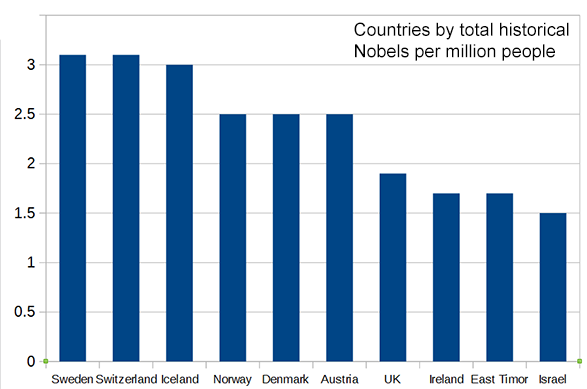
The objection makes superficial sense. The list of Nobel winners per capita puts Israel at a modest tenth place, after places like Norway and the United Kingdom.

This doesn’t look promising for any Ashkenazi-Jew-based theory.

2. But their more modern numbers look much more impressive

On the other hand, that list counts total Nobels won, ever, and divides them by modern population. That gives an advantage to older countries. Norway’s been collecting Nobels since 1903; Israel wasn’t even founded until 1948. And for the first couple generations the Israelis were pretty busy starting kibbutzim, building infrastructure, fighting off enemies, et cetera. Setting up a good university system capable of churning out Nobels takes time. So Norway and the UK had an unfair head start.

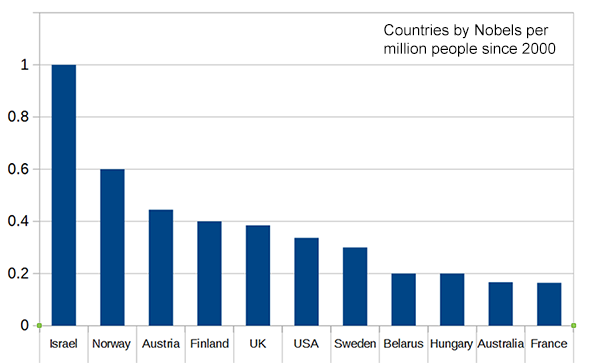
I redid their analysis looking only at Nobels won since the year 2000 (because it was big and round and serves as a signal that I’m trying to avoid optional stopping). My source was this list of Nobel laureates by country, and I deferred to Wikipedia’s judgment about whether or not to count dual citizens, immigrants, et cetera. Here’s the results:

We see that during this period, Israel has by far the highest number of Nobel prizes per capita.

3. This advantage increases if we look only at Ashkenazim

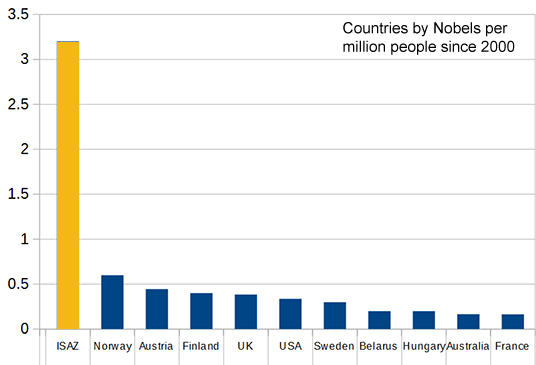
The original theory was about Ashkenazi Jews in particular. Only about a third of Israels are Ashkenazi (the rest are other types of Jews, or Palestinians, or other non-Jewish minorities). If we separate out the Ashkenazim, the graph looks like this.

ISAZ is Israeli Ashkenazi Jews, considered as a separate population. On the one hand, it’s kind of unfair comparing Israel’s most successful population group to other countries taken as a whole. On the other hand, if we were to take other countries’ most successful population groups, those would be Ashkenazi Jews too, so whatever. Since Israeli Ashkenazim get about five times more Nobels per capita than any country, I’m going to consider the “what about Israel?” objection officially refuted.

4. But there’s not a lot of evidence for benefits to concentration, and other factors might be involved

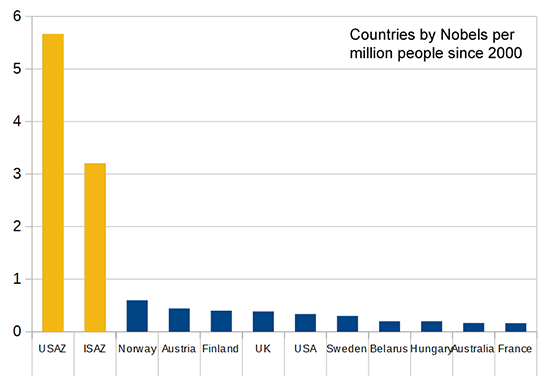
One more graph:

USAZ is US Ashkenazi Jews, who get twice as many Nobels per capita as their Israeli cousins (I’m not sure how seriously to take this; the Israeli data is based on eight Nobel laureates, so there’s a lot of room for sampling issues.)

And although it’s hard for me to get exact numbers, it looks like a lot of Israeli Nobelist (maybe more than half) did their best work abroad, usually in the US.

Israel went from 1948 to 2002 without winning a single science Nobel (it did win in Literature and Peace during that time). Now it’s winning more of them – a lot more, more than any other country per capita – but mostly when its citizens go and study in foreign universities. This seems consistent with an Israeli educational system that’s still struggling to get its act together.

Does this mean that once the educational system gets its act together more fully, the ISAZ Nobel rate will approximately double to match the USAZ Nobel rate? I’m not sure.

Just from this analysis, it doesn’t look like the theory in the last post, where everyone gets benefits from concentrating closer together, is true. Israel has about ten times as many Ashkenazi Jews per capita than the US, but still does worse than they do.

These data don’t challenge the conclusion from the last post that Ashkenazim might have been responsible for Hungary’s sudden crop of great scientists. But they do potentially challenge the implicit conclusion that the education system didn’t matter that much. I’ll have more on that later this week.

Posted in Uncategorized | Tagged | 226 Comments

The Atomic Bomb Considered As Hungarian High School Science Fair Project

I.

A group of Manhattan Project physicists created a tongue-in-cheek mythology where superintelligent Martian scouts landed in Budapest in the late 19th century and stayed for about a generation, after which they decided the planet was unsuitable for their needs and disappeared. The only clue to their existence were the children they had with local women.

The joke was that this explained why the Manhattan Project was led by a group of Hungarian supergeniuses, all born in Budapest between 1890 and 1920. These included Manhattan Project founder Leo Szilard, H-bomb creator Edward Teller, Nobel-Prize-winning quantum physicist Eugene Wigner, and legendary polymath John von Neumann, namesake of the List Of Things Named After John Von Neumann.

The coincidences actually pile up beyond this. Von Neumann, Wigner, and possibly Teller all went to the same central Budapest high school at about the same time, leading a friend to joke about the atomic bomb being basically a Hungarian high school science fair project.

But maybe we shouldn’t be joking about this so much. Suppose we learned that Beethoven, Mozart, and Bach all had the same childhood piano tutor. It sounds less like “ha ha, what a funny coincidence” and more like “wait, who was this guy, and how quickly can we make everyone else start doing what he did?”

In this case, the guy was Laszlo Ratz, legendary Budapest high school math teacher. I didn’t even know people told legends about high school math teachers, but apparently they do, and this guy features in a lot of them. There is apparently a Laszlo Ratz Memorial Congress for high school math teachers each year, and a Laszlo Ratz medal for services to the profession. There are plaques and statues to this guy. It’s pretty impressive.

A while ago I looked into the literature on teachers and concluded that they didn’t have much effect overall. Similarly, Freddie deBoer writes that most claims that certain schools or programs have transformative effects on their students are the result of selection bias.

On the other hand, we have a Hungarian academy producing like half the brainpower behind 20th century physics, and Nobel laureates who literally keep a picture of their high school math teacher on the wall of their office to inspire them. Perhaps even if teachers don’t explain much of the existing variability, there are heights of teacherdom so rare that they don’t show up in the statistics, but still exist to be aspired to?

II.

I’ve heard this argument a few times, and I think it’s wrong.

Yes, two of Ratz’s students went on to become supergeniuses. But Edward Teller, another supergenius, went to the same high school but (as far as I know) was never taught by Ratz himself. That suggests that the school was good at producing supergeniuses regarldess of Ratz’s personal qualities. A further point in support of this: John Harsanyi also went to the school, also wasn’t directly taught by Ratz, and also went on to win a Nobel Prize and invent various important fields of mathematics. So this school – the Fasori Gymnasium – seems to have been about equally excellent for both its Ratz-taught and its non-Ratz-taught pupils.

Yet the Fasori Gymnasium might not have even been the best high school in its neighborhood. It competed with the Minta Gymnasium half a mile down the street, whose alumni include Manhattan Project physicists Nicholas Kurti and Theodore von Karman (von Karman went on to found the Jet Propulsion Laboratory), brilliant chemist-philosopher Michael Polanyi, economists Thomas Balogh and Nicholas Kaldor (of Kaldor-Hicks efficiency fame), and Peter Lax, who once said “You don’t have to be Hungarian to be a mathematician – but it helps”. There are also some contradictory sources suggesting Teller attended this school and not Fasori; for all I know he might have attended both. Once again, most of these people were born in the 1890-1910 period when the Martian scouts were supposedly in Budapest.

Worse, I’m not even sure that the best high school in early 20th-century Hungary was either of the two mentioned above. The Berzsenyi Gymnasium, a two mile walk down Gyorgy Street from the others, boasts alumni including multizillionaire George Soros, Intel founder Andrew Grove, BASIC inventor John Kemeny, leading cancer biologist George Klein, great mathematician George Polya, and Nobel Prize winning physicist Dennis Gabor.

Given that the Fasori Gymnasium wasn’t obviously better than either of these others, is it possible that the excellence was at a higher level – neither excellent teachers nor excellent principals, but some kind of generally excellent Hungarian culture of education?

This is definitely what the Hungarians want us to think. According to Cultures of Creativity:

What’s so special about Budapest’s schools? A certain elitism and a spirit of competition partly explains the successes of their students. For example, annual competitions in mathematics and physics have been held since 1894. The instruction the students receive as well as these contests are an expression of a special pedagogy and a striving to encourage creativity. Mor Karman, founder of the Minta school, believed that everything should be taught by showing its relation to everyday life. Instead of learning rules by heart from books, students tried to formulate the rules themselves.

This paper on “The Hungarian Phenomenon” makes similar claims, but adds a few more details:

The Eotvos Contests were a powerful mean for the stimulation of mathematics on a large scale and were used to motivate mathematical culture in the society. It also provided a channel to search for talented youths. The contests, which have been open to Hungarian high school students in their last year since 1894, played a remarkable role in the development of mathematics.

Okay. But I want to challenge this. During this era, formal education in Hungary began at age 10. By age ten, John von Neumann, greatest of the Hungarian supergeniuses, already spoke English, French, German, Italian, and Ancient Greek, knew integral and differential calculus, and could multiply and divide 8-digit numbers in his head. Wikipedia notes that on his first meeting with his math teacher, the math teacher “was so astounded with the boy’s mathematical talent that he was brought to tears”. This doesn’t sound like a guy whose potential was kindled by formal education. This sounds like a guy who would have become one of history’s great mathematicians even if his teachers had slept through his entire high school career.

Likewise, the book above notes that Dennis Gabor, the Hungarian inventor of holography, “developed his passion for physics during his youth, but did so for the most part on his own”. His biography notes that “During his childhood in Budapest, Gabor and his brother would often duplicate the experiments they read about in scientific journals in their home laboratory.”

Likewise, consider Paul Erdos, a brilliant mathematician born in Budapest around this time. As per his Wikipedia page, “Left to his own devices, he taught himself to read through mathematics texts that his parents left around their home. By the age of four, given a person’s age, he could calculate, in his head, how many seconds they had lived.”

I have no knock-down proof that Hungary’s clearly excellent education system didn’t contribute to this phenomenon. A lot of child prodigies burn out, and maybe Hungary was unusually good at making sure that didn’t happen. But it sure seems like they had a lot of child prodigies to work with.

So what’s going on? Should we just accept the Manhattan Project consensus that there was a superintelligent Martian scout force in early 20th-century Budapest?

III.

Here’s something interesting: every single person I mentioned above is of Jewish descent. Every single one. This isn’t some clever setup where I only selected Jewish-Hungarians in order to spring this on you later. I selected all the interesting Hungarians I could find, then went back and checked, and every one of them was Jewish.

This puts the excellence of the Hungarian education system in a different light. Hungarian schools totally failed to work their magic on Gentiles. You can talk all you want about “elitism and a spirit of competition” and “striving to encourage creativity”, yet for some reason this worked on exactly one of Hungary’s many ethnic groups.

This reduces the difficult question of Hungarian intellectual achievement to the easier question of Jewish intellectual achievement.

I say “easier question” because I find the solution by Cochran, Hardy, and Harpending really compelling. Their paper is called A Natural History Of Ashkenazi Intelligence (“Ashkenazi” means Eastern European Jew) and they start by expressing the extent of the issue:

Ashkenazi Jews have the highest average IQ of any ethnic group for which there are reliable data. They score 0.75 to 1.0 standard deviations above the general European average, corresponding to an IQ 112 – 115. This fact has social significance because IQ (as measured by IQ tests) is the best predictor we have of success in academic subjects and most jobs. Ashkenazi Jews are just as successful as their tested IQ would predict, and they are hugely overrepresented in occupations and fields with the highest cognitive demands. During the 20th century, they made up about 3% of the US population but won 27% of the US Nobel science prizes and 25% of the Turing Awards [in computer science]. They account for more than half of world chess champions.

This doesn’t seem to be due to any advantage in material privilege; Ashkenazi Jews frequently did well even in countries where they were persecuted. Nor is it obviously linked to Jewish culture; Jews from other regions of the world show no such advantage. So what’s going on?

Doctors have long noted that Ashkenazi Jews are uniquely susceptible to various genetic diseases. For example, they’re about a hundred times more likely to have Gaucher’s Disease, a hundred times more likely to get Tay-Sachs Disease, ten times more likely to have torsion dystonia, et cetera. Genetic diseases are so common in this population that the are official recommendation is that all Ashkenazi Jewish couples get screened for genetic disease before marriage. I’m Ashkenazi Jewish, I got screened, and I turn out to be a carrier for Riley-Day syndrome – three hundred times as common in Ashkenazi Jews as in anyone else.

Evolution usually gets rid of genetic diseases pretty quickly. If they stick around, it’s because they’re doing something to earn their keep. One common pattern is “heterozygote advantage” – two copies of the gene cause a disease, but one copy does something good. For example, people with two copies of the sickle cell gene get sickle cell anaemia, but people with one copy get some protection against malaria. In Africa, where malaria is relatively common, the tradeoff is worth it – so people of African descent have high rates of the sickle cell gene and correspondingly high rates of sickle cell anaemia. In other places, where malaria is relatively uncommon, the tradeoff isn’t worth it and evolution eliminates the sickle cell gene. That’s why sickle cell is about a hundred times more common in US blacks than US whites.

The moral of the story is: populations can have genetic diseases if they also provide a useful advantage to carriers. And if those genetic diseases are limited to a single group, we expect them to provide a useful advantage for that group, but not others. Might the Jewish genetic diseases provide some advantage? And why would that advantage be limited to Jews?

Most of the Jewish genetic diseases cluster into two biological systems – the sphingolipid system and the DNA repair system. This is suspicious. It suggests that they’re not just random. They’re doing something specific. Both of these systems are related to neural growth and neural branching. Might they be doing something to the brain?

Gaucher’s disease, one of the Ashkenazi genetic diseases, appears to increase IQ. CHH obtained a list of all of the Gaucher’s patients in Israel. They were about 15 times more likely than the Israeli average to be in high-IQ occupations like scientist or engineer; CHH calculate the probability that this is a coincidence to be 4×10^-19.

Torsion dystonia, another Ashkenazi genetic disease, shows a similar pattern. CHH find ten reports in the literature where doctors comment on unusual levels of intelligence in their torsion dystonia patients. Eldridge, Harlan, Cooper, and Riklan tested 14 torsion dystonia patients and found an average IQ of 121; another similar study found an average of 117. Torsion dystonia is pretty horrendous, but sufferers will at least get the consolation prize of being really, really smart.

Moving from medicine to history, we find that Ashkenazi Jews were persecuted for the better part of a millennium, and the particular form of this persecution was locking them out of various jobs until the main career opportunities open to them were things like banker, merchant, and doctor. CHH write:

For 800 to 900 years, from roughly 800 AD to 1650 or 1700 AD, the great majority of the Ashkenazi Jews had managerial and financial jobs, jobs of high complexity, and were neither farmers nor craftsmen. In this they differed from all other settled peoples of which we have knowledge.

They continue:

Jews who were particularly good at these jobs enjoyed increased reproductive success. Weinryb (1972, see also Hundert 1992) comments: “More children survived to adulthood in affluent families than in less affluent ones. A number of genealogies of business leaders, prominent rabbis, community leaders, and the like – generally belonging to the more affluent classes – show that such people often had four, six, sometimes even eight or nine children who reached adulthood. On the other hands, there are some indications that poorer families tended to be small ones…as an example, in a census of the town of Brody in 1764 homeowner households had 1.2 children per adult member while tenant households had 0.6.

Now we can start to sketch out the theory in full. Due to persecution, Jews were pushed into cognitively-demanding occupations like banker or merchant and forced to sink or swim. The ones who swam – people who were intellectually up to the challenge – had more kids than the ones who sank, producing an evolutionary pressure in favor of intelligence greater than that in any other ethnic group. Just as Africans experiencing evolutionary pressure for malaria resistance developed the sickle cell gene, so Ashkenazim experiencing evolutionary pressure for intelligence developed a bunch of genes which increased heterozygotes’ IQ but caused serious genetic disease in homozygotes. As a result, Ashkenazi ended up somewhat more intelligent – and somewhat more prone to genetic disease – than the rest of the European population.

If true, this would explain the 27% of Nobel Prizes and 50% of world chess champions thing. But one still has to ask – everywhere had Jews. Why Hungary in particular? What was so special about Budapest in the early 1900s?

IV.

Okay, sure, everywhere had Jews. But it’s surprising exactly how many Jews were in early 1900s Hungary.

The modern United States is about 2% Jewish. Hungary in 1900 was about 5%. The most Jewish city in America, New York, is about 15% Jewish. Budapest in 1900 was 25%. It was one of the most Jewish large cities anywhere in history, excepting only Israel itself. According to Wikipedia, the city’s late 19th-century nickname was “Judapest”.

So is it possible that all the Jews were winning Nobel Prizes, and Hungary just had more Jews and so more Nobelists?

No. This doesn’t seem right. The 1933 European Jewish Population By Country site lists the following size for each country’s Jewish communities:

Poland: 3 million
Russia: 2.5 million
Romania: 750,000
Germany: 500,000
Hungary: 500,000
Britain: 300,000
France: 250,000
Austria: 200,000

It’s hard to find a good list of all famous Manhattan Project physicists, but I tried this article and got the following number of famous Jewish Manhattan Project physicists per country of origin:

Hungary: 4
Germany: 2
Poland: 2
Austria: 2
Italy: 1
Netherlands: 1
Switzerland: 1

Here’s an alternative source with a different definition of “famous”, broken down the same way:

Germany: 5
Hungary: 4
Poland: 3
Italy: 2
Austria: 2

The main point seems to be disproportionately many people from Central European countries like Hungary and Germany, compared to either Eastern European countries like Poland and Russia or Western European countries like France and Britain.

The Central European advantage over Western Europe is unsurprising; the Western European Jews probably weren’t Ashkenazim, and so didn’t have the advantage mentioned in the CHH paper above. But is there any reason to think that Central European Jews were more intelligent than Polish and Russian Jews?

I’m not really sure what to think about this. This paper finds that the sphingolipidoses and other Jewish genetic diseases are about twice as common in Central European Jews as in Eastern European Jews, but I have very low confidence in these results. Intra-Jewish gossip points out the Lithuanians as the geniuses among world Jewry, but doesn’t have any similar suggestions about Hungarians. And torsion dystonia, maybe the most clearly IQ-linked disease, is unique to Lithuanians and absent in Hungarians.

Probably much more promising is just to focus on the obvious facts of the social situation. Early`1900s Hungary was a great nation and a prosperous center of learning. Remember, we’re talking about the age of the Austro-Hungarian Empire, one of the most industrialized and dynamic economies of the time. It might have had advantages that Poland, Romania, and Russia didn’t. My list of historical national GDPs per capita is very unimpressed by the difference between Hungarian and Polish GDPs in 1900, but maybe it’s wrong, or maybe Budapest was an especially modern part of Hungary, or maybe there’s something else I’m missing.

Also, there could have been a difference in the position of Jews in these countries. Russia was still experiencing frequent anti-Jewish pogroms in 1900; in Hungary, Jews were among the country’s most noble families. Actually, the extent of Jewish wealth and influence in Hungary sort of defies belief. According to Wikipedia, in 1920 Jews were 60% of Hungarian doctors, 50% of lawyers, 40% of engineers and chemists, and 90% of currency brokers and stock exchange members. “In interwar Hungary, more than half and perhaps as much as 90 percent of Hungarian industry was owned or operated by a few closely related Jewish banking families.”

So Central European Jews – the Jews in Hungary and Germany – had a unique combination of intellectual and financial advantages. This means Hungary’s only real rival here is Germany. Since they were rich, industrialized, and pretty liberal about Jewish rights at the beginning of the 20th century – and since they had just as many Jews as Hungary – we should expect to see the same phenomenon there too.

And we kind of do. Germany produced its share of Jewish geniuses. Hans Bethe worked for the Manhattan Project and won a Nobel Prize. Max Born helped develop quantum mechanics and also won a Nobel Prize. James Franck, more quantum physics, another Nobel Prize. Otto Stern, even more quantum physics, yet another Nobel Prize. John Polanyi, chemical kinetics, Nobel Prize (although he was half-Hungarian). And of course we probably shouldn’t forget about that Einstein guy. All of these people were born in the same 1880 – 1920 window as the Martians in Hungary.

I think what’s going on is this: Germany and Hungary had about the same Jewish population. And they produced about the same number of genius physicists in the same window. But we think of Germany as a big rich country, and Hungary as a small poor country. And the German Jews were spread over a bunch of different cities, whereas the Hungarian Jews were all crammed into Budapest. So when we hear “there were X Nobel Prize winning German physicists in the early 1900s”, it sounds only mildly impressive. But when we hear “there were X Nobel Prize winning physicists from Budapest in the early 1900s”, it sounds kind of shocking. But the denominator isn’t the number of Germans vs. Hungarians, it’s the number of German Jews vs. Hungarian Jews, which is about the same.

V.

This still leaves one question: why the period 1880 to 1920?

On further reflection, this isn’t much of a mystery. The emancipation of the Jews in Eastern Europe was a difficult process that took place throughout the 19th century. Even when it happened, it took a while for the first generation of Jews to get rich enough that their children could afford to go to fancy schools and fritter away their lives on impractical subjects like physics and chemistry. In much of Eastern Europe, the Jews born around 1880 were the first generation that was free to pursue what they wanted and seek their own lot in the world.

The end date around 1920 is more depressing: any Jew born after this time probably wasn’t old enough to escape the Nazis. Almost all the famous Hungarian Jews became physics professors in Europe, fled to America during WWII using channels open to famous physicists, and then made most of their achievements on this side of the Atlantic. There are a couple of stragglers born after 1920 who survived – George Soros’ family lived because they bought identity documents saying they were Christian; Andrew Grove lived because he was hidden by righteous Gentiles. But in general Jews born in Europe after 1920 didn’t have a great life expectancy.

All of this suggests a pretty reasonable explanation of the Martian phenomenon. For the reasons suggested by Cochran, Hardy, and Harpending, Ashkenazi Jews had the potential for very high intelligence. They were mostly too poor and discriminated against to take advantage of it. Around 1880, this changed in a few advanced Central European economies like Germany, Austria, and Hungary. Austria didn’t have many Jews. Germany had a lot of Jews, but it was a big country, so nobody really noticed. Hungary had a lot of Jews, all concentrated in Budapest, and so it was really surprising when all of a sudden everyone from Budapest started winning Nobel Prizes around the same time. This continued until World War II, and then all anyone remembered was “Hey, wasn’t it funny that so many smart people were born in Budapest between 1880 and 1920?”

And this story is really, really, gloomy.

For centuries, Europe was sitting on this vast untapped resource of potential geniuses. Around 1880, in a few countries only, economic and political conditions finally became ripe for the potential to be realized. The result was one of the greatest spurts of progress in scientific history, bringing us relativity, quantum mechanics, nuclear bombs, dazzling new mathematical systems, the foundations of digital computing, and various other abstruse ideas I don’t even pretend to understand. This lasted for approximately one generation, after which a psychopath with a stupid mustache killed everyone involved.

I certainly can’t claim that the Jews were the only people being crazy smart in Central Europe around this time. This was the age of Bohr, Schrodinger, Planck, Curie, etc. But part of me wonders even here. If you have one physicist in a town, he sits in an armchair and thinks. If you have five physicists in a town, they meet and talk and try to help each other with their theories. If you have fifty physicists in a town, they can get funding and start a university department. If you have a hundred, maybe some of them can go into teaching or administration and help support the others. Having this extra concentration of talent in central Europe during this period might have helped Jews and Gentiles alike.

I wonder about this because of a sentiment I hear a lot, from people who know more about physics than I do, that we just don’t get people like John von Neumann or Leo Szilard anymore. That there was some weird magical productivity to the early 20th century, especially in Central Europe and Central European immigrants to the United States, that we’re no longer really able to match. This can’t be a pure numbers game – the Ashkenazi population has mostly recovered since the Holocaust, and people from all over the world are coming to American and European universities and providing more of a concentration of talent than ever. And even though it’s impossible to measure, there’s still a feeling that it’s not enough.

I started down this particular research rabbit hole because a friend challenged me to explain what was so magical about early 20th century Hungary. I think the Jewish population calculations above explain a lot of the story. I’m not sure whether there’s a missing ingredient, or, if so, what it might be. Maybe it really was better education. Maybe it really was math competitions and talent searches.

Or maybe it was superintelligent Martian scouts with an Earthling fetish.

Posted in Uncategorized | Tagged , | 852 Comments

Those Modern Pathologies

[Related to: The Fidget Spinner Is The Perfect Toy For The Trump Presidency, In Defense Of Liking Things, Open Marriage Is A Neoliberal Pathology]

That modern pathology, the Pyramid of Cheops

The final triumph of modern individualism is an afterlife ensconed in a giant stone structure, carefully segregated from any other souls, based entirely around stuff. No county churchyards here. No slow surrender to nature and the weeds. Just piles of golden goblets and jeweled necklaces, carefully guarded by snake-infested traps. And, of course the bones of dead servants, guaranteed to keep serving you in the great beyond. Of course Heaven is neoliberal. There is no alternative!

That modern pathology, heterosexual intercourse for the sole purpose of procreation

Sex can bring people together. It can cement relationships between people and families. It can pulse with celestial fire, it can shatter inner worlds, it can inspire transcendent art, it can remake souls. Of course moderns took one look at all of that and thought: you know what the only acceptable purpose of sex is? Making a smaller copy of myself.

But calling this narcissism would be missing half the picture. It’s equally related to a sort of productivity fetish, a mindset where anything that doesn’t leave a material token didn’t really happen. Enjoyed the company of your closest friends? Not real unless you put the pictures on Facebook, tagged #bestiesforever. Broadened your horizons with a trip to another culture? Not real without crushed pennies or some other gift-shop tchotchke. Met your soulmate? Not real unless you’ve got a lump of screaming flesh to show for it. This is what capitalism does – reduce experiences to souveniers, reduce relationships to commodities, demand that everything good be mediated by a material end product in order to model the laboring-for-others that workers are told is their only life purpose.

That modern pathology, Homer’s Odyssey

If Harry Potter wasn’t vapid enough for you, now we have a travelogue for the Instagram generation.

Odysseus’ only salient characteristic is being “polymetis”, Very Smart. This is enough to give him a raving fan club of front-row-kids and aspirational Ivy Leaguers, the same people who thought Hermione Granger’s straight A’s made her a symbol of an entire generation of womenhood. Odysseus proves his chops in his very first adventure, where he encounters Lotus-Eaters who convince most of his men to eat a magic fruit that leaves them drugged and listless; Odysseus nobly drags them back to the ship and forces them to keep on rowing for him.

Imagine the horrors of a world where poor galley slaves can leave behind their unpaid labor to live on a tropical beach and enjoy their lives! It is only thanks to Odysseus that this catastrophe is averted. One might think a few readers would note that a few months later, the vast majority of sailors in Odysseus’ fleet died horribly, eaten by cannibals. One might think a few readers would wonder if, really, the guy who dragged galley slaves back to their galleys only to get them killed a few months later was really such a good guy. In fact, nobody asks this question, because Odysseus is Very Smart. It’s no coincidence that the Odyssey came out in the generation of the invasion of Iraq War – if Very Smart people declare that dying horribly was the right thing to do, and then it turns out it wasn’t, at least they were benevolent technocrats with your best interests in mind.

Odysseus then goes on to have sex with various sorceresses and sea-nymphs while protesting that he doesn’t want to have sex with them and is loyal to his far-off wife. This is portrayed as clearly a difficult problem that we should empathize with. Also, his sailors get turned into pigs, eaten by sea monsters, and drowned in a giant whirlpool. This is not portrayed as clearly a difficult problem that we should empathize with. In one scene, some starving sailors eat a sacred cow belonging to the Sun God; this is portrayed as clearly justifying their deaths.

We can start to sketch a psychological picture of the sort of person who could enjoy the Odyssey. They identify with Odysseus, that’s obvious. They want to feel like they’ve suffered – after all, suffering is ennobling! – but they don’t want to actually suffer. They imagine the “suffering” of having to have sex with lots of sea nymphs they’re not super-interested in, all while their friends and subordinates are massacred all around them (but only for good reasons, like them stealing cattle, or them not being Very Smart). At the end of all of it, much like the rich kids attending the Fyre Festival, they can show up on their front doorstep and say “Oh, what suffering I have seen – and I the only survivor!”

The Odyssey is a book for rich individualist aspirational Very Smart narcissists who simultaneously want to outsource their ennobling hardships to the lower classes, and remain so contemptuous of those lower classes that they imagine them literally getting turned into swine by a sorceress, and end up having sex with that sorceress, who is unable to resist them because they are Very Smart.

I weep for the modern generation.

That modern pathology, the Aristotelian theory of virtue

You see, perfect virtue in all things approaches the mean. The traditionalist who wants to make the system more conservative is unvirtuous. And the radical who wants to make the system more progressive is exactly equally unvirtuous. The virtuous person is the liberal intellectual who considers both positions, then places himself exactly in the middle.

Anybody who seems too fiery, too deep, or too sincere is automatically wrong. You can reject both the grandparents who urge clean and sober living, and the hippies who tell you that drugs are the only way to break outside the system and achieve true consciousness, in favor of having a joint or two whenever you feel like it. You can reject both the ascetic who urges simple water, and the aesthete who urges fine wine, in favor of the bottle of Diet Coke already in your fridge.

Aristotle reduces virtue to abandoning the highs of ecstasy and the lows of misery in favor of the comfortable neoliberal plateau of watching Mad Men on TV and ordering off Amazon Echo. No wonder his message resonates so well with millennials.

That modern pathology, Catholicism

The Old Testament God demanded adherence to hundreds of rules and rained down collective punishment on entire nations for breaking them. But you are a yuppie with an hour a week for religion, tops, and consider yourself part of a different species from anyone who doesn’t go to a Starbucks at least twice a week. You get your coffee in packets from Keurig, your razors in packets from Dollar Shave Club, and your juice in packets from Juicero. If only there were some large corporation that would package religion and send it to your doorstep for one low price.

Enter Catholicism. God loves you, just for being you. He suffered and died for you two thousand years ago, granting you redemption. All you have to do to pick it up is sign on the dotted line and pay ten percent of your income.

Consider eg the ritual of confession. You eliminate your sin in a standardized dyadic interaction no harder than eliminating your muscle tension at the massage parlor, or eliminating your back pain with a chiropractor. It’s quick, impersonal, and completely tailored to your individual sinner profile.

Or consider the Eucharist. The Prozac generation has already had personal change reduced to the process of swallowing a pill, and the Catholic Church is eager to comply, reducing finitude to a DSM-V ailment curable with correctly prepared bread products. The Church is a corporation the same as Coca-Cola and McDonalds, and we already know the sacred ritual for interacting with corporations. And so our consumer culture reduces the human relationship with the Divine to literally consuming God.

And like all good corporations, you can rest assured that the whole thing is organized in a very logical top-down chain under the absolute command of an incredibly rich guy who lives in a house covered in gold. “Father, am I forgiven now?” “Um, one second, let me check with the manager in branch headquarters”. And why shouldn’t he? The word “Catholic” means “universal”; we’re so separated from our own neighbors that we’d rather our religion come in the form of Standardized Religion Product shipped in from Rome than anything which forces us to confront people near us as individuals, or trust our local communities for anything more than naming the parish church.

Let’s be honest: the recent success of Catholicism is the ultimate sign of our inability to deal with the world through anything other than a late capitalist lens of standardizaton, corporatism, and carefully-packaged pablum. It’s the perfect religion for the Age of Trump.

Posted in Uncategorized | Tagged | 150 Comments

Classified Ads Thread

I’m away at a conference, so no blogging today.

Instead, let’s try having people post ads. Jobs, housing, products, websites, etc.

(Personal ads okay from women and gay people; given the demographics here I don’t think it’s worth it for straight men)

OT76: Extropenism

This is the bi-weekly visible open thread. Post about anything you want, ask random questions, whatever. You can also talk at the SSC subreddit or the SSC Discord server.

1. San Diego meetup still planned for today, Irvine meetup still planned for next weekend. Details here.

2. In Silicon Valley: A Reality Check, I included Vox in a list of publications that were overly harsh on Silicon Valley because of the Juicero incident. Vox requests a correction that their article, although somewhat harsh at points, also did note that there was lots of good research and development going on too, and doesn’t deserve to be pilloried in the same way as the others. You can read their article here and judge for yourself.

3. There were a lot of complaints about Polyamory Is Not Polygyny, so let me clarify. The articles I cited were generally criticizing polyamory as it actually exists, ie in a few weird communities. I presented data from one weird community showing that it didn’t look like their criticisms were true. Some other people in the comments presented data from other weird communities showing the same thing. I don’t claim this is necessarily an accurate representation of what a future hypothetical worldwide polyamorous society would be like. For all I know maybe it would be exactly the opposite, the same way we expect a future hypothetical worldwide socialist society to have the exact opposite results as every time socialism has ever been tried in real life.

4. Mingyuan has been doing a lot of work aggregating data and comments from all of the SSC meetups that have been going on lately. See her writeup here. She’s also got a frequently-updated list of where and when the next SSC meetup close to you is here. I’m going to add that somewhere more prominent when I get around to it.

5. My serial novel Unsong is now complete. If you were waiting to read it until it was finished, now’s the time.

6. The Report Comments button is broken and seems to have been so for a while. If you posted something terrible in the past few months, you’re probably off the hook. My normal tech support has given up on this one, but if you want to try fixing it, let me know.

7. Cafe Chesscourt has agreed to serve as an unofficial (official?) SSC forum, so if you prefer bulletin boards to all the other methods of communication we’ve got around here, head on over.

Posted in Uncategorized | Tagged | 1,136 Comments

Postmarketing Surveillance Is Good And Normal

I.

Scientific American notes a recent study saying that a third of drugs approved by the FDA over the past ten years have since been recalled, been given new boxed warnings, or been given new “safety communications”.

A few people have asked me whether this means the FDA is too lax and needs to tighten its standards. Let’s look at this in more detail.

What the study actually says: of 222 drugs approved by the FDA in the last ten years, only 3 (1.3%) were taken off the market. Another 30% or so received “boxed warnings” or “safety communications”, basically the FDA’s way of adding new rules to their safety information. For example, the FDA might approve a drug for the general population, then issue a boxed warning saying “actually, we noticed that this drug can cause seizures as a side effect, don’t take it if you have a history of seizure disorder”.

The most serious category are the drugs taken off the market. As mentioned above, these are about 1% of the total. This doesn’t sound like the story of a weak regulatory agency failing to do its job. This sounds like a really impressive success rate. In fact, if our standards are so stringent that we’re insisting on a 1% false positive rate, I’m kind of horrified thinking of all the false negatives we must be throwing out.

But doesn’t even a 1% false positive rate mean the FDA failed in some way?

No. Let’s consider the most recent psychiatric drug to be withdrawn. This is nefazodone, an antidepressant withdrawn after the discovery that it causes liver failure once every 300,000 patient-years. That is, if 300,000 patients took it for one year, there would be one extra case of liver failure.

How, exactly, do you want to discover this in pre-approval studies? An average drug study has maybe 500 patients. Do you want to run an average drug study for six hundred years? Or do you want to figure out how to run a drug study that’s six hundred times bigger than average? And these numbers are underestimates – one extra liver failure might be a coincidence. You’d want to see two or three extra liver failures before you start thinking the drug might be involved. The average clinical trial costs something like $50 million. Are you sure you want to multiply this number by six hundred to catch a side effect that will affect one out of hundreds of thousands of people?

So what we actually do is post-marketing surveillance. The FDA demands an average drug study on 500 people to make sure that there aren’t any common problems. Then over hundreds of thousands of patients over the space of decades (nefazodone was out almost ten years before it got withdrawn) people collect records and see if there’s any unusual disorder that happens more often when people are on the drug.

Here’s another example from earlier this year: the FDA issued a safety communication that a new drug called Viberzi can cause pancreatitis in people who don’t have a gall bladder. I’m not sure how many patients in the original approval study didn’t have gall bladders, but I bet it wasn’t enough to draw any useful conclusions from. Should all drugs be delayed until they can do separate studies in the gall-bladder-less population? And how would we know beforehand that gall bladders were the problem? Why not separate studies in people with one kidney? People taking antidepressants? Red-haired people? Chinese people? Don’t laugh, Tegretol has a fatal side effect that’s only been observed in Han Chinese.

And then you do the kidney study, the antidepressant study, the red-haired study, and the Chinese study, and darnit, you forgot to look at people who eat way more sauerkraut than any normal person. There you go, linezolid just killed your patient.

You are never going to be able to figure out everything pre-approval. At best, you can prove that the drug is reasonably safe for the vast majority of people. Then later you find something that only happens once in a hundred thousand years, or only to people without gall bladders, or only to Han Chinese, or only if you eat too much sauerkraut. And then the FDA issues a safety communication about it. That’s what it looks like when the system works.

II.

Except I want to look a little further into FDA safety communications and boxed warnings, the large majority of the events found in the study. Some of these are important updates about things like the drug being dangerous to people without gallbladders. Others are…well, the FDA really likes warning people about stuff.

This February, the FDA issued a safety communication about chlorhexidine, aka antiseptic soap. This has been used since the 1950s by loads of surgeons, doctors, and random people who need antiseptic soap for something, and it’s currently a WHO Essential Medication. The FDA wanted us to know that, during fifty years of worldwide use of this product, about one person a year had experienced a severe allergic reaction (by comparison, there are 200 deaths a year from peanut allergies). The safety communication said that if you found yourself having a severe allergic reaction to antiseptic soap, you should call 911.

Last summer, the FDA added a boxed warning to all benzodiazepines (Valium, Xanax, Ativan, Librium, etc) and all opiates (morphine, Norco, Percocet, Vicodin, Oxycontin, etc) warning doctors that it could be dangerous to prescribe those two classes of drugs together. Doctors, who had been warned against prescribing those two classes of drugs together for fifty years, collectively said “well, duh”, and then continued prescribing those two classes of drugs together the same as always, because dealing with anxious people who have chronic pain is really hard.

In 2006, the FDA added a boxed warning to warfarin, saying it could cause major bleeding. Warfarin is a 50-year old medication taken by millions of people each year, which has probably saved hundreds of thousands of lives over the past half-century. It’s an anticoagulant, which means the whole point is to make your blood clot less and bleed more. Mentioning that warfarin can cause major bleeding is a lot like mentioning that sleeping pills might cause tiredness, or weight gain pills could make you fat. Nevertheless, after fifty years and tens of millions of patients, the FDA decided to issue a boxed warning about this. The medical community collectively say “Well, duh” again and got on with their lives.

Also in 2006, the FDA added a boxed warning to Ritalin, saying it might slightly increase the risk of heart disease in children. Everyone kept prescribing it anyway, and later on some better studies showed that it might not slightly increase the risk of heart disease in children. I’m not sure what the current status of this debate is, but it sure hasn’t stopped like half the children I meet from being on Ritalin.

In 2004, the FDA added a boxed warning to every single antidepressant – yes, every single one – warning that they might increase suicide risk in teens. There is still a heated debate about this, with some recent review articles seeming to confirm, and other people pointing out that, when the FDA warning discouraged people from giving antidepressants to teens, teen suicide attempts suddenly went way up. Anyway, antidepressants are hardly alone here – other psychiatric drugs that received boxed warnings include all typical antipsychotics, all atypical antipsychotics, all benzodiazepines, all stimulants, lithium, Depakote, Lamictal, and I think literally every single psychiatric drug except buspirone.

What I’m saying is – the FDA issuing a safety communication or boxed warning doesn’t mean the drug was a mistake, or you should be scared that something went wrong. It’s a routine part of the pharmacological monitoring system. This doesn’t mean it should feel routine to your doctor – they should get worried every time a new one comes out and make sure they’re not inadvertantly harming their patients without gall bladders – but it should feel routine to somebody looking at this on the institutional/systems level.

III.

So does this study mean that the FDA is too lax and needs to tighten its standards?

I’m not sure. Maybe the best answer is “not necessarily“. We definitely shouldn’t be aiming for a 0% post-marketing event rate. Is a 33% post-marketing event rate too high?

I’ve seen a lot of discussion on this recently which I think takes shortcuts. It points out that the FDA has a higher/lower post-marketing event rate than European agencies. Or that the FDA takes longer/shorter to approve drugs than it did a couple of years ago. Or that its standards are stricter/looser than some comparable area of the federal bureaucracy.

None of this matters. What actually matters is the number of people helped by incentivizing new drug development and getting it to market quickly, versus the number of people harmed by the safety problems that slip through the cracks.

It looks like some of the post-marketing surveillance events here were pretty silly, while others were pretty serious – two people died from that drug that causes pancreatitis in people without gall bladders. Are those two deaths justified in the context of saving thousands of other people who had whatever condition that drug cures? I don’t know without a lot more work. The only study I’ve ever seen on this is stuff in the vein of Isakov, Lo, and Motazerhodjat, which always finds the FDA is too conservative. Maybe they’re wrong, but if someone wants to prove they’re wrong, they should do the same kind of cost-benefit analysis and let us know that they came to a different result.

The finding that 33% of approved drugs get post-marketing safety events may factor into such a calculation. But without the rest of the calculation, it’s just a meaningless number.

Polyamory Is Not Polygyny

[Content warning: polyamory, brief quote of weird Heartiste stuff]

The objections I hear to polyamory tend to separate into two narratives sharing a common thread.

The first narrative is supposedly concerned about women, and typified by National Review’s Polyamory Is A Modern Name For A Backward Practice. It asks:

What happens to women in a world where we scrap the “binary axis” of monogamy? Women suffer, that’s what. Nobody is asking for a show called “Brother Husbands.” Nine of ten pictures for polyamory involve one man with multiple women. The other one in ten is usually just a crowd of people. Men may sleep around, but they don’t tolerate the degradation of being a part of a modern male harem, nor have they ever, really. Polygamy uniquely subjugates one sex; it’s like an institutionalized form of the hookup culture — with women on call for male pleasure, just with some boundaries and a relationship status.

The second narrative is supposedly concerned about men, and typified by Heartiste’s Polyamory Is Disguised Polygamy:

Polyamory — multiple and simultaneous sexual relationships — means, in practice, a few high value dudes hording all the pussy. Multitudinously and concurrently. Polyamory cheerleaders, like Christopher Ryan, note the shape of our penis heads and go on to weave a happy utopia of free love where all the men and all the women get their rocks off whenever and however they wish, like the bonobos (who, by the way, are territorially squeezed compared to their more prodigiously successful chimp cousins). But he has to ignore female hypergamous mate choice and male jealousy to concoct this vision of a peaceful hedonist paradise. The reality would be considerably darker; women would still want to bang the alpha, leaving the beta male out in the cold, clawing and scratching for rode-worn scraps, but now shackled with the obligation to help provide for kids that are likely not his own.

Despite the different focuses, they both have the same theory. Men – especially high-status men – are going to date lots of women. But women aren’t going to date lots of men, so all the women will end up dating the same few high-status men and ignore the low-status men. Therefore, women (NRO’s concern) and low-status men (Heartiste’s concern) will lose out.

I got so tired of trying to explain that this doesn’t match reality that I started digging back in old survey data to see if I could just disprove it. The latest SSC survey didn’t have enough questions on relationships, but the 2014 LW survey did. I got a sample of 53 poly women, 164 poly men, 70 monogamous women, and 690 monogamous men.

I interpret NRO and Heartiste’s theories to predict that more poly men than mono men would be single, that the median poly woman would have more partners than the median poly man, but that there would be more poly men with very high numbers of partners than poly women with the same. None of these hypotheses were confirmed.

For poly men, 29% were single, 47% had one partner, 17% had two partners, 4% had three, 2% had four, and only 0.5% had five or more.

For poly women, 8% were single, 44% had one partner, 23% had two partners, 15% had three partners, 8% had four, and 4% had five or more.

For both sexes, the median person had one partner. But the average number of partners was higher for women, and there were more women with very high numbers of partners than men with the same.

Poly men were more likely than poly women to be single. However, poly men were still less likely to be single than mono men. 45% of the mono men in the sample were single, suggesting polyamory doesn’t hurt low-status men’s chances of getting a date.

This sample is pretty skewed since it has three times more poly men than poly women. This at least partly corresponds to there being many more men than women in the community it was sampling. Poly men might either date women from outside the community, or have one poly woman date multiple poly men in order to even the odds. I think this second factor probably explains some of poly women’s higher number of partners.

There’s another possible skew: I’m not sure how people decided to identify as poly or monogamous (the question itself asked whether you “prefer polyamory” or “prefer monogamy”). If single people defaulted to monogamy, and some people only claimed to be polyamorous insofar as they were actually dating somebody, that might skew the percent of single people in each style. People who said they were “unsure” whether they were poly or mono were more likely to be single than people with either style (70% of unsure men and 58% of unsure women).

This doesn’t seem compatible with NRO and Heartiste’s theory, but it’s also not great data. If some supporter of theirs wants to tell me what I have to do in the next SSC survey to get results that they’ll be willing to believe, then let’s talk.

[EDIT: Many people are pointing out I’m looking at actually-existing-polyamory, not polyamory as it would be practiced if it hypothetically took over all of society. But actually-existing-polyamory is the thing at issue here, and the practice that has to defend itself. I consider the idea of polyamory taking over all of society maybe somewhat more probable than the idea of homosexuality or transgender doing so, but not probable enough to be very likely.]

Bail Out

Nobody likes that the US has the highest (second-highest after Seychelles?) incarceration rate in the world. But attempts to do something about it tend to founder on questions like “So, who do you want to release? The robbers, or the murderers?” Ending the drug war would be a marginal improvement but wouldn’t solve the problem on its own. And I’ve had trouble finding other ideas that engage with the reality that people are going to prioritize safety over reform and anything that significantly increases violent crime is a likely non-starter.

This was why I was interested to read the scattered thoughts in the effective-altruism-sphere about bail reform.

(source)

About a fifth of the incarcerated population – the top of the orange slice, in this graph – are listed as “not convicted”. These are mostly people who haven’t gotten bail. Some are too much of a risk. But about 40% just can’t afford to pay. They are stuck in jail until their trial, which could take a long time:

Length of time that defendants spend in jail before trial (source). Although 50% are out by day 7, 25% are still in by day 50, 10% are still in by day 150, and one was still in after three years

I talked to a correctional psychiatrist a few weeks ago who was telling me that conditions for inmates awaiting trial were worse than conditions for already-convicted inmates. The convicted inmates get officially integrated into whatever prison they’re in and receive various jobs and privileges. The inmates awaiting trial just sit in their cells doing nothing.

People who commit serious crimes might be looking at years or decades in prison. Do the few months they gain or lose because of bail really make that big a difference?

Yes. First, because most people aren’t looking at decades in prison. This article tells the story of a man accused of attacking some police officers; he claimed innocence and expected to be vindicated at trial. Prosecutors offered him a plea bargain of sixty days in jail, which he refused. But he ended up spending more than sixty days in jail waiting for trial, which kind of defeated the point.

Second, because much of the time this ends in people just taking the plea bargain. For example, the man in the article above almost took the plea bargain after serving sixty days in jail – an understandable choice, since it let him walk free immediately with time served. But this would put a guilty plea on his record, which would make it harder for him to get jobs in the future and reframe any further crimes he might commit as “repeat offenses”. If his case goes to trial, he might have been be found not guilty and avoid the black mark.

Third, because people who are detained pretrial end up getting longer sentences. Some of this seems to be because they’re less able to contact their lawyer and prepare a good defense. Some more seems to be related to prosecutors setting harsher plea bargains for imprisoned defendants because they have a worse bargaining position. And some more might be related to psychological factors where judges think of people who just showed up from jail as “more criminal” than someone who came to the court from their home.

This legal advice site advises suspects not to stay in jail before trial even if they don’t mind the environment and just want to get it over with. It confirms my friend’s suspicion that jails are worse for people awaiting trial than for convicted offenders, but also notes some other interesting aspects. People in jail have a bad habit of making incriminating statements that get reported and used against them on trial. Suspects out on bail can rack up prosocial accomplishments to list off at their trial – they give the example of going to a counselor and making restitution to victims. And they get the option to delay their case until the trail grows cold and prosecutors get bored and everyone just agrees to a lesser sentence.

(something I didn’t realize which is relevant here: 96% of felony convictions involve guilty pleas. Plea bargaining is the rule, not the exception, and anything which makes it easier or harder is going to impact the large majority of cases)

There have been a bunch of studies trying to determine to what degree bail vs. pretrial detention affects case outcome. Some early studies like this found that it could alter sentence length by about ten percent, but the data were necessarily not very good – there’s no way to randomize suspects, and the sort of hardened criminals who don’t get bail are the same sort of hardened criminals who maybe deserve tougher sentences. People tried their best to control for all observable factors, but this never works. Better is Gupta, Hansman & Frenchman, which tries a quasi-experimental design based on suspects’ random assignment to more or less strict judges who are more or less likely to demand lots of money for bail. Suspects who are assessed bail are 6% more likely to be convicted (they’re also 4% more likely to reoffend, which is weird but might be related to imprisonment hardening criminals and increasing recidivism). Stevenson tries a similar method and finds that inability to make bail produces a 13% increase in convictions, mostly through more guilty pleas.

This study also finds that size of bail was less important than whether there was bail at all, which confused me until they pointed out that most suspects are really, really poor. As per the Stevenson paper:

Some of these defendants are facing very serious charges, and accordingly, have very high bail. But many have bail set at amounts that would be affordable for the middle or upper-middle class but are simply beyond the reach of the poor. In Philadelphia, the site of this study, more than half of pretrial detainees would be able to secure their release by paying a deposit of $1000 or less, most of which would be reimbursed if they appear at all court dates. Many defendants remain incarcerated even at extremely low amounts of bail, where the deposit necessary to secure release is only $50 or $100.

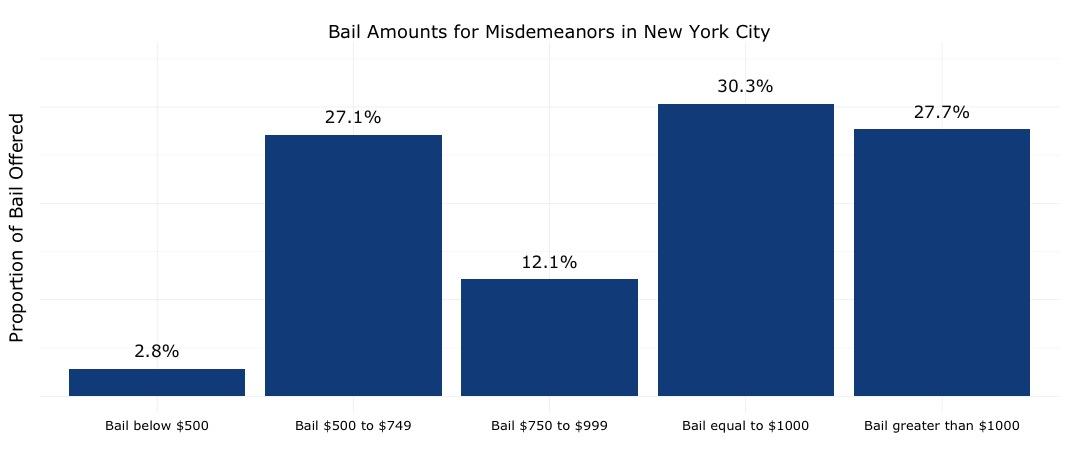
The New York Times notes that

Even when bail is set comparatively low – at $500 or less, as it is in one-third of nonfelony cases = only 15% of defendants are able to come up with the money to avoid jail.

And from here:

The guy in the NPR article above – the one who might or might not have attacked some cops – was in jail for 60 days because he couldn’t make bail of $1000.

So bail causes people to be stuck in jail for months, increases guilty pleas independent of defendants’ actual guilt, and causes more convictions and longer sentences. Since many of the people harmed by this are innocent, or deserve less punishment than they end up receiving, this seems like an important point of leverage at which to try to fight incarceration. On the other hand, bail is supposed to serve a useful purpose in preventing suspects from running away. It is possible to do without?

Maybe. Washington DC is one of the highest-crime areas of the country, but it uses an alternative system without monetary bail which uses an algorithm to calculate risk, releases low-risk people, and keeps high-risk people imprisoned without bail. It looks like about 10% of Washingtonians, versus 47% of other Americans, are detained in jail pre-trial. Of Washingtonians released without bail, 87% show up for all court dates, and 98% avoid committing violent crimes while free.

I’m not able to find a good comparison between Washington and other jurisdictions, but this page on bounty hunters gives the unsourced statistic that 20% of people on bail fail to show up for court anyway. This equally-credible-looking site gives an equally unsourced statistic of 10%, and notes that these people are more likely to be flakes who forgot their court date than supercriminals who have donned a fake mustache and are on their way to the Cayman Islands. These numbers suggests that Washington’s no-show rate is about the same as everywhere else’s.

Bronx Freedom Fund is a charity that helps people pay bail. They claim that 96% of the people whose bail they pay show up to trial, which matches the numbers from Washington and the numbers from normal places where people have to pay their own bail. I am sure they select their beneficiaries very carefully, but if it’s possible to select a group of people who are definitely going to show up to their trial whether they can make bail or not, why are those people still in jail?

I can’t find any studies clearly proving this, but it looks like there’s no obvious and proven tendency for bail to improve show-up-at-trial rates, and some evidence that with good risk assessment and selection 90% of people released without bail will show up to trial, which may be around the same as the rate for people who do get bail. This would make all of the problems with bail not only outrageous but pointless, not even the unfortunate side effects of a generally-reasonable policy.

It looks like there are two possible solutions – one small and short-term, the other systemic and long-term.

In the short term, there are some great charities – like the aforementioned Bronx Freedom Fund – that pay people’s bail. If the people show up to trial (which, again, 90% or so do), then the charity gets its money back and can use it to pay more people’s bail, ad infinitum. This makes them very high-value per dollar.

I’m not sure how much to trust BFF’s self-reported statistics. I see that on their front page they mention that “defendants who await trial in jail are 4x more likely to be sentenced to time in prison”, which is much more than any of the studies above report and which is probably a misleading uncorrected raw estimate. I see they say that “$39 can help us secure someone’s freedom”, which since average bail is something like $500 and only 2.8% of bails are less than $50 might be more of a “this is the lowest bail that has ever occurred in history” than any kind of representative estimate. But I don’t really hold it against them to give technically correct but misleading numbers in an advertising pitch. The question is – what are the real numbers? GiveWell and Open Philanthropy Project have been looking at them, but I can’t find a complete writeup, so let me do a terrible and very approximate job of trying to estimate them myself.

They note that their average bail is $790. Supposing that their 96% success rate is true, the average case costs them $30 – they cite a similar figure in their own literature. If, as they say, the average pretrial detention period is 15 days (which more or less matches the chart above), they can keep someone out of jail for $2/day even without selecting the worst cases.

They also note that their clients get cleared of all charges about half the time, compared to only 10% of the time for people in jail. I don’t know how much of this is selection effects, but suppose we take it at face value. And suppose that an average prison sentence for whatever kinds of petty crimes these people commit is two months. That means they’re saving the average suspect about 25 days worth of prison sentence, and improves their cost-effectiveness. I’d say this comes out to about $0.75 per jail day prevented, but that might be double-counting some people who, had they been in jail, would have had the time deducted from their sentence. Let’s say somewhere between $0.75 and $2.

A confusion: their 2014 annual report notes that they received $53,000 in donations and helped 140 people, suggesting a cost of $380 (not $30) per person helped. In 2015 they helped 160 people with $120,000, suggesting a cost of $750 per person that doesn’t seem to improve with scale. A similar organization, Brooklyn Community Bail Fund, got $404,800 from Good Ventures, and boasts of helping 1,100 people, for $367/person (this is a very rough estimate; it assumes this is all in the same year and they got no other donations).

I’m not sure why these numbers are so much bigger than the ones derived from first principles, but taken seriously, if we continue to assume that each successful case saves an average of forty days in jail, they prevent a jail day for about $10.

We compare to other efficient charities. GiveWell thinks it takes antimalaria charities about $7500 to save a human life. If that person lives another 20 years, that’s about $1/day.

So using their own numbers, these bail-related charities might be able to prevent imprisonment at the same cost-per-day as other charities can save lives. Using less optimistic numbers, they might be able to prevent imprisonment at about ten times the rate. Depending on where you fall on the death vs suffering philosophical tradeoff, this might be attractive. I’m confused these charities haven’t received more attention, if only to debunk them properly.

And even though everyone likes to talk about how individual charity doesn’t work and only systemic change can make a real difference, paying the bail of 50% of the people in the United States currently awaiting trial would be well within the abilities of one philanthropic-feeling billionaire, after which the money could be recycled again and again for the same purpose. I agree this is a kind of hokey calculation since it doesn’t include the overhead cost of getting the money to the suspects, but it’s still shocking how small the amounts involved are compared to other social problems.

In the long-term, we probably need some kind of criminal justice reform. The Obama administration seemed to be pursuing some kind of fourteenth amendment argument to get a court ruling that monetary bail was illegal. Some libertarian groups like Reason and the Cato Institute are on board. Some charities, like Equal Justice Under Law, are supporting the same cause.

I don’t think that bail reform is the largest or most important change that could be made to the US criminal justice system. But I think it might be tied with drug reform for the easiest. And given how well politics has been going lately, this might be a good time for lowered ambitions.

Posted in Uncategorized | Tagged , | 364 Comments