SSC Meetups: Berkeley, San Diego, Irvine

I’m in California for the next few weeks and want to catch up with people I know. I’ve got some meetups planned, but these are all preliminary, so check back there before the meetup to see if I’ve edited the time and date:

1. Unsong wrap party in Berkeley on Sunday, May 14, at 4:30, in the Cal Alumni Student Association. See here for more details.

2. SSC Berkeley Meetup on Tuesday, May 16th at 7PM at the 7th floor of 2030 Addison St. I am a little worried about space here, so be prepared for it to be cramped or us to have to relocate or something.

3. San Diego meetup on Monday, May 22nd, 7:30PM at Lestat’s Hillcrest coffee, 1041 University Ave. Psychiatrists in town for APA welcome!

4. Irvine meetup on Saturday, May 27th, 7PM at Peet’s Coffee at 4213 Campus Dr.

And if anyone’s at the American Psychiatric Association conference, say hi to me. I’ll be presenting a poster on patient ratings of antidepressants at Resident Poster Competition 3 at 10 AM Sunday, plus wandering around the rest of the week. I’ll probably be in a black hospital jacket with my real name (Scott ______) on it.

Posted in Uncategorized | Tagged | 9 Comments

Silicon Valley: A Reality Check

The nation has spoken: weird pointless $400 wi-fi enabled juicer company Juicero is the perfect symbol of Silicon Valley.

So says the Washington Post: Juicero Shows What’s Wrong With Silicon Valley Thinking. So says TechCrunch, which calls Juicero “the absurd avatar of Silicon Valley hubris”. So says Newsweek, which renames the area Silly-Con Valley in its honor. And of course there’s Deadspin, which calls it “the best story ever written about Silicon Valley… a stupid libertarian dystopia where investor-class vampires are the consumers and a regular person’s money is what they go shopping for.”

In case you missed it, Juicero was a startup that got $120 million in funding to manufacture high-end juicers which were supposed to be the bleeding-edge in juice-related technology. Then Bloomberg did some investigative reporting and found that you could actually make juice equally well by skipping the $400 juicer and just squeezing the juice packets with your bare hands.

This is, admittedly, pretty silly. But I want to take a step back and suggest a reality check.

While Deadspin was busy calling Silicon Valley “awful nightmare trash parasites”, my girlfriend in Silicon Valley was working for a company developing a structured-light optical engine to manipulate single cells and speed up high-precision biological research.

While FastCoDesign was busy calling Juicero “a symbol of the Silicon Valley class designing for its own, insular problems,” a bunch of my friends in Silicon Valley were working for Wave, a company that helps immigrants send remittances to their families in East Africa.

While Vox was busy writing about how Juicero “says a lot about the state of Silicon Valley right now”, Silicon Valley was leading a revolution in solar power that’s resulted in a 1500% increase in cell installations over the past few years.

While Slate was busy telling us that Silicon Valley companies “repackage familiar ideas and sell them back to us as exemplars of Groundbreaking Disruptive Innovation”, Silicon Valley was shooting a fifteen-story rocket a hundred miles into the air at 4,100 mph, then landing it gently on a 300 foot platform in the middle of the ocean.

While Gizmodo was busy writing that this “is not an isolated quirk” because Silicon Valley investors “don’t care that they do not solve problems [and] exist to temporarily excite the affluent into spending money”, Silicon Valley investors were investing $35 million into an artificial pancreas for diabetics.

While Freddie deBoer was busy arguing that Silicon Valley companies “siphon money from the desperate throngs back to the employers who will use them up and throw them aside like a discarded Juicero bag and, of course, to themselves and their shareholders. That’s it. That’s all they are. That’s all they do”, Silicon Valley companies were busy inventing cultured meat products that could end factory farming and save millions of animals from horrendous suffering while also helping the environment.

Or maybe we should try to be more quantitative about this. I looked at the latest batch of 52 startups from legendary Silicon Valley startup incubator Y Combinator.

Thirteen of them had an altruistic or international development focus, including Neema, an app to help poor people without access to banks gain financial services; Kangpe, online health services for people in Africa without access to doctors; Credy, a peer-to-peer lending service in India; Clear Genetics, an automated genetic counseling tool for at-risk parents; and Dost Education, helping to teach literacy skills in India via a $1/month course.

Twelve of them seemed like really exciting cutting-edge technology, including CBAS, which describes itself as “human bionics plug-and-play”; Solugen, which has a way to manufacture hydrogen peroxide from plant sugars; AON3D, which makes 3D printers for industrial uses; Indee, a new genetic engineering system; Alem Health, applying AI to radiology, and of course the obligatory drone delivery startup.

Eighteen of them seemed like boring meat-and-potatoes companies aimed at businesses that need enterprise data solution software application package analytics targeting management something something something “the cloud”.

And the remaining nine were your ridiculous niche Uber-for-tacos startups that we all know and love, including Cowlar (“FitBit for cows – it’s way smarter than it sounds!”); Origin (“Keurig for smoothies”), MoveButter, which compares itself to three different companies I’ve never heard of in its first sentence but seems to be grocery-related in some way; Mere Coffee, a better-tasting coffee machine for small businesses; and LitHit, a smart target for shooting sports. I’m sure somebody in the comments is going to tell me why FitBits for cows is actually a vital service that will revolutionize agriculture, but I’m trying to err on the side of caution here.

I’m concerned that Y Combinator might be so successful that they’re unique in going for status and do-gooding rather than being a real cross-sample of startups (and they also seem to recruit a lot of international startups from outside Silicon Valley). So I also looked at the first twenty startups in the portfolio of Andreessen Horowitz, a famous Valley venture capitalist firm. One of them seemed explicitly prosocial – some kind of science education partnership company. Four of them seemed high-tech or otherwise awesome – including the obligatory aerial-surveying-with-drones company. Twelve seemed to be some sort of enterprise data solution software application package analytics targeting management something something something “the cloud”. And only two of them seemed even a little vapid – eg this high-end photo sharing/printing site. Which is hardly that vapid – nobody would bat an eye at that if it were done by Kodak or Staples.

So although meat-and-potato business/software companies do outnumber really high-tech or altruistic ventures, there’s not a lot of evidence for silly Juicero-style startups being much of the Silicon Valley business community at all. So how come everyone thinks that they are?

Here’s my theory. If you’re an average well-off person, leading your average well-off life, consuming average well-off media and seeing ads targeted at the average well-off demographic, and going over to your average well-off friends’ houses and seeing their average well-off products, which are you more likely to hear about? A structured-light optical engine for cytological research? Or a juicer?

Or to put it another way: there’s a chapter in Unsong (spoiler!) where an archangel brings peace to the Middle East by splitting the Holy Land into two parallel dimensions. Any Jew who enters will find themselves in a united Israel; any Muslim who enters will find themselves in an independent Palestine.

And sometimes I wonder if the same archangel has gotten to Silicon Valley.

If a deeply good person crusading for a better world enters Silicon Valley, she’ll find herself surrounded by deeply good people crusading for a better world. She’ll see mobile apps that track tropical diseases, clean energy startups that fight global warming by directly sucking carbon dioxide out of the air, companies bringing microbanking to poor Nepalese villagers, and boutique pharmaceutical labs searching for cures for orphan diseases.

If a futurist enters Silicon Valley, she’ll find herself surrounded by futurists. She’ll see neural nets and deep learning, reusable rockets and flying cars, high-throughput genome sequencing and CRISPR, metamaterials and nanotechnology.

If a social-media-obsessed narcissist whose view of the world begins and ends with his own Instagram page enters Silicon Valley, he’ll find himself surrounded by social-media-obsessed narcissists whose view of the world begins and ends with their Instagram pages. He’ll see a bunch of streaming video services and Uber-for-hair-products apps and elite pay-to-play dating scams and people trying to disrupt the gymwear market.

And if one of those people who talks about “the cloud” all the time enters Silicon Valley, he’ll find himself surrounded by people who talk about “the cloud” all the time. I have no idea who these people are or what they’re doing, but they all seem really happy with each other and I’m glad they’re enjoying themselves.

They’ll all have their blind-men-and-elephant view of what kinds of things Silicon Valley “does”. And they’ll all be sort of right.

(thinkpiece writers: “Can you believe that Silicon Valley only makes products for shallow elites obsessed with the latest fads? It’s the strangest thing!“)

So I would recommend people stop talking about how Silicon Valley only makes ridiculous overpriced juicers. It’s not that it doesn’t make those. It does, just like everywhere else. A Facebook friend pointed out that QVC has been selling our parents ridiculous overpriced kitchen items since before we were born. Billy Mays pitched the EZ Crunch Bowl, which promised to “revolutionize your cereal-eating experience”. The unique thing about Silicon Valley isn’t that it’s got overpriced status goods designed to separate rich people from their money. The unique thing about Silicon Valley is that it’s got anything else.

I don’t want to downplay the problem. Anything remotely good in the world gets invaded by rent-seeking parasites and empty suits. Silicon Valley is no exception, and raising awareness of the infestation is certainly a public service. But for some reason, it’s hard for me to believe that – let’s say Deadspin – really believes in the spirit of Silicon Valley, really thinks that there was once somewhere that weird nerdy people could get together and produce amazing things for the good of everybody, and that to some degree this is still going on, and is a precious thing that needs to be protected. At its worst, some of their criticism sounds more like a worry that there might still be some weird nerds who think they can climb out of the crab-bucket, and they need to be beaten into submission by empty suits before they can get away. Or maybe that’s just paranoia. Fine, I admit I’m paranoid. But I still feel like people should lay off the criticism a little.

When Capitol Hill screws up, tens of thousands of innocent Iraqis get killed.

When Wall Street screws up, the country is plunged into recession and poor families lose their homes.

When Silicon Valley screws up, people who want a pointless Wi-Fi enabled juicer get a pointless Wi-Fi enabled juicer. Which by all accounts makes pretty good juice.

Links 5/17: Rip Van Linkle

Multiocular O, “the rarest Cyrillic letter”, used only to describe the eyes of seraphim. Kind of sounds like something out of a Borges book.

More on Low-Trust Russia: Do Russian Who Wants To Be A Millionaire contestants avoid asking the audience because they expect audience members to deliberately mislead them?

Xenocrypt on the math of economic geography: “A party’s voters should get more or less seats based on the shape of the monotonic curve with integral one they can be arranged in” might sound like a very silly belief, but it is equivalent to the common mantra that you deserve to lose if your voters are ‘too clustered’”

Please stop trying to “buy Congress’ Internet history” to “punish” them for “ending Internet privacy”. Please stop donating to crowdfunding campaigns promising to do this. Please stop claiming that now anyone can learn what you read on the Internet in a personally identifiable way. And please remember that the sense in which they “ended Internet privacy” was “they repealed a less-than-one-year-old regulation that hadn’t come into effect yet, changing literally nothing” (though see here for counterargument)

Facebook plans to launch GoFundMe-style fundraising tool. Seems like a good business move, though a little bit monopoly-ish.

Amber A’Lee Frost on attending Left Forum. “At its best, Left Forum remains a reassuring beacon of cameraderie and ambition…at its worst, however, Left Forum is Comic Con for Marxists — Commie Con, if you will—and an absolute shitshow of nerds and social rejects.”

Contra stereotypes, at least one study shows autistic children are more likely to share.

A combination men’s business suit / onesie is a thing that exists and that you can pay $378 for. The company involved being called “Betabrand” might be a little too on the mark, though.

Largest ever study on sex differences in the brain finds the usual – sex differences definitely exist and are significant, but there are nevertheless large areas of overlap between sexes in pretty much everything.

Okay, look, I went way too long between writing up links posts this time, so you’re getting completely dated obsolete stuff like Actually, Neil Gorsuch Is A Champion Of The Little Guy. But aside from the Gorsuch reference this is actually pretty timeless – basically an argument for strict constructionism on the grounds that “a flexible, living, bendable law will always tend to be bent in the direction of the powerful.”

Epidemiology buffs, is this true? US life expectancy, long believed one of the worst in the developed world, is actually the best in the developed world if you correct for our very high violent death rate. [EDIT: This CDC paper investigates fewer causes of violent death but might get proportionally similar results]

The Kernel Project is an in-planning rationalist group house and community center in Manchester, UK.

Chicago mayor Rahm Emanuel proposes denying diplomas to students leaving high school unless they can provide a “plan for their future” – acceptance to college or some kind of trade. Current Affairs has pretty much the right take with Rahm Emanuel’s College Proposal Is Everything Wrong With Democratic Education Policy, although I might have used the words “tulip subsidies” a few more times.

The company that makes Taser is offering free body cameras to every police officer, although this might just be part of a plot to get police locked into their system so they can jack up prices later.

Reductress: Are You Dating, Or Just Friends Who Have Sex And See Each Other Five Times A Week? This is even more confusing when you’re poly.

Otium: Are Adult Developmental Stages Real? Looks at Kohlberg, Kegan, etc.

Edge asks “What do you consider the most interesting recent scientific news”. Evo psych founder John Tooby answers: the race between genetic meltdown and germline engineering.

FDA agrees to let 23andMe start telling people their genetic disease risk again. Seems to be less of a Trump pivot than a carefully-considered decision that, whatever point they were trying to make by randomly impeding technological growth and preventing people from getting important health information, they had apparently finished making it.

Beeminder adds a feature to automatically beemind your writing by tracking word count.

I mentioned the debate over 5-HTTLPR, a gene supposedly linked to various mental health outcomes, in my review of pharmacogenomics. Now a very complete meta-analysis finds that a lot of the hype around it isn’t true. This is pretty impressive since there are dozens of papers claiming otherwise, and maybe the most striking example yet of how apparently well-replicated a finding can be and still fail to pan out.

Rootclaim describes itself as a crowd-sourced argument mapper. See for example its page on who launched the chemical attack in Syria.

Apparently if you just kill off all the cells that are growing too old, you can partly reverse organisms’ aging (paper, popular article)

Pope John XIX ruled from 1024-1032; Pope John XXI ruled from 1276 – 1277. It wasn’t until years later that the Catholic Church realized they had gotten confused and accidentally skipped over having a Pope John XX

[Small brain]: Attachment style toward parents
[Bigger brain]: Attachment style toward peers
[Giant glowy brain]: Attachment style toward God

Overcoming Bias on the role of jargon and mythology: “Similarly, religions often expose children to a mass of details, as in religious stories. Smart children can be especially engaged by these details because they like to show off their ability to remember and understand detail. Later on, such people can show off their ability to interpret these details in many ways, and to identify awkward and conflicting elements. Even if the conflicts they find are so severe as to reasonably call into question the entire thing, by that time such people have invested so much in learning details of their religion that they’d lose a lot of ability to show off if they just left and never talked about it again. Some become vocally against their old religion, which lets them keep talking and showing off about it. But even in opposition, they are still then mostly defined by that religion.” Of course, I wouldn’t know anything about that.

From Garrett Jones on Twitter: no correlation between a country’s change in education and its change in growth rate.

List Of Greek And Roman Architectural Records. Did you know Constantine’s bridge across the Danube was over a mile long?

The American Federation Of Teachers, one of the US’ largest teachers unions, comes out in favor of bombing Syria. I feel like this is some sort of reductio ad absurdum of unnecessary politicization of stuff.

Some past studies that I took somewhat seriously suggested that antidepressant use during the first trimester pregnancy could slightly raise autism risk. The latest very large study fails to replicate this result and finds only a slightly increased risk of preterm birth.

The person who put together the list of vindicated scientific mavericks responded to my criticism here; I responded to the response here.

The Politics Of The Gene: “Contrary to expectations, however, we find little evidence that it is more common for whites, the socioeconomically advantaged, or political conservatives to believe that genetics are important for health and social outcomes.”

Related: the hereditarian left. This seems like as close to a useful self-identifier as I’m going to get.

White House refuses to give Exxon Mobil special waiver to drill in sanctioned Russia. I want to emphasize how proud I am of (some parts of) America right now. Our Secretary of State is the former CEO of Exxon Mobile, our President is widely suspected of having benefitted from Russian interference in his election, but the government is still able to rule against Exxon and Russia when it needs to. Given how corrupt half of what we do is, it’s nice to know we have some weird hidden talent at not-being-corrupt that we can pull out sometimes.

More interesting techniques for surveying scientists and sounding out consensus: “As level of expertise in climate science grew, so too did the level of agreement on anthropogenic causation…the respondents’ quantitative estimate of the [greenhouse gas] contribution appeared to strongly depend on their judgment or knowledge of the cooling effect of aerosols.” Also: “Respondents who characterized human influence on climate as insignificant, reported having had the most frequent media coverage regarding their views on climate change.”

Siberian Fox linked me to two studies that somewhat contradicted my minimalist interpretation of childhood trauma here: Alemany on psychosis and Turkheimer on harsh punishment.

Deep learning system is able to generate new poems on arbitrary topics. See page 6 for its poem about bipolar disorder, which passes the Emo Teenage Girl Turing Test with flying colors.

A certain population in Bosnia is found to be the tallest in the world, likely for genetic reasons (study, popular article). This sort of thing drives me berserk; everyone can talk about between-populations genetic variation in height as if it’s so obvious it doesn’t even need defending, and then as soon as someone mentions between-populations genetic variation in cognitive abilities, it’s “Haven’t you heard? Scientists proved race is a social construct!” People should either be frantically trying to debunk all of these height-related claims, or else shrugging and saying “yeah, that’s a plausible minor extension of the existing literature” when they read cognition-related claims.

More evidence linking BDNF to depression: it appears to be a good biomarker for antidepressant treatment response. Usually my eyes start rolling when I see “psychiatry” and “biomarker” in the same paper, but with an n = 6000, d = 1.3, and p=4.4E-07, I am grudgingly prepared to take note. Extra neat – it’s serum rather than CSF, so we might actually be able to use it in real life.

Pictures of big data dot tumblr dot com

Matthew Yglesias changes my mind and convinces me that Obama accepting a $400,000 Wall Street speaking fee is bad. Basic argument: as long as corporations can offer politicians lucrative deals after they retire, they can reward pro-corporate decisions with plausible deniability, which incentivizes politicians to be pro-corporate. If you’re anti-corporate, this is directly bad; if you’re pro-corporate, this makes it impossible to convince people that you’re really making well-considered decisions in their best interests and not just being corrupt.

There have been a lot of hot takes that the March For Science was bad in some vague way (see eg Slate’s here), but despite sharing their intuition of discomfort none of them really rang true to me. One thing that did strike me was this tweet about the focus on funny signs and who had the best costume. It seems to me that if we were protesting something genuinely awful (like a genocide abroad), we wouldn’t wear silly costumes and funny signs. Does that mean that a decision to go ahead with the signs and costumes reflects some kind of subconscious feeling that this isn’t really that bad, or a motivation springing from something other than true outrage?

Lyrebird is an AI project which, if fed samples of a person’s voice, can read off any text you want in the same voice. See their demo with Obama, Trump, and Hillary (I find them instantly recognizable but not at all Turing-passing). They say making this available is ethical because it raises awareness of the potential risk, which a Facebook friend compared to “selling nukes to ISIS in order to raise awareness of the risk of someone selling nukes to ISIS.”

Rod Dreher’s Monastic Vision. I had always thought of Rod Dreher as some sort of crotchety conservative blogger who was deeply concerned about The Gays. Apparently he is actually a tragic figure resembling an Old Testament prophet come to life. I regret the error.

Current Affairs on the back-stabbing, infighting, and comical errors of Hillary Clinton’s campaign. Although of course if a handful of Rust Belters had voted differently, we’d be praising every one of these people as geniuses right now.

Magazine The American Interest recently print-published a version of my essay Considerations On Cost Disease. And here’s the editor’s commentary and proposed explanation.

FHI’s April Fools’ joke – a paper On The Impossibility Of Supersized Machines. Size isn’t even a well-defined natural concept, so how could machines ever become “larger” than humans?

The Myth Of Superhuman AI is yet another poorly thought-out repetition of the same anti-AI claims, and in some cases uses exactly the arguments the article above is parodying. But I link it because it’s the first article that explicitly claims that the “scientific consensus” is in favor of superintelligence, saying things like “a panel of nine of the most informed gurus on AI all agreed this superhuman intelligence was inevitable and not far away”, and that it wants to distinguish itself from the “orthodoxy”. I’m not sure that’s quite right, but it’s nice to see the criticism shift from “stupid crackpot idea that no sane person believes” to “entrenched scientific orthodoxy that must be challenged”, even if I do wish we’d been able to spend at least a little time as “plausible idea that should be approached with interest and curiosity”.

Related: Siberian Fox – “Before thermometers, people mocked the idea of temperature ever being measurable, with all its nuance, complexity, and subjectivity.”

Freddie deBoer gives lots of evidence that there is no shortage of qualified STEM workers relative to other fields and the industry is actually pretty saturated. But Wall Street Journal seems to think they have evidence for the opposite? Curious what all of the tech workers here think.

Also, I can’t remember if I’ve recommended Freddie deBoer’s new education science blog ANOVA on here yet, but you should definitely read it. He’s one of the most engaging writers I know, plus also one of the few people I really trust to report on scientific research accurately, plus also has a rare gift to write about politics without making me want to scream at my computer. See also: his Patreon.

80,000 Hours presents what they recommend as a rare actually-evidence-based self-help career guide. I am a little skeptical of the billing – the “evidence” is mostly along the lines of “a popular book written by science-y sounding person recommended this”, and there are actually ten million different self-help guides that do that kind of thing. But it’s not bad advice and if you’re looking for self-help you could probably do worse.

Scott Sumner: How Can There Be A Shortage Of Construction Workers? That is, is it at all plausible that (as help wanted ads would suggest) there are areas where construction companies can’t find unskilled laborers willing to work for $90,000/year? Sumner splits this question in two – first, an economics question of why an efficient market wouldn’t cause salaries to rise to a level that guarantees all jobs get filled. And second, a political question of how this could happen in a country where we’re constantly told that unskilled men are desperate because there are no job opportunities for them anymore. The answers seem to be “there’s a neat but complicated economics reason for the apparent inefficiency” and “the $90,000 number is really misleading but there may still be okay-paying construction jobs going unfilled and that’s still pretty strange”.

Roscoe Arbuckle, one of the most famous silent movie actors, had his career destroyed by a Trial-Of-The-Century-style rape scandal that sounds like a 1920s version of the UVA Rolling Stone case. Key quote “The jury began deliberations April 12, and took only six minutes to return with a unanimous not guilty verdict — five of those minutes were spent writing a formal statement of apology to Arbuckle for putting him through the ordeal…After the reading of the apology statement, the jury foreman personally handed the statement to Arbuckle who kept it as a treasured memento for the rest of his life. Then, one by one, the entire 12-person jury plus the two jury alternates walked up to Arbuckle’s defense table where they shook his hand and/or embraced and personally apologized to him”. Also a good example of how it doesn’t matter what the justice system finds as long as an industry is controlled by people happy to blacklist you for being unpopular. Also, trigger warning for…fatphobia? That wasn’t the trigger warning I was expecting to have to give, but it’s definitely needed here.

US Supreme Court rejects the argument that states can keep certain suspects’ money even after they are found innocent. This seems like a kind of niche situation, but the article correctly points out that it establishes a strong precedent that might be applied later to rein in civil forfeiture, which definitely isn’t a niche problem and is a really important issue.

Also, Alyssa Vance on Facebook on law: the test cases that set Fourth Amendment precedent will inevitably be ones where defendants are clearly guilty, biasing judges in favor of expanding police search powers.

Study which is so delightfully contrarian I choose to reblog it before reading it all the way through: mandatory class attendance policies in college decrease grades by preventing students from making rational decisions about when and how to study.

You’ve probably heard of Vantablack, the “world’s blackest pigment”, and seen the creepy pictures. But it’s proprietary, it requires special equipment to apply, and you can’t have it. But now artist Stuart Semple has released an open-access version that anyone can use – except, presumably, Anish Kapoor.

Posted in Uncategorized | Tagged | 912 Comments

OT75: The Comment King

This is the bi-weekly visible open thread. Post about anything you want, ask random questions, whatever. You can also talk at the SSC subreddit or the SSC Discord server. Also:

1. My serial novel Unsong will be finished next week. I’ll be doing a reading of the final chapter in Berkeley on Sunday, May 14, details at the bottom of Chapter 71, RSVP at the link mentioned there if you’re interested. There are other events planned in NYC, Tel Aviv, and Boston.

2. I’ll be visiting California starting next week. I still need to figure out exactly where and when I’ll have time for meetups, so watch for a post about that if you’re interested. Provisionally I’ll be going to the SSC Berkeley Meetup on Tuesday, May 16th at 7PM at the 7th floor of 2030 Addison St.

3. On a related note, I’ll be at the American Psychiatric Association meeting in San Diego later this month. In particular, I’ll be presenting a version of this analysis on Sunday May 21 starting 10 AM at the resident poster session, so if you’re at the conference come say hi. I don’t know how many readers are going to the APA, but if enough people are interested we can try to figure out a way to meet over dinner one night or something.

4. In a previous post, I described FIRE (Foundation for Individual Rights in Education) as related to conservatives fighting liberal dominance of academia. FIRE has asked me to correct the record and specify that they are a politically neutral organization fighting for everyone’s rights within academia. I regret the error.

5. In case the subreddit and Discord aren’t enough for you, there is now an old-school online bulletin board for the rationalist community.

Posted in Uncategorized | Tagged | 865 Comments

Getting High On Your Own Supply

There’s a lot of debate over what Hillary did wrong in her campaign, and how the Democrats can change before 2018 or 2020.

Some of this revolves around policy positions. For example, should she have supported expanding Medicare to everyone? Should she have been tougher on immigration to preempt some of Trump’s support? These are tough questions, made tougher by the need to balance what’s right against what’s electable.

But other parts of the debate revolve more around her vision and way of looking at the world. Some common points here:

1. She focused too much on identity politics and ignored the white working class
2. She tried to reason with people (eg her performance in the debates) rather than appeal to their emotions
3. She proposed complicated wonkish policy schemes instead of simple things normal people understood like “tax the rich” or “build a wall”
4. She talked too much about managerial competence and not enough about her Soaring Vision
5. She was too “we’re all in this together” and not enough “us vs. them”, where the “them” is some combination of billionaires, political elites, and Republicans.

Advocates of these points usually end with some plea for Democrats to change their ways and approach these matters differently.

Consider two possible ways that Democrats might act on the first point (and for now we’ll ignore the part where “the Democratic Party” is not a single monolithic entity that can take direct action).

They might act superficially by eg telling the campaign worker in charge of TV commercials to make more commercials about the white working class, and fewer commercials about identity politics.

Or they might act deeply by changing the entire culture of the Democratic Party, so that Democrats think about identity politics less, identity politics activists are marginalized within party circles, white working class activists are promoted within party circles, party-aligned media sources focus more space on the plight of the white working class, et cetera.

Likewise regarding point 2, the Democrats could fire their old speechwriters and hire new ones who are better at writing emotional appeals. Or they could change the epistemic culture of the party, so that discussions of how to amend Section 421B of the tax code to be 2.4% more fair were met with eye-rolling everywhere from local meetings to DNC headquarters, but rousing speeches about Taking Back The Country were universally met with applause.

And the point I want to make is that the epistemic culture that makes you sound electable isn’t necessarily the epistemic culture that makes you competent.

It might be that appealing to the white working class really is the most important way to win elections, but that in the real world “identity politics” surrounding minority groups are a more important or more tractable issue, where government interventions can help far more people.

Or it might be that raving about your Grand Vision is the best way to get elected, but that most of the low-hanging fruit for helping people right now does involve wonkish tinkering around with very complicated parts of health care regulation.

Let me give an example of what I mean. The Republicans have an electoral strategy based on a Grand Vision talking about how the elites in Washington have become corrupt and sold out the country to Big Government. This has been very successful for them; no Republican can complain that they don’t win enough elections. But it’s also completely screwed up their party’s ability to govern. Their trouble repealing Obamacare seems like the most glaring example – there just wasn’t enough overlap between reality-based policies that made political sense, and policies that legislators could support without worrying about getting primaried by Tea Party types accusing them of selling out.

And this is just a rare (though increasing) example of a time when Republican dysfunction hurt the Republican Party. Most of the time it just hurts the country. Only time will tell exactly who the GOP’s dysfunctional presidential primary and subsequent nomination of Trump hurts, but I doubt Republicans will be happy with the results.

Of course, remaining epistemically pure and never winning anything isn’t much fun either, so whatever. I guess my only advice for the Democrats is: don’t get high on your own supply.

What do I mean by that? A while back, I discussed the recent trend in articles – mostly on the Left – explaining how using facts and reason don’t work and so we should switch to making emotion-based appeals. There was an article like this on Financial Times, and another one in Current Affairs.

So what I’m wondering is: are Financial Times and Current Affairs taking their own advice? That is, when I read one of their articles, am I reading somebody trying to rationally present their argument for my evaluation? Or am I reading an emotional appeal written by someone who thinks facts don’t matter? When a writer at one of these publications tries to decide which side of an issue to support, are they, within their own head, trying to obtain facts and reason about them? Or are they making emotional appeals to themselves?

The media – especially intellectual partisan media like National Review or Jacobin – are ideologies talking to themselves, processing information, and settling on opinions. The way they report is the way that their respective ideologies think. If a news source decides to report via emotional appeals rather than facts, their ideology’s thinking is taking place through emotional calculations and not factual ones.

Or to put this another way – a lot of the conversation assumes a divide between two natural categories – elites and the public. Elites are unmoved movers, who set strategies and policies based on their own omniscient knowledge of the political calculation. The public is unmoving movees, receiving information from the elites and voting based on which set of elites sounds more convincing.

But reality is more of a spectrum, down from party committee members reading internal bulletins, to party elites reading National Review, to informed people reading The New York Times, to random yahoos watching reality TV and catching campaign ads in the commercial breaks. Everybody is influenced by the prevailing media environment and helps influence it in turn.

If you optimize for the epistemic culture that’s best for getting elected, but that culture isn’t also the best for running a party or governing a nation, then the fact that your culture affects your elites as well becomes a really big problem. If focus groups tell you that your campaign ads need to be more emotional, more zero-sum, more simplistic, and more oriented to the white working class, it’s pretty scary if you don’t reflect before making your whole ideology’s culture more emotional, zero-sum, simplistic, and oriented to the white working class.

Luckily this has an easy solution. From the same Tim Harford article I cited earlier:

Last year, three researchers — Seth Flaxman, Sharad Goel and Justin Rao — published a study of how people read news online. The study was, on the face of it, an inquiry into the polarisation of news sources. The researchers began with data from 1.2 million internet users but ended up examining only 50,000. Why? Because only 4 per cent of the sample read enough serious news to be worth including in such a study. (The hurdle was 10 articles and two opinion pieces over three months.) Many commentators worry that we’re segregating ourselves in ideological bubbles, exposed only to the views of those who think the same way we do. There’s something in that concern. But for 96 per cent of these web surfers the bubble that mattered wasn’t liberal or conservative, it was: “Don’t bother with the news.”

If you’re online, your audience isn’t “the public”. Although I don’t have hard statistics on this, my guess is that if you’re writing for a magazine, or speaking at a conference, your audience isn’t “the public” either. You might as well say what you believe to be true, in the manner you think is most productive, and promote the epistemic culture you think is healthiest for the party and the country. And if you write an argument saying not to use facts and reason, maybe append something like “but our publication will continue to be factual and rational, and you should keep being factual and rational in anything with consequences other than public relations.”

If you’re a speechwriter, campaign commercial director, or TV producer, I assume everything you do is already tested via ten million polls and focus groups and meetings. You can keep doing that, except apparently you’re terrible at it and you should probably get much much better.

Posted in Uncategorized | Tagged | 772 Comments

Neutral vs. Conservative: The Eternal Struggle

I.

Vox’s David Roberts writes about Donald Trump and the rise of tribal epistemology.

It’s got a long and complicated argument which I can’t really do justice to here, but the thesis seems to be that the US Right is defecting against the country’s shared institutions in favor of forming its own echo chambers.

So for example, there used to be a relatively fair media in which both liberals and conservatives got their say. But Republicans didn’t like having to deal with facts, so they formed their own alternative media – FOX and Rush Limbaugh and everyone in that sphere – where only conservatives would have a say and their fake facts would never get challenged.

Or: everyone used to trust academia as a shared and impartial arbitrator of truth. But conservatives didn’t like the stuff it found – whether about global warming or trickle-down economics or whatever – so they seceded into their own world of alternative facts where some weird physicist presents his case that global warming is a lie, or a Breitbart journalist is considered an expert on how cultural Marxism explains everything about post-WWII American history.

It concludes that “the press cannot be neutral”, although it also “cannot afford to be, or be seen as primarily instruments of the Democrats”. To its credit, it admits this is kind of contradictory:

They must figure out a way to play a dual role: to be fair and consistent referees of policy and ideological disputes within the public square — while also acting to defend the institutional integrity of the square itself from what is, at present, a highly asymmetrical threat. They must fight to keep some core principles and commitments inviolate, outside the sphere of normal political dispute, against an administration that wants to drag them in…that’s a humdinger of a problem.

Let me start by saying what this article gets right.

I think it’s right that the two parties used to have much more in common, and be able to appeal to shared gatekeeper institutions that both trusted.

I think it’s right the Republicans unilaterally seceded from those shared gatekeeper institutions, so that now we’re in the weird position of having two sets of institutions: one labeling itself “neutral” and the other labeling itself “conservative”.

I think it’s right to consider the situation asymmetrical. Yes, CNN leans liberal, but it’s not as liberal as FOX is conservative, and it’s not as open about it – it has a pretense of neutrality that FOX doesn’t, and although we can disagree about how realistic that pretense is I think few people would disagree that the pretense is there. Nor is there a liberal version of FOX that lacks that pretense of neutrality.

I think it’s right that the conservative side is worse than the neutral side. However biased and crappy you think CNN and mainstream academia are, FOX and the conservative academic bubble are working on a different level (though note that as a liberal, I would say this, and you should interpret it with the same grain of salt that you would any other “my side is better than yours” claim).

I think it’s right that this situation is horrible and toxic and destroying the country, and it’s really good that someone has pointed this out and framed it this clearly.

I think it’s wrong in exactly the way I would expect it to be wrong, which is also an example of what’s wrong with it.

II.

Roberts devotes four sentences in his six thousand word article to the possibility that conservatives might be motivated by something deeper than a simple hatred of facts:

The right’s view that the institutions lean liberal is hyperbolic, but not without foundation. Science, academia (at least liberal arts and social sciences), and journalism do tend to draw their personnel from left-leaning demographics.

Those institutions have cosmopolitan aspirations — fair application of transpartisan standards — but there’s no doubt that in practice, those aspirations often cover for more parochial preferences.

But the right has not sought greater fairness in mainstream institutions; it has defected to create its own.

Roberts says that these neutral gatekeeper institutions “tend to draw their personnel from left-leaning demographics”, as if this was just a big fuss about 105 New Englanders for every 100 Texans. I would like to counter with a report from a friend who graduated from a top university last year:

I was at my graduation last weekend, and the commencement address was basically about twenty minutes of vitriolic insults directed at Trump. And in between burying my head in my friend’s shoulder in discomfort and laughing nervously, I was thinking about the family of this guy in my class.

He’s the first person in his family to go to college. He drove an hour every day to go to a somewhat better high school because there was an epidemic of gang violence at his local school. Against the odds, he did well, and got into college, where he has continued to get good grades and play sports and generally do things that make parents proud.

His family is not well off. They’re Mexican-American. And they’re Trump supporters.

Yeah, I’m kind of confused too. But they honestly are. (Not even reluctant Republicans supporting Trump–they voted for him in the primary. His aunt owns a Make America Great Again cap.) And all I could think about was how happy they must have been to be attending their son’s graduation from one of the best universities in the world [citation needed], only to have that happiness turn to bewilderment and anger as everyone around them cheered a series of caustic attacks against them and their values. The message couldn’t have been clearer: “You don’t belong here.”

My mom thought this speech was So Courageous. When I suggested that it might have been more courageous to say something that not everyone there agreed with, she replied, “the students maybe, but a lot of the parents looked unhappy.”

Seventy percent of the parents there had family incomes over six figures. (More, probably, since low-income parents are less likely to attend graduation.) A lot of them are members of the self-perpetuating intellectual/economic elite. This probably isn’t true of the few Trump supporters among them.

So if we are going to single them out for judgment, force them to account for their support for an “infantile,” “bullying,” “proto-fascist” “charlatan”…can it not be on the day of their kids’ graduation?

And sure, if you consider me your friend, then that makes this one of those “friend of a friend” stories. But I dare you to say that any of this sounds the least bit implausible. My point is, just because a university paints “ACTUALLY, WE ARE POLITICALLY NEUTRAL” in big red letters on the college quad, doesn’t mean that anyone is required to believe it. And the ideology that invented the microaggression can’t hide behind “but we haven’t officially declared you unwelcome!”

And the same thing is happening in the media. For example, in this very piece, Roberts cites a Vox poll showing that Trump supporters are more likely to be authoritarians. Vox has pushed this same claim many more times: Authoritarianism: The Political Science That Explains Trump, The Rise Of American Authoritarianism: A Niche Group Of Political Scientists May Have Uncovered What’s Driving Donald Trump’s Ascent, The Rise Of American Authoritarianism Explained In 6 Minutes, The Best Predictor Of Trump Support Is Authoritarianism.

Okay. But Vox is working off an internal poll that it hasn’t released (or at least I can’t find it) meaning no one has any idea if the sample size and methodology are okay. And some political science professors tried the same exercise around the same time with excellent methodology and a sample size of over a thousand and found the opposite – Trump supporters were less authoritarian than Cruz supporters, and no more authoritarian than Rubio supporters. They did find that Republicans were a bit more authoritarian than Democrats, but correctly noted that the measure involved is literally called “Right-Wing Authoritarianism”, is based on a scale invented by Theodor Adorno to prove conservatives had fascist tendencies, and only asks questions about child-rearing practices (you get marked as “authoritarian” if you have a traditional religious child-rearing style). And there are other investigations of authority that try to control for this sort of thing and sometimes find find liberals and conservatives are about equal in respect for authority.

I don’t want to overdo my criticism. “Right-wing authoritarianism” is a powerful idea with a good academic reputation, and the decision to focus solely on child-rearing was a principled choice to avoid including politics itself in the construct. And failed replications should be an opportunity for reflection rather than a cause to instantly dismiss a finding.

Yet it’s still good practice to mention their existence. And I still feel like somewhere there might be a conservative who reads this sort of thing and feels like Vox is not quite the perfectly-neutral mutually-beneficial gatekeeper institution of their dreams.

And whenever I mention this sort of thing, people protest “But Fox and Breitbart are worse!” And so they are. But I feel like Vox has aspirations to be something more than just a mirror image of Fox with a left-wing slant and a voiced fricative. It’s trying to be a neutral gatekeeper institution. If some weird conservative echo chamber is biased, well, what did you expect? If a neutral gatekeeper institution is biased, now we have a problem.

Roberts writes that “the right has not sought greater fairness in mainstream institutions; it has defected to create its own”. This is a bizarre claim, given the existence of groups like Accuracy In Media, Media Research Center, Newsbusters, Heterodox Academy, et cetera which are all about the right seeking greater fairness in mainstream institutions, some of which are almost fifty years old. Really “it’s too bad conservatives never complained about liberal bias in academia or the mainstream media” seems kind of like the opposite of how I remember the late 20th and early 21st centuries.

The way I remember it, conservatives spent about thirty years alternately pleading, demanding, suing, legislating, and literally praying for greater fairness in mainstream institutions, and it was basically all just hitting their heads against a brick wall. Then they defected to create their own.

III.

This predictably went badly.

I wrote before (1, 2) about the sort of dynamics this situation produces. A couple of years ago, Reddit decided to ban various undesirables and restrict discussion of offensive topics. A lot of users were really angry about this, and some of them set up a Reddit clone called Voat which promised that everyone was welcome regardless of their opinion.

What happened was – a small percent of average Reddit users went over, lured by curiosity or a principled commitment to free speech. And also, approximately 100% of Reddit’s offensive undesirables went there, lured by the promise of being able to be terrible and get away with it.

Even though Voat’s rules were similar to Reddit’s rules before the latter tightened its moderation policies, Voat itself was nothing like pre-tightening Reddit. I checked to see whether it had gotten any better in the last year, and I found the top three stories were:

The moral of the story is: if you’re against witch-hunts, and you promise to found your own little utopian community where witch-hunts will never happen, your new society will end up consisting of approximately three principled civil libertarians and seven zillion witches. It will be a terrible place to live even if witch-hunts are genuinely wrong.

FOX’s slogans are “Fair and Balanced”, “Real Journalism”, and “We Report, You Decide”. They were pushing the “actually unbiased media” angle hard. I don’t know if this was ever true, or if people really believed it. It doesn’t matter. By attracting only the refugees from a left-slanted system, they ensured they would end up not just with conservatives, but with the worst and most extreme conservatives.

They also ensured that the process would feed on itself. As conservatives left for their ghettos, the neutral gatekeeper institutions leaned further and further left, causing more and more conservatives to leave. Meanwhile, the increasingly obvious horribleness of the conservative ghettos made liberals feel more and more justified in their decision to be biased against conservatives. They intensified their loathing and contempt, accelerating the conservative exodus.

The equilibrium is basically what we see now. The neutral gatekeeper institutions lean very liberal, though with a minority of conservative elites who are good at keeping their heads down and too mainstream/prestigious to settle for anything less. The ghettos contain a combination of seven zillion witches and a few decent conservatives who are increasingly uncomfortable but know there’s no place for them in the mainstream.

IV.

I don’t want to give the impression that this is limited to the places people traditionally gripe about like academia and the media. The same dynamics are going on everywhere.

In the hospital where I work, there’s a RESIST TRUMP poster on the bulletin board in our break room. I don’t know who put it there, but I know that anybody who demanded that it be taken down would be tarred as a troublemaker, and anyone who tried to put a SUPPORT TRUMP poster up next to it would be lectured about how politics are inappropriate at work. This is true even though I think at least a third of my colleagues are Trump supporters.

I went to a scientific conference in a field completely unrelated to politics where one of the researchers giving a presentation started with a five minute tangentially-related anti-Trump rant. I can’t imagine someone giving the opposite rant any more than I can imagine a pro-Trump commencement speaker at my friend’s graduation.

I’m desperately trying to avoid the Nerd Culture Wars, which have somehow managed to be even worse than the Regular Culture Wars, but even I’ve heard about GamerGate and the Rabid Puppies. These were originally movements to fight a perceived liberal bias in regular gaming/sci-fi. They of course failed, and now they’re their own little separate conservative spaces practicing conservative video game commentary/sci-fi writing. I don’t want to deny that they’re often horrible. They’re horrible in exactly the same way FOX News is horrible, and for exactly the same reasons. I expect this pattern of conservatives seceding from theoretically-neutral-but-realistically-left-leading communities and forming terrible communities full of witches to repeat itself again and again, because it’s happening for systemic rather than community-specific reasons.

The overall impression is of a widespread norm, well-understood by both liberals and conservatives, that we have a category of space we call “neutral” and “depoliticized”. These sorts of spaces include institutions as diverse as colleges, newspapers, workplaces, and conferences. And within these spaces, overt liberalism is tolerated but overt conservativism is banned. In a few of these cases, conservatives grew angry enough that they started their own spaces – which began as noble attempts to avoid bias, and ended as wretched hives of offensive troglodytes who couldn’t get by anywhere else. This justifies further purges in the mainstream liberal spaces, and the cycle goes on forever.

Stanford historian Robert Conquest once declared it a law of politics that “any organization not explicitly right-wing sooner or later becomes left-wing”. I have no idea why this should be true, and yet I’ve seen it again and again. Taken to its extreme, it suggests we’ll end up with a bunch of neutral organizations that have become left-wing, plus a few explicitly right-wing organizations. Given that Conquest was writing in the 1960s, he seems to have predicted the current situation remarkably well.

V.

David Roberts ends by noting that he doesn’t really know what to do here, and I agree. I don’t know what to do here either.

But one simple heuristic: if everything you’ve tried so far has failed, maybe you should try something different. Right now, the neutral gatekeeper institutions have tried being biased against conservatives. They’ve tried showing anti-conservative bias. They’ve tried ramping up the conservativism-related bias level. They’ve tried taking articles, and biasing them against conservative positions. I appreciate their commitment to multiple diverse strategies, but I can’t help but wonder whether there’s a possibility they’ve missed.

Look. I read Twitter. I know the sorts of complaints people have about this blog. I’m some kind of crypto-conservative, I’m a traitor to liberalism, I’m too quick to sell out under the guise of “compromise”. And I understand the sentiment. I write a lot about how we shouldn’t get our enemies fired lest they try to fire us, how we shouldn’t get our enemies’ campus speakers disinvited lest they try to disinvite ours, how we shouldn’t use deceit and hyperbole to push our policies lest our enemies try to push theirs the same way. And people very reasonably ask – hey, I notice my side kind of controls all of this stuff, the situation is actually asymmetrical, they have no way of retaliating, maybe we should just grind our enemies beneath our boots this one time.

And then when it turns out that the enemies can just leave and start their own institutions, with horrendous results for everybody, the cry goes up “Wait, that’s unfair! Nobody ever said you could do that! Come back so we can grind you beneath our boots some more!”

Conservatives aren’t stuck in here with us. We’re stuck in here with them. And so far it’s not going so well. I’m not sure if any of this can be reversed. But I think maybe we should consider to what degree we are in a hole, and if so, to what degree we want to stop digging.

Posted in Uncategorized | Tagged | 1,909 Comments

Anorexia And Metabolic Set Point

[Content warning: fat, anorexia, dieting]
[Epistemic status: crazy speculation from someone who isn’t an expert in the field. Please don’t take too seriously.]

Some anorexics I talk to describe their condition as falling into two phases.

In Phase 1, they’re a model or a ballerina or something where they’re under a lot of pressure to become thin. So they go on a diet, they have trouble just like everyone else, but they stick to it and gradually get thinner. People praise them for their thinness. They win the Ballerina Of The Year award. They’re pretty happy with how things are going, and their dieting is ego syntonic – ie they agree with it and can explain the reasons they think it’s a good decision.

In Phase 2, somebody tells them, wait, this is unhealthy. Maybe they end up in the hospital. Maybe some friends stage an intervention. They admit that they have anorexia and decide to get better and gain weight. And then they can’t. The exact way that this presents varies among people. A few say they never feel hungry – as if they’re always so stuffed they couldn’t eat another bite. More often they still feel hungry, but they feel a sense of horror at their fatness, even if they rationally understand they’re really thin. This makes it very hard to regain weight.

This reminds me of the model of obesity I talked about the other day. People start overeating for social reasons (specifically, because our society is full of tasty food). Then they find they can’t stop – their body has adjusted to its higher weight as a new set point and will defend it vigorously, producing hunger pangs and food obsessions if they try to diet.

The brain system producing these effects is called the “lipostat”, and it seems to work through a control loop. Fat cells produce a hormone called leptin. The hypothalamus measures the amount of leptin, compares to its preferred set point, and based on the result generates strong urges to eat/exercise/fidget either more or less. This in turn makes the person gain or lose weight, increasing or decreasing the amount of fat and the concentration of leptin, and completing the loop.

In (at least some cases of) obesity, constant overeating makes the hypothalamus leptin-resistant – that is, it systematically underestimates the blood level of leptin. Suppose a healthy person weighs 150 lbs, his body is on board with that, and his lipostat is set to defend a 150 lb set point. Then for some reason he becomes leptin-resistant, so that the brain is only half as good at detecting leptin as it should be. Now he will have to be 300 lbs before his brain “believes” he is the right weight and stops encouraging him to eat more. If he goes down to a “mere” 250 lbs, his brain will panic, believe he’s starving, and demand he eat more.

One point that The Hungry Brain stressed again and again is the cognitive complexity of the hunger response. For example, from Ancel Keys’ Starvation Experiment:

Over the course of their weight loss, Keys’s subjects developed a remarkable obsession with food. In addition to their inescapable, gnawing hunger, their conversations, thoughts, fantasies, and dreams revolved around food and eating – part of a phenomenon Keys called “semistarvation neurosis”. They became fascinated by recipes and cookbooks, and some even began collecting cooking utensils. Like leptin-deficient adolescents, their lives revolved around food. Also like leptin-deficient adolescents, they had very low leptin levels due to their semi-starved state.

And from studies of leptin-deficient children:

Farooqi explains that the primary reason leptin-deficient children develop obesity is that they have “an incredible drive to eat”…leptin-deficient children are nearly always hungry, and they almost always want to eat, even shortly after meals. Their appetite is so exaggerated that it’s almost impossible to put them on a diet: if their food is restricted, they find some way to eat, including retrieving stale morsels from the trash can and gnawing on fish sticks directly from the freezer. This is the desperation of starvation […] Unlike normal teenagers, those with leptin deficiency don’t have much interest in films, dating, or other teenage pursuits. They want to talk about food, about recipes. “Everything they do, think about, talk about, has to do with food” says [Dr.] Farooqi. This shows that the [leptin system] does much more than simply regulate appetite – it’s so deeply rooted in the brain that it has the ability to hijack a broad swath of brain functions, including emotions and cognition.

Once again, it’s not really clear how people’s metabolic set point drifts up, but it seems to maybe have something to do with overeating junk food.

So suppose there was an exactly opposite process. People who severely undereat find that their metabolic set point drifts down, with their hypothalamus becoming hypersensitive to leptin. Again, consider a person who would ideally weight 150 lbs. If they become twice as sensitive to leptin, their body won’t be happy unless they weigh 75 pounds. If they gain weight to be 100 pounds instead, they’ll be getting “too much” leptin, their brain will feel like they’re too fat, and their bodies will vigorously “defend against” weight gain to try to return to the distorted set point. This sounds a lot like anorexia nervosa.

Some more evidence: people with anorexia fidget like crazy. This is the conventional wisdom among generations of psychiatrists, and has been confirmed in studies – see for example Measurement Of Fidgeting In Patients With Anorexia Nervosa Using A Novel Shoe-Based Monitor, which found anorexics fidget almost twice as much as healthy controls. This seems really damning to me. Consciously deciding to fidget is hard. If you don’t believe me, try to fidget as much as possible for the next two hours (the length of the study linked above) and see how well it goes. Most people just can’t do it. On the other hand, fidgeting (renamed to the more dignified “non-exercise activity thermogenesis”) is the classic strategy that the lipostat uses to maintain unconscious control over weight:

The research of James Levine, an endocrinologist who works with the Mayo Clinic and Arizona State University, explains this puzzling phenomenon. In a carefully controlled overfeeding study, his team showed that the primary reason some people readily burn off excess calories is that they ramp up a form of calorie-burning called “non-exercise activity thermogenesis” (NEAT). NEAT is basically a fancy term for fidgeting. When certain people overeat, their brains boost calorie expenditure by making them fidget, change posture frequently, and make other small movements throughout the day. It’s an involuntary process, and Levine’s data show that it can incinerate nearly 700 calories per day.

A purely social paradigm of anorexia can’t explain the fidgeting; a biological paradigm outright predicts it.

I’m not an expert on anorexia, so for all I know lots of people have thought of this and I’m late to the party. But a quick Google search only reveals a few small leads. Heidebrand et al have studied leptin in anorexia nervosa, but only because they think it might affect symptoms. They find circulating levels are low – which makes sense given anorexics’ low BMI, and which neither confirms nor disconfirms a leptin hypersensitivity hypothesis. They also find that leptin increases more quickly when anorexics gain weight than when healthy people gain weight, which is suggestive but doesn’t prove that much.

I also found a paper, the appropriately-named Treasure (2005) which described anorexia nervosa apparently due to brain lesions. For example:

Of the seven anorexia cases associated with primary tumours in the area of brain stem and the fourth ventricle (Table 1: cases 24–30),12,25–30 two (24 and 25) presented as typical restrictive anorexia nervosa with fear of fatness; surgical removal of the tumours led to remission and sustained weight gain in both cases.

Thirteen cases of eating disorders associated with lesions in the cerebral hemispheres were identified (Table 1: 31–43).31–38 The damage was predominantly localised in the frontal and temporal lobes (six frontal, four temporal, three frontotemporal) of the right hemisphere (nine right, three left, one bilateral)…seven cases presented as “typical” anorexia nervosa with weight and shape preoccupations.

Most of these cases weren’t typical anorexia, and almost all of them involved other obviously-neurological symptoms that ordinary anorexics lack. And most of the relevant tumors were not the hypothalamus (although a similar paper by Chipkevitch finds a disproportionately high number of hypothalamic lesions). But it does prove that excessive concern about becoming fat isn’t just caused by ballet coaches and the patriarchy. It can also be induced by purely neurological mechanisms.

(and a complicating factor – most brain tumors increase intracranial pressure, which seems to increase the ability of leptin to enter the cerebrospinal fluid in ways that might cause obesity or something. There’s actually some suggestive literature that “leptin resistance” might just be serum leptin not making it into the cerebrospinal fluid, and a bunch of studies show that anorexics have proportionally much higher – and obese people proportionally much lower – CSF:serum leptin ratios. But these studies don’t explore causality and it might just be that if you’re too fat your leptin transporters get overloaded.)

I probably shouldn’t focus on leptin so much. Everybody agrees that leptin is only one part of the biology of weight gain, that other hormones are probably more important in weight loss, and that using leptin to represent the entire biological regulation of obesity is kind of a streetlight effect.

But I feel like something like this might be true. There must be some reason why the symptoms of anorexia resemble lipostat action so closely. There must be some reason why anorexics fidget so much. And there must be some reason why brain tumors can mimic some of the most striking symptoms of anorexia, like obsessive fear of becoming fat. All of these make sense only in the context of metabolic set point theory, and I hope more people start trying to link these two ideas up.

Posted in Uncategorized | Tagged , | 144 Comments

Book Review: The Hungry Brain

[Content note: food, dieting, obesity]

I.

The Hungry Brain gives off a bit of a Malcolm Gladwell vibe, with its cutesy name and pop-neuroscience style. But don’t be fooled. Stephan Guyenet is no Gladwell-style dilettante. He’s a neuroscientist studying nutrition, with a side job as a nutrition consultant, who spends his spare time blogging about nutrition, tweeting about nutrition, and speaking at nutrition-related conferences. He is very serious about what he does and his book is exactly as good as I would have hoped. Not only does it provide the best introduction to nutrition I’ve ever seen, but it incidentally explains other neuroscience topics better than the books directly about them do.

I first learned about Guyenet’s work from his various debates with Gary Taubes and his supporters, where he usually represents the “scientific consensus” side. He is very careful to emphasize that the consensus doesn’t look anything like Taubes’ caricature of it. The consensus doesn’t believe that obesity is just about weak-willed people voluntarily choosing to eat too much, or that obese people would get thin if they just tried diet and exercise, or that all calories are the same. He writes

The [calories in, calories out] model is the idea that our body weight is determined by voluntary decisions about how much we eat and move, and in order to control our body weight, all we need is a little advice about how many calories to eat and burn, and a little willpower. The primary defining feature of this model is that it assumes that food intake and body fatness are not regulated. This model seems to exist mostly to make lean people feel smug, since it attributes their leanness entirely to wise voluntary decisions and a strong character. I think at this point, few people in the research world believe the CICO model.

[Debate opponent Dr. David] Ludwig and I both agree that it provides a poor fit for the evidence. As an alternative, Ludwig proposes the insulin model, which states that the primary cause of obesity is excessive insulin action on fat cells, which in turn is caused principally by rapidly-digesting carbohydrate. According to this model, too much insulin reduces blood levels of glucose and fatty acids (the two primary circulating metabolic fuels), simultaneously leading to hunger, fatigue, and fat gain. Overeating is caused by a kind of “internal starvation”. There are other versions of the insulin model, but this is the one advocated by Ludwig (and Taubes), so it will be my focus.

But there’s a third model, not mentioned by Ludwig or Taubes, which is the one that predominates in my field. It acknowledges the fact that body weight is regulated, but the regulation happens in the brain, in response to signals from the body that indicate its energy status. Chief among these signals is the hormone leptin, but many others play a role (insulin, ghrelin, glucagon, CCK, GLP-1, glucose, amino acids, etc.)

The Hungry Brain is part of Guyenet’s attempt to explain this third model, and it basically succeeds. But like many “third way” style proposals, it leaves a lot of ambiguity. With CICO, at least you know where you stand – confident that everything is based on willpower and that you can ignore biology completely. And again, with Taubes, you know where you stand – confident that willpower is useless and that low-carb diets will solve everything. The Hungry Brain is a little more complicated, a little harder to get a read on, and at times pretty wishy-washy.

But listening to people’s confidently-asserted simple and elegant ideas was how we got into this mess, so whatever, let’s keep reading.

II.

The Hungry Brain begins with the typical ritual invocation of the obesity epidemic. Did you know there are entire premodern cultures where literally nobody is obese? That in the 1800s, only 5% of Americans were? That the prevalence of obesity has doubled since 1980?

Researchers have been keeping records of how much people eat for a long time, and increased food intake since 1980 perfectly explains increased obesity since 1980 – there is no need to bring in decreased exercise or any other factors. Exercise has decreased since the times when we were all tilling fields ten hours a day, but for most of history, as our exercise decreased, our food intake decreased as well. But for some reason, starting around 1980, the two factors uncoupled, and food intake started to rise despite exercise continuing to decrease.

Guyenet discusses many different reasons this might have happened, including stress-related overeating, poor sleep, and quick prepackaged food. But the ideas he keeps coming back to again and again are food reward and satiety.

In the 1970s, scientists wanted to develop new rat models of obesity. This was harder than it sounded; rats ate only as much as they needed and never got fat. Various groups tried to design various new forms of rat chow with extra fat, extra sugar, et cetera, with only moderate success – sometimes they could get the rats to eat a little too much and gradually become sort of obese, but it was a hard process. Then, almost by accident, someone tried feeding the rats human snack food, and they ballooned up to be as fat as, well, humans. The book:

Palatable human food is the most effective way to cause a normal rat to spontaneously overeat and become obese, and its fattening effect cannot be attributed solely to its fat or sugar content.

So what does cause this fattening effect? I think the book’s answer is “no single factor, but that doesn’t matter, because capitalism is an optimization process that designs foods to be as rewarding as possible, so however many different factors there are, every single one of them will be present in your bag of Doritos”. But to be more scientific about it, the specific things involved are some combination of sweet/salty/umami tastes, certain ratios of fat and sugar, and reinforced preferences for certain flavors.

Modern food isn’t just unusually rewarding, it’s also unusually bad at making us full. The brain has some pretty sophisticated mechanisms to determine when we’ve eaten enough; these usually involve estimating food’s calorie load from its mass and fiber level. But modern food is calorically dense – it contains many more calories than predicted per unit mass – and fiber-poor. This fools the brain into thinking that we’re eating less than we really are, and shuts down the system that would normally make us feel full once we’ve had enough. Simultaneously, the extremely high level of food reward tricks the brain into thinking that this food is especially nutritionally valuable and that it should relax its normal constraints.

Adding to all of this is the so-called “buffet effect”, where people will eat more calories from a variety of foods presented together than they would from any single food alone. My mother likes to talk about her “extra dessert stomach”, ie the thing where you can gorge yourself on a burger and fries until you’re totally full and couldn’t eat another bite – but then mysteriously find room for an ice cream sundae afterwards. This is apparently a real thing that’s been confirmed in scientific experiments, and a major difference between us and our ancestors. The !Kung Bushmen, everyone’s go-to example of an all-natural hunter-gatherer tribe, apparently get 50% of their calories from a single food, the mongongo nut, and another 40% from meat. Meanwhile, we design our meals to include as many unlike foods as possible – for example, a burger with fries, soda, and a milkshake for dessert. This once again causes the brain to relax its usual strict constraints on appetite and let us eat more than we should.

The book sums all of these things up into the idea of “food reward” making some foods “hyperpalatable” and “seducing” the reward mechanism in order to produce a sort of “food addiction” that leads to “cravings”, the “obesity epidemic”, and a profusion of “scare quotes”.

I’m being a little bit harsh here, but only to highlight a fundamental question. Guyenet goes into brilliant detail about things like the exact way the ventral tegmental area of the brain responds to food-related signals, but in the end, it all sounds suspiciously like “food tastes good so we eat a lot of it”. It’s hard to see where exactly this differs from the paradigm that he dismisses as “attributing leanness to wise voluntary decisions and a strong character…to make lean people feel smug”. Yes, food tastes good so we eat a lot of it. And Reddit is fun to read, but if someone browses Reddit ten hours a day and doesn’t do any work then we start speculating about their character, and maybe even feeling smug. This part of the book, taken alone, doesn’t really explain why we shouldn’t be doing that about weight too.

III.

There is only one fat person on the Melanesian island of Kitava – a businessman who spends most of his time in modern urbanized New Guinea, eating Western food. The Kitavans have enough food, and they live a relaxed tropical lifestyle that doesn’t demand excessive exercise. But their bodies match caloric intake to expenditure with impressive precision. So do the !Kung with their mongongo nuts, Inuit with their blubber, et cetera.

And so do Westerners who limit themselves to bland food. In 1965, some scientists locked people in a room where they could only eat nutrient sludge dispensed from a machine. Even though the volunteers had no idea how many calories the nutrient sludge was, they ate exactly enough to maintain their normal weight, proving the existence of a “sixth sense” for food caloric content. Next, they locked morbidly obese people in the same room. They ended up eating only tiny amounts of the nutrient sludge, one or two hundred calories a day, without feeling any hunger. This proved that their bodies “wanted” to lose the excess weight and preferred to simply live off stored fat once removed from the overly-rewarding food environment. After six months on the sludge, a man who weighed 400 lbs at the start of the experiment was down to 200, without consciously trying to reduce his weight.

In a similar experiment going the opposite direction, Ethan Sims got normal-weight prison inmates to eat extraordinary amounts of food – yet most of them still had trouble gaining weight. He had to dial their caloric intake up to 10,000/day – four times more than a normal person – before he was able to successfully make them obese. And after the experiment, he noted that “most of them hardly had any appetite for weeks afterward, and the majority slimmed back down to their normal weight”.

What is going on here? Like so many questions, this one can best be solved by grotesque Frankenstein-style suturing together of the bodies of living creatures.

In the 1940s, scientists discovered that if they damaged the ventromedial hypothalamic nucleus (VMN) of rats, the rats would basically never stop eating, becoming grotesquely obese. They theorized that the VMN was a “satiety center” that gave rats the ability to feel full; without it, they would feel hungry forever. Later on, a strain of mutant rats was discovered that seemed to naturally have the same sort of issue, despite seemingly intact hypothalami. Scientists wondered if there might be a hormonal problem, and so they artificially conjoined these rats to healthy normal rats, sewing together their circulatory systems into a single network. The result: when a VMN-lesioned rat was joined to a normal rat, the VMN-lesioned rat stayed the same, but the normal rat stopped eating and starved to death. When a mutant rat was joined to a normal rat, the normal rat stayed the same and the mutant rat recovered and became normal weight.

The theory they came up with to explain the results was this: fat must produce some kind of satiety hormone, saying “Look, you already have a lot of fat, you can feel full and stop eating now”. The VMN of the hypothalamus must detect this message and tell the brain to feel full and stop eating. So the VMN-lesioned rats, whose detector was mostly damaged, responded by never feeling full, eating more and more food, and secreting more and more (useless) satiety hormone. When they were joined to normal rats, their glut of satiety hormones flooded the normal rats – and their normal brain, suddenly bombarded with “YOU ALREADY HAVE WAY TOO MUCH FAT” messages, stopped eating entirely.

The mutant rats, on the other hand, had lost the ability to produce the satiety hormone. They, too, felt hungry all the time and ate everything. But when they were joined to a normal rat, the normal levels of satiety hormone flowed from the normal rat into the mutant rat, reached the fully-functional detector in their brains, and made them feel full, curing their obesity.

Skip over a lot of scientific infighting and unfortunate priority disputes and patent battles, and it turns out the satiety hormone is real, exists in humans as well, and is called leptin. A few scientists managed to track down some cases of genetic leptin deficiency in humans, our equivalent of the mutant rats, and, well…

Usually they are of normal birth weight and then they’re very, very hungry from the first weeks and months of life. By age one, they have obesity. By age two, they weigh 55-65 pounds, and their obesity only accelerates from there. While a normal child may be about 25% fat, and a typical child with obesity may be 40% fat, leptin-deficient children are up to 60% fat. Farooqi explains that the primary reason leptin-deficient children develop obesity is that they have “an incredible drive to eat”…leptin-deficient children are nearly always hungry, and they almost always want to eat, even shortly after meals. Their appetite is so exaggerated that it’s almost impossible to put them on a diet: if their food is restricted, they find some way to eat, including retrieving stale morsels from the trash can and gnawing on fish sticks directly from the freezer. This is the desperation of starvation […]

Unlike normal teenagers, those with leptin deficiency don’t have much interest in films, dating, or other teenage pursuits. They want to talk about food, about recipes. “Everything they do, think about, talk about, has to do with food” says [Dr.] Farooqi. This shows that the [leptin system] does much more than simply regulate appetite – it’s so deeply rooted in the brain that it has the ability to hijack a broad swath of brain functions, including emotions and cognition.

It’s the leptin-VNM-feedback system (dubbed the “lipostat”) that helps people match their caloric intake to their caloric requirements so impressively. The lipostat is what keeps hunter-gatherers eating exactly the right number of mongongo nuts, and what keeps modern Western overeaters at much closer to the right weight than they could otherwise expect.

The lipostat-brain interface doesn’t just control the raw feeling of hunger, it seems to have a wide range of food-related effects, including some on higher cognition. Ancel Keys (of getting-blamed-for-everything fame) ran the Minnesota Starvation Experiment on some unlucky conscientious objectors to World War II. He starved them until they lost 25% of their body weight, and found that:

Over the course of their weight loss, Keys’s subjects developed a remarkable obsession with food. In addition to their inescapable, gnawing hunger, their conversations, thoughts, fantasies, and dreams revolved around food and eating – part of a phenomenon Keys called “semistarvation neurosis”. They became fascinated by recipes and cookbooks, and some even began collecting cooking utensils. Like leptin-deficient adolescents, their lives revolved around food. Also like leptin-deficient adolescents, they had very low leptin levels due to their semi-starved state.

Unsurprisingly, as soon as the experiment ended, they gorged themselves until they were right back at their pre-experiment weights (but no higher), at which point they lost their weird food obsession.

Just as a well-functioning lipostat is very good at keeping people normal weight, a malfunctioning lipostat is very good at keeping people obese. Fat people seem to have “leptin resistance”, sort of like the VMN-lesioned rats, so that their bodies get confused about how much fat they have. Suppose a healthy person weighs 150 lbs, his body is on board with that, and his lipostat is set to defend a 150 lb set point. Then for some reason he becomes leptin-resistant, so that the brain is only half as good at detecting leptin as it should be. Now he will have to be 300 lbs before his brain “believes” he is the right weight and stops encouraging him to eat more. If he goes down to a “mere” 250 lbs, then he will go into the same semistarvation neurosis as Ancel Keys’ experimental subjects and become desperately obsessed with food until they get back up to 300 again. Or his body will just slow down metabolism until his diet brings him back up. Or any of a bunch of other ways the lipostat has to restore weight when it wants to.

This explains the well-known phenomenon where contestants on The Biggest Loser who lose 200 or 300 pounds for the television camera pretty much always gain it back after the show ends. Even though they’re highly motivated and starting from a good place, their lipostat has seized on their previous weight as the set point it wants to defend, and resisting the lipostat is somewhere between hard and impossible. As far as I know, nobody has taken Amptoons up on their challenge to find a single peer-reviewed study showing any diet that can consistently bring fat people to normal weight and keep them there. After a certain level of lipostat dysregulation, “solving” weight problems by diet and exercise becomes hard-to-impossible, and the people who loudly insist otherwise tend to kind of be jerks.

And alas, it doesn’t seem to work to just inject leptin directly. As per Guyenet

People with garden variety obesity already have high levels of leptin…while leptin therapy does cause some amount of fat loss, it requires enormous doses to be effective – up to forty times the normal circulating amount. Also troubling is the extremely variable response, with some people losing over thirty pounds and others losing little or no weight. This is a far cry from the powerful fat-busting effect of leptin in rodents. [Leptin as] the new miracle weight-loss drug never made it to market.

This disappointment forced the academic and pharmaceutical communities to confront a distressing possibility: the leptin system defends vigorously against weight loss, but not so vigorously against weight gain. “I have always thought, and continue to believe,” explained [leptin expert Rudy] Leibel, “that the leptin hormone is really a mechanism for detecting deficiency, not excess.” It’s not designed to constrain body fatness, perhaps because being too fat is rarely a problem in the wild. Many researchers now believe that while low leptin levels in humans engage a powerful starvation response that promotes fat gain, high leptin levels don’t engage an equally powerful response that promotes fat loss.

Yet something seems to oppose rapid fat gain, as Ethan Sims’ overfeeding studies (and others) have shown. Although leptin clearly defends the lower limit of adiposity, the upper limit may be defended by an additional, unidentified factor – in some people more than others.

This is the other half of the uncomfortable dichotomy that makes me characterize The Hungry Brain as “wishy-washy”. The lipostat is a powerful and essentially involuntary mechanism for getting weight exactly where the brain wants, whether individual dieters are cooperative or not. Here it looks like obesity is nobody’s fault, unrelated to voluntary decisions, and that the standard paradigm really is just an attempt by lean people to feel smug. Practical diet advice starts to look like “inject yourself with quantities of leptin so massive that they overcome your body’s resistance”. How do we connect this with the other half of the book, the half with food reward and satiety and all that?

IV.

With more rat studies!

Dr. Barry Levin fed rats either a healthy-rat-food diet or a hyperpalatable-human-food diet, then starved and overfed them in various ways. He found that the rats defended their obesity set points in the expected manner, but that the same rats defend different set points depending on their diets. Rats on healthy-rat-food defended a low, healthy-for-rats set point; rats on hyperpalatable-human-food defended a higher set point that kept them obese.

That is, suppose you give a rat as much Standardized Food Product as it can eat. It eats until it weighs 8 ounces, and stays that weight for a while. Then you starve it until it only weighs 6 ounces, and it’s pretty upset. Then you let it eat as much as it wants again, and it overeats until it gets back to 8 ounces, then eats normally and maintains that weight.

But suppose you get a rat as many Oreos as it can eat. It eats until it weighs 16 ounces, and stays that weight for a while. Then you starve it until it only weighs 6 ounces. Then you let it eat as much as it wants again, and this time it overeats until it gets back to 16 ounces, and eats normally to maintain that weight.

Something similar seems to happen with humans. A guy named Michel Cabanac ran an experiment in which he put overweight people on two diets. In the first diet, they ate Standardized Food Product, and naturally lost weight since it wasn’t very good and they didn’t eat very much of it. In the second diet, he urged people to eat less until they matched the first group’s weight loss, but to keep eating the same foods as normal – just less of them. The second group reported being hungry and having a lot of trouble dieting; the first group reported not being hungry and not having any trouble at all.

Guyenet concludes:

Calorie-dense, highly rewarding food may favor overeating and weight gain not just because we passively overeat it but also because it turns up the set point of the lipostat. This may be one reason why regularly eating junk food seems to be a fast track to obesity in both animals and humans…focusing the diet on less rewarding foods may make it easier to lose weight and maintain weight loss because the lipostat doesn’t fight it as vigorously. This may be part of the explanation for why all weight-loss diets seem to work to some extent – even those that are based on diametrically opposed principles, such as low-fat, low-carbohydrate, paleo, and vegan diets. Because each diet excludes major reward factors, they may all lower the adiposity set point somewhat.

(this reminds me of the Shangri-La Diet, where people would drink two tablespoons of olive oil in the morning, then find it was easy to diet without getting hungry during the day. People wondered whether maybe the tastelessness of the olive oil had something to do with it. Could it be that the olive oil is temporarily bringing the lipostat down to its “bland food” level?)

Why should some food make the lipostat work better than other food? Guyenet now gets to some of his own research, which is on a type of brain cell called a POMC neuron. These neurons produce various chemicals, including a sort of anti-leptin called Neuropeptide Y, and they seem to be a very fundamental part of the lipostat and hunger system. In fact, if you use superprecise chemical techniques to kill NPY neurons but nothing else, you can cure obesity in rats.

The area of the hypothalamus with POMC neurons seem to be damaged in overweight rats and overweight humans. Microglia and astrocytes, the brain’s damage-management and repair cells, proliferated in appetite-related centers, but nowhere else. Maybe this literal damage corresponds to the metaphorically “damaged” lipostat that’s failing to maintain weight normally, or the “damaged” leptin detector that seems to be misinterpreting the body’s obesity?

In any case, eating normal rat food for long enough appears to heal this damage:

Our results suggest that obese rodents suffer from a mild form of brain injury in an area of the brain that’s critical for regulating food intake and adiposity. Not only that, but the injury response and inflammation that developed when animals were placed on a fattening diet preceded the development of obesity, suggesting that this brain injury could have played a role in the fattening process.

Guyenet isn’t exactly sure what aspect of modern diets cause the injury:

Many researchers have tried to narrow down the mechanisms by which this food causes changes in the hypothalamus and obesity, and they have come up with a number of hypotheses with varying amounts of evidence to support them. Some researchers believe the low fiber content of the diet precipitates inflammation and obesity by its adverse effects on bacterial populations in the gut (the gut microbiota). Others propose that saturated fat is behind the effect, and unsaturated fats like olive oil are less fattening. Still others believe the harmful effects of overeating itself, including the inflammation caused by excess fat and sugar in the bloodstream and in cells, may affect the hypothalamus and gradually increase the set point. In the end, these mechanisms could all be working together to promote obesity. We don’t know all the details yet, but we do know that easy access to refined, calorie-dense, highly rewarding food leads to fat gain and insidious changes in the lipostat in a variety of species, including humans. This is particularly true when the diet offers a wide variety of sensory experiences, such as the hyperfattening “cafeteria diet” we encountered in chapter 1.

Personally, I believe overeating itself probably plays an important role in the process that increases the adiposity set point. In other words, repeated bouts of overeating don’t just make us fat; they make our bodies want to stay fat. This is consistent with the simple observation that in the United States, most of our annual weight gain occurs during the six-week holiday feasting period between Thanksgiving and the new year, and that this extra weight tends to stick with us after the holidays are over…because of some combination of food quantity and quality, holiday feasting ratchets up the adiposity set point of susceptible people a little bit each year, leading us to gradually accumulate and defend a substantial amount of fat. Since we also tend to gain weight at a slower rate during the rest of the year, intermittent periods of overeating outside of the holidays probably contribute as well.

How might this happen? We aren’t entirely sure, but researchers, including Jeff Friedman, have a possible explanation: excess leptin itself may contribute to leptin resistance. To understand how this works, I need to give you an additional piece of information: Leptin doesn’t just correlate with body fat levels; it also responds to short-term changes in calorie intake. So if you overeat for a few days, your leptin level can increase substantially, even if your adiposity has scarcely changed (and after your calorie intake goes back to normal, so does your leptin). As an analogy for how this can cause leptin resistance, imagine listening to music that’s too loud. At first, it’s thunderous, but eventually, you damage your hearing, and the volume drops. Likewise, when we eat too much food over the course of a few days, leptin levels increase sharply, and this may begin to desensitize the brain circuits that respond to leptin. Yet Rudy Leibel’s group has also shown that high leptin levels alone aren’t enough – the hypothalamus also seems to require a second “hit” for high leptin to increase the set point of the lipostat. This second hit could be the brain injury we, and others, have identified in obese rodents and humans.

And he isn’t sure exactly what aspect of the normal rodent diet promotes the healing:

I did do some research in mice suggesting that unrefined, simple food does reverse the brain changes and the obesity. I don’t claim that it’s all attributable to the blandness though– the two diets differed in many respects (palatability, calorie density, fiber content, macronutrient profile, fatty acid profile, content of nonessential nutrients like polyphenols). Also, we don’t know how well the finding applies to humans yet. One of the problems is that it’s very hard to get a group of humans to adhere strictly to a whole food diet for long enough to study its long-term effects on appetite and body fatness. People are very attached to the pleasures of the palate!

But all of this together seems to point to a potential synthesis between the hyperpalatability and lipostat models. For most of human history, the lipostat faced only mild stresses and was able to maintain a normal weight without much trouble. Modern society has been incentivized to produce hyperpalatable, low-satiety food as superstimuli. This modern food is able to overwhelm normal satiety cues and produce short-term overeating. And for some reason this short-term overeating raises the lipostat’s set point (maybe because of brain damage and leptin resistance), causing long-term weight gain in a way that is very difficult to reverse.

V.

But I still have trouble reconciling these two points of view.

A couple of days ago, I walked by an ice cream store. I’d just finished lunch, and I wasn’t very hungry at the time, but it looked like really good ice cream, and it was hot out, so I gave in to temptation and ate a 700 calories sundae. Does this mean:

1. Based on the one pound = 3500 calories heuristic, I have now gained 0.2 lbs. That extra weight will stay with me my whole life, or at least until some day when I diet and eat 700 calories less than my requirement. If I were to eat ice cream like this a hundred times, I would gain twenty pounds.

2. My lipostat adjusts for the 700 extra calories, and causes me to exercise more, or ramp up my metabolism, or burn more brown fat, or eat less later on, or something. I don’t gain any weight, and eating the ice cream was that rarest of all human experiences, a completely guiltless pleasure. I should eat ice cream whenever I feel like it, or else I am committing the sin of denying myself a lawful pleasure.

3. My lipostat will more or less take care of the ice cream today, and I won’t notice the 0.2 pounds on the scale, but it is very gradually doing hard-to-measure damage to my hypothalamus, and if I keep eating ice cream like this, then one day when I’m in my forties I’m going to wake up weighing three hundred pounds, and no diet will ever be able to help me.

4. Not only will I gain 0.2 pounds immediately, but my lipostat will adjust to want to be 0.2 pounds heavier, and I will never lose it, even if I try really hard to diet later.

5. The above scenario is impossible. Even if I think I just ate ice cream because it looked good, in reality I was driven to do it by my lipostat’s quest for caloric balance. Any feeling of choice in the matter is an illusion.

I think the reason this is so confusing is because the real answer is “it could be any one of these, depending on genetics.”
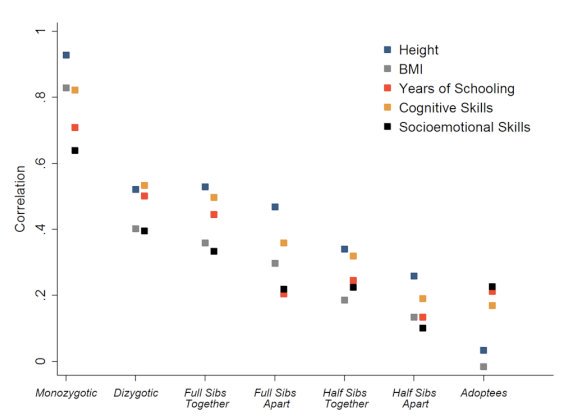
Note the position of the grey squares representing BMI

Right now, within this culture, variation in BMI is mostly genetic. This isn’t to say that non-genetic factors aren’t involved – the difference between 1800s America and 2017 America is non-genetic, and so is the difference between the perfectly-healthy Kitavans on Kitava and the one Kitavan guy who moved to New Guinea. But once everyone alike is exposed to the 2017-American food environment, differences between the people in that environment seem to be really hereditary and not-at-all-related to learned behavior. Guyenet acknowledges this:

Genes explain that friend of yours who seems to eat a lot of food, never exercises, and yet remains lean. Claude Bouchard, a genetics researcher at the Pennington Biomedical Research Center in Baton Rouge, Louisiana, has shown that some people are intrinsically resistant to gaining weight even when they overeat, and that this trait is genetically influenced. Bouchard’s team recruited twelve pairs of identical twins and overfed each person by 1,000 calories per day above his caloric needs, for one hundred days. In other words, each person overate the same food by the same amount, under controlled conditions, for the duration of the study.

If overeating affects everyone the same, then they should all have gained the same amount of weight. Yet Bouchard observed that weight gain ranged from nine to twenty-nine pounds! Identical twins tended to gain the same amount of weight and fat as each other, while unrelated subjects had more divergent responses…Not only do some people have more of a tendency to overeat than others, but some people are intrinsically more resistant to gaining fat even if they do overeat.

The research of James Levine, an endocrinologist who works with the Mayo Clinic and Arizona State University, explains this puzzling phenomenon. In a carefully controlled overfeeding study, his team showed that the primary reason some people readily burn off excess calories is that they ramp up a form of calorie-burning called “non-exercise activity thermogenesis” (NEAT). NEAT is basically a fancy term for fidgeting. When certain people overeat, their brains boost calorie expenditure by making them fidget, change posture frequently, and make other small movements throughout the day. It’s an involuntary process, and Levine’s data show that it can incinerate nearly 700 calories per day. The “most gifted” of Levine’s subjects gained less than a pound of body fat from eating 1,000 extra calories per day for eight weeks. Yet the strength of the response was highly variable, and the “least gifted” of Levine’s subjects didn’t increase NEAT at all, shunting all the excess calories into fat tissue and gaining over nine pounds of body fat…

Together, these studies offer indisputable evidence that genetics plays a central role in obesity and dispatch the idea that obesity is primarily due to acquired psychological traits.

These studies suggest that one way genetics affects obesity is by altering the tolerance level of the lipostat. Genetically privileged people may have very finicky lipostats that immediately burn off any extra calories they eat, and which never become dysregulated. Genetically unlucky people may have weak lipostats which fail to defend against weight gain, or which are too willing to adjust their set point up in the presence of an unhealthy food environment.

So, given how many people seem to have completely different weight-gain-related experiences to each other, the wishy-washyness here might be a feature rather than a bug.

One reason I’ve always found genetics so exciting is that there are all these fields – nutrition is a great example, but this applies at least as much to psychiatry – where everyone has wildly different personal experiences, and where there’s a large and vocal population of people who say that the research is exactly the opposite of their lived experiences. People have tried to shoehorn the experiences to fit the research, with various levels of plausibility and condescendingness. And for some reason, it’s always really hard to generate the hypothesis “people’s different experiences aren’t an illusion; people are genuinely really different”. Once you start looking at genetics, everything sort of falls into place, and ideas which seemed wishy-washy or self-contradictory before are revealed as just reflecting the diversity of nature. People who were previously at each other’s throats disputing different interpretations of the human condition are able to peacefully agree that there are many different human conditions, and that maybe we can all just get along. The Hungry Brain and other good books in its vein offer a vision for how we might one day be able to do that in nutrition science.

VI.

Lest I end on too positive a note, let me reiterate the part where happiness is inherently bad and a sort of neo-Puritan asceticism is the only way to avoid an early grave.

There’s a sort of fatalism to talking about “food reward”. If the enemy were saturated fat, we could just stick with the sugary sweetness of Coca-Cola. If the enemy were carbohydrates, we could go out for steak every night. But what do we do if the enemy is deliciousness itself?

A few weeks ago Guyenet announced The Bland Food Cookbook, a collection of tasteless recipes guaranteed to be low food-reward and so discourage overeating. It was such a natural extension of his philosophy that it took me a whole ten seconds to realize it was an April Fools joke. But why should it be? Shouldn’t this be exactly the sort of thing we’re going for?

I asked him, and he responded that:

If I thought enough people would actually be capable of following the diet, I would consider making such a cookbook non-ironically. The second point I want to make here is that there are many ways to lose weight, and deliberately reducing food reward is only one of them. You could also exercise, eat a low-calorie-density diet, eat a high-protein diet, restrict a macronutrient, restrict animal foods, restrict plant foods, eat nothing but potatoes. Most approaches overlap with a low-reward diet to varying degrees, but I don’t think the low reward value encapsulates everything about why every weight loss strategy works. BTW, low-carb folks often have a knee-jerk reaction to the low-reward thing that goes something like this: “I eat food that’s delicious, such as steaks, bacon, butter, etc. It’s not low in reward.” But it is low reward in the sense that you’re cutting out a broad swath of foods, and an entire macronutrient, that the brain very much wants you to eat. Eating more of a particular category of rewarding food doesn’t completely make up for the fact that you’re cutting out a whole other category of rewarding food that you would avidly consume if you weren’t restricting yourself.

So things aren’t maximally bad. And hunter-gatherers enjoy their healthy diets just fine. And certainly there are things like steak and wine and so on which are traditionally “good food” without being hyperprocessed hyperpalatable junk food. But if you really enjoy a glass of Chardonnay, is that “food reward” in a sense that’s potentially dangerous? Is anything safe? What about mongongo nuts? Is there anywhere we can get them?

At least the consolation of things making a little more sense. One thing that always used to bother me was the so-called “ice cream diet” – that is, if you eat a 700-calorie ice cream sundae for breakfast, lunch, and dinner every day, that’ll be only 2100 calories – around the average person’s daily requirement, and low enough for many people to lose weight. Why wouldn’t you want to do that? The idea of junk food being inherently damaging – while it has a bit of Puritan feel to it – at least fits our intuitions on these sorts of things and gives us a first step towards reconciling the conventional wisdom and the calorie math.

Overall I strongly recommend The Hungry Brain for everything I talk about here and for some other good topics I didn’t even get to (stress, sleep, economics). I would also recommend Guyenet’s other writing, especially his debate with Dr. David Ludwig on the causes of obesity (Part 1, Part 2, Part 3. I also recommend the list of diet tips that Guyenet gives at the end of the book. I won’t give them all away here – he’s been nice enough to me that maybe I should repay him by not reprinting the entire text of his book online for free. But it’s similar to a lot of standard advice for healthy living, albeit with more interesting reasoning behind it. Did you know that exercise might help stabilize the lipostat? Or that protein might do the same? Also, one piece of advice you might not hear anywhere else – potatoes are apparently off-the-charts in terms of satiety factor and may be one of the single best things to diet on.

And speaking of good things to diet on…

(note that this next part is my own opinion, not taken from The Hungry Brain or endorsed by Stephan Guyenet)

Slate Star Codex’s first and most loyal sponsor is MealSquares, a “nutritionally complete” food product sort of like a whole-foods-based, protein-rich, solid version of Soylent (it looks and tastes basically like a scone). I’m having some trouble writing this paragraph, because I want to recommend them as potentially dovetailing with The Hungry Brain‘s philosophy of nutrition without using phrases that might make MealSquares Inc angry at me like “bland”, “low food reward”, or “not hyperpalatable”. I think the best I can come up with is “unlikely to injure your hypothalamus”. So, if you’re looking for an easy way to quit the junk food and try a low-variety diet that’s unlikely to injure your hypothalamus, I recommend MealSquares as worth a look.


Posted in Uncategorized | Tagged , | 418 Comments

OT74: Copan Thread

This is the bi-weekly visible open thread. Post about anything you want, ask random questions, whatever. You can also talk at the SSC subreddit or the SSC Discord server. Also:

1. A message from Tom Ash: “Time to take the 2017 Effective Altruism Survey, especially if you are an effective altruist, though you’re welcome to take it even if you’re not. If you took the survey last year and are short on time, take the donations only version.”

2. My last post listed a few studies suggesting there were relatively few long-term personality-related effects of childhood abuse. @SilverVVulpes on Twitter pointed out to me a few studies that seemed to show the opposite, Lynch et al and Alemany et al (I’m a little confused by the latter’s β values; are they missing a decimal?) I will have to look over these more to see what I think of them.

3. Thanks to everyone who took the survey last open thread. People were pretty strongly opposed to splitting the comment section in two, and I won’t try it.

4. Bakkot has added some new features to the comment system, which you can read about here. As always, many thanks to him for all his hard work.

5. “Comment” of the week is the index for Bean’s many comments on battleships.

6. New moderation policy: I am getting very paranoid after the various physical and reputational attacks on people saying “offensive” speech, especially given some ominous noises from within what I previously considered a bubble of safety. In order to protect myself and non-anonymous readers of this blog, I am going to be more careful about allowing things that hostile parties could interpret as reason to go Middlebury on someone. I am banning the terms “human biodiversity” and “hbd” – this doesn’t necessarily mean banning all discussion of those topics, but it should force people to concentrate on particular claims rather than make sweeping culture-war-ish declarations about the philosophy as a whole. I will also be deleting without notice any comments that I consider to have too high a heat-to-light ratio, especially when they’re the easily-visible first comment in the thread. You won’t get banned for making these comments, because I don’t expect people to be able to predict which of their comments I will worry has too high a heat-to-light ratio, but if you predict your comment might get this treatment you may want to save it somewhere so you can repost it somewhere else. I anticipate only having to do this very rarely. I’m sorry about this and wouldn’t go to this extreme if I didn’t think it was necessary to protect this community’s ability to do what it does at all.

Posted in Uncategorized | Tagged | 1,215 Comments

SSC Journal Club: Childhood Trauma And Cognition

This month’s American Journal of Psychiatry includes Danese et al, Origins Of Cognitive Deficits In Victimized Children. Previous studies had found that abused children had lower IQ. They concluded that the severe stress of being abused must decrease brain function. Danese et al challenge that assumption in the context of the new paradigm of shared-environment-skeptical psychiatry.

They looked at some of the big developmental studies that had followed thousands of children from birth and evaluated them throughout the years. Most of these kids had gotten a bunch of different IQ tests every year, starting as young as 3. These children had also been screened for abuse, both by questions that tended to predict abuse (for example, asking parents whether they ever “punished their children harshly”) and by asking the kids, once they were grown up, whether they’d ever been abused or not.

The hope was to find children who hadn’t been abused before their first IQ test at age 3, but who started being abused before their last IQ test at age 18. Then they would see whether IQ at age 3 predicted IQ at age 18 in the same way it would in unabused children, or whether IQ was lower than predicted, presumably because of the abuse.

Before the adjustments, they found the same thing as every other study – abused children had lower IQ than unabused children (p < 0.01, B = 0.1):

Consistent with previous research, we found that adolescents and adults with a history of childhood victimization have pervasive deficits in clinically significant cognitive functions, including both general intelligence and more specific measures of executive unction, processing speed, memory, perceptual reasoning, and verbal comprehension.

After the adjustments, there was no difference between IQs in the two groups (p = 0.13, B = 0.03):

In contrast to the conventional causal interpretation of these findings, our longitudinal prospective design revealed that cognitive deficits in victimized adolescents and adults were largely explained by cognitive deficits present before the observational period for childhood victimization and by nonspecific effects of childhood socioeconomic disadvantage. On the one hand, the results are consistent with the high heritability of cognitive functions, their strong continuity across the life course, and the stable cognitive deficits previously described in children exposed to adversity. On the other hand, they are inconsistent with the causal effects of early-life stress on brain function reported in experimental animal models.

The study raises the possibility that kids from poorer families were more likely to get abused and to have lower IQs. Other possibilities include abusers (like criminals) having lower-than-average IQs and passing them on to their kids, or low-IQ kids being less able to figure out ways to escape abuse.

I find this interesting for two reasons.

First, twin studies famously find that early family experiences (the “shared environment”) are less important than previously believed. This has led to a small cottage industry of trying to deny twin studies and saying they don’t work. There’s a lot of interesting debate in this area, and by “interesting” I mean “annoying and interminable”. Maybe the best solution is to route around the whole problem by viewing twin studies as an incentive to conduct really rigorous non-twin studies to see if alternate methodologies can confirm the same surprising conclusions. Danese et al is a rare example of this being done right.

Second, a lot of discussion of the limited role of the shared environment adds the caveat “of course, we’re not talking about actual abuse here. Of course that affects outcomes.” It probably affects some of them. But here we see that it’s not necessarily true along every axis.

A recent twin study showed that child abuse doesn’t increase risk for ADHD, autism, or learning disorders. But I don’t think most people expected it to increase the risk of these disorders, which are traditionally viewed as really genetic.

A 2010 study found that it didn’t increase the risk of “conduct problems” broadly defined. These are traditionally viewed as linked with child abuse, so that’s interesting.

A 2013 study found that child abuse mostly didn’t explain personality disorders. Traditionally borderline personality disorder in particular is viewed as almost invariably associated with abuse, but if I’m reading the study right abuse really only explained about 1% of the variance in who had the condition. And although this called itself a “co-twin analysis”, it wasn’t a real twin study – it used non-abused twins as the control group for abused twins, but it didn’t check if they were identical or non-identical; this controls for family socioeconomic status but not for genetics. This leaves open the possibility that even the 1% remaining abuse-related variance might not be real.

The strongest study I could find was this one linking childhood sexual abuse to a threefold lifetime increase in psychiatric disorders. It, too, was a cotwin analysis and so not genetically controlled. And although I am not going to win any sensitivity points for saying that genetics can affect likelihood of being sexually abused, this is my impression of a lot of the cases I’ve seen – for example, children with a lot of of preexisting issues and bad relationships with their parents are more willing to secretly meet predators who have been grooming them online.

On the other hand, there are also reasons to believe these studies might understate the dangers of abuse. For example, the Danese et al study sampled 3000 kids who were supposed to be representative of the communities they came from. Suppose only 1% of children experience very severe child abuse. Then they would only have a sample of 30 – far too small to find any interesting conclusions. Maybe most of what they’re picking up is differences between not-abused-at-all kids and only-mildly-abused kids, and we shouldn’t be too surprised if they don’t find anything major.

I don’t want to underplay the role of child abuse. My impression from anecdotal evidence is that it does seem to have serious negative effects on kids later in life. For example, I’ve seen some kids from well-off, genetically-healthy families who were sexually abused by a coach or a neighbor or a priest or someone and who became nervous wrecks later in life, unable to stop thinking about it or to stop feeling guilty. Even good studies usually find that trauma is a risk factor for PTSD (thank goodness), proving that highly stressful events can be psychologically scarring and lead to future problems. Once you’ve accepted that, you’ve got most of the assumptions you need to reconstruct the case for child abuse causing psychological problems.

I think the safest assumption is that child abuse that rises to the level of trauma is associated with a PTSD-like picture (although I’ve heard some experts discourage thinking of it as literally PTSD) that seriously affects later-life outcomes. I think it’s less likely that child abuse has many effects that are wildly different from what we see in normal PTSD. And since normal PTSD doesn’t decrease IQ, I’m not surprised to hear that child abuse doesn’t do that either.