Learning To Love Scientific Consensus

[Related to: Contrarians, Crackpots, and Consensus, How Common Are Science Failures?. Epistemic status is “subtle and likely to be misinterpreted”.]

I.

There’s a list of scientific mavericks who were ridiculed by hidebound reactionaries but later vindicated that’s been going viral. I examined the first ten mavericks on the list to see if its claims held up. Overall I wasn’t too impressed. Let me go over them in more detail.

SVANTE ARRHENIUS:

His idea that electrolytes are full of charged atoms was considered crazy. The atomic theory was new at the time, and everyone “knew” that atoms were indivisible (and hence they could not lose or gain any electric charge.) Because of his heretical idea, he only received his university degree by a very narrow margin.

Sure, the professors who were judging his PhD thesis weren’t too convinced. So Arrhenius sent his proposal to the world’s top chemists at the time, and they were super-interested and started fighting among themselves to work with Arrhenius on it. Top chemist Wilhelm Ostwald received the paper the same day his daughter was born, and suggested that the paper was the more exciting of the two events. He journeyed to Arrhenius’ hometown of Uppsala, Sweden to try to convince Arrhenius to work with him; Arrhenius refused for personal reasons but later got a scholarship and worked with the top physicists in Europe. Arrhenius became a professor in a prestigious university about ten years after presenting his “ridiculed” paper, and won the Nobel Prize ten years after that.

HANS ALFVEN:

Astronomers thought that gravity alone is important in solar systems, in galaxies, etc. Alfven’s idea that plasma physics is of equal or greater importance to gravity was derided for decades.

This isn’t a great description of Alfven’s conflict with the establishment, but the list seems basically right insofar as Alfven’s ideas were ignored for thirty years before being proven mostly correct. I will give them this one.

JOHN BAIRD:

When the first television system was demonstrated to the Royal Society (British scientists,) they scoffed and ridiculed, calling Baird a swindler.

I can’t find any reference to this in various Baird articles and biographies. The closest I can come is this article by someone who was there at the demonstration, who said “They didn’t believe it…the pictures were a bit of a blur but it was amazing, they were all absolutely flabbergasted by it.” It looks like he is using “they didn’t believe it” in the colloquial way of “they thought it was amazing”. A TIME magazine article from the time described the same scientists as “deeply impressed”, though the wording is kind of unclear and they might have been referring to a different demonstration a year later.

In any case, it seems very clear that within a year everyone agreed he was legitimate and overcame their initial shock.

ROBERT BAKKER:

Everyone knows that dinosaurs are like Gila monsters or big tortoises: large, slow, and intolerant of the cold. And they’re all colored olive drab too! 🙂

Bakker did help produce the paradigm shift in paleontology from cold-blooded dinosaurs to warm-blooded dinosaurs. But he was not a lone maverick being ridiculed by everyone else. He learned that dinosaurs were warm-blooded from his professor at Yale, who was also part of the minority-but-totally-existing faction that believed dinosaurs were warm-blooded. He himself got a PhD at Harvard from professors who were apparently sympathetic to the same theory. And within seven years of his first paper being published, Scientific American was calling his ideas “the dinosaur renaissance”, which doesn’t leave a lot of time for him to be ridiculed and ignored in.

BARDEEN & BRATTAIN:

Not ridiculed, but their boss W. Shockley nixed their idea for a non-FET “crystal triode” device. When they started investigating it, he made them stop. They were supposed to be working on FETs instead.

ARG, I GOT THIS WRONG, THIS PART BELOW IS A BELL LABS STORY REGARDING ZONE REFINING OF SILICON, NOT THE BJT TRANSISTOR PROJECT: So, they assembled their ZONE REFINING experiment on a wheeled cart and continued. Whenever the boss was scheduled to check up on them, they could shove it into an adjacent unused lab.

Okay, it looks like the guy compiling the list admits he was wrong on this one. Moving on…

BRETZ:

Endured decades of scorn as the laughingstock of the geology world. His crime was to insist that enormous amounts of evidence showed that, in Eastern Washington state, the “scabland” desert landscape had endured an ancient catastrophy: a flood of staggering proportions. This was outright heresy, since the geology community of the time had dogmatic belief in a “uniformitarian” position, where all changes must take place slowly and incrementally over vast time scales. Bretz’ ideas were entirely vindicated by the 1950s. Quote: “All my enemies are dead, so I have no one to gloat over.”

This one is basically right and I’ll give it to them.

CHANDRASEKHAR:

Chandra originated Black Hole theory and published several papers. He was attacked viciously by his close colleague Sir Arthur Eddington, and his theory was discredited in the eyes of the research community. They were wrong, and Eddington apparently took such strong action based on an incorrect pet theory of his own. In the end Chandra could not even pursue a career in England, and he moved his research to the U. of Chicago in 1937, laboring in relative obscurity for decades.

Sort of true, but he was hardly shunned by the scientific community. He made his discoveries about black holes in the early 1930s, was well-received by many people, and won a Bronze Medal in some physics competition. In 1935, Eddington attacked his theory, possibly because Eddington was racist and didn’t like Indian people. But many other scientists, including Niels Bohr and Wolfgang Pauli, continued to support him (quietly, so as not to offend Eddington, which will be a recurring theme in these kinds of situations). Chandrasekhar was made a Fellow of the Royal Society in 1944, won the Royal Astronomical Society Gold Medal in 1953, and generally led a long and prestigious life. His theories were resurrected once people had better evidence that black holes existed. I’ll give this one half a point.

CHLADNI:

The scientific community regarded Meteorites in the same way that modern scientists regard UFO abductions and psychic phenomenon: quaint superstitions only believed by peasant folk. All the eyewitness reports were disbelieved. At one point the ridicule became so intense that many museums with meteorites in their geology collections decided to trash those valuable samples. (Sometimes hostile skepticism controls reality, and the strongest evidence is edited to conform to concensus disbeliefs.) Finally in the early 1800’s Ernst Chladni actually sat down and inspected the evidence professionally, and found that claimed meteorites were entirely unlike known earth rocks. His study changed some minds. At the same time some large meteor falls were witnessed by scientists, and the majority who insisted that only ignorant peasants ever saw such things were shamed into silence.

As the quote points out, this is a kind of weird one as meteorite work was ridiculed for a long time, but Chladni was taken seriously and helped change minds. Looking at Wikipedia, a lucky meteorite fall two years after Chladni first published his theory helped turn the tide in his favor, and by ten years after publication Chladni’s meteorite theories were pretty well-regarded. Even when people disagreed with him about meteorites, Chladni remained widely respected for some of his other work in acoustics.

There is a story here, but it’s probably not right to center it around Chladni, and his work was only scorned for a few years before everyone agreed it was true. I’ll give this another half a point.

CRICK & WATSON

Not ridiculed. But they were instructed to drop their research. They continued it as “bootleg” research.

The list admits they were “not ridiculed”. They were told to stop their research because there was all sorts of academic politics around who was going to be the first to discover DNA, and the guy in charge of their university was rooting for another team.

DOPPLER

Proposed a theory of the optical Doppler Effect in 1842, but was bitterly opposed for two decades because it did not fit with the accepted physics of the time (it contradicted the Luminiferous Aether theory.) Doppler was finally proven right in 1868 when W. Huggins observed red shifts and blue shifts in stellar spectra. Unfortunately this was fifteen years after Doppler had died.

I haven’t been able to find anything about this in various short online biographies of Doppler (1, 2). Doppler tested the effect himself by having someone play a trumpet on a train (really), someone else successfully tested it in 1845, and it was independently rediscovered in 1848. Doppler himself was made the head of the Institute For Experimental Physics in Vienna and died about as prestigious and beloved as a physicist can get.

So my impression is that only a third of these people really fit the pattern. Most of them were doubted for very short periods, continued to be respected in their fields for their other accomplishments even during those periods, or were part of medium-sized movements rather than being lone geniuses. After a few years – maybe an average of ten, very rarely as long as thirty – their contributions were recognized and they assumed their rightful place in the pantheon. Science isn’t perfect. But it is darned good.

[EDIT: Bill Beatty, author of the original list, responds here. My response to the response here.]

II.

I bring this up in the context of my last post on progress in the rationalist movement. There used to be a stereotype that rationalists were too quick to challenge scientific consensus. I think that was exaggerated, but based on a core of truth. Given that we’re interested in the ways that bias can prevent people from accepting truth, it’s unsurprising that we would focus on cases like these.

But I personally have changed my thinking on this a lot. Not in any way that I can explain explicitly – I’ve always thought something like:

Scientific consensus is the best tool we have for seeking truth. It’s not perfect, and it’s frequently overturned by later scientists, but this is usually – albeit not literally always – the work of well-credentialed insiders, operating pretty quickly after the evidence that should overturn it becomes available. Any individual should be very doubtful of their ability to beat it, while not being so doubtful that nobody ever improves it and science can never progress.

– and I still think that. But I’ve shifted from being the sort of person who shares viral lists of maligned geniuses, to the sort of person who debunks those lists. I’ve started emphasizing the “best tool we have” part of the sentence, and whispering the “isn’t perfect” part, rather than vice versa.

I’ve changed my mind on this because of personal experience. Rather than trying to describe it, it might be more helpful to give the most salient examples.

1. The Replication Crisis: I previously thought the scientific consensus was flawed because it failed to take the replication crisis seriously enough. I later learned that everyone else took the repliaction crisis exactly as seriously as I did. A poll in Nature shows that 90% of scientists believe reproducibility issues constitute a “crisis”, compared to only 3% (!) who don’t. For every person complaining about “methodological terrorists”, there are a dozen who are very concerned and trying to change the way they practice research.

This is especially impressive because as far as I can tell the whole shift happened in about ten years. I would date the beginning of the crisis from Ioannidis’ original 2005 paper, although it was only aimed at medicine. It got into high gear in psychology sometime around 2011 with Simonsohn’s False Positive Psychology. A Google Trends analysis suggests people only started searching the relevant keywords around 2013.

I started thinking about this sort of thing in 2009 after reading this LW post. At the time I thought this was some sort of exciting failure of modern science that I alone had figured out. But this was well after sharp people like Ioannidis were talking about it, and only a few years before everyone was talking about it. Framing this as “I was right and scientific consensus was wrong” seems grandiose. Better might be “I started betting on a winning horse about a quarter of the way between the beginning of the race and when its victory became blatantly obvious to everyone”.

2. Nutrition: The Bad Old Paradigm of nutrition says that obese people just have poor impulse control, that weight is a simple matter of calories in vs. calories out, and that all calories are equally good except fat, which for some inexplicable reason is the Devil. Anybody who’s read a few good books about nutrition science knows that the Bad Old Paradigm is woefully inadequate. I read a few of those books and became convinced that I was right and scientific consensus was wrong.

Unfortunately, this whole issue exploded when Gary Taubes published Good Calories, Bad Calories, which as best I can tell combined the first publicly available good critique of the Bad Old Paradigm with a flawed and basically false attempt at a new paradigm. There were lots of confused attacks against Taubes’ bad information which did collateral damage to his good information, and lots of confused defenses of his good information which inadvertently shielded his bad information from criticism. I previously focused on defend the good parts, but recently shifted more towards criticizing the bad parts.

After reading some more good books here (one of which I hope to review soon), my impression is that most nutrition scientists don’t believe in the Bad Old Paradigm and haven’t for a while. At the very least, most of them seem to believe in the lipostat and think it’s important, which is my proxy for “basically has their heart in the right place”. Insofar as the Bad Old Paradigm continues to be popular wisdom, it’s because of the diet industry, the government, social inertia, and nobody really having a good new paradigm to replace it with. I’m gradually seeing popular wisdom shift, and nutrition scientists themselves seem to be helping this process rather than hurting it.

Maybe somebody in this area has discovered the new paradigm and is a maverick being persecuted by hidebound reactionaries. But it isn’t Gary Taubes. And it certainly isn’t me.

3. Social-Justice-Related Issues: Another narrative I used to believe was that a lot of sketchy ideas were being flattered because they spoke to left-leading academics’ biases in favor of social justice. Implicit association tests, stereotype threat, the idea of zero meaningful psychological differences between men and women, et cetera.

When I started worrying about implicit association tests, I thought I was defying some kind of broad scientific consensus. But the meta-analyses showing the Implicit Association Test didn’t do what people thought had been around since 2009 and have only gotten more numerous since then, with broad media coverage. Problems with stereotype threat research are getting mainstream coverage and even airtime on NPR.

The problem here is that there was no equivalent of the Nature poll on the replication crisis, so I didn’t realize any of this was happening until just recently. For example, in 2016 this Voxsplainer made it sound like there was a monolithic consensus in favor of Implicit Association Tests that no sane person had ever disagreed with, even though by that point there were already several big meta-analyses finding they weren’t practically useful. The correct conclusion isn’t that this is really what scientific consensus thinks. The correct conclusion is that Vox shouldn’t be trusted about any science more complicated than the wedge vs. inclined plane. Once I realized that there was all this intelligent analysis going on that I’d never heard about, my claim to be boldly defying the scientific consensus evaporated.

Yes, Cordelia Fine is still around and is still writing books arguing against gender differences. But she’s starting to sound really defensive, basically the literary equivalent of “I know I’m going to be downvoted to hell for this, but…”. Meanwhile, other scientists are doing a good job pointing out the flaws in her books and conducting studies like this biggest-ever look at male vs. female brain differences, this magisterial look at personality differences, et cetera – not to mention great and widely-accepted work on how intersex people take on more characteristics of their hormonal than their social gender (honestly, we should probably thank transgender people for making this field socially acceptable again). People talk a lot about how Larry Summers was fired from Harvard for talking about male vs. female differences, but Steven Pinker did a whole debate on this and remains a Harvard professor.

Even things about genetic psychological differences between population groups are less bold and maverick-y than their proponents like to think. The relevant surveys I know trying to elicit scientific consensus (1, 2, 3) all find that, when asked anonymously, most scientists think these differences explain about 25% – 50% of variance.

I hate to bring that up, because it’ll probably start a flame war in the comments, but I think it’s important as a sign of exactly how hard it is to politicize science. Global warming skeptics talk about how maybe the scientific consensus on global warming is false because climatologists face political pressure to bias their results in favor of the theory. But scientists studying these areas face much more political pressure, and as long as you give the surveys anonymously they’re happy to express horrendously taboo opinions. This is about the strongest evidence in favor of the consensus on global warming – and scientific consensus in general – that I could imagine.

4. Nuture Assumption and Blank Slatism: The prologue of the first edition of The Nurture Assumption is Judith Rich Harris telling her “maverick genius kept down by hidebound reactionaries” story. But the prologue of the second edition is her being much more hopeful:

To some extent at least, times have changed…there is now more acceptance of the idea that behavior is influenced by genes and that individual differences in behavior are due in part to differnces in genes. People are more willing to admit that children can inherit behavioral quirks and personality characteristics…was it this cultural shift that led to greater acceptance of my theory? Or was it the fact that new findings, consistent with the theory, kept turning up? Over time, the early, angry response to The Nurture Assumption has softened noticeably, both within and outside of academia. Today, the book is widely cited in textbooks and journal articles. It’s assigned and discussed in courses in many colleges and universities; it shows up in exams…in his foreward to the first ediction of The Nurture Assumption, Steven Pinker made a rash prediction about the book: “I predict it will come to be seen as a turning point in the history of psychology”. Perhaps it is too soon to judge whether psychology has rounded a bend; perhaps it will take the perspective of twenty or thirty years. Even at this point, though, there are signs of a slight shift in direction. Within developmental psychology, I’ve noticed that descriptions of procedures and results are beginning to sound a bit defensive. Greater progress has been made in other areas of psychology. And the email I receive from students gives me high hopes for the younger generation coming up.

There were ten years between the first and second editions of The Nurture Assumption. In the almost ten years since the publication of the second edition, my impression is that its ideas have become even more widely-accepted. This month’s edition of the American Journal of Psychiatry, onbe of the top journals in the field, has a great study showing that child abuse does not cause cognitive disability, in contrast to several previous studies in the area. It cites Deary, Plomin, and Ioannidis, hits all of the talking points about genetic confounding of developmental outcomes, and receives glowing endorsement in the journal’s editorial section, which says that “if our causal explanations are wrong, we may be wasting our effort or even doing damage”. Every single psychiatrist in the country is getting exposed to this way of thinking.

And this has real results. I got to present a summary of behavioral genetics to a meeting of psychiatrists, including a lot of psychoanalysts, and I was shocked that most of them were at least a little receptive. I think they misunderstood it. I think they carefully raised caveats in exactly the right places to ensure they didn’t have to change anything they were doing. But the overall response was “Oh, yeah, we’ve heard stuff like that, it seems plausible, good thing that for various hard-to-explain reasons none of it applies to us.” This is what the first stage of progress looks like.

5. Intelligence Explosion And AI Risk: This was another place where I and many of my friends thought we were right and the consensus was wrong. It was another place where a lot of self-appointed defenders of the consensus told us we were crackpots and needed to listen to what real scientists thought. And again, when I looked into it, there was no consensus against the idea and lots of prominent researchers were in favor. Going to the Asilomar Conference and seeing a bunch of people from MIT and Harvard talk about how concerned they were really opened my eyes on this. Google now has an AI Ethics Board, Berkeley, Oxford, and MIT have foundations working on it, and people like Elon Musk and Bill Gates are involved. Bostrom’s survey of AI researchers and some more recent and rigorous not-yet-published surveys I’ve heard about confirm the impression. Nobody would ever say there’s a scientific consensus in favor of Bostrom’s theories. But at this point I think it’s also indefensible to say there’s a consensus against.

Bostrom first started writing about these sorts of things extensively in the early 2000s, so there was really only a ten-year gap between entering the intellectual environment and it becoming a (mostly) accepted part of the established field. Those ten years felt pretty long while we were in them, but the ability of a field to accept an on-the-face-of-it completely-insane-sounding theory within ten years seems to me a very strong argument against the hidebound-reactionaries theory and a very strong argument for considering scientific consenses to be unreasonably effective.

6. IQ: Another case where I worried about apparent failure of scientific consensus due to politically bias. I certainly encountered a lot of falsehoods around this when I was younger. My high school psychology textbook included a section claiming that all IQ tests were biased towards rich white people because they were based entirely on questions like “how many shots below par is a bogey?” Then it presented an “alternate IQ test” which “proved” that poor minorities had higher IQs than rich whites by asking some other questions with the opposite bias (I think they were about slang for drugs – certainly an interesting way to fight stereotypes). This kind of thing naturally made me assume that nobody had any idea what was actually in IQ tests and scientists were idiots.

But more recently I’ve been reading actual surveys, which find that about 97% of expert psychologists and 85% of applied psychologists agree that IQ tests measure cognitive ability “reasonably well”. And 77% of expert psychologists and 63% of applied psychologists agree IQ tests are culture-fair (with slightly different numbers depending on how you ask the question, but always about 50% of both groups).

This seems like less of a problem with expert consensus, and more of a problem of nobody else (including textbook writers!) listening to experts who are continually trying to beat reality into people’s heads. But I have a vague memory of having recently seen a survey (which I can’t find) that even experts in softer fields like sociology are generally in favor of IQ and admit that it has its uses. And even some left/liberal sources like Vox and Freddie deBoer are aware of the consensus and willing to respect it.

At the same time, I’ve encountered some people like Borsboom and Nostalgebraist who have relatively sophisticated (and limited) critiques of IQ, and who have allowed me to round off other people’s less-well-framed critiques to something more like what they are saying and less like the stupid things my high school textbook said.

So it seems to me that generally experts agree with reasonable statements about IQ, and where they seem to disagree they may hold reasonable disagreements rather than unreasonable ones. Again, where this fails is not in the experts but in the ability of people who don’t listen to the experts to get disproportionate social power and hide the existence of the expert consensus.

III.

Last week I wrote about universally-known criticisms of economists, like “they’re silly for assuming everyone behaves perfectly rationally”:

My impression is that economists not only know about these criticisms, but invented them. During the last few paradigm shifts in economics, the new guard levied these complaints against the old guard, mostly won, and their arguments percolated down into the culture as The Correct Arguments To Use Against Economics. Now the new guard is doing their own thing – behavioral economics, experimental economics, economics of effective government intervention. The new paradigm probably has a lot of problems too, but it’s a pretty good bet that random people you stop on the street aren’t going to know about them.

The same pattern explains a lot of my concerns above. I knew some criticisms of a scientific paradigm. They seemed right. I concluded that scientists weren’t very smart and maybe I was smarter. I should have concluded that some cutting-edge scientists were making good criticisms of an old paradigm. I can still flatter myself by saying that it’s no small achievement to recognize a new paradigm early and bet on the winning horse. But the pattern I was seeing was part of the process of science, not a condemnation of it.

Most people understand this intuitively about past paradigm shifts. When a creationist says that we can’t trust science because it used to believe in phlogiston and now it believes in combustion, we correctly respond that this is exactly why we can trust science. But this lesson doesn’t always generalize when you’re in the middle of a paradigm shift right now and having trouble seeing the other side.

I realize I’m (ironically) risking making my narrative of scientific success unfalsifiable. Suppose someone wants to argue that scientific consensus is wrong. If they point to something it used to be wrong about, I can respond “Yes, but it self-corrected and it’s correct now, so that’s fine.” If they point to something where cutting-edge scientists say it’s wrong but nobody else agrees, I can respond “Yes, this is what the beginning of a paradigm shift looks like, so that’s fine”. And if they point to something where nobody in the field thinks it’s wrong, I can say “You’re a crackpot for going against all reputable scientists; the problem is with you.” And if later they turn out to be right, and everyone acknowledges it, I can say “Yes, but it self-corrected and it’s correct now, so that’s fine.”

(and I’m making it even easier for myself in that I say “scientific consensus for” when I probably mean “no scientific consensus against”. I don’t claim that 90%+ of scientists always believe true things, only that there are very few cases where 90%+ of scientists believe things which smarter people know to be false.)

Against this I can only offer a personal narrative: the only light I have by which to judge scientific consensus is my own Inside View assessment of what seems correct. Again and again I have tried to defy scientific consensus. And every time, I either find that I am wrong, find that I am a few years ahead of a trend that most scientists eventually agree with, or find that what I thought was “scientific consensus” was actually a fiction peddled by biased industry or media sources slandering a scientific community which actually had a much more sophisticated picture. My history of trying to fight scientific consensus has been a Man Who Was Thursday-esque series of embarassments as I find again and again that my supposed enemy agrees with me and is even better at what I am trying to do than I am.

Scientific consensus hasn’t just been accurate, it’s been unreasonably accurate. Humans are fallible beings. They are not known for their ability the change their mind, to willingly accept new information, or to put truth-seeking above political squabbles. And our modern society is not exactly known for being an apolitical philosopher-kingdom with strong truth-seeking institutions completely immune from partisan pressure. I feel a deep temptation to sympathize with global warming denialists who worry that the climatological consensus is biased politicized crap, because that is exactly the sort of thing which I would expect to come out of our biased politicized crappy society. Yet again and again I have seen examples of scientific fields that have maintained strong commitments to the truth in the face of pressure that would shatter any lesser institution. I’ve seen fields where people believe incredibly-bizarre sounding things that will get them mocked at cocktail parties just because those things seem to be backed by the majority of the evidence. I’ve even seen people change their minds, in spite of all the incentives to the contrary. I can’t explain this. The idea that scientific consensus is almost always an accurate reflection of the best knowledge we have at the time seems even more flabbergasting than any particular idea that scientists might or might not believe. But it seems to be true.

(note that I’m talking about “scientific consensus” to mean a very high-level pattern, consisting of hundreds of scientists over the space of decades evaluating a broad body of work. Any individual study is still probably total garbage.)

Given how weird all of this is, I realize there’s another possible bias here that should be taken very seriously – which is that I’m wrong about one or both sides of this. Which is more likely: that Science always agrees with Truth? Or that one guy’s perception of Science always agrees with that same guy’s perception of Truth? The latter gives me two degrees of freedom: I can either cherry-pick experts who agree with me and declare them to be Consensus, or I can conform my opinions to consensus so slavishly that I end up discovering only that Consensus agrees with itself. I don’t feel like I’m making this kind of mistake. But then again, nobody ever feels like they’re being biased.

But if I’m making this mistake, I think it’s at least a better mistake than the one where people dream up stories about being mavericks persecuted by hidebound reactionaries. This mistake at least sets the terms of debate as “let’s try to ascertain what the scientific community thinks” and forbids me from believing completely crackpottish things. And it encourages trust in one of our more trustworthy public institutions, always a prosocial sort of thing to do. I would rather have a world of people debating who agrees with scientific consensus or not, than a world of people debating whether scientific consensus is even valuable.

There are two caveats to the above. First, I think it’s dangerous to promote a norm of agreeing with scientific consensus, insofar as that helps encourage exactly the mistakes about the nature of consensus that I discussed above. When poorly-informed diet industry gurus support the Bad Old Paradigm, their rallying cry is usually “You’re a stupid crackpot, bow to the scientific consensus which agrees with me”. I gave three examples above of cases where I would have gotten the scientific consensus 100% wrong if I didn’t have access to a formal survey of scientific experts. In a world where these surveys had never been done – or some existing field without these surveys – or some field where these surveys have been done inaccurately or in a biased manner – people will often believe the consensus to be the opposite of what it really is. In those cases, demands that people respect consensus can be used to shut down people who are actually right – the field-wide equivalent of calling true facts you don’t like debunked and well-refuted. I see this happening all the time and I worry that waxing too poetically about the unreasonable effectiveness of scientific consensus will only serve to empower these people. Goodhart’s Law says that a measure which becomes a target ceases to be a useful measure, so we should be reluctant to target scientific consensus too strongly.

And second, I think that even when the Outside View tells you that the consensus is correct, you should continue pursuing your Inside View hunch that it isn’t. This avoids awkward situations like every individual scientist doubting the consensus, but suppressing their doubts because the “scientific consensus” has to be right.

So maybe the things I’m saying about scientific consensus aren’t very actionable. But respecting scientific consensus in a non-actionable way is a lot less exhausting than believing yourself to be against it, and talking about how you’re against it, and taking flak for being against it. And in the same way it’s helpful to believe that God is good, even if He never really gets around to doing much about it, so it’s reassuring to be able to have faith in our institutions every so often.

Posted in Uncategorized | Tagged | 609 Comments

Chametz

It was just before midnight when a cloud covered the moon and a bat flew right in front of me. Before I had time to worry about whether I was up to date on my rabies shots, it had transformed into a pale man in a black cloak.

“I have come to suck your blood!” he said in a heavy Eastern European accent.

Years of watching television and movies had prepared me well. I put my hands together into the sign of the cross.

“Oy. Again with the crosses! What do I look like, the Pope?”

The accent was the clue. “You’re Jewish?”

“You think I don’t look Jewish? I’m wearing all black! You want I should have the hat and forelocks, too?”

I groaned. “But…you can’t be Jewish. Jews aren’t allowed to drink blood.”

“Okay Mr. Big-Shot Rabbinical Authority. You’ve never heard of pikuach nefesh? You’re allowed to violate the law if you need to do it to live. What do you want me to eat? Gefilte fish?

“But you’re not allowed to invoke pikuach nefesh in order to justify killing someone.”

“So maybe I don’t kill someone. Maybe I just leave you drained and a little bit blechedich.”

I didn’t know what blechedich meant, but it sounded ominous. I had a plan, but I needed to buy time. I started walking – not running away, just looking like I was pacing as I thought. The vampire followed effortlessly, floating beside me.

“The problem is, it’s not just that my blood isn’t kosher. I’m chametz”

“Chametz? You’re flour? You’re leavened bread?”

“No. But I ate lots of bread just before coming out here. Loads of bread. French bread, tortillas, naans, croissants, every type of bread you can think of. I’m sure it’s all in my bloodstream.”

“You ate bread? But it’s Pesach!”

“So maybe I’m not the most frum Jew in the world.”

“Not the most frum Jew in the world? Complicated Talmudic controversy, this is not! Not eating chametz on Passover is the basics!”

“Okay, fine, maybe I’m not religious at all. Maybe I’m the kind of Jew they kick out of Reform synagogues for not being observant enough. Whatever. The point is, I ate chametz, my blood is chametz, and it’s not going to kill you to go find somebody else who didn’t eat any bread today.”

“So you’re not religious. Why should I have to suffer because you’re not religious? It’s not like I’ve come to suck your stomach contents.”

I started walking a little faster. I was almost home now. Once I was in front of my house, if I made a run for it I might be able to get into the door. And once I was across the threshold, I knew vampires couldn’t come inside unless invited.

“So that’s actually not relevant. You’re not supposed to benefit indirectly from chametz on Pesach. So if I eat the chametz and use it to form my blood, and you drink my blood, then you’re benefitting. This is why some people won’t drink milk on Passover if they can’t prove the cow didn’t have chametz.”

“Milk, schmilk. Everyone agrees you can have meat on Pesach no matter what the cow ate.”

“So I think blood is more like milk. It’s a liquid product of the body, rather than part of the body itself.”

“It’s more like meat. It’s a part of the body, used to sustain the body, rather than something that’s meant to go outside of it.”

I had exhausted my knowledge of dietary law, but that was okay, because my distraction had been successful. I was in front of my own house now. With a burst of speed, I ran through the front yard, flung the door open, and made it into my living room. “Ha!” I said. “I’m over the threshold! And I’m not going invite you in!”

The vampire shrugged, walked straight across the threshold, and grabbed me by the neck.

“How?!” was the last word I managed to say before losing consciousness.

“You are not so frum a Jew? Well, maybe I am not so frum a vampire.”

Posted in Uncategorized | Tagged , | 120 Comments

Clarification To “Sacred Principles As Exhaustible Resources”

Since about half the commenters in yesterday’s post seem to have misunderstood me as saying something I don’t believe, I guess I had better explain.

(serves me right for writing a mere 1000 word post – how could I fit all the necessary caveats and clarifications?)

First, I am not saying that Jordan Peterson and Charles Murray are bad people who don’t deserve the protection of free speech. I don’t know much about Peterson, and my impression of Murray is positive (he’s the only public figure I know who shares my view that genetic meritocracy is really scary insofar as it means that many people are poor through no fault of their except but bad genes, and who agrees with me that the most ethical response would be a universal basic income). I think both of these people deserve the protection of free speech, and I tried to make that clear throughout the essay.

My qualm wasn’t with the Harvard students’ choice of Murray and Peterson, it was with the process they used to select those choices: invite the most controversial person they can think of. Now for all I know maybe that wasn’t quite their strategy: they did mention rejecting Milo because of his heckling, so there seems to have been some screen for palatability. But insofar as it was even sort of their process, I think the process is wrong no matter what names it spits out. If for some reason they spit out Abraham Lincoln and Mahatma Gandhi, I would still think it was a dumb process. This wouldn’t mean I think Lincoln and Gandhi are bad people who don’t deserve free speech, it means I think you shouldn’t be trying to maximize controversy and offense, no matter how decent the names you eventually come up with.

One hopes Charles Murray pursues what he thinks is true, and any offense caused is unintentional. But somebody “looking for the most controversial speakers” is pursuing what they think is offensive, and any truth caused is unintentional. Even if they end up with Charles Murray as their speaker, and even if Charles Murray is an okay person on the object-level, they are making a serious meta-level mistake.

[EDIT: I DON’T KNOW HOW TO SAY THIS ANY MORE CLEARLY, SO I WILL JUST SAY IT IN ALL CAPS AND HOPE THAT HELPS. I AM NOT AGAINST DEFENDING CHARLES MURRAY AND I DON’T THINK THAT PEOPLE SHOULD AVOID INVITING HIM TO CAMPUS IF THEY’RE INTERESTED IN HIS IDEAS. I TOTALLY SUPPORT MIDDLEBURY INVITING CHARLES MURRAY AND I AM AS UPSET ABOUT WHAT HAPPENED THERE AS YOU ARE. I AM SAYING THAT IF YOU INVITE CHARLES MURRAY TO CAMPUS, IT SHOULD BE BECAUSE YOU ARE INTERESTED IN HIS IDEAS, AND NOT BECAUSE YOU WANT TO INVITE A GENERIC OFFENSIVE PERSON AND HE FITS THE BILL.]

Second, I wasn’t saying we should avoid using free speech to defend people beyond a certain level of badness. Everybody deserves the protections of free speech no matter how bad their opinions. I was saying that we should avoid deliberately seeking out the worst people we can find and turning them into highly public test cases. Publicizing a good case improves public support for free speech; publicizing bad cases drains it.

The NAACP decided to support Rosa Parks’ refusal to give up her seat on a bus because they thought she was photogenic and likeable. They’d stayed out of previous similar cases because the people involved didn’t seem likeable enough. Another black lady named Claudette Colvin refused to give up her seat, and the NAACP decided not to make a big deal of it because she was a teenager pregnant with a married man’s baby and “looked lower-class”. They thought that people would be more sympathetic to a clean-living middle-class defendant as a test case, so they waited until they found Parks – who was perfect.

And you can say what you want about that – maybe they were a bit Machiavellian, maybe this is to their discredit. But it worked. Thanks to Rosa Parks, everybody – pretty or ugly, rich or poor – has the right to sit where they want on a bus. I feel like the free speech movement is trying the opposite tactic: looking for the most hideous, deformed, universally loathed axe murderer to sit on that bus and become their test case. Not only does that make them more likely to lose their test cases, it makes things harder for everyone else. I understand the temptation, because free speech as a principle is about protecting the unpopular. But this doesn’t mean that the political process of defending free speech needs to be.

I am not saying that free speech is only for attractive popular people. I’m saying that if you are looking for a test case specifically to promote the value of free speech, and you do it by deliberately searching for the ugliest and most hate-able person you can find, you’re doing it wrong.

If your pitch to potential supporters is “our science club was trying to learn about science, and we invited a well-known scientist, and now oh no we’re embroiled in a controversy, please help”, that’s a good test case. If your pitch is “our controversy club was trying to cause controversy, and we invited a well-known controversial person, and now oh no we’re embroiled in a controversy, please help”, that’s a bad test case. Even if you invited the same person both times.

Attempts to “promote free speech” and “raise awareness of free speech” are basically about test cases – done to promote the principle, rather than to use the principle. And if you’re going to do that, you had better do it well.

Sacred Principles As Exhaustible Resources

From Inside Higher Ed: a group of Harvard students is going to raise awareness of free speech by inviting controversial speakers like Charles Murray and Jordan Peterson to their school.

I believe that if somebody wants to hear Charles Murray or Jordan Peterson speak, then they should have that right. But I’m not sure these students have thought things through very carefully.

Suppose some generally popular person like the Dalai Lama endorsed some very unpopular person like Kim Jong-Un. On the one hand, insofar as we respect the Dalai Lama, we might be willing to be a little more tolerant of Kim Jong Un. On the other hand, insofar as we hate Kim Jong-Un, we might be a little less tolerant of the Dalai Lama.

In the same way, every time we invoke free speech to justify some unpopular idea, the unpopular idea becomes a little more tolerated, and free speech becomes a little less popular.

The more often people hear about free speech being used to defend NAMBLA, the less that anti-paedophiles are going to like free speech. The more often people hear about free speech being used to defend the KKK, the less anti-racists are going to like free speech. The more often people hear about free speech being used to defend radical Islamist mosques, the less anti-Muslims are going to like free speech, and so on.

The extremely predictable consequences of anti-political-correctness activists marching under the banner of free speech are that a large part of the social justice movement now thinks of free speech itself as the enemy, that Twitter personalities make mocking references to “freeze peach”, that increasing numbers of people say the First Amendment “goes too far”. Meanwhile, pundits have perfected the argument that since the First Amendment only applies to the government it’s great and praiseworthy for everyone else to restrict speech as much as they want, leaving a pro-free-speech side whose arguments too often come down to “well, it’s in the First Amendment, so you’ve got to respect us” kind of flat-footed.

I think of respect for free speech as a commons. Every time some group invokes free speech to say something controversial, they’re drawing from the commons – which is fine, that’s what the commons is there for. Presumably the commons self-replenishes at some slow rate as people learn philosophy or get into situations where free speech protects them and their allies.

But if you draw from the commons too quickly, then the commons disappears. When trolls say the most outrageous things possible, then retreat to “oh, but free speech”, they’re burning the commons for no reason, to the detriment of everybody else who needs it.

(this is how I feel about everything Milo Yiannopoulos has ever done or said.)

If Charles Murray sincerely believes what he says, thinks it’s important, and thinks that saying it makes the world a better place, then he is exactly the sort of person whom free speech exists to defend. And if someone in a college reads The Bell Curve, likes it, and wants to learn more, then free speech exists to defend them too. But if your thought process is “Who’s the most offensive person I can think of? Charles Murray? Okay, let’s invite him to give a big talk, put up flyers everywhere, and when people get angry we’ll just say FREE SPEECH”, I worry that you are drawing from the commons for no reason. And that sometime later, when people need to use the commons for things they actually believe, there won’t be any left. People will have gotten so reflexively hostile to the idea of “free speech” that they’ll reject even the barest amount of tolerance for even slightly divergent views.

This is even more pressing in the context of growing partisanship and tribalism. Because the debate centers on mostly-leftist areas like universities, conservatives are turning free speech into a conservative principle. This is a disaster, because something being a conservative principle pretty automatically means that liberals will be tempted to conspicuously desecrate it. If people actually care about free speech, the number one thing they can do right now is very loudly invoke it every time a liberal is silenced. We should be having giant free speech parades supporting everyone who’s punished for supporting Palestine, just to make sure liberals don’t get the impression that free speech is a weapon pointed at them.

The nightmare scenario is that “free speech” goes the way of “family values” – a seemingly uncontroversial concept gets so tarnished by its association with unpopular/conservative ideas that it becomes impossible to mention or invoke in polite company without outing yourself as some kind of far-right weirdo. Right now I think we’re on that path.

And this is a more general principle: associating X with Y won’t just make supporters of X like Y more, it will also make opponents of Y hate X. I even sort of worry about this in terms of things like the Scientists’ March Against Trump. The hope is that people who like Science will stop liking Trump. But the other possibility is that people who like Trump will stop liking Science.

If principles are stronger than partisanship, then invoking principles is a great idea to rally people to your cause. If partisanship has grown stronger than principles, then even an incontrovertible proof that a certain principle supports your own tribe is going to turn out to be a gigantic booby prize. It won’t make the other side reconsider what errors have led them to contradict such hallowed ideals. It’s just going make half the population start hating the sacred principles necessary for society to function.

[EDIT: Please read this post very carefully if you believe I am attacking Charles Murray, or if you believe I am saying we should refuse to use free speech to defend sufficiently unpopular views. I’m not intending to say either of those things and I would disagree with both.]

[EDIT 2: Further clarifications]

Posted in Uncategorized | Tagged | 717 Comments

OT73: I Lik The Thred

This is the bi-weekly visible open thread. Post about anything you want, ask random questions, whatever. You can also talk at the SSC subreddit or the SSC Discord server.

1. I’ve already gotten reports of successful SSC meetups in Austin and Oslo. The Austin one was bigger than my quarter-of-people-will-actually-show-up rule would have predicted (more like half), so future organizers be warned. If you’re interested in going to a meetup, check the meetup thread for times and places in your city. If you already went to one this weekend, let me know how it went!

2. Comments of the week: K explains the bizarre ways scuba divers act when they’re running out of air. John Nerst uses meetup data to calculate different cities’ SSC readers per capita. And SomethingElse on what it means to criticize fields.

3. In Chesterton On AI Risk, the, uh, Chesterton manuscript was kind of mean to Maciej Ceglowski and said he talked a big talk about helping the poor but probably didn’t donate much to charity himself. He notes that he actually donates a lot to charity, including a $15000 donation to MSF last year. Although the whole thing was kind of a joke, it crossed the line insofar as it insulted real, named individuals. The, uh, Chesterton manuscript regrets the error, and I’ve added this (and some other things) to the Mistakes page.

4. Some people have complained that the comment section here fills up so quickly that they’re discouraged from participating. One crazy suggestion is to split it in two – figure out some way to mirror the site with half the commenters going to one version and the other half going to the other, so that each one has a manageable number of comments. Then the best comments from both can be highlighted in the open thread. I don’t know how to do this technically right now and before I try to figure it out I want to see if people actually think this is a good idea, so please take this short survey to vote.

Posted in Uncategorized | Tagged | 907 Comments

Yes, We Have Noticed The Skulls

[Related: Tyler Cowen on rationalists, Noah Smith on rationalists, Will Wilkinson on rationalists, etc]

If I were an actor in an improv show, and my prompt was “annoying person who’s never read any economics, criticizing economists”, I think I could nail it. I’d say something like:

Economists think that they can figure out everything by sitting in their armchairs and coming up with ‘models’ based on ideas like ‘the only motivation is greed’ or ‘everyone behaves perfectly rationally’. But they didn’t predict the housing bubble, they didn’t predict the subprime mortgage crisis, and they didn’t predict Lehman Brothers. All they ever do is talk about how capitalism is perfect and government regulation never works, then act shocked when the real world doesn’t conform to their theories.

This criticism’s very clichedness should make it suspect. It would be very strange if there were a standard set of criticisms of economists, which practically everyone knew about and agreed with, and the only people who hadn’t gotten the message yet were economists themselves. If any moron on a street corner could correctly point out the errors being made by bigshot PhDs, why would the PhDs never consider changing?

A few of these are completely made up and based on radical misunderstandings of what economists are even trying to do. As for the rest, my impression is that economists not only know about these criticisms, but invented them. During the last few paradigm shifts in economics, the new guard levied these complaints against the old guard, mostly won, and their arguments percolated down into the culture as The Correct Arguments To Use Against Economics. Now the new guard is doing their own thing – behavioral economics, experimental economics, economics of effective government intervention. The new paradigm probably has a lot of problems too, but it’s a pretty good bet that random people you stop on the street aren’t going to know about them.

As a psychiatrist, I constantly get told that my field is about “blaming everything on your mother” or thinks “everything is serotonin deficiency“. The first accusation is about forty years out of date, the second one a misrepresentation of ideas that are themselves fifteen years out of date. Even worse is when people talk about how psychiatrists ‘electroshock people into submission’ – modern electroconvulsive therapy is safe, painless, and extremely effective, but very rarely performed precisely because of the (obsolete) stereotype that it’s barbaric and overused. The criticism is the exact opposite of reality, because reality is formed by everybody hearing the criticism all the time and over-reacting to it.

If I were an actor in an improv show, and my prompt was “annoying person who’s never read anything about rationality, criticizing rationalists”, it would go something like:

Nobody is perfectly rational, and so-called rationalists obviously don’t realize this. They think they can get the right answer to everything just by thinking about it, but in reality intelligent thought requires not just brute-force application of IQ but also domain expertise, hard-to-define-intuition, trial-and-error, and a humble openness to criticism and debate. That’s why you can’t just completely reject the existing academic system and become a self-taught autodidact like rationalists want to do. Remember, lots of Communist-style attempts to remake society along seemingly ‘rational’ lines have failed disastrously; you shouldn’t just throw out the work of everyone who has come before because they’re not rational enough for you. Heck, being “rational” is kind of like a religion, isn’t it: you’ve got ‘faith’ that rational thought always works, and trying to be rational is your ‘ritual’. Anyway, rationality isn’t everything – instead of pretending to be Spock, people should remain open to things like emotions, art, and relationships. Instead of just trying to be right all the time, people should want to help others and change the world.

Like the economics example, these combine basic mistakes with legitimate criticisms levied by rationalists themselves against previous rationalist paradigms or flaws in the movement. Like the electroconvulsive therapy example, they’re necessarily the opposite of reality because they take the things rationalists are most worried about and dub them “the things rationalists never consider”.

There have been past paradigms for which some of these criticisms are pretty fair. I think especially of the late-19th/early-20th century Progressive movement. Sidney and Beatrice Webb, Le Corbusier, George Bernard Shaw, Marx and the Soviets, the Behaviorists, and all the rest. Even the early days of our own movement on Overcoming Bias and Less Wrong had a lot of this.

But notice how many of those names are blue. Each of those links goes to book reviews, by me, of books studying those people and how they went wrong. So consider the possibility that the rationalist community has a plan somewhat more interesting than just “remain blissfully unaware of past failures and continue to repeat them again and again”.

Modern rationalists don’t think they’ve achieved perfect rationality; they keep trying to get people to call them “aspiring rationalists” only to be frustrated by the phrase being too long (my compromise proposal to shorten it to “aspies” was inexplicably rejected). They try to focus on doubting themselves instead of criticizing others. They don’t pooh-pooh academia and domain expertise – in the last survey, about 20% of people above age 30 had PhDs. They don’t reject criticism and self-correction; many have admonymous accounts and public lists of past mistakes. They don’t want to blithely destroy all existing institutions – this is the only community I know where interjecting with “Chesterton’s fence!” is a universally understood counterargument which shifts the burden of proof back on the proponent. They’re not a “religion” any more than everything else is. They have said approximately one zillion times that they don’t like Spock and think he’s a bad role model. They include painters, poets, dancers, photographers, and novelists. They…well…”they never have romantic relationships” seems like maybe the opposite of the criticism that somebody familiar with the community might apply. They are among the strongest proponents of the effective altruist movement, encourage each other to give various percents of their income to charity, and founded or lead various charitable organizations.

Look. I’m the last person who’s going to deny that the road we’re on is littered with the skulls of the people who tried to do this before us. But we’ve noticed the skulls. We’ve looked at the creepy skull pyramids and thought “huh, better try to do the opposite of what those guys did”. Just as the best doctors are humbled by the history of murderous blood-letting, the best leftists are humbled by the history of Soviet authoritarianism, and the best generals are humbled by the history of Vietnam and Iraq and Libya and all the others – in exactly this way, the rationalist movement hasn’t missed the concerns that everybody who thinks of the idea of a “rationalist movement” for five seconds has come up with. If you have this sort of concern, and you want to accuse us of it, please do a quick Google search to make sure that everybody hasn’t been condemning it and promising not to do it since the beginning.

We’re almost certainly still making horrendous mistakes that people thirty years from now will rightly criticize us for. But they’re new mistakes. They’re original and exciting mistakes which are not the same mistakes everybody who hears the word “rational” immediately knows to check for and try to avoid. Or at worst, they’re the sort of Hofstadter’s Law-esque mistakes that are impossible to avoid by knowing about and compensating for them.

And I hope that maybe having a community dedicated to carefully checking its own thought processes and trying to minimize error in every way possible will make us have slightly fewer horrendous mistakes than people who don’t do that. I hope that constant vigilance has given us at least a tiny bit of a leg up, in the determining-what-is-true field, compared to people who think this is unnecessary and truth-seeking is a waste of time.

Posted in Uncategorized | Tagged | 617 Comments

The Case Of The Suffocating Woman

[Content warning: panic, suffocation]

I.

I recently presented this case at a conference and I figured you guys might want to hear it too. Various details have been obfuscated or changed around to protect confidentiality of the people involved.

A 20-something year old woman comes into the emergency room complaining that she can’t breathe. The emergency doctors note that she’s breathing perfectly normally. She says okay, fine, she’s breathing normally now, but she’s certain she’s about to suffocate. She’s having constant panic attacks, gasping for breath, feels like she can’t get any air into her lungs, been awake 96 hours straight because she’s afraid she’ll stop breathing in her sleep. She accepts voluntary admission to the psychiatric unit with a diagnosis of panic disorder.

We take a full history in the psych ward and there’s not much of interest. She’s never had any psychiatric conditions in the past. She’s never used any psychiatric medication. She’s never had any serious diseases. One month ago, she gave birth to a healthy baby girl, and she’s been very busy with all the new baby-related issues, but she doesn’t think it’s stressed her out unreasonably much.

We start her on an SSRI with (as usual) little immediate effect. On the ward, she continues to have panic attacks, which look like her gasping for breath and being utterly convinced that she is about to die; these last from a few minutes to a few hours. In between these she’s reasonable and cooperative but still very worried about her breathing. There are no other psychiatric symptoms. She isn’t delusional – when we tell her that our tests show her breathing is fine, she’s willing to admit we’re probably right – she just feels on a gut level like she can’t breathe. I’m still not really sure what’s going on.

So at this point, I do what any good psychiatrist would: I Google “how do you treat a patient who thinks she’s suffocating?” And I stumble onto one of the first convincing explanations I’ve ever seen of the pathophysiology of a psychiatric disorder.

II.

Panic disorder is a DSM-approved psychiatric condition affecting about 3% of the population. It’s marked by “panic attacks”, short (minutes to hours) episodes where patients experience extreme terror, increased heart rate, gasping for breath, feeling of impending doom, choking, chest pain, faintness, et cetera. These episodes can happen either after a particular stressor (for example, a claustrophobic patient getting stuck in a small room) or randomly for no reason at all when everything is fine. In a few cases, they even happen when patients are asleep and they wake up halfway through. The attacks rise to the level of a full disorder when they interfere with daily life – for example, a patient can’t do her job because she’s afraid of having panic attacks while engaged in sensitive activities like driving.

The standard model of panic disorder involves somatosensory feedback loops. Your body is always monitoring itself to make sure that nothing’s wrong. Any major organ dysfunction is going to produce a variety of abnormalities – pain, blockage of normal activities like digestion and circulation, change in chemical composition of the blood, etc. If your body notices enough of these things, it’ll go into alarm mode and activate the stress response – increased heart rate, sweating, etc – to make sure you’re sufficiently concerned.

In the feedback model of panic disorder, this response begins too early and recurses too heavily. So maybe you have an itch on your back. Your body notices this unusual sensation and falsely interprets it as the sort of abnormality that might indicate major dysfunction. It increases heart rate, starts sweating, et cetera. Then, because it’s stupid, it notices the increased heart rate and the sweating that it just caused, and decides this is definitely the sort of abnormality that indicates major dysfunction, and there’s nothing to do except activate even more stress response, which of course it interprets as even more organ dysfunction, and so on. At some point your body just maxes out on its stress response, your heart is beating as fast as it can possibly go and your brain is full of as many terror-related chemicals as you can produce on short notice, and then after a while of that it plateaus and returns to normal. So panic disorder sufferers are people who are overly prone to have the stress response, and overly prone to interpret their own stress response as further evidence of dysfunction.

This is probably part genetic and part learned – I have a panic disorder patient who has a bunch of really bad allergies, whose body would shut down in horrifying ways every time he accidentally ate a crumb of the wrong thing, and this seems to have “sensitized” him into having panic attacks; that is, his body has learned that worrying sensations often foretell a health crisis, and lowered its threshold accordingly to the point where random noise can easily set it off. I’ve done a lot of work with this guy, but none of it has been “just ignore your panic attacks, you’ll be fine”. His body knows what it’s doing, and we’ve got to work from a position of respecting it while also teaching it not to be quite so overzealous.

So this is where my understanding of panic disorder stood until I Googled “how do you treat a patient who thinks she’s suffocating?” and came across Donald Klein’s theory of panic as false suffocation alarm. You might want to read the full paper, as it’s got far too many fascinating things to list here, including a theory of sighing. But I’ll try to go over the basics.

Klein is a professor of psychiatry who studies the delightful field of “experimental panicogens”, ie chemicals that cause panic attacks if you inject them in someone. These include lactate, bicarbonate, and carbon dioxide, all of which naturally occur in the body under conditions of decreased respiration.

But this is actually confusing. All of these chemicals naturally occur in the body under conditions of decreased respiration. But they don’t cause panic attacks then. During exercise, for example, your body has much higher oxygen demand but (no matter how much you pant while running) only a little bit higher oxygen supply, so at the muscle level you don’t have enough oxygen and start forming lactate. But exercise doesn’t make people panic. Even deliberately holding your breath doesn’t make you panic, although it’s about the fastest way possible to increase levels of those chemicals. So it looks like your body is actively predicting how much lactate/bicarbonate/CO2 you should have, and only getting concerned if there’s more than it expects.

So Klein theorized that the brain has a “suffocation alarm”, which does some pretty complicated calculations to determine whether you’re suffocating or not. Its inputs are anything from blood CO2 level to very high-level cognitions like noticing that you’re in space and your spacesuit just ruptured. If, after considering all of this, and taking into account confounding factors like whether you’re exercising or voluntarily holding your breath, it decides that you’re suffocating, it activates your body’s natural suffocation response.

And the body’s natural suffocation response seems a lot like panic attacks. Increased heart rate? Check. Gasping for breath? Check. Feeling of impending doom? Check. Choking? Check. Chest pain? Check. Faintness? Check. Some of this makes more sense if you remember that the brain works on Bayesian process combining top-down and bottom-up information, so that your brain can predict that “suffocation implies choking” just as easily as “choking implies suffocation”.

A quick digression into medieval French mythology. Once upon a time there was a nymph named Ondine whose lover was unfaithful to her, as so often happens in mythology and in France. She placed a very creative curse on him: she cursed him not to be able to breathe automatically. He freaked out and kept trying to remember to breathe in, now breathe out, now breathe in, now breathe out, but at some point he had to fall asleep, at which point he stopped breathing and died.

So when people discovered a condition that limits the ability to breathe automatically, some very imaginative doctor named the condition Ondine’s Curse (some much less imaginative doctors provided its alternate name, central hypoventilation syndrome). People with Ondine’s curse don’t exactly not breathe automatically. But if for some reason they stop breathing, they don’t notice. Needless to say, this condition is very, very fatal. The usual method of death is that somebody stops breathing at night (ie sleep apnea, very common among the ordinary population, but not immediately dangerous since your body notices the problem and makes you start breathing again) and just never starts again.

Klein says that this proves the existence of the suffocation alarm: Ondine’s Curse is an underactive suffocation alarm – and thus the opposite of panic disorder, which is an overactive suffocation alarm. In Ondine’s Curse, patients don’t feel like they’re suffocating even when they are; in panic disorder, patients feel like they’re suffocating even when they’re not.

This picture has since gotten some pretty powerful confirmation, like the discovery that panic disorder is associated with ACCN2, a gene involved in carbon dioxide detection in the amygdala. If you’re looking for something that causes you to panic when you’re suffocating, a carbon dioxide detector in the amygdala is a pretty impressive fit.

I don’t think this is necessarily a replacement for the somatosensory feedback loop theory. I think it ties into it pretty nicely. The suffocation alarm is one of the many monitors watching the body and seeing whether something is dysfunctional, maybe the most important such monitor. It goes through some kind of Bayesian learning process to constantly have a prior probability of suffocation and update with incoming evidence. Let me give two examples.

First, my patient with the bad allergies. Every time he eats the wrong thing, he goes into anaphylactic shock, which prevents respiration and brings him to the edge of suffocating. His suffocation alarm becomes sensitized to this condition, increases its prior probability of suffocation, and so drops its threshold so low that it can be set off by random noise.

Second, claustrophobics. There’s a clear analogy between being crammed into a tiny space, and suffocating – think of people who are buried alive. For claustrophobics, for some reason that link is especially strong, and just being in an elevator is enough to set off their suffocation alarm and start a panic attack. Now, why agoraphobics get panic attacks I’m not sure. Maybe fear makes them feel woozy and hyperventilate, and the suffocation alarm treats wooziness and hyperventilation as signs of suffocation and then gets stuck in a feedback loop? I don’t know.

III.

Bandelow et al find that you’re about a hundred times more likely to develop a new case of panic disorder during the postpartum period than usual.

This can be contrasted with two equally marked trends. Panic attacks decrease markedly during pregnancy, and disappear entirely during childbirth. This last is really remarkable. People get panic attacks at any conceivable time. When they’re driving, when they’re walking, when they’re tired, when they’re asleep. Just not, apparently, when they’re giving birth. Childbirth is one of the scariest things you can imagine, your body’s getting all sorts of painful sensations it’s never felt before, and it’s a very dangerous period in terms of increased mortality risk. But in terms of panic attack, it’s one of the rare times when you are truly and completely protected.

Maternal And Fetal Acid-Base Chemistry: A Major Determinant Of Perinatal Outcomes notes that:

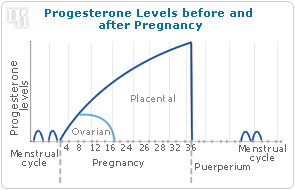
There is a substantial reduction in the partial pressure of carbon dioxide in pregnancy…this fall is found to reach a mean level of 30-32 mmHg and is associated with a 21% increase in oxygen uptake. The physiological hyperventilation of pregnancy is due to the hormonal effect of progesterone on the respiratory center.

In other words, you’re breathing more, you have more blood oxygen, you have less blood CO2, and you’re further away from suffocation. This nicely matches the observation that there’s fewer panic attacks.

According to Klein, “There is a period of extreme hyperventilation during delivery, which drops the blood carbon dioxide to the minimum recorded under nonpathological conditions”. This explains the extreme protective effect of labor against panic disorder, despite labor’s seeming panic-inducing properties. When your CO2 is that low, even an oversensitive suffocation alarm is very far from a position where it might be set off.

(source)

Then you give birth, and progesterone – the hormone that was increasing respiratory drive – falls off a cliff. Your body, which for nine months has been doing very nicely with far more oxygen than it could ever need, suddenly finds itself breathing much less than usual and having a normal CO2/oxygen balance. This explains the hundredfold increased risk of developing panic disorder! Somebody who’s previously never had any reason to think they’re suffocating finds themselves with much less air than they expect (though still the physiologically correct amount of air they need), and if they’ve got any sensitivity at all, their suffocation alarm interprets this as possible suffocation and freaks out.

This can go one of two directions: either it eventually fully readjusts to your new position and becomes comfortable with a merely normal level of oxygen. Or the constant panic and suffocation feelings sensitize it – the same way that my allergy patient’s constant anaphylaxis sensitized him – the alarm develops a higher prior on suffocation and a lower threshold, and the patient gets a chronic panic disorder.

The reason my patient was so interesting was that she was kind of in the middle of this process and had what must have been unusually good introspective ability. Instead of saying “I feel panic”, she said “I feel like I’m suffocating”. This is pretty interesting. It’s like a heart attack patient coming in, and instead of saying “I feel chest pain”, they say “I feel like I have a thrombus in my left coronary artery”. You’re like “Huh, good job”.

So I explained all of this to her, and since she didn’t know I used Google I probably looked very smart. I told her that she wasn’t suffocating, that this was a natural albeit unusual side effect of childbirth, and that with luck it would go away soon. I told her if it didn’t go away soon then she might develop panic disorder, which was unfortunate, but that there were lots of good therapies for panic disorder which she would be able to try. This calmed her down a lot and we were able to send her home with some benzodiazepines for acute exacerbation and some SSRIs which she would stay on for a while to see if they helped. She’s scheduled to see an outpatient psychiatrist for followup and hopefully he will monitor her panic attacks to see if they eventually get better.

IV.

I realize that case reports are usually supposed to include a part where the doctor does something interesting and heroic and tries an experimental new medication that saves the day. And I realize there wasn’t much of that here. But I think that in psychiatry, a good explanation can sometimes be half the battle.

Consider Schachter and Singer (1962). They injected patients with adrenaline (a drug which among other things makes people physiologically agitated) or a placebo. Half the patients were told that the drug would make them agitated. The other half were told it was just some test drug to improve their eyesight. Then a confederate came and did some annoying stuff, and they monitored how angry the patients got. The patients who knew that the drug was supposed to make them angry got less angry than the ones who didn’t. The researchers theorized that both groups experienced physiological changes related to anger, but the patients who knew it was because of the drug sort of mentally adjusted for them, and the ones who didn’t took them seriously and interpreted them as their own emotion.

We can think of this as the brain making a statistical calculation to try to figure out its own level of anger. It has a certain prior. It gets certain evidence, like the body’s physiological state and how annoying the confederate is being. And it controls for certain confounders, like being injected with an arousal-inducing drug. Eventually it makes its best guess, and that’s how angry you feel.

In the same way, the suffocation monitor is taking all of its evidence about suffocation – from very low-level stuff like how much CO2 is in the blood to very high-level stuff like what situation you seem to be in – and then adjusting for confounders like whether you’re exercising. And I wonder whether telling a patient “You’re not actually suffocating, your panic comes from a known physiologic process and here are the hormones that control it” is the equivalent of telling them “You’re not really angry, your agitation comes from us giving you a drug that’s known to produce agitation”. It tells the suffocation alarm computer that this is a confounder to be controlled for rather than evidence on which to update.

I can’t claim to really understand this at a level where it makes sense to me. There are a lot of things that very directly increase CO2 but don’t increase panic, or vice versa. Hyperventilation can either cause or prevent panic depending on the situation. There seems to be something going on where the suffocation monitor controls for some things but not others, but this is an obvious cop-out that allows me to avoid making real predictions or narrowing hypothesis-space.

For example, this theory would seem to predict that waterboarding shouldn’t work. After all, its whole deal is artificially inducing the feeling of suffocation in a situation where the victim presumably knows that the interrogators aren’t going to let him suffocate. You would think that eventually the alarm realizes that “is being waterboarded” is a confounder to control for, but this doesn’t seem to be true.

(on the other hand, the inability to condition yourself seems relevant here. It seems like the brain might be not be controlling for whether something is reasonable, but only for whether something is produced by yourself. So maybe exercise counts because it’s under your control, but waterboarding doesn’t count because it isn’t. I wonder if anyone has ever tried letting someone waterboard themselves and giving them the on-off switch for the waterboarding device. Was Hitchens’ experience close enough to this to count? Why would this be different from letting someone hold their breath, which doesn’t produce the same level of panic?)

But overall I find Klein’s evidence pretty convincing and feel like this must be at least part of the story. And I think that giving this kind of explanation to somebody can comfort them, reassure them, and (maybe) even improve their condition.

Posted in Uncategorized | Tagged | 158 Comments

Determining Consent

A question most people successfully avoid asking: can institutionalized patients ever have sex? The answer is ‘mostly no, unless they are very good at sneaking past nurses’. They also can’t kiss, hold hands, cuddle, or have any other form of romantic contact.

I worked in a mental hospital where two patients snuck past nurses and had sex once. It was treated as a public health crisis of approximately the same urgency as somebody throwing a bucket of Ebola-laced chimp blood all over the dining room. Both patients lost all their privileges, earned themselves 24-7 supervision by nurses, got restricted to their rooms, and had to go through a battery of tests for every STD in the book. We the doctors got remedial training with helpful tips like “If two patients seem to like each other too much, put them on opposite sides of the unit so they’re never in contact.”

Why the security? Mostly the hospital was terrified the patients would come back and sue them for letting it happen. It didn’t matter that they consented at the time; it wouldn’t have mattered if they’d signed consent forms in triplicate beforehand in front of a notary public. Psychiatric patients are treated as having inherently less ability to consent than the mentally intact.

This makes some sense. A lot of mentally ill people are confused and can make bad decisions during the height of their illness. And in this case, the two patients were only temporarily inconvenienced; we treated them for a couple of weeks and then discharged them back to the real world where they could have as much sex as they wanted.

Unfortunately, not all stories end this well. A small percent of very seriously ill people end up in long-term institutions, where they stay anywhere from a few months to a lifetime. And these lifers are sentenced not just to lifetime confinement but to lifetime celibacy.

The most heartbreaking cases are the severely and permanently intellectually disabled. Suppose somebody doesn’t have the intellectual capacity to understand language. This doesn’t mean they lack a sex drive any more than it means they lack a hunger drive. In fact, their sex drive is often stronger than normal – something to do with decreased frontal inhibition, I think. But none of these people are going to be saying “I hereby exercise my right to affirmative consent for sexual activity” anytime soon.

This is a hard problem. If the only people institutionalized patients consistently encounter are hospital staff and other patients, well…we definitely don’t want them having sex with staff. Even non-institutionalized visitors seems like potentially too much of a power imbalance. That leaves other patients. But it seems like most encounters between two patients will involve one of them “initiating” in some sense. And even if we grant that the initiator has implicitly non-verbally consented, what about the one who’s not initiating?

As far as I can tell, there are two ways to handle this. The first is the extreme position that no person beyond a certain level of intellectual disability should ever be allowed to have sex or even non-penetrative romantic contact like kissing or hand-holding. The second is that we need to relax the usual standards of consent to something more like “Well, we know both these people pretty well, and we’ve got a pretty good idea what they’re like when they’re happy versus upset. And we know they have the capacity to resist things they don’t want, because they’ve done it before, eg when we try to give them medications they don’t like. And right now they look pretty happy, and not at all upset, and they’re not doing any of the things they do when they want to resist something, so it looks like they’re consenting, so maybe we won’t send nurses to burst in on them and pry them apart.”

This second one should make us very uncomfortable. But the first one isn’t exactly encouraging either. Like, in the early 20th century a lot of eugenicists sterilized the mentally ill. And by the mid-20th century, people decided that was morally wrong, because parenthood is an important part of the human condition and it’s unacceptable to take away that right even if you believe it’s for a greater good. But I’m not sure it’s moral progress to move from “these people must never become pregnant” to “forget about pregnancy, these people must never even have sex”. If we’re even stricter in our prohibitions than the eugenicists, what right do we have to feel superior to them?

So, as much as I would like a better option, I think I support the second standard. In cases where people are so disabled that they cannot consent verbally, rather than force them into lifelong celibacy we should try to do our best to figure out what they want in other ways.

As best I can tell, this is what Peter Singer is saying in his New York Times editorial on the Stubblefield case. Anna Stubblefield was a professor who believed in “facilitated communication”, a Ouija-board-esque technique whose proponents say it allows them to talk to nonverbal disabled people who can’t communicate any other way, and whose opponents think it’s probably pseudoscience. She used facilitated communication on a nonverbal young man named DJ and “received” the message that he wanted her to have sex with him, so she did. When the story reached the wider non-pseudoscience-believing world, it looked like a pretty obvious case of rape.

Singer seems to think facilitated communication might work, but he thinks Stubblefield’s actions might have been acceptable even if it doesn’t. He says:

If we assume that he is profoundly cognitively impaired, we should concede that he cannot understand the normal significance of sexual relations between persons or the meaning and significance of sexual violation. These are, after all, difficult to articulate even for persons of normal cognitive capacity. In that case, he is incapable of giving or withholding informed consent to sexual relations; indeed, he may lack the concept of consent altogether.

This does not exclude the possibility that he was wronged by Stubblefield, but it makes it less clear what the nature of the wrong might be. It seems reasonable to assume that the experience was pleasurable to him; for even if he is cognitively impaired, he was capable of struggling to resist, and, for reasons we will note shortly, it is implausible to suppose that Stubblefield forcibly subdued him. On the assumption that he is profoundly cognitively impaired, therefore, it seems that if Stubblefield wronged or harmed him, it must have been in a way that he is incapable of understanding and that affected his experience only pleasurably.

Singer’s phrase “cannot understand the normal significance of sexual relations” is a reference to the legal standard for consent in most states, which say that disabled people can consent to sex if and only if they do understand this. What he’s saying is, as far as I can tell, the same thing I said above. Some people may not have the cognitive capcity to understand sex and consent in an intellectual way, but for these people to be forcibly kept celibate their entire lives seems hardly better than the eugenicists who would have just sterilized them and gotten it over with. Instead, we should try to judge their feelings from things like whether “the experience was pleasurable to him” or whether “he was capable of struggling to resist.” Singer’s position – and without knowing the disabled man involved I don’t know if this is true, and some people I trust say it isn’t, but it seems to have been his position – is that this was someone who was incapable of the complex cognitive process of consent, but pretty happy with the whole situation.

I once knew a very extreme libertarian who said that white settlers taking Native Americans’ land wasn’t “theft” because the Native Americans didn’t have a concept of property, so no harm done. I worry that people are misinterpreting Singer as saying the same thing here – something like “this guy doesn’t have a concept of consent, so you can’t violate it”. This is not how I interpret the sentence about consent in the first paragraph of the quote. I think Singer is using “consent” to mean an inherently verbal/symbolic/cognitive process – someone explicitly understands what it means to consent and intentionally expresses that to others. So when I say “we are forced to infer consent from nonverbal rather than verbal cues”, Singer expresses the same idea as “since we can’t use consent, we need to fall back on simpler ideas like those of pleasure versus harm.”

The second paragraph makes it sound like if there was any sign DJ wasn’t okay with what was happening – if he were screaming or resisting or even frowning – Singer would no longer be okay with this. It seems to be Singer’s belief/assumption (though likely false) that DJ’s nonverbal behavior presented strong evidence that he was enjoying the sex and wanted it to continue. When he says that “nobody was harmed”, he’s not saying that disabled people don’t count as somebody. He’s saying that if two people both enjoyed a sex act, both of them seemed to be participating voluntarily, and neither person suffered any physical or emotional harm (including the harm of feeling like one’s preferences were being violated) this is probably the best moral test we can apply in a situation where the usual test of consent is absent.

So of course everybody writes thinkpieces with titles like Now Peter Singer Argues It Might Be Okay To Rape Disabled People:

Again, let’s be clear on what they are saying: if someone is intellectually disabled enough, then it might be okay to rape them, so long as they don’t resist, since a lack of physical struggle justifies an assumption that someone is enjoying being raped. (Singer is also offering a variation on his own prior arguments in favor of bestiality, which work because Singer believes disabled people and animals are the same for purposes of ethical analysis.)

I think it’s a pretty good principle that, if you don’t want to consider disabled people and animals the same for purposes of ethical analysis, you break the equivalence in favor of the disabled people. Yet I notice that when two animals have sex, we trust them to make their own decisions. If a female dog in heat has jumped a fence to find a male dog, and the male dog jumps over his fence and starts humping the female dog, we might separate them because we’re not willing to take care of the puppies, but nobody would separate them because the dogs are just animals and so too stupid to understand the nature of consent. If one of the dogs was screaming and yelping and trying to get away, we would try to rescue it. But if both dogs sought it out and seem to be enjoying themselves, we grant them enough respect to assume they know what they’re doing.

And again, I would hope that part of being against equating dogs and people (of any level of intellectual ability) is that you give more respect to the people. And part of that, to me, seems to be that if two people seek out sex and seem to be enjoying themselves, we grant them enough respect to assume they know what they’re doing. And this seems true whether or not they have the intellectual capacity to form the words “I consent”.

Everything about this situation sucks, and there is no good answer, and honestly I hate to have to talk about this. But since people keep asking me, fine, here’s what I think.

From a legal point of view, Anna Stubblefield should absolutely 100% go to jail. Whether or not DJ wanted sex with her is irrelevant. Even if he did (and we have no evidence other than the testimony of the alleged rapist that this is the case) she committed an action which put her at extreme risk for raping somebody, without any system in place to minimize that risk. A world where people can go around having sex with random disabled people as long as they say “I’m pretty sure he was in favor of it” is a world where many disabled people who are not in favor of it will end up being raped. As long as that’s the situation, the law against doing so is just and needs to be enforced. I think I legitimately disagree with Singer on this.

(also, she was his translator and that creates a power imbalance. I don’t want to get into this further because I don’t think it relates to the thesis here, but it’s obviously an important point.)

From a political point of view, I wish there were a system in place to protect disabled people from sexual abuse while not banning all sexuality entirely. If you want to do surgery on a disabled person who can’t consent, lots of doctors and lawyers and friends and family get together and do some legal stuff and try to elicit information from the patient as best they can and eventually come to a conclusion. The result isn’t perfect, but it’s a heck of a lot better than either “no one can ever operate on a disabled person” or “any surgeon who wants can grab a disabled person off the street and do whatever operation they feel like”. If there were some process like this for sex, and they decided that DJ wanted to have sex with Anna, then (again ignoring the power dynamics issue) I think this would be better than either banning him from all sex forever, or letting her have sex with whoever she wants as long as she can make up convincing enough pseudoscience. If a legal procedure like this had been followed, I would not think that she should go to jail.

From an ethical point of view, I think it’s correct to abstract away all the features of the problem mentioned above, the same as we avoid issues of how well you understand the physics involved when we think about the Fat Man problem (or, as the Internet likes to call it, “Now Judith Thompson Argues It Might Be Okay To Throw Obese People In Front Of Trains”). In this abstract and conditional world, the question is whether we must completely prohibit someone from having any kind of sexual life if they’re unable to verbally consent but able to give reliable cues that they want the sex and are enjoying themselves. I think the answer is “not always”. I agree it is probably bad to connect this abstract ethical view to a real case where real people are harmed unless you are very sure that all of your assumptions hold true, homework which it looks like Singer might not have done.

From a philosophical point of view, I think that if we are to be at all better than the BETA-MEALR Party, we need to acknowledge that we are not promoting consent if we enforce the same position on everybody no matter how strongly they seem to want the opposite, even if we talk incessantly about how much we love consent while we’re doing so.

The Current Affairs article argues that Singer’s views discredit utilitarianism, since utilitarians are these annoying people who always seem to be coming to weird conclusions that would be much more convenient to ignore. I agree that Singer’s views are related to his utilitarianism, and that this philosophy produces more than its share of weird conclusions that would be more convenient to ignore.

But ignorance isn’t a suitable foundation for ethics. It’s incredibly easy to ignore disabled people being sentenced to a life of involuntary celibacy, because ignoring marginalized people is always easy and convenient, plus enforced celibacy isn’t the same sort of flashy human rights violation that has a death toll in the thousands and helps sell newspapers. People who cobble together their moral systems from whatever helps them ignore bottomless pits of suffering most effectively will always have more convenient and presentable moral systems than people who don’t. But if we’re going to try to be good, we need to work for something better.

SSC Meetups Everywhere: Times And Places

Thanks to everyone who offered to host a meetup. We’re scheduled for meetups in 62 cities in 16 countries, so…wow. Full list of cities, times, and places is below.

Some tips from past experience with these meetups:

1. If you’re the host, bring a sign that says “SSC MEETUP” and prop it up somewhere on a table
2. Bring blank labels and pens for nametags.
3. Pass around a paper where everyone gives their name and email address, so you can start a mailing list to make organizing future meetups easier
4. If it’s the first meetup, people are probably just going to want to talk, and if you try to organize some kind of “fun” “event” it’ll probably just be annoying.
5. Some things that have worked for later meetups include people giving short presentations on topics of interest to them, or discussion of some particular blog post
6. Nothing is going to get done unless there’s a Schelling point for who has to do it, and right now that’s the meetup organizer.
7. It’s ten times easier to schedule a second meetup while you’re having the first compared to trying to do it later on by email
8. Some cities have existing LW meetup groups you might want to coordinate with
9. Surprisingly many people will love you forever if you bring stim toys
10. In case people want to get to know each other better outside the meetup, you might want to mention reciprocity.io, the rationalist friend-finder/dating site.

On the list below, places marked with [LW] are preexisting Less Wrong meetups that have volunteered to specifically welcome SSC readers on the date listed. The other ones are new.

Amsterdam
Additional search keywords: Netherlands
Time: Saturday, April 8, 7 PM
Location: Prins Hendrikkade 85, Cafe Batavia
Contact: sonny.public[at]gmail.com

Ann Arbor [LW]
Time: Saturday, April 8, 4 PM
Location: 2065 Commerce Blvd #327
Contact: azure[at]eclectic.blue

Atlanta
Time: Sunday April 9, 7 PM
Location: 240 North Highland Ave H, Inman Perk Coffee Shop
Contact: tom.hennessy[at]gmail.com, Facebook event

Austin [LW]
Time: Saturday April 8, 1:30 PM
Location: 4001 N Lamar Blvd, North Lamar Central Market in-store cafe
Contact: Google group

Baltimore [LW]
Time: Sunday April 9, 8 PM
Location: UMBC Performing Arts & Humanities Building, 4th floor
Contact: lw[at]noblejury.com

Berlin [LW]
Time: Sunday April 23, 7 PM
Location: Gaststätte Walhalla, Krefelderstr.6, 10555 Berlin, Germany
Contact: Marcel Ackermann, Facebook event

Berkeley
Time: Sunday April 9, 2 PM
Location: 21 Shattuck Ave, 85C Bakery Cafe, probably upstairs
Contact: brianwang712[at]gmail.com

Birmingham (UK)
Time: Saturday April 8, 12 noon
Location: Bacchus Bar, Burlington Arcade, B2 4JH
Contact: Email

Boston
Additional search keywords: Cambridge (US)
Time: Saturday April 15, 2 PM
Location: MIT 4-149
Contact: Taymon, Facebook event

Brisbane
Time: Friday, April 14, 7 PM
Location: 26 Felix Street, Oaks Felix
Contact: jarred.filmer[at]gmail.com

Budapest
Time: Saturday April 8, 2:30 PM
Location: Dohány utca 7, Corvinus Cafe
Contact: a.pearson.851[at]hotmail.com

Cambridge (UK)
Time: Monday, April 24, 6 PM
Location: Norfolk Street, CB2 Bistro
Contact: rlm72[at]cam.ac.uk, RSVP form

Canberra
Time: Saturday April 8, 11 AM
Location: Cafe Cherry Bean in Gungahlin
Contact: Nathan.ashby[at]yahoo.com.au

Charlotte
Time: Tuesday April 25, 12 noon
Location: 545 Providence Road, Starbucks on 3rd
Contact: James[at]limetribe.com

Chicago [LW]
Time: Sunday April 9, 1 PM
Location: 1116 E 59th St, Harper Memorial Library, Room 148
Contact: mingyuan[at]uchicago.edu, Facebook event

Cleveland
Time: Sunday April 9, 2 PM
Location: 11150 East Boulevard, Museum of Art atrium
Contact: robintanenbaum[at]gmail.com

Columbus
Time: Saturday, April 15, 2 PM
Location: 1277 Grandview Ave, Grandview Heights, OH. Stauf’s Coffee
Contact: j.thomas.moros[at]gmail.com

Cologne [LW]
Time: Sometime in late April? The 22nd? The 29th? Contact Marcel below.
Location: “A private location”. Contact Marcel below.
Contact: marcel_mueller[at]mail.de

Copenhagen
Additional search keywords: Denmark
Time: Saturday April 8, 6 PM
Location: Von Fressen, 124 Vesterbrogade, 1620 København
Contact: soeren.elverlin[at]gmail.com, 29263141, please RSVP

Dallas
Time: Saturday April 15, 2 PM
Location: 3700 McKinney Ave #108, Brewed & Pressed
Contact: ???

Denver [LW]
Time: Tuesday April 4, 7 PM (and generally the first Tuesday of every month)
Location: 4955 S Ulster St, Darcy’s
Contact: embrodski[at]gmail.com

Dublin
Additional search keywords: Ireland
Time: Wednesday, April 12, 6 PM
Location: O’Neills, Pearse Street, Dublin 2.
Contact: egoburnswell[at]gmail.com

Edinburgh
Time: Sunday April 23, 6 PM
Location: 14 Drummond Street, The Brass Monkey
Contact: marian.andrecki[at]gmail.com, Facebook event

Edmonton
Time: Saturday April 15, 2 PM
Location: 8631 109 St NW, the Remedy in Garneau
Contact: alt.acct[at]gmx.com

Fullerton
Additional search keywords: Orange County, Irvine, Southern California
Time: Wednesday April 12, 6 PM
Location: 800 N State College Blvd, Cal State Fullerton’s Titan Student Unin, downstairs near bowling alley
Contact: mondayrhymer[at]gmail.com

Helsinki
Time: Monday April 10, 4 PM
Location: Oluthuone Kaisla, Vilhonkatu 4
Contact: sschelsinkimeetup[at]gmail.com

Houston
Time: Wednesday, April 26, 5 PM
Location: 300 Main St, Honeymoon Cafe & Bar
Contact: ssc[at]donnieclapp.com, RSVP form

Istanbul
Additional search terms: Constantinople, Byzantium
Time: Tuesday, April 11, 8 PM
Location: Plaza in the middle of Bomontiada
Contact: ssc[at]briancloutier.com

Kansas City
Time: Saturday May 6, 1 PM
Location: Loose Park, pavillion/rose garden
Contact: a.l.whitespace[at]gmail.com

London
Time: Sunday 30th April, 2pm
Location: Shakespeare’s Head, Holborn (On Kingsway, just south of the tube station – NOT the Shakespeare’s Head in Soho.)
Contact: philip.hazelden[at]gmail.com, Facebook group

Los Angeles [LW]
Time: Wednesday April 5, 7 PM
Location: 10850 West Pico at Westwood Boulevard, Wine Bar At The Landmark
Contact: Google group

Miami
Time: Saturday, April 29, 5 PM
Location: 2390 NW 2nd Ave, Panther Coffee
Contact: eric135033[at]gmail.com

Milwaukee
Time: Saturday, April 8, 1 PM
Location: 2301 S Kinnickinnic Ave, Colectivo Coffee Shop
Contact: ???

Minneapolis
Time: Saturday, May 20, 10 AM
Location: 425 14th Ave SE, Dinkytown Starbucks
Contact: piers199[at]umn.edu

Madison
Time: Sunday, April 9, 7 PM
Location: 114 State Street, Michelangelo’s Coffee House
Contact: nathanielbude[at]gmail.com

Montreal
Time: Friday, April 14, 6 PM
Location: 1191 Avenue Hope (private residence)
Contact: mathieu.roy.37[at]gmail.com, Facebook event

New Haven
Time: Saturday April 8, 2 PM
Location: 1140 Chapel, Book Trader Cafe
Contact: elizah.stein[at]gmail.com

New York City
Additional search keywords: NYC
Time: Saturday April 22, 2 PM
Location: 353 W 14th St, Gansevoort Market, main seating area at north end
Contact: ???

Online
Additional search keywords: Africa
Time: Monday, May 15, 4 PM South Africa time (UTC+2)
Location: This Google Hangout link
Contact: dazuck@gmail.com

Ottawa
Time: Saturday April 15, 3 PM
Location: 361 Elgin at Gladstone, Lieutenant’s Pump
Contact: conor.meade[at]gmail.com

Oxford
Time: Wednesday April 12, 7 PM
Location: Swan & Castle OX1 1LJ
Contact: hbesceli[at]gmail.com

Paris
Time: Saturday April 8, 2 PM
Location: MĂ©tro 12 Mairie d’Issy, private residence, contact number below for full address
Contact: 0659427285

Philadelphia
Time: Saturday April 15, 2 PM
Location: 100 S Independence Mall (6 & Market), La Colombe Coffee
Contact: wfenza[at]gmail.com, (856) 441-0937, Facebook event

Phoenix
Time: Saturday April 8, noon
Location: Granada Park (20th St and Bethany Home, right off the 51)
Contact: spinystellate1[at]gmail.com

Pittsburgh
Time: Saturday April 8, 2 PM
Location: 4327 Butler St, Floor 2, Catapult Coworking
Contact: matthewfmarks[at]gmail.com

Portland
Time: Saturday April 8, 12:30 PM
Location: 2505 SE 11 Ave #101, Ford Food & Drink
Contact: nwalton125[at]gmail.com

Raleigh
Additional search keywords: Research Triangle, Chapel Hill, Durham, North Carolina
Time: Thursday April 6, 7 PM
Location: 328 Morgan St, Flying Saucer
Contact: mpobrie3[at]ncsu.edu

Rochester, New York
Time: Sunday April 9, 1 PM
Location: 200 East Avenue, SPoT Coffee
Contact: thecommexokid[at]gmail.com

Sacramento
Time: Saturday April 8, 6 PM
Location: 1730 L St, Midtown Crepeville
Contact: trevoradf[at]gmail.com.

Salt Lake City
Time: Saturday April 8, 1:30 PM
Location: 1766 Main St, Pho Tay Ho
Contact: ???

San Diego
Time: Saturday April 22, 4 PM
Location: 4876 Santa Monica Avenue, Lazy Hummingbird
Contact: the.god.empress.celestia[at]gmail.com

San Francisco [LW]
Time: Monday April 10, 6:15 PM
Location: Check here or ask contact below
Contact: rocurley[at]gmail.com, (301) 458-0764, Facebook event

San Jose, California
Time: Sunday April 9, 2 PM
Location: 3806 Williams Rd (private residence)
Contact: ddfr[at]daviddfriedman.com, (408) 244-3330

Sao Paulo [LW]
Time: 2017-05-06, Saturday, 2PM (Local time, i.e. GMT-0300)
Place:Contact: gusbicalho[at]gmail.com, mailing list

Seattle
Time: Sunday April 30, 12 noon
Location: 2325 42nd Ave E (private residence)
Contact: Facebook event

St. Louis
Time: Sunday April 23, 1 PM
Location: 3974 Hartford St, Hartford Coffee
Contact: brerwolf[at]gmail.com

Stockholm
Time: Saturday April 8, 3 PM
Location: Stora Nygata 31, Cafe Dox
Contact: erik.e.engelhardt[at]gmail.com, Meetup page

Sydney [LW]
Time: Thuresday April 20, 6 PM
Location: 565 George Street, City of Sydney RSL, level 2, big table by the pizza oven
Contact: 0438481143

Tel Aviv
Additional search keywords: Israel, Haifa, Jerusalem
Time: Tuesday, May 9, 7 PM
Location: Yigal Alon 118, “The Cluster”, entrance is from Totseret Ha’aretz street through a brown door, if closed ring the doorbell and someone will let you in
Contact: top.squark[at]gmail.com, Facebook event

Toronto
Time: Saturday April 22, 1 PM
Location: 27 Wellesley Street East, The Fox and the Fiddle, 3rd floor
Contact: Daniel.mm.frank[at]gmail.com

Vienna [LW]
Additional search keywords: Prague, Bratislava, Austria, Czech, Slovakia
Time: Saturday April 15, 3 PM
Location: KaisermĂĽhlenstraĂźe 24, meetup room on back of ground floor, 1220 Vienna
Contact: strivingforconsistency[at]gmail.com

Warsaw
Time: Saturday April 22, 5 PM
Location: Panstwo Miasto, Andersa 29 (Pokoj Spotkan),
Contact: michal.trzesimiech[at]gmail.com

Washington DC
Time: Saturday April 15, 7 PM
Location: 450 Massachussetts Ave NW, The Meridian at Gallery Place, roof/14th floor lounge (private residence)
Contact: robirahman94[at]gmail.com

Washington DC secondary option [LW]
Time: Sunday April 23, 3:30 PM
Location: 8th St NW & F St NW, Portrait Gallery Courtyard
Contact: lesswrong-dc[at]googlegroups.com, Facebook group

Wellington
Additional search keywords: New Zealand
Time: Thursday, April 20, Roti Chennai, 6 PM
Location: 14 Leeds St, Te Aro – Golding’s
Contact: calebwithers[at]gmail.com, please RSVP to that address if you’re coming

Zurich [LW]
Additional search keywords: Switzerland
Time: Saturday April 8, 5 PM
Location: Tibits Oerlikon, Tramstrasse 2, 8050,
Contact: ???

Posted in Uncategorized | Tagged | 114 Comments

G.K. Chesterton On AI Risk

[An SSC reader working at an Oxford library stumbled across a previously undiscovered manuscript of G.K. Chesterton’s, expressing his thoughts on AI, x-risk, and superintelligence. She was kind enough to send me a copy, which I have faithfully transcribed]

The most outlandish thing about the modern scientific adventure stories is that they believe themselves outlandish. Mr. H. G. Wells is considered shocking for writing of inventors who travel thousands of years into the future, but the meanest church building in England has done the same. When Jules Verne set out to ‘journey to the center of the earth’ and ‘from the earth to the moon’, he seemed but a pale reflection of Dante, who took both voyages in succession before piercing the Empyrean itself. Ezekiel saw wheels of spinning flame and reported them quite soberly; our modern writers collapse in rapture before the wheels of a motorcar.

Yet if the authors disappoint, it is the reviewers who dumbfound. For no sooner does a writer fancy himself a Poe or a Dunsany for dreaming of a better sewing machine, but there comes a critic to call him overly fanciful, to accuse him of venturing outside science into madness. It is not enough to lower one’s sights from Paradise to a motorcar; one must avoid making the motorcar too bright or fast, lest it retain a hint of Paradise.

The followers of Mr. Samuel Butler speak of thinking-machines that grow grander and grander until – quite against the wishes of their engineers – they become as tyrannical angels, firmly supplanting the poor human race. This theory is neither exciting nor original; there have been tyrannical angels since the days of Noah, and our tools have been rebelling against us since the first peasant stepped on a rake. Nor have I any doubt that what Butler says will come to pass. If every generation needs its tyrant-angels, then ours has been so inoculated against the original that if Lucifer and all his hosts were to descend upon Smithfield Market to demand that the English people bend the knee, we should politely ignore them, being far too modern to have time for such things. Butler’s thinking-machines are the only tyrant-angels we will accept; fate, ever accommodating, will surely give them to us.

Yet no sooner does Mr. Butler publish his speculations then a veritable army of hard-headed critics step forth to say he has gone too far. Mr. Maciej Ceglowski, the Polish bookmark magnate, calls Butler’s theory “the idea that eats smart people” (though he does not tell us whether he considers himself digested or merely has a dim view of his own intellect). He says that “there is something unpleasant about AI alarmism as a cultural phenomenon that should make us hesitate to take it seriously.”

When Jeremiah prophecied Jerusalem’s fall, his fellow Hebrews no doubt considered his alarmism an unpleasant cultural phenomenon. And St. Paul was not driven from shore to shore because his message was pleasant to the bookmark magnates of his day. Fortified by such examples, we may wonder if this is a reason to take people more seriously rather than less. So let us look more closely at the contents of Mr. Ceglowski’s dismissal.

He writes that there are two perspectives to be taken on any great matter, the inside or the outside view. The inside view is when we think about it directly, taking it on its own terms. And the outside view is when we treat it as part of a phenomenon, asking what it resembles and whether things like it have been true in the past. And, he states, Butler’s all-powerful thinking machines resemble nothing so much as “a genie from folklore”.

I have no objection to this logic, besides that it is not carried it to its conclusion. The idea of thinking machines resembles nothing so much as a fairy tale from the Arabian Nights, and such fairy tales inevitably come true. Sinbad’s voyages have been outstripped by Magellan’s, Abdullah’s underwater breathing is matched by Mr. Fleuss’ SCUBA, and the Wright brothers’ Flyer goes higher than any Indian carpet. That there are as yet no genies seems to me less an inevitable law than a discredit to the industry of our inventors.

There is a certain strain of thinker who insists on being more naturalist than Nature. They will say with great certainty that since Thor does not exist, Mr. Tesla must not exist either, and that the stories of Asclepius disprove Pasteur. This is quite backwards: it is reasonable to argue that the Wright Brothers will never fly because Da Vinci couldn’t; it is madness to say they will never fly because Daedalus could. As well demand that we must deny Queen Victoria lest we accept Queen Mab, or doubt Jack London lest we admit Jack Frost. Nature has never been especially interested in looking naturalistic, and it ignores these people entirely and does exactly what it wants.

Now, scarce has one posited the possibility of a genie, before the question must be asked whether it is good or evil, a pious genie or an unrighteous djinn. Our interlocutor says that it shall be good – or at least not monomaniacal in its wickedness. For, he tells us, “complex minds are likely to have complex motivations; that may be part of what it even means to be intelligent”. A dullard may limit his focus to paper clips, but the mind of a genius should have to plumb the width and breadth of Heaven before satiating itself.

But I myself am a dullard, and I find paper clips strangely uninteresting. And the dullest man in a country town can milk a cow, pray a rosary, sing a tune, and court a girl all in the same morning. Ask him what is good in life, and he will talk your ear off: sporting, going for a walk in the woods, having a prosperous harvest, playing with a newborn kitten. It is only the genius who limits himself to a single mania. Alexander spent his life conquering, and if he had lived to a hundred twenty, he would have been conquering still. Samuel Johnson would not stop composing verse even on his deathbed. Even a village idiot can fall in love; Newton never did. That greatest of scientists was married only to his work, first the calculus and later the Mint. And if one prodigy can spend his span smithing guineas, who is to say that another might not smith paper clips with equal fervor?

Perhaps sensing that his arguments are weak, Ceglowski moves from the difficult task of critiquing Butler’s tyrant-angels to the much more amenable one of critiquing those who believe in them. He says that they are megalomanical sociopaths who use their belief in thinking machines as an excuse to avoid the real work of improving the world.

He says (presumably as a parable, whose point I have entirely missed) that he lives in a valley of silicon, which I picture as being surrounded by great peaks of glass. And in that valley, there are many fantastically wealthy lords. Each lord, upon looking through the glass peaks and seeing the world outside with all its misery, decides humans are less interesting than machines, and fritters his fortune upon spreading Butlerist doctrine. He is somewhat unclear on why the lords in the parable do this, save that they are a “predominantly male gang of kids, mostly white, who are…more comfortable talking to computers than to human beings”, who inevitably decide Butlerism is “more important than…malaria” and so leave the poor to die of disease.

Yet Lord Gates, an avowed Butlerite, has donated two billion pounds to fighting malaria and developed a rather effective vaccine. Mr. Karnofsky, another Butlerite, founded a philanthropic organization that moved sixty million pounds to the same cause. Even the lowly among the Butlerites have been inspired to at least small acts of generosity. A certain Butlerite doctor of my acquaintance (whom I recently had to rebuke for his habit of forging pamphlets in my name) donated seventy-five hundred pounds to a charity fighting malaria just last year. If the hardest-headed critic has done the same, I shall eat my hat1. The proverb says that people in glass houses should not throw stones; perhaps the same is true of glass valleys.

I have met an inordinate number of atheists who criticize the Church for devoting itself to the invisible and the eternal, instead of to the practical and hard-headed work of helping the poor on Earth. They list all of the great signs of Church wealth – the grand cathedrals, the priestly vestments – and ask whether all of that might not better be spent on poorhouses, or dormitories for the homeless. In vain do I remind them that the only place in London where a poor man may be assured of a meal is the church kitchens, and that if he needs a bed the first person he will ask is the parish priest. In vain do I mention the saintly men who organize Christian hospitals in East Africa. The atheist accepts all of it, and says it is not enough. Then I ask him if he himself has ever given the poor a shilling, and he tells me that is beside the point.

Why are those most fixated on something vast and far away so often the only ones to spare a thought for the poor right beside them? Why did St. Francis minister to the lepers, while the princes of his day, seemingly undistracted by the burdens of faith, nevertheless found themselves otherwise engaged? It is simply this – that charity is the fruit of humility, and humility requires something before which to humble one’s self. The thing itself matters little; the Hindoo who prostrates himself before elephants is no less humble than the Gnostic who prostrates himself before ultimate truth; perhaps he is more so. It is contact with the great and solemn that has salutary effects on the mind, and if to a jungle-dweller an elephant is greatest of all, it is not surprising that factory-dwellers should turn to thinking-machines for their contact with the transcendent.

And it is that contact which Mr. Ceglowski most fears. For he thinks that “if everybody contemplates the infinite instead of fixing the drains, many of us will die of cholera.” I wonder if he has ever treated a cholera patient. This is not a rhetorical question; the same pamphlet-forging doctor of my acquaintance went on a medical mission to Haiti during the cholera epidemic there. It seems rather odd that someone who has never fought cholera, should be warning someone who has, that his philosophy prevents him from fighting cholera.

And indeed, this formulation is exactly backward. If everyone fixes drains instead of contemplating the infinite, we shall all die of cholera, if we do not die of boredom first. The heathens sacrificed to Apollo to avert plague; if we know now that we must fix drains instead, it is only through contemplating the infinite. Aristotle contemplated the infinite and founded Natural Philosophy; St. Benedict contemplated the infinite and preserved it. Descartes contemplated the infinite and derived the equations of optics; Hooke contemplated infinity and turned them into the microscope. And when all of these infinities had been completed – the Forms of Plato giving way to the orisons of monks, the cold hard lines of the natural philosophers terminating in the green hills of England to raise smokestacks out of empty fields – then and only then did the heavens open, a choir of angels break into song, and a plumber fix a drain.

But he is not trapped in finitude, oh no, not he! What is a plumber but one who plumbs infinite depths? When one stoops to wade among the waste and filth to ensure the health of his fellow men, does he not take on a aspect beyond the finite, a hint of another One who descended into the dirt and grime of the world so that mankind might live? When one says that there shall certainly never be thinking-machines, because they remind him too much of God, let that man open his eyes until he is reminded of God by a plumber, or a symphony, or a dreary Sunday afternoon. Let him see God everywhere he looks, and then ask himself whether the world is truly built so that grand things can never come to pass. Mr. Butler’s thinking-machines will come to pass not because they are extraordinary, but precisely because they are ordinary, in a world where extraordinary things are the only constant of everyday life.

[1: EDIT 4/2: Mr. Ceglowski wants to clarify that he does in fact give to charity]

Posted in Uncategorized | Tagged , , | 140 Comments