

This is the bi-weekly visible open thread. Post about anything you want, ask random questions, whatever. You can also talk at the SSC subreddit or the SSC Discord server.
This is the bi-weekly visible open thread. Post about anything you want, ask random questions, whatever. You can also talk at the SSC subreddit or the SSC Discord server.
SSC’s review of postmodernism got very mixed reviews. Some of them made a good point: why should I be trying this at all? I’m not a postmodernist, I’m not a philosophy professor, surely someone much more qualified has already written a blog-post-length explanation of postmodernism.
This is all true. My only excuse is that trying to figure out complicated concepts requires a different approach than trying to teach simple ones.
Some knowledge is easy to transfer. “What is the thyroid?” Some expert should write an explanation, anyone interested can read it, and nobody else should ever worry about it again.
Other knowledge is near-impossible to transfer. What about social skills? There are books on social skills. But you can’t just read one and instantly become as charismatic as the author. At best they can hint at areas worth exploring.
There are lots of books about social skills, and there should be lots of them – I don’t know which social skills book is the best, but it doesn’t obsolete all the others. Maybe it’s because you need a kind of triangulation – one person’s views on social skills give you one perspective, another person’s views on social skills give you another perspective, and after reading enough different books you can sort of make out the shape of the territory in question. Maybe it’s about different people having different problems and deficiencies, but our language is imprecise enough that they all get called “Social Skills” and it won’t help unless you stumble across the one solving your specific issue. Or maybe it’s about different people’s minds working in different ways, so that you can only make sense of a book by someone who thinks like you – whose mind groups things into the same concepts as yours, so that you can import them over directly. There are some Social Skills For Autistic People books out there, and the autistic people I know say they’re much more helpful than the generic-brand. Autism is a well-circumscribed thing; how many less-well-circumscribed groups are out there with similar needs?
Complicated ideas are like this too. I remember reading a mathematician talking about how there were two different-but-equivalent formulations of some high-level mathematical concept – let’s say an algebraic one vs. a geometric one. He’d always learned it as the algebraic one and had only the slipperiest grasp on it. Then one day he read a textbook presenting the equivalent geometric version, and it made perfect sense; he really understood it, could mentally manipulate it, could think creatively with it and make progress. He wondered why everybody didn’t teach the geometric version first. Another mathematician responded that he had the same story – except that for him, he’d learned the geometric version first, hated it, and only really been able to make progress once he learned the algebraic version. Then a third mathematician chimed in, said that both the geometric and algebraic version had confused her, but that in some obscure textbook she was able to find a third equivalent formulation she thought was better than either.
My own version of this experience was reading Eliezer Yudkowsky’s A Human’s Guide To Words, which caused a bunch of high-level philosophical ideas to slip neatly into place for me. Last week David Chapman wrote about what was clearly the same thing, even centering around the same key example of whether Pluto is a planet. A Gender Studies major I know claims (I can’t confirm) that the same thing is a major part of queer theory too. But Chapman’s version and queer theory don’t make a lot of sense to me; I was able to understand the former only because I already knew what he was talking about, and I have to take any statements about the latter on pure faith. On the other hand, nobody else seems to have found Guide To Words as important as I did; I don’t see paeans to it all over, nobody’s offering Eliezer any Nobel Prizes. It was a perfect fit for where my mind was at that moment – but there are probably a hundred other versions equally objectively good, some of which don’t even realize they’re versions of the same thing.
To carry on the analogy to social skills: even after reading the best, most perfect-fit social skills book in the world, it’s still not going to be enough. People need to ask questions. Both in my psychiatrist role and my community-member role, I have to answer (and sometimes ask) a lot of “Hey, is this socially acceptable? What’s the best way to behave here?” type questions.
And questioning requires mental fit at least as much as straight information-transfer does. Speaking of having poor social skills, I remember what I used to be like in college. A professor would say something that didn’t make any sense to me. I at least had the social skills to avoid saying “that doesn’t make any sense”, so I would raise my hand and ask the professor “Excuse me, I don’t understand what Aristotle meant when he said everything had a telos. Do snails have telos? Do air molecules? Does a random rock?” The professor would mumble something kind of meaningless that didn’t answer the question, and again being too polite to say so, I would say “I’m not quite sure what you meant by that ‘only specific things have a telos’. Which specific things are you talking about? How would we figure out which ones?” And then so on, until I became more and more exasperated with the professor seemingly giving irrelevant responses or completely misunderstanding my questions, and the professor started thinking I was some sort of hostile troll trying to embarrass him. I quickly learned that there were some professors, tutors, and fellow students who would immediately understand what I was asking and answer as best they could, and others who would go through the motions of answering while leaving me even more confused than before.
And continuing on the social skills analogy even further: at some point you have to go to a party, try out what you know, and totally humiliate yourself. The intellectual version is something like steelmanning – you try to construct the position you’re trying to understand as best you can, then see if it sounds right to people who know about it.
One of the great things about the old Less Wrong was that it was a community built for this kind of thing. A bunch of people with a certain worldview and way-of-thinking explained some curated hard-to-understand knowledge to other people who also shared their worldview and way-of-thinking. Then they discussed it among themselves, questioned it back and forth, agreed or disagreed with it, and absorbed it in a social way. This is also what I’m trying to do with SSC. The knowledge itself may or may not be original – I think at a certain level of complexity “originality” becomes hard to monitor (what percent of the 10,000 psychology books that have been published are truly “original”?). But it’s packaged slightly differently than what’s come before, and it’s well-targeted at a community of people who have the right mental fit to absorb it and then refine it among themselves.
Some of the academics I know say similar things about their own field. It’s not just that you have to read lots of books, although you do. It’s the experience of working with an advisor and other grad students, of coming up with theories and having them be shot down. Two stories I’ve heard from multiple grad student friends: “I spent two months working on something really cool, and in the first thirty seconds of presenting it to my advisor she came up with a simple proof it could never work” and “I spent two months working on something really cool, and in the first thirty seconds of presenting it to my advisor, she said ‘Oh yeah, that’s Smith’s Lemma, very exciting when it was published forty years ago.'” But eventually you come out of it not just with book learning, but with the thought-patterns and methods of a field baked into your brain, a strong sense of what is or isn’t interesting, can or can’t be done.
The spiritual traditions seem to endorse some similar process. They have some complicated thing you’re supposed to ‘get’ – enlightenment, gnosis, whatever. They make a big deal of how it’s useless to communicate in words. But they also make a big deal of reading the scriptures, of having teachers, of the importance of back-and-forth conversations with teachers beyond just reading books and listening to lectures. So you read lots of sutras, and you do lots of meditation, and you talk to your guru a lot, and then suddenly (at least in some traditions), it makes sense. You see a falling leaf, or you hear a raindrop, or someone hits you with their stick, or something else that’s never the same for two different people, and you get it. I know the suddenness aspect is exaggerated, I know there are some traditions that say it’s not like this at all, but they all share this view of a knowledge which can’t be mass produced through traditional educational methods.
Maybe this is on my mind because of the recent post on Kolmogorov complicity. Some people asked – why can’t people just figure out what’s taboo, either believe it quietly or reject it openly, and then shut up about it? And part of the answer has to be that the process of coming to understand a field at all has to involve this pattern of back-and-forth questioning, approaching from multiple sides, devil-advocating, etc. Lots of the process will look the same whether you end out ultimately rejecting or accepting a truth; you’ve got to go through the same steps just to understand what you’re considering.
The Internet seems like an increasingly hostile place for this sort of thing. I can’t remember how many times I’ve read an essay I really liked and appreciated only to see somebody mocking it for “reinventing the wheel”. Oddly enough, none of these people ever point out who said the thing first, or what its standard name is. Maybe they think it’s too obvious to mention? Or, if someone screws up, or asks a stupid question, it gets screenshotted and goes viral all over Twitter as “Look what this stupid person said now!” I will admit being complicit in this – I get really nervous whenever someone posts something unsophisticated in the comments here or on the subreddit, because I’m worried it will go viral as an example of “what those people at Slate Star Codex believe”. I’m not even talking about offensive things here! Just stupid ones!
There’s an awkward tension between blogs and comments as “something some random person has typed into a box on the Internet” vs. “strong claim to authority and of being worthy to educate everyone else”. Offline it’s easier to distinguish these sorts of things – tone of voice, what kind of situation you’re in, whether you preface it awkwardly with “This is stupid, but…”, whether you’re just talking to your equally-stoned friend. On the Internet, having a blog gives this aura of “Hey, I’m going to educate you about things using my superior knowledge”. I try to fight that with epistemic status tags explaining when things are tentative or just me looking for feedback, but I guess maybe these are sometimes hard to believe. Sometimes they just earn more anonymous hate: “If you’re admitting you’re too stupid to have an opinion on this, you must be really stupid to give it anyway!”
This is a shame. The authoritative-lecture format works for facts, but isn’t enough when you’ve got any subject more complicated than thyroid anatomy. Collaborative truth-seeking where people are throwing out ideas, trying to reconstruct arguments themselves, asking questions, and arguing – these are more promising, but they leave you open to accusations of reinventing the wheel, arrogantly dabbling in fields you don’t understand, or being too insular. When some of the topics involved are taboo, add the sins of “just asking questions” or “thinking it’s my job to educate you”. But unless you’re such a good lecturer that everybody will understand you on the first try, this is a necessary part of communicating hard things.
EDIT: Been told by people I trust that this is not a good explanation. Retracted.
Ulpian’s life table is the closest thing we have to actuarial data from ancient Rome. Key quote: “Although Keith Hopkins called the table not ‘demographically possible’, it corresponds well to other observed populations with abnormally high mortality rates (such as postwar Mauritius), and to a priori constructions of plausible Roman age structures. In any case, the picture they present is appalling: a society with one of the highest mortality rates on record, with a predicted life expectancy at birth of between 19 and 23.”
Vaughan Bell of MindHacks on good and bad criticisms of psychiatric diagnosis. Interesting to me for the “Psychiatric diagnoses are not reliable” section, which shows that although you can’t get reliable diagnoses out of ordinary practice, you can get them from structured interviews. Which no one does.
Chinese censorship expands to group chats in response to dissidents turning them into “lecture halls” for banned material. Related: China cracks down on Winnie-The-Pooh for purported resemblance to Chinese president Xi Jinping.
Independent: “each day, a cruise ship emits as much particulate matter as a million cars. They say that “30 cruise ships pollute as much as all the cars in the UK”, but I wonder if that’s true – eg if particulate matter is the relevant kind of pollution, and how much pollution in the middle of the ocean compares to in major cities. Probably can’t just ban cruise ships and then stop worrying about car pollution so much.
If you like your questionable science served with a side of other questionable science, here’s MBTI Facial Phenotypes, the average face appearance for each of the Myers-Briggs types (eg “ESTJ”, “INFP”, etc)
Man accused of being D. B. Cooper, the famous hijacker who held an airplane hostage, parachuted out with the money, and was never seen again.
Investigative reporter finds that drug offenders sent to “rehab” instead of prison often end up in privately-owned work camps with a thin veneer of rehabness, where they’re exploited as slave labor in terrible conditions. The camps claim that labor can help teach people good work values which prevents drug relapse, but the “programs” are essentially indistinguishable from difficult work in dangerous conditions without pay or protections. Many “clients” end up just choosing to go with the prison sentence after a while. ACLU vowing to investigate.
Speaking of ACLU cases: city of Dickinson, Texas, tries to make hurricane relief aid conditional on recipients promising not to boycott Israel; appears to be attempt to comply with state law banning officials from doing business with Israel-boycotters.
Inspired by my map of online rationality, Søren Elverlin makes a map of the AI safety community. But how could they represent Roman Yampolskiy with a medieval looking building? Shouldn’t they have used something Romanesque? So disappointed.
Not the Onion: Universe Shouldn’t Exist, CERN Physicists Conclude. Not a moral claim, just a study failing to find any asymmetries separating matter and antimatter.
Profile of leading self-driving car researcher Anthony Levandwoski, who used to lead Waymo, co-founded self-driving truck company Otto, and now…is trying to start some kind of church relating to the Singularity?
A cautionary tale: the archives of fuckedgoogle.com, an early 2000s website arguing everyone else was idiots for not realizing Google was a fad that was about to collapse. Useful vaccination against taking confident-sounding people seriously.
Research in Journal of Personality and Social Psychology: People do better than chance at matching people’s faces with their names, suggesting it really is possible to “look like a Bob” or whatever, “even when ethnicity, age, and other socioeconomic variables are controlled for”. Authors claim “people alter their face to meet cultural expectations”, but my guess is it’s going to be some kind of sub-sub-ethnicity sort of thing where Scottish people and Swedish people are both classified as “white” but look sort of different and give their kids different names. Although the studies were done in France and Israel and I don’t know the ethnic situation there.
“My current pet theory of the function of REM is that it is doing the same thing as experience replay in DeepMind’s reinforcement learning algorithms.”
Current Affairs: The Sad Spectacle Of Cities Groveling To Amazon.
Biggest test of police body cameras so far finds they have no effect on police brutality or citizen complaints. Article suggests this is shocking but I remember seeing other studies showing the same last year (but see here).
Puerto Rico is still a disaster area. One bright spot: Google successfully restoring some communications with stratospheric Internet balloons, Tesla successfully restoring some power with portable solar arrays. Meanwhile, in the actual government…
Related: it’s easy to get the impression from the media that everybody hates tech companies, but actually Google’s approval rating is 88%, Amazon’s is 72%, and Facebook’s is 60%. Key quote: “The campaign against big tech isn’t resonating, because it’s based on false premises that most people see right through.”
You know that story about how a neural net trained to detect tanks actually just ended up classifying sunny vs. cloudy days because all the tank pictures were taken during sunny weather? Probably an urban legend.
BBC on Viking re-enactors. Interesting both because Vikings are inherently interesting, and because of the attempt to make a bunch of ‘combat veterans and former football hooligans’ waving war-axes at each other sound touchy-feely and lovey-dovey. The title is “The Viking Therapy Club” and key quotes are eg “According to Qanun the true Viking message, which the Jomsborg Vikings try to promote, is one of tolerance and diversity.”
Related BBC article: Viking textiles have the word “Allah” on them, demonstrating strong connections between Viking and Islamic cultures. Related Twitter followup: No they don’t, although contact between Vikings and Muslims was real enough. A good reminder that everything looks kind of like Arabic if you stare at it hard enough.
Eliezer Yudkowsky on the MIRI site: There’s No Fire Alarm For Artificial General Intelligence. There will be no particular event that creates common knowledge that it’s okay to say AGI seems near, so a conventional wisdom that it’s certainly a long way off will last long past the point when the evidence suggests otherwise.
Related on the new AlphaGo Zero: “I emphasize how all the mighty human edifice of Go knowledge, the joseki and tactics developed over centuries of play, the experts teaching children from an early age, was entirely discarded by AlphaGo Zero with a subsequent performance improvement. These mighty edifices of human knowledge, as I understand the Hansonian thesis, are supposed to be the bulwark against rapid gains in AI capability across multiple domains at once. I said, ‘Human intelligence is crap and our accumulated skills are crap,’ and this appears to have been borne out…[AI proved] fast enough to blow past centuries of human-style learning in 3 days”. And Robin Hanson’s response.
Related…ish: Paperclip maximizer, the game. As if all of you haven’t already played this. If you don’t get the reference, this article explains. Hint: don’t do what I did and use negative quantum operations to turn back time, it just makes you start over from the beginning.
Also: Eliezer is writing a book on the idea of low-hanging fruit vs. the argument from humility (“Surely I’m not so great that I can discover low-hanging fruit everyone else has missed”). First chapter up here, some responses here and here.
The only time you’re allowed to sign up for Obamacare insurance policies this year is between November 1 and December 15 (slightly longer in some states). This is poorly advertised possibly as a sinister Republican plot. If you’re an American and you need health care, check out the Obamacare FAQ sometime during that period so you don’t get left behind.
Relevant to my interests: Ninth Circuit Court rules that whales count as fish for certain legal purposes.
Trump Supporters Help Fill Republican Party Coffers. Key point is probably this graph – whatever other problems Trump is causing the GOP, he’s caused an almost unprecedented flood of small donor fundraising and given the Republicans a major financial advantage going into the midterm elections. May be used for intra-Republican primary conflicts to support Trumpist candidates.
Some good (and not so good) reactions to my post on New Atheism, including Siderea, Nathan Robinson, Jerry Coyne, and the subreddit comment section.
Michael Huemer: What’s Wrong With Soliciting Letters Of Recommendation? For one thing, these have become an irritating exercise in social obligation – most teachers don’t want to ruin their students’ lives or get in trouble, so if the student is at all okay the teacher feels obligated to call them “the next Einstein” or whatever. But it’s also the essence of “who you know rather than what you know”, reinforces the credentialist system, and distributes positions to people who are most sycophantic, most willing to pester others for favors, and who have the teachers most willing to be dishonest. Another factor reinforcing credentialism and undermining meritocracy. Also costs professors many hours of unpaid labor. Huemer recommends weighing other factors instead.
Documents Banned By Section 58 Of The Terrorism Act 2000. British censorship has intensified, with long jail sentences for anybody who reads “terrorist content” online, with “terrorist content” being anything from an ISIS magazine to (potentially) news articles about terrorism. Already used to convict a British Muslim whose brother had gone to fight for ISIS and who had looked up some ISIS stuff to try to understand how her brother was doing. Another person given suspended sentence for possessing a terrorist magazine with a copied Buzzfeed listicle about evading drone strikes.
On how police unions can either fight or reinforce corruption: “The things cop unions do that reformers don’t like – reflexively defend all officers in all situations, fund legal defenses and media campaigns…those are all felt, by cops, as safeguards against police corruption”.
This year’s best Halloween costumes so far: Winnie-the-Pooh’s Tigger (and other variations on a theme), and Person Getting Deported By Trump
I.
Rat Park is a famous study in which lab rats were kept in a really nice habitat that satisfied their every need. Contrary to the usual results with lab animals, scientists couldn’t get these happier rats addicted to drugs. Researchers concluded that drug addiction, far from being the simple biological story everyone assumed it was, was really a just coping mechanism for intolerable social situations. Rats stuck in terrible cages get addicted to drugs, as do humans in terrible slums. But give them other opportunities for happiness, and the problem disappears.
This has become a sort of popular legend. From HuffPo: The Likely Cause Of Addiction Has Been Discovered, And It Is Not What You Think. From Intellihub: Rat Park Heroin Experiment Shows Cultural Roots Of Drug Addiction. There’s even a Rat Park Comic and the inevitable Trump Could Learn From The Rat Park Experiment thinkpiece.
Rat Park lead researcher Bruce Alexander eventually developed a whole alternative theory of drugs, provocatively titled The Myth Of Drug-Induced Addiction. He notes that there are lots of people who take supposedly-addictive drugs without getting even the least bit addicted to them. The particular example he gives are patients who were prescribed cocaine for chronic pain, did well on it, and never abused the cocaine or escalated the dose. Even people who use it illicitly are unlikely to get addicted: “American and Canadian population surveys indicate that merely having used cocaine is associated with less than a 10% chance of having it as often as 100 times”. He uses this to draw a picture where cocaine isn’t really “addicting” per se, but people can repeatedly use drugs for “nondeterministic” reasons; for example, “certain people choose an addictive lifestyle as a lesser evil in desperate circumstances”.
Alexander makes his point with cocaine, but others working along the same lines have an impressive collection of related anecdotes. In World War II the Nazis, never ones to pass up unethical applications of science, put much of their army on methamphetamine to give them more energy and stamina. After the war, these soldiers reintegrated back into German society without much trouble; there was no epidemic of continuing meth addiction. Likewise, people worry about the opiate epidemic today, but only about 10% of people put on opiates for chronic pain become addicted; most take it as prescribed and then stop without any problems when their pain gets better. Even more obviously, the vast majority of social drinkers stay social drinkers; only a fraction become alcoholics. So – Alexander and his followers would tell us – clearly non-biological variables must be involved. And Rat Park tells us what those variables are: the social factors that make the difference between a terrible life and a flourishing one.
II.
How does this argument fare?
Two studies (1, 2) tried to replicate the results of Rat Park and failed. Another two (1, 2) tried and mostly succeeded. There’s some concern that the rat strain involved might have various substrains that the different experiments didn’t control for. But a result that can’t survive a change in rat substrains has pretty dismal prospects for applicability to humans.
There seems to be a more general problem with rat drug experiments in general, where everyone in the field realizes they can sometimes throw out weird results. The Drug Monkey blog says that rats self-administering cocaine is the best-replicated result in drug abuse science, but also that it can be screwed up by anything from the diameter of the cocaine infusion catheter, to whether the experimenter is wearing a dirty vs. clean lab coat, to who you buy the rats from.
So let’s take a step back and look at 13th century Mongolia.
Who had the best life – the happiest, most fortunate, most blessed existence in all of history? I don’t know, but Ogedei Khan had to be in the top ten. The son of Genghis Khan, he took over his father’s empire and continued the family tradition of conquering things. China, Korea, and Eastern Europe all fell to his armies; for over a decade he conquered and conquered without suffering a single serious defeat.
For his enjoyment, Ogedei built the Tumen Amgalan, “Palace Of Myriad Peace”, 2500 square meters in area. It had:
64 pillars, a green-and red-tiled, Chinese-style roof, and green-tiled floor built over a heating system. When the khan met important visitors he sat at a great throne with one staircase for ascending and another for descending. Inside the palace was a fountain, designed by a French jeweler captured in Hungary, that embraced a silver tree that spewed out mare’s milk from a lion’s head and wine, rice wine, mead and airag from from four snake heads. At the top was an angel with trumpets that blew and dispensed more drink.
We don’t know the exact size of Ogedei’s harem, but his father Genghis kept about three thousand concubines, and his successor Kublai had seven thousand, so if this kind of thing increases linearly, we can estimate Ogedei had somewhere around 5,000. The records, shamefully imprecise, tell us only that he took “pleasures in the company of beauteous ladies and moonfaced mistresses”.
Of his own character, Wikipedia says:
Ögedei was considered to be his father’s favorite son, ever since his childhood. As an adult, he was known for his ability to sway doubters in any debate in which he was involved, simply by the force of his personality. He was a physically big, jovial, and very charismatic man, who seemed mostly to be interested in enjoying good times. He was intelligent and steady in character.
So if you had to be a historical figure, you could do worse than Ogedei Khan.
I mention this because he was a raging alcoholic who drank himself to death.
History tells us that the Khan’s advisors were so concerned about his drinking that they staged a sort of medieval Mongolian intervention, begging him to cut down. Ogedei was moved by their plea, and swore to limit himself to one cup of alcohol a day from then on. But he later regretted his pledge and ordered the imperial artisans to create a purpose-made giant cup that could hold as much alcohol as he wanted. He died at 55, probably of alcohol poisoning. His successor, equally blessed, also became an alcoholic. So did several other members of the Khan family, rich and victorious all.
So: How do we square the idea that addiction is a disease of deprivation and misery with the addiction of the Great Khan, happiest and most fortunate of men?
And what about the American Indians during colonial times? Not the ones who were being displaced and uprooted by white settlers. The ones who were still participating in their traditional lifestyle with only distant relationships with the British colonists. Without wanting to go full on noble-savage or minimize the difficulties of a hunter-gatherer lifestyle, they seemed to have things pretty good. We know that Indians taken captive by white men found European civilization intolerable, but whites taken captive by Indians enjoyed Indian life so much that they often refused to return home once rescued. Most of the testimony that’s come down to us from historical Indians and their white observers indicates that their lifestyle was, if not perfectly idyllic, at least enviable.
But the early Native Americans were famously susceptible to alcohol, far more so than whites, so much so that entire tribes were destroyed by alcoholism epidemics and the ones that weren’t had to ban the substance as an existential threat.
And if neither Khans nor Indians seem happy enough, what about celebrities? They seem to have it all – wealth, power, fame, groupies. But they still get addicted to drugs at a high enough rate to produce six seasons of Celebrity Rehab With Dr. Drew (key quote: “In May 2013, Pinsky announced that season six was the final season, as he was tired of the criticism leveled at him after celebrities he treated had relapsed into addiction and died”).
Can you invent some convoluted definition of flourishing which classifies stormtroopers, chronic pain patients, and enriched-environment-rats as flourishing, but Khans, Indians, and celebrities as deprived? Maybe. But by that point the Rat Park hypothesis is becoming unfalsifiable; any seemingly flourishing group that becomes addicted will just lead to more twists in the definition of “flourishing”. Better to just admit people can succumb to addiction no matter what their apparent happiness level.
III.
A more responsible look at addiction would emphasize that it’s at least half genetic:

Some of these genes seem to differ across populations. The best-studied are different frequencies of ADH and ALDH polymorphisms. Asians in particular tend to have some very protective alleles here in a way showing signs of recent selection, with the extreme version being the alcohol flush reaction seen in about a third of East Asian individuals. There’s a plausible story where cultures that have lived with potent forms of alcohol for millennia have evolved some level of biological resistance to it, whereas cultures that didn’t get it until recently (like Mongolians and Native Americans) are worse off.
This lets us accept some of the Rat Park data without having to swallow their conclusion. Yes, most chronic pain patients can take opiates for years and never get addicted. Most cocaine users experiment once or twice but don’t end up as cokeheads. And most social drinkers never become full-on alcoholics. But this is a consequence of genetic luck, not enriched vs. less-enriched environments, and we don’t have to throw out the entire concept of “addictive drug” just to deal with it.
But does environment affect addiction at all?
This is really hard to solve empirically. You can find a lot of pictures like this:

Sometimes they come up with different answers depending on how you define the outcome of interest. Maybe poor people have more drug abuse but rich people have more drug dependence, or vice versa. In one study, rich people were more likely to have dangerous drinking-related behaviors, but only because they were more likely to drink and drive because they were more likely to own cars. Often rich people will be found to abuse one drug more, and poor people another, with unclear overall significance.
The better studies seem to have confusing conclusions like that of Patrick et al:
Smoking in young adulthood was associated with lower childhood family SES, although the association was explained by demographic and social role covariates. Alcohol use and marijuana use in young adulthood were associated with higher childhood family SES, even after controlling for covariates.
This seems a lot more subtle than the Rat Park model of “only people in bad environments ever get addicted and addiction is entirely an environmental condition.”
IV.
But at some point you have to try using common sense, and common sense tells me that unhappy people use drugs more than happy people. At least, individuals seem to use drugs when they’re least happy, and be best able to quit when everything is going well.
A lot of the genes, neural correlates, imaging findings, [insert science term here] of addiction involve the reward system, especially dopamine and the nucleus accumbens. The story goes something like “drugs are really rewarding, your brain does whatever gets it lots of reward, therefore your brain compels you to do drugs”.
And without having a great scientific explanation of exactly how this works, I think that having other sources of reward besides drugs available can attenuate this effect. Nothing in real life is ever going to be quite as rewarding as heroin. But if having a happy family and doing meaningful work and so on are, I don’t know, a quarter as rewarding as heroin, then maybe you have an opportunity to use “““willpower””” to force yourself the rest of the way and take the only-a-quarter-as-rewarding option. If you have a crappy life that doesn’t have any other source of reward at all, then all the “““willpower””” in the world won’t save you.
Imagine someone engaged in a scummy job they feel bad about doing, like spammer or tobacco advertiser or bioethicist. They want to quit, but they get a really good salary – let’s say $100,000/year – and they’re not sure they can do without the money. If they’ve got another wholesome option that pays $50,000, maybe their conscience is strong enough to help them make the leap. If their only other option pays $15,000, that’s going to be a lot harder. This is how I think about drugs too.
The rest of this post, Parts I II and III, is pretty sound science. This part is just my toy model. But it seems like something of this sort has to be true. Society and genetics have to interact somehow, and this seems about as good a way as any.
But remember: society is fixed, biology is mutable. You should work on the super-long-term project of improving society because that’s the right thing to do. But if you want to fight drug addiction now, in an effective way with some hope for helping today’s addicts, the best choices are still deregulating suboxone and legalizing research into psychedelic therapy.
The Baffler publishes a long article against “idiot” New Atheists. It’s interesting only in the context of so many similar articles, and an inability to imagine the opposite opinion showing up in an equally fashionable publication. New Atheism has lost its battle for the cultural high ground. r/atheism will shamble on as some sort of undead abomination, chanting “BRAAAAAAIIINSSSS…are what fundies don’t have” as the living run away shrieking. But everyone else has long since passed them by.
The New Atheists accomplished the seemingly impossible task of alienating a society that agreed with them about everything. The Baffler-journalists of the world don’t believe in God. They don’t disagree that religion contributes to homophobia, transphobia, and the election of some awful politicians – and these issues have only grown more visible in the decade or so since New Atheism’s apogee. And yet in the bubble where nobody believes in God and everyone worries full-time about sexual minorities and Trump, you get less grief for being a Catholic than a Dawkins fan. When Trump wins an election on the back of evangelicals, and the alt-right is shouting “DEUS VULT” and demanding “throne and altar conservativism”, the real scandal is rumors that some New Atheist might be reading /pol/. How did the New Atheists become so loathed so quickly?
The second article presents a theory:
It has something to do with a litany of grievances against the believoisie so rote that it might well (or ironically) be styled a catechism. These New Atheists and their many fellow travelers all share an unpleasant obsessive tic: they mouth some obvious banality—there is no God, the holy books were all written by human beings—and then act as if it is some kind of profound insight. This repetition-compulsion seems to be baked right into their dogma.
It compares New Atheists to Kierkegaard’s lunatic:
Soren Kierkegaard, the great enemy of all pedants, offers a story that might shed considerable light. In his Concluding Unscientific Postscript, he describes a psychiatric patient who escapes from the asylum, climbing out a window and running through the gardens to rejoin the world at large. But the madman worries: out in the world, if anyone discovers that he is insane, he will instantly be sent back. So he has to watch what he says, and make sure none of it betrays his inner imbalance—in short, as the not-altogether unmad Danish genius put it, to “convince everyone by the objective truth of what he says that all is in order as far as his sanity is concerned.” Finding a skittle-bowl on the ground and popping it in his pocket, he has an ingenious idea: who could possibly deny that the world is round? So he goes into town and starts endlessly repeating that fact, proffering it over and over again as he wanders about with his small furious paces, the skittle-bowl in his coat clanking, in strict conformity with Newton’s laws, against what Kierkegaard euphemistically refers to as his “a–.” Of course, the poor insistent soul is then sent right back to the asylum […]
Kierkegaard’s villagers saw someone maniacally repeating that the world is round and correctly sent him back to the asylum. We watched [Neil de Grasse] Tyson doing exactly the same thing, and instead of hiding him away from society where nobody would have to hear such pointless nonsense, thousands cheer him on for fighting for truth and objectivity against the forces of backwardness. We do the same when Richard Dawkins valiantly fights for the theory of evolution against the last hopeless stragglers of the creationist movement, with their dinky fiberglass dinosaurs munching leaves in a museum-piece Garden of Eden. We do it when Sam Harris prises deep into the human brain and announces that there’s no little vacuole there containing a soul.
So the problem with New Atheism was that its whole shtick was repeating obviously true things that everyone already knew? But about 80% of Americans identify as religious, 63% claim to be “absolutely certain” that there is a God, and 46% think the world was literally created in seven days. This is a surprising number of people disagreeing with a thing that everybody already knows.
I could be misreading the article. The article could be wrong. But I don’t think so. This is my intuitive feeling of what was wrong with New Atheism as well. It wasn’t that they were wrong. Just that they were right in a loud, boring, and pointless way.
A charitable reading: New Atheists weren’t reaching their intellectual opponents. They were coming into educated urban liberal spaces, saying things that educated urban liberals already believed, and demanding social credit for it. Even though 46% of America is creationist, zero percent of my hundred-or-so friends are. If New Atheists were preaching evolution in social circles like mine, they were wasting their time.
This seems like an accurate criticism of New Atheism, one that earns them all the condescension they have since received. But the New Atheist still ought to feel betrayed. Why isn’t this an equally correct criticism of everything else?
While the atheists were going around saying there was no God, the environmentalists were going around saying climate change was real. The feminists were going around saying sexism was bad. And the Democrats were going around saying Donald Trump was an awful person. All of these statements might be controversial somewhere, but meet basically zero resistance in educated urban liberal spaces. All get repeated day-in and day-out by groups of people who make entire careers out of repeating them. And all get said in the same condescending way, a sort of society-wide plague of Voxsplaining.
This is 90% of popular intellectual culture these days: progressives regurgitating progressivism to other progressives for nothing but the warm glow of being told “Yup, that was some good progressiving there”. Conservatives make fun of this incessantly, and they are right to do so. But for some reason, in the case of New Atheism and only in the case of New Atheism, Progressivism itself suddenly turned and said “Hey, you’re just repeating our own platitudes back to us!” And New Atheism, caught flat-footed, mouth open wide: “But…but..we thought we were supposed to…we thought…”.
Think of one of those corrupt kleptocracies where the dictator takes bribes, all his ministers take bribes, all their assistants take bribes, the anti-corruption task force takes bribes, etc. Then one day some shmuck manages to get on the dictator’s bad side and – bam – the secret police nab him for taking bribes. The look on his face the moment before the firing squad shoots – that’s how I imagine New Atheists feeling too.
So who’s the dictator in this analogy? And what did New Atheism do to get on their bad side?
Maybe New Atheism failed to make the case that it was socially important. All these movements have a mix of factual claims and social calls to action – climate change activism combines “we should accept the scientifically true fact that the climate is changing” with “we should worry about climate change causing famines, hurricanes, etc”, just as atheism combines “we should accept the scientifically true fact that God does not exist” with “we should worry about religion’s promotion of terrorism, homophobia, et cetera”. But the climate change people seem better at sounding like they care about the people involved, compared to atheists usually sounding more concerned with Truth For Its Own Sake and bringing in the other stuff as a justification.
Or maybe the New Atheists just didn’t know how to stay relevant. Trump resistance always has new tweets to keep its attention. Social justice always has a new sexist celebrity to be angry about. Sure, a few New Atheists tried to keep up with the latest secretly-gay televangelist, but most of them kept going about intricacies of the kalam argument that had been done to death by 1400 AD. This is just an example – maybe there are other asymmetries that are more important?
Maybe the New Atheists accidentally got on board just before a nascent Grey Tribe/Blue Tribe split and tried to get Blue Tribe credibility by sending Grey Tribe signals. At some point there was a cultural fissure between Acela Corridor thinkfluencers with humanities degrees and Silicon Valley bloggers with STEM degrees, and the former got a head start on hating the latter while the latter still thought everybody was on the same anti-Republican side.
And the cynic in me wonders whether New Atheism wasn’t pointless and obvious enough. There are more church-goers in educated liberal circles than Trump supporters, climate deniers, or self-identified racists. Maybe that made the “repeat platitudes to people who already believe them” game a little less fun, caused some friction – “You’re talking about my dear grandmother!”
I don’t know. The whole problem is so strange. For a brief second, modern culture looked at New Atheism, saw itself, and said “Huh, this is really stupid and annoying”. Then it cast New Atheism into the outer darkness while totally failing to generalize that experience to anything else. Why would it do that? Could it happen again? Please can it happen again? Pretty please?
A good scientist, in other words, does not merely ignore conventional wisdom, but makes a special effort to break it. Scientists go looking for trouble.
— Paul Graham, What You Can’t Say
I.
Staying on the subject of Dark Age myths: what about all those scientists burned at the stake for their discoveries?
Historical consensus declares this a myth invented by New Atheists. The Church was a great patron of science, no one believed in a flat earth, Galileo had it coming, et cetera. Unam Sanctam Catholicam presents some of these stories and explains why they’re less of a science-vs-religion slam dunk than generally supposed. Among my favorites:
Roger Bacon was a thirteenth century friar who made discoveries in mathematics, optics, and astronomy, and who was the first Westerner to research gunpowder. It seems (though records are unclear) that he was accused of heresy and died under house arrest. But this may have been because of his interest in weird prophecies, not because of his scientific researches.
Michael Servetus was a sixteenth-century anatomist who made some early discoveries about the circulatory and nervous system. He was arrested by Catholic authorities in France and fled to Geneva, where he was arrested by Protestant authorities, and burnt at the stake “atop a pyre of his own books”. But this was because of his heretical opinions on the Trinity, and not for any of his anatomical discoveries.
Lucilio Vanini was a philosopher/scientist/hermeticist/early heliocentrism proponent who was most notable as the first person recorded to have claimed that humans evolved from apes – though his theories and arguments were kind of confused and he probably got it right mostly by chance. City authorities arrested him for blasphemy, cut out his tongue, strangled him, and burned his body at the stake. But nobody cared about his views on evolution at the time; the exact charges are unclear but he was known to make claims like “all religious things are false”.
Pietro d’Abano was a fourteenth century philosopher and doctor who helped introduce Arabic medicine to the West. He was arrested by the Inquisition and accused of consorting with the Devil. He died before a verdict was reached, but the Inquisition finished the trial, found him guilty, and ordered his corpse burnt at the stake. But he wasn’t accused of consorting with the Devil because he was researching Arabic medicine. He was accused of consorting with the Devil because he was kind of consorting with the Devil – pretty much everyone including modern historians agree that he was super into occultism and wrote a bunch of grimoires and magical texts.
Giordano Bruno was a contemporary of Galileo’s. He also believed in heliocentrism, and promoted (originated?) the idea that the stars were other suns that might have other planets and other life-forms. He was arrested, tortured, and burned at the stake. But although his “innumerable worlds” thing was probably a strike against him, the church’s main gripe was his denial of Christ’s divinity.
I’m not a historian and I don’t want to debate any of these accounts. Let’s say they’re all true, let’s accept every excuse we’re given and accept the Church never burned anybody just for researching science. Scientists got in trouble for controversial views on non-scientific subjects like prophecies or the Trinity, or for political missteps.
Scott Aaronson writes about the the Kolmogorov option (suggested alternate title: “Kolmogorov complicity”). Mathematician Andrey Kolmogorov lived in the Soviet Union at a time when true freedom of thought was impossible. He reacted by saying whatever the Soviets wanted him to say about politics, while honorably pursuing truth in everything else. As a result, he not only made great discoveries, but gained enough status to protect other scientists, and to make occasional very careful forays into defending people who needed defending. He used his power to build an academic bubble where science could be done right and where minorities persecuted by the communist authorities (like Jews) could do their work in peace.
It’s tempting to imagine a world where Servetus, Bacon, and Bruno followed Aaronson’s advice. They pursued their work in optics, astronomy, anatomy, or whatever other subject, but were smart enough never to go near questions of religion. Maybe they would give beautiful speeches on how they had seen the grandeur of the heavens, but the true grandeur belonged to God and His faithful servant the Pope who was incidentally right about everything and extremely handsome. Maybe they would have ended up running great universities, funding other thinkers, and dying at a ripe old age.
Armed with this picture, one might tell Servetus and Bruno to lay off the challenges. Catholicism doesn’t seem quite true, but it’s not doing too much harm, really, and it helps keep the peace, and lots of people like it. Just ignore this one good prosocial falsehood that’s not bothering anybody, and then you can do whatever it is you want.
II.
But Kolmogorov represents an extreme: the politically savvy, emotionally mature scientist able to strategically manipulate tough situations. For the opposite extreme, consider Leonid Kantorovich.
Kantorovich was another Russian mathematician. He was studying linear optmization problems when he realized one of his results had important implications for running planned economies. He wrote the government a nice letter telling them that they were doing the economy all wrong and he could show them how to do it better. The government at this point happened to be Stalin during his “kill anybody who disagrees with me in any way” phase. Historians are completely flabbergasted that Kantorovich survived, and conjecture that maybe some mid-level bureaucrat felt sorry for him and erased all evidence the letter had ever existed. He was only in his 20s at the time, and it seems like later on he got more sophisticated and was able to weather Soviet politics about as well as anybody.
How could such a smart guy make such a stupid mistake? My guess: the Soviet government didn’t officially say “We will kill anyone who criticizes us”. They officially said “Comrade Stalin loves freedom and welcomes criticism from his fellow citizens”, and you had to have some basic level of cynicism and social competence to figure out that wasn’t true.
Even if the Soviet government had been more honest and admitted they were paranoid psychopaths, the exact implications aren’t clear. Kantorovich was a professor, he was writing about a very abstract level of economics close to his area of expertise, and he expressed his concerns privately to the government. Was that really the same as some random hooligan shouting “I hate Stalin!” on a street corner? Surely there were some highly-placed professors of unquestionable loyalty who had discussed economics with government officials before. Even a savvier version of Kantorovich would have to consider complicated questions of social status, connections, privileges, et cetera. The real version of Kantorovich showed no signs of knowing any of those issues even existed.
If you think it’s impossible to be that oblivious, you’re wrong. Every couple of weeks, I have friends ask me “Hey, do you know if I could get in trouble for saying [THING THAT THEY WILL DEFINITELY GET IN TROUBLE FOR SAYING]?” When I stare at them open-mouthed, they follow with “Well, what if I start by specifying that I’m not a bad person and I just honestly think it might be true?” I am half-tempted to hire babysitters for these people to make sure they’re not sending disapproving letters to Stalin in their spare time.
The average person who grows up in a censored society may not even realize for a while that the censorship exists, let alone know its exact limits, let alone understand that the censors are not their friends and aren’t interested in proofs that the orthodoxy is wrong. Given enough time, such a person can become a savvy Kolmogorov who sees the censorship clearly, knows its limits, and understands how to skirt them. If they’re really lucky, they may even get something-like-common-knowledge that there are other Kolmogorovs out there who know this stuff, and that it’s not their job to be a lone voice crying in the wilderness. But they’re going to have a really cringeworthy edgelord period until they reach that level.
All of this would be fine except that, as Graham says in the quote above, scientists go looking for trouble. The first virtue is curiosity. I don’t know how the internal experience of curiosity works for other people, but to me it’s a sort of itch I get when the pieces don’t fit together and I need to pick at them until they do. I’ve talked to some actual scientists who have this way stronger than I do. An intellectually curious person is a heat-seeking missile programmed to seek out failures in existing epistemic paradigms. God help them if they find one before they get enough political sophistication to determine which targets are safe.
Did Giordano Bruno die for his astronomical discoveries or his atheism? False dichotomy: you can’t have a mind that questions the stars but never thinks to question the Bible. The best you can do is have a Bruno who questions both, but is savvy enough to know which questions he can get away with saying out loud. And the real Bruno wasn’t that savvy.
III.
So imagine the most irrelevant orthodoxy you can think of. Let’s say tomorrow, the government chooses “lightning comes after thunder” as their hill to die on. They come up with some BS justification like how atmospheric moisture in a thunderstorm slows the speed of light. If you think you see lightning before thunder, you’re confused – there’s lots of lightning and thunder during storms, maybe you grouped them together wrong. Word comes down from the UN, the White House, the Kremlin, Zhongnanhai, the Vatican, etc – everyone must believe this. Senior professors and funding agencies are all on board. From a scientific-truth point of view it’s kind of a disaster. But who cares? Nothing at all depends on this. Even the meteorologists don’t really care. What’s the worst-case scenario?
The problem is, nobody can say “Lightning comes before thunder, but our social norm is to pretend otherwise”. They have to say “We love objective truth-seeking, and we’ve discovered that lightning does not come before thunder”. And so the Kantoroviches of the world will believe that’s what they really think, and try to write polite letters correcting them.
The more curiosity someone has about the world, and the more they feel deep in their gut that Nature ought to fit together – the more likely the lightning thing will bother them. Somebody’s going to check how light works and realize that rain can’t possibly slow it down that much. Someone else will see claims about lightning preceding thunder in old books, and realize how strange it was for the ancients to get something so simple so wrong so consistently. Someone else will just be an obsessive observer of the natural world, and be very sure they weren’t counting thunderclaps and lightning bolts in the wrong order. And the more perceptive and truth-seeking these people are, the more likely they’ll speak, say “Hey, I think we’ve got the lightning thing wrong” and not shut up about it, and society will have to destroy them.
And the better a school or professor is, the better they train their students to question everything and really try to understand the natural world, the more likely their students will speak up about the lightning issue. The government will make demands – close down the offending schools, fire the offending academics. Good teachers will be systematically removed from the teaching profession; bad teachers will be systematically promoted. Any educational method that successfully instills curiosity and the scientific spirit will become too dangerous to touch; any that encourage rote repetition of approved truths will get the stamp of approval.
Some other beliefs will be found to correlate heavily with lightning-heresy. Maybe atheists are more often lightning-heretics; maybe believers in global warming are too. The enemies of these groups will have a new cudgel to beat them with, “If you believers in global warming are so smart and scientific, how come so many of you believe in lightning, huh?” Even the savvy Kolmogorovs within the global warming community will be forced to admit that their theory just seems to attract uniquely crappy people. It won’t be very convincing. Any position correlated with being truth-seeking and intelligent will be always on the retreat, having to forever apologize that so many members of their movement screw up the lightning question so badly.
Some people in the know will try to warn their friends and students – “Look, just between you and me, lightning obviously comes before thunder, but for the love of God don’t say that in public“. Just as long as they’re sure that student will never want to blackmail them later. And won’t be able to gain anything by ratting them out. And that nobody will hack their private email ten years later, then get them fired or imprisoned or burned at the stake or whatever the appropriate punishment for lightning-heresy is. It will become well-known that certain academic fields like physics and mathematics are full of crypto-lightning-heretics. Everyone will agree that the intelligentsia are useless eggheads who are probably good at some specific problems, but so blind to the context of important real-world issues that they can’t be trusted on anything less abstruse than e equalling mc squared. Dishonest careerists willing to go in front of the camera and say “I can reassure everyone, as a physicist that physics proves sound can travel faster than light, and any scientists saying otherwise are just liars and traitors” will get all the department chairs and positions of power.
But the biggest threat is to epistemology. The idea that everything in the world fits together, that all knowledge is worth having and should be pursued to the bitter end, that if you tell one lie the truth is forever after your enemy – all of this is incompatible with even as stupid a mistruth as switching around thunder and lightning. People trying to make sense of the world will smash their head against the glaring inconsistency where the speed of light must be calculated one way in thunderstorms and another way everywhere else. Try to start a truth-seeking community, and some well-meaning idiot will ask “Hey, if we’re about pursuing truth, maybe one fun place to pursue truth would be this whole lightning thing that has everyone all worked up, what does everybody think about this?” They will do this in perfect innocence, because they don’t know that everyone else has already thought about it and agreed to pretend it’s true. And you can’t just tell them that, because then you’re admitting you don’t really think it’s true. And why should they even believe you if you tell them? Would you present your evidence? Would you dare?
The Kolmogorov option is only costless when it’s common knowledge that the orthodoxies are lies, that everyone knows the orthodoxies are lies, that everyone knows everyone knows the orthodoxies are lies, etc. But this is never common knowledge – that’s what it means to say the orthodoxies are still orthodox. Kolmogorov’s curse is to watch slowly from his bubble as everyone less savvy than he is gets destroyed. The smartest and most honest will be destroyed first. Then any institution that reliably produces intellect or honesty. Then any philosophy that allows such institutions. It will all be totally pointless, done for the sake of something as stupid as lightning preceding thunder. But it will happen anyway. Then he and all the other savvy people can try to pick up the pieces as best they can, mourn their comrades, and watch the same thing happen all over again in the next generation.
The Church didn’t lift a finger against science. It just accidentally created a honeytrap that attracted and destroyed scientifically curious people. And any insistence on a false idea, no matter how harmless and well-intentioned, risks doing the same.
IV.
I’m not against the Kolmogorov Option. It’s nothing more than a band-aid on the problems that even a harmless orthodoxy will cause – but if there’s no way to get rid of the orthodoxy, the band-aid is better than nothing. But politically-savvy Kolmogorov types can’t just build a bubble. They have to build a whisper network.
They have to build a system that reliably communicates the state of society. “Stalin claims that he welcomes advice from everyone, but actually he will kill you if you try to give it.” Or “God probably doesn’t exist, but lots of us know this, and we all just go to Mass and mouth the right words anyway.”
This is harder than it sounds. A medieval monk being told God doesn’t exist probably has a lot of questions. He’s likely to go kind of crazy for a while, crave the worldview-shards that he needs to rebuild his fractured philosophy. “What about Heaven? Does that exist? Where do we go when we die?” (“Psssst, Epicurus has some good arguments for why the soul doesn’t survive death, you can get a copy of his books from the monastery library.”) You might even have to prevent overcorrection: “Is there even such a place as Jerusalem?” (“Yes, now you’re just being silly, Brother Michael went there on Crusade and says it’s very nice.”)
(when a heretical belief turns out to really be completely wrong – maybe occultism would be a good example here – a whisper network might be the only place where you could get high-enough-quality debate to be sure.)
They have to serve as psychological support. People who disagree with an orthodoxy can start hating themselves – the classic example is the atheist raised religious who worries they’re an evil person or bound for Hell – and the faster they can be connected with other people, the more likely they are to get through.
They have to help people get through their edgelord phase as quickly as possible. “No, you’re not allowed to say this. Yes, it could be true. No, you’re not allowed to say this one either. Yes, that one also could be true as best we can tell. This thing here you actually are allowed to say still, and it’s pretty useful, so do try to push back on that and maybe we can defend some of the space we’ve still got left.”
They have to find at-risk thinkers who had started to identify holes in the orthodoxy, communicate that they might be right but that it could be dangerous to go public, fill in whatever gaps are necessary to make their worldview consistent again, prevent overcorrection, and communicate some intuitions about exactly which areas to avoid. For this purpose, they might occasionally let themselves be seen associating with slightly heretical positions, so that they stand out to proto-heretics as a good source of information. They might very occasionally make calculated strikes against orthodox overreach in order to relieve some of their own burdens. The rest of the time, they would just stay quiet and do good work in their own fields.
Such a whisper network would be in the best interests of the orthodox authorities. Instead of having to waste their good scientists, they could let the good scientists could join the whisper network, learn which topics to avoid, and do good science without stepping on orthodox toes. But the authorities couldn’t just say this. Maybe they wouldn’t even think of it, and nobody (except maybe Kantorovich) would be dumb enough to try to tell them. Individual secret policemen are always going to see the written law – “arrest heretics” – and consider the whisper network a legitimate target. Kolmogorov is doing the Lord’s work, but that won’t give him a pass from the Inquisition.
His reward will be that people with a drive to make the world make sense – to have everything fit together seamlessly and beautifully – will be able to quietly collect all the orthodox and all the heretical pieces, satisfy themselves, and then move on to doing good work in math or physics or whatever harmless field doesn’t affect Christianity or Marxism or lightning or whatever. Academies other than the worst and most curiosity-crushing have a little better chance to endure; academic bureaucrats other than the most slavish have a little more chance to remain in their position.
But also: maybe this is how common knowledge spreads. Maybe some atheists survive, go into science, become vaguely aware of each other’s existence, feel like they have safety in numbers, get a little bolder, and maybe the Church decides it’s not worth killing all of them. Maybe everyone stays quiet until Mao dies, and then Deng and Zhao look at each other and say “So, just between you and me, all of that was totally insane, right?” I don’t know how often this happens. But the chances seem better than for open defiance followed by certain retribution.
This is the bi-weekly visible open thread. Post about anything you want, ask random questions, whatever. You can also talk at the SSC subreddit or the SSC Discord server. Also:
1. The New York Solstice celebration will be on December 9 this year, and has a Kickstarter campaign to raise the necessary funds. There will also be an associated East Coast LW Megameetup. Bay Area, Seattle, and other versions probably coming soon.
2. Frequent SSC commenter JRM has thrown his hat into the ring in a local district attorney campaign. He’s looking for “campaign donations, quality political advice, and graphic artists”. If interested, check his website or just comment here and he’ll find you.
3. Some later Dark Age comments that didn’t make it into the original highlights: Watchman on population swings, Tim O’Neill disputing the whole thesis.
4. Bean’s posts about naval warfare in SSC Open Threads have moved to their own blog, Naval Gazing.
[Warning: non-historian arguing about history, which is always dangerous and sometimes awful. I will say in my defense that I’m drawing off the work of plenty of good historians like Bryan Ward-Perkins and Angus Maddison whom I interpret as agreeing with me. And that the people I am disagreeing with are not historians themselves, but other non-historians trying to interpret historians’ work in a popular way that I interpret as wrong. And that as far as I know no historian believes non-historians should never be allowed to talk about history if they try to be careful and cite their sources. Read at your own risk anyway.]
Cracked offers Five Ridiculous Myths You Probably Believe About The Dark Ages; number one is “The Dark Ages Were A Real Thing”:
The Dark Ages were never a thing. The entire concept is complete and utter horseshit cobbled together by a deluded writer. The term “Dark Ages” was first used in the 14th century by Petrarch, an Italian poet with a penchant for Roman nostalgia. Petrarch used it to describe, well, every single thing that had happened since the fall of Rome. He didn’t rain dark judgment over hundreds of years of human achievement because of historical evidence of any kind, by the way; his entire argument was based on the general feeling that life sucked absolute weasel scrotum ever since Rome went belly-up.
Likewise There Were No European Dark Ages, The Myth Of The Dark Ages, The Myth Of The “Dark Ages”, Medieval Europe: The Myth Of The Dark Ages, Busting The “Dark Ages” Myth, and of course smug Tumblr posts.
This isn’t coming out of nowhere. Many people’s idea of medieval times is exaggerated. Not every scientist was burned at the stake, not everyone thought the world was flat and surrounded by space dragons, and the High Middle Ages were notable for impressive levels of material progress which in some cases outpaced the Classical World and which set the stage for the upcoming Renaissance (the continuity thesis). Granted.
But I worry that as usual, this corrective to an overblown narrative of darkness has itself been overblown. People are now talking about how you’re a gullible rube if you still believe in a so-called “Dark Age”, and how all the real intellectuals know that this was a time of flourishing civilization every bit as good as the Romans or the Renaissance.
Bulls**t. The period from about 500 to about 1000 in Christian Western Europe was marked by profound economic and intellectual decline and stagnation relative to the periods that came before and after it. This is incompatible with the “no such thing as the Dark Ages” claim except by a bunch of tortured logic, isolated demands for rigor, and historical ignorance.
To go through the arguments one by one:
1. The “Dark Ages” were only dark in Europe. And not even all of Europe – not in the Eastern Roman Empire, not in al-Andalus…
I wonder if these people interrupt anyone who talks about the Warring States period with “actually, there were only warring states in China. Many other areas during this period had no warring states at all! Guess you fell victim to the Myth Of The Warring States Period.”
What about the Bronze Age? There wasn’t any bronze in Australia. The Hellenistic period? Huge swathes of the Earth’s land area remained un-Hellenized. The Time of Troubles? Actually, outside of Russia there were no more troubles than usual. The Era of Good Feelings? Maybe there were a bunch of bad feelings not in the US.
Every other historical age name is instantly understood by everyone to refer to both a time and a place. The only time anyone ever gives anybody else grief over this is when they talk about the Dark Ages. This is an isolated demand for rigor. And if this is really your true objection, let’s just agree to call it the Western European Dark Ages, as long as we can also agree it existed and was bad.
2. What about all the great stuff in the Dark Ages? Thomas Aquinas! Gothic cathedrals! Dante! Troubadours! The Song of Roland! Roger Bacon! Musical notation! Surely no period that produced all that can be called ‘dark’!
All of those are from after the period 500 – 1000 AD.
Suppose someone tells you that the middle of America contains the Great Plains, a very flat region. But you know that actually there are lots of tall mountains, like the Rockies. Have you debunked the so-called Great Plains narrative and proven that its believers are credulous morons? Or have you just missed that there’s a natural and well-delineated area suitable to be called “Great Plains” that doesn’t include your supposed counterexamples?
The period after 1000 AD did indeed have lots of great accomplishments. That’s because Europe at that time had 500 years to recover from the civilizational collapse that demolished its economic and intellectual capacity – a collapse whose immediate aftermath we call “the Dark Ages”. I agree there are some concepts of the Dark Ages that mistakenly include some of the time after the recovery, and that Petrarch’s original version commits this error. But I think that there’s also a five hundred year period – more than long enough to count as a real historical age – that absolutely fits the bill.
3. The term “Dark Ages” was invented by Petrarch – who wasn’t even a real historian – based only on his personal opinion.
The term “World War I” was invented by Ernst Haeckel, who was not a historian, based on his personal opinion that it seemed to be a war, and involve the whole world, and be the first one to do so.
The term “Cold War” was invented by George Orwell, who was not a historian, based only on his personal opinion that it seemed conflict-y but without much actual fighting.
Very few of the historical terms we use were invented by professional historians, and they are all necessarily based on that person’s opinion that it correctly describes the thing being described. I await people admitting that there was no Cold War, because who is George Orwell to think he can just name an era based on what he feels it was like?
This is another isolated demand for rigor. Historical periods get their names from random individuals reflecting on them; the names catch on if people agree that they fit.
4. The term “Dark Ages” was originally just supposed to mean that there aren’t many sources describing it, not that the era was bad
Nope, wrong. Some people have used it this way, but this is neither how the term’s original inventors intended it, nor how a majority of modern people (historian or otherwise) think of it.
As mentioned above, the idea of a Dark Age was first developed by the late medieval/early Renaissance thinker Petrarch. As per Wikipedia:
The idea of a Dark Age originated with the Tuscan scholar Petrarch in the 1330s. Writing of the past, he said: “Amidst the errors there shone forth men of genius; no less keen were their eyes, although they were surrounded by darkness and dense gloom”. Christian writers, including Petrarch himself, had long used traditional metaphors of ‘light versus darkness’ to describe ‘good versus evil’. Petrarch was the first to give the metaphor secular meaning by reversing its application. He now saw Classical Antiquity, so long considered a ‘dark’ age for its lack of Christianity, in the ‘light’ of its cultural achievements, while Petrarch’s own time, allegedly lacking such cultural achievements, was seen as the age of darkness. […]
Petrarch wrote that history had two periods: the classic period of Greeks and Romans, followed by a time of darkness in which he saw himself living. In around 1343, in the conclusion of his epic Africa, he wrote: “My fate is to live among varied and confusing storms. But for you perhaps, if as I hope and wish you will live long after me, there will follow a better age. This sleep of forgetfulness will not last for ever. When the darkness has been dispersed, our descendants can come again in the former pure radiance.”
Petrarch can’t just be referring to an absence of good historical sources – he’s talking about his own era!
Part of the evidence for the “absence of sources” claim is that the first use of the exact term “Dark Age” may come from by the 16th-century writer Caesar Baronius, who had a more specific time in mind, 888 – 1046. He wrote:
The new age (saeculum) which was beginning, for its harshness and barrenness of good could well be called iron, for its baseness and abounding evil leaden, and moreover for its lack of writers dark.
But Baronius was writing well after Petrarch, his “Dark Age” was very different from the one we know today (only used to refer to a 150-year period in the Church), and in the same sentence that he mentioned dark = few writers, he also calls it “harsh”, “barren of good”, “base”, and full of “abounding evil”. This is not exactly a resounding victory for people claiming that the Dark Age had nothing wrong with it except slightly fewer records.
5a. It’s historical malpractice to call something “The Dark Ages”. The job of historians is to record, not to judge.
So I assume you also raise a fuss whenever someone talks about Alexander the Great? The Golden Age of Athens? The Five Good Emperors? The Enlightenment? Ivan the Terrible? The Belle Époque? I S O L A T E D . D E M A N D . F O R . R I G O R.
I agree there’s some level on which all of these are a sort of boundary-crossing in the ethics of historiography. And I agree that maybe very responsible historians want to avoid this and come up with more neutral names for very official work – I’ve seen some people talk about “Alexander III of Macedon”. Well, okay. The “Periclean Age Of Athens”. Fine. The “Time There Were Five Whole Emperors In A Row, None Of Whom Were Sadistic, Perverted, Or Insane, Which As Responsible Historians We Cannot Officially Call “Good”, But Which By The Standards Of Ancient Rome Is Seriously Super Impressive”. Whatever.
But if you only challenge the term “Dark Ages”, I feel like you’re doing the opposite of this suspension-of-judgment. If you say “The Dark Ages weren’t really dark!” you’re putting yourself in a position to judge historical eras, saying that maybe some of them were dark and others weren’t, but this particular one wasn’t. In this case you’re not responsibly abdicating historical judgment. You’re making a historical judgment, and getting it wrong.
5b. The Dark Ages were only “dark” if you like big centralized states with powerful economies. There were lots of ways they might have been good. For example, ancient Rome had slavery, and most Dark Age societies didn’t. That seems pretty light-side to me!
And Alexander the Great was only “great” if you like killing a lot of people and conquering their lands.
Look, a lot of history sucked, and moral judgments are hard. Jared Diamond thinks hunter-gatherers were freer and happier than anyone since. Maybe the real Golden Age of Athens was in 40,000 BC, when Neanderthals on the rocky plain that would one day become Athens hunted mammoths in carefree abandon, loving life and being at one with nature and the changing seasons. Maybe the title “Alexander the Great” should really go to Alexander IV of Macedon, who was killed at age 14 and so never conquered, murdered, or oppressed anyone – truly an outstanding achievement matched by approximately zero other kings of the era.
In order to avoid this kind of speculation, I think of history as being along at least two axes: goodness and impressiveness. Alexander may or may not have been a good person, but he was certainly an impressive one. Periclean Athens might not have been the most virtuous city, but it was certainly one with lasting accomplishments. Since it is so hard to judge the goodness or badness of historical figures, most of our claims of greatness are claims about impressiveness. And compared to the periods before or after, Dark Ages Europe was unimpressive.
I’m probably an overly literal person, but whenever I think about dark ages, I think of the modern (and anachronistic for the period in question) association between light, population density, and economic activity:

The Dark Ages in Europe were a time when things would have been more towards the North Korean end of that picture. In fact, you probably could have taken a similar picture at the time, with an east/west instead of north/south axis. From The Muslims of Andalusia:
[In medieval times], Europe was darkened at sunset, Al-Andalus shone with public lamps; Europe was dirty, Al-Andalus built a thousand baths; Europe lay in mud, Al-Andalus’ streets were paved.
I get that this is just a pun I’m taking too seriously. If you don’t like the term Dark Ages, I am happy to use the term “Unimpressive Ages”, “Disappointing Ages”, or “Pathetic Ages”. My point is that there is some axis, not the same as morality but involving economic and intellectual activity, in which the period 500 – 1000 AD was uniquely sucky.
6. Okay, forget disputes about the meanings of words or how to do history. On the object level, using normal meanings of the word “bad”, the Dark Ages were not that bad.
Wrong.
It’s hard to prove this is wrong, because there weren’t great statistics back then to compare Classical, Dark Age, and High Medieval societies on. As far as I know only two groups have dared try to estimate Western European GDP for these eras. Again from Wikipedia:
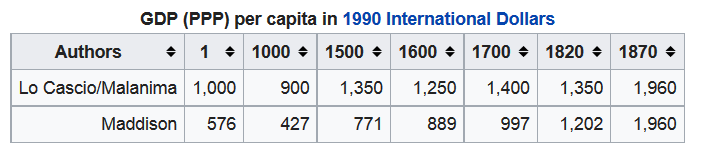
Both groups find that GDP declined from 1 AD (classical era) to 1000 AD (late Dark Age / medieval era). 1 was not the height of Rome, and 1000 was well into recovery from the Dark Ages, so we expect the difference between the Roman peak and the Dark Age nadir to be even more profound than this. But even these attenuated numbers tell the story of an entire millennium when human economic progress across an entire continent went backwards.
Although these numbers are inherently sketchy, the few real pieces of evidence we have seem to back them up. Arctic ice cores preserve a record of how much lead pollution was in the air, probably linked to human lead-mining activities. This allows us a pretty good look at how much lead-mining various European civilizations were doing:

And granted, the Romans were a little more obsessed with lead than could possibly have been healthy. But these data are supported by reconstructions of silver mining, copper mining, and iron mining. All of these are easily quantifiable activities that reinforce Maddison, Lo Cascio, and Malanima’s picture of economic decline between the fall of Rome and 1000.
We see a similar decline in population. The Atlas of World Population History thinks that continental Europe had a population of 36 million people at its peak in 200 AD, falling to 26 million at a nadir in 600 AD, and gradually recovering back to 36 million or so around 1000 AD. Various other estimates for the population of the Roman Empire and medieval Europe broadly support this picture (though remember that the Roman Empire didn’t occupy the same space as medieval Europe and so comparisons have to be more complicated than just comparing two sets of numbers). If this is true, the Classical to Dark Age transition caused a population decrease of about 10 million, or 30% of the population (though some of this happened in Late Antiquity). These are the sorts of numbers usually only associated with the worst plagues and genocides.
Classical Rome had a population of between 500,000 and a million. Even classical Athens had a population of over 100,000. By mid Dark Ages, there was no city in Christian Western Europe larger than about 50,000 people. The infrastructure for maintaining large urban populations had fallen apart.
And true, a lot of this is sparse and reconstructed. My usual go-to for economic history questions, Tumblr user xhxhxhx, was able to get me a bunch of excellent graphs comparing classical Rome to the High Middle Ages, classical Rome to the Golden Age of Islam, High Middle Ages to the Golden Age of Islam, etc. When I complained that none of them compared anything to the Dark Ages which was the whole point of my question, he answered that the data were worse quality, because “civilization collapsed, so fewer people were tracking wages and prices”.
So yes, I agree that there’s only a limited amount of data proving that the Dark Ages sucked. That’s because civilization collapsed, so people weren’t keeping great records. I don’t think this is a strong argument against the Dark Ages being bad.
7. But aside from the economy, there was still lots of great culture and intellectual advancements
If I ask Google for a list of the hundred greatest philosophers of all time, it brings up http://www.listal.com/list/100-greatest-philosophers. It doesn’t seem especially professional or official, but it’s a decent-looking list and because it’s the top Google result I can prove I wasn’t biased by selecting it.
Here’s a graph of number of European philosophers on the list per 500 year period:
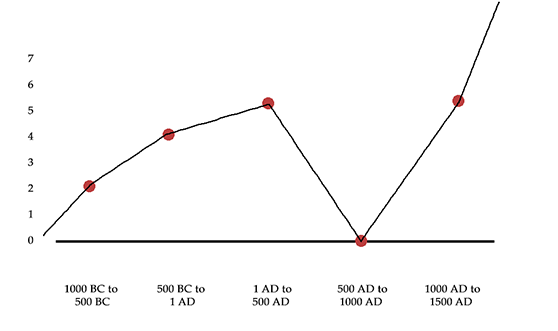
The giant pit from 500 to 1000 where there was not a single European philosopher worthy of inclusion on the list corresponds to the traditional concept of a Dark Age without very impressive intellectual output.
Harold Bloom has a list of great books in ‘the Western Canon’. Once again separating them into 500 year intervals and graphing:
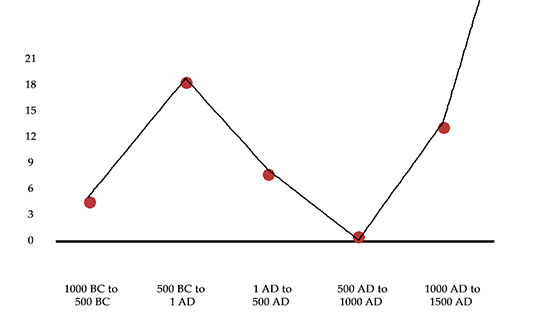
Again, we see a giant pit from 500 to 1000 AD (though this time it is not completely empty – Beowulf is the sole qualifying work).
Here’s a map (admittedly a later reproduction, since the originals are lost) by the greatest classical geographer Ptolemy:
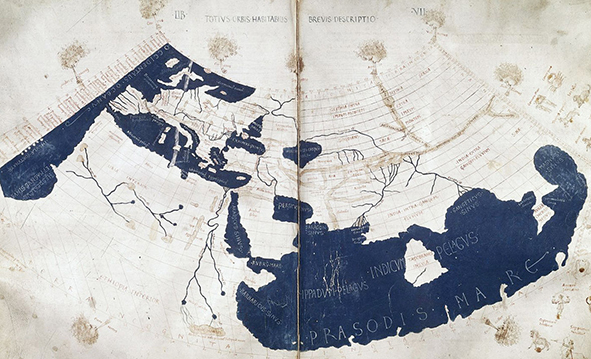
And here’s an 8th-century map by Beatus of Liebana:
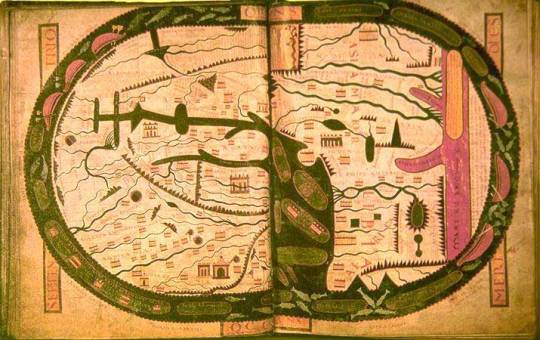
I’m not cheating here by taking the worst-quality Dark Age map (that would be one of these). If you can find a better Christian Western European map from 500 – 1000, tell me and I’ll replace this one with it. But as far as I can tell, this really was state-of-the-art.
The decreased quality of intellectual output seems to have been matched by a decline in quantity. I can’t find any great sources quantifying the number of books written in the classical world, but there are a few semi-reliable numbers about library size. The Ulpian Library of Emperor Trajan seemed to have tens of thousands of scrolls, and it was only one of as many as 28 libraries in Rome. Estimates of the number of volumes in the Library of Alexandria range from 40,000 to 400,000. Archaeologists studying the Villa of the Papyri in Herculaneum, a private residence in a medium sized town, have found a private library of almost 2,000 scrolls.
Medieval libraries seem to be much smaller. From Oxford Bibliographies:
It follows from this that the wealth and fame of any institution that required books would inevitably affect the size of its library, and, given the fact that books were always expensive, medieval libraries were, from a modern point of view, not large. The largest Anglo-Saxon libraries may have contained about two hundred books. In 1331 the collection at Christ Church, Canterbury, numbered 1,850, which may well have been the biggest collection in England and Wales. In 1289 the library of the university of Paris contained 1,017 volumes which, by 1338, had increased to 1,722—an increase of about 70 percent.
This might not be entirely fair – Roman scrolls were smaller than medieval books, so a work that took up one medieval book might have occupied several Roman scrolls, inflating the size of Roman libraries. But there still seems to be a pretty big gap between the tens to hundreds of thousands of volumes in classical libraries and the few hundred to few thousand in libraries all the way up until the High Middle Ages.
[EDIT: This might not be true – see here]
In a lot of cases, the people of the Dark Ages (and the High Middle Ages afterwards) themselves acknowledged this. The Roman author Vitruvius was the gold standard for architecture up to the Renaissance, and Brunelleschi became famous for creating a dome that surpassed the Roman domes made 1300 years earlier. Roman doctors like Galen and Celsus were semi-worshipped by medieval doctors; when the 16th century (!) doctor Theophrastus von Hohenheim became known as “Paracelsus” (meaning “equal to or better than Celsus”), it was taken as an outrageous boast of ability despite his having the benefit of 1500 extra years of medical science.
8. The Dark Ages weren’t all bad. There were still a few important accomplishments. Therefore, they cannot truly be called “dark”.
The night includes several bright things, such as the moon, the stars, and streetlights. But it’s still fair to call the night “dark”. You don’t have to prove that 100% of something fits a description at 100% of times to use the description.
One of the links from the top of the post says:
If the “dark ages” were so unproductive and backwards, how does one explain the proliferation of inventions and developments during this time period. A simple listing of inventions, discoveries and developments demonstrates the the Middle Ages were anything but dark.
…then goes on to give various inventions, the only ones of which from 500 AD – 1000 AD are “collar and harness for horses and oxen”, “iron horseshoes”, and “the swivel axle”.
Look. I am sure that horseshoes were a revolutionary advance in equine footwear. But the ancient Greeks gave us geometry, history, cartography, the screw, the water wheel, gears, cranes, lighthouses, and fricking analog computers. If you want to stake your claim to be more than a miserable failure as a historical age, you are going to have to do better than horseshoes.
(also, maybe the Romans invented iron horseshoes first anyway?)
9. I still think the term “Dark Ages” could possibly lead to misconceptions.
Yeah.
I like this debate because it’s so pointless, but also reveals some of the basic structure of these kinds of arguments. Like most language questions, we act like we’re debating facts, when in fact we’re debating fuzzy category boundaries that are underdetermined by facts. See previous work on is Pluto a planet?, is obesity a disease?, are transgender people their chosen gender?, etc.
There’s no strict criteria for what makes something a Dark Age or whether the term should be used at all. We’re left to wonder whether using it conveys more useful information than it does misinformation.
There are many interpretations of “The Dark Ages happened” that might be wrong, like:
1. There was darkness everywhere, not just in Europe
2. There was darkness in Europe all the way until the Renaissance, and the High Middle Ages sucked
3. Every single person in this era was an illiterate superstitious peasant covered in filth, and not one good thing ever happened
4. Greco-Roman civilization was better in every way than the period that followed it, including morally
On the other hand, there are many interpretations of “the Dark Ages didn’t happen” that might also be wrong, like:
1. The fall of Rome was not associated with a decline in wealth and population.
2. The fall of Rome was not associated with a loss of capacity for things like urban living or large-scale infrastructure
3. The intellectual output of the period was exactly as high in quality and quantity as the intellectual outputs of other periods
4. Civilization always proceeds in a nice Whig History straight upward line with no risk of catastrophic collapses
Surely people can get caught in different bravery debates here. If they live in a bubble where everyone falls prey to the first set of misconceptions, it can be tempting to try to rectify that by saying the Dark Ages never happened. If they (like me) live in a bubble where everyone seems to fall prey to the second, it’s tempting to…well, write a post like this one.
And then there are political implications that will work for the benefit of one group or another. If there was a Dark Age:
1. …maybe it casts Catholicism or Christianity in a bad light, since this was also the age when they rose to be a major power
2. …maybe it points to a broader conflict between science and religion, since this was a very religious age in ways
3. …maybe it suggests that civilization is more fragile than we think, and since it collapsed once it can collapse again
4. …maybe it makes Greece and Rome look extra good, since they were again of the curve in terms of civilizational greatness
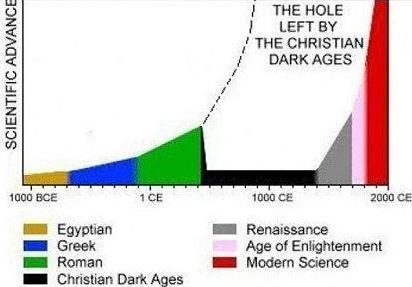
Pictured: one way to politicize this discussion; not recommended
And finally, there are signaling aspects. Since everybody hears a vague Monty-Python-And-The-Holy-Grail-esque conception of the Dark Ages (“He must be a king…he doesn’t have shit all over him”), but only people who take a history class in college hear about the Continuity Thesis, loudly proclaiming that there was never a Dark Age is one way to signal education and intellectualism (I dare you to tell me that isn’t what’s going on in this Tumblr post). On the other hand, if you’re one of those people who rails against “postmodernism” and “cultural relativity” and wants a reputation for “calling a spade a spade”, it might be gratifying to get to say that actually, that one historical era that seems kind of sucky (but fancy college professors keep insisting otherwise) does, in fact, suck.
I think I know why this question bothers me so much, and it’s because I hate when faux-intellectuals give stupid black-and-white narratives that are the tiniest sliver more sophisticated than the stupid black-and-white narratives that the general population believes, then demand to be celebrated for their genius and have everyone who disagrees with them shunned as gullible science-denying fools.
(I know a lot of people accuse me and this blog of doing exactly this, and I’m sorry. All I can say is that I’m at the odd-numbered levels of some signaling game you’re at the even-numbered levels of, and it sucks for all of us.)
For other people, maybe it’s something different. Maybe a Chinese historian doesn’t like the term “Dark Ages” because she sees too many people think Europe-specific terms apply to the whole world, and for her the tiny number of people who do this are so annoying that it overwhelms any possible advantage the idea might have. Maybe a Muslim likes it because it helps contrast the poverty of Christendom with the glory of al-Andalus, and shake the myth that Europe has always been on top. I don’t know.
10. So you’re saying both positions are true and everyone is equally right?
No. Although I sympathize with the feelings behind both positions, I say the Dark Ages happened. I think the best evidence we have suggests the fall of Rome (and the period just before) was associated with several centuries of economic and demographic decline, only reaching back to their classical level around 1000 AD. I think it was also associated with a broader intellectual and infrastructure decline, which in some specific ways and some specific fields didn’t reach back up to its Roman level until the Renaissance. I think that common sense – the sense you get when you treat the question of the Dark Age the same as any other question, and try to avoid isolated demands for rigor – says that qualifies for the phrase “Dark Age”.
[see also: Highlights From The Comments On Dark Ages]

Substack is a blogging site that helps writers earn money and readers discover articles they'll like.

Beeminder's an evidence-based willpower augmention tool that collects quantifiable data about your life, then helps you organize it into commitment mechanisms so you can keep resolutions. They've also got a blog about what they're doing here

Norwegian founders with an international team on a mission to offer the equivalent of a Norwegian social safety net globally available as a membership. Currently offering travel medical insurance for nomads, and global health insurance for remote teams.

Seattle Anxiety Specialists are a therapy practice helping people overcome anxiety and related mental health issues (eg GAD, OCD, PTSD) through evidence based interventions and self-exploration. Check out their free anti-anxiety guide here
.
80,000 Hours researches different problems and professions to help you figure out how to do as much good as possible. Their free career guide show you how to choose a career that's fulfilling and maximises your contribution to solving the world's most pressing problems.

AISafety.com hosts a Skype reading group Wednesdays at 19:45 UTC, reading new and old articles on different aspects of AI Safety. We start with a presentation of a summary of the article, and then discuss in a friendly atmosphere.

Altruisto is a browser extension so that when you shop online, a portion of the money you pay goes to effective charities (no extra cost to you). Just install an extension and when you buy something, people in poverty will get medicines, bed nets, or financial aid.

Giving What We Can is a charitable movement promoting giving some of your money to the developing world or other worthy causes. If you're interested in this, consider taking their Pledge as a formal and public declaration of intent.

Metaculus is a platform for generating crowd-sourced predictions about the future, especially science and technology. If you're interested in testing yourself and contributing to their project, check out their questions page

The COVID-19 Forecasting Project at the University of Oxford is making advanced pandemic simulations of 150+ countries available to the public, and also offer pro-bono forecasting services to decision-makers.

Support Slate Star Codex on Patreon. I have a day job and SSC gets free hosting, so don't feel pressured to contribute. But extra cash helps pay for contest prizes, meetup expenses, and me spending extra time blogging instead of working.

Dr. Laura Baur is a psychiatrist with interests in literature review, reproductive psychiatry, and relational psychotherapy; see her website for more. Note that due to conflict of interest she doesn't treat people in the NYC rationalist social scene.

B4X is a free and open source developer tool that allows users to write apps for Android, iOS, and more.

MealSquares is a "nutritionally complete" food that contains a balanced diet worth of nutrients in a few tasty easily measurable units. Think Soylent, except zero preparation, made with natural ingredients, and looks/tastes a lot like an ordinary scone.

The Effective Altruism newsletter provides monthly updates on the highest-impact ways to do good and help others.

Jane Street is a quantitative trading firm with a focus on technology and collaborative problem solving. We're always hiring talented programmers, traders, and researchers and have internships and fulltime positions in New York, London, and Hong Kong. No background in finance required.

Highlights From The Comments On Dark Ages
Thanks to everyone who made interesting comments on yesterday’s post about Dark Ages.
Several people challenged the matching of the economic/population decline to the “fall of Rome”. For example, from David Friedman:
From ksvanhorn:
Dissonant Cognizance:
And ctj09 agrees:
Other people thought the end date of the Dark Ages could also be earlier. Many brought up the Carolingian Renaissance. For example, Krill12:
From RIP_Finnegan:
Lillian disagrees:
So “300 – 800 AD” might be as good a five hundred year interval to call “the Dark Ages” as 500 – 1000. I think this is true of a lot of historical periods – depending on what artists or scientists you think are most important “the Scientific Revolution” or “the Renaissance” can have pretty fluid boundaries – but it’s worth noticing the fuzziness.
I had briefly noted that scrolls might be shorter than codices, but felt okay dismissing this because they would have to be something like two orders of magnitude shorter for it to make much difference. Well…here’sCaf1815:
If this is at all right, then mea culpa.
A lot of people don’t like the idea of Dark Ages because they underestimate the continuity between the classical and medieval world; John of Salisbury argues that they overestimate it:
Similar concerns from georgioz:
offwo2000 makes a fascinating claim about the year 1000 I’d never heard before:
(I’m not sure how seriously to take this since the wikipedia article on the Peace of God movement doesn’t really mention the “year 1000” thing, which I found the most interesting part).
On the philosophical implications of saying the Dark Ages “were real”, John Nerst:
And on the political implications, the anonymouse:
(fortaleza84 adds “Debate about the Dark Ages, to an extent, is a proxy for anxiety over the present-day West.”)
Finally, I talked a bit about the Dark Ages bringing up two axes of “civilizational moral goodness” vs. “civilizational impressiveness”. Cernos quotes Will Durant on a different way of judging the “impressiveness” of the Dark Ages: