Verses Composed Upon Reading A Review From TripAdvisor

Source is this page

The Tourist Board of Xanadu
Did recently impose a fee
On those who travel far from home
To visit Kubla’s pleasure dome
Of $20, 9 to 3

So twice five miles of fertile ground
With fence and wire are girdled round
And signs proclaiming “ENTRY AT THE GATE”
Where gather many a camera-bearing crowd
And here are docents, who in solemn state
Explain the Mongol histories aloud

But oh! That deep romantic chasm protracting
Into a hill, athwart a cedarn cover
A savage region, visitors attracting
By actresses, forever reenacting
A woman wailing to her demon-lover

And from this chasm, with ceaseless turmoil spilling
Crowds of old men in fat thick pants are milling
And there, a fountain momently is forced:
Amid whose swift half-intermitted burst
Groups of eight to ten people, screaming ever
White-water-raft upon the sacred river

Five miles continuing to a crashing climax
Through wood and dale the sacred waters run;
I didn’t think this part was too much fun,
So skip the crowds, and head down to the IMAX,
Where in surround-sound, you can hear from far
Ancestral voices prophesying war!

The shadow of the dome of pleasure
Stands reflected in the mere;
Take some photos there to treasure
As a special souvenir
It is a miracle of rare device:
A tourist trap, but also pretty nice.

A damsel with a dulcimer
In a vision once I saw:
It was an Abyssinian maid
And on her dulcimer she played,
Singing of Mount Abora.
Could I revive within me
Her symphony and song,
To such a deep delight ’twould win me,
That with music loud and long,
I would build that dome in air

That sunny dome! those caves of ice!
And all who heard should see them there,
And all should cry, Beware! Beware!
His flashing eyes! His floating hair!
Hide the sight from eyes profane,
And weave a circle round him thrice
For he hath tasted Paradise,
5/5, would taste again.

Posted in Uncategorized | Tagged , | 28 Comments

Value Differences As Differently Crystallized Metaphysical Heuristics

[Previously in sequence: Fundamental Value Differences Are Not That Fundamental, The Whole City Is Center. This post might not make a lot of sense if you haven’t read those first.]

I.

Thanks to everyone who commented on last week’s posts. Some of the best comments seemed to converge on an idea like this:
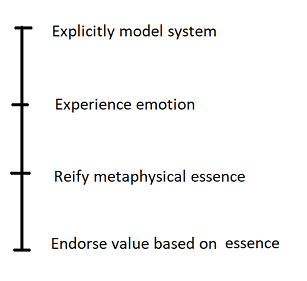

Confusing in that people who rely on lower-level features are placed higher, but the other way would have been confusing too.
We need to navigate complicated philosophical questions in order to decide how to act, what to do, what behaviors to incentivize, what behaviors to punish, what signals to send, and even how to have a society at all.

Sometimes we can use theories from science and mathematics to explicitly model how a system works and what we want from it. But even the scholars who understand these insights rarely know exactly how to objectively apply them in the real world. Yet anyone who lives with others needs to be able to do these things; not just scholars but ordinary people, children, and even chimpanzees.

So sometimes we use heuristics and approximations. Evolution has given us some of them as instincts. Children learn others as practically-innate hyperpriors before they’re old enough to think about what they’re doing. And cultural evolution creates others alongside the institutions that encourage and enforce them.

In the simplest case, we just feel some kind of emotional attraction or aversion to something.

In other cases, the emotions are so compelling that we crystallize them into a sort of metaphysical essence that explains them.

And in the most complicated cases, we endorse the values implied by those metaphysical essences above and beyond whatever values we were trying to model in the first place.

Some examples:

People and animals need a diet with the right number of calories, the right macronutrient ratios, and the right vitamins and minerals. A few nutritional scientists know enough to figure out what’s going on explicitly. Everyone else has evolved instincts that guide them through this process. Hunger and satiety are such instincts; when they’re working well, they make sure someone eats as much as they need and no more. So are occasional cravings for some food with exactly the right nutrient – most common in high-nutrient-use states like pregnancy. But along with these innate heuristics, we have culturally determined ones. Everyone has a vague sense that potato chips are “unhealthy” and spinach is “healthy”, though most people can’t explain why. Instead of asking ordinary people and children to calculate their macronutrient and micronutrient profile, we ask them to eat “healthy” foods and avoid “unhealthy” foods. There’s something sort of metaphysical about this – as if “health” were a magic essence that adheres to apples. And in fact, sometimes this goes wrong and people will do things like blend a thousand apples into some hyper-pure apple-elixir to get extra health-essence – but overall it mostly works.

EXPLICIT MODEL: Trying to count how many calories and milligrams of each nutrient you get
EMOTIONAL EXPERIENCE: Feeling hungry or full
REIFIED ESSENCE: Some foods are inherently healthy or unhealthy
ENDORSED VALUE: Insisting on only eating organic foods even when those foods have no quantifiable benefit over nonorganic

Every society has some kind of punishment for people who don’t follow their norms, whether it’s ostracism or community service or beheading. There’s a good consequentialist grounding for why this is necessary, with some of the most academic work being done in the field of prisoners’ dilemmas and tit-for-tat strategies. But again, we don’t expect ordinary people, children, and chimpanzees to absorb this work. The solution is the (innate? culturally learned? some combination of both?) idea of punishment. Punishment relies on a weird metaphysical essence of moral desert; people who do bad things deserve to suffer. The balance of the Universe is somehow off when a crime goes unavenged. Take this too far and you get the Erinyes and the idea that justice is the most important thing. There are references from ancient China to Hamlet that if you have something important you need to avenge, you need to do that now or you’re a bad person. None of this follows from the game theory, but it’s a really good way to enforce the game-theoretically correct action.

EXPLICIT MODEL: Trying to figure out how to best deter antisocial behavior and optimize society
EMOTIONAL EXPERIENCE: Feeling angry when someone wrongs you
REIFIED ESSENCE: Justice: the world is out of balance when crimes go unavenged
ENDORSED VALUE: Wrongdoers must suffer whether or not that prevents future crimes

If you reward people who create value, sometimes those people will be inspired to keep creating value. This is hard for people to keep in mind, and there’s a constant temptation to confiscate other people’s things for our own enrichment. Some kind angel gave us the metaphysical idea of “deserving”, the opposite of punishment. We get rights claims like “People deserve to keep what they’ve earned”. Five thousand years of taxation have made only a partial dent in this intuition, to the point where many people still feel like something is going wrong when a producer and the value they produced are separated. Some would argue that this has gotten completely out of hand, to the point where we insist on people keeping money far past the point where it could possibly be any further incentive to them.

EXPLICIT MODEL: Letting people keep what they produce incentivizes further production
EMOTIONAL EXPERIENCE: Anger when someone takes something rightfully yours
REIFIED ESSENCE: Natural rights; governments cannot take away property rights because they are ordained by God or natural law
ENDORSED VALUE: You can’t take people’s property, whether or not this will affect further production

In past societies, STDs were a common cause of death and disfigurement. Nobody had the medical knowledge to really understand what an STD was or how to avoid getting one. But every society had some kind of complicated code of sexual purity. Usually this was designed from a male perspective, and said that women who had sex with too many other men were “impure”, virgins were especially “pure”, and a woman who had only had sex with you was “pure” relative to you. These rules protect people who follow them against STDs, and plausibly culturally evolved for that purpose (among others). But because no one knew about STDs, the rules rely on a kind of metaphysical notion of “purity” that doesn’t correspond to any real-world characteristic. For example, someone who’s had sex with a hundred people but who nevertheless never contracted an STD would seem metaphysically “impure” by the rules, but in reality safe to have sex with; this would be irrelevant to medievals who had no way to identify such people, but is very relevant now. Or: if you have good sexual protection and STDs are easily treatable, the whole “purity” system seems a lot less important, but if you think of it as a metaphysical construct important in its own right you might not realize this.

(before you tell me that STDs aren’t important enough to inspire something as universal and compelling as sexual purity laws, remember that in the pre-antibiotic era about 10% of city-dwellers had syphilis (see studies from early Mesoamerica, 1700s Chester, early 1900s London. During this period syphilis had a mortality rate of up to 20%, with survivors often permanently unhealthy and disfigured. And this is just one of many dangerous STDs!)

EXPLICIT MODEL: Figuring out the likelihood that your partners have STDs helps you avoid high-risk pairings
EMOTIONAL EXPERIENCE: Feeling grossed out at the idea of having sex with somebody who “sleeps around”
REIFIED ESSENCE: Idea of sexual purity
ENDORSED VALUE: It’s wrong to be slutty or have sex with a slutty person even if there are effective strategies for preventing STDs

Most people are happier when they’re in at least some Nature, whether this means a grand national park or just a leafy suburb with lots of chirping birds. The average person would consider a concrete lot full of Brutalist apartments a little soul-crushing. This probably comes from an evolutionary heuristic in favor of fertile areas and against barren ones; the closest chimpanzee-parseable equivalent to a concrete lot would be a desert or lava flow, where food and shelter are scarce. But nowadays we can order takeout, and the Brutalist apartment buildings provide all the shelter we need. This is probably another obsolete evolutionary relic, but it’s a very persistent one.

EXPLICIT MODEL: More plants and less gray rock means a more hospitable area with more food sources
EMOTIONAL EXPERIENCE: Contentment when surrounded by plants; depression when surrounded by concrete
REIFIED ESSENCE: Idea of “Nature”
ENDORSED VALUE: Environmentalism; the preservation of Nature for its own sake whether it benefits humans or not

Value differences, then, are people who operate at different levels of the ladder.

For example, “sexually liberated” people might use condoms, or ask their partners to check if they have STDs. But having done this, they’ll ignore the metaphysical idea of “purity”; they don’t care how many other people their partner has had sex with. And if they’re not planning to have sex with someone, they’ll ignore their “purity” full stop – having STDs doesn’t make you a bad person. These people explicitly model the complicated dynamic of STD contagion, and cast off the metaphysics as a primitive approximation they no longer have any use for.

Traditional or religious communities are more likely to endorse values based on the “purity” metaphysical essence. They understand the biology of STDs just as well as the sexually liberated people. They just don’t care. On an intellectual level, they believe that sexual purity is more than just a predictive model of STD risk, or that they’ve gained some additional function in the meantime, or that the predictive model still works better than calculating it out explicitly. Or they might not think in these terms at all, and value purity as a terminal good. Or they might be following their instincts in a way that can’t be reducible to anything at all.

Other people are somewhere in between. I know in theory that I cannot get AIDS through touching infected blood left on a sheet or chair. Absent some sort of very unlikely chain of events involving weird mouth ulcers and very fast turnaround times, I can’t even get it by rubbing the blood on food and eating it. But I would still feel more than zero trepidation about doing this. It would seem that even though I identify with the sexually-liberated explicit-complicated-dynamic-modellers, I have some weak vestige of the metaphysical purity heuristic left. This makes me more sympathetic to people with the full version. They don’t seem like weird mutants too stupid to figure out what an STD is, they feel like people with my instincts magnified a million times until they’ve become irresistible.

I have tried very hard to cultivate a vital rationalist skill called “admitting I am being an idiot while feeling no obligation to change”. That is, I feel comfortable saying I’m being very silly by objecting to touching the HIV-infected blood. If someone were to lecture me that admitting this obligates me to touch the blood or else I will have proven myself a hypocrite, I would tell them to go jump in a lake. This is important because I’m pretty sure my purity-instinct urge not to eat HIV-infected blood is stronger than my urge to be right about factual issues. If I was forced to either eat the blood, or to make up some plausible-but-false reason why the experts were wrong and blood was unsafe, I would make up the reason. And then not only would I not eat the blood – a venial sin if ever there was one – but I would be obfuscating the debate, screwing up lots of people’s ideas about epidemiology, and taking a step on the slippery slope toward becoming a dishonest and dishonorable person. I would rather just admit I’m silly.

But I think this is a hard skill, one that I often get wrong even despite frequent practice, and one I don’t expect anyone to succeed at all the time. I think some people with strong metaphysical heuristics – around HIV, around sex, around whatever – are going to get to work justifying them. If many people share a certain strong metaphysical heuristic, then there will be entire communities dedicated to researching justifications for it, coming up with philosophy around it, and reinforcing one another for being wise and good enough to believe it.

I think this is a big part of where value differences come from, and why I’ve insisted that despite the differences being real, they’re not incomprehensible. Most people have at least some level of metaphysical-STD-purity-intuition. And most people have at least some level of explicit-dynamic-modeling-of-STD-risk. Our differences come not from some people being enlightened and other people being mutants with the bizarre idea of “sluttiness” as a terminal bad, but by settling on a different part of the ladder from totally-endorsed-value-based-on-essence to total-explicit-modeling.

II.

A natural interpretation of Part I: people with explicit modeling are smart and good, people who still use metaphysical heuristics are either too hidebound to switch or too stupid to do the modeling.

I think this is partly right, but since our goal is to make value differences seem less clear-cut and fundamental, I want to make the devil’s advocate case for respecting metaphysical heuristics.

First, the heuristics are, if nothing else, proven to be compatible with continuing to live; the explicit models often suck.

Soylent uses an explicit model of nutrition to try to replace our vague heuristics about “eating healthy”. I am mostly satisfied with the quality of its research; it generally avoids stupid mistakes. It does not completely avoid them; the product has no cholesterol, because “cholesterol is bad”, but the badness of cholesterol is controversial, and even if we grant the basic truth of the statement, it applies only at the margin in the standard American diet. If you eat only one food item, you had better get that food item really right, and it turns out that having literally zero cholesterol in your diet is long-term dangerous. This was an own-goal, and a smarter explicit modeler could have avoided it. But explicit models that only work when you get everything exactly right will fail 95% of the time for geniuses and 100% of the time for the rest of us.

And even if Soylent had avoided own-goals, they still risk running up against the limit of our understanding. Decades ago, doctors invented a Soylent-like fluid to pump into the veins of patients whose digestive systems were so damaged they could not eat normally. These patients tended to get a weird form of diabetes and die. After a lot of work, the doctors discovered that chromium – of all things – was actually a really important dietary nutrient, and nobody had ever noticed before because it’s more or less impossible to run out of chromium with any diet except having synthetic fluids pumped into your veins. After years of progress on nutritional fluids, the patients who need them no longer die; we can be pretty sure we’ve found everything that’s fatal in deficiency. But these patients do tend to feel much worse, and be much less healthy, than people eating normal diets. How many mildly-important trace micronutrients are left to discover? And how many of these are or aren’t in Soylent?

We know that for some reason eating multivitamins does not work as well even for vitamin-having purposes as eating food with the relevant vitamins in them. This seems to have something to do with absorption and bioavailability, but we’re not sure what. Does Soylent have the good bioavailability of food, or the bad bioavailability of multivitamins? Nobody knows, because we still don’t quite understand how bioavailability works. All we know is that evolution seems to have found one viable solution, given that people who eat food do not immediately die. If we replace food with intelligent application our best available explicit models, we might do okay – or we might feel vaguely ill all the time because there’s something important we’re missing.

On the society-wide level, the sort of explicit-modeling that created Soylent becomes high modernism, the philosophy critiqued in James Scott’s Seeing Like A State. You subject everything to the command of a central planner, who is supposed to be able to explicitly model social dynamics, and try to prevent people from using fuzzy evolved heuristics like tradition or “the way things are”. The extreme version of this is those Young Adult Dystopias: can’t justify exactly why there should be families? Then families are just obsolete detritus of our evolutionary past, and we should form a Department Of Child-Rearing that takes all kids and subjects them to carefully-doled-out industrial-scale parenting techniques.

Second, all of our values are unjustifiable crystallizations of heuristics at some level, and we have to have some value.

One of the examples above supposes that our love of nature comes from heuristics about where to find food and water. Suppose we proved this conjecture was right. Given that we can now order pizza and bottled water to concrete lots, the heuristic is obsolete. Does this mean we should stop caring about nature, and cut down all our forests and national parks and replace them with concrete lots? Suppose this would be very profitable, and that on cost-benefit analysis this outweighs the practical economic benefits of wild spaces (carbon sinks, drug discovery from exotic species). Is there any remaining reason we still want the national parks?

Compare this to punishment-for-the-sake-of-punishment. Maybe now we can replace this with an explicit model of consequentialist punishment where we should only punish people up to the point where it’s necessary to have a safe and stable society. Returning to the dialogue:

Simplicio: I admit – I believe in punishment in a sense stronger than as a heuristic for consequentialism. I think it’s morally important, in a terminal sense, that evildoers be made to suffer for their deeds. Not suffer infinitely. But suffer some amount proportional to how much they hurt others. I want this regardless of whether it deters them or not.

Sophisticus: But that’s just reifying a weird misfiring of an obsolete heuristic about how to maintain a safe community.

Simplicio: Yup! And me wanting Yellowstone to continue to exist is just reifying a weird misfiring of an obsolete heuristic about how to get delicious elk meat. And surely you don’t want to pave over Yellowstone.

Sophisticus: I take joy in Yellowstone. That’s an emotional experience in my brain. I’m happier and more comfortable in Nature. Even if the heuristics that produced this are wrong, that feature of my brain isn’t going away any time soon. So on a consequentialist level, I can argue that Yellowstone should be maintained for my sake and the sake of everyone else who enjoys it, even though I’m not sure my enjoyment comes from a reasonable source.

Simplicio: I take joy in watching murderers and rapists get what they deserve. This is a base-level pleasure for me, just like seeing trees and mountains are for you. I am under no more imperative to justify what I want than you are.

Sophisticus: You are, though. Because you directly desire for people to suffer, which violates some of our other shared values. We have to reach reflective equilibrium among our values, and for me at least the value to wish happiness rather than suffering on other people overwhelms the desire for punishment.

Simplicio: First, I think we should be careful to frame it the way you just did: “Making people suffer for their crimes is good, but this is outweighed by other goods”. If we say it that way, it sounds no more exotic than the trolley problem.

Sophisticus: It’s at a –

Simplicio: – but second, if paving over Yellowstone would have economic benefits, then those benefits would cash out in jobs, lower housing costs, cheaper consumer goods, and the like. All of those produce utility for people. Both of our weird preferences – mine for punishment, yours for nature – satisfy some crystallized heuristic at the expense of general utility. I still fail to see how we’re different.

Sophisticus: I agree that preserving Yellowstone may incidentally fail to maximize utility. But it seems like you’re directly aiming at reducing people’s utility. That’s a pretty big difference.

Simplicio: Exactly which principle are you invoking here? The act-omission distinction? Or the principle that the morality of an act depends upon what feelings are going through your head when you do it?

Sophisticus: Um…

Simplicio: Because I think both of those are sometimes useful – as heuristics. But if you’re going crystallize those heuristics, let me have my crystallized heuristic about punishment.

Simplicio is actually being nice here. If he wanted to be especially brutal, he might ask Sophisticus something like – wait, why are we privileging utilitarianism (here being called “consequentialism”, but it seems like both of them are working from an implicitly utilitarian framework) anyway? Utilitarianism says that what’s really important is reducing suffering, but we can invent an evolutionary story for that too. We want to help other people and make them happy because that’s a useful heuristic for creating a flourishing community, being well-liked, and being likely to have other people help us in our own time of need. But some utilitarian applications of this principle go beyond that; certainly caring about effective charity for the Third World, or wild animal suffering, or anything in those realms brings us just as far from the proper domain of our help-and-don’t-harm-others heuristic as how to build a suburb with widely-available pizza delivery takes us from our nature-as-fertile-lands heuristic. Why should we privilege the harm foundation over the justice foundation? Why not just say “My urge to relieve suffering conflicts with my urge to inflict punishment on evildoers. Both urges have their place, and either can be extended out to infinity with weird results. Today I choose my urge to inflict punishment; tomorrow I might choose the other. So it goes.”

To be absolutely brutal about it:

EXPLICIT MODEL: Helping others will key me in to networks of reciprocal altruism and raise my status in the community
EMOTIONAL EXPERIENCE: Desire to help others, empathy, horror at the suffering of others
REIFIED ESSENCE: “Utility”
ENDORSED VALUE: Utilitarianism, the belief that maximizing utility is the highest good regardless of what other goods it produces

III.

Leave it there, and the fundamental-value-differences narrative starts to sound more appealing again. I reify and endorse utility, you reify and endorse punishment, now we have to fight. So I want to talk about how in principle people end up choosing what level to crystallize heuristics at.

First, let’s be blunt: dumber (here meaning either less educated or lower-IQ) people probably crystallize heuristics lower on the ladder. Chimpanzees, cavemen, and children can’t understand game theory and shouldn’t try. They usually run off instinct and taboo, and if you take that away from them they will just get confused.

There are widely replicated findings that higher-IQ and more-educated people tend to be less socially conservative. Social conservativism means a lot of things, but I think in this case it’s probably a stand-in for where you crystallize your heuristics; sexual purity intuitions are an obvious example. This makes sense; smarter people are probably more successful at explicit models, or at least have a higher estimation of their likelihood of success at such models. Smarter people do better on the Cognitive Reflection Test, a measure of whether people go with snap intuitive answers or try to explicitly model situations.

But there’s also reason to think that the more exposure someone has to a heuristic-relevant situation, the more compelling the heuristic will be. I described how my great-grandmother, usually a very kind and forgiving person, became more vengeful once someone close to her was murdered; I was able to partly replicate her experience just by vividly imagining terrible crimes happening to people close to me. This matches the cliche that “a conservative is a liberal who has been mugged; a liberal is a conservative who has been arrested”.

One of the weirdest examples of this is the germ theory of democracy, which finds the presence of tolerant multicultural individualist societies to be correlated with pathogen stress even after accounting for other relevant confounders. In this view, people at high risk of disease feel an urge to stick to people they know well – their family members, neighbors, and co-ethnics – to avoid the sort of mixing that spreads exotic pathogen strains. People at low risk of disease are more cosmopolitan, happy to receive anyone who comes around.

Related: people crystallize heuristics on a lower level when the system the heuristic is meant to model is a system they care about getting right. Consider Haidt’s Moral Foundation of Authority, which he says conservatives have and liberals lack. This fits nicely into the explicit-model-to-essence-to-endorsed-value model. The explicit reasoning is that social groups need to coordinate, and once whatever mechanism you have to produce rules has produced its rules, people need to respect and listen to them or else they’ll be in a Hobbesian state of nature. Liberals may say they’re “against authority”, but when the Vice-President of the NAACP asks an NAACP staffer to prepare a report by next week, she will probably prepare a report by the next week, not just because she’s afraid of being fired but because the NAACP will fail if it can’t handle basic tasks like “get reports prepared”. When a labor union leader tells the workers to strike, they will probably strike, even if they don’t feel like it, because they know that unless they act as a coordinated group they’ll never be able to exert any power. So:

EXPLICIT MODEL: Top-down organization is an effective way to coordinate large organizations
EMOTIONAL EXPERIENCE: Respect, deference
REIFIED ESSENCE: “Authority”, “legitimacy” (in the sense of “this guy is the rightful king, but that guy is a pretender”)
ENDORSED VALUE: Respect for authority

Frimer et al (study, popular article) have done some work on this. They find that when you ask people to imagine “Authority”, they imagine a police officer, a military commander, or some other stereotypically conservative figure who conservatives respect and liberals do not. Since liberals have little interest in making the police more effective, there’s no reason for them to “respect authority” in this case. When researchers give subjects the example of some environmental organization trying to coordinate its environmental activism, liberals are much more likely to say people should respect the authority of the organization leaders.

A more recent study (study, popular article) found similar results, although with similar caveats. They were investigating a construct called cognitive rigidity, and asked questions like “true or false: a group which tolerates too much dissent among its members cannot exist for long?”. Conservatives tend to agree with the base question more, but when you specify “an environmental group”, liberals agree more. I still think this is kind of stupid and more about liberals’ willingness to agree to anything that sounds vaguely pro-environmental. At one point they’re investigating the question “A dead hero is better than a live coward”, they change it to “When it comes to preventing global warming, a dead hero is better than a live coward”, and liberals just go ahead and agree with the statement instead of asking what the f@#k. I consider these studies very questionable and preliminary. But here are some true-or-false questions I offer to the next person to do a study like this:

A: It is dangerous to show too much mercy to people who commit crimes
B: It is dangerous to show too much mercy to people who commit gun violence

A: Barack Obama was the president, and his opponents should have treated him with respect even when they disagreed with his policies
B: Donald Trump is the president, and his opponents should treat him with respect even when they disagree with his policies

A: If I were an employee in a company, I would try to carry out the CEO’s orders even if I disagreed with them, because otherwise we would be disorderly and totally ineffective
B: If I were a member of a labor union, I would try to carry out the union leader’s policies even if I disagreed with them, because otherwise we would be disorderly and totally ineffective

I’m not asserting that liberals and conservatives would answer their respective questions exactly the same. My guess is that even in a value-neutral way, conservatives have these foundations a little more crystallized than liberals, just as they have most other heuristics a little more crystallized than liberals. But I am saying that nobody has done this experiment correctly, and I am suspicious that the groups would be closer than people think.

People can choose metaphysical heuristics or explicit models based on their own innate tendencies, their education, their intelligence, their experiences, and what kind of question we’re thinking about. Rather than talking too much about fundamental value differences, we should be asking where a given person has chosen to place themselves on the metaphysical-heuristic-to-explicit-model ladder at any particular moment.

IV.

This way of looking at things will be valuable if it helps people who crystallize heuristics at different levels understand each other. Here are a couple of common mistakes I think I see:

People who endorse values based on crystallized essences might think that people who use explicit models are weirdly and inexplicably evil, because the essentialists assume the modelers believe in the essences but don’t care about them, or prefer the opposite. If you believe in Essential Purity, then someone who doesn’t might seem like someone who supports Essential Impurity, rather than somebody working off a totally different system.

On the opposite side, if you’re a pure consequentialist, you might see someone who endorses crystallized-essence values as doing something inexplicable and evil. If you think of it as no different from what you do when you like nature, it might be easier to understand.

I have to bring these up because they’re obvious, but really I don’t see either of these that often. The main mistake I see is people on both sides having at least moderately good understanding of how to do explicit causal models, but accusing the other of being Neanderthals who only care about a crystallized-metaphysical-essence and have totally abandoned reason.

That is, I see communists assuming every single libertarian in the world is a fundamentalist about property rights and thinks they’re so sacrosanct that they must be maintained even in the face of horrible suffering, whereas they (the communists) quite reasonably want what makes a flourishing society full of happy people. Whereas the libertarians say they just want universal wealth and prosperity, whereas communists so bloody-mindedly attached to the metaphysical principle of Equality that they don’t care whether attempts to create it will lead to gulags and total economic collapse.

I see cosmopolitans believing that they want what’s best for society, but that nativists are working off an essentialist racism, where foreigners are inherently inferior in some vague metaphysical way. And the nativists, for their part, are arguing that they’re really concerned about the effects of too much immigration, but the cosmopolitans’ blind adherence to Multiculturalism as good in itself makes them unwilling to debate the real-world consequences of their actions.

Since most metaphysical heuristics are a stand-in for something real, we should expect blocs of allied people to contain some people who want the real thing, and other people who are running metaphysical heuristics that point at the thing. That is, the Tough On Crime bloc will have some members who just want to deter crime more, and other members who believe criminals deserve to suffer because of metaphysical Justice. The Soft On Crime bloc will have some members who question whether people need a ten year prison term for stealing a CD-ROM, and others who believe that prison is torture (metaphysical essence!) and so unconscionable regardless of its deterrent effect. If both sides try to position themselves as the hard-headed practical people, but weak-man the other side as having some incomprehensible metaphysics that makes them impervious to reason, that’s going to effectively shut down the possibility of debate.

Except my actual position is that the same sort of experiences that give you the metaphysical Justice intuition – having personally been a victim of crime, really caring a lot about making it as rare as possible, not being very well-educated – are also likely to make you overestimate the consequentialist value of deterring crime (and vice versa for the other side). My guess is a lot of people fluidly move back and forth between these levels, just as I would expect people who are very interested in only eating organic food to also be more likely to care about what percent RDA of vitamins are in their food. This isn’t sinister, or a reason to think that people are only claiming consequentialist arguments for their heuristics. It’s just a natural consequences of the way our values get produced and the fuzziness in everybody’s value system.


Posted in Uncategorized | Tagged , | 379 Comments

Open Thread 106.5

This would normally be one of the hidden open threads, but I’m posting it visibly so we can sort out issues around the adversarial collaboration contest. As the off-weekend thread, it’s still culture-war-free, so please try to avoid overly controversial topics. And:

1. Of the fifteen teams that signed up for the adversarial collaboration contest, two submitted a piece by the deadline – JohnBuridan’s team and TracingWoodgrains’ team. One more – lamaybe’s team – thinks they can get it in if they’ve got a little more time, which I will give them. Right now my plan is to extend the deadline one month, to August 22. If we only get three teams, we only get three teams, and the competition will go forward anyway with the $1000 prize (I won’t ask anyone else to contribute prize money to something this minimal).

This would also mean that any fourth team that manages to get something done in the next month will have a 25% chance at winning $1000. If you’re looking for teammates, try all the people who started a collaboration but whose teammates abandoned them – or post in the thread below. I will reserve the top comment here for people who want to enter and coordinate with each other. I will not ask you to formally register this time, though it would be helpful to inform me. Anyone who gets something in before August 22 will be officially entered.

(people who did finish on time, I beg your patience for extending the deadline)

2. New ad on the sidebar, for James Koppel’s programmer coaching. He wants me to announce RIGHT NOW that he’s doing an Advanced Software Design Weekend Intensive Session this weekend (July 28 – 29) in San Francisco, so if that’s the sort of thing that interests you, you’ve got five days to sign up.

3. Many people’s good comments are being caught in the spam filter for mysterious reasons. I don’t want to disable the filter because it catches a lot of spam, and I don’t always have time to manually sift through it and save good comments, so I don’t really know what to do here except, again, beg your patience. You can improve your chances of missing the filter by not putting more than five or so different links in your comments.

4. There were some really good comments and other-people’s-blog posts on the value differences posts last week. I want to write a response to all of them, but for now consider reading Ozy and SarahC on how learning to think of laziness as not existing was emotionally important and transformative for them, Sniffnoy on how many people really do think in terms of metaphysical essences, moridinamael on cognitive decoupling, and Zvi on why the characters in the dialogue should have had opposite names.

Posted in Uncategorized | Tagged | 709 Comments

Sentimental Cartography

A long time ago, I made a map of the rationalist community.

This is in the same geographic-map-of-something-non-geographic tradition as the Greater Ribbonfarm Cultural Region or xkcd’s map of the Internet. There’s even some sort of therapy program that seems to involve making a map like this of your life, though I don’t know how seriously they take it.

There’s no good name for this art and it’s really hard to Google. If you try “map of abstract concept” you just get a bunch of concept maps. It seems the old name, from back when this was a popular Renaissance amusement, is “sentimental cartography”, since it was usually applied to sentiments like love or sorrow. This isn’t great – the Internet’s not a sentiment – but it’s what we’ve got and I’ll do what I can to try to make it catch on.

Here are some of the best (ie, only) works of modern sentimental cartography I’ve been able to find. Sorry if this ends up a little clickbaity, but I’m annoyed that these haven’t been gathered together in one place before. I am very limited by some of them being offline and copyrighted, so some of these will be teasers rather than the full map. Others will be thumbnails that you can click through to get to the full map or an approximation.

The best modern sentimental cartography I can find comes from illustrator James Turner, who made the Map of Humanity.

You can find more samples at this site. Turner also has a map of love and relationships, but it’s even harder to find any good images of.

This is all I’ve got

You can buy poster versions of both maps at the SLG Publishing Store, and you really should. This is one of my favorite things in the whole world, and it’s sold a grand total of seven copies so far (I think I might be two of the seven).


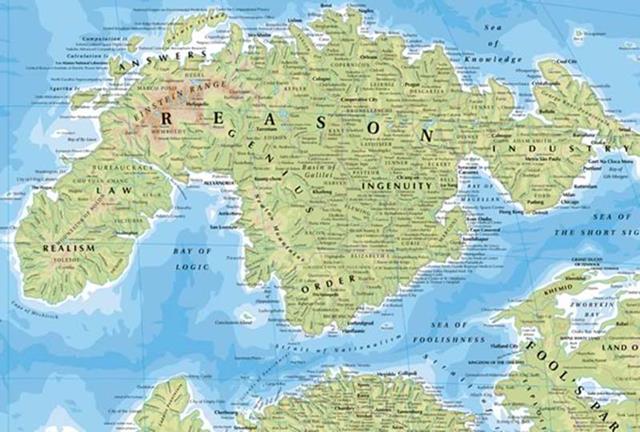
There are some similar works in the Atlas Of Experience, available in part as a website and in full as a book on Amazon. This seems to be their main offering:

And this is a magnification of one of their peninsulae:


Martin Vargic has a bunch of really good sentimental cartography. The most easily accessible is his Map Of The Internet.

He also has a Map of Literature, not particularly accessible except for teasers:

Not a thumbnail, sorry – this is the biggest I have

The full version of this map and several others with no online presence are available in Vargic’s book Miscellany Of Curious Maps.


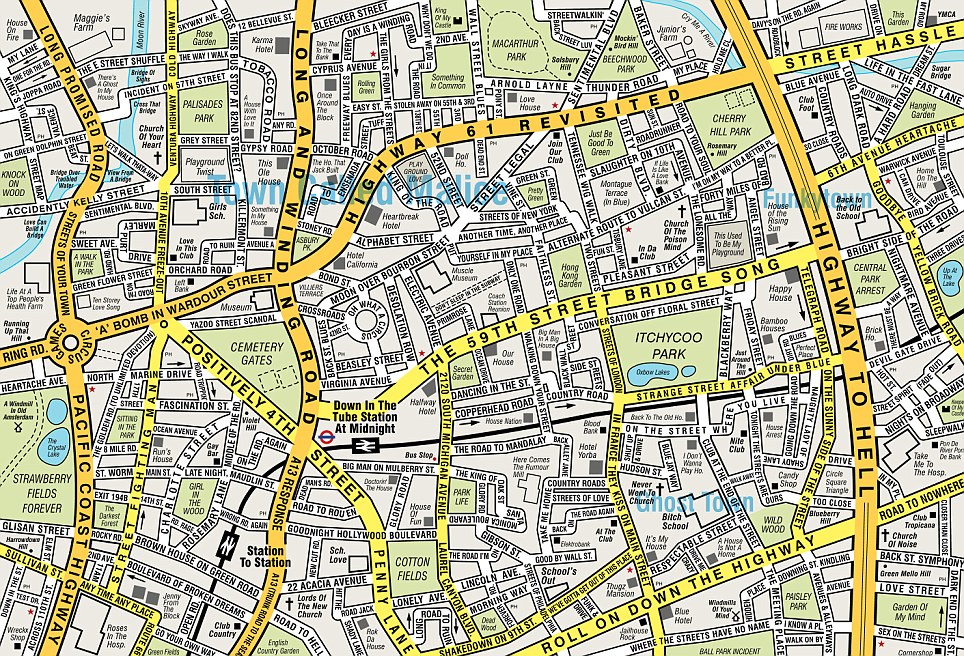
This is road map of songs whose names sound like things that should be on a road map:

The poster version is available for purchase here, as are a similar TV map, book map, game map, and film map.

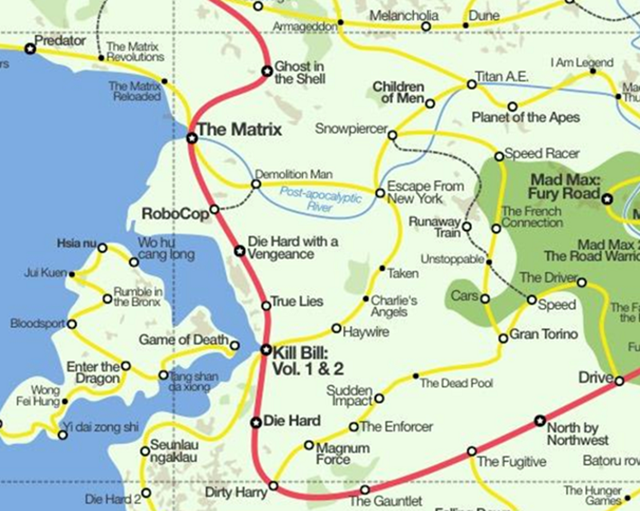
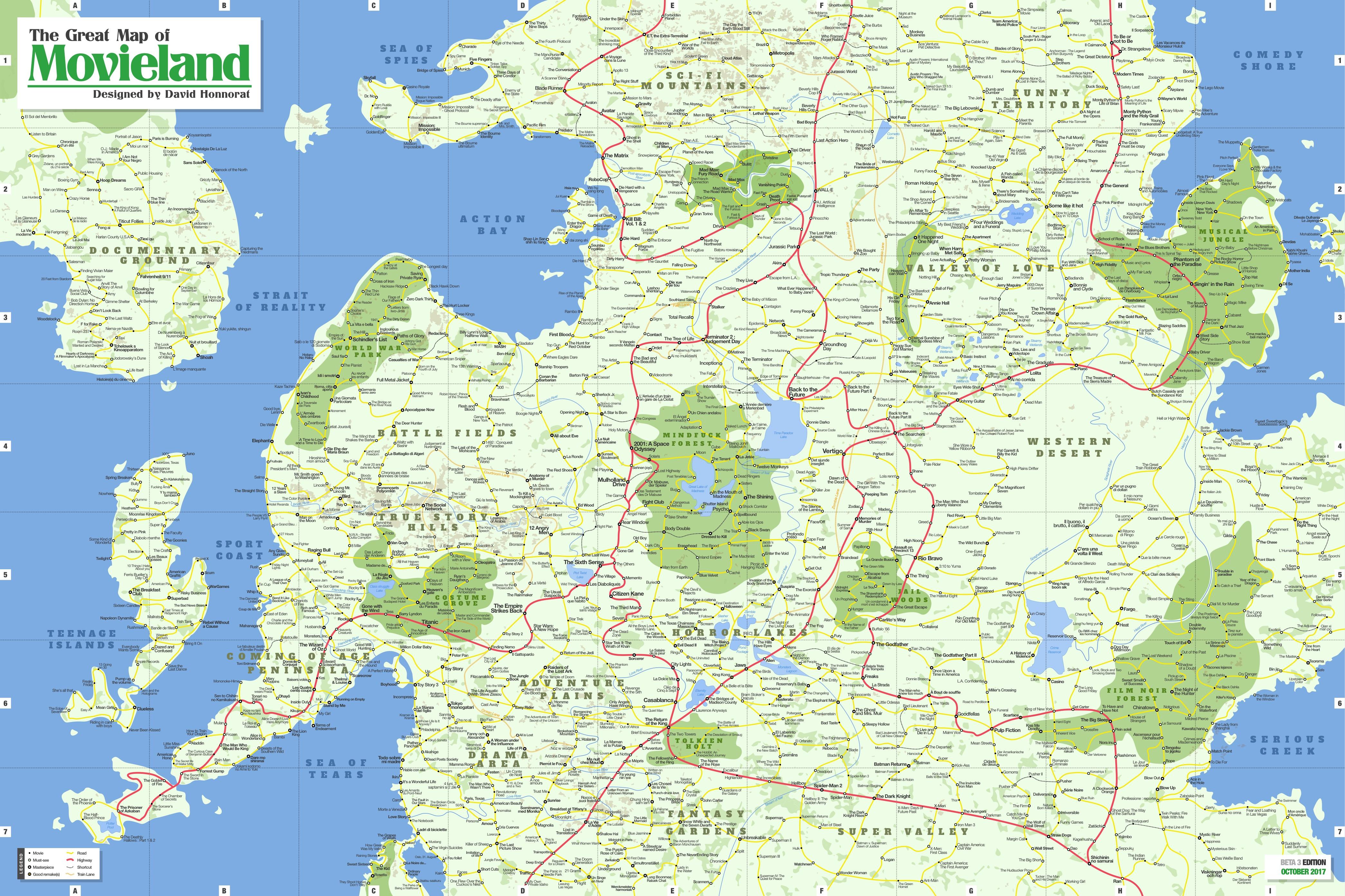
And speaking of film maps, a random Reddit commenter made one:

That’s it. These are literally all the good modern sentimental cartography maps I know. This is a good art, it shouldn’t have died with the Renaissance, and people should do more work to resurrect it.

Posted in Uncategorized | Tagged , , | 51 Comments

The Whole City Is Center

Related to yesterday’s post on people being too quick to assume value differences: some of the simplest fake value differences are where people make a big deal about routing around a certain word. And some of the most complicated real value differences are where some people follow a strategy explicitly and other people follow heuristics that approximate that strategy.

There’s a popular mental health mantra that “there’s no such thing as laziness” (here are ten different articles with approximately that title: 1, 2, 3, 4, 5, 6, 7, 8, 9, 10). They all make the same basically good point. We shame people who don’t work very hard as “lazy”, and think they should have lower status than the rest of us. But actually, these people don’t just randomly choose not to work. Some of them have psychological issues, like anxiety and trauma that are constantly distracting them from their work, or a fear of success, or self-defeating beliefs about how nothing they do matters anyway. Others have biological issues – maybe hypothyroidism, or vitamin deficiencies, or ADHD, or other things we don’t understand that lower their energy and motivation. Still others just don’t want to do the specific thing we are asking them to do right now and can’t force themselves to work uphill against that gradient. When we call people “lazy”, we’re ignorantly dismissing all these possibilities in favor of a moralistic judgment.

A dialogue:

Sophisticus: I don’t believe in laziness.

Simplicio: What about my cousin Larry? He keeps promising to do important errands for his friends and family, and then he never does them. Instead he just plays video games all the time. This has happened consistently over the past few years, every time he’s promised to do something. One time my aunt asked him to go to the DMV to get some paperwork filled out, he promised he would do it, and then he kept putting it off for a month until it was past the deadline and she almost lost her car. He didn’t forget about it or anything, he just couldn’t bring himself to go out and do it. And he’s been fired from his last three jobs for not showing up, and…

Sophisticus: Yes, yes, I’m sure there are people like this. But he probably has some self-defeating beliefs, or vitamin deficiencies, or mental health issues.

Simplicio: Okay. Well, my mother is going to be away for the next week, and she needs someone to dog-sit for her. Her dog is old and sick and requires a lot of care each day. She’s terrified that if he doesn’t get his food and medication and daily walk on time, something terrible will happen to him. She’s willing to pay a lot of money. Do you think I should recommend she ask my cousin Larry?

Sophisticus: No, of course not.

Simplicio: Why not?

Sophisticus: He probably won’t do it. He’ll just play video games instead.

Simplicio: Why do you think so?

Sophisticus: Because he has a long history of playing video games instead of doing important tasks.

Simplicio: If only there were a word for the sort of person who does that!

Sophisticus: Oh, I see. Now you’re making fun of me. But I’m not saying everyone is equally reliable. I’m saying that instead of denouncing someone as “lazy”, we should look for the cause and try to help them.

Simplicio: Hey, we did try to help him. Larry’s family has taken him to the doctor loads of times. They didn’t anything on the lab tests, but the psychiatrist thought he might be ADHD and gave him some Adderall. I would say now he pulls through on like 20% of the things we ask him to do instead of zero percent. We also tried to get him to go to therapy, but the therapist deferred because ADHD has a very low therapy response rate. His parents tried to change the way they asked him to do things to make it easier for him, or to let him choose a different set of tasks that were more to his liking, but that only worked a little, if at all. Probably there’s some cause we don’t understand, but it’s beyond the reach of medical science, incentive design, or the understanding that exists between loving family members to identify.

Sophisticus: See! The Adderall helped! And letting him choose his own tasks helped a little too!

Simplicio: I agree it helped a little. So should I recommend him to my mother as a dog-sitter?

Sophisticus: No, of course not.

Simplicio: Then I still don’t see what the difference between us is. I agree it was worth having him go to the doctor and the therapist to rule out any obvious biological or psychological issues, and to test different ways of interacting with him in case our interaction style was making things worse. You agree that since this still hasn’t made him reliably fulfill his responsibilities and we don’t have any better ideas, he’s a bad choice for a dog-sitter. Why can’t I communicate the state of affairs we both agree on to my mother using the word “lazy”?

I imagine Sophisticus believing he has a fundamental value difference with people who use the term “lazy”. They think that some people are just bad and should be condemned, whereas he wisely believes that everything has a cause and people who have issues with motivation should be helped. But it’s not clear to me that this is a real difference. I can imagine someone signaling hard-headedness and strictness by insisting that they were against laziness, and someone else signaling compassion by insisting that they don’t believe in laziness, but it’s pretty hazy exactly where their maps of the world diverge.

But back to the dialogue:

Sophisticus: Because “lazy” is laden with the idea that lazy people should be punished. You should yell at them to get off their ass and do some work.

Simplicio: I mean, I’m not sure that’s wrong? When my aunt and uncle tried to take Larry to the psychiatrist, he didn’t want to go. My uncle started screaming at him that if he didn’t make the appointment he would never amount to anything, and he would be a loser his entire life, and they would disown him – and I guess it freaked Larry out enough that he made the appointment. And it seems like if that kind of thing makes people do important stuff for their own good – whether it’s make appointments or hold down a job – then it might be reasonable, at least from people whom the lazy person has entered into some kind of relationship with.

Sophisticus: I think that kind of strategy might occasionally work in the short-term, but that in the long-term it makes things much worse.

Simplicio: I agree that’s possible, but it seems like we have a factual disagreement here. And I think that factual disagreement is best expressed by the question “Does laziness respond to social shaming or not?”, not a claim that laziness doesn’t exist. It certainly doesn’t seem like we have a value difference unrelated to any purely-factual beliefs.

Maybe both participants are wrong here. My impression is that some forms of laziness respond to incentives and others don’t. I know many people who will start work on a project they’ve been putting off if they know it’s due the next day and worth half their grade. I also know other people who won’t. But continuing:

Sophisticus: I can imagine some cases in which it’s useful to use external rewards and punishments to encourage people with low motivation to do something. But the word “lazy” doesn’t just mean “can be motivated by external reinforcement”. It’s an attempt to judge somebody, to say they’re lesser, to lower their social status.

Simplicio: You just said that my mother should avoid hiring Larry for a lucrative job. Surely that’s a judgment, and surely keeping him unemployed forever lowers his social status.

Sophisticus: I’m judging him as bad at one thing, not as a Universally Bad Person.

Simplicio: Do you think Larry would be a good pilot?

Sophisticus: Well, no…

Simplicio: Nuclear engineer?

Sophisticus: No, but…

Simplicio: Lieutenant colonel in the army?

Sophisticus: I agree there are many things Larry would not be good at.

Simplicio: And surely the person who thinks he is lazy agrees there are some things he might be good at – for example, he might be handsome, or intelligent. Indeed, the “lazy but bright” student is a stock cultural figure. The main judgment that “lazy” represents is that he’s not a very hard worker – a judgment you seem to share.

Sophisticus: I think that for them it’s a moral judgment, and for me it isn’t.

Simplicio: A moral judgment? I don’t think of a lazy person as more likely to rob or murder. Do you think others do?

Sophisticus: No, I don’t think so. It’s not a judgment that they’re bad at a specific field we both agree is moral. It’s a judgment that they should be considered less moral just because they’re lazy.

Simplicio: But how does that cash out? Both you and they want them to not get certain jobs. Both you and they believe some level of reinforcement might make them more motivated, though we can debate the factual specifics. Is there anything that a moralist would do that you wouldn’t?

Sophisticus: I’m not sure the belief would cash itself out in some specific way, but they would have it.

Simplicio: If you both give him the same jobs and treat him the same, what’s the difference? Just give him the Heartstone and call it a day!

Sophisticus: You’re mocking me again.

Simplicio: I think we’re treating the word “laziness” differently. I’m thinking of “lazy” as a way to communicate a true fact about the world. You agree that the true fact should be communicated by some word, but you’re interpreting “lazy” to mean some sort of awful concept like “a person who avoids responsibilities in a way not caused by anything whatsoever except being bad, and so we should hurt them and make them suffer”. Are you sure this isn’t kind of dumb? Given that we need a word for the first thing, and everyone currently uses “lazy” for it, and we don’t need a word for the second thing because it’s awful, and most people would deny that “lazy” means that, why don’t we just use “lazy” for the very useful purpose it’s served thus far?

Sophisticus: I think…

Simplicio: And it’s the same with “judgment”. I’m using it to mean a reasonable thing that everyone does and has to do. You’re demanding we reserve it for some kind of ultimate judgment about everything that doesn’t really make sense and probably should never happen.

Sophisticus: I think you’re wrong about common usage. I think a lot of people – maybe not you, but a lot of people – really do use “lazy” to mean the second thing. And that even for good people like yourself, “lazy” has a bit of a connotation of the second thing which you can’t avoid letting slip into your mind.

Simplicio: If you’re right, I worry you’re going up against the euphemism treadmill. If we invent another word to communicate the true fact, like “work-rarely-doer”, then anyone who believes that people who play video games instead of working deserve to suffer will quickly conclude that work-rarely-doers deserve to suffer.

Sophisticus: Then let’s not invent something like “work-rarely-doer”. Let’s just say things like “You shouldn’t have Larry as a dog-sitter, because due to some social or psychological issue he usually plays video games instead of doing difficult tasks.”

Simplicio: I think people are naturally going to try to compress that concept. You can try to stop them, but I think you’ll fail. And I think insofar as you can communicate the concept at all, people are going to think less of Larry because of it. It’s possible you can slightly decrease the degree to which people think less of Larry, but only by slightly decreasing their ability to communicate useful information.

Sophisticus: Well, that’s a risk I’m willing to take.

Simplicio: If there were such a thing as laziness, but it was rare, then it would make sense to argue “most people aren’t lazy”, since lazy would be pointing at a particular quality that most people don’t have. But if you say there’s no such thing as laziness, then it sounds like maybe you’re kind of weird to insist on defining “laziness” to refer a quality that nobody has, yet refuse to use any word to refer to the quality that many people do have. It would be like wanting our language to have a word for “unicorn” but not for “horse”.

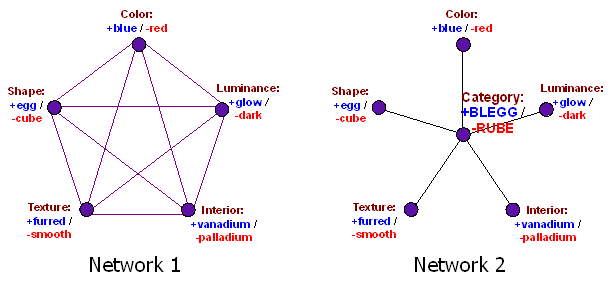
I think Simplicio is working off one of these kinds of models (from How An Algorithm Feels From The Inside, but see also here):

…where “lazy” is the node at the center of the second one. He’s saying that if he and Sophisticus both agree on all of the outside nodes, why exactly are they holding a debate on the status of the center, when the center is just a way to help us predict the values of the others? He feels like Sophisticus is insisting on designing the structure such that the central node has some deep metaphysical meaning that he can’t explain but which is very bad, whereas he just wants it to be a perfectly ordinary predictor. Moving on:

Sophisticus: What about this? I think that people with low motivation sometimes can be helped by reinforcement – including negative reinforcement. But other people think they should be punished. There’s a big difference between simple negative reinforcement and punishment. If you’re just using negative reinforcement, you’re trying to use as little as possible to get the result you want. But when you’re judgmental and you divide people into good and bad, you usually add that the bad people deserve to suffer, regardless of the effect.

Simplicio: This is a strange distinction. Suppose I beat up my wife and threaten to do it again. Shouldn’t I go to jail?

Sophisticus: I think we shouldn’t be excessive about it, and I don’t support mass incarceration, but I don’t want you to get off scot-free, because it seems like that would encourage future domestic violence.

Simplicio: If only there were a word for the sort of thing where we made sure people didn’t get off scot-free in a way that encouraged future crime!

Sophisticus: No no no, you still don’t get it. There’s a difference between a principled consequentialist view of discouraging actions, and wanting people to suffer.

Simplicio: Look, I happen to know one of those Hogwarts wizards everyone keeps writing books about, and he’s offered to let me take a magic Unbreakable Vow that I won’t assault anyone ever again. Now that there’s no point in discouraging me, I don’t need to deal with this jail thing, right?

Sophisticus: It’s not just about discouraging you personally. It’s about making an example of you to discourage everyone else. Also, there’s a Parfit’s Hitch-Hiker type element – the threat of punishment now could have presented you from committing the crime in the past, and the threat couldn’t be credible unless we agreed to actually punish you.

Simplicio: Then I question whether the “principled consequentialist view” ever differs from the “believing in punishment and wanting bad people to suffer” view in terms of what actions it recommends.

Sophisticus: The people who believe in punishment often say things like “I hope that person rots in jail” or “Let’s make the conditions in jail extra bad”. Whereas I want domestic violence discouraged by nice Scandinavian-style prisons and – when possible – community service.

Simplicio: If you learned that having nice jails actually…

Sophisticus: Oh, I know what you’re going to say. You’re going to say this is just a factual difference between me and the pro-punishment faction. They believe, as a matter of fact, that bad conditions discourage crime extra effectively, since some criminals who would be willing to take the risk of a nice Scandinavian-style prison would be scared off by a dark overheated cage. And I agree this is a possible axis on which people can differ, and that if you proved to me that this was true I could be persuaded to reconsider my views. But I have talked to people who have literally said the words “I don’t care how much it discourages crime or not, I want criminals to suffer.”

Simplicio: Okay. I agree that’s good evidence for your view

Sophisticus: You…do? Really? I won one of these? REALLY?!

Simplicio: I guess.

Sophisticus: So you admit sometimes there are fundamental value differences?

Simplicio: Sometimes, yeah, I guess. But I want to be really careful with this. Humans are adaptation-executors, not fitness-maximizers. Only one person in a thousand could give the principled consequentialist defense of criminal justice that you’re giving here. The game theory necessary to understand the defense is only a few decades or centuries old, depending on how exactly you define it – but even chimpanzees need to discourage defectors. Since evolution couldn’t cram the whole principled consequentialist defense into a chimpanzee brain, it just gave us the urge to punish.

Sophisticus: I agree that’s a plausible scientific account of the genesis of the urge to punish. But that doesn’t mean that I have to agree with it. After all, evolution gave us an urge to eat sugary food, but I can ignore that urge when I don’t think it’s the healthy thing for me to do at the moment.

Simplicio: Thanks to modern medical science, you’re smarter than your urge telling you to eat sugar. I’m not sure how many people are smarter than their urges to punish. If you miss the Parfit’s Hitch-Hiker angle, you punish the wrong people. If you miss the angle where you have to adjust for probability of catching the crime, you punish people the wrong amount. But the person just following their evolutionary urges would get both of those right – more or less. Imagine that, using physics, you are able to approximate the ball-trajectory-predicting power of the world’s best golfer – but the golfer still does a little bit better. Would you pooh-pooh him for merely following his base evolutionary urges?

Sophisticus: If it harmed people, yes! You’re trying to reduce this to factual differences again, but you already admitted that’s not going to work. We’re not debating the effectiveness of different punishment levels here. For all I know, evolutionary urges are more effective at the goal of keeping me alive – which is notably different from the goal of being just. But that’s not the point. The point is that I think there are people who, even if God handed them a stone tablet saying “YOU ONLY NEED TO PUNISH THIS PERSON X AMOUNT TO EFFECTIVELY DISCOURAGE FUTURE ACTIONS”, would still punish them X+1 amount just to make them suffer.

Simplicio: Okay, I didn’t want to re-open the factual differences thing. I agree they are not aiming at the same thing you are. My point is just that the only difference between you and the pro-punishment faction is that you are following an explicitly-calculated version of the principled consequentialist defense of punishment, and they are following a heuristic approximating the principled consequentialist defense of punishment, and their heuristic might actually be more accurate than your explicit calculation.

Sophisticus: So what? Again, they outright say they would deviate from the principled consequentialist position.

Simplicio: Yes. Adaptation-execution rather than fitness-maximization again. Evolution can’t quite cram the entire principled consequentialist position into our heads, so it just gives us an urge, and sometimes the urge does weird stuff that the principles wouldn’t.

Sophisticus: Again, so what? I agree there’s a biological/psychological cause for other people being wrong about punishment – just as there is a biological/psychological cause for other people being bad at fulfilling responsibilities – “lazy”, you would say – but that doesn’t mean I can’t continue to disagree with them.

Simplicio: My point is that, if you squint, this is sort of a factual disagreement. It’s not a factual disagreement between you and them. It’s a factual disagreement between you and the evolutionary/biochemical process that created their sense of justice. The evolution/biochemistry is trying to instantiate a view of punishment that does the best job of protecting them and their loved ones without expending unnecessary resources. But it’s getting it wrong – probably erring on the side of caution, as you would expect these sorts of processes to do. I agree you have a value disagreement with them, but this is less them having some value totally foreign to you, and more them attempting to implement your values but not doing a very good job.

Sophisticus: You’re screwing up levels again! If what you’re saying is true, then I have a mere “factual disagreement” with the evolutionary/biological process that produced their values, insofar as you can have a factual disagreement with a blind impersonal force. But I still don’t agree with the people who are the end result of the process! They should be abandoning their evolutionary/biochemical process in favor of what’s actually right.

Simplicio: Nobody has a coherent theory of when to abandon their evolutionary/biochemical processes, though. I have the urge to care about my children more than I care about some random people somewhere else. That’s clearly an evolutionary/biochemical process. I cannot justify it based on pure reason. But I choose, in reflective equilibrium, to keep that urge. What moral law can you tell me that allows me to ditch the irrational consequences of my excessive-punishment-urge, but keep the irrational consequences of my love-children-urge?

Sophisticus: Hmmm…what about “the excessive-punishment urge is wrong, even by the standards of the evolutionary/biochemical process that produced it, but the love children urge is right?”

Simplicio: I’ve been told that we love kittens based on a misfiring of our evolutionary urge to love children. Should I abandon that one? I’ve been told I love beauty and nature and high mountains and deep forests based on evolutionary heuristics about what kind of places will have a good food supply – now that I can order take-out, should I ditch that too? Huge chunks of our hopes and dreams are the godshatter of misfired-evolutionary processes. Tell me what principled decision lets us judge among them, rejecting one as evil but the other as good?

Sophisticus: I cannot. I make no claim that I can. I only say that, by my arbitrary choice of methods of reaching reflective equilibrium, natural beauty is good but punishment is bad. And that if someone else’s arbitrary choice of methods of reaching reflective equilibrium pronounces the opposite, they have a fundamental value difference from me, and I won’t shirk from saying so.

Simplicio: Then all I am saying is to be understanding. They’re not people who are coming from some sort of alien ideology of suffering being good for its own sake. They’re people who are taking the same godshatter you are, and applying a different process of arbitrary reflective equilibrium to it, in a world where none of us really understand or control the process of reflective equlibrium we go through. That gives me a different and more understanding perspective on them. It may not make me agree with them, but it makes me more willing to think of them as an odd but sympathetic potential-negotiating-partner rather than some sort of hostile villain.

I need to admit here that I personally am neither as saintly as Sophisticus nor as reasonable as Simplicio. A while ago, I learned that my great-grandfather was murdered, and my great-grandmother – normally a deeply kind and compassionate woman – demanded the death penalty rather than life imprisonment for his murderers. When the jury went with life imprisonment anyway, she yelled at them that she hoped someone killed their loved ones so they knew how it felt. This story had a pretty big impact on me and made me try to generate examples of things that could happen such that I would really want the perpetrators to suffer, even more than consequentialism demanded. I may have turned some very nasty and imaginative parts of my brain, the ones that wrote the Broadcast interlude in Unsong, to imagining crimes perfectly calculated to enrage me. And in the end I did it. I broke my brain to the point where I can very much imagine certain things that would happen and make me want the perpetrator to suffer – not infinitely, but not zero either. I am not going to claim that this is just some misfiring of evolutionary urges which I obviously denounce. I think I stick to them the same way I stick to liking kittens. I’m not sure I would promote them as policy – in the same kind of second-level way where I can think of some people who would make good dictators but still don’t actually want them to set up a dictatorship – but I don’t renounce them entirely either. I guess reflective equilibrium is easier to disturb than I thought.

Sophisticus: I’ve been thinking, Simplicio – doesn’t your philosophy hoist itself on its own petard?

Simplicio: What do you mean?

Sophisticus: You insist that much of what people consider value differences is actually a difference in what words they are willing to use while describing basically the same values. And that if a term seems unsavory to us, we should use it to describe the closest useful concept, rather than condemning it for applying to a bad concept we shouldn’t have. If we hear “laziness”, we should assume it stands for the way your cousin Larry is, rather than some package of moral and metaphysical assumptions. If we hear “judgment”, we should assume it stands for assessing someone’s ability as a dog-walker, rather than some package of moral evaluations. If we hear “punishment”, we should assume it stands for some kind of consequentialist negative reinforcement, rather than the belief that some people deserve to suffer.

Simplicio: I’m not sure that’s exactly how I would describe my position, but go on.

Sophisticus: What about the term “value difference” itself? It seems like you’re being a hypocrite here. After all, there are plenty of things that look like value differences to us – I disagree with people on moral questions about a thousand times a day. But you insist that none of those are real value differences, and instead we must reserve the concept of “value difference” for some Platonic perfect value difference that doesn’t exist in real life.

Simplicio: I agree these rarely exist in practice. I think the difference is that they can exist in theory. Imagine a paperclip maximizer robot vs. a paperclip minimizer robot. These have a true value difference. They’re not doing the same thing and applying different words to it. If I were a paperclip minimizer, I could never get a paperclip maximizer to say it wanted to do a specific thing, and then sarcastically say “If only there was a word for that thing!”, and then it would have to admit that word was “paperclip minimization”.

Sophisticus: Okay. But there are no paperclip maximizers or minimizers in real life. So I still think you’re denying real-life use of a term in favor of some Platonic version that doesn’t exist.

Simplicio: I just don’t like the connotations of “value difference”. I think they suggest the non-existent thing.

Sophisticus: That’s exactly what I’ve been trying to tell you is true of “laziness” or “judgment”, and you never let me get away with it!

Simplicio: I just realized I have to, uh, wash my toaster. I’ll be back in a minute.

Ten years go by. Sophisticus is never able to find Simplicio again. He seems to have disappeared. Sophisticus knows it’s bizarre to think somebody would skip town and change identities just to avoid a philosophical debate, but he cannot think of any other explanation. One day, Sophisticus goes on a vacation to a city very far away, and becomes hopelessly lost. He notices a stranger in glasses and a mustache, who looks familiar in a way he cannot quite place, and asks him for directions.

Sophisticus: Excuse me, do you know the way to city center?

Stranger: Don’t worry, good sir! You’re in city center right now!

Sophisticus: But…this whole area looks suburban. And the edge of the city is right there – past that street there’s only rolling fields as far as the eye can see. How can this be city center?

Stranger: The whole city is the city center!

Sophisticus: What?

Stranger: That’s right. We decided that it was pretty stigmatizing to say that certain parts of the city were non-central. You know, it implied that the people there were just a bunch of yokels who weren’t real citizens the same way everyone else was. So we held a referendum, and everyone agreed that the whole city would be classified as the city center.

Sophisticus: That’s pretty weird, but…look, I need to get to the tourist office, and I know it’s in city center, so if you’re not going to direct me to city center..can you just tell me what part of town the tourist office is in?

Stranger: It’s in the center. The whole city is center.

Sophisticus: Let’s try this again. Please point me in the direction of the Tourist Office.

Stranger: Perhaps you think the Tourist Office is some kind of mystical place that will answer all of your tourist-related questions and give you a perfect vacation, but that everywhere-not-the-Tourist-Office is some kind of hellscape with nothing of any value to visitors? In that case, I reject your Tourist-Office vs. Non-Tourist-Office distinction. There is no such thing as the Tourist Office.

Sophisticus: By “Tourist Office”, I just mean an ordinary non-perfect building with a greater-than-average propensity to give tourist information!

Stranger: Well, if you mean “building” to mean something 100% artificial without even natural materials which is hermetically insulated from the outside, then really there aren’t any buildings here. There are just –

Sophisticus: Wait, I know you! You’re my old friend Simplicio, who skipped town so he didn’t have to answer my challenge about his theory of value differences.

Simplicio: Guilty as charged. But now I hope you better understand what I mean. There is a sense in which you’re right, and a sense in which I’m right. Words both convey useful information, and shape our connotations and perceptions. While we can’t completely ignore the latter role, it’s also dangerous to posit fundamental value differences between people who use words one way and people who use them another. My concern is that I’ve seen people say “I am the kind of person who doesn’t believe in laziness, or in punishment, or in judging others. But that guy over there accuses people of being lazy, wants people to suffer, and does judge others. Clearly we have fundamental value differences and must be enemies.” All I’m trying to do is say that those people may have differing factual beliefs on how to balance the information-bearing-content of words versus their potential connotations. If we understand the degree to which other people’s differences from us are based on factual rather than fundamental value differences, we can be humbler and more understanding when we have to interact with them.

Sophisticus: Okay, but seriously, I need to get to city center.

Simplicio: The whole city is the city center.

Sophisticus: Screw you.

Simplicio: Hey, don’t be so judgmental.

Posted in Uncategorized | Tagged | 414 Comments

Fundamental Value Differences Are Not That Fundamental

I.

Ozy (and others) talk about fundamental value differences as a barrier to cooperation.

On their model (as I understand it) there are at least two kinds of disagreement. In the first, people share values but disagree about facts. For example, you and I may both want to help the Third World. But you believe foreign aid helps the Third World, and I believe it props up corrupt governments and discourages economic self-sufficiency. We should remain allies while investigating the true effect of foreign aid, after which our disagreement will disappear.

In the second, you and I have fundamentally different values. Perhaps you want to help the Third World, but I believe that a country should only look after its own citizens. In this case there’s nothing to be done. You consider me a heartless monster who wants foreigners to starve, and I consider you a heartless monster who wants to steal from my neighbors to support random people halfway across the world. While we can agree not to have a civil war for pragmatic reasons, we shouldn’t mince words and pretend not to be enemies. Ozy writes (liberally edited, read the original):

From a conservative perspective, I am an incomprehensible moral mutant…however, from my perspective, conservatives are perfectly willing to sacrifice things that actually matter in the world– justice, equality, happiness, an end to suffering– in order to suck up to unjust authority or help the wealthy and undeserving or keep people from having sex lives they think are gross.

There is, I feel, opportunity for compromise. An outright war would be unpleasant for everyone…And yet, fundamentally… it’s not true that conservatives as a group are working for the same goals as I am but simply have different ideas of how to pursue it…my read of the psychological evidence is that, from my value system, about half the country is evil and it is in my self-interest to shame the expression of their values, indoctrinate their children, and work for a future where their values are no longer represented on this Earth. So it goes.

And from the subreddit comment by GCUPokeItWithAStick:

I do think that at a minimum, if you believe that one person’s interests are intrinsically more important than another’s (or as the more sophisticated versions play out, that ethics is agent-relative), then something has gone fundamentally wrong, and this, I think, is the core of the distinction between left and right. Being a rightist in this sense is totally indefensible, and a sign that yes, you should give up on attempting to ascertain any sort of moral truth, because you can’t do it.

I will give this position its due: I agree with the fact/value distinction. I agree it’s conceptually very clear what we’re doing when we try to convince someone with our same values of a factual truth, and confusing and maybe impossible to change someone’s values.

But I think the arguments above are overly simplistic. I think rationalists might be especially susceptible to this kind of thing, because we often use economic models where an agent (or AI) has a given value function (eg “produce paperclips”) which generates its actions. This kind of agent really does lack common ground with another agent whose goal function is different. But humans rarely work like this. And even when they do, it’s rarely in the ways we think. We are far too quick to imagine binary value differences that line up exactly between Us and Them, and far too slow to recognize the complicated and many-scaled pattern of value differences all around us.

Eliezer Yudkowsky writes, in Are Your Enemies Innately Evil?:

On September 11th, 2001, nineteen Muslim males hijacked four jet airliners in a deliberately suicidal effort to hurt the United States of America. Now why do you suppose they might have done that? Because they saw the USA as a beacon of freedom to the world, but were born with a mutant disposition that made them hate freedom?

Realistically, most people don’t construct their life stories with themselves as the villains. Everyone is the hero of their own story. The Enemy’s story, as seen by the Enemy, is not going to make the Enemy look bad. If you try to construe motivations that would make the Enemy look bad, you’ll end up flat wrong about what actually goes on in the Enemy’s mind.

So what was going through the 9/11 hijackers’ minds? How many value differences did they have from us?

It seems totally possible that the hijackers had no value differences from me at all. If I believed in the literal truth of Wahhabi Islam – a factual belief – I might be pretty worried about the sinful atheist West. If I believed that the West’s sinful ways were destroying my religion, and that my religion encoded a uniquely socially beneficial way of life – both factual beliefs – I might want to stop it. And if I believed that a sufficiently spectacular terrorist attack would cause people all around the world to rise up and throw off the shackles of Western oppression – another factual belief – I might be prepared to sacrifice myself for the greater good. If I thought complicated Platonic contracts of cooperation and nonviolence didn’t work – sort of a factual belief – then my morals would no longer restrain me.

But of course maybe the hijackers had a bunch of value differences. Maybe they believed that American lives are worth nothing. Maybe they believed that striking a blow for their homeland is a terminal good, whether or not their homeland is any good or its religion is true. Maybe they believe any act you do in the name of God is automatically okay.

I have no idea how many of these are true. But I would hate to jump to conclusions, and infer from the fact that they crashed two planes that they believe crashing planes is a terminal good. Or infer from someone opposing abortion that they just think oppressing women is a terminal value. Or infer from people committing murder that they believe in murderism, the philosophy that says that murder is good. I think most people err on the side of being too quick to dismiss others as fundamentally different, and that a little charity in assessing their motives can go a long way.

II.

But that’s too easy. What about people who didn’t die in self-inflicted plane crashes, and who can just tell us their values? Consider the original example – foreign aid. I’ve heard many isolationists say in no uncertain terms that they believe we should not spend money to foreign countries, and that this is a basic principle and not just a consequence of some factual belief like that foreign countries would waste it. Meanwhile, I know other people who argue that we should treat foreigners exactly the same as our fellow citizens – indeed, that it would be an affront to basic compassion and to the unity of the human race not to do so. Surely this is a strong case for actual value differences?

My only counter to this line of argument is that almost nobody, me included, ever takes it seriously or to its logical conclusion. I have never heard any cosmopolitans seriously endorse the idea that the Medicaid budget should be mostly redirected from the American poor (who are already plenty healthy by world standards) and used to fund clinics in Africa, where a dollar goes much further. Perhaps this is just political expediency, and some would talk more about such a plan if they thought it could pass. But in that case, they should realize that they are very few in number, and that their value difference isn’t just with conservatives but with the overwhelming majority of their friends and their own side.

And if nativist conservatives are laughing right now, I know that some of them have given money to foreign countries affected by natural disasters. Some have even suggested the government do so – when the US government sent resources to Japan to help rescue survivors of the devastating Fukushima tsunami, I didn’t hear anyone talk about how those dollars could better be used at home.

Very few people have consistent values on questions like these. That’s because nobody naturally has principles. People take the unprincipled mishmash of their real opinions, extract principles out of it, and follow those principles. But the average person only does this very weakly, to the point of having principles like “it’s bad when you lie to me, so maybe lying is wrong in general” – and even moral philosophers do it less than a hundred percent and apply their principles inconsistently.

(this isn’t to say those who have consistent principles are necessarily any better grounded. I’ve talked a lot about shifting views of federalism: when the national government was against gay marriage, conservatives supported top-down decision-making at the federal level, and liberals protested for states’ rights. Then when the national government came out in support, conservatives switched to wanting states’ rights and liberals switched to wanting top-down federal decisions. We can imagine some principled liberal who, in 1995, said “It seems to me right now that state rights are good, so I will support them forevermore, even when it hurts my side”. But her belief still would have ended up basically determined by random happenstance; in a world where the government started out supporting gay marriage but switched to oppose it, she would have – and stick to – the opposite principle)

But I’m saying that what principle you verbalize (“I believe we must treat foreigners exactly as our own citizens!”) isn’t actually that interesting. In reality, there’s a wide spectrum of what people will do with foreigners. If we imagine it as a bell curve, the far right end has a tiny number of hyper-consistent people who oppose any government money going abroad unless it directly helps domestic citizens. A little further towards the center we get the people who say they believe this, but will support heroic efforts to rescue Japanese civilians from a tsunami. The bulge in the middle is people who want something like the current level of foreign aid, as long as it goes to sufficiently photogenic children. Further to the left, we get the people I’m having this discussion with, who usually support something like a bit more aid and open borders. And on the far left, we get another handful of hyper-consistent people, who think the US government should redirect the Medicaid budget to Africa.

If you’re at Point N in some bell curve, how far do you have to go before you come to someone with “fundamental value differences” from you? How far do you have to go before someone is inherently your enemy, cannot be debated with, and must be crushed in some kind of fight? If the answer is “any difference at all”, I regret to inform you that the bell curve is continuous; there may not be anyone with exactly the same position as you.

And that’s just the one issue of foreign aid. Imagine a hundred or a thousand such issues, all equally fraught. God help GCU, who goes further and says you’re “indefensible” if you believe any human’s interests are more important than any other’s. Does he (I’ll assume it’s a he) do more to help his wife when she’s sick than he would to help a random stranger? This isn’t meant to be a gotcha, it’s meant to be an example of how we formulate our morality. Person A cares more about his wife than a random person, and also donates some token amount to help the poor in Africa. He dismisses caring about his wife as noise, then extrapolates from the Africa donation to say “we must help all people equally”. Person B also cares more about his wife than a random person, and also donates some token amount to Africa. He dismisses the Africa donation as noise, then extrapolates from his wife to “we must care most about those closest to us”. I’m not saying that how each person frames his moral principle won’t have effects later down the line, but those effects will be the tail wagging the dog. If A and B look at each other and say “I am an everyone-equally-er, you are a people-close-to-you-first-er, we can never truly understand one another, we must be sworn enemies”, they’re putting a whole lot more emphasis on which string of syllables they use to describe their mental processes than really seems warranted.

Why am I making such a big deal of this? Isn’t a gradual continuous value difference still a value difference?

Yes. But I expect that (contra the Moral Foundations idea) both the supposed-nativist and the supposed-cosmopolitan have at least a tiny bit of the instinct toward nativism and the instinct toward cosmopolitanism. They may be suppressing one or the other in order to fit their principles. The nativist might be afraid that if he admitted any instinct toward cosmopolitanism, people could force him to stop volunteering at his community center, because his neighbor’s children are less important than starving Ethiopians and he should be helping them somehow instead. The cosmopolitan might be afraid that if he admitted any instinct toward preferring people close to him, it would justify a jingoistic I’ve-got-mine attitude that thinks of foreigners as subhuman.

But the idea that they’re inherently different, and neither can understand the other’s appeals or debate each other, is balderdash. A lot of the our-values-are-just-inherently-different talk I’ve heard centers around immigration. Surely liberals must have some sort of strong commitment to the inherent moral value of foreigners if they’re so interested in letting them into the country? Surely conservatives must have some sort of innate natives-first mentality to think they can just lock people out? But…

Okay. I admit this is a question about hard work and talents, which is a factual question. But we both know that you would get basically the same results if you asked “IMMIGRATION GOOD OR BAD?” or “DO IMMIGRANTS HAVE THE SAME RIGHTS TO BE IN THIS COUNTRY AS THE NATIVE BORN?” or whatever. And what we see is that this is totally contingent and dependent on the politics of the moment. Of all those liberals talking about how they can’t possibly comprehend conservatives because being against immigration would just require completely alien values, half of them were anti-immigrant ten years ago. Of all those conservatives talking about how liberals can never be convinced by mere debate because debate can’t cut across fundamental differences, they should try to figure out why their own party was half again as immigrant-friendly in 2002 as in 2010.

I don’t think anyone switched because of anything they learned in a philosophy class. They switched because it became mildly convenient to switch, and they had a bunch of pro-immigrant instincts and anti-immigrant instincts the whole time, so it was easy to switch which words came out of their mouths as soon as it became convenient to do so.

So if the 9/11 hijackers told me they truly placed zero value on American lives, I would at least reserve the possibility that sure, this is something you say when you want to impress your terrorist friends, but that in a crunch – if they saw an anvil about to drop on an American kid and had only a second to push him out of the way – they would end up having some of the same instincts as the rest of us.

III.

Is there anyone at all whom I am willing to admit definitely, 100%, in the most real possible way, has different values than I do?

I think so. I remember a debate I had with my ex-girlfriend. Both of us are atheist materialist-computationalist utilitarian rationalist effective altruist liberal-tarians with 99% similar views on every political and social question. On the other hand, it seemed axiomatic to me that it wasn’t morally good/obligatory to create extra happy people (eg have a duty to increase the population from 10,000 to 100,000 people in a way that might eventually create the Repugnant Conclusion), and it seemed equally axiomatic to her that it was morally good/obligatory to do that. We debated this maybe a dozen times throughout our relationship, and although we probably came to understand each other’s position a little more, and came to agree it was a hard problem with some intuitions on both sides, we didn’t come an inch closer to agreement.

I’ve had a few other conversations that ended with me feeling the same way. I may not be the typical Sierra Club member, but I consider myself an environmentalist in the sense of liking the environment and wanting it to be preserved. But I don’t think I value biodiversity for its own sake – if you offered me something useful in exchange for half of all species going extinct – promising that they would all be random snails, or sponges, or some squirrel species that looked exactly like other squirrel species, or otherwise not anything we cared about – I’d take it. If you offered me all charismatic megafauna being relegated to zoos in exchange for lots of well-preserved beautiful forests that people could enjoy whenever they wanted, I would take that one too. I know other people who consider themselves environmentalists who are horrified by this. Some of them agree with me on every single political issue that real people actually debate.

I think these kinds of things are probably real fundamental value difference. But if I’m not sure I have any fundamental value differences with the 9-11 hijackers, and I am sure I have one with one of the people I’m closest to in the entire world, how big a deal is it, exactly? The world isn’t made of Our Tribe with our fundamental values and That Tribe There with their fundamental values. It’s made of a giant mishmash of provisional things that solidify into values at some point but can be unsolidified by random chance or temporary advantage, and everyone probably has a couple unexplored value differences and unexpected value similarities with everyone else.

This means that trying to use shaming and indoctrination to settle value differences is going to be harder than you think. Successfully defeat the people on the other side of the One Great Binary Value Divide That Separates Us Into Two Clear Groups, and you’re going to notice you still have some value differences with your allies (if you don’t now, you will in ten years, when the political calculus changes slightly and their deepest ethical beliefs become totally different). Beat your allies, and you and the subset of remaining allies will still have value differences. It’s value differences all the way down. You will have an infinite number of fights, and you’re sure to lose some of them. Have you considered getting principles and using asymmetric weapons?

I’m not saying you don’t have to fight for your values. The foreign aid budget still has to be some specific number, and if your explicitly-endorsed principles disagree with someone else’s explicitly-endorsed principles, then you’ve got to fight them to determine what it is.

But “remember, liberals and conservatives have fundamental value differences, so they are two tribes that can’t coexist” is the wrong message. “Remember, everyone has weak and malleable value differences with everyone else, and maybe a few more fundamental ones though it’s hard to tell, and neither type necessarily line up with tribes at all, so they had damn well better learn to coexist” is more like it.

Posted in Uncategorized | Tagged | 704 Comments

OT106: Alexios I Commentos

This is the bi-weekly visible open thread (there are also hidden open threads twice a week you can reach through the Open Thread tab on the top of the page). Post about anything you want, ask random questions, whatever. You can also talk at the SSC subreddit or the SSC Discord server. Also:

1. I had originally asked teams in the Adversarial Collaboration Contest to be done by today. I would like each of the fifteen teams who originally signed up to check in (as a reply to the first comment on this thread) and tell me whether you’re done, whether you need more time, or whether you’ve given up. If done, please send your finished product to scott[at]shireroth[dot]org.

2. I’m going to write some posts soon that reference Conflict vs. Mistake, but I’m not entirely happy with it as some people said they thought it was wrong in important ways. I tried talking to those people and didn’t get a good feel for what they disliked, especially whether they rejected the idea that there was a dichotomy at all or just thought my post misrepresented one side of it. I would be interested in having someone who does think there is a dichotomy but thinks I misrepresented it rewrite the post, changing it as little as possible except to correct what they thought the misrepresentation was. If anyone does a good enough job of this I’ll post it on here as a new post and link the original to it.

3. Comments of the week are by bbeck, a drug patent lawyer who explains how a melatonin patent could incentivize supplement companies to sell the wrong dose, and how drug dosing patents work more generally.

Posted in Uncategorized | Tagged | 1,105 Comments

Did A Melatonin Patent Inspire Current Dose Confusion?

Yesterday I wrote about melatonin, mentioning that most drugstore melatonin supplements were 10x or more the recommended dose. A commenter on Facebook pointed me to an interesting explanation of why.

Dr. Richard Wurtman, an MIT scientist who helped discover melatonin’s role in the body and pioneer its use as a sleep aid, writes:

MIT was so excited about our research team’s melatonin-sleep connection discovery that they decided to patent the use of reasonable doses of melatonin—up to 1 mg—for promoting sleep.

But they made a big mistake. They assumed that the FDA would want to regulate the hormone and its use as a sleep therapy. They also thought the FDA wouldn’t allow companies to sell melatonin in doses 3-times, 10-times, even 15-times more than what’s necessary to promote sound sleep.

Much to MIT’s surprise, however, the FDA took a pass on melatonin. At that time, the FDA was focusing on other issues, like nicotine addiction, and they may have felt they had bigger fish to fry.

Also, the FDA knew that the research on melatonin showed it to be non-toxic, even at extremely high doses, so they probably weren’t too worried about how consumers might use it. In the end, and as a way of getting melatonin on to the market, the FDA chose to label it a dietary supplement, which does not require FDA regulation. Clearly, this was wrong because melatonin is a hormone, not a dietary supplement.

Quickly, supplement manufacturers saw the huge potential in selling melatonin to promote good sleep. After all, millions of Americans struggled to get to sleep and stay asleep, and were desperate for safe alternatives to anti-anxiety medicines and sleeping pills that rarely worked well and came with plenty of side effects.

Also, manufacturers must have realized that they could avoid paying royalties to MIT for melatonin doses over the 1 mg measure. So, they produced doses of 3 mg, 5 mg, 10 mg and more! Their thinking–like so much else in our American society–was likely, “bigger is better!” But, they couldn’t be more wrong.

So he’s saying that…in order to get around a patent on using the correct dose of melatonin…supplement manufacturers…used the wrong dose of melatonin? I enjoy collecting stories of all the crazy perversities created by our current pharmaceutical system, but this one really takes the cake.

Assuming it’s true, that is. Commenter Rodrigo brings up some reasons to be suspicious:

1. Who would patent a drug only up to a certain dose? Isn’t this really dumb?

2. To avoid the patent on the correct dose, drugstores just have to sell more than 1 mg – for example, 2 mg. But they actually sell up to 10 mg.

To these I would add:

3. Lots of supplements are very high dose. When I Google Vitamin C, the first product that comes up advertises that it has 1111% of the recommended daily allowance, which seems better optimized for numerological purposes than medical ones.

4. A few companies do sell melatonin at the right dose range, and MIT hasn’t sued them yet.

Normally I would find these considerations pretty persuasive, but I feel like the guy who discovered melatonin and ran a pharmaceutical company for a while knows more about the history of melatonin and pharmaceutical regulations than I do.

From last week:

This kind of thing is the endless drudgery of rationality training…questions like “How much should you discount a compelling-sounding theory based on the bias of its inventor?” And “How much does someone being a famous expert count in their favor?” And “How concerned should we be if a theory seems to violate efficient market assumptions?” And “How do we balance arguments based on what rationally has to be true, vs. someone’s empirical but fallible data sets?”

Here I’m just really skeptical of the MIT patent story. Wurtman seems to admit that “bigger is better” played a role. Maybe the patent thing was a very small issue, around the beginning of melatonin sales, and was soon forgotten – but the tradition of expecting melatonin to be very high dose stuck around forever, mostly for other reasons?

EDIT: Commenters, including a patent lawyer, have filled in the rest of the story. Because melatonin is a natural hormone and not an invention, patents can only cover specific uses of it. The MIT patent covered the proper way to use it for sleep; a broader patent might not have been granted. The patent probably guided supplement companies, but expired about five years ago. It’s now legal to produce melatonin 0.3 mg pills, but people are so used to higher doses that few people do.

Melatonin: Much More Than You Wanted To Know

[I am not a sleep specialist. Please consult with one before making any drastic changes or trying to treat anything serious.]

Van Geiklswijk et al describe supplemental melatonin as “a chronobiotic drug with hypnotic properties”. Using it as a pure hypnotic – a sleeping pill – is like using an AK-47 as a club to bash your enemies’ heads in. It might work, but you’re failing to appreciate the full power and subtlety available to you.

Melatonin is a neurohormone produced by the pineal gland. In a normal circadian cycle, it’s lowest (undetectable, less than 1 pg/ml of blood) around the time you wake up, and stays low throughout the day. Around fifteen hours after waking, your melatonin suddenly shoots up to 10 pg/ml – a process called “dim light melatonin onset”. For the next few hours, melatonin continues to increase, maybe as high as 60 or 70 pg/ml, making you sleepier and sleepier, and presumably at some point you go to bed. Melatonin peaks around 3 AM, then declines until it’s undetectably low again around early morning.

Is this what makes you sleepy? Yes and no. Sleepiness is a combination of the circadian cycle and the so-called “Process S”. This is an unnecessarily sinister-sounding name for the fact that the longer you’ve been awake, the sleepier you’ll be. It seems to be partly regulated by a molecule called adenosine. While you’re awake, the body produces adenosine, which makes you tired; as you sleep, the body clears adenosine away, making you feel well-rested again.

In healthy people these processes work together. Circadian rhythm tells you to feel sleepy at night and awake during the day. Process S tells you to feel awake when you’ve just risen from sleep (naturally the morning), and tired when you haven’t slept in a long time (naturally the night). Both processes agree that you should feel awake during the day and tired at night, so you do.

When these processes disagree for some reason – night shifts, jet lag, drugs, genetics, playing Civilization until 5 AM – the system fails. One process tells you to go to sleep, the other to wake up. You’re never quite awake enough to feel energized, or quite tired enough to get restful sleep. You find yourself lying in bed tossing and turning, or waking up while it’s still dark and not being able to get back to sleep.

Melatonin works on both systems. It has a weak “hypnotic” effect on Process S, making you immediately sleepier when you take it. It also has a stronger “chronobiotic” effect on the circadian rhythm, shifting what time of day your body considers sleep to be a good idea. Effective use of melatonin comes from understanding both these effects and using each where appropriate.

1. Is melatonin an effective hypnotic?

Yes.

That is, taking melatonin just before you want to get to sleep, does help you get to sleep. The evidence on this is pretty unanimous. For primary insomnia, two meta-analyses – one by Brzezinski in 2005 and another by Ferracioli-Oda in 2013 – both find it safe and effective. For jet lag, a meta-analysis by the usually-skeptical Cochrane Collaboration pronounces melatonin “remarkably effective”. For a wide range of primary and secondary sleep disorders, Buscemi et al say in their abstract that it doesn’t work, but a quick glance at the study shows it absolutely does and they are incorrectly under-reporting their own results. The Psychiatric Times agrees with me on this: “Results from another study reported as negative actually demonstrated a statistically significant positive result of a decrease in sleep latency by an average of 7.2 minutes for melatonin”.

Expert consensus generally follows the meta-analyses: melatonin works. I find cautious endorsements by the Mayo Clinic and John Hopkins less impressive than its less-than-completely-negative review on Science-Based Medicine, a blog I can usually count on for a hit job on any dietary supplement.

The consensus stresses that melatonin is a very weak hypnotic. The Buscemi meta-analysis cites this as their reason for declaring negative results despite a statistically significant effect – the supplement only made people get to sleep about ten minutes faster. “Ten minutes” sounds pretty pathetic, but we need to think of this in context. Even the strongest sleep medications, like Ambien, only show up in studies as getting you to sleep ten or twenty minutes faster; this New York Times article says that “viewed as a group, [newer sleeping pills like Ambien, Lunesta, and Sonata] reduced the average time to go to sleep 12.8 minutes compared with fake pills, and increased total sleep time 11.4 minutes.” I don’t know of any statistically-principled comparison between melatonin and Ambien, but the difference is hardly (pun not intended) day and night.

Rather than say “melatonin is crap”, I would argue that all sleeping pills have measurable effects that vastly underperform their subjective effects. The linked article speculates on one reason this might be: people have low awareness around the time they get to sleep, and a lot of people’s perception of whether they’re insomniac or not is more anxiety (or sometimes literally dream) than reality. This is possible, but I also think of this in terms of antidepressant studies, which find similarly weak objective effects despite patients (and doctors) who swear by them and say they changed their lives. If I had to guess, I would say that the studies include an awkward combination of sick and less-sick people and confuse responders and non-responders. Maybe this is special pleading. I don’t know. But if you think any sleeping pill works well, melatonin doesn’t necessarily work much worse than that.

Sleep latency statistics are hard to compare to one another because they’re so dependent on the study population. If your subjects take an hour to fall asleep, perhaps melatonin could shave off thirty-four minutes. But if your subjects take twenty minutes to fall asleep, then no sleeping pill will ever take off thirty-four minutes, and even an amazing sleeping pill might struggle to make fifteen. I cannot directly compare the people who say melatonin gives back ten minutes to the people who say melatonin gives back thirty-four minutes to the people who say Ambien gives back twelve, but my totally unprincipled guess is that melatonin is about a third as strong as Ambien. It also has about a hundred times fewer side effects, so there’s definitely a place for it in sleep medicine.

2. What is the right dose of melatonin?

0.3 mg.

“But my local drugstore sells 10 mg pills! When I asked if they had anything lower, they looked through their stockroom and were eventually able to find 3 mg pills! And you’re saying the correct dose is a third of a milligram?!”

Yes. Most existing melatonin tablets are around ten to thirty times the correct dose.

Many early studies were done on elderly people, who produce less endogenous melatonin than young people and so are considered especially responsive to the drug. Several lines of evidence determined that 0.3 mg was the best dose for this population. Elderly people given doses around 0.3 mg slept better than those given 3 mg or more and had fewer side effects (Zhdanova et al 2001). A meta-analysis of dose-response relationships concurred, finding a plateau effect around 0.3 mg, with doses after that having no more efficacy, but worse side effects (Brzezinski et al, 2005). And doses around 0.3 mg cause blood melatonin spikes most similar in magnitude and duration to the spikes seen in healthy young people with normal sleep (Vural et al, 2014).

Other studies were done on blind people, who are especially sensitive to melatonin since they lack light cues to entrain their circadian rhythms. This is a little bit of a different indication, since it’s being used more as a chronobiotic than a sleeping pill, but the results were very similar: lower doses worked better than higher doses. For example, in Lewy et al 2002, nightly doses of 0.5 mg worked to get a blind subject sleeping normally at night; doses of 20 mg didn’t. They reasonably conclude that the 20 mg is such a high dose that it stays in their body all day, defeating the point of a hormone whose job is to signal nighttime. Other studies on the blind have generally confirmed that doses of around 0.3 to 0.5 mg are optimal.

There have been disappointingly few studies on sighted young people. One such, Attenburrow et al 1996 finds that 1 mg works but 0.3 mg doesn’t, suggesting these people may need slightly higher doses, but this study is a bit of an outlier. Another Zhdanova study on 25 year olds found both to work equally. And Pires et al studying 22-24 year olds found that 0.3 mg worked better than 1.0. I am less interested in judging the 0.3 mg vs. 1.0 mg debate than in pointing out that both numbers are much lower than the 3 – 10 mg doses found in the melatonin tablets sold in drugstores.

UpToDate, the gold standard research database used by doctors, agrees with these low doses. “We suggest the use of low, physiologic doses (0.1 to 0.5 mg) for insomnia or jet lag (Grade 2B). High-dose preparations raise plasma melatonin concentrations to a supraphysiologic level and alter normal day/night melatonin rhythms.” Mayo Clinic makes a similar recommendation: they recommend 0.5 mg. John Hopkins’ experts almost agree: they say “less is more” but end up chickening out and recommending 1 to 3 mg, which is well above what the studies would suggest.

Based on a bunch of studies that either favor the lower dose or show no difference between doses, plus clear evidence that 0.3 mg produces an effect closest to natural melatonin spikes in healthy people, plus UpToDate usually having the best recommendations, I’m in favor of the 0.3 mg number. I think you could make an argument for anything up to 1 mg. Anything beyond that and you’re definitely too high. Excess melatonin isn’t grossly dangerous, but tends to produce tolerance and might mess up your chronobiology in other ways. Based on anecdotal reports and the implausibility of becoming tolerant to a natural hormone at the dose you naturally have it, I would guess sufficiently low doses are safe and effective long term, but this is just a guess, and most guidelines are cautious in saying anything after three months or so.

3. What are circadian rhythm disorders? How do I use melatonin for them?

Circadian rhythm disorders are when your circadian rhythm doesn’t match the normal cycle where you want to sleep at night and wake up in the morning.

The most popular circadian rhythm disorder is “being a teenager”. Teenagers’ melatonin cycle is naturally shifted later, so that they don’t want to go to bed until midnight or later, and don’t want to wake up until eight or later. This is an obvious mismatch with school starting times, leading to teenagers either not getting enough sleep, or getting their sleep at times their body doesn’t want to be asleep and isn’t able to use it properly. This is why every reputable sleep scientist and relevant scientific body keeps telling the public school system to start later.

When a this kind of late sleep schedule persists into adulthood or becomes too distressing, we call it Delayed Sleep Phase Disorder. People with DSPD don’t get tired until very late, and will naturally sleep late if given the chance. The weak version of this is “being a night owl” or “not being a morning person”. The strong version just looks like insomnia: you go to bed at 11 PM, toss and turn until 2 AM, wake up when your alarm goes off at 7, and complain you “can’t sleep”. But if you can sleep at 2 AM, consistently, regardless of when you wake up, and you would fall asleep as soon as your head hit the pillow if you first got into bed at 2, then this isn’t insomnia – it’s DSPD.

The opposite of this pattern is Advanced Sleep Phase Disorder. This is most common in the elderly, and I remember my grandfather having this. He would get tired around 6 PM, go to bed by 7, wake around 1 or 2 AM, and start his day feeling fresh and alert. But the weak version of this is the person who wakes up at 5 each morning even though their alarm doesn’t go off until 8 and they could really use the extra two hours’ sleep. These people would probably do fine if they just went to bed at 8 or 9, but the demands of work and a social life make them feel like they “ought” to stay up as late as everyone else. So they go to bed at 11, wake up at 5, and complain of “terminal insomnia”.

Finally, there’s Non-24-Hour-Sleep Disorder, where somehow your biological clock ended up deeply and unshakeably convinced that days on Earth are twenty-five (or whatever) hours long, and decides this is the hill it wants to die on. So if you naturally sleep 11 – 7 one night, you’ll naturally sleep 12 – 8 the next night, 1 to 9 the night after that, and so on until either you make a complete 24-hour cycle or (more likely) you get so tired and confused that you stay up 24+ hours and break the cycle. This is most common in blind people, who don’t have the visual cues they need to remind themselves of the 24 hour day, but it happens in a few sighted people also; Eliezer Yudkowsky has written about his struggles with this condition.

Melatonin effectively treats these conditions, but you’ve got to use it right.

The general heuristic is that melatonin drags your sleep time towards the direction of when you take the melatonin.

So if you want to go to sleep (and wake up) earlier, you want to take melatonin early in the day. How early? Van Geijlswijk et al sums up the research as saying it is most effective “5 hours prior to both the traditionally determined [dim light melatonin onset] (circadian time 9)”. If you don’t know your own melatonin cycle, your best bet is to take it 9 hours after you wake up (which is presumably about seven hours before you go to sleep).

What if you want to go to sleep (and wake up) later? Our understanding of the melatonin cycle strongly suggests melatonin taken first thing upon waking up would work for this, but as far as I know this has never been formally investigated. The best I can find is researchers saying that they think it would happen and being confused why no other researcher has investigated this.

And what about non-24-hour sleep disorders? I think the goal in treatment here is to advance your phase each day by taking melatonin at the same time, so that your sleep schedule is more dependent on your own supplemental melatonin than your (screwed up) natural melatonin. I see conflicting advice about how to do this, with some people saying to use melatonin as a hypnotic (ie just before you go to bed) and others saying to use it on a typical phase advance schedule (ie nine hours after waking and seven before sleeping, plausibly about 5 PM). I think this one might be complicated, and a qualified sleep doctor who understands your personal rhythm might be able to tell you which schedule is best for you. Eliezer says the latter regimen had very impressive effects for him (search “Last but not least” here). I’m interested in hearing from the MetaMed researcher who gave him that recommendation on how they knew he needed a phase advance schedule.

Does melatonin used this way cause drowsiness (eg at 5 PM)? I think it might, but probably such a minimal amount compared to the non-sleep-conduciveness of the hour that it doesn’t register.

Melatonin isn’t the only way to advance or delay sleep phase. Here is a handy cheat sheet of research findings and theoretical predictions:

TO TREAT DELAYED PHASE SLEEP DISORDER (ie you go to bed too late and wake up too late, and you want it to be earlier)
– Take melatonin 9 hours after wake and 7 before sleep, eg 5 PM
– Block blue light (eg with blue-blocker sunglasses or f.lux) after sunset
– Expose yourself to bright blue light (sunlight if possible, dawn simulator or light boxes if not) early in the morning
– Get early morning exercise
– Beta-blockers early in the morning (not generally recommended, but if you’re taking beta-blockers, take them in the morning)

TO TREAT ADVANCED PHASE SLEEP DISORDER (ie you go to bed too early and wake up too early, and you want it to be later)
– Take melatonin immediately after waking
– Block blue light (eg with blue-blocker sunglasses or f.lux) early in the morning
– Expose yourself to bright blue light (sunlight if possible, light boxes if not) in the evening.
– Get late evening exercise
– Beta-blockers in the evening (not generally recommended, but if you’re taking beta-blockers, take them in the evening)

These don’t “cure” the condition permanently; you have to keep doing them every day, or your circadian rhythm will snap back to its natural pattern.

What is the correct dose for these indications? Here there is a lot more controversy than the hypnotic dose. Of the nine studies van Geijlswijk describes, seven have doses of 5 mg, which suggests this is something of a standard for this purpose. But the only study to compare different doses directly (Mundey et al 2005) found no difference between a 0.3 and 3.0 mg dose. The Cochrane Review on jet lag, which we’ll see is the same process, similarly finds no difference between 0.5 and 5.0.

Van Geijlswijk makes the important point that if you take 0.3 mg seven hours before bedtime, none of it is going to be remaining in your system at bedtime, so it’s unclear how this even works. But – well, it is pretty unclear how this works. In particular, I don’t think there’s a great well-understood physiological explanation for how taking melatonin early in the day shifts your circadian rhythm seven hours later.

So I think the evidence points to 0.3 mg being a pretty good dose here too, but I wouldn’t blame you if you wanted to try taking more.

4. How do I use melatonin for jet lag?

Most studies say to take a dose of 0.3 mg just before (your new time zone’s) bedtime.

This doesn’t make a lot of sense to me. It seems like you should be able to model jet lag as a circadian rhythm disorder. That is, if you move to a time zone that’s five hours earlier, you’re in the exact same position as a teenager whose circadian rhythm is set five hours later than the rest of the world’s. This suggests you should use DSPD protocol of taking melatonin nine hours after waking / five hours before DLMO / seven hours before sleep.

My guess is for most people, their new time zone bedtime is a couple of hours before their old bedtime, so you’re getting most of the effect, plus the hypnotic effect. But I’m not sure. Maybe taking it earlier would work better. But given that the new light schedule is already working in your favor, I think most people find that taking it at bedtime is more than good enough for them.

5. I try to use melatonin for sleep, but it just gives me weird dreams and makes me wake up very early

This is my experience too. When I use melatonin, I find I wake the next morning with a jolt of energy. Although I usually have to grudgingly pull myself out of bed, melatonin makes me wake up bright-eyed, smiling, and ready to face the day ahead of me…

…at 4 AM, invariably. This is why despite my interest in this substance I never take melatonin myself anymore.

There are many people like me. What’s going on with us, and can we find a way to make melatonin work for us?

This bro-science site has an uncited theory. Melatonin is known to suppress cortisol production. And cortisol is inversely correlated with adrenaline. So if you’re naturally very low cortisol, melatonin spikes your adrenaline too high, producing the “wake with a jolt” phenomenon that I and some other people experience. I like the way these people think. They understand individual variability, their model is biologically plausible, and it makes sense. It’s also probably wrong; it has too many steps, and nothing in biology is ever this elegant or sensible.

I think a more parsimonious theory would have to involve circadian rhythm in some way. Even an 0.3 mg dose of melatonin gives your body the absolute maximum amount of melatonin it would ever have during a natural circadian cycle. So suppose I want to go to bed at 11, and take 0.3 mg melatonin. Now my body has a melatonin peak (usually associated with the very middle of the night, like 3 AM) at 11. If it assumes that means it’s really 3 AM, then it might decide to wake up 5 hours later, at what it thinks is 8 AM, but which is actually 4.

I think I have a much weaker circadian rhythm than most people – at least, I take a lot of naps during the day, and fall asleep about equally well whenever. If that’s true, maybe melatonin acts as a superstimulus for me. The normal tendency to wake up feeling refreshed and alert gets exaggerated into a sudden irresistable jolt of awakeness.

I don’t know if this is any closer to the truth than the adrenaline theory, but it at least fits what we know about circadian rhythms. I’m going to try to put some questions about melatonin response on the SSC survey this year, so start trying melatonin now so you can provide useful data.

What about the weird dreams?

From a HuffPo article:

Dr. Rafael Pelayo, a Stanford University professor of sleep medicine, said he doesn’t think melatonin causes vivid dreams on its own. “Who takes melatonin? Someone who’s having trouble sleeping. And once you take anything for your sleep, once you start sleeping more or better, you have what’s called ‘REM rebound,’” he said.

This means your body “catches up” on the sleep phase known as rapid eye movement, which is characterized by high levels of brain-wave activity.

Normal subjects who take melatonin supplements in the controlled setting of a sleep lab do not spend more time dreaming or in REM sleep, Pelayo added. This suggests that there is no inherent property of melatonin that leads to more or weirder dreams.

Okay, but I usually have normal sleep. I take melatonin sometimes because I like experimenting with psychotropic substances. And I still get some really weird dreams. A Slate journalist says he’s been taking melatonin for nine years and still gets crazy dreams.

We know that REM sleep is most common towards the end of sleep in the early morning. And we know that some parts of sleep structure are responsive to melatonin directly. There’s a lot of debate over exactly what melatonin does to REM sleep, but given all the reports of altered dreaming, I think you could pull together a case that it has some role in sleep architecture that promotes or intensifies REM.

6. Does this relate to any other psychiatric conditions?

Probably, but this is all still speculative.

Seasonal affective disorder is the clearest suspect. We know that the seasonal mood changes don’t have anything to do with temperature; they seem to be based entirely on winter having shorter (vs. summer having longer) days.

There’s some evidence that there are two separate kinds of winter depression. In one, the late sunrises train people to a late circadian rhythm and they end up phase-delayed. In the other, the early sunsets train people to an early circadian rhythm and they end up phase-advanced. Plausibly SAD also involves some combination of the two where the circadian rhythm doesn’t know what it’s doing. In either case, this can make sleep non-circadian-rhythm-congruent and so less effective at doing whatever it is sleep does, which causes mood problems.

How does sunrise time affect the average person, who is rarely awake for the sunrise anyway and usually sleeps in a dark room? I think your brain subconsciously “notices” the time of the dawn even if you are asleep. There are some weird pathways leading from the eyes to the nucleus governing circadian rhythm that seem independent of any other kind of vision; these might be keeping tabs on the sunrise if even a little outside light is able to leak into your room. I’m basing this also on the claim that dawn simulators work even if you sleep through them. I don’t know if people get seasonal affective disorder if they sleep in a completely enclosed spot (eg underground) where there’s no conceivable way for them to monitor sunrise times.

Bright light is the standard treatment for SAD for the same reason it’s the standard treatment for any other circadian phase delay, but shouldn’t melatonin work also? Yes, and there are some preliminary studies (paper, article) showing it does. You have to be a bit careful, because some people are phase-delayed and others phase-advanced, and if you use melatonin the wrong way it will make things worse. But for the standard phase-delay type of SAD, normal phase advancing melatonin protocol seems to go well with bright light as an additional treatment.

This model also explains the otherwise confusing tendency of some SAD sufferers to get depressed in the summer. The problem isn’t amount of light, it’s circadian rhythm disruption – which summer can do just as well as winter can.

I’m also very suspicious there’s a strong circadian component to depression, based on a few lines of evidence.

First, one of the most classic symptoms of depression is awakening in the very early morning and not being able to get back to sleep. This is confusing for depressed people, who usually think of themselves as very tired and needing to sleep more, but it definitely happens. This fits the profile for a circadian rhythm issue.

Second, agomelatine, a melatonin analogue, is an effective (ish) antidepressant.

Third, for some reason staying awake for 24+ hours is a very effective depression treatment (albeit temporary; you’ll go back to normal after sleeping). This seems to sort of be a way of telling your circadian rhythm “You can’t fire me, I quit”, and there are some complicated sleep deprivation / circadian shift protocols that try to leverage it into a longer-lasting cure. I don’t know anything about this, but it seems pretty interesting.

Fourth, we checked and depressed people definitely have weird circadian rhythms.

Last of all, bipolar has a very strong circadian component. There aren’t a whole lot of lifestyle changes that really work for preventing bipolar mood episodes, but one of the big ones is keeping a steady bed and wake time. Social rhythms therapy, a rare effective psychotherapy for bipolar disorder, revolves around training bipolar people to control their circadian rhythms.

Theories of why circadian rhythms matter so much revolve either around the idea of pro-circadian sleep – that sleep is more restorative and effective when it matches the circadian cycle – or the idea of multiple circadian rhythms, with the body functioning better when all of them are in sync.

7. How can I know what the best melatonin supplement is?

Labdoor has done purity tests on various brands and has ranked them for you. All the ones they highlight are still ten to thirty times the appropriate dose (also, stop calling them things like “Triple Strength!” You don’t want your medications to be too strong!). As usual, I trust NootropicsDepot for things like this – and sure enough their melatonin (available on Amazon) is exactly 0.3 mg. God bless them.

The Craft And The Codex

The rationalist community started with the idea of rationality as a martial art – a set of skills you could train in and get better at. Later the metaphor switched to a craft. Art or craft, parts of it did get developed: I remain very impressed with Eliezer’s work on how to change your mind and everything presaging Tetlock on prediction.

But there’s a widespread feeling in the rationalist community these days that this is the area where we’ve made the least progress. AI alignment has grown into a developing scientific field. Effective altruism is big, professionalized, and cash-rich. It’s just the art of rationality itself that remains (outside the usual cognitive scientists who have nothing to do with us and are working on a slightly different project) a couple of people writing blog posts.

Part of this is that the low-hanging fruit has been picked. But I think another part was a shift in emphasis.

Martial arts does involve theory – for example, beginning fencers have to learn the classical parries – but it’s a little bit of theory and a lot of practice. Most of becoming a good fencer involves either practicing the same lunge a thousand times in ideal conditions until you could do it in your sleep, or fighting people on the strip.

I’ve been thinking about what role this blog plays in the rationalist project. One possible answer is “none” – I’m not enough of a mathematician to talk much about the decision theory and machine learning work that’s really important, and I rarely touch upon the nuts and bolts of the epistemic rationality craft. I freely admit that (like many people) I tend to get distracted by the latest Outrageous Controversy, and so spend way too much time discussing things like Piketty’s theory of inequality which get more attention from the chattering classes but are maybe less important to the very-long-run future of the world.

Any argument in my own defense is entirely post hoc. But if I can advance such an argument anyway, it would be that this kind of thing is the endless drudgery of rationality training, the equivalent of fighting a thousand bouts and honing your reflexes. Controversial things are, at least, hard problems. There’s a lot of misinformation and conflicting interpretations and differing heuristics and compelling arguments on both sides. Figuring out what’s going on with Piketty is good practice for figuring out what’s going on with deworming etc.

Looking back on the Piketty discussion, people brought up questions like “How much should you discount a compelling-sounding theory based on the bias of its inventor?” And “How much does someone being a famous expert count in their favor?” And “How concerned should we be if a theory seems to violate efficient market assumptions?” And “How do we balance arguments based on what rationally has to be true, vs. someone’s empirical but fallible data sets?”

And in the end, I think we made a lot of progress on those questions. With the help of some very expert commenters, I resolved a lot of my confusions and changed some of my conclusions. That not only gives me a different view of Piketty, but – I hope – long-term trains my thought processes to better understand which heuristics and generators-of-heuristics are reliable in which situations.

Last year, I had a conversation with a friend over how we should think about the latest round of scientific results. I said over the past few years I’d learned to trust science more; he said he’d learned to trust science less. We argued it for a while, and in the end I think we basically had the same insights and perspectives – there are certain situations where science is very definitely trustworthy, and others where it is very definitely untrustworthy. Although I could provide heuristics about which is which, they would be preliminary and much worse than the intuitions that generated them. I live in fear of someone asking something like “So, since all the prominent scientists were wrong about social priming, isn’t it plausible that all the prominent scientists are wrong about homeopathy?” I can come up with some reasons this isn’t the right way to look at things, but my real answer would have to sound more like “After years of looking into this kind of thing, I think I have some pretty-good-though-illegible intuitions about when science can be wrong, and homeopathy isn’t one of those times.”

I think by looking at a lot of complicated cases, and checking back on them after they’re solved (which sometimes happens! Just look at the Fermi Paradox paper from earlier this week!) we can refine those intuitions and get a better idea of how to use the explicit-textbook-rationality-techniques. If this blog still has value to the rationalist project, it’s as a dojo where we do this a couple of times a week and absorb the relevant results.

This is one reason I’m so grateful for everyone’s comments. I only post a Comments Highlights thread every so often, but I’m constantly making updates based on things I read there and getting a chance to double-check which of the things I think are right or wrong. This isn’t just good individual rationality practice, it’s also community rationality practice, and so far I’m pretty happy with how it’s going.