Open Thread 148

This is the bi-weekly visible open thread (there are also hidden open threads twice a week you can reach through the Open Thread tab on the top of the page). Post about anything you want, but please try to avoid hot-button political and social topics. You can also talk at the SSC subreddit – and also check out the SSC Podcast. Also:

1. Is anyone here an oncologist or orthopaedic surgeon who feels competent to answer some hard questions about pareosteal osteosarcoma, for a smart good person who will not misinterpret you or treat you as official medical advice? If so, please get in touch with me at scott[at]slatestarcodex[dot]com so I can connect you with a friend of mine who needs some help. They already have a doctor and are on track to get good care, they just want to get clarification on some of the evidence base around which treatments are best.

2. Tina White is looking for people to critique, collaborate with, or just get in touch with her about her idea for a privacy-aware app to track the spread of infectious diseases like the coronavirus. She’s especially interested in anyone who knows about the history of how plagues and quarantines have interacted with traditional privacy rights. See her EA forum post or Facebook post and request for collaborators for more information.

Posted in Uncategorized | Tagged | 1,000 Comments

Links 2/20

[Epistemic status: I haven’t independently verified each link. On average, commenters will end up spotting evidence that around two or three of the links in each links post are wrong or misleading. I correct these as I see them, but can’t guarantee I will have caught them all by the time you read this.]

Lebanon’s Hope For Peace Monument is a bunch of tanks in a tall building. It’s pretty striking.

You know those crazy stories of people who are born without brains, or with only tiny shreds of brains, who somehow manage to be just as smart as anyone else? Gwern is on the case and he thinks it’s fake.

This week in “you cannot control for confounders and you will make yourself very confused if you try” – is receiving a single suspension in school really so stigmatizing that it causes you to be significantly more likely to go to prison as an adult?

Moore’s Law vs. actual transistor count over time: the video. If (as they say) Moore’s Law is really slowing down, it sure doesn’t show up in these data.

longbets.org is a site recording long-term (several year) public bets about the future between different people. Lots of famous people like Steven Pinker and Eric Schmidt have entries, though it seems to accept bets by regular people too. Betting against Warren Buffett looks like just as bad an idea as you would think.

Well, Boris Johnson Talking About Pink-Eyed Terminators at the UN Sure Was Weird, says this article written by someone who apparently hasn’t been following Dominic Cummings very closely.

California recently passed a law saying that all corporate boards need to be gender-balanced. A recent study finds that affected firms underperformed expectations as investors reacted negatively to them having to hire female board members less qualified than the male candidates they replaced. The paper says that “a back of the envelope calculation provides a total loss in value in excess of $60 billion”, which would mean this single bill wiped out an amount of value equal to the total GDP of North Dakota, or to the yearly price tag of Bernie Sanders’ free-college-for-all plan. Can this possibly be true? Norway passed a similar law a few decades earlier, and early studies found similarly dismal results, although a more recent study is challenging their methods. I don’t know enough econometrics to resolve their dispute, but I am updating in favor of good corporate governance being potentially a really big deal.

Mark Twain’s last universally accepted work was his autobiography, concluded just before his death in 1910. But in 1917, two spiritualist mediums claimed that Twain’s ghost had dictated them a novel via Ouija Board. The book, called Jap Herron, got generally poor reviews: the New York Times wrote that “if this is the best that ‘Mark Twain’ can do by reaching across the barrier, the army of admirers that his works have won for him will all hope that he will hereafter respect that boundary.” It is more famous for the ensuing legal case. The Twain estate sued the publishers and trapped them in a double-bind: if the book was a fraud, they needed to cease publication; if real, they needed to pay royalties to Twain’s heirs!

“Death rates increasing among rural whites” has turned into “death rates increasing among all ethnic groups in all environments”.

I previously linked an article showing that (contra the usual narrative) most successful entrepreneurs were middle-aged or older. For a counterpoint, here’s an article demonstrating that (in accordance with the narrative) most very successful tech entrepreneurs are pretty young.

Best of new LW: Wei Dai – What determines the balance between intelligence signaling and virtue signaling? This is a much more interesting question than just accusing people of signaling things.

Did you know: cooking hamburgers any way other than well-done is illegal in Canada, and Canadians seek out a tiny US enclave where they can find the forbidden medium-rare burger. Related to my post Self-Serving Bias.

This month in sociology: politics as a balance between cultural capital vs. economic capital. Be sure to check out the very interesting linked graph.

The most powerful fire engine in the world looks like something out of Star Wars. It is limited to putting out oil well fires, because if it was used in urban areas “it would probably cause more damage to the building than a fire would”.

I’d previously heard bad things about Narendra Modi, but assumed it was the usual panic about any right-wing foreign leader. This article changed my mind. I now think that he didn’t just fail at preventing deadly anti-Muslim riots in his home state but actively helped organize them, that he organizes the intimidation and sometimes murder of journalists who investigate him and judges who rule against him, and that he’s created a climate of intimidation that makes Indians afraid to share negative information about him. And his chosen counter-narrative – that at least he makes the trains run on time – is probably false – the superb economic growth statistics that have marked his administration seem to have been faked. I think in general “this guy has a reign of terror and people are afraid to speak out against him, but at least all the official numbers show things are going well” should sound suspicious. Overall Modi and Erdogan scare me the most of any world leaders, because they show a path by which a democracy can slowly become dictatorial without a clear line where everyone unites and stops it.

Fred Newman invented a form of Marxist psychotherapy combining Vygotsky and Wittgenstein, leveraged it into a cult, and ended up taking over the New York branch of Ross Perot’s Independence Party. “According to Newman, who was not a psychologist, this ‘therapy’ helped people to ‘overthrow’ what he labeled the ‘bourgeois ego.'” Also might have been sort of responsible for pushing Bloomberg over the edge to become Mayor of New York. Also, his second-in-command was a black communist who endorsed Pat Buchanan for President.

This month in sentimental cartography: r/PoliticalCompassMemes has a map of left-libertarianism and map of right-libertarianism.

Clinical Psychiatry News: new study finds a combination of dextromethorphan and bupropion causes “a strikingly rapid and clinically meaningful reduction in depressive symptoms”.

Germany guarantees unemployed citizens around $330 per month indefinitely. The policy looks a little like basic income. I like basic income, but the way this got done was kind of sad. German law says that citizens can get unemployment benefits indefinitely, but only as long as they are trying hard to get a job. A man on benefits wanted to turn down jobs that were offered to him if they weren’t in his preferred field, and sued the state saying he should be allowed to do that. The Supreme Court agreed and said it was unconstitutional for Germany to require that people on unemployment be looking for jobs. I guess I always hoped UBI would come from a widespread utopian desire to free people from the drudgery of work, and not from judicial activism without broad-based support, but I guess I’ll see where this goes.

Mark Ledwich published a recent study showing that YouTube’s algorithm is not radicalizing people (though many commenters noted that it’s been improved since 2017, and maybe it was radicalizing people then). Now he’s published a very strong polemic arguing the same, and lambasting what he considers the echo chamber that ever made people believe otherwise. I find this a really interesting ethics-of-scientific-communication case, because although it’s a great article, he seems to be so intensely passionate about this issue that I have trouble believing he is the best person to conduct studies about it. But surely it’s wrong to say scientists should never write passionate polemics arguing for what they believe – I wouldn’t want to keep climatologists out of the debate around global warming, for example. I’m not really sure what to think about this.

I’ve been following the debate about whether the media is undercovering Bernie Sanders for a while. Town Hall Index, a really interesting “statistical news dashboard”, has a lot of neat stuff. But one of them is a tracker of how many media mentions each candidate is getting; at least if we believe them, Bernie is covered the correct amount compared to his polls (and before his polls went up, he was actually significantly over-covered).

My Semester With The Snowflakes – a 52 year old retired Navy SEAL gets accepted to an undergraduate humanities program at Yale. What happens next will surprise you! (it’s that everything goes well and there is mutual respect on all sides)

Dril vs. GPT-2 dril bot: the dril Turing Test.

Best of new LW: Nostalgebraist – Human Psycholinguists: A Critical Appraisal. Discussion of Gary Marcus’ views on language and AI and how they’ve evolved over the years.

The Center For Applied Rationality’s Participant Handbook of rationality training techniques is now freely available for the first time.

Aragon is a court system on the blockchain. I know, I know, everything on the blockchain is a scam. But this actually has a certain elegance to it – it works as a Keynesian beauty contest. “Jurors are not asked to rule impartially on disputes but instead are asked to rule the way they expect other jurors to rule. I think the idea is that the correct verdict (or what a reasonable person would interpret as the correct verdict, which in a well-functioning legal system should be the same) forms a Schelling point that everyone is supposed to converge upon. I assume somebody has thought about all the ways this could possibly go wrong and is trying to prevent them? In any case, it’s interesting purely as a statement of legal philosophy and mechanism design.

Speaking of things we definitely didn’t ask for blockchain versions of, this dating site promises to use blockchain to “revolutionize sexual consent”. Not only is the consent part even worse than it sounds, but they may have chosen literally the worst possible name for a dating site, so bad that I have no idea how it could even happen.

More confirmation that we are definitely making progress in the war on cancer.

Give GPT-2 a list of all the popular conspiracy theories, then ask it to invent new conspiracy theories. What could go wrong?

Bui et al (2011) in Psychiatry Research: Is Anakin Skywalker suffering from borderline personality disorder?

A few years ago there was a story about UC Berkeley having to stop offering free publicly available course lecture videos after deaf people sued them for not including closed captioning. Now the situation has become critical: deaf man sues PornHub for offering videos without closed captioning. Who even wants to know what people are saying in pornography anyway‽

YouGov poll – would you rather be happily married with an average income, or single but a billionaire? 23% chose the billionaire, 60% the happy marriage. If we take these results seriously, how does that change what we focus on in terms of policy and society?

When I was young, my dentist told me to read The China Study to learn about healthy eating. I never got around to it, which turns out to be a good thing. Red Pen Reviews (Stephan Guyenet’s scientific nutrition site) demolishes it. Enlightening both on diet and as a great example of how to identify and pick apart bad science.

In 1866, Congress asked the Mint to print currency notes honoring William Clark (of Lewis & Clark fame). But the text of the legislation just said it should feature “Clark”. Treasury official Spencer Clark spotted the opportunity of a lifetime and began printing currency with his own picture on it. Read the article for other highlights of Clark’s career, which include accusations that he turned the Treasury into a “house for orgies and bacchanals”.

From the “drama in communities that you personally are not in” department: The Problem With Witches Manifesting Rain

I’ve been reading about the ROS Theory Of Obesity recently (site is kind of poorly arranged, you will have to piece together the right order to read it yourself). It’s semi-amateur scientific speculation and you shouldn’t take it too seriously, but I’m curious what any nutrition experts here think.

If you don’t like Google search results’ new look, you can download a script to revert it back.

Jason Collins: Ergodicity Economics: A Primer. More interesting than it sounds, though I realize that doesn’t say much.

How accurately have all climate models since 1970 predicted the evolution of climate since that time? (answer: pretty accurately)

NPR: Let’s Stop Talking About The 30 Million Word Gap. Remember the research showing that poor people (or black people) hear fewer words from their parents as children, and that’s why they fall behind in school? It failed replication. This is also an interesting study in narrative construction. When everyone believed in the word gap, it was framed as an argument for progressive ideas – “maybe you think poor/black people’s problems are their own fault, but actually the odds were stacked against them because of a childhood word gap, so we should be more willing to admit blame for poverty and fund social services” (example). Now that the word gap’s been proven false, its falsehood is an argument supporting progressive ideas- “maybe you think we don’t need to examine structural inequality because the only problem is a word gap, but that’s been debunked and is just racist victim-blaming, so we should be more willing to admit blame for poverty and fund social services.” (example). The science did a 180, but the political implications stayed exactly the same. And this beats the alternative – without this sleight-of-hand, the scientific consensus wouldn’t have been allowed to switch sides anywhere that ordinary people might hear about it.

High-context but good: In this house, we believe: this place is not a place of honor…”

The White House is apparently considering ordering that all taxpayer-funded research must be open-access (ie not paywalled). If you’re a scientist or science-adjacent, there’s a petition you can sign here.

If you’ve liked Eliezer Yudkowsky’s past fiction, you might enjoy his short stories about superhero The Masculine Mongoose and his “secret identity” (1, 2, 3).

As of earlier this month, China’s coronavirus case numbers followed such a neat quadratic curve that they seem kind of like low-effort fakes. Not sure if this also applies to the current numbers.

Related: prediction aggregation site Metaculus is launching the Li Wenliang Prize for whoever does the best job predicting the course of the coronavirus epidemic in their amateur forecasting tournament.

According to Rowling-approved Harry Potter canon, Hermione was Minister of Magic as of 2019. According to same, every time a new Muggle UK Prime Minister is elected, the Minister of Magic has to give them a briefing. Writing prompt: describe the meeting between Hermione Granger and Boris Johnson.

Posted in Uncategorized | Tagged | 501 Comments

Sleep Support: An Individual Randomized Controlled Trial

I worry my sleep quality isn’t great. On weekends, no matter when I go to bed, I sleep until 11 or 12. When I wake up, I feel like I’ve overslept. But if I try to make myself get up earlier, I feel angry and want to go back to sleep.

A supplement company I trust, Nootropics Depot, recently released a new product called Sleep Support. It advertises that, along with helping you fall asleep faster, it can “improve sleep quality” by “improv[ing] sleep architecture, allowing you to achieve higher quality and more refreshing sleep.” I decided to try it.

The first night I took it, I woke up naturally at 9 the next morning, with no desire to go back to sleep. This has never happened before. It shocked me. And the next morning, the same thing happened. I started recommending the supplement to all my friends, some of whom also reported good results.

I decided the next step was to do a randomized controlled trial. I obtained sugar pills, and put both the sugar pills and the Sleep Support pills inside bigger capsules so I couldn’t tell which was which. The recommended dose was two Sleep Support pills per night, so for my 24 night trial I created 12 groups of two Sleep Support pills and 12 groups of two placebo pills.

Then I asked a friend to flip a coin 24 times, and depending on the result place either a pair of Sleep Support pills or a pair of placebo pills in each slot of a monthly pill planner, and record which slot contained which pills on a secret piece of paper I could see at the end of the experiment. Then every weekend night for three months I took the next pair of pills in the planner and recorded:

– the time I went to bed
– the time I woke up
– my subjective rating of how well-rested I was upon waking
– my subjective rating of how much energy I felt like I’d had that day
– my subjective rating of how vivid my dreams were that night
– my subjective guess about whether I’d taken placebo or experimental that night

The time I went to bed wasn’t intended to be a dependent variable; I generally took the pills just before going to bed, so they couldn’t affect that. And I had no way of measuring what time I went to sleep. It was just so that I could measure my total time in bed that night.

The time I woke up was the hardest to operationalize. Usually I wake up a few times in the morning, groggily check the clock, and decide to go back to bed, then wake up for good once it becomes so late I start feeling guilty about how much of the day I’m wasting. I considered setting wake-up time as the very first time I woke up to check the clock, but sometimes I wake up at 5 AM to go to the bathroom, and I didn’t want that to get recorded as me “waking up” at 5 AM. And if I used a cutoff like “the first time I wake up after 7”, then a night I wake up at 6:59 and go back to bed and wake up for good at 11 would get recorded completely differently from a night I wake up at 7:01 and go back to bed and wake up for good at 11. But if I defined wake-up time as the time I finally woke up for good, then it would be too easy for me to subconsciously bias the experiment. “This feels like a night I took placebo, better stay in bed until at least 11:30”.

I decided to eliminate the whole problem by forbidding myself to check the clock while in bed. I would go to sleep, wake up, either decide to go back to sleep or not, and I wasn’t allowed to check the clock until I had gotten out of bed and gotten dressed.

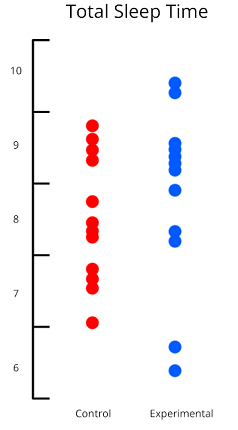
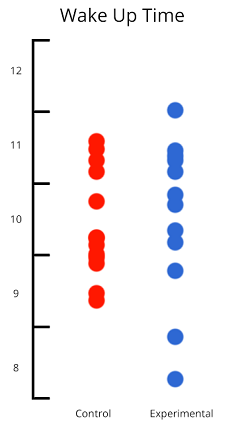
Here’s the headline results of the experiment – number of hours I slept during experimental vs. control nights, and wake up time during experimental vs. control nights

On average there was no difference between the two groups on either measurement. There was also no difference on any of the subjective measures. My subjective guess about whether I’d taken experimental or placebo capsules that night had no correlation with the reality.

My conclusion isn’t that Sleep Support doesn’t work; I didn’t even try it for its main indication of helping with insomnia. My study was too underpowered to detect even medium-sized effects. And just because it didn’t work for me doesn’t mean it won’t work for somebody else.

My conclusion is that the effect I thought that I observed – a consistent change of two hours in my otherwise stable wake-up time – wasn’t real. This shocked me. What’s going on?

I think my original strategy of “wake up a few times in the morning, check the clock, and finally get out of bed when you really feel like it” is very susceptible to the placebo effect. Usually I might wake up at 9, decide that was too early to face the world, and go back to bed. Maybe I wouldn’t even remember doing this. Part of this was probably inertia – I wasn’t used to getting up at 9, I figured I must not have gotten enough sleep to feel good, and so I didn’t want to do it today. Once I had an exciting new sleep supplement in my system, I woke up at 9, actually checked whether or not I felt ready to wake up, and absent my usual prior that I wasn’t, I found that I was, and woke up.

This hypothesis is supported by the results of the experiment. On about a third of days, I woke up before 10 – again, something I never would have done before starting Sleep Support. I think the active ingredient here was not letting myself look at the clock. Without external cues to tell me how tired I should feel, I was forced to rely on how tired I actually felt, which in many cases was “not tired at all”. This happened regardless of whether I was taking Sleep Support or placebo that day.

Ironically, even though the supplement failed to differentiate itself from placebo, I think this is one of the most successful biohacking experiments I’ve ever done. I’m getting up on average an hour or so earlier than I did before, getting more done, and not feeling any more tired by the evening.

Future research: see if this keeps working even now that I know what’s going on.

You can download my raw data here. If you want to replicate this experiment, you can buy Sleep Support capsules here. There are lots of ways to make a placebo; I found these very large empty capsules helpful.

I’m interested in hearing about anyone else’s experience conducting controlled trials of supplements on themselves; if you do something like this and want to publish it on a blog, let me know.

Addendum to “Targeting Meritocracy”

I’ve always been dissatisfied with Targeting Meritocracy and the comments it got. My position seemed so obvious to me – and the opposite position so obvious to other people – that we both had to be missing something.

Reading it over, I think I was missing the idea of conflict vs mistake theory.

I wrote the post from a mistake theory perspective. The government exists to figure out how to solve problems. Good government officials are the ones who can figure out solutions and implement them effectively. That means we want people who are smart and competent. Since meritocracy means promoting the smartest and most competent people, it is tautologically correct. The only conceivable problem is if we make mistakes in judging intelligence and competence, which is what I spend the rest of the post worrying about.

From a conflict theory perspective, this is bunk. Good government officials are ones who serve our class interests and not their class interests. At best, merit is uncorrelated with this. At worst, we are the lower and middle class, they are the upper class, and there is some system in place (eg Ivy League universities) that disproportionately funnels the most meritorious people into the upper class. Then when we put the most meritorious people in government, we are necessarily seeding the government with upper class people who serve upper class interests.

This resolves my confusion about why people disagree with me on this point. It reinforces a lesson I’ve had to learn again and again: if people seem slightly stupid, they’re probably just stupid. But if they seem colossally and inexplicably stupid, you probably differ in some kind of basic assumption so fundamental that you didn’t realize you were assuming it, and should poke at the issue until you figure it out.

Posted in Uncategorized | Tagged | 524 Comments

Confirmation Bias As Misfire Of Normal Bayesian Reasoning

From the subreddit: Humans Are Hardwired To Dismiss Facts That Don’t Fit Their Worldview. Once you get through the preliminary Trump supporter and anti-vaxxer denunciations, it turns out to be an attempt at an evo psych explanation of confirmation bias:

Our ancestors evolved in small groups, where cooperation and persuasion had at least as much to do with reproductive success as holding accurate factual beliefs about the world. Assimilation into one’s tribe required assimilation into the group’s ideological belief system. An instinctive bias in favor of one’s in-group” and its worldview is deeply ingrained in human psychology.

I think the article as a whole makes good points, but I’m increasingly uncertain that confirmation bias can be separated from normal reasoning.

Suppose that one of my friends says she saw a coyote walk by her house in Berkeley. I know there are coyotes in the hills outside Berkeley, so I am not too surprised; I believe her.

Now suppose that same friend says she saw a polar bear walk by her house. I assume she is mistaken, lying, or hallucinating.

Is this confirmation bias? It sure sounds like it. When someone says something that confirms my preexisting beliefs (eg ‘coyotes live in this area, but not polar bears’), I believe it. If that same person provides the same evidence for something that challenges my preexisting beliefs, I reject it. What am I doing differently from an anti-vaxxer who rejects any information that challenges her preexisting beliefs (eg that vaccines cause autism)?

When new evidence challenges our established priors (eg a friend reports a polar bear, but I have a strong prior that there are no polar bears around), we ought to heavily discount the evidence and slightly shift our prior. So I should end up believing that my friend is probably wrong, but I should also be slightly less confident in my assertion that there are no polar bears loose in Berkeley today. This seems sufficient to explain confirmation bias, ie a tendency to stick to what we already believe and reject evidence against it.

The anti-vaxxer is still doing something wrong; she somehow managed to get a very strong prior on a false statement, and isn’t weighing the new evidence heavily enough. But I think it’s important to note that she’s attempting to carry out normal reasoning, and failing, rather than carrying out some special kind of reasoning called “confirmation bias”.

There are some important refinements to make to this model – maybe there’s a special “emotional reasoning” that locks down priors more tightly, and maybe people naturally overweight priors because that was adaptive in the ancestral environment. Maybe after you add these refinements, you end up at exactly the traditional model of confirmation bias (and the one the Fast Company article is using) and my objection becomes kind of pointless.

But not completely pointless. I still think it’s helpful to approach confirmation bias by thinking of it as a normal form of reasoning, and then asking under what conditions it fails.

Posted in Uncategorized | Tagged , | 115 Comments

Welcome (?), Infowars Readers

Hello to all the new readers I’ve gotten from, uh, Paul Watson of Infowars. Before anything else, consider reading this statement by the CDC about vaccines.

Still here? Fine.

Infowars linked here with the headline Survey Finds People Who Identify As Left Wing More Likely To Have Been Diagnosed With A Mental Illness. This is accurate only insofar as the result uses the publicly available data I provide. The claim about mental illness was made by Twitter user Philippe Lemoine and not by me. In general, if a third party analyzes SSC survey data, I would prefer that media sources reporting on their analysis attribute it to them, and not to SSC.

As far as I can tell, Lemoine’s analysis is accurate enough, but needs some clarifications:

1. Both extreme rightists and extreme leftists are more likely than moderates to have been diagnosed with most conditions.

2. Leftists might be more likely to trust the psychiatric system and get diagnosed. My survey shows some signs of that. Liberals are 60% more likely than conservatives to have formal diagnoses of depression, but only 30% more likely to have a self-diagnosis of depression.

3. Leftists might be more likely to think of their issues through a psychiatric lens than rightists, meaning that even the self-diagnosis numbers might be inflated.

4. The SSC survey is a bad sample to use for this, not just because it’s unrepresentative, but because it might be unrepresentative of different political affiliations in different ways. For example, SSC Marxists really are surprisingly depressed, but maybe the only Marxists who would read an anti-Marxist blog are depressed Marxists looking for things to be miserable and angry about (though see below for some counterevidence).

5. A commenter on Lemoine’s tweet links to this blog post by someone who found the same thing in the General Social Survey. The General Social Survey is much larger and more rigorous than my survey, and there’s no reason to care what my survey has to say when there are GSS results available.

In general, if a survey analysis is posted on this blog, it’s mine. If not, then it isn’t mine and you should link to whoever performed it and let them clean up their own mess. Thanks – and seriously, vaccines are fine.

Autogenderphilia Is Common And Not Especially Related To Transgender

“Autogynephilia” means becoming aroused by imagining yourself as a woman. “Autoandrophilia” means becoming aroused by imagining yourself as a man. There’s no term that describes both, but we need one, so let’s say autogenderphilia.

These conditions are famous mostly because a few sexologists, especially Ray Blanchard and Michael Bailey, speculate that they are the most common cause of transgender. They point to studies showing most trans women endorse autogynephilia. Most trans people disagree with this theory, sometimes very strongly, and accuse it of reducing transgender to a fetish.

Without wading into the moral issues around it, I thought it would be interesting to get data from the SSC survey. The following comes partly from my own analyses and partly from wulfrickson’s look at the public survey data on r/TheMotte.

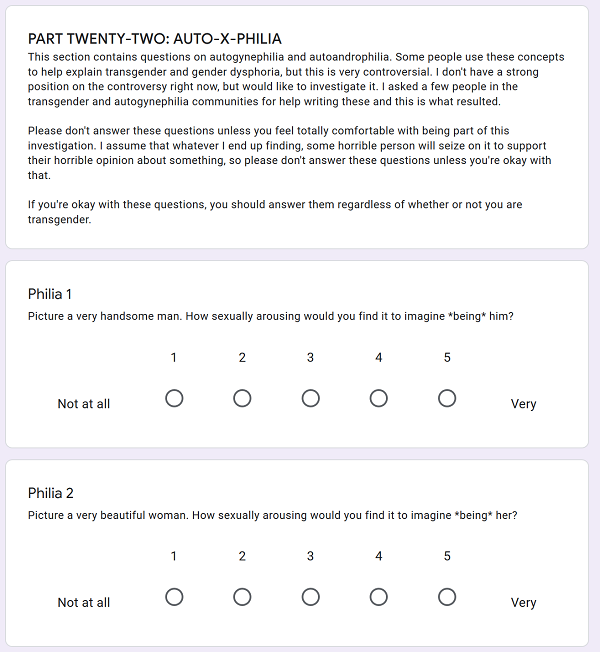
The survey asked the following questions:

First of all, thanks to the 6,715 people (182 trans, 6259 cis, 274 confused) who answered these questions despite my disclaimers. Here’s how it worked out. 5 is maximally autogenderphilic, 1 is no autogenderphilia at all:

Group (n) Autogynephilia Autoandrophilia
Cis men (5592) 2.6 1.9
Cis women (667) 2.5 2
Trans men (35) 1.9 2.3
Trans women (147) 3.2 1.3

Group* (n)** Autogynephilia (1 – 5) Autoandrophilia (1 – 5)
Straight cis men (4871) 2.6 1.8
Bi cis men (430) 2.6 3.3
Gay cis men (197) 1.7 3.4
Straight cis women (375) 2.4 1.9
Bi cis women (201) 2.8 2.5
Lesbian cis women (31) 2.5 1.9
Straight trans men (5) ??? ???
Bi trans men (19) ??? ???
Gay trans men (3) ??? ???
Straight trans women (5) ??? ???
Bi trans women (76) 3.1 1.4
Lesbian trans women (39) 3.4 1.2

*sexual orientation was self-reported. Almost all transgender people report sexual orientation relative to their current gender rather than their birth gender, so for example a “lesbian trans woman” would be someone who grew up male, currently identifies as female, and is attracted to other women. This is the opposite of how Blanchard and Bailey sometimes use these terms, so be careful comparing these results to theirs!
**results are marked as ??? for groups with sample size lower than 20

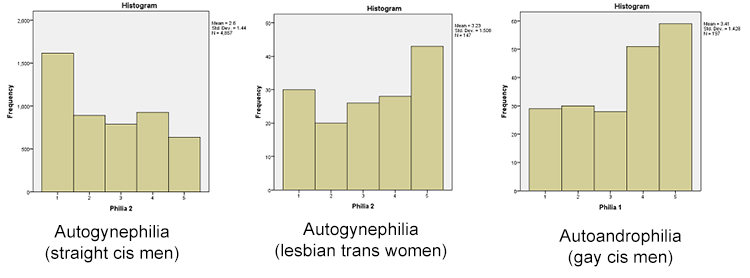
The survey confirmed Blanchard and Bailey’s finding that many lesbian trans women had strong autogynephilia. But it also confirmed other people’s findings that many cis people also have strong autogenderphilia. In this dataset, autogenderphilia rates in gay cis men were equal to those in lesbian trans women.

Autogenderphilia in cis people was divided between fantasies about being the opposite gender, and fantasies about being the gender they already were. What does it mean to fantasize about being a gender you already are? I asked a cis female friend who admitted to autogynephilia. She told me:

My literal body is arousing – it’s hot that I have breasts and can get pregnant and have a curvy figure and a feminine face and long hair, and it’s hot to dress up in femme clothes. There are certain gendered/social interactions that are very hot, or that can easily springboard into ones that are very hot. I’ve honestly wondered whether I might not be nonbinary or trans male, because I’m not really sure how euphoric being female is, besides that it’s like living in a sex fantasy.

(score one for the hypothesis that this kind of thing causes gender transition, because after reading this I kind of want to be a woman.)

Uh…moving on. The highest rates of autogenderphilia were found in bi cis men (autoandrophilia), gay cis men (autoandrophilia), bi trans women (autogynephilia), and lesbian trans women (autogynephilia).

These groups all have three things in common: they identify as the gender involved, they are attracted to the gender involved, and they are biologically male.

I would guess biological men have more of every fetish, regardless of their current gender identity, so it’s not surprising that they have more autogenderphilia also. In fact, we see that in biological women, the two highest categories are bi cis women (autogynephilia), and lesbian cis women (autogynephilia); again, they identify as the gender involved, and they are attracted to the gender involved.

So abstracting that away, the SSC survey data suggest a very boring hypothesis of autogenderphilia: if you identify as a gender, and you’re attracted to that gender, it’s a natural leap to be attracted to yourself being that gender.

The SSC survey hypothesis explains the same evidence that Blanchard and Bailey’s hypothesis explains (that lesbian trans women very often have autogynephilic fantasies), but reverse the proposed causation: it’s not that autogynephilia causes gender transition; it’s that identification as a gender is one factor that causes autogenderphilia.

But after that, it can go on to explain other things that Blanchard and Bailey can’t explain, like why cis gay men have as much autoandrophilia as trans lesbian women have autogynephilia. Or why some people with low levels of autogenderphilia transition, but many people with high levels don’t. I think it’s a simpler and more defensible explanation of the evidence.

I asked some people I know who supported Blanchard and Bailey’s theory for their thoughts. They focused on a few concerns about the data.

First, weird Internet samples plausibly have more of every paraphilia. This might inflate the rate for cis gay men and the number of trans lesbian women, assuming the latter all had to be above some cutoff; that might falsely lead me to believe the two groups have the same rate.

One counterargument might be that the responses among cis people alone are enough to generate the hypothesis discussed above. The low rates of autogynephilia in gay men, compared to in straight and bi men, suggest that being attracted to a gender is a prerequisite of autogenderphilia to it. And (adjusting again for the general tendency of male-bodied people to have more fetishes) the higher rates of autogynephilia in cis women/autoandrophilia in cis men, compared to autoandrophilia in cis women/autogynephilia in cis men, suggest that identifying as a gender is a prequisite to autogenderphilia to it.

Another counterargument might be the similarity of the histograms produced by cis gay male and trans lesbian female responses; they don’t look like they’re being generated by two different processes which have only coincidentally averaged out into the same summary statistic:

This doesn’t look like all cis men over a certain cutoff are becoming trans women; it looks like the curve for cis gay men and trans lesbian women are being shaped by the same process.

Second, did the survey questions accurately capture autogenderphilia? Fetishes range from very mild to very extreme; some people like being slapped during sex, other people have whole BDSM dungeons in their basement. Is it possible the survey captured some boring meaning of autogenderphilia, like “sure, I guess it would be hot to be a woman”, but some people have a much stronger and more obsessive form? The histogram above argues against this a little, but there might be ceiling effects.

Alice Dreger seems to take something like this perspective here:

Q: Do you think autogynephilia might be a part of the female experience, trans or cis? I’ve seen some (very preliminary) theorizing about it as well as a paper with a tiny sample size that suggest that cis women also experience sexual arousal at the thought of themselves as women.

A: I’ve talked with Blanchard, Bailey, and also Anne Lawrence about this, and my impression is they all doubt cis (non-transgender) women experience sexual arousal at the thought of themselves as women. Clinically, Blanchard observed autogynephilic natal male individuals who were aroused, for example, at the ideas of using a tampon for menses or knitting as a woman with other women. I have never heard a natal woman express sexual arousal at such ideas. I’ve never heard of a natal woman masturbating to such thoughts.

I asked the same cis female friend who gave me the quotation above, and she described using a tampon to masturbate and finding it hot. I think Dreger makes an important point that there are some pretty unusual manifestations of autogenderphilic fetishes out there and we should hesitate before drawing too many conclusions from a single question that lumps them all together. But also, Alice Dreger seems like an really dignified and important person who probably doesn’t hang out with people who talk openly about their menstruation-related masturbation fantasies, and she should probably adjust for that. Maybe she could move to the Bay Area.

There’s a common failure mode in psychiatry, where we notice people with some condition doing some weird thing, and fail to notice that huge swathes of people without the condition do the exact same weird thing. For example, everyone knows schizophrenics hear voices, but until recently nobody realized that something like 20% of healthy people do too. Everyone knows that LSD users can end up with permanent visual hallucinations, but until recently nobody realized that lots of drug-free people have the same problem. Schizophrenics definitely hear more voices than healthy people, and LSD users have more permanent visual hallucinations, but it’s movement along the distribution rather than a completely novel phenomenon.

I think autogenderphilia is turning out to work the same way, and that this will require us to reassess the way we think about it.

As usual, I welcome people trying to replicate or expand on these results. All of the data used in this post are freely available and can be downloaded here. I’ve also heard Michael Bailey is going to release his own interpretation of these data, so stay tuned for that. I’d like to delve into these issues further on future surveys, so let me know if you have ideas about how to do that.

And a big thanks to Tailcalled for helping me set up this section of the survey. If you’re interested in these issues, you might enjoy his blog or his own analysis of these results.

Open Thread 147

This is the bi-weekly visible open thread (there are also hidden open threads twice a week you can reach through the Open Thread tab on the top of the page). Post about anything you want, but please try to avoid hot-button political and social topics. You can also talk at the SSC subreddit – and also check out the SSC Podcast. Also:

1. I’m no longer soliciting updates about when links in my old posts no longer work. There are over a thousand SSC posts, and some are 5+ years old. I’m sure there are lots of links that no longer work, but keeping up with them would be a full-time job and I’m not interested (if someone else is, let me know).

2. I’ve added this to my Mistakes page, but it seems important enough that I want to signal-boost it here too: I’ve been informed of some studies suggesting Ritalin is just as likely to increase Parkinson’s disease risk as Adderall. This contradicts my previous position expressed in Adderall Risks: Much More Than You Wanted To Know that only Adderall and not Ritalin had this risk. I can no longer trace down the evidence supporting my previous position. Sorry for getting this wrong.

3. I had originally planned to end my review of Human-Compatible with a push for Soeren Everlin’s AI Safety Reading Group, which meets online every Wednesday and which was discussing Human Compatible for a while. But I waited too long and didn’t publish the review until they were done with the discussion. But that’s not their fault, and I still think you should check them out [see this comment for logistical info]

4. Comment on the week is Nick on Tyler Cowen’s state capacity libertarianism and the whole ensuing comment thread. And somehow I’ve lost the source comment, but also check out this article on how latitude affects binge drinking and not alcohol consumption per se. This may mean we don’t have to bring in sexual abuse to understand Greenland’s continued high suicide rates.

Posted in Uncategorized | Tagged | 709 Comments

Suicide Hotspots Of The World

[Content warning: suicide, rape, child abuse. Thanks to MC for some help with research.]

I.

Guyana has the highest national suicide rate in the world, 30 people per year per 100,000. Guyana has poverty and crime and those things, but no more so than neighboring Brazil (suicide rate of 6) or Venezuela (suicide rate of 4). What’s going on?

One place to start: Guyana is a multi-ethnic country. Is its sky-high suicide rate focused in one ethnic group? The first answer I found was this article by a social justice warrior telling us it constitutes racial “essentialism” to even ask the question. But in the process of telling us exactly what kind of claims we should avoid, she mentions someone bringing up that “80% of the reported suicides are carried out by Indo-Guyanese”. I feel like one of those classicists who has reconstructed a lost heresy through hostile quotations in Irenaeus.

Indo-Guyanese aren’t American Indians; they’re from actual India. Apparently thousands of Indians immigrated to Guyana as indentured laborers in the late 1800s. Most went to Guyana, and somewhat fewer went to neighboring Suriname. Suriname also has a sky-high suicide rate, but slightly less than Guyana’s, to the exact degree that its Indian population is slightly less than Guyana’s. Basically no Indians went anywhere else in South America, and nowhere else in South America has anywhere near the suicide rate of these two countries. The most Indian regions of Guyana also have the highest suicide rate. Hmmm.

Does India itself have high suicide rates? On average, yes. But India has a lot of weird suicide microclimates. Statewide rates range from from 38 in Sikkim (higher than any country in the world) to 0.5 in Bihar (lower than any country in the world except Barbados). Indo-Guyanese mostly come from Bihar and other low-suicide regions. While I can’t rule out that the Indo-Guyanese come from some micro-micro-climate of higher suicidality, this guy claims to have traced them back to some of their ancestral villages and found that those villages have low suicide rates.

So what’s going on? Social and Cultural Dimensions of Indian Indentured Labour and Its Diaspora argues that despite the mixed suicide rates in India itself, rates across the Indian Diaspora are universally high. For example:

The Fiji Indian suicide rate in the period 1900 to 1915 was the highest among all Indian labour importing colonies in Africa and the West Indies, and much higher than in India itself. In Mauritius too, hundreds of indentured Indian laborers committed suicide by jumping from a particular hillock during the indenture period, which acquired the name of ‘Suicide Hill’, now turned into a monument […]

In his article ‘Veil of Dishonor’ Lal (1985) describes what officials tend to point out as the primary cause of the Fiji Indian suicides: sexual jealousy arising from the persistent shortage of women on the plantations. The rate of indentured adult Indian females to males in Fiji was only 43 to 100. The intense competition for women among the indentured men was seen as the main reason for male suicides in Fiji. Lomarsh Roopnarine (2007) also shows high rates of suicides among indentured Indians in British Guiana […]

Although there is no reason to doubt the existence of sexual jealousy, this emphasis on the scarcity of women disregards the arduous circumstances in which the indentured labourers were working, and the disruption of the “integrative institutions” of society – family, marriage, caste, kinship, and religion – as the underlying causes of suicide and other ills affecting the Indian indentured labour population.

Yeah, but arduous circumstances affected dozens of different ethnicities involved in various colonization and forced labor schemes, and most of them didn’t have these kinds of suicide rates. I can kind of imagine a story where first-generation laborers had no hope of settling down or raising families, committed suicide at high rates, and that ingrained suicidal tendencies in the culture that never went away. But then how come that didn’t happen to eg indentured Englishmen in Virginia?

The incongruously named Vijayakumar and John (2018) blame the Hindu religion. Did you know that the Ramayana ends with Rama, three of brothers, and the entire population of his kingdom committing mass suicide by drowning? Or that the mahaparasthana is a traditional Hindu method of suicide “where the person walks in a north easterly direction, subsisting only on water and air, until his body sinks to rest”? Any religion that has a traditional direction to walk in while you’re committing suicide by starving yourself seems kind of suspicious here. But then how come Hindus in some parts of India have such low suicide rates? How come it’s just the diaspora that suffers. The paper suggests maybe it’s because religiosity plays a protective effect, but it sounds kind of strained.

I don’t have better answers to any of these questions. Maybe the combination of Hindu religion, imbalanced gender ratios, and uprooted communities created a perfect storm. I don’t have any better ideas.

II.

Guyana, at 30 suicides per year per 100,000, is the highest national suicide rate in the world. But if Greenland ever wins independence, it will steal first place. Greenland’s suicide rate is 83 per year per 100,000, almost three times higher than any other country in the world.

Like Guyana, this is more ethnic than national. Greenland is mostly Inuit, and Inuit everywhere have equally high suicide rates. The suicide rate in the mostly-Inuit Canadian province of Nunavit is 71 (for comparison, Canada in general is 10). The suicide rate among Alaskan Inuit is 40 (for comparison, the US in general is 14).

This definitely is not just because of the cold and darkness. White Alaskans who live right next to Alaskan natives have a rate of about 20, not much higher than the US average. And suicide in Greenland – like everywhere else – peaks in the spring and summer anyway.

Most damning of all, Greenland’s high suicide rates are a recent phenomenon. In 1971, the rate was 4. I didn’t forget a zero there. Fifty years ago, Greenland had one of the lowest suicide rates in the world. But by 1990, it had reached 120 (it’s since come down a little bit). What happened in those twenty years?

You would think limiting it to such a short time period would make things easy. It isn’t. There are two main theories: social alienation, and alcohol.

There is definitely a lot of social alienation. For centuries, the Inuit hunted seals in traditional villages. At some point the Danish government decided that was unacceptably backwards and resettled them in cities, especially the capital of Nuuk. This didn’t go well.

One counterargument to this story is that Nuuk has the lowest suicide rate in Greenland, and the more remote the village, the worse the suicide crisis. Maybe you could argue that everywhere was modernized and disrupted and alienated but at least a big city has some interesting stuff to do. This would kind of match the American experience, where it’s small towns in West Virginia that are getting hit by the opioid crisis and deaths of despair.

Another counterargument is that all Native American communities suffered a lot of displacement and alienation and modernization, but none of them suffered the same suicide spike as the Inuit. Sources disagree on the exact Native American suicide rate in the US, but it isn’t unusually high; the CDC numbers say it is slightly below the rate for non-Hispanic whites. Canadian First Nations suicide rates are elevated, but still only a third or so of Inuit levels. Maybe Inuits suffered stronger relocation pressures than other native peoples because of their Arctic environment? Or maybe every native group suffered a suicide spike, but Native Americans and Canadians have adjusted by now and their suicide rates have come back down? I’m not sure.

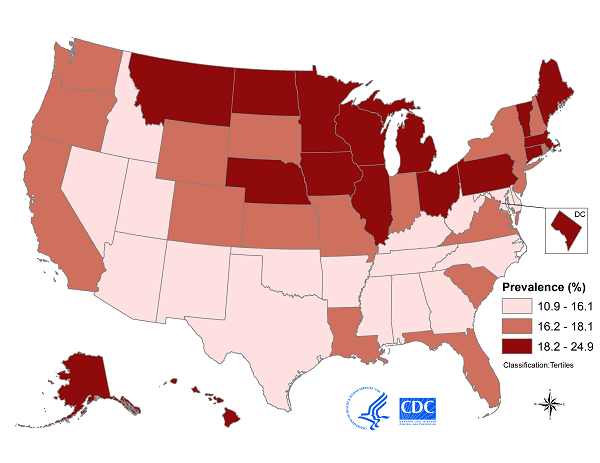
The other theory about Greenland is alcohol. Alcohol consumption in Greenland skyrocketed around the same time suicide did, reached levels that temporarily made Greenland by far the most alcoholic country in the world – then started declining around the same time suicide did. This seems to be a pattern when hunter-gatherers with no genetic or cultural resistance encounter alcohol for the first time – Native Americans in the 1700s got up to some crazy stuff.

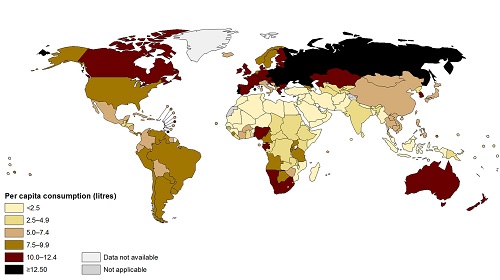
But the Inuit seem to have gotten it much worse. Now we can bring back in the cold and darkness. Alcohol consumption seems to increase reliably with latitude, whether we’re talking about the US:
Japan:

Or the whole world:
So you take some hunter-gatherers who have never encountered alcohol before, stick them in the northernmost place in the world, and throw cheap Danish alcohol at them at the exact moment their communities are being uprooted and destroyed forever, and you get…well, you get this:
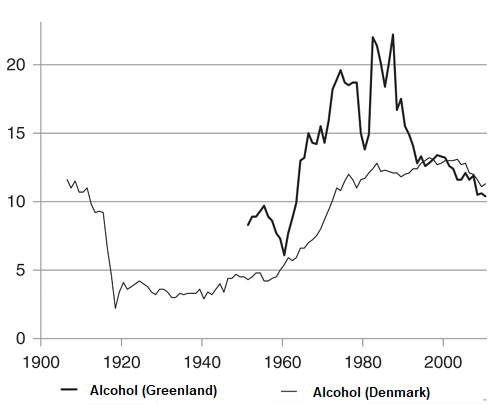
By 1980, Greenland was the most alcoholic country in the world, drinking an average of 22 liters of pure alcohol per capita per year (Russia is 15). It doesn’t look like this was responsible social drinking either. Take the most deranged binge drinking in the worst college fraternity in the world, multiply it by a thousand, and that was Greenland during much of the late 20th century.

But this can’t be the whole story. Alcohol consumption in Greenland has since dropped to the same level as Denmark and other European countries. But the suicide rate is still ten times higher. Why? Maybe the moderate quantities are hiding deeply dysfunctional drinking patterns with lots of binging and addiction.

Or maybe it’s something worse. Child sexual abuse rates in Greenland range from 37% in Nuuk to 46% in East Greenland. As far as I can tell, you are understanding those numbers correctly – almost half of children in Greenland are sexually abused. In Nunavut, the numbers are 52% of women and 22% of men suffering “severe” childhood sexual abuse. The New York Times sets a disturbingly vivid scene:

Pay days are the worst time for the children of Tasiilaq, officials say. With their salaries or social benefits in hand, many adults tend to drink and parents become too inebriated to look after their children, officials say. That’s when an already high rate of sexual abuse rises, according to a police study published last week […]

So on the last Friday of every month, officials open a sports hall in the district as a shelter to keep children away from sexual abuse.

“Children were abused by their stepfathers, cousins and by the neighbor looking after them as the parents were on a bender,” Naasunnguaq Ignatiussen Streymoy, the mother of a sexual abuse victim and an anti-abuse activist, told Weekendavisen, a newsweekly, in an article published on Friday about the crisis.”

Correlation is not causation. Maybe the same dysfunction or social alienation or alcoholism that causes the sexual abuse separately causes the suicides. But maybe the obvious answer is true, and the sexual abuse contributes to the mental health problems that eventually lead to suicide. Maybe a generation of staggeringly high alcoholism led to staggeringly high child abuse, and a generation later those children are still committing suicide at staggeringly high rates.

III.

This is getting really depressing. Let’s talk about something a little bit lighter, like the remote Siberian okrugs with the highest suicide rates in the world.

The highest suicide rate I have seen credibly attributed to an ethnic group is the Chukchi of northeastern Russia, who are said to have reached 165 per year per 100,000 in 1998. They may be distantly related to the Inuit, but I wouldn’t put too much weight on this; Siberia is riddled with weird ethnicities with super-high suicide rates. The Evenks reached 121; their western neighbors the Nenets reached 119. There is a group called the Koryaks with a rate of 92, and another group called the Udmurts with a rate of 40ish – which is still higher than Guyana.

Voracek, Fisher, and Marusic try to tie some of these groups into their Finno-Ugrian Suicide Hypothesis, claiming that the genetically-related Finno-Ugric group have a unique predisposition to suicidality. The theory has some superficial plausibility – in the 1990s, the world’s first, second, and third most suicidal countries were Finland, Hungary, and Estonia – all Finno-Ugric. Their surrounding non-Finno-Ugric neighbors, like Sweden or Austria, were unremarkable, so a genetic hypothesis made sense. Unfortunately for the theory (but fortunately for everyone else) these countries have since improved by a lot, and now are barely above the world average; improved mental health care may be responsible (and the fall of Communism didn’t hurt). I’m actually a little confused what happened here.

But the Finno-Ugric hypothesis can’t explain the Chukchi, Evenks, Nenets, Koryaks, and Udmurts. Sure, the Udmurts are Finno-Ugric. And the Nenets are closely related. But the Chukchi, Evenks, and Koryaks aren’t. It’s tempting to group all of these tiny Siberian ethnic groups together, but eg the Evenks are more closely related to the Japanese than they are to the Nenets (despite living right next to them). Any genetic hypothesis flounders on the sheer genetic diversity and unrelatedness of this region.

Psychologist David Lester tries to point the finger at these groups’ ancient culture, which he says has been especially suicidal since the time of the earliest records. He quotes an account of the 19th-century Chukchi:

Bogoras described the [Chukchi] as irritable and obstinate and, when frustrated, impulsively self-destructive. He reports the case of a young girl who hung herself when her mother refused to take her to a feast in a neighboring camp. [He] reported cases of suicide in a husband over grief at his wife’s death andof a mother after her ten-year-old son’s death; a case motivated by bad fortune, compounded by the fear of further bad fortune; a woman who no longer found any pleasure in life; a young man who was driven away by his father-in-law for being lazy who then killed his pregnant wife and himself; and a young woman whose husband wanted to lend her to a friend in a group marriage, a friend whom she disliked.

Suicidal behavior appeared to be so common that people planning to kill themselves would often ask for a last meal of exotic tastes before they did so. Some Chukchee prefer to commit suicide by having someone else kill them. The man reported above who committed suicide because of present and anticipated misfortune asked to be strangled. In another case,a man who fell ill asked his wife to shoot him. Bogoras noted that ‘voluntary death’ as he called it, suicide by getting others to kill oneself, was common for the elderly and those suffering from physical illnesses.

However, Bogoras also noted ‘peculiar’ causes of voluntary death, such as that of a man who grew weary of quarrelling with his wife over their ill-behaved sons. Part of the motive in these cases may be to induce guilt in the survivors. As one father said, ‘Then he asks to be killed, and charges the very son who offended him with the execution of his request. Let him give me the mortal blow, let him suffer from the memory of it’.

I can only aspire to one day achieve this level of passive-aggressiveness. But in the end it has the same problem as the genetic hypothesis: these groups are just totally unrelated to each other. The Chukchi are not much more suicidal than the Nenets or Evenks, who have none of these traditions. And the Inuit are up there with all of them, and they had one of the lowest suicide rates in the world pre-colonization.

I think the explanation here is the same as with Greenland: the combination of alcohol-naive hunter gatherers, alcohol, the alcohol-promoting effects of high latitudes, and a disruption of the traditional way of life. There’s apparently a Russian proverb about Siberians that goes “reindeer-herders are sober only when they don’t have the money to get drunk” – and when the Russians are appalled by your alcoholism, you know you have a problem. Alcohol was found in the blood of 75 – 80% of Nenets suicides. And if anything, the Siberians had their way of life disrupted even worse than the Inuit did – Soviet central planners tried to collectivize them as a PR move – they wanted to demonstrate that Communism could work for even the most primitive of peoples. Well, it didn’t, and here we are.

While genetics or culture may matter a little, overall I am just going to end with a blanket recommendation to avoid being part of any small circumpolar ethnic group that has just discovered alcohol.


Posted in Uncategorized | Tagged | 274 Comments

Map Of Effective Altruism

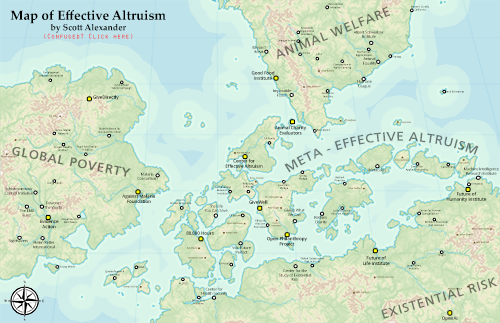
In the spirit of my old map of the rationalist diaspora, here’s a map of effective altruism:


Thumbail – click to expand

Continents are cause areas; cities are charities or organizations; mountains are individuals. Some things are clickable links with title-text explanations. Thanks to AG for helping me set up the imagemap.

Posted in Uncategorized | Tagged , , , , | 102 Comments