The APA Meeting: A Photo-Essay

The first thing you notice at the American Psychiatric Association meeting is its size. By conservative estimates, a quarter of the psychiatrists in the United States are packed into a single giant San Francisco convention center, more than 15,000 people.

Being in a crowd of 15,000 psychiatrists is a weird experience. You realize that all psychiatrists look alike in an indefinable way. The men all look balding, yet dignified. The women all look maternal, yet stylish. Sometimes you will see a knot of foreign-looking people huddled together, their nametags announcing them as the delegation from the Nigerian Psychiatric Association or the Nepalese Psychiatric Association or somewhere else very far away. But however exotic, something about them remains ineffably psychiatrist.


The second thing you notice at the American Psychiatric Association meeting is that the staircase is shaming you for not knowing enough about Vraylar®.
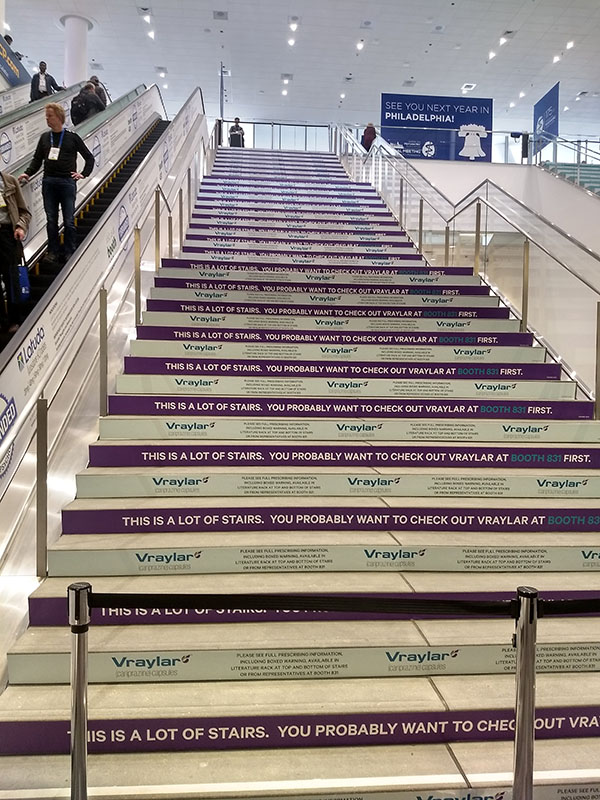
Seems kind of weird. Maybe I’ll just take the escalator…
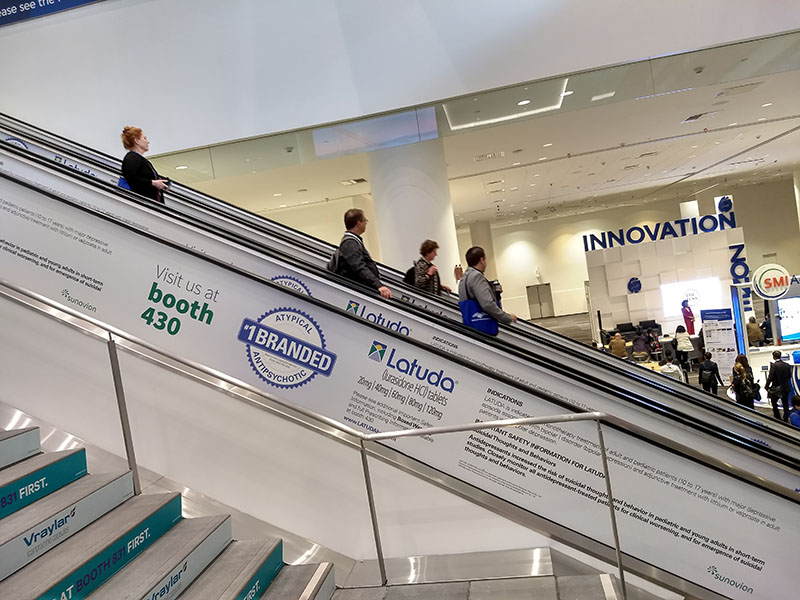
…no, the escalator is advertising Latuda®, the “number one branded atypical antipsychotic”. Aaaaaah! Maybe I should just sit down for a second and figure out what to do next…
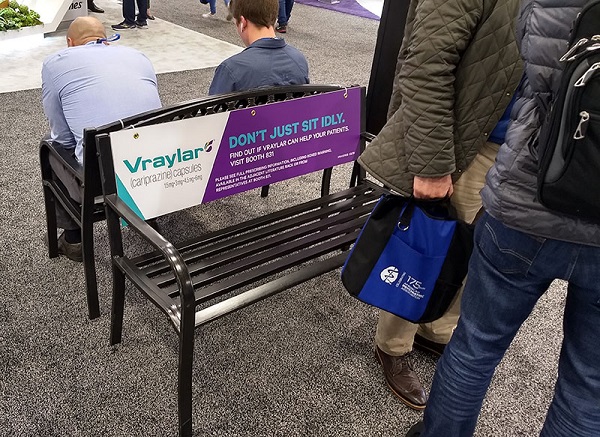
AAAAH, CAN’T SIT DOWN, VRAYLAR® HAS GOTTEN TO THE BENCHES TOO! Surely there’s a non-Vraylar bench somewhere in this 15,000 person convention center!
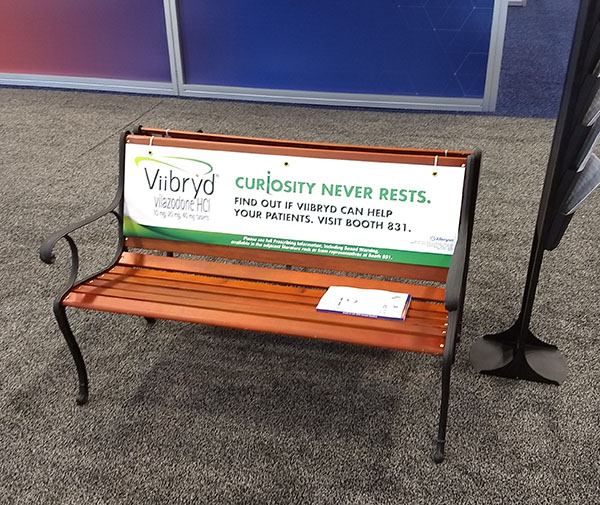
…whatever, close enough.

You know how drug companies pay six or seven figures for thirty-second television ads just on the off chance that someone with the relevant condition might be watching? You know how they employ drug reps to flatter, cajole, and even seduce doctors who might prescribe their drug? Well, it turns out that having 15,000 psychiatrists in one building sparks a drug company feeding frenzy that makes piranhas look sedate by comparison. Every flat surface is covered in drug advertisements. And after the flat surfaces are gone, the curved sufaces, and after the curved surfaces, giant rings hanging from the ceiling.

The ads overflow from the convention itself to the city outside. For about two blocks in any direction, normal ads and billboards have been replaced with psychiatry-themed ones, until they finally peter off and segue into the usual startup advertisements around Market Street.


There’s a popular narrative that drug companies have stolen the soul of psychiatry. That they’ve reduced everything to chemical imbalances. The people who talk about this usually go on to argue that the true causes of mental illness are capitalism and racism. Have doctors forgotten that the real solution isn’t a pill, but structural change that challenges the systems of exploitation and domination that create suffering in the first place?

No. Nobody has forgotten that. Because the third thing you notice at the American Psychiatric Association meeting is that everyone is very, very woke.

Here are some of the most relevant presentations listed in my Guidebook:

Saturday, May 18
Climate Psychiatry 101: What Every Psychiatrist Should Know
Women's Health In The US: Disruption And Exclusion In The Time Of Trump
Gender Bias In Academic Psychiatry In The Era Of the #MeToo Movement
Revitalizing Psychiatry – And Our World – With A Social Lens
Hip-Hop: Cultural Touchstone, Social Commentary, Therapeutic Expression, And Poetic Intervention
Lost Boys Of Sudan: Immigration As An Escape Route For Survival
Treating Muslim Patients After The Travel Ban: Best Practices In Using The APA Muslim Mental Health Toolkit
Making The Invisible Visible: Using Art To Explore Bias And Hierarchy In Medicine
Navigating Racism: Addressing The Pervasive Role Of Racial Bias In Mental Health
.
Sunday, May 20
Addressing Microaggressions Toward Sexual And Gender Minorities: Caring For LGBTQ+ Patients And Providers
Latino Undocumented Children And Families: Crisis At The Border And Beyond
Racism And Psychiatry: Growing A Diverse Psychiatric Workforce And Developing Structurally Competent Psychiatric Providers
Sex, Drugs, And Culturally Responsive Treatment: Addressing Substance Use Disorders In The Context Of Sexual And Gender Diversity
Grabbing The Third Rail: Race And Racism In Clinical Documentation
Racism And The War On Terror: Implications For Mental Health Providers In The United States
The Multiple Faces Of Deportation: Being A Solution To The Challenges Faced By Asylum Seekers, Mixed Status Families, And Dreamers
What Should The APA Do About Climate Change?
Intersectionality 2.0: How The Film Moonlight Can Teach Us About Inclusion And Therapeutic Alliance In Minority LGBTQ Populations
Transgender Care: How Psychiatrists Can Decrease Barriers And Provide Gender-Affirming Care
Gun Violence Is A Serious Public Health Problem Among America's Adolescents And Emerging Adults: What Should Psychiatrists Know And Do About It?
Working Clinically With Eco-Anxiety In The Age Of Climate Change: What Do We Know And What Can We Do?
Are There Structural Determinants Of African-American Child Mental Health? Child Welfare – A System Psychiatrists Should Scrutinize
.
Monday, May 21
Community Activism Narratives In Organized Medicine: Homosexuality, Mental Health, Social Justice, and the American Psychiatric Association
Disrupting The Status Quo: Addressing Racism In Medical Education And Residency Training
Ecological Grief, Eco-Anxiety, And Transformational Resilience: A Public health Perspective On Addressing Mental Health Impacts Of Climate Change
Immigration Status As A Social Determinant Of Mental Health: What Can Psychiatrists Do To Support Patients And Communities? A Call To Action
Psychiatry In The City Of Quartz: Notes On The Clinical Ethnography Of Severe Mental Illness And Social Inequality
Racism And Psychiatry: Understanding Context And Developing Policies For Undoing Structural Racism
Trauma Inflicted To Immigrant Children And Parents Through Policy Of Forced Family Separation
Deportation And Detention: Addressing The Psychosocial Impact On Migrant Children And Families
How Private Insurance Fails Those With Mental Illness: The Case For Single-Payer Health Care
Imams In Mental Health: Caring For Themselves While Caring For Others
Misogynist Ideology And Involuntary Celibacy: Prescription For Violence?
Advocacy: A Hallmark Of Psychiatrists Serving Minorities
Inequity By Structural Design: Psychiatrists' Responsibility To Be Informed Advocates For Systemic Education And Criminal Justice Reform
Treating Black Children And Families: What Are We Overlooking?
Blindspotting: An Exploration Of Implicit Bias, Race-Based Trauma, And Empathy
But I'm Not Racist: Racism, Implicit Bias, And The Practice Of Psychiatry
No Blacks, Fats, or Femmes: Stereotyping In The Gay Community And Issues Of Racism, Body Image, And Masculinity
Silence Is Not Always Golden: Interrupting Offensive Remarks And Microaggressions
Black Minds Matter: The Impact Of #BlackLivesMatter On Psychiatry

…you get the idea, please don’t make me keep writing these.

Were there really more than twice as many sessions on global warming as on obsessive compulsive disorder? Three times as many on immigration as on ADHD? As best I can count, yes. I don’t want to exaggerate this. There was still a lot of really meaty scientific discussion if you sought it out. But overall the balance was pretty striking.

I’m reminded of the idea of woke capital, the weird alliance between very rich businesses and progressive signaling. If you want to model the APA, you could do worse than a giant firehose that takes in pharmaceutical company money at one end, and shoots lectures about social justice out the other.


The fourth thing you notice at the American Psychiatric Association meeting is the Scientologists protesting outside.

They don’t tell you they’re Scientologists. But their truck has a link to CCHR.org on it, and Wikipedia confirms them as a Scientology front group. Scientology has a long-standing feud with psychiatry, with the psychiatrists alleging that Scientology is a malicious cult, and the Scientologists alleging that psychiatry is an evil pseudoscience that denies the truth of dianetics. And that psychiatrists helped inspire Hitler. And that the 9/11 was masterminded by Osama bin Laden’s psychiatrist. And that psychiatrists are plotting to institute a one-world government. And that psychiatrists are malevolent aliens from a planet called Farsec. Really they have a lot of allegations.

This particular truck is especially sad, because they’re reinforcing the myths about electroconvulsive therapy. ECT is a very effective treatment for depression. It is essentially always consensual – although most other psychiatric treatments can be administered involuntarily if someone is judged too out-of-touch with reality to make decisions, ECT has a special status as a treatment which can only be given with patient permission. It’s always performed under anaesthesia and muscle relaxants, so patients are not conscious during the procedure and not spasming. And it can be a life-changing option for treatment-resistant depression. See this Scientific American article for more.


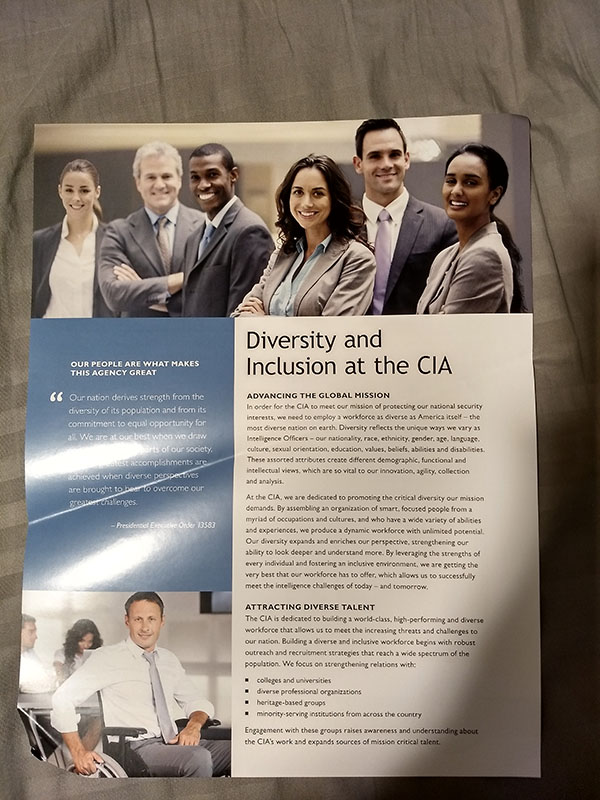
The fifth thing you notice at the American Psychiatric Association meeting is that the CIA has set up a booth.

I was pretty curious about what the CIA wanted from psychiatrists (did they lose the original MKULTRA data? do they need to gather more?), but I was too shy to ask their representative directly. I did take one of their flyers, but it turned out to just be about how woke they were:

The sixth thing you notice at the American Psychiatric Association meeting is that Vraylar® has built an entire miniature city. The buildings are plastered with pamphlets on Vraylar®. Billboards advertising Vraylar® hang over the streets and bridges. Giant Vraylar balloons hover serenly over everything, looking down with contempt and sorrow upon the non-Vraylar®-prescribing world below.

Occupying pride of place in city center, some sort of Important Vraylar Scientist is constructing the Transamerica Pyramid out of playing cards.
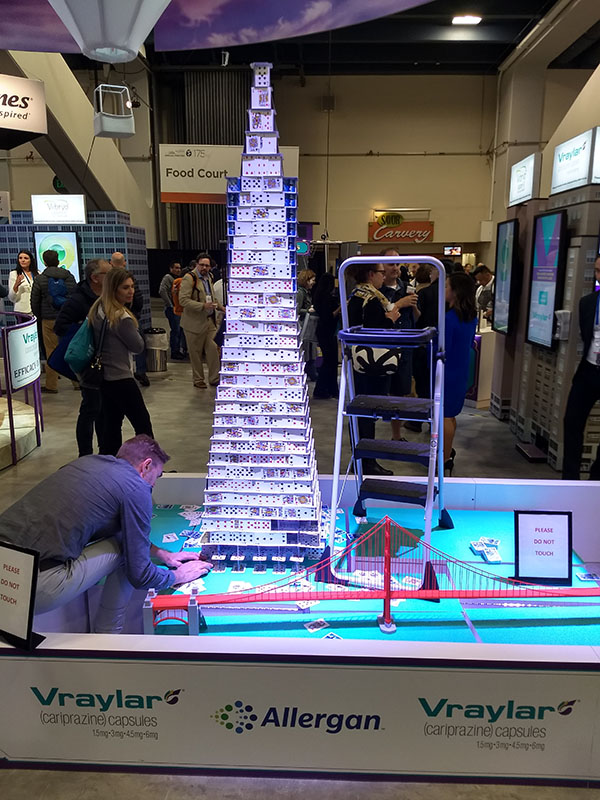
I dunno, if I were working in an area where the research supporting a treatment has a tendency to collapse suddenly and spectacularly, I might want to avoid building an association in people’s minds between my medication and a house of cards. But the ways of Vraylar® are inscrutable to mortal men.


The seventh thing you notice at the American Psychiatric Association meeting is that many of the new drugs are ridiculous.

It’s hard to blame pharmaceutical companies for this. The return on investment for pharma R&D is rapidly shrinking – drug discovery is too expensive to consistently make money anymore.

Rather than give up and die, pharma is going all in on newer, me-too-er me-too drugs. The current business plan looks kind of like this:

1. Take an popular older drug

2. Re-invent it, either with a minor change to the delivery mechanism, or by finding a similar molecule that works the same way

3. Call this a new drug, advertise the hell out of it, and sell it for 10x – 100x the price of the older drug

4. Profit!

Consider Lucemyra®:
It’s an alpha-2a receptor agonist used to treat acute opiate withdrawal. Alpha-2a receptor agonists are a fine choice for acute opiate withdrawal, but we already have one that works great: clonidine. Clonidine costs $4.84 per month. Lucemyra® costs $1,974.78. Is there any difference at all between the two medications? Some studies suggest maybe lofexedine can cause less hypotension, but realistically we throw random doses of clonidine at ADHD kids all the time, so it’s not like clonidine-induced hypotension is some kind of giant menace which will destroy us all.

I asked the Lucemyra® representative why I might prescribe Lucemyra® instead of clonidine for opiate withdrawal. She said it was because Lucemyra® is FDA-approved for this indication, and clonidine isn’t. This is the same old story as Rozerem® vs. melatonin, Lovaza® vs. fish oil, and Spravato® vs. ketamine. As long as doctors continue to outsource their thinking to the FDA approval process, in a way even the FDA itself doesn’t endorse, pharma companies will be able to inflate the prices of basic medications by a thousand times just by playing games with the bureaucracy.

But also:
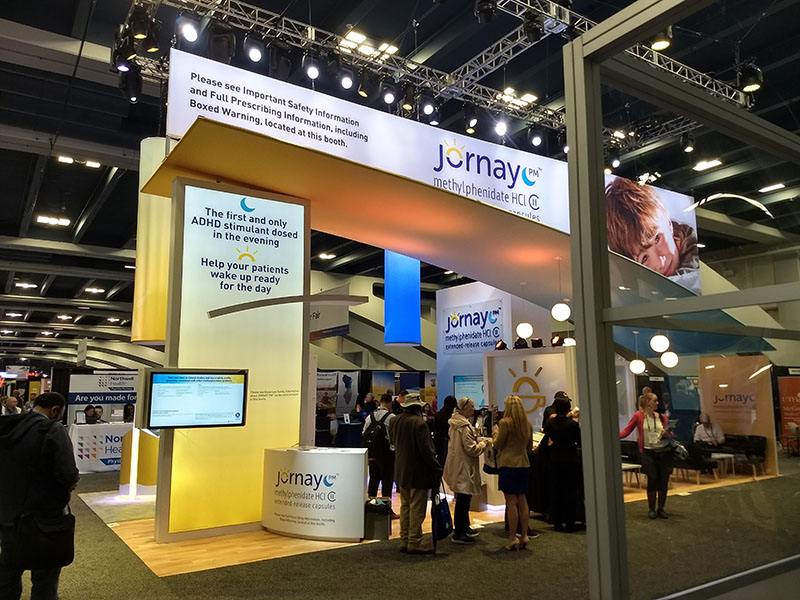
Jornay® is a new form of methylphenidate, ie Ritalin. The usual comparison: a month of Ritalin costs $25.19, a month of Jornay® costs $387.48. What’s the difference? You can take Jornay® at night. Why is this interesting? The Jornay® representatives say that maybe people want to have Ritalin in their system as soon as they wake up, rather than having to wait the half-hour or so it usually takes for it to start having an effect. I have to admit, from a scientific perspective Jornay® is kind of cool; I expect the pharmacologists who designed it had a lot of fun. But the oppressed people of the world haven’t exactly been crying out for Dark Ritalin. Nobody has been saying “Help us, pharmaceutical industry, merely having Ritalin®, Concerta®, Metadate®, Focalin®, Daytrana®, Quillivant®, Quillichew®, Aptensio®, Biphentin®, Equasym®, Medikinet®, and Rubifen® just isn’t enough for us! We need more forms of Ritalin, stat!”

My favorite was Subvenite®, which is just lamotrigine in a conveniently-packaged box that tells you how much to take each day. The same amount of normal lamotrigine would cost about $12; it’s hard for me to figure out exactly how much Subvenite® costs, but this site suggests $540. To be fair, lamotrigine is a really inconvenient drug whose dosing schedule often leaves patients confused. To be less fair, seriously, $540 for some better instructions? Get a life.

How do all these people keep doing it? What’s their business plan? Here’s a hint:
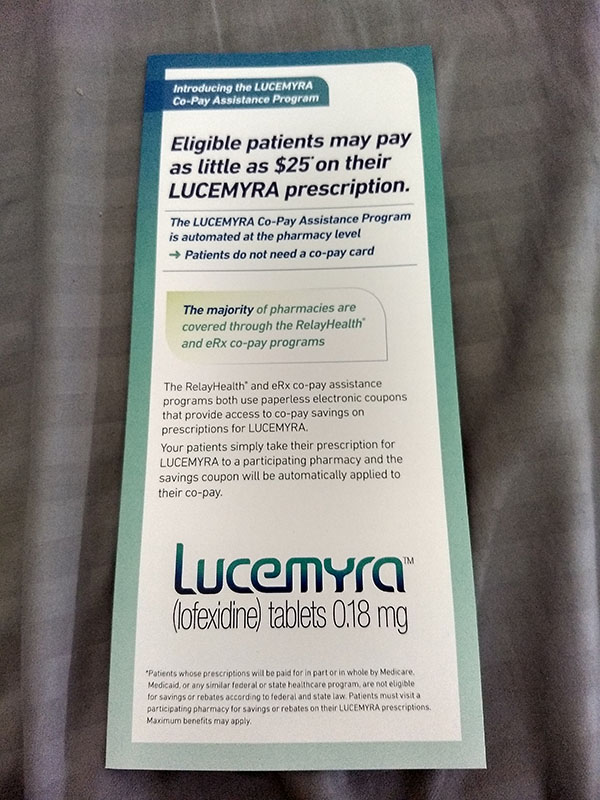
This is the brochure for Lucemyra®, the opiate withdrawal medication that costs $1,974.78. No patient is paying $1,974.78 for it. Patients are paying $25. And doctors sure aren’t paying $1,974.78. The way all these companies are getting away with it is because in Healthcaristan SSR, nobody ever pays for their own medication.

To a first approximation, doctors make purchasing decisions, but insurances cough up the money. Insurances have a few weapons to prevent doctors from buying arbitrarily expensive drugs, but they tend to back off in the face of magic words like “I believe this is medically necessary” or “This is the one the FDA approved”. So to fill in the missing pieces of the pharma strategy mentioned above:

1. Take an popular older drug

2. Re-invent it, either with a minor change to the delivery mechanism, or by finding a similar molecule that works the same way

3. Call this a new drug, advertise the hell out of it, and sell it for 10x – 100x the price of the older drug

4. Advertise it to patients (who don’t have to pay for it) and doctors (who definitely don’t have to pay for it), neither of whom care at all what price you’re setting.

5. Make sure doctors know the magic words they need to use to force insurance companies to pay for it.

6. Profit!

This has become so lucrative that pharma companies barely have to do any real research and development at all these days. The only genuinely exciting new drugs at the conference were Ingrezza® and Austedo®, both of which treat tardive dyskinesia – a side effect you get from having been on too many other psychiatric drugs. This is probably a metaphor for something.


The eighth thing you notice at the American Psychiatric Association meeting is that there’s a presentation called “Yer A Psychiatrist, Harry!”: Learning Psychiatric Concepts Through The Fictional Worlds Of Game Of Thrones And Harry Potter. I didn’t go. I realize I have failed you, my readers, but if I had to listen to ninety minutes of that, all the Vraylar® in the world would not be enough to maintain my sanity.


The ninth thing you notice at the American Psychiatric Association meeting is that, after winning last place in a head-to-head comparison of various antipsychotics, doing worse than drugs that cost less than 1% as much…
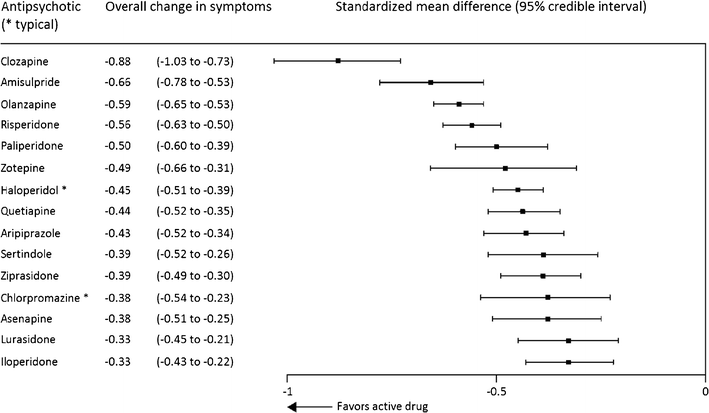
…Fanapt® (iloperidone) has pivoted to a marketing strategy of bribing doctors with free ice cream:


The tenth thing you notice at the American Psychiatric Association meeting is that all of this has happened before.

This is the 175th anniversary of the APA. It’s been a pretty crazy century-and-three-quarters, no pun intended. Like, seriously, take a look at this guy:
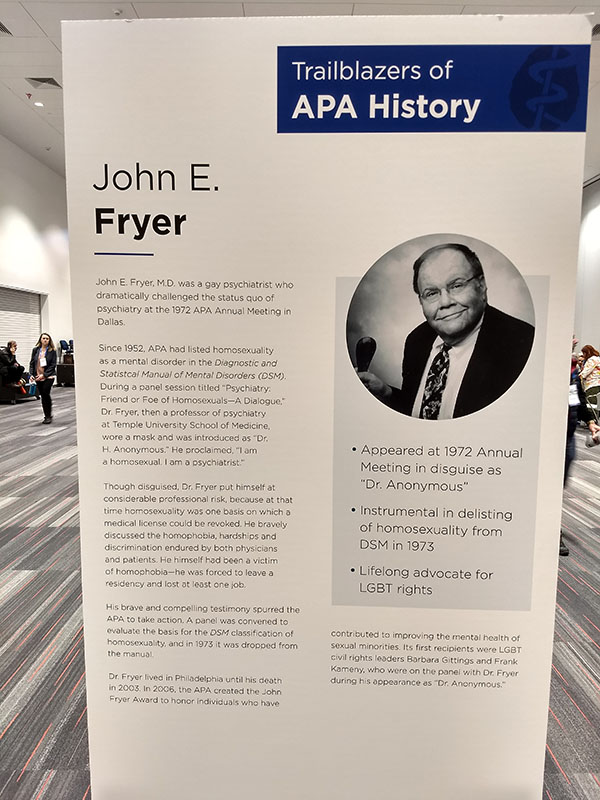
Back when you could still lose your medical license for being gay, he went to the APA meeting in a mask and gave a presentation arguing for gay rights, and the APA de-listed homosexuality as a psychiatric disorder the following year. How amazing is that?

The APA highlighted a bunch of people like this, heroes and trailblazers all. But for every great hero celebrated on posters, there is an embarrassment buried somewhere deep in an archive. My favorite of these is the APA Presidential Address from 1918, the very tail end of WWI. The head of the Association, a very distinguished psychiatrist named Dr. Anglin, gets up in front of the very same conference I attended this week (the 1918 version was held in Chicago) and declared that the greatest problem facing psychiatry was…the dastardly Hun:

The maxim that medical science knows no national boundaries has been rudely shaken by the war. The Fatherland has been preparing for isolation from the medical world without its confines. Just as, years ago, the Kaiser laid his ban on French words in table menus, so, as early as 19 14, German scientists embarked on a campaign against all words which had been borrowed from an enemy country. A purely German medical nomenclature was the end in view. The rest of the world need not grieve much if they show their puerile hate in this way. It will only help to stop the tendency to Pan-Germanism in medicine which has for some years past been gaining headway. ‘

The Germans excel all other nations in their genius for advertising themselves. They have proved true the French proverb that one is given the standing he claims. On a slender basis of achievement they have contrived to impress themselves as the most scientific nation. Never was there greater imposture. They display the same cleverness in foisting on a gullible world their scientific achievements as their shoddy commercial wares. The two are of much the same value, made for show rather than endurance — in short, made in Germany […]

In the earliest months of the war it was pointed out that there are tendencies in the evolution of medicine as a pure science as it is developed in Germany which are contributing to the increase of charlatanism of which we should be warned. A medical school has two duties — one to medical science, the other to the public. The latter function is the greater, for out of every graduating class 90 per cent. are practitioners and less than 10 per cent, are scientists. The conditions in Germany are reversed. There, there were ninety physicians dawdling with science to every ten in practice. Of these 90, fully 75 per cent were wasting their time. In Germany the scientific side is over-done, and they have little to show for it all, while the human side is neglected. Even in their new institutions, splendid as they are in a material sense, it is easily seen that the improved conditions are not for the comfort of the patients.

Out of this war some modicum of good may come if it leads to a revision of the exaggerated estimate that has prevailed in English-speaking countries of the achievements of the Germans in science. We had apparently forgotten the race that had given the world Newton, Faraday, Stephenson, Lister, Hunter, Jenner, Fulton, Morse, Bell, Edison, and others of equal worth. German scientists wait till a Pasteur has made the great discovery, on which it is easy for her trained men to work. She shirks getting for herself a child through the gates of sacrifice and pain ; but steals a babe, and as it grows bigger under her care, boasts herself as more than equal to the mother who bore it. Realising her mental sterility, drunk with self-adoration, she makes insane war on the nations who still have the power of creative thought.

But it is especially in the realm of mental science that the reputation of the Germans is most exalted and is least deserved. For every philosopher of the first rank that Germany has produced, the English can show at least three. And in psychiatry, while we have classical writings in the English tongue, and men of our own gifted with clinical insight, we need seek no foreign guides, and can afford to let the abounding nonsense of Teutonic origin perish from neglect of cultivation.

The Germans are shelling Paris from their Gothas and their new gun. Murdering innocents, to create a panic in the heart of France! With what effect ? The French army cries the louder, “They shall not pass ” ; Paris glows with pride to be sharing the soldiers’ dangers, and increases its output of war material; and the American army sees why it is in France, and is filled with righteous hatred. Panic nowhere. Vengeance everywhere. What does the Hun know of psychology? His most stupid, thick-witted performance was his brutal defiance of the United States with its wealth, resources, and energy. That revealed a mental condition both grotesque and pitiable.

After the war a centre of medical activity will be found on this side the Atlantic, and those who have watched the progress medical science has made in the United States will have no misgivings as to your qualifications for leadership. If we learn to know ourselves, great good will come out of this war.

Anglin does not deny that some may find it inappropriate to discuss politics at a psychiatry conference, but notes that:

If in these introductory remarks I have not been able to detach myself from the world’s most serious business at the present time, perhaps on reflection they may not have gone very far afield from the subject which binds us together in an association. If there is to be a change in the conditions under which we live this must have its effect on the minds of men ; whether for good or ill, I will not stop to speculate. We are intensely concerned with environment. This war itself is entangled with it,

England’s greatness, her devotion to honour, truth, and fidelity, is due to the environment in which her children are trained and grow to manhood. The ivy-grown wall, the vine-clad hills and the rose-covered bowers constitute the birth-place of English character.

Gerard tells us the cause of the war is the uncongenial environment in which the German youth is cradled and reared. The leaden skies for which Prussia is noted, its bleak Baltic winds, the continuous cold, dreary rains, the low-lying land, and the absence of flowers have tended to harden the spirit and rob it of its virtue, produce a sullen and morose character, curdling the milk of human kindness.

He does raise one warning, one problem that risks sabotaging even countries as congenial-climate-having as ourselves and our allies:

The quack medicine vendor is busier than ever. Money is plenty and he wants some of it. He uses mental suggestion and interests us. He is a specialist in distortion who probes into the ordinary sensations of
healthy people and perverts them into symptoms. Every billboard, newspaper, fence-rail, barn and rock thrusts out a suggestion of sickness as never before. The only vulnerable point to attack the vicious traffic is the advertising. If governments forbid that as they should, the next generation will be healthier and richer.

From Dr. Anglin’s address, I gather three things.

First, the billboards we shall always have with us. It’s easy to imagine this a modern problem, but apparently the generation that confronted the Kaiser was confronting annoying psychiatric advertising too. The Kaiser is gone; the annoying psychiatric advertising has proven a tougher foe.

Second, psychiatry has always been the slave of the latest political fad. It is just scientific enough to be worth capturing, but not scientific enough to resist capture. The menace du jour will always be a threat to our mental health; the salient alternative to “just forcing pills down people’s throat” will always be pursuing the social agenda of whoever is in power; you will always be able to find psychiatrists to back you up on this.

But third, science advances anyway. Psychiatry is light-years ahead of where it was a hundred years ago. Since Dr. Anglin’s 1918 address, we’ve discovered psychotherapy and psychopharmacology; come up with deinstitutionalization and destigmatization; and put rights in place to protect psychiatric patients and to protect the general public from being unnecessarily psychiatrized. We’ve even invented Vraylar®.

On my way out of the conference, I encountered this ad:
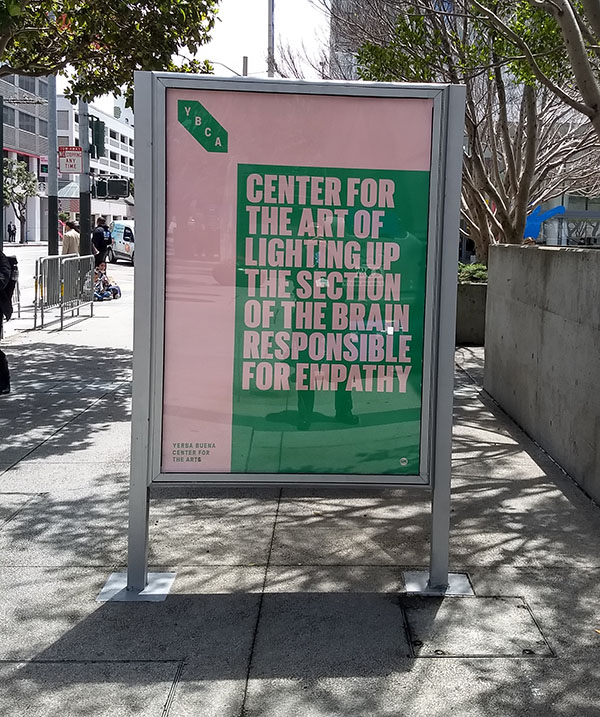
I don’t think it was even related to the psychiatry conference. I think it was for a nearby art museum. But it struck me. It struck me because it’s the sort of picture psychiatry wants to have of itself, a combination of hard neuroscience and basic human goodness. It struck me because as written, it’s obviously bogus (which Brodmann area is responsible for empathy again? How bright does it have to light up before you start feeling empathic?) in much the same way psychiatry can be obviously bogus (how much Vraylar® does it take before you can “take back control of your life” or “feel better than well”?), but is sort of an exaggerated and slightly-too-literal version of something that could potentially not be bogus. It struck me because, after making fun of it, I had to admit to myself that the thing it was pointing at was good and important and probably exactly what an art museum should be trying to do. And a psychiatrist, for that matter.

OT128: Opentos Thread

This is the bi-weekly visible open thread (there are also hidden open threads twice a week you can reach through the Open Thread tab on the top of the page). Post about anything you want, but please try to avoid hot-button political and social topics. You can also talk at the SSC subreddit or the SSC Discord server – and also check out the SSC Podcast. Also:

1. Comments of the week: scchm presents an apparently original theory that buspirone works on D4 receptors (but see the whole thread, including my comments). And Murphy gives some pointers for determining when to believe claims of large effects from single genes.

Posted in Uncategorized | Tagged | 765 Comments

APA Meetup This Saturday

I’d like to meet any SSC readers who will be at the American Psychiatric Association meeting this weekend in San Francisco.

I propose lunch on Saturday 5/18, 12 PM. We can meet at Room 312 (randomly chosen as a room that doesn’t seem to be occupied at the time; if I’m wrong and it’s in use we’ll congregate awkwardly by the door) then go to a nearby restaurant. I’ll be wearing a dark blue shirt (if I remember), the silver spiral necklace I use as my avatar in the comments, and a nametag with my real name (Scott S_____). Please watch this post for potential emergency changes in time/location.

If you’re thinking of coming, send me an email at scott@slatestarcodex.com with your phone number so I know how many people to expect/wait for and can contact you if needed. If you don’t send me an email on time, don’t worry, you can still show up.

Posted in Uncategorized | Tagged | 20 Comments

A Critical Period For Lactation Fetishes

Enquist et al on lactation fetishes is one of my favorite papers.

They wonder – as we’ve all wondered at one point or another – how people develop fetishes. One plausible hypothesis is “sexual imprinting”. During childhood, you have a critical period (maybe ages 1 to 5) where you figure out what sex is. If you see some weird stuff during that time, you could end up with a fetish. For example, a child who sees latex used in a sexualized way (for example, they catch a glimpse of a sexy movie where someone is wearing latex) might grow up with a latex fetish.

Enquist et al realize lactation fetishes offer a natural test of this hypothesis. Children with younger siblings will see a lot of breastfeeding going on during their critical window; children without younger siblings will see less. Since it’s easy to ask people how many siblings they have, you can see if younger siblings correlate with lactation fetishes.

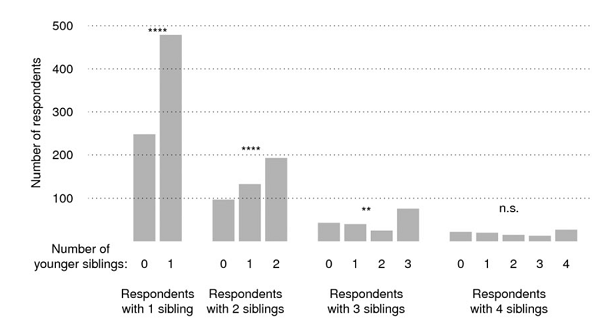
They survey some online lactation fetishist communities and ask everyone how many older and younger siblings they have. Although by chance we would expect an equal number of both, in fact the fetishists have many more younger than older siblings:

They interpret this as support for their critical window theory.

But their graph looks a lot like this graph of SSC readers:

I use the opposite order they do, but both graphs show the same thing: more older than younger siblings.

I interpret the SSC data as showing a birth order effect on intellectual curiosity. But if this is true, it casts Enquist et al’s results into doubt. The trait I’m calling “intellectual curiosity” is linked to openness to experience. Could it also cause people to be more curious and open about fetishes, or more likely to join online communities about those fetishes?

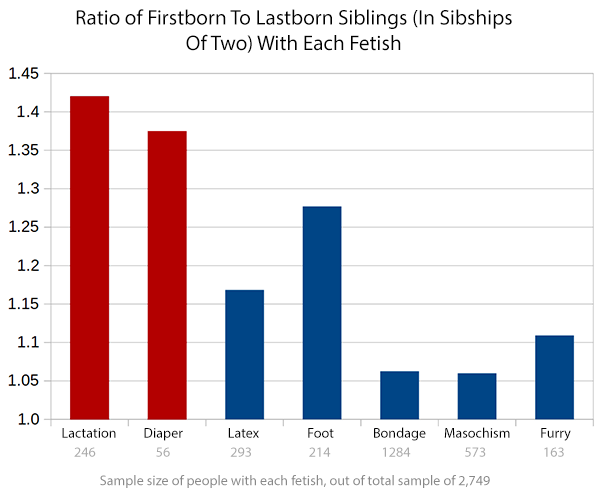
I decided to test these hypotheses using the SSC 2019 Survey, which contained data on participants’ fetishes. I looked into lactation to replicate the Enquist results, but also into diaper fetishes, since that seemed like another fetish where exposure to the relevant stimulus would depend a lot on having a baby in the house. I also looked at latex, foot, bondage, masochism, and furry fetishes as control groups. Here are the results:

All fetishes had more older than younger siblings. But the difference was only significant in lactation fetish (p = 0.01). The difference between significant and nonsignificant results is not always itself significant, and I’m not sure how I would properly analyze this given the many different comparisons (some of which I made after seeing the data). i lean towards not being very impressed with the critical window theory on this metric.

But here’s another potential test: compare people with younger siblings to people with no siblings.

In Enquist et al’s model, the presence of a younger sibling causes the lactation fetish. In my model, the presence of an older sibling suppresses openness to experience and prevents fetish formation. So if only children behaved more like older siblings, that would support my model; if they behaved more like younger children, it would support Enquist et al.

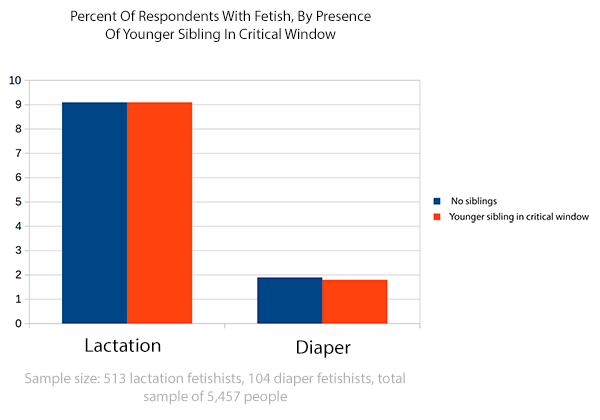
I compared participants with no siblings to participants with a younger sibling in the critical window of less than five years age gap. Here are the results:

No difference. This suggests that having a younger sibling does not make you more likely to develop a baby-related fetish, which suggests it’s just that having an older sibling makes you less likely to develop it. This casts doubt on any simple critical window theory of fetishes, and makes it more likely that Enquist et al were just detecting the same birth order effects on openness to experience that can be found in many unusual communities.

These data are thanks to people who graciously revealed their deepest secrets for the cause of science; please be kind and don’t make fun of them or call them gross in the comments. Although I’ve made every other part of the survey publicly available, given the sensitivity of fetishes I’m keeping these particular answers private. If you are a professional researcher (or an amateur researcher with a good track record of professionalism and data integrity), and you want to test these results, please email me at scott[at]slatestarcodex[dot]com and we can discuss how to make that happen.

Age Gaps And Birth Order Effects

[Parts of this post have since been shown to be wrong, as explained in this post. I endorse this reanalysis as better than the current post.]

Psychologists are split on the existence of “birth order effects”, where oldest siblings will have different personality traits and outcomes than middle or youngest siblings. Although some studies detect effects, they tend to be weak and inconsistent.

Last year, I posted Birth Order Effects Exist And Are Very Strong, finding a robust 70-30 imbalance in favor of older siblings among SSC readers. I speculated that taking a pre-selected population and counting the firstborn-to-laterborn ratio was better at revealing these effects than taking an unselected population and trying to measure their personality traits. Since then, other independent researchers have confirmed similar effects in historical mathematicians and Nobel-winning physicists. Although birth order effects do not seem to consistently affect IQ, some studies suggest that they do affect something like “intellectual curiosity”, which would explain firstborns’ over-representation in intellectual communities.

Why would firstborns be more intellectually curious? If we knew that, could we do something different to make laterborns more intellectually curious? A growing body of research highlights the importance of genetics on children’s personalities and outcomes, and casts doubt on the ability of parents and teachers to significantly affect their trajectories. But here’s a non-genetic factor that’s a really big deal on one of the personality traits closest to our hearts. How does it work?

People looking into birth order effects have come up with a couple of possible explanations:

1. Intra-family competition. The oldest child choose some interest or life path. Then younger children don’t want to live in their older sibling’s shadow all the time, so they do something else.

2. Decreased parental investment. Parents can devote 100% of their child-rearing time to the oldest child, but only 50% or less to subsequent children.

3. Changed parenting strategies. Parents may take extra care with their firstborn, since they are new to parenting and don’t know what small oversights they can get away with vs. what will end in disaster. Afterwards, they are more relaxed and willing to let the child “take care of themselves”. Or they become less interested in parenting because it is no longer novel.

4. Maternal antibodies. Studies show that younger sons with older biological brothers (but not sisters!) are more likely to be homosexual. This holds true even if someone is adopted and never met their older brother. The most commonly-cited theory is that during a first pregnancy, the mother’s immune system may develop antibodies to some unexpected part of the male fetus (maybe androgen receptors?) and damages these receptors during subsequent pregnancies. A similar process could be responsible for other birth order effects.

5. Maternal vitamin deficiencies. An alert reader sent me Does Birth Spacing Affect Maternal Or Child Nutritional Status? It points out that people maintain “stockpiles” of various nutrients in their bodies. During pregnancy, a woman may deplete her nutrient stockpiles in the difficult task of creating a baby, and the stockpiles may take years to recover. If the woman gets pregnant again before she recovers, she might not have enough nutrients for the fetus, and that may affect its development.

How can we distinguish among these possibilities? One starting point might be to see how age gaps affect birth order effects. How close together do two siblings have to be for the older to affect the younger? If a couple has a child, waits ten years, and then has a second child, does the second child still show the classic laterborn pattern? If so, we might be more concerned about maternal antibodies or changes in parenting style. If not, we might be more concerned about vitamin deficiencies or distracted parental attention.

Methods And Results

I used the 2019 Slate Star Codex survey, in which 8,171 readers of this blog answered a few hundred questions about their lives and opinions.

Of those respondents, I took the subset who had exactly one sibling, who reported an age gap of one year or more, and who reported their age gap with an integer result (I rounded non-integers to integers if they were not .5, and threw out .5 answers). 2,835 respondents met these criteria.

Of these 2,835, 71% were the older sibling and 29% were the younger sibling. This replicates the results from last year’s survey, which also found that 71% of one-sibling readers were older.

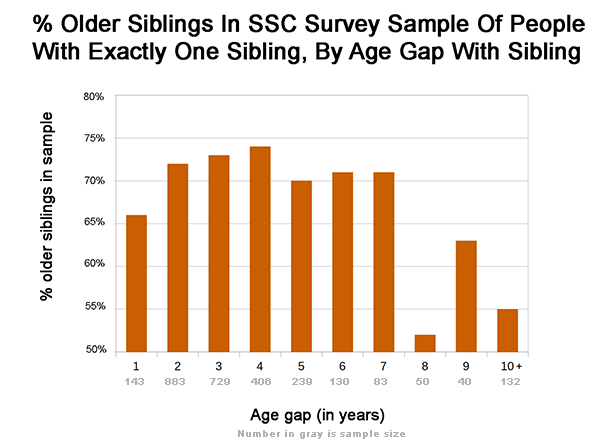
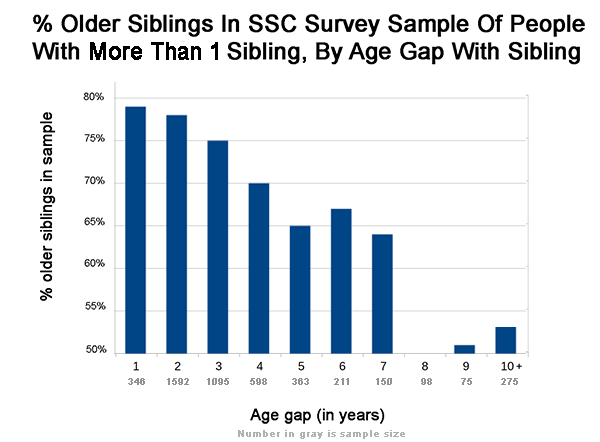
Here are the results by age gap:

Birth order effects are strong from one-year to seven-year age gaps, and don’t differ much within that space. After seven years, birth order effects decrease dramatically and are no longer significantly different from zero.

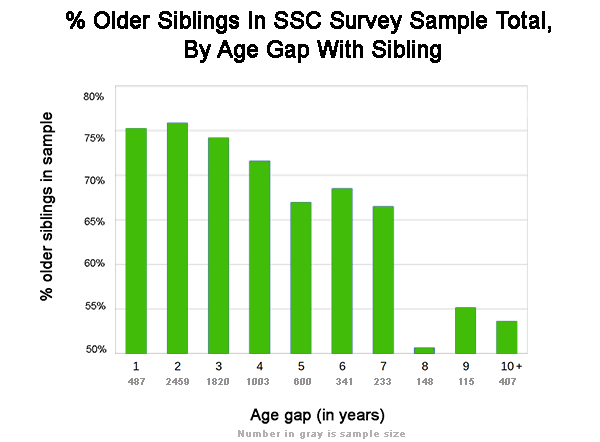
I also investigated people who had more than one sibling, but were either the oldest or the youngest in their families.

More siblings = more problems more of a birth order effect, but the overall pattern was similar. There is a possible small decline in strength from one to seven years, followed by a very large decline between seven and eight years.

Here’s the previous two graphs considered as a single very-large-n sample:

The pattern remains pretty clear: vague hints of a decline from age 1 to 7, followed by a very large decline afterwards.

(Tumblr user athenaegalea kindly double-checked my calculations; you can see her slightly-differently-presented results here).

Weirdly, among people who reported a zero-year age gap, 70% are older siblings. This wouldn’t make much sense for twins, since here older vs. younger just means who made it out of the uterus first. I don’t know if this means there’s some kind of reporting error that discredits this entire project, whether people who were born about 9 months apart reported this as a zero year age gap, or whether it’s just an unfortunate coincidence.

These results suggest that age gaps do affect the strength of birth order effects. People with siblings seven or fewer years older than them will behave as laterborns; people separated from their older siblings by more than seven years will act like firstborn children.

Discussion

This study found an ambiguous and gradual decline from one to seven years, but also a much bigger cliff from seven to eight years. Is this a coincidence, or is there something important that happens at seven?

Most of the sample was American; in the US, children start school at about age five. Although it might make sense for older siblings stop mattering once they are in school, this would predict a cliff at five years rather than seven years.

Developmental psychologists sometimes distinguish between early childhood (before 6-8 years) and middle childhood (after that point). This is supposed to be a real qualitative transition, just like eg puberty. We might take this very seriously, and posit that having a sibling in early childhood causes birth order effects, but one in middle childhood doesn’t. But why should this be? Overall I’m still pretty confused about this.

These results may be consistent with an intra-family competition hypothesis. Children try to avoid living in the shadow of their older siblings, perhaps by avoiding intellectual pursuits those children find interesting. But if there is too much of an age gap, then siblings are at such different places that competition no longer feels relevant.

These results may be partly consistent with a parental investment hypothesis. Parents might have to split their attention between first and laterborn children, so that laterborns never get the period of sustained parental attention that firstborns do. But since an age gap as small as one year produces this effect, this would suggest that only the first year of childrearing matters; after the first year, even the firstborn children in this group are getting split attention. This is hard to explain if we are talking about as complicated a trait as “intellectual curiosity” – surely there are things parents do when a child is two or three to make them more curious?

These results don’t seem consistent with hypotheses based on changing parenting strategies or maternal antibodies, unless parenting strategies or the immune system “reset” to their naive values after a certain number of years.

They also don’t seem too consistent with vitamin-based hypotheses. I don’t know how long it takes to replenish vitamin stockpiles, and it’s probably different for every vitamin. But I would be surprised if giving people one vs. five years for this had basically no effect, but giving them eight instead of seven years had a very large effect. Overall I would expect the first year of vitamin replenishment to be the most important, with diminishing returns thereafter, which doesn’t fit the birth order effect pattern.

Overall these results make me lean slightly more towards intra-family competition or parental investment as the major cause of birth order effects. I can’t immediately think of a way to distinguish between these two hypotheses, but I’m interested in hearing people’s ideas.

I welcome people trying to replicate or expand on these results. All of the data used in this post are freely available and can be downloaded here.

Is There A Case For Skepticism Of Psychedelic Therapy?

There’s been an explosion of interest in the use of psychedelics in psychiatry. Like everyone else, I hope this works out. But recent discussion has been so overwhelmingly positive that it’s worth reviewing whether there’s a case for skepticism. I think it would look something like this:

1. Psychedelics have mostly been investigated in small studies run by true believers. These are the conditions that produce a field made of unreplicable results, like the effects of 5-HTTLPR. Some of the most exciting psychedelic findings have already failed to replicate; for example, a study two years ago found that psilocybin did not permanently increase the Openness personality trait. This was one of the most exciting studies and had shaped a lot of my thinking around the issue. Now it’s gone.

2. Some of the most impressive stories involve psychedelic-assisted psychotherapy, where people who talk with a therapist, while on a substance, obtain true insight and get real closure. But every psychotherapy has amazing success stories floating out there. Back when psychoanalysis was new, the whole world was full of people telling their amazing success stories about how Dr. Freud helped them obtain true insight and get real closure. I think of psychotherapy as a domain where people can get as many amazing success stories as they want whether or not they’re really doing anything right, for unclear reasons.

3. Ketamine is the best comparison for psychedelics. Like psychedelics, it’s often used as a recreational drug, and produces profound experiences. Like psychedelics, it got hyped as an exciting new innovation that was going to revolutionize everything in psychiatry (in this case, depression treatment). But it’s been in pretty common (albeit non-formulary) use for five years now, and nothing has been revolutionized; my (very anecdotal) impression is that most patients who seek ketamine treatment find it only about as helpful as anything else. The gold-standard FDA studies are abysmal, worse than most other antidepressant medications. I’m sure ketamine works great for some people, just as SSRIs, therapy, and diet/exercise work well for some people. But at least so far it hasn’t been revolutionary.

4. Another good comparison is NSI-189. Again, a totally revolutionary new drug with a totally revolutionary new mechanism, with so many anecdotes of amazing success that depressed people started getting it on the black market before the FDA trials were even underway. People were posting testimonials that NSI-189 changed their life and that it was going to destroy the market for every other antidepressant. When the FDA trials finally finished, it was discovered to be ineffective. Seriously, the graveyards are littered with revolutionary new treatments for treatment-resistant depression that have great success in anecdotes and preliminary studies.

5. Between 10% and 50% of Americans have tried psychedelics. If psychedelics did something shocking, we would already know about it. I occasionally hear stories like “I did LSD and my depression went away”, but I also occasionally hear stories like “I did LSD and then my depression got worse”, so whatever. I know plenty of people who use heroic amounts of LSD all the time, and are still nervous wrecks. It’s possible there’s some set and setting that will improve this, but see part 7 below.

(one exception to this might be microdosing, which is a pretty new idea and might work differently from regular trips.)

6. In my model of psychedelics, they artificially stimulate your insight system the same way heroin artificially stimulates your happiness system. This leads to all those stories where people feel like they discovered the secret of the universe, but when they recover their faculties, they find it was only some inane triviality. This sounds very likely to produce people who think their psychedelic experience has changed everything and solved all their problems, which means we should discount these impressions as evidence that psychedelics really do change everything and solve all your problems. Granted, feeling like you truly understand the universe may itself help with depression, but I worry this is not a very lasting effect. See my posts on PIHKal and Universal Love, Said The Cactus Person.

7. Even if all of the above are wrong and psychedelics work very well, the FDA could kill them with a thousand paper cuts. Again, look at ketamine: the new FDA approval ensures people will be getting the slightly different esketamine, through a weird route of administration, while paying $600 a pop, in specialized clinics that will probably be hard to find. Given the price and inconvenience, insurance companies will probably restrict it to the most treatment-resistant patients, and it probably won’t help them (treatment-resistant patients tend to stay that way). Given the panic around psychedelics, I expect it to be similarly difficult to get them even if they are legal and technically FDA-approved. Depressed people will never be able to walk into a psychiatrist’s office and get LSD. They’ll walk into a psychiatrist’s office, try Prozac for three months, try Wellbutrin for three months, argue with their insurance for a while, eventually get permission to drive to a city an hour away that has a government-licensed LSD clinic, and get some weird form of LSD that might or might not work, using a procedure optimized to minimize hallucinations. I don’t know what the optimal set and setting for LSD is, but if it’s anything other than “the inside of a government-licensed LSD clinic, having a government-licensed LSD therapist ask you standard questions”, you won’t get it.

I hope I am wrong about this, I really do. And I think there’s a good chance that I might be. I really want psychedelic research to succeed and I support it wholeheartedly. But there’s been so much hype around so many things before that I want to avoid getting burned again, so I ‘ll stay skeptical for now.

Posted in Uncategorized | Tagged | 100 Comments

5-HTTLPR: A Pointed Review

In 1996, some researchers discovered that depressed people often had an unusual version of the serotonin transporter gene 5-HTTLPR. The study became a psychiatric sensation, getting thousands of citations and sparking dozens of replication attempts (page 3 here lists 46).

Soon scientists moved beyond replicating the finding to trying to elucidate the mechanism. Seven studies (see here for list) found that 5-HTTLPR affected activation of the amygdala, a part of the brain involved in processing negative stimuli. In one especially interesting study, it was found to bias how the amygdala processed ambiguous facial expression; in another, it modulated how the emotional systems of the amygdala connected to the attentional systems of the anterior cingulate cortex. In addition, 5-HTTLPR was found to directly affect the reactivity of the HPA axis, the stress processing circuit leading from the adrenal glands to the brain.

As interest increased, studies began pointing to 5-HTTLPR in other psychiatric conditions as well. One study found a role in seasonal affective disorder, another in insomnia. A meta-analysis of twelve studies found a role (p = 0.001) in PTSD. A meta-analysis of twenty-three studies found a role (p = 0.000016) in anxiety-related personality traits. Even psychosis and Alzheimer’s disease, not traditionally considered serotonergic conditions, were affected. But my favorite study along these lines has to be 5-HTTLPR Polymorphism Is Associated With Nostalgia-Proneness.

Some people in bad life situations become depressed, and others seem unaffected; researchers began to suspect that genes like 5-HTTLPR might be involved not just in causing depression directly, but in modulating how we respond to life events. A meta-analysis looked at 54 studies of the interaction and found “strong evidence that 5-HTTLPR moderates the relationship between stress and depression, with the s allele associated with an increased risk of developing depression under stress (P = .00002)”. This relationship was then independently re-confirmed for every conceivable population and form of stress. Depressed children undergoing childhood adversity. Depressed children with depressed mothers. Depressed youth. Depressed adolescent girls undergoing peer victimization. They all developed different amounts of depression based on their 5-HTTLPR genotype. The mainstream media caught on and dubbed 5-HTTLPR and a few similar variants “orchid genes”, because orchids are sensitive to stress but will bloom beautifully under the right conditions. Stories about “orchid genes” made it into The Atlantic, Wired, and The New York Times.

If finding an interaction between two things is exciting, finding an interaction between even more things must be even better! Enter studies on how the interaction between 5-HTTLPR and stress in depressed youth itself interacted with MAO-A levels and gender. What about parenting style? Evidence That 5-HTTLPR x Positive Parenting Is Associated With Positive Affect “For Better And Worse” What about decision-making? Gender Moderates The Association Between 5-HTTLPR And Decision-Making Under Uncertainty, But Not Under Risk. What about single motherhood? The influence of family structure, the TPH2 G-703T and the 5-HTTLPR serotonergic genes upon affective problems in children aged 10–14 years. What if we just throw all the interesting genes together and see what happens? Three-Way Interaction Effect Of 5-HTTLPR, BDNF Val66Met, And Childhood Adversity On Depression.

If 5-HTTLPR plays such an important role in depression, might it also have relevance for antidepressant treatment? A few studies of specific antidepressants started suggesting the answer was yes – see eg 5-HTTLPR Predicts Non-Remission In Major Depression Patients Treated With Citalopram and Influence Of 5-HTTLPR On The Antidepressant Response To Fluvoxamine In Japanese Depressed Patients. A meta-analysis of 15 studies found that 5-HTTLPR genotype really did affect SSRI efficacy (p = 0.0001). Does this mean psychiatrists should be testing for 5-HTTLPR before treating patients? A cost-effectiveness analysis says it does. There’s only one problem.

ALL.

OF.

THIS.

IS.

LIES.

Or at least this is the conclusion I draw from Border et al’s No Support For Historical Candidate Gene Or Candidate Gene-by-Interaction Hypotheses For Major Depression Across Multiple Large Samples, in last month’s American Journal Of Psychiatry.

They don’t ignore the evidence I mention above. In fact, they count just how much evidence there is, and find 450 studies on 5-HTTLPR before theirs, most of which were positive. But they point out that this doesn’t make sense given our modern understanding of genetics. Outside a few cases like cystic fibrosis, most important traits are massively polygenic or even omnigenic; no one gene should be able to have measurable effects. So maybe this deserves a second look.

While psychiatrists have been playing around with samples of a few hundred people (the initial study “discovering” 5-HTTLPR used n = 1024), geneticists have been building up the infrastructure to analyze samples of hundreds of thousands of people using standardized techniques. Border et al focus this infrastructure on 5-HTTLPR and its fellow depression genes, scanning a sample of 600,000+ people and using techniques twenty years more advanced than most of the studies above had access to. They claim to be able to simultaneously test almost every hypothesis ever made about 5-HTTLPR, including “main effects of polymorphisms and genes, interaction effects on both the additive and multiplicative scales and, in G3E analyses, considering multiple indices of environmental exposure (e.g., traumatic events in childhood or adulthood)”. What they find is…nothing. Neither 5-HTTLPR nor any of seventeen other comparable “depression genes” had any effect on depression.

I love this paper because it is ruthless. The authors know exactly what they are doing, and they are clearly enjoying every second of it. They explain that given what we now know about polygenicity, the highest-effect-size depression genes require samples of about 34,000 people to detect, and so any study with fewer than 34,000 people that says anything about specific genes is almost definitely a false positive; they go on to show that the median sample size for previous studies in this area was 345. They show off the power of their methodology by demonstrating that negative life events cause depression at p = 0.000000000000000000000000000000000000000000000000000000000000000000000000000000000000000000000000000000000000000000000000000000000000000000000001, because it’s pretty easy to get a low p-value in a sample of 600,000 people if an effect is real. In contrast, the gene-interaction effect of 5-HTTLPR has a p-value of .919, and the main effect from the gene itself doesn’t even consistently point in the right direction. Using what they call “exceedingly liberal significance thresholds” which are 10,000 times easier to meet than the usual standards in genetics, they are unable to find any effect. This isn’t a research paper. This is a massacre.

Let me back off a second and try to be as fair as possible to the psychiatric research community.

First, over the past fifteen years, many people within the psychiatric community have been sounding warnings about 5-HTTLPR. The first study showing failure to replicate came out in 2005. A meta-analysis by Risch et al from 2009 found no effect and prompted commentary saying that 5-HTTLPR was an embarrassment to the field. After 2010, even the positive meta-analyses (of which there were many) became guarded, saying only that they seemed to detect an effect but weren’t sure it was real. This meta-analysis on depression says there is “a small but statistically significant effect” but that “we caution it is possible the effect has an artifactual basis”. This meta-analysis of 5-HTTLPR amygdala studies says there is a link, but that “most studies to date are nevertheless lacking in statistical power”.

Counter: there were also a lot of meta-analyses that found the opposite. The Slate article on the “orchid gene” came out after Risch’s work, mentioned it, but then quoted a scientist calling it “bullshit”. I don’t think the warnings did anything more than convince people that this was a controversial field with lots of evidence on both sides. For that matter, I don’t know if this new paper will do anything more than convince people of that. Maybe I trust geneticists saying “no, listen to me, it’s definitely like this” more than the average psychiatrist does. Maybe we’re still far from hearing the last of 5-HTTLPR and its friends.

Second, this paper doesn’t directly prove that every single study on 5-HTTLPR was wrong. It doesn’t prove that it doesn’t cause depression in children with depressed mothers in particular. It doesn’t prove that it doesn’t cause insomnia, or PTSD, or nostalgia-proneness. It doesn’t prove that it doesn’t affect amygdala function.

Counter: it doesn’t directly prove this, but it casts doubt upon them. The authors of this paper are geneticists who are politely trying to explain how genetics works to psychiatrists. They are arguing that single genes usually matter less than people think. They do an analysis of depression to demonstrate that they know what they’re talking about, but the points they are making apply to insomnia, nostalgia, and everything else. So all the studies above are at least questionable.

Third, most of these studies were done between 2000 – 2010, when we understood less about genetics. Surely you can’t blame people for trying?

Counter: The problem isn’t that people studied this. The problem is that the studies came out positive when they shouldn’t have. This was a perfectly fine thing to study before we understood genetics well, but the whole point of studying is that, once you have done 450 studies on something, you should end up with more knowledge than you started with. In this case we ended up with less.

(if you’re wondering how you can do 450 studies on something and get it wrong, you may be new here – read eg here and here)

Also, the studies keep coming. Association Between 5-HTTLPR Polymorphism, Suicide Attempts, And Comorbidity In Mexican Adolescents With Major Depressive Disorder is from this January. Examining The Effect Of 5-HTTLPR ON Depressive Symptoms In Postmenopausal Women 1 Year After Initial Breast Cancer Treatment is from this February. Association Of DRD2, 5-HTTLPR, And 5-HTTVNTR With PTSD In Tibetan Adolescents was published after the Border et al paper! Come on!

Having presented the case for taking it easy, I also want to present the opposite case: the one for being as concerned as possible.

First, what bothers me isn’t just that people said 5-HTTLPR mattered and it didn’t. It’s that we built whole imaginary edifices, whole castles in the air on top of this idea of 5-HTTLPR mattering. We “figured out” how 5-HTTLPR exerted its effects, what parts of the brain it was active in, what sorts of things it interacted with, how its effects were enhanced or suppressed by the effects of other imaginary depression genes. This isn’t just an explorer coming back from the Orient and claiming there are unicorns there. It’s the explorer describing the life cycle of unicorns, what unicorns eat, all the different subspecies of unicorn, which cuts of unicorn meat are tastiest, and a blow-by-blow account of a wrestling match between unicorns and Bigfoot.

This is why I start worrying when people talk about how maybe the replication crisis is overblown because sometimes experiments will go differently in different contexts. The problem isn’t just that sometimes an effect exists in a cold room but not in a hot room. The problem is more like “you can get an entire field with hundreds of studies analyzing the behavior of something that doesn’t exist”. There is no amount of context-sensitivity that can help this.

Second, most studies about 5-HTTLPR served to reinforce all of our earlier preconceptions. Start with the elephant in the room: 5-HTTLPR is a serotonin transporter gene. SSRIs act on the serotonin transporter. If 5-HTTLPR played an important role in depression, we were right to focus on serotonin and extra-right to prescribe SSRIs; in fact, you could think of SSRIs as directly countering a genetic deficiency in depressed people. I don’t have any evidence that the pharmaceutical industry funded 5-HTTLPR studies or pushed 5-HTTLPR. As far as I can tell, they just created a general buzz of excitement around the serotonin transporter, scientists looked there, and then – since crappy science will find whatever it’s looking for – it was appropriately discovered that yes, changes in the serotonin transporter gene caused depression.

But this was just the worst example of a general tendency. Lots of people were already investigating the role of the HPA axis in depression – so lo and behold, it was discovered that 5-HTTLPR affected the HPA axis. Other groups were already investigating the role of BDNF in depression – so lo and behold, it was discovered that 5-HTTLPR affected BDNF. Lots of people already thought bad parenting caused depression – so lo and behold, it was discovered that 5-HTTLPR modulated the effects of bad parenting. Once 5-HTTLPR became a buzzword, everyone who thought anything at all went off and did a study showing that 5-HTTLPR played a role in whatever they had been studying before.

From the outside, this looked like people confirming they had been on the right track. If you previously doubted that bad parenting played a role in depression, now you could open up a journal and discover that the gene for depression interacts with bad parenting! If you’d previously doubted there was a role for the amygdala, you could open up a journal and find that the gene for depression affects amygdala function. Everything people wanted to believe anyway got a new veneer of scientific credibility, and it was all fake.

Third, antidepressant pharmacogenomic testing.

This is the thing where your psychiatrist orders a genetic test that tells her which antidepressant is right for you. Everyone keeps talking these up as the future of psychiatry, saying how it’s so cool how now we have true personalized medicine, how it’s an outrage that insurance companies won’t cover them, etc, etc, etc. The tests have made their way into hospitals, into psychiatry residency programs, and various high-priced concierge medical systems. A company that makes them recently sold for $410 million, and the industry as a whole may be valued in the billions of dollars; the tests themselves cost as much as $2000 per person, most of which depressed patients have to pay out of pocket. I keep trying to tell people these tests don’t work, but this hasn’t affected their popularity.

A lot of these tests rely on 5-HTTLPR. GeneSight, one of the most popular, uses seven genes. One is SLC6A4, the gene containing 5-HTTLPR as a subregion. Another is HTR2A, which Border et al debunked in the same study as 5-HTTLPR. The studies above do not directly prove that these genes don’t affect antidepressant response. But since the only reason we thought that they might was because of evidence they affected depression, and now it seems they don’t affect depression, it’s less likely that they affect antidepressant response too.

The other five are liver enzymes. I am not an expert on the liver and I can’t say for sure that you can’t use a few genes to test liver enzymes’ metabolism of antidepressants. But people who are experts in the liver tell me you can’t. And given that GeneSight has already used two genes that we know don’t work, why should we trust that they did any better a job with the liver than they did with the brain?

Remember, GeneSight and their competitors refuse to release the proprietary algorithms they use to make predictions. They refuse to let any independent researchers study whether their technique works. They dismiss all the independent scientists saying that their claims are impossible by arguing that they’re light-years ahead of mainstream science and can do things that nobody else can. If you believed them before, you should be more cautious now. They are not light-years ahead of mainstream science. They took some genes that mainstream science had made a fuss over and claimed they could use them to predict depression. Now we think they were wrong about those. What are the chances they’re right about the others?

Yes, GeneSight has ten or twenty studies proving that their methods work. Those were all done by scientists working for GeneSight. Remember, if you have bad science you can prove whatever you want. What does GeneSight want? Is it possible they want their product to work and make them $410 million? This sounds like the kind of thing that companies sometimes want, I dunno.

I’m really worried I don’t see anyone updating on this. From where I’m sitting, the Border et al study passed unremarked upon. Maybe I’m not plugged in to the right discussion networks, I don’t know.

But I think we should take a second to remember that yes, this is really bad. That this is a rare case where methodological improvements allowed a conclusive test of a popular hypothesis, and it failed badly. How many other cases like this are there, where there’s no geneticist with a 600,000 person sample size to check if it’s true or not? How many of our scientific edifices are built on air? How many useless products are out there under the guise of good science? We still don’t know.

OT127: Openinsula Thread

This is the bi-weekly visible open thread (there are also hidden open threads twice a week you can reach through the Open Thread tab on the top of the page). Post about anything you want, but please try to avoid hot-button political and social topics. You can also talk at the SSC subreddit or the SSC Discord server – and also check out the SSC Podcast.

Posted in Uncategorized | Tagged | 849 Comments

Little Known Types Of Eclipse

A lunar eclipse occurs when the Earth gets between the Moon and the Sun.

A solar eclipse occurs when the Moon gets between the Earth and the Sun.

A terrestrial eclipse occurs when the Earth gets between you and the Sun. Happens once per 24 hours.

An atmospheric eclipse occurs when an asteroid gets between you and the sky. Generally fatal.

A reverse solar eclipse occurs when the Sun gets between the Moon and the Earth. Extremely fatal.

A motivational eclipse occurs when the Moon gets between you and your goals. You can’t let it stop you! Destroy it! Destroy the Moon!

A marital eclipse occurs when the Moon gets between you and your spouse. You’re going to need to practice good communication about the new celestial body in your life if you want your relationship to survive.

A capillary eclipse occurs when your hair gets between your eyes and the Sun. Get a haircut.

A lexicographic eclipse occurs when “Moon” gets between “Earth” and “Sun” in the dictionary. All Anglophone countries are in perpetual lexicographic eclipse.

A filioque eclipse occurs when the Holy Spirit gets between the Father and the Son.

An apoc eclipse occurs when the Great Beast 666, with seven heads and ten horns, and upon the horns ten crowns, and upon its heads the name of blasphemy, gets between the Earth and the Sun. Extremely fatal.

Posted in Uncategorized | Tagged | 73 Comments

Update To Partial Retraction Of Animal Value And Neuron Number

[Update 10/2/23: See also here]

A few weeks ago I published results of a small (n = 50) survey showing that people’s moral valuation of different kinds of animals scaled pretty nicely with the animals’ number of cortical neurons (see here for more on why we might expect that to be true).

A commenter, Tibbar, did a larger survey on Mechanical Turk and got very different results, so I retracted the claim. I wasn’t sure why we got such different results, but I chalked it down to chance, or perhaps to my having surveyed an animal-rights-conscious crowd who thinks a lot about this kinds of things vs. Tibbar surveying random MTurkers.

Now David Moss, from effective altruist organization Rethink Priorities, has looked into this more deeply and resolved some of the discrepancies.

The problem is that I did a terrible job explaining my procedure (I linked to the form I used, but the link was broken when Tibbar did his survey). In particular, I included the line:

If you believe [animals have moral value] in general, but think some specific animal I ask about doesn’t work this way, feel free to leave the question blank or put in “99999”, which I will interpret as “basically infinity”

About 5 – 10% of respondents took me up on this. Tibbar didn’t make this suggestion, and none of his participants did this.

Moss surveyed 490 people on Mechanical Turk, and did not offer people a “basically infinity” option. However, many (20% – 40%) of his participants said the question didn’t apply to specific animals.

He found that when he ignored these, he got the same (low) numbers as Tibbar; when he counted an N/A answer as a vote for “basically infinity”, he got the same (high) numbers that I did.

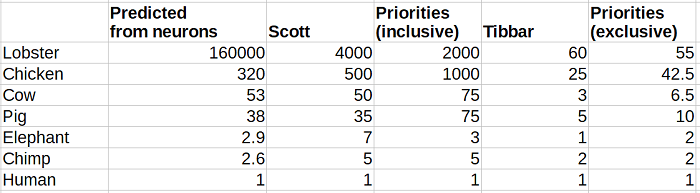
This graph measures people’s perceptions of how many of each animal is morally equivalent to one human. “Priorities (inclusive)” is Rethink Priorities’ survey, with refusal to vote counted as “basically infinity”. “Priorities (exclusive)” is Rethink Priorities’ survey, with refusals to vote thrown out. I think this demonstrates pretty well that you can get either mine or Tibbar’s numbers depending on which choice you make.

But Moss also points out that all of this is just a fragile balance between people who say every life is worth the same regardless of species, versus people who just spam the box with as many nines as they can.

So it’s not clear how much we should be drawing from this in any case. Whatever. I still think it’s neat.

The moral of the story is to always explain your procedures really well before you try to replicate something. Also to make sure the link to your procedures actually goes to your procedures, although maybe no one other than me has ever made that specific mistake before.