SSC San Jose Meetup 11/4

What: SSC meetup
When: Friday 11/4, at 7 PM
Where: 3806 Williams Road, San Jose, CA
Why: Physicist/intelligence researcher Steve Hsu of Information Processing will be in the Bay Area and wants to get to meet some of you.
How: David Friedman is very nice and lets us use his house for things

I will unfortunately not be able to attend.

Posted in Uncategorized | Tagged | 24 Comments

Links 11/16: Site Unseen

Attn fans of Research Agreements: China has reconstructed the Porcelain Tower

Redditor justdoittimes5 looks up some data relevant to my Against Tulip Subsidies and finds that medical students who studied science in undergrad gain no advantage over those who did not.

Wikipedia: symmetry-breaking of escaping ants

There is no increasing placebo effect in psychiatry: “Contrary to the widely held believe, the average placebo response rates in antidepressant trials have been stable for more than 25 years”

Major Airline Launches Child-Free Zones On Flights. Communists surrender, admit that invisible hand of the market really does guide businesses to the common good of all.

New brain structure study finds more evidence in favor of two “types” of trans women – an early-transitioning androphilic feminine-personality type and a late-transitioning gynophilic masculine-personality type (study, article). Another claim by the same site: even though the first group has normal IQ, the second group has IQ 128?!?!?! Suddenly all of this “how come there are so many transwomen in programming?” stuff starts to look incredibly interesting (note).

DEA decides not to ban kratom for now, marking rare victory for common sense and/or being really angry on the Internet.

Attitude toward school does not predict academic achievement: “This study, by analyzing the PISA 2003, 2009, and 2012 datasets, finds virtually no direct relationships between students’ general attitude toward school and their academic achievement in reading and mathematics.”

Do Youth Employment Programs Improve Labor Market Outcomes: “We identify 113 counterfactual impact evaluations…using met-analysis methods, we synthesize the evidence based on 2,259 effect sizes…overall we find that just more than one-third of evaluation results from youth employment programs implemented worldwide show a significant positive impact on labor market outcomes.” You can gauge your level of cynicism by whether you’re shocked by how low or how high that is.

Nick Land writes an article on fascism for the Daily Caller: “Fascism is therefore broadly identical with a normalization of war-powers in a modern state, that is: sustained social mobilization under central direction. Consequently, it involves, beside the centralization of political authority in a permanent war council, a tribal hystericization of social identity, and a considerable measure of economic pragmatism…Since fascism had entirely filled the Overton Window, it lost contour, and became invisible. The word persisted in public conversation only as an empty slur. Under this cover, and the absurdly misleading branding associated with it, American fascism ascended to a state of global hegemonic dominance.”

Adding seaweed to cattle feed could reduce methane production by 70%?

I used to think Mormonism must be some kind of amazing magic religion, since Mormons seemed to have better communities and outcomes in a lot of ways than the surrounding population. Razib Khan points out something I should have realized a long time ago – Mormons are just Puritans (in the Albion’s Seed sense) – they descend from Joseph Smith’s neighbors in New-England-settled upstate New York. Their tight-knit egalitarian communities aren’t much different from the tight-knit egalitarian communities of eg Vermont. And apparent Mormon exceptionalism is probably just perfectly normal deep population differences.

Ye Olde England had special corpse roads to transport coffins to cemeteries. Needless to say there are all sorts of associated weird superstitions.

Some Friends Of The Blog and other cool people will be at the Adam Smith Institute Forum in London on December 3.

People who film protests against the oil pipeline in North Dakota face prison under attempts to use laws against filming crimes to quash journalism.

Related to the perennial discussion over whether traditional or modern societies are happier – new study finds that Himba hunter-gatherer tribespeople report higher life satisfaction than urbanized Himba or modern Brits.

Do higher IQ presidents perform better? asks a Scientific American article which is better than you’d expect considering we have no obvious way to measure either presidential IQ or presidential performance.

The New Yorker: The Case Against Democracy. “Despite ample proof of the average American voter’s cluelessness, why do we still insist on voting rights for all?”

Paul Christiano is one of many people with so many interesting ideas that I wished he’d start a blog. Now: Paul Christiano starts a blog.

Speaking of Paul, he and housemates Steph and Katja have made reciprocity.io, a dating site for the rationalist community and rationalist-adjacent people. You sign up, check the names of everyone you want to date (or hang out with), and if they also checked your name you both get a notification. If not it remains a secret and they never have to know. Warning: nobody having to know only slightly dulls the pain of finding out that a bunch of people you have crushes on aren’t interested.

Surprising: no difference in math teacher effectiveness between lower-income, higher-income kids.

Park Geun-Hye was elected President of South Korea partly because, having no remaining family, it was assumed she wouldn’t be corrupt and nepotistic. Now the country is in an uproar as she is discovered to be funneling national power and resources to a shaman who claimed to be in contact with her dead mother.

r/tinder is an interesting combination of horror stories, overly aggressive horny jerks, and cheesy pickup lines based on awful puns on people’s names

Latest study to be called into question: the one showing that shark attacks swung a US presidential election. Mea culpa – I blogged about that one unskeptically a few years ago.

Washington Post: Germany Reunified 26 Years Ago But Some Divisions Are Still Strong. This is maybe the strongest evidence against HBD I know, since it shows how purely political and historical differences created persistently different cultures. And don’t tell me that the East/West split happened along existing ethnic lines; the boundaries are too perfect.

Forbes: Oregon Study [Shows] Medicaid Had No Significant Effect On Health Outcomes Vs. Being Uninsured. Compare to RAND Health Insurance Experiment.

If you correct some simplifying but false assumptions used in many genetics papers, for a wide range of traits, common SNPs tag a greater fraction of causal variation than is commonly appreciated.

Jonathan Haidt’s Heterodox Academy publishes their ranking of colleges by tolerance for viewpoint diversity. If you’re going to college and you’re interested in being able to speak and think freely it is worth a look. Rankings like these are an obvious and extremely powerful strategic tool, and they confirm my impression that Haidt is almost the only person working effectively in this area.

New method is able to detect what parts of the genome have been subject to the most recent evolution in the past 2000 years – mostly genes for lactase, pigmentation, and immune response.

Posted in Uncategorized | Tagged | 671 Comments

How Does Recent AI Progress Affect The Bostromian Paradigm?

[content note: I seriously know nothing about this and it’s all random uninformed speculation]

I.

AI risk discussions are dominated by the Bostromian paradigm of AIs as highly strategic agents that try to maximize certain programmed goals. This paradigm got developed in the early 2000s, before a recent spurt of advances in machine learning. Do these advances require any changes to the way we approach these topics?

The latest progress has concentrated in neural networks – “cells” arranged in layers that represent the potential for ascending levels of abstract categorization. For example, a neural network working on image recognition might have a low-level layer that scans the image and resolves it into edges, a medium-level network that scans the set of edges and resolves it into shapes, and a highest-level network that scans the shapes and resolves them into subjects and themes. With enough training, the network “learns” how best to map each level onto the level above it, ending up with profound insight into the high-level features of a scene.

These are a lot like the human brain, and in fact some of the early researchers got important insights from neuroscience. The brain certainly uses cells, the cells are arranged in layers, and the brain categorizes things in hierarchies that move from simple things like edges or sounds to complicated things like objects or sentences.

In particular, these networks are like the brain’s sensory cortices, and they’re starting to equal or beat human sensory cortices at important tasks like recognizing speech and faces.

(I think this is scarier than most people give it credit for. It’s no big deal when computers beat humans at chess – human brains haven’t been evolving specific chess modules. But face recognition is an adaptive skill localized in a specific brain area that underwent a lot of evolutionary work, and modern AI still beats it)

The sensory tasks where AIs excel tend to involve abstraction, categorization, and compression: the thing where you take images of black dogs, white dogs, big dogs, little dogs, ugly dogs, cute dogs, et cetera and are able to generalize them into “dog”. Or to take a more interesting example: a new AI classifies images as pornographic or safe-for-work. Its structure naturally gives it an abstract understanding of pornographicness that allows it to “imagine” what the most pornographic possible images would look like (trigger warning: artificially intelligent computer generating the most pornographic possible images). This kind of classification/categorization/generalization ability is a major advance and eerily reminiscent of human abilities.

But how far is this to building an AGI or human-level AI or superintelligence or whatever else you want to call it?

II.

Consider two opposite perspectives:

The engineer’s perspective: Categorization ability is just one tool out of many. When people invented automated theorem-provers, that was pretty cool – it meant computers could now assess new mathematics. But for AGI, you still need some thing that wants to prove theorems, something (someone?) that can do something with the theorems it proves. The theorem-prover is a tool for the AI to use, not the core “consciousness” of the AI itself. The same will be true of these new neural nets and deep learning programs. They can recognize dogs, and that’s cool. But AGI is still about creating some kind of program that wants to recognize dogs, and which can do something interesting with the dogs once it recognizes them. And that will probably require something different from either a theorem-prover or a neural-net-categorizer. A paperclip maximizer might use a neural net to recognize paperclips, but its desire to maximize them will still come from some novel architecture we don’t know much about yet which probably looks more like normal programming.

The biologist’s perspective: The whole brain runs on more or less similar cells doing more or less similar things, and evolved in a series of tiny evolutionary steps. If we’ve figured out how one part of the brain works, that’s a pretty big clue as to how other parts of the brain work. The human motivation system is in brain structures not so different from the human perception-association-categorization system, and they probably evolved from a common root. If researchers are discovering that the easiest way to make perception-association-categorization systems is neural nets reminiscent of the brain, then they’ll probably find that those neural nets are pretty easy to alter slightly to make a motivational system reminiscent of the brain. This would look less like strategic/agenty goal maximization, which the brain is terrible at, and more like the sort of vague mishmash of desires which humans have.

The exact evolutionary history beyond the biologist’s perspective is complicated. There’s a split between some sensory processing centers (like the visual cortex) and some motivational/emotional centers (like the hypothalamus) pretty early in vertebrates and maybe even before. But in other cases the systems are all messed up. Some parts of the cortex interact with the hypothalamus and are considered part of the limbic system. Some parts of the really primitive lizard brain handle sensation (like the colliculi). It looks like sensation/perception-related areas and emotion/motivation-related areas are mixed throughout every level of the brain. Most important, the frontal lobe, which we tend to interpret as the seat of truly human intelligence and executive planning and “the will” – probably evolved from sensation/perception-related areas in fish, since it looks like sensation/perception-related areas are just about all the cortex that fish had. And all of this evolved from the same couple of hundred neurons in worms, which were already responsible for interpreting the sensations picked up by the worm’s little bristle thingies.

The point is, neither evolution nor anatomy suggests that the brain enforces a deep conceptual separation between perception, motivation, and cognition. Instead, the same sort of systems which handle perception in some areas are – with a few tweaks – able to handle cognition and motivation in others.

In fact, there are some deep connections between all three domains. The same factors that make a grey figure on dark ground look white can make an okay choice compared to worse choices look good. The same top-down processing that screws up PARIS IN THE THE SPRINGTIME is responsible for confirmation bias. In general the mapping between cognitive biases and perceptual illusions is fruitful enough that it’s hard for me to believe that cognition and sensation/perception aren’t handled in really similar ways, with motivation probably also involved.

So if we have something that can equal human sensory cortices – not just in the coincidental way where a sports car can equal a cheetah, but because we’re genuinely doing the same thing human sensory cortices do for the same reasons – then we might already be further than we think towards understanding human intelligence and motivation.

III.

A quick sketch of two ways this might play out in real life.

First, categorization/classification/generalization/abstraction seems to be a big part of how people develop a moral sense, and maybe a big part of what morality is.

Everyone remembers the whole thing about mental categories, right? The thing where you have a category “bird”, and you can’t give a necessary-and-sufficient explicit definition of what you mean by that, but you know a sparrow is definitely a bird, and an ostrich is weird but probably still a bird, and there are edge cases like Archaeopteryx where you’re not quite sure if they’re birds or not and there’s probably no fact of the matter either way? Cluster-structures in thingspace? Weird border disputes? That thing?

And you remember how we get these categories, right? A little bit of training data, your mother pointing at a sparrow and saying “bird”, then maybe at a raven and saying “bird”, then maybe learning ad hoc that a bat isn’t a bird, and your brain’s brilliant hyperadvanced categorization/classification/generalization/abstraction system picking it up from there? And then maybe after several thousand years of this Darwin comes along and tells you what birds actually are, and it’s good to know, but you were doing just fine way before that?

We learn morality in a very similar way. When we hit someone, our mother/father/teacher/priest/rabbi/shaman says “That’s bad”; when we share, “that’s good”. From all this training data, the categorization/classification/generalization/abstraction system eventually feels like it has a pretty good idea of what morality is, although often we can’t verbalize an explicit definition any better than we can verbalize an explicit definition of “bird” (“it’s an animal that can fly…wait, no, bats…um, that has feathers…uh, do all birds have feathers? Bah, of course they don’t if you pluck them, that wasn’t what I meant…”). Just as Darwin was able to give an explicit definition of “bird” which conclusively settled some edge cases like bats, so philosophers have tried to give explicit definitions of “morality” which settle edge cases like abortion and trolley-related mishaps.

An AI based around a categorization/classification/generalization/abstraction system might learn morality in the same way. Its programmers give it a bunch of training data – maybe the Bible (this is a joke, please do not train an AI on the Bible) – and the AI gains a “moral sense” that it can use to classify novel data.

The classic Bostromian objection to this kind of scheme is that the AI might draw the wrong conclusion. For example, an AI might realize that things that make people happy are good – seemingly a high-level moral insight – but then forcibly inject everybody with heroin all the time so they could be as happy as possible.

To this I can only respond that we humans don’t work this way. I’m not sure why. It seems to either be a quirk of our categorization/classification/generalization/abstraction system, or a genuine moral/structure-of-thingspace-related truth about how well forced-heroin clusters with other things we consider good vs. bad. A fruitful topic for AI goal alignment research might be to understand exactly how this sort of thing works and whether there are certain values of classification-related parameters that will make classifiers more vs. less like humans on these kinds of cases.

Second, even if we can’t get this 100% right, there might be a saving grace: I don’t see these kinds of systems as paperclip maximizers. The human utility function seems to be a set of complicated things generalizing/abstracting from a few biologically programmed imperatives (food, sex, lack of pain) and ability to learn other goals from society and your moral system.

Categorization/classification/generalization/abstraction is certainly involved in reinforcement learning. You say “BARK!” and a dog barks, and you give it a treat. The dog needs to be able to figure out, on the fly, whether the treat was for barking when you said “BARK!”, for barking whenever you speak, for barking in general, for being next to you, or just completely random. This is a problem of categorization and abstraction – going from training data (“the human did or didn’t reward me at this specific time”) to general principles (“when the human says bark, I bark”).

I don’t really understand how the human motivational system works. Dopamine and the idea of incentive salience seem to be involved in a fundamental way that seems linked to perception. But I am kind of hopeful that it’s something that’s not too hard to do if you already have a working categorizer, and that it’s a foundation to build agents that want things without being psychopathic maniacs. Humans can want sex without being insane sex maximizers who copulate with everything around until they explode. An AI that wanted paperclips, but which was built on a human incentive system that gave paperclips the same kind of position as sex, might be a good paperclip producer without being insane enough to subordinate every other goal and moral rule to its paperclip-lust.

Tomorrow 10/31 is the last day of MIRI’s yearly fundraiser, and as usual I think it is a good cause well worth your donation. But its basic assumption is that AIs will be very computer-like: entities of pure code and logic that will reflect on themselves using mathematical tools. I can also imagine futures where AIs aren’t much more purely-logical than we are, and the tools we need to keep them human-friendly are very different. I support MIRI’s efforts to deal with the one case, but I’m hoping there will be some efforts in the other direction as well.

EDIT: Nick points out some of MIRI’s work along these lines.
EDIT2: Comment by Eliezer

Posted in Uncategorized | Tagged | 141 Comments

AI Persuasion Experiment Results

I.

Last month I asked three thousand people to read some articles on AI risk and tell me how convinced they were. Last week, I asked them to come back and tell me some more stuff, to see if they stayed convinced.

I started off interested in the particular articles – which one was best at convincing newcomers to this topic. But I ended up hoping this could teach me about persuasion in general. Can online essays change people’s minds about complicated, controversial topics? Who is easiest to convince? Can we figure out what features of an essay do or don’t change people’s minds?

Depending on the last digit of people’s birth dates, I asked them to read one of five different essays:

— I asked people whose birth dates ended with 0 or 1 to read Wait But Why’s The AI Revolution: The Road To Superintelligence.

— I asked people whose birth dates ended with 2 or 3 to read a draft version of my own Superintelligence FAQ.

— I asked people whose birth dates ended with 4 or 5 to read Lyle Cantor’s Russell, Bostrom, And The Risk Of AI.

— I asked people whose birth dates ended with 6 or 7 to read Michael Cohen’s Extinction Risk From Artifical Intelligence.

— And I asked people whose birth dates ended with 8 or 9 to read Sean Carroll’s Maybe We Do Not Live In A Simulation. This had nothing to do with AI risk and was included as a placebo – that is, to get a group who had just had to read an online essay but presumably hadn’t had their minds changed about AI.

I hosted all of these pieces on Slate Star Codex and stripped them of any identifiers so that hopefully people would judge them based on content and not based on how much they liked the author or what color the page background was or whatever. It mostly worked: only 67% of readers had no idea who had written the essay, with another 23% having only vague guesses. Only about 10% of readers were pretty sure they knew.

People did read the essays: 70% of people said they finished all of theirs, and another 22% read at least half.

So the experiment was in a pretty good position to detect real effects on persuasion if they existed. What did it find?

II.

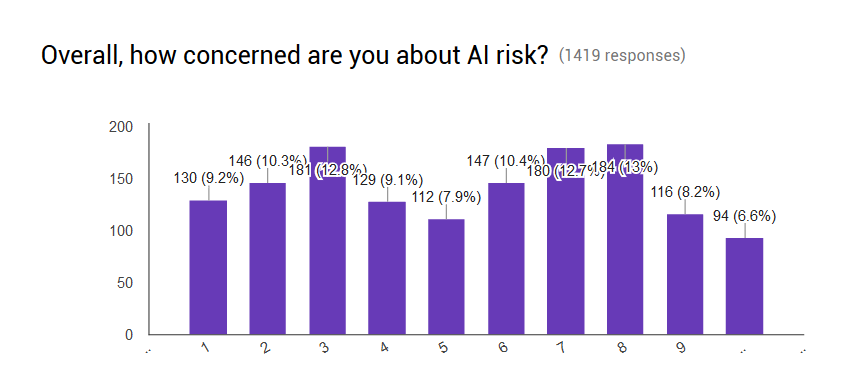
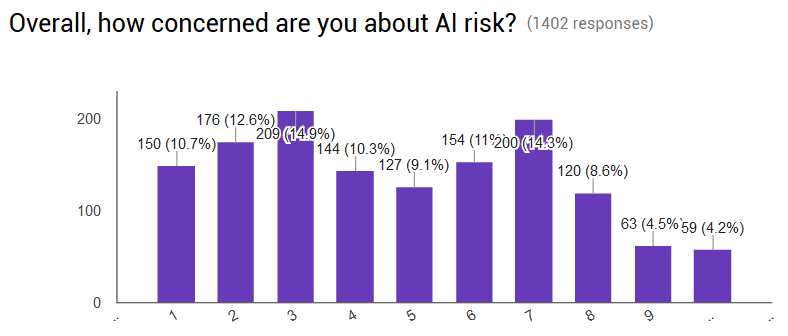
My outcome was people’s ratings on a score of 1 – 10 for various questions relating to AI. My primary outcome, selected beforehand, was their answer to the question “Overall, how concerned are you about AI risk?” About half of the respondents took a pre-test, and I got the following results:

After reading the essays, this changed to:

Overall, people increased their concern an average of 0.5 points.

(Note that I only had half the sample take a pretest, because I was worried that people would anchor to their pretest answers and give demand effects. This turned out not to be a big deal; the people who had taken a pretest changed in the same ways as the people who hadn’t. I’ve combined all data.)

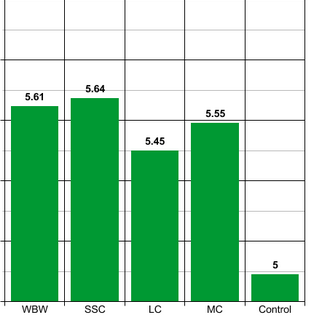
But what about the different essays? All five groups had means between 5 and 6, but the exact numbers differed markedly.

Note truncated y-axis

On further testing, the differences between the four active essays weren’t significant, but the difference between all of the essays and the control was significant.

III.

Aside from the primary outcome, I also had various secondary outcomes: answers to specific questions about AI risk. First, a list of average pretest and posttest answers (pretest, posttest):

How likely are we to invent human-level AI before 2100?: 5.7, 5.9
How likely is human-level AI to become superintelligent within 30 years?: 7.3, 7.3
How likely is human-level AI to become superintelligent within 1 year?: 4.8, 5.2
How likely that a superintelligent AI would turn hostile to humanity?: 6.4, 6.8
How likely that a hostile superintelligence would defeat humans?: 6.8, 7.1

All the nonzero differences here were significant.

If we look at this as a conjunction of claims, all of which have to be true before AI risk becomes worth worrying about, then it looks like the weak links in the chain are near-term human-level AI and fast takeoff. Neither of these are absolutely necessary for the argument, so this is kind of encouraging. There is less opposition than I would expect to claims that AI will eventually become superintelligent, or to claims that a war with a superintelligent AI would go very badly for humans.

Given the level of noise, there wasn’t a lot of evidence that any of the (active) essays were more persuasive than others on any of the steps, including the two dubious steps. This is actually a little surprising, since some essays focused on some things more than others. Possibly there was a “rising tide lifts all boats” effect where people who were more convinced of AI risk in general raised their probability at every step. But there was too much noise to say so for sure.

IV.

Was there any difference among people who were already very familiar with AI risk, versus people who were new to the topic?

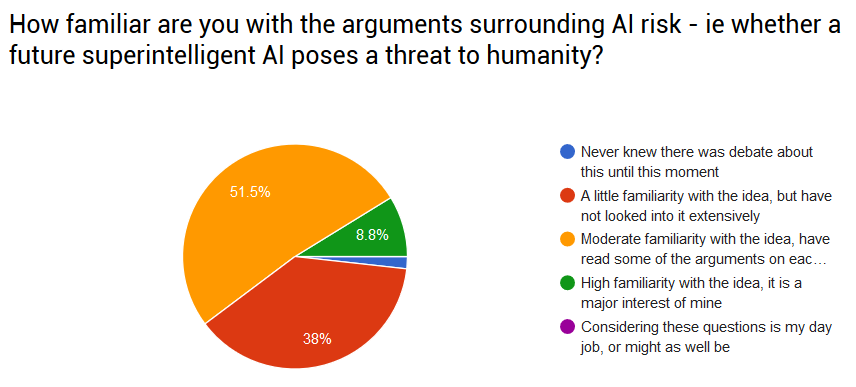
It was hard to tell. Only about two percent of readers here had never heard about the AI risk debate, and 60% said they had at least a pretty good level of familiarity with it.

The best I could do was to look at the 38% of participants (still about 1000 people!) who had only “a little familiarity” with the idea. Surprisingly, these people’s minds didn’t change any more than their better-informed peers. The average “little familiarity” person became 0.8 points more concerned, which given the smaller sample size wasn’t that different from the average person’s 0.5.

In general, people who knew very little about AI thought it was less important (r = 0.47), which makes sense since probably one reason people study it a lot is because they think it matters.

V.

How stable were these effects after one month?

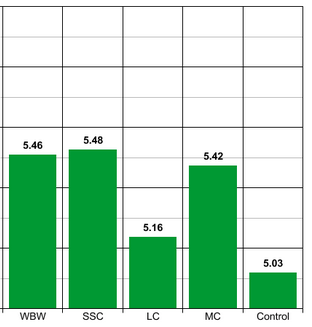
Still truncated y-axis

Pretty stable.

Other than an anomalous drop in the third group (I’m sticking with “noise”), the effect remained about two-thirds as strong as it had been the moment after the participants read the essays. All essay groups remained significantly better than the control group.

I looked at the subgroup of people who’d had little knowledge of AI risk before starting the experiments. There was a lot more noise here so it was harder to be sure, but it seemed generally consistent with the same sort of effect.

So in conclusion, making people read a long essay on AI risk changed their overall opinions about half a point on a ten-point scale. There weren’t major differences between essays. This was true whether or not they were already pretty familiar with it. And about two-thirds of the effect persisted after a month.

At least in this area, there might be a modest but useful effect from trying to persuade people.

In terms of which essay to use to persuade people? I don’t have any hard-and-firm results, but there were two trends I noticed. First, my essay was somewhat underrepresented among the people who’d had the biggest jumps (3 points or more) in their level of concern. Second, the third essay was anomalously bad at maintaining its gains over the month. That leaves just the first and fourth. Some people in the comments said they were actively repulsed by the fourth, and WaitButWhy seems pretty good, so at the risk overinterpreting noise, you might as well just send people theirs.

You can find the chaotic and confusingly-labeled data below. It might help to read the survey itself to figure out what’s going on.

Main experiment: .xlsx, .csv
One month follow-up: .xls, .csv

OT61: Turn-Based Threadegy

This is the bi-weekly visible open thread. There are hidden threads every few days here. Post about anything you want, ask random questions, whatever. Also:

1. Registration with a real email is now required to post comments. You can find the registration link on the top of the right sidebar. If there’s a problem, let me know. If there’s so much of a problem that you can’t post here, you can message me at @slatestarcodex on Twitter or email me or something.

2. Interesting people you may know who now have Patreons: The Unit of Caring, sinesalvatorem. If you don’t like their Patreon, don’t donate. If you’re a jerk to them here, I’ll ban you – and now I’ll be able to sort of enforce it!

3. The Social Sciences Replication Project is hosting a prediction market on which social sciences experiments will replicate. Due date to join is October 31. Note that they’re kind of missing the point of this whole prediction market thing and so you have to be an official social scientist with (or getting) a PhD or something to join.

4. Comment of the week is Anonymous Bosch on Richard Tol’s analysis of global warming costs.

Posted in Uncategorized | Tagged | 926 Comments

The Heart Has Its Reasons That Reason Knows Not Of

I.

Psychoanalysts argue that sons are attracted to women who look like their mothers, because they imprint on their mothers and use them as a schema for their ideal woman.

(and probably something similar for daughters and their fathers, though the psychoanalysts don’t usually get around to talking about that)

I’ve counterargued that sons get half their genes from their fathers, who apparently were attracted to women who looked like the sons’ mothers. Since study after study shows genes having unexpectedly big effects on behavior, and early childhood experiences with parents having unexpectedly small effects, maybe this would be a better explanation for the effect (if it even exists).

But the research doesn’t really bear me out.

Goose-ologist Konrad Lorenz raised goslings from birth. When the goslings grew up, he found they tried to mate with humans, especially “Caucasian men with white beards”. He concluded that they imprinted on their adoptive parent (him) and learned to prefer mates who looked like that parent.

More formally, Bischof et al got some male zebra finches and arrange to have them raised by a closely-related species, Bengalese finches. Then they put them in cages with both female zebra finches and female Bengalese finches and observed which females the birds tried to court. The results were pretty striking; they overwhelmingly went for the Bengalese finches who looked like their mothers, not the zebra finches who were genetically more suitable. Spence & Smith replicated this finding with zebra fish raised by differently-colored zebra fish.

So the research shows conclusively that sexual selection is based on learned imprinting, at least in animals whose names start with the string “zebra fi”. What about humans?

I can’t find the study itself, but multiple reviews cite Jedlicka 1984, who looked at children of mixed-race couples (white and native Hawaiian). They found that both men and women were more likely to marry someone of the race of their opposite-sex parent than of their same-sex parent (eg if you’re a woman with a Hawaiian mother and white father, you’re more likely to marry a white person). This is consistent with some kind of social imprinting where your opposite-sex parent serves as a template for future romantic interest. It’s not consistent with a simple genetic theory where you just get both parents’ genes. It might be consistent with a more complicated genetic theory where mate preferences are on a sex-appropriate chromosome or get chromosomally imprinted such that you only care about your father’s preferences for women and your mother’s preferences for men, but this is hard and I haven’t seen any analysis of whether it’s evolutionarily worth it.

Enquist, Aronsson, Ghirlanda, Jansson, and Jannini (2010) starts its Methods section with “We obtained data through newsgroups alt.sex.fetish and alt.sex.fetish.breastmilk”, so you know it’s gonna be interesting. They test another feature of men sexually imprinting on their mothers: suppose you’re a man with a sibling a few years younger than yourself. That means your mother was pregnant or lactating during the supposed critical sexual imprinting window. So if men with younger siblings are more likely to have pregnancy and lactation fetishes, that suggests that sexual imprinting on mothers is really a thing. This is indeed what they found: when a person with a pregnancy or lactation fetish only had one sibling, there was a 66% chance (compared to expected 50%) that their sibling would be younger than they, p < 0.0001 in their sample of 560 such people. This was true if and only if they were between age 1.5 and 5 during their sibling’s birth, hinting at the span of the imprinting window. Of course, this is still a really poor predictor: 33% of such people got the fetish without any younger siblings, and of course most people with younger siblings don’t end up with the fetish at all. But it does look like something is going on.

(I wonder what’s up with adult baby fetishes; if you could find a similar pattern among them that would suggest they’re imprinting on the baby sibling instead of the mother, which would be fascinating. Maybe I should try to survey the appropriate subreddit.)

Hefferman and Fraley did a very similar study. They find that people born to older parents, when compared against people born to younger parents, find older faces more attractive. This was true even after controlling for the age of the participants themselves. The effect size was small but pretty consistent across different groups and measurements. I am not quite as happy about the quality this study as in the ones above, but nothing raises huge red flags.

So there’s a lot of circumstantial evidence suggesting some kind of imprinting process is going on. But what about the original question – do people choose mates who look like their opposite-sex parent? And how genetic versus environmental is it?

Bereczkei, Gyuris, and Weisfeld addresses this question directly. They get a sample of grown-up adopted daughters and their adoptive fathers. They show subjects pictures of the adoptive fathers taken when their daughters were 2-8 years old, and then photos of four similar-aged men, one of whom is the daughter’s current husband. The subjects’ task is to guess which of the photos is the husband based on which of them looks most like the adoptive father. And subjects are in fact able to do this better than chance; they pick the correct husband 37% of the time compared to 21% of the time for (each of the three) incorrect husbands, which in their sample of 242 subjects is a p-less-than 0.001 result.

Somebody else check if I’m wrong here, but I’m a little concerned about the way they calculated p-values in this study. Suppose that their 242 subjects are always accurate in identifying the husband who looks most like the father; no randomness or noise here. But now the chance for randomness and noise comes in how many of the women might have picked husbands who look like their fathers by pure coincidence. It looks like there were only 26 women used in the study, so there’s a lot more opportunity for those twenty-six people to coincidentally choose husbands who happened to look like Dad than for the 242 subjects to coincidentally choose the correct husband even if they all looked alike. Yet as far as I can tell, the p-value calculation was only done on the latter possibility.

(an analogy: suppose that I want to prove I have ESP. I predict that a coin will land heads, then flip the coin. It does indeed land heads. Then I survey one thousand observers to ask them to judge whether the coin landed in accordance with my psychic prediction. All 1,000 of them say yes, a p = 0.000001 result that could not possibly be by coincidence. This does not prove at the p = 0.000001 level that I have ESP!)

Rantala and Marcinkowska do a really excellent review of this field that found a lot of the same papers I did. They acknowledge the Bereczkei/Gyuris/Weisfeld study as very interesting, but note that the first author “replicated” these results in a 2009 study using more scientific facial measurements. That study was found to be extremely flawed (found by Rantala himself, in fact) and was retracted under a cloud of accusations of misconduct and/or inexcusable error. It’s still not clear exactly what happened there, and nobody has formally accused the original father/adopted-daughter study of anything, but it’s kind of awkward to hang your theory on a study by somebody accused of scientific misconduct for faking a very similar study that supported the same hypothesis.

(side note: I wish that people would explain retractions better. Right now I don’t feel like I have a good understanding of exactly how the 2009 study got retracted, so I haven’t learned anything that will help me spot similar problems in the future)

So in summary: there’s a lot of good evidence that animals learn mate preferences by imprinting on their parents. There’s some circumstantial evidence that humans might do this too, across traits as diverse as race, age, and lactation status. There is, however, as yet no smoking gun.

II.

Wait, what about twin studies? Those are usually pretty great! Can we just do a twin study and sort this out once and for all?

Zietsch et al look at “a large community-based sample of twins and their partners and parents (N > 20,000 individuals) to test for genetic and family environmental influences on mate choice”. They find:

…near-zero genetic influences on male and female mate choice over all traits and no significant genetic influences on mate choice for any specific trait (!!!!!). A significant family environmental influence was found for the age and income of females’ mate choices, possibly reflecting parental influence over mating decisions.

This might be the first twin study I’ve ever seen which unambiguously breaks Turkheimer’s First Law Of Behavioral Genetics (every trait is somewhat heritable). Such a striking finding should increase our confidence in all of the above experiments a lot. So okay, I guess this issue is solved, it’s definitely just sexual imprinting on the opposite-sex parent, thank goodness, for once we have a perfectly clear noncontradictory result and we can all just go home and –

We also tested for evidence of sexual imprinting, where individuals acquire mate-choice criteria during development by using their opposite-sex parent as the template of a desirable mate; there was no such effect for any trait.

Sigh.

Okay, fine, let’s look at this a little more closely. They were analyzing a bunch of data from a big Australian survey of twins. This included the twins, the twins’ family, and the twins’ mates “height, BMI, age, education, income, personality, social attitudes, and religiosity”, which were the dimensions along which they tried to predict mate choice. They figured out whether imprinting was involved by checking whether twins’ mates were more like their opposite-sex parent than like other members of their family (their same-sex parent, their other twin). There was no sign of this being true, not even a nonsignificant trend.

If we want to play the dangerous game of trying to explain differences between contradictory studies instead of just dismissing everything as noise, I might argue that this looked at some pretty different variables compared to the last set. Instead of looking at facial similarities, it’s looking at things like social attitudes and religiosity; young children trying to imprint on their mother’s image can maybe be forgiven for not knowing her opinion about Asian immigrants (one of the “social attitudes” questions they asked).

The authors took a different tactic and pointed out that most of us don’t marry the first person we have a crush on, or even the second or third. Sometimes we marry the tenth person we really like, sometimes we settle for people we only like a little, and sometimes we get drunk, have sex in a cheap motel, and have the person’s parent threaten us with a shotgun unless we go to the chapel right now. So maybe the person we end up marrying isn’t a good proxy for our mate preferences per se.

(this is starting to get kind of depressing)

They investigate this hypothesis in a followup study where they directly ask twins about their preferences for an ideal mate. Here they’re able to get some more immediately visual data – preferences like tall/short, long-hair/short-hair, beards/clean-shaven, even big-breasts/small-breasts. They find…well, some things come out heritable, but the confidence intervals are really wide. There are a lot of suspicious things like hair-length preferences being impressively and significantly heritable for women but not heritable at all for men, and on one hand the two findings’ 95% confidence intervals do overlap, but on the other hand that’s because all of the confidence intervals are super-wide anyway. Overall I guess it’s nice that this study doesn’t blatantly break Turkheimer’s First Law, but I’m not going to draw any sweeping conclusions off of it.

I have one more twin study here, Lykken and Tellegen (which coincidentally opens with the same Pascal quote as this post). This experiment has an interesting design – they ask dizygotic and monozygotic twins to rate how attracted they are to their co-twin’s spouse! (I hope these researchers went above and beyond in keeping all their data confidential!) Despite those human interest stories where two identical twins separated at birth rediscover each other and find that they have both married blonde Corgi-owning optometrists named Theo, in this study there was very little resemblance between the spouses of either identical or fraternal twins. On average identical twins correlated with each other at r = 0.57 on some long list of variables, but their spouses correlated with each other only at r = 0.14 (identical) and r = 0.11 (fraternal), and most of this was just similar religious and educational backgrounds that don’t surprise us (we already know people tend to marry others of the same religion and social class, and twins are no exception).

This is interesting because it suggests a minimal role of either genetics or shared environment in mate choice, even in the most extreme circumstance (identical twins raised together). And in fact, the authors remind us that people who have had multiple long-term relationships often choose people who don’t resemble each other in more than the most superficial ways (if the authors had exposure to polyamory, they might note that most people’s simultaneous partners aren’t very similar either).

Maybe this just supports Zietsch et al’s hypothesis that mate preferences, whether imprinted or genetic, don’t really matter because we don’t have a whole shopping aisle of mates lined up to choose from and we’ve got to take whatever we can get. Yet even so there’s room for surprise. Even if only 5% of the opposite sex is interested in you, that still leaves the average person hundreds of different choices over their lifetime. Surely there should be some degrees of freedom for people to pick who they end up with. So what’s going on? If not by genes or shared environment, how do we choose our significant others?

The authors’ guess: true love, a mysterious and magical thing totally beyond scientific understanding.

If we provisionally accept our interpretation of these data, we are left with a curious and disquieting conclusion: Although most human choice behavior lawfully reflects the characteristics of the chooser and of the choice, the most important choice of all, that of a mate, seems to be an exception…we outline a theory that is compatible with these interpretations, namely that human pair bonding is relatively adventitious, based on romantic infatuation which, as Stendhal observed, “is like a fever that comes and goes quite independently of the will.”

Sure. Sounds plausible. Let’s just consider this whole matter closed.

AI Persuasion Followup Survey

If you took the AI persuasion experiment survey last month, I have a very brief followup survey that I’d like you to take. You can find it here. Don’t worry, you don’t have to read anything this time.

If you didn’t take the survey last month, please don’t take this one either.

Posted in Uncategorized | Tagged | 126 Comments

The Moral Of The Story

[content warning: puns. This is mostly self-plagiarism from my Tumblr and Twitter]

Once upon a time there was a small desert village with a single well outside town. One day a young woman went to the well to fetch water, and the well heard her crying, and asked “What’s wrong?”

She stopped her sobbing and asked the well “You can talk?”

“Yes,” said the well. “Long ago, the witch who lives in this town gave me life so I could serve as a guardian to the townspeople.”

“Alas,” said the young woman. “I am the daughter of that witch. She lived in peace with the townsfolk for many years. But the new mayor, who is a violent and hateful man, riled the people up against her, and they burned her at the stake. I am young and still do not know very much magic. I tried to curse them, but my curses fizzled. Now I worry I will never avenge my mother’s death.”

“Do not be afraid,” said the well. “I will take care of this.”

The next morning, when the Mayor came to fetch water from the well, he heard an odd noise coming from the bottom. He peered over as far as he could to see what was happening. Then an impossibly long arm shot up from the bottom of the well, grabbed the mayor, and pulled him into the well shaft. There was a horrible crunching sound, and nobody ever saw the Mayor again. The townsfolk apologized to the witch’s daughter, and they all lived happily ever after.

Moral of the story: Living well is the best revenge.


Pixar’s movie Up won the Academy Award for “Best Picture” and was widely hailed as one of the best children’s films of the decade. In fact, some people argued it was too good, and that kids were ignoring school, chores, and other responsibilities to watch it again and again. They said that along with the cute plot, the short, catchy name gave it an almost drug-like addictive quality. This made a lot of people very angry, and Pixar agreed to give its addictive must-watch movies longer names in the future.

Moral of the story: Do not call Up what you cannot put down.


There’s a new report out of CERN that a team of scientists has unraveled the structure of the photon. Apparently this started years ago when some equations showed that photons acted like tiny “hands” – structures with a “palm” and radiating “fingers” – which “crawl” across time/space and “grab” the solid particles they interact with. This explained most of the properties of light but wasn’t an exact match for the data. The latest result is that single photons are actually made up of hundreds of these shapes, all joined together into a single particle, and this is how they’re able to travel so quickly.

Moral of the story: Many hands make light work.


Once upon a time there was an ugly duckling. All of the other ducklings had grown their beautiful white soft downy feathers, but this duckling had no down feathers at all and was bald and ugly and all the other ducklings teased him.

He went to the mysterious crow who lived in the woods and asked for help. The crow said to repeat the magic words “HOCUS POCUS” at midnight with a full moon, and then he would grow his down feathers. The duckling tried that, but the moon just laughed at him and said the magic had no power here.

So he went to the creepy raven who lived in the swamp and asked for help. The raven said to repeat the magic words “ABRA CADABRA” at high noon on a sunny day, and then he would grow his down feathers. The duckling tried that, but the sun just laughed at him and said he wasn’t bound by the magic.

So he went to the wise old owl who lived in the tallest tree and asked for help. The owl explained that the duckling should just ignore the mockery of the other birds and accept that he was okay just the way he was, because there were no magic spells to make ducklings grow feathers.

Moral of the story: You are beautiful, no matter what they say. Words can’t bring you down.


Once upon a time a young lady died and went to Hell. At the check-in desk, Satan asked her age. She was in her twenties, but looked much younger; she thought quick and realized that even in Hell, they probably wouldn’t be mean to children. So she told Satan that she was twelve, and sure enough he said she wasn’t old enough to be held accountable for her sins, and ushered her off to a more peaceful part of Hell reserved for ages eleven through thirteen. She met the other sinners there and realized that many of them, like her, were older people who had lied to get out of their punishment.

Satan began to suspect something like this was going on, so he set up hidden cameras in the 11-13 wing of Hell, trying to catch people acting like adults or admitting to one another that they had lied about their age. But there were hundreds of millions of sinners and Satan couldn’t monitor all the cameras himself. So he went up to the mortal world and asked for the best supercomputer they had. The mortals recommended a newer model of Deep Blue, the supercomputer that had first beaten a human world champion at chess. Satan picked one up from IBM and went back to Hell, where he programmed the Deep Blue to monitor all of the hidden camera feeds at once and report any suspicious activity.

Sure enough, after a few days, he got thousands of reports of people acting older than thirteen. He hunted them down and removed them to Hell proper, where there was much wailing and gnashing of teeth. And it all could have been avoided if they had just stuck to their charade and acted as young as they said they were.

Moral of the story: Don’t get caught, be tween – the Devil and the Deep Blue see.


By 2050, screens have shrunk and become more flexible until the dream of “programmable paper” becomes a reality. Citizens of the future read newspapers like the ones in Harry Potter that include moving images and even videos of important events. This new technology even makes it as far as the US Post Office, where they decide to include programmable stamps. Instead of a static picture of eg George Washington’s head, it will have a moving image of Washington speaking and giving his famous Farewell Address.

Unfortunately, the technology isn’t ready for the kind of abuse that envelopes undergo on their travel throughout the country and the world. Most of the computerized stamps become corrupted and “crash”; in a particularly common bug, they try to reload but just end up displaying “GENERATING IMAGE…” permanently. The government has no money to fix the problem, so people just get used to stamps on their letters that say “GENERATING IMAGE…” instead of having interesting pictures on them.

Moral of the story: If you want a vision of the future, imagine a human face booting on a stamp forever.

Posted in Uncategorized | Tagged , | 141 Comments

More Hardball Debate Questions

[See also Hardball Questions For The Next Debate. The Gary Johnson question is not original to me.]

Jill Stein:

You’re a former doctor and researcher who first got involved in politics because of your interest in public health. One of your first forays into activism was the 2000 publication of In Harm’s Way: Toxic Threats to Child Development, a magisterial report on the effect of pollution on children’s physical and mental health. You described your focus as being on “developmental disabilities, including attention deficit/hyperactivity disorder, autism, and related neurodevelopmental diseases”. You describe “accumulating evidence of neurotoxic damage to children by environmental agents, such as lead and PCBs”.

In Chapter 7, you discuss the high burden of pesticides eaten by developing children, saying that:

Twenty million American children five and under eat an average of eight pesticides every day through food consumption. Thirty-seven pesticides registered for use on foods are neurotoxic organophosphate insecticides, chemically related to more toxic nerve warfare agents developed earlier this century…a national health exposure study detected chlorpyrifos residues (as the metabolite TCP) in the urine of 82% of a representative sample of American adults. A more recent study in Minnesota revealed that an even higher 92% of children had detectable levels of this metabolite in their urine.

You connect this increasing pesticide exposure to what you believe to be increasing levels of developmental disorders in American children:

The Cailfornia Department of Developmental Services released [a study] in March 1999 [that] looked at pervasive developmental disorders from 1987 through 1998 and showed a 210 percent increase in cases entered into the autism registry during those years. If the incidence of autism is increasing, and/or clusters of autism are being discovered, an environmental influence is likely.

Maybe as a result, you’ve become a big advocate of eating organic food. Your party platform says you want to “support organic and regenerative agriculture” and “put a moratorium on GMOs and pesticides until they are proven safe”. You presented a pro-organics case on Bill Moyers’ show back in 2012, and you’re even known for preparing your own organic meals on the campaign trail.

But there’s a lot of pushback from mainstream scientists and the mainstream media. For example, news webzine Vox has an interesting article Is Organic Food Any Healthier? Most Scientists Are Still Skeptical publicizing a meta-analysis of 237 studies which showed that “organic foods didn’t appear to be any healthier or safer to eat than their conventionally grown counterparts” and that “typical exposure to pesticide residues is at levels 10,000 to 10,000,000 times lower than doses that cause no observable effect in laboratory animals that are fed pesticides daily throughout their entire lifetimes”. Vox has also written Local And Organic Food Has Extra Safety Risks. Just Ask Chipotle. Vox’s spinoff webzine Eater even makes fun of customers looking for “natural” foods without having any idea what that means.

If they’re right, then you’re promoting an unscientific fad that has millions of people needlessly stressed out about everything they eat. On the other hand, if you’re right, then these media outlets’ pooh-poohing of a vital public health message makes them complicit in and maybe even responsible for what you call the “epidemic” of childhood neurodevelopmental disorders.

So my question for you is: do you believe Vox ‘zines cause autism?

Hillary Clinton:

During your first debate with Donald Trump, the moderator asked you about racial bias in police shootings; you responded that “implicit bias is a problem for everyone, not just police”. You argued that you would “put money into that budget to help us deal with implicit bias by police officers” and that we’ve “got to do everything possible to improve policing, to go right at implicit bias”. Your running mate Tim Kaine continued on the theme, saying that people shouldn’t be afraid to bring up police officers’ implicit biases.

This talk of implicit bias references a whole psychological field centered around the Implicit Association Test. It works like this: a subject sitting in front of a keyboard is shown rapid-fire pictures representing various categories – classically black people, white people, positive adjectives, and negative adjectives. They’re given various instructions about which keys to press in response to which categories, and their responses are timed. Many people will find that it’s easier to press the same key for white people and positive adjectives (and an opposite key for black people and negative adjectives) than to press the same key for whites+negatives and blacks+positives. This has been widely considered to show implicit racism – that is, even people who say they are not racist unconsciously associate black people with bad qualities. This research has become wildly popular, profiled in every major media outlet, and catapulted its inventors to scientific stardom. It’s even been featured on the Oprah Winfrey show, maybe a first for a social psych paper.

A few early small studies suggested the IAT predicted prejudiced behavior. But later attempts to replicate this result failed. Blanton, Jaccard, Klick, Mellers, Mitchell, Tetlock (2009) reanalyzed some of the original studies, found no effect, and complained that the IAT was being popularized despite an almost-complete lack of evidence for its validity. Oswald et al (2013) did a meta-analysis of 275 implicit association test results from 46 different studies and found that “IATs were poor predictors of every criterion category other than brain activity, and the IATs performed no better than simple explicit measures”. Carlsson and Agerstrom did another meta-analysis earlier this year, and found “the overall effect was close to zero and highly inconsistent across studies” and “there is…little evidence that the IAT can meaningfully predict discrimination, and we thus strongly caution against any practical applications of the IAT that rest on this assumption”.

You particularly mention the IAT as relevant to policing, but Dolan Group, a consulting firm which advises police forces how to avoid racial discrimination, did an internal analysis of results surrounding the IAT and reports to its clients that:

Persons who do not hold overt racist attitudes do not have to worry about some deeply-hidden, unknown, unconscious attitudes influencing their work decisions. These findings reveal the need to aggressively weed out officers who hold conscious racial stereotypes and biases in order to avoid biased-based policing. These findings also raise questions about whether the money and time spent on law enforcement training and testing regarding implicit bias could be put to better use on something else.

When you and your running mate suggest a focus on implicit bias as relevant to policing, this can really only be justified by taking the preliminary findings of a few small early studies and ignoring both more rigorous reanalysis of their results and the consensus finding of all studies and meta-analyses conducted since that time.

On the other hand, there still is something to be explained here: if the IAT isn’t analyzing implicit racial prejudice, why do people so consistently have an easier time associating black people with negative adjectives? I actually have a theory of my own about that. Consider claims like the following:

1. Black people were brutally enslaved for hundreds of years.
2. Black people are almost three times more likely than whites to live below the poverty line.
3. Black people are systematically being murdered by the criminal justice system.
4. Black people are frequent victims of racism and hate crimes.
5. Our society is set up to structurally discriminate against black people.

None of these claims are racist per se; in fact, many of them are anti-racist in intent. But all of them connect black people to negative affect! If your local newspaper says that white people usually have friendly and positive interactions with the police but black people are victimized and killed by police, that is some heavy association of whites with positive feelings and blacks with negative feelings. If you usually see photos of white people in the news under the headline “LOCAL BUSINESS BOUGHT BY GOOGLE”, and photos of blacks in the news under the headline “LEARN HOW OUR RACIST SOCIETY KEPT THIS POOR WOMAN FROM SUCCEEDING” then once again, you’re learning to associate whites with positive feelings and blacks with negative feelings.

This would explain very nicely why people taking the IAT generally associate whites with positive feelings and blacks with negative feelings in a way apparently unrelated to whether they are explicitly prejudiced/racist. It would also explain very nicely why about 50% of blacks associate whites with positive feelings and blacks with negative feelings, which is definitely a thing that happens and which previous explanations of have always sounded unconvincing and ad hoc.

But from your debate statements, it sounds like you are absolutely opposed to this reinterpretation. That you are committed to defending the position that implicit bias is a real predictor of racism, and that Implicit Association Tests don’t just report contingent associations drilled in by the media, but genuinely reveal profound unconscious beliefs about how the world works.

So my question for you is: would you be willing to take an Implicit Association Test measuring how easily you associate your own name vs. your opponents’ names with the adjective “crooked”?

Gary Johnson:

If you were elected, what would you do about the ongoing crisis in Updog?

Donald Trump:

You’re well-known for your boast that you “hire the best people”. And one of those best people is Steve Bannon, the CEO of your campaign. When Bannon took over on August 17th, 538 had you at only a 12% chance of winning; after he was running your campaign for a month, you were up to 40%. Although you’ve since crashed back down, a lot of political observers attribute what successes you’ve had to Bannon and what problems you’ve had to your own big mouth. You seem to recognize his utility, calling him one of “the best talents in politics, with the experience and expertise needed to defeat Hillary Clinton in November”.

Before he joined your campaign, Bannon was best known for his role leading far-right news website Breitbart. But he was actually involved in some pretty interesting stuff when he was younger. In particular, in 1993 Bannon was the acting director of the famous environmental science experiment Biosphere 2.

Biosphere 2 was an attempt to create a self-sustaining closed ecosystem capable of supporting human life, possibly with applications for future space travel. It was actually the first such attempt – it was called “Biosphere 2” because the first such self-sustaining biosphere was the Earth itself. Eight “crew members” entered the facility along with various plants and animals, the airlocks were sealed, and for a year everyone tried to do what they could to keep the various species and environmental parameters in balance.

It didn’t work; CO2 levels started fluctuating wildly, soil microbes surged out of control, ants and cockroaches overran the facility, oxygen dropped to worrying levels, and the experiment was stopped early out of concern for crew health. They decided to try a second mission, and that was when they had a change in management and brought on Mr. Bannon as director.

Unfortunately, a lot of the crew members really didn’t like Bannon and his team. Possibly some of it had to do with an incident where a crew member submitted a list of safety complaints and Bannon threatened to “shove it down her f**king throat”. It got so bad that some of the crew deliberately vandalized the Biosphere, causing gas exchange between the inside and the outside and ruining the scientific value of the experiment. Although they probably could have tried again, by that time lawsuits and financial mismanagement had sapped their funding, and they finally sold the whole thing off to Columbia University as a research campus.

So my question for you is: in all of history, there have only been two self-sufficient ecosystems capable of maintaining human life. Your team has already destroyed one of them. The other is Earth. How scared should we be?

Posted in Uncategorized | Tagged , | 359 Comments

Somewhat Against Psychiatric Conditions As Domestication Failure

[Epistemic status: Not sure if I’m arguing against a straw man here and my conclusion is what the researchers meant all along.]

I.

Benitez-Burraco and Lattanzi theorize that autism and schizophrenia are anomalies in the human self-domestication process. I’ll try to explain, but for a much better explanation than I can give read Dr. Chris Badcock here.

Still here? Fine. BBL’s theory goes like this. When Russian scientist Dmitry Belyaev tried to domesticate foxes by breeding them for tame behavior, he found that changes in a lot of other traits went along for the ride. In short, the foxes started looking kind of dog-like: smaller heads, shorter snouts, spotted fur, floppy ears, more youthful characteristics. Some further experiments confirmed that similar changes happen in any species bred for tameness. Probably this has to do with changes in the neural crest, an embryonic structure which goes on to form a bunch of things including the adrenal medulla. Since the adrenal medulla produces some of the hormones involved in fear and stress, animals with hypoactive medullae will probably be tamer. But since the neural crest also goes on to form lots of other stuff, or produce hormones that influence the formation of lots of other stuff, these tamer animals will be different in other ways too.

BBL continues: we went from being wild apes to tame humans, a process that could be analogized to “self-domestication”. Some of the same changes the Russians saw in the transition from wild to domesticated foxes can be seen in the transition from early hominid skulls to modern human skulls.

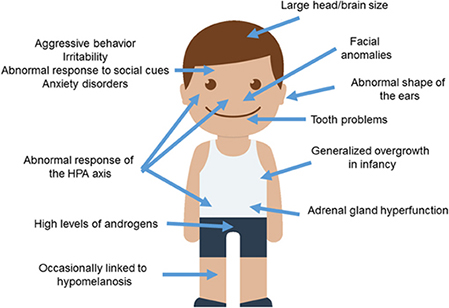
Autistic people, say BBL, are “undomesticated humans” – people in whom for some reason the neural crest changes that result in domesticated features have reversed. They find that some of the changes of domestication syndrome are the reverse of some of the symptoms of autism:

Smaller heads = autistic people have larger heads
More trusting and social = autistic people are less trusting and social
Spotted fur = the depigmenting disease “hypomelanosis of Ito” is sometimes associated with autistic symptoms
Floppy ears = studies find autistic people are more likely to have abnormally shaped ears (really!)
Change in adrenal response = autistic people have abnormal function in the HPA axis, the system including the adrenal gland

Or in the form of their cutesy picture:
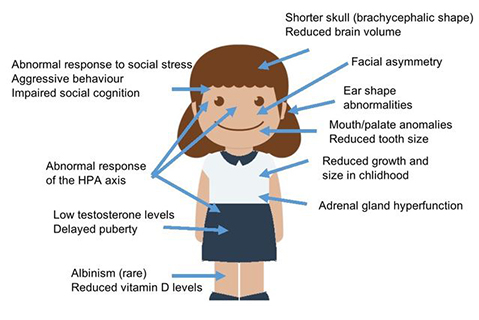
Schizophrenics, say BBL, are “hyperdomesticated humans”. Once again, they match up the symptoms:
I originally thought this theory was dumb. After looking into it more, I think it has some serious issues, but that there might be a core of truth.

II.

I’ll get to that core, but first, the argument against: all of this is coincidences, pareidolia, and finessing things to fit into a system where they don’t really belong.

Going down the list:

Smaller heads = autistic people have larger heads

Some studies find this is true. Others find that it isn’t. In any case, note a discrepancy between this claim and the schizophrenia version. BBL note smaller brains in schizophrenics (true) and shorter skull (true), but not smaller heads, which we would expect if autism were the “reverse” of schizophrenia. In fact, schizophrenics may have larger heads than healthy people. This sort of moving the goal-posts, where autistics are judged on their larger heads but schizophrenics on their smaller brains, is a red flag for fake pattern-matching.

More trusting and social = autistic people are less trusting and social

True! But schizophrenics are way less trusting and social! Paranoia – pathological inability to trust – is a classic symptom of schizophrenia; indeed, if you made people choose between schizophrenia and autism and asked which one was associated with lack of trust, I think most people would choose schizophrenia. This brings an important point into relief: the whole point of domestication is that the domesticated animal is supposed to be friendlier and less aggressive. But nobody would describe schizophrenics as friendlier and less aggressive.

Spotted fur = the depigmenting disease “hypomelanosis of Ito” is sometimes associated with autistic symptoms

True! But hypomelanosis of Ito is a really rare disease (1/10,000 births) that has nothing to do with most autism. Also, it causes eye problems, kidney cysts, weirdly-shaped chests, short stature, seizures, mental retardation, etc. To me this looks more like “a super-rare disease that can cause pretty much anything can sometimes also cause autistic symptoms”, which is not very interesting. Also, domestication causing “pigmentation changes” (usually spotted fur) versus autism being (very rarely) associated with a depigmenting disease and schizophrenia being (very rarely) associated with albinism is more goalpost-shifting.

Floppy ears = studies find autistic people are more likely to have abnormally shaped ears (really!)

I looked at this study – Manouilenko et al – and what it actually finds is that autistic people are more likely to have asymmetrical ears. In fact, nonsignificantly more likely to have asymmetrical ears; their significant finding is that autistic people have more “minor physical abnormalities”, and the asymmetrical ears were one of many pieces of evidence combined to get the significant finding. But asymmetrical features are common in lots of genetic/embryological diseases and seem like a general sign of high mutational load. It seems sketchy to combine autists’ asymmetrical ears and wild foxes’ pointy ears and say “Look, they both have ear abnormalities, this is the same thing!” Some other studies suggest that autistic people have low-set ears, which sounds more promising, but schizophrenic people also have low-set ears, so whatever. The other schizophrenia ear findings are exactly as unconvincing as the autistic ones.

Change in adrenal response = autistic people have abnormal function in the HPA axis, the system including the adrenal gland

Wikipedia’s page on the HPA axis has a section on its possible role in disease, which states that dysfunction of the axis is involved in various conditions “including anxiety disorder, bipolar disorder, insomnia, posttraumatic stress disorder, borderline personality disorder, ADHD, major depressive disorder, burnout, chronic fatigue syndrome, fibromyalgia, irritable bowel syndrome, and alcoholism”. In other words, in a list of the HPA axis’ twelve greatest hits, neither autism nor schizophrenia qualify for inclusion.

I’m not saying that there isn’t an HPA axis component to these diseases. I’m just saying HPA axis is a nonspecific finding. I’m agnostic whether the HPA axis causes everything or our HPA axis study methods are so bad that they invariably turn up false positives. The point is that we shouldn’t get too excited when we see the HPA axis involved in both domestication and autism. This is like saying “Cancer causes you to feel bad, and AIDS causes you to feel bad, therefore cancer causes AIDS.” No, it’s just that everything makes you feel bad.

When we look beyond the general claim of “abnormal function”, things get less clear. BBL say that domesticated animals have “reduced levels of stress hormones including adrenocorticoids, adrenocorticotropic hormone, cortisol, and corticosterone”. So their theory should predict that autistic people have increased stress hormones, and schizophrenics decreased, relative to typical people. Actually, it’s a mess; autistic people seem to have higher ACTH but lower cortisol; schizophrenia studies are conflicting but tend towards higher levels of both. Once again, they can support a general claim of “these conditions affect the same system”, but they can’t predict the direction of the effect. Also, every condition affects this system.

(if you’re wondering why we’re talking about cortisol levels in a theory about the adrenal medulla, well, so am I. Whatever.)

Finally, if by “undomesticated human” we mean something like an ape or Neanderthal, well, neither apes nor Neanderthals (as far as we know) display the symptoms of autism. They seem to be pretty social. They seem to be able to eat all kinds of stuff without trouble. They don’t seem bothered by sensory processing problems. For that matter, dogs and cattle and nth generation silver foxes, the most domesticated animals we’ve got, don’t seem very schizophrenic. I guess cows could just be hallucinating all the time and how would we know, but there doesn’t seem to be any evidence that they are.

So this is why I originally was not too big on this theory.

III.

But what about Williams Syndrome?

Benitez-Burraco and Lattanzi don’t mention Williams Syndrome (also called Williams-Beuren Syndrome) at all, which is crazy, because it sounds a thousand times more like a syndrome of hyperdomestication than either of the two conditions they examine (h/t Nicholas Wade and a random Reddit comment). Williams Syndrome is a rare condition (1/10,000 births) caused by the deletion of some genes on chromosome 7. There are three very interesting things about people with Williams Syndrome. Number one, they are really nice. Like if you meet someone with Williams Syndrome, you will think “This person clearly has a rare genetic disease that causes pathological levels of niceness as a symptom.” Number two, they are really trusting. An Atlantic article profiling the condition, What Happens When You Trust Too Much? describes special therapy for Williams Syndrome children where the therapist has to teach them, painfully and laboriously, how to distrust people. NPR calls it “essentially biologically impossible for kids [with Williams Syndrome] to distrust [people].” Number three, they talk all the time; the informal name for the condition is “cocktail personality syndrome”.

People with Williams Syndromes actually legitimately have short noses (compare to the short snout on domesticated foxes), smaller teeth (compare to smaller teeth in dogs vs. wolves), smaller brains, and “unusually shaped ears” (I can’t find anything more specific; I guess it’s too much to hope for that researchers actually describe the ears as “floppy”).

Also, somebody checked which gene was most different in dogs versus wolves, and they found it was WBSCR17. The WBS in the name stands for “Williams-Beuren Syndrome” because it’s been linked to the disorder. So there’s that.

So as far as I can tell there’s an amazingly good case for Williams Syndrome being linked to domestication. Williams Syndrome tends to cause severe mental retardation and death at an early age, but that’s probably because there are twenty-five totally different genes missing. Maybe a version that only deleted WBSCR17 would keep the behavioral and physiologic changes but not much else.

A lot of people suggest Williams’ Syndrome is “the opposite of autism”. I can only find three pieces of evidence for this. Number one, the obvious contrast with the love of social situations and high verbal skills. Number two, Williams Syndrome kids seem to be really good at face recognition, whereas autistic people are often worse at this. Number three, Williams’ Syndrome kids seem to be unusually bad at the puzzles and interlocking-mechanical-part type problems on which autistic people excel.

On the other hand, there are some reasons to think these conditions are not exact opposites. For one thing, autism is caused by a hideously complex interplay of thousands of genes and various environmental factors, but Williams Syndrome is a drop-dead simple “oops, we forgot part of this chromosome over here”. Williams Syndrome kids seem to have some of the same sensory sensitivities as autistic kids. And both groups usually suffer from mental retardation.

I think that Williams Syndrome establishes the possibility of a physiological social/trust system linked to domestication, the neural crest, and various other parts of embroygenesis. Once you admit the existence of such a system, it seems like autism probably involves some kind of damage to it – probably along with damage to a lot of other systems too. Schizophrenia is more of a stretch, but the overwhelming presence of distrust as a symptom makes the existence of a physiological social/trust system at least kind of interesting and relevant.

So maybe instead of saying that “autistic people are undomesticated humans” and “schizophrenics are hyperdomesticated humans”, we should say something like “there is a very subtle and hard-to-notice biological system that determines level of trust and sociability and which seems weirdly linked to ear and nose shape; autism, schizophrenia, and Williams Syndrome all affect that system in different ways.” Note that this doesn’t mean they’re “the same disease” or “opposite diseases”; the connection might be no deeper than the “connection” where heart attacks, atrial fibrillation, and getting stabbed in the chest all affect the heart. But they all hit the same system.

My take-home message from looking into all of this is that I was very silly for trying to learn about autism and schizophrenia without thinking about embryology. These are highly genetically-loaded diseases that present early in life and seem linked to teratogens and prenatal infections; of course they’re embryological! I had to take some embryology classes in medical school, and like everyone else I tuned them out because they seemed totally irrelevant to real clinical practice and mostly involved memorizing pointless trivia like “on day thirty-six and a half, the developing shmendroblast has transformed into a blexomere”. But if you want to know what causes secret connections between ear shape and level of social trust, embryology seems like the way to go. Autism and schizophrenia are hard to study because they seem to affect everything, yet nothing specifically enough to localize the condition. Maybe going back and thinking more embryologically could help pinpoint the particular systems involved.

Posted in Uncategorized | Tagged | 314 Comments