Albion’s Seed, Genotyped

Last year I reviewed Albion’s Seed, historian David Fischer’s work on the four great English migrations to America (and JayMan continues the story in his series on American Nations). These early migrations help explain modern regional patterns like why Massachusetts is so liberal or why Appalachia seems so backwards. As always, there’s the lingering question of how much of these patterns are cultural versus genetic versus gene-cultural interaction.

Now Han et al take this field high-tech with the publication of Clustering Of 770,000 Genomes Reveals Post-Colonial Population Structure Of North America (h/t gwern, werttrew)

The team looked at 770,000 genomes analyzed by the AncestryDNA company and used a technique called identity-by-descent to find recent common ancestors. Then they used some other techniques to divide them into natural clusters. This is what they got:

This is the European-settler-focused map – there’s another one focusing on immigrant groups lower down here

This is kind of beautiful. While not exactly matching Albion’s Seed, it at least clearly shows its New Englander and Pennsylvania Quaker migrations (more realistically the Germans who came along with the Quakers), with less distinct signals for Borderers and Virginians. It shows how they spread directly west from their place of origin in almost exactly the way American Nations predicted. It even confirms my own conjecture that the belt of Democrat voters along southern Michigan corresponds to an area of New Englander settlement there (see part III here, or search “linear distribution of blue”). And it confirms Razib Khan’s observation that the Mormons are just displaced New Englanders and that their various unusual demographic features make sense in that context.

My biggest confusion is in the Southern/Appalachian region. I think Fischer would have predicted two distinct strains: a Tidewater/Virginian population along the coasts, and a Borderer/Appalachian population centered in West Virginia and Kentucky. Instead there are three populations, all of which start along the Atlantic Coast and continue inland in about the same way. Assuming red/”Appalachian” is the Borderers, I don’t know if Fischer has a good explanation for the purple/”upland south” vs. gold/”lower south” distinction. Nor I do get understand why, if one of those two represent the Tidewater Virginians, they don’t seem to be in the Tidewater Virginia region (which here is inhabited mostly by Borderers). Maybe this has something to do with the Civil War, or with the growth of the DC suburbs?

(And I guess we still haven’t ruled out the maximally boring explanation that interbreeding is entirely geographic and north-south is a bigger distinction than east-west so we’re just seeing the country divided into five equal-sized latitudinal bands.)

Not exactly a confusion, but more a disappointment: this map doesn’t provide the confirmation I’d hoped for that Californians, Seattleites, and other “Left Coasters” are displaced New Englanders – which would complete the circle of “Liberal Democrats = Puritan/Quaker population subgroup”. It’s also disappointing how little data they have for the Mountain West in general; I don’t know if that’s because there weren’t enough people there to show up, or because they’re a mix of every genetic lineage and don’t fit into any of the clusters nicely.

Still, I find this a really elegant example of hard science confirming historical speculation. Thanks to everyone who brought it to my attention.

[EDIT: Jayman goes much more into depth on this]

Posted in Uncategorized | Tagged | 105 Comments

Notes From The Asilomar Conference On Beneficial AI

Last month I got to attend the Asilomar Conference on Beneficial AI. I tried to fight it off, saying I was totally unqualified to go to any AI-related conference. But the organizers assured me that it was an effort to bring together people from diverse fields to discuss risks ranging from technological unemployment to drones to superintelligence, and so it was totally okay that I’d never programmed anything more complicated than HELLO WORLD.

“Diverse fields” seems right. On the trip from San Francisco airport, my girlfriend and I shared a car with two computer science professors, the inventor of Ethereum, and a UN chemical weapons inspector. One of the computer science professors tried to make conversion by jokingly asking the weapons inspector if he’d ever argued with Saddam Hussein. “Yes,” said the inspector, not joking at all. The rest of the conference was even more interesting than that.

I spent the first night completely star-struck. Oh, that’s the founder of Skype. Oh, those are the people who made AlphaGo. Oh, that’s the guy who discovered the reason why the universe exists at all. This might have left me a little tongue-tied. How do you introduce yourself to eg David Chalmers? “Hey” seems insufficient for the gravity of the moment. “Hey, you’re David Chalmers!” doesn’t seem to communicate much he doesn’t already know. “Congratulations on being David Chalmers”, while proportionate, seems potentially awkward. I just don’t have an appropriate social script for this situation.

(the problem was resolved when Chalmers saw me staring at him, came up to me, and said “Hey, are you the guy who writes Slate Star Codex?”)

The conference policy discourages any kind of blow-by-blow description of who said what in order to prevent people from worrying about how what they say will be “reported” later on. But here are some general impressions I got from the talks and participants:

1. In part the conference was a coming-out party for AI safety research. One of the best received talks was about “breaking the taboo” on the subject, and mentioned a postdoc who had pursued his interest in it secretly lest his professor find out, only to learn later that his professor was also researching it secretly, lest everyone else find out.

The conference seemed like a (wildly successful) effort to contribute to the ongoing normalization of the subject. Offer people free food to spend a few days talking about autonomous weapons and biased algorithms and the menace of AlphaGo stealing jobs from hard-working human Go players, then sandwich an afternoon on superintelligence into the middle. Everyone could tell their friends they were going to hear about the poor unemployed Go players, and protest that they were only listening to Elon Musk talk about superintelligence because they happened to be in the area. The strategy worked. The conference attracted AI researchers so prestigious that even I had heard of them (including many who were publicly skeptical of superintelligence), and they all got to hear prestigious people call for “breaking the taboo” on AI safety research and get applauded. Then people talked about all of the lucrative grants they had gotten in the area. It did a great job of creating common knowledge that everyone agreed AI goal alignment research was valuable, in a way not entirely constrained by whether any such agreement actually existed.

2. Most of the economists there seemed pretty convinced that technological unemployment was real, important, and happening already. A few referred to Daron Acemoglu’s recent paper Robots And Jobs: Evidence From US Labor Markets, which says:

We estimate large and robust negative effects of robots on employment and wages. We show that commuting zones most affected by robots in the post-1990 era were on similar trends to others before 1990, and that the impact of robots is distinct and only weakly correlated with the prevalence of routine jobs, the impact of imports from China, and overall capital utilization. According to our estimates, each additional robot reduces employment by about seven workers, and one new robot per thousand workers reduces wages by 1.2 to 1.6 percent.

And apparently last year’s Nobel laureate Angus Deaton said that:

Globalisation for me seems to be not first-order harm and I find it very hard not to think about the billion people who have been dragged out of poverty as a result. I don’t think that globalisation is anywhere near the threat that robots are.

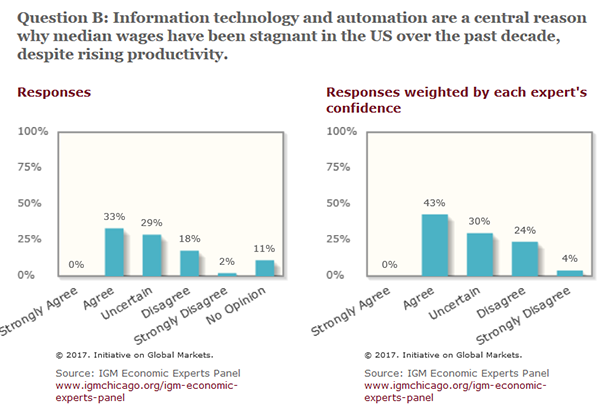
A friend reminded me that the kind of economists who go to AI conferences might be a biased sample, so I checked IGM’s Economic Expert Panel (now that I know about that I’m going to use it for everything):

It looks like economists are uncertain but lean towards supporting the theory, which really surprised me. I thought people were still talking about the Luddite fallacy and how it was impossible for new technology to increase unemployment because something something sewing machines something entire history of 19th and 20th centuries. I guess that’s changed.

I had heard the horse used as a counterexample to this before – ie the invention of the car put horses out of work, full stop, and now there are fewer of them. An economist at the conference added some meat to this story – the invention of the stirrup (which increased horse efficiency) and the railroad (which displaced the horse for long-range trips) increased the number of horses, but the invention of the car decreased it. This suggests that some kind of innovations might complement human labor and others replace it. So a pessimist could argue that the sewing machine (or whichever other past innovation) was more like the stirrup, but modern AIs will be more like the car.

3. A lot of people there were really optimistic that the solution to technological unemployment was to teach unemployed West Virginia truck drivers to code so they could participate in the AI revolution. I used to think this was a weird straw man occasionally trotted out by Freddie deBoer, but all these top economists were super enthusiastic about old white guys whose mill has fallen on hard times founding the next generation of nimble tech startups. I’m tempted to mock this, but maybe I shouldn’t – this From Coal To Code article says that the program has successfully rehabilitated Kentucky coal miners into Web developers. And I can’t think of a good argument why not – even from a biodeterminist perspective, nobody’s ever found that coal mining areas have lower IQ than anywhere else, so some of them ought to be potential web developers just like everywhere else. I still wanted to ask the panel “Given that 30-50% of kids fail high school algebra, how do you expect them to learn computer science?”, but by the time I had finished finding that statistic they had moved on to a different topic.

4. The cutting edge in AI goal alignment research is the idea of inverse reinforcement learning. Normal reinforcement learning is when you start with some value function (for example, “I want something that hits the target”) and use reinforcement to translate that into behavior (eg reinforcing things that come close to the target until the system learns to hit the target). Inverse reinforcement learning is when you start by looking at behavior and use it to determine some value function (for example, “that program keeps hitting that spot over there, I bet it’s targeting it for some reason”).

Since we can’t explain human ethics very clearly, maybe it would be easier to tell an inverse reinforcement learner to watch the stuff humans do and try to figure out what values we’re working off of – one obvious problem being that our values predict our actions much less than we might wish. Presumably this is solvable if we assume that our moral statements are also behavior worth learning from.

A more complicated problem: humans don’t have utility functions, and an AI that assumes we do might come up with some sort of monstrosity that predicts human behavior really well while not fitting our idea of morality at all. Formalizing what exactly humans do have and what exactly it means to approximate that thing might turn out to be an important problem here.

5. Related: a whole bunch of problems go away if AIs, instead of receiving rewards based on the state of the world, treat the reward signal as information about a reward function which they only imperfectly understand. For example, suppose an AI wants to maximize “human values”, but knows that it doesn’t really understand human values very well. Such an AI might try to learn things, and if the expected reward was high enough it might try to take actions in the world. But it wouldn’t (contra Omohundro) naturally resist being turned off, since it might believe the human turning it off understood human values better than it did and had some human-value-compliant reason for wanting it gone. This sort of AI also might not wirehead – it would have no reason to think that wireheading was the best way to learn about and fulfill human values.

The technical people at the conference seemed to think this idea of uncertainty about reward was technically possible, but would require a ground-up reimagining of reinforcement learning. If true, it would be a perfect example of what Nick Bostrom et al have been trying to convince people of since forever: there are good ideas to mitigate AI risk, but they have to be studied early so that they can be incorporated into the field early on.

6. AlphaGo has gotten much better since beating Lee Sedol and its creators are now trying to understand the idea of truly optimal play. I would have expected Go players to be pretty pissed about being made obsolete, but in fact they think of Go as a form of art and are awed and delighted to see it performed at superhuman levels.

More interesting for the rest of us, AlphaGo is playing moves and styles that all human masters had dismissed as stupid centuries ago. Human champion Ke Jie said that:

After humanity spent thousands of years improving our tactics, computers tell us that humans are completely wrong. I would go as far as to say not a single human has touched the edge of the truth of Go.

A couple of people talked about how the quest for “optimal Go” wasn’t just about one game, but about grading human communities. Here we have this group of brilliant people who have been competing against each other for centuries, gradually refining their techniques. Did they come pretty close to doing as well as merely human minds could manage? Or did non-intellectual factors – politics, conformity, getting trapped at local maxima – cause them to ignore big parts of possibility-space? Right now it’s very preliminarily looking like the latter, which would be a really interesting result – especially if it gets replicated once AIs take over other human fields.

One Go master said that he would have “slapped” a student for playing a strategy AlphaGo won with. Might we one day be able to do a play-by-play of Go history, finding out where human strategists went wrong, which avenues they closed unnecessarily, and what institutions and thought processes were most likely to tend towards the optimal play AlphaGo has determined? If so, maybe we could have have twenty or thirty years to apply the knowledge gained to our own fields before AIs take over those too.

7. People For The Ethical Treatment Of Reinforcement Learners got a couple of shout-outs, for some reason. One reinforcement learning expert pointed out that the problem was trivial, because of a theorem that program behavior wouldn’t be affected by global shifts in reinforcement levels (ie instead of going from +10 to -10, go from +30 to +10). I’m not sure if I’m understanding this right, or if this kind of trick would affect a program’s conscious experiences, or if anyone involved in this discussion is serious.

8. One theme that kept coming up was that most modern machine learning algorithms aren’t “transparent” – they can’t give reasons for their choices, and it’s difficult for humans to read them off of the connection weights that form their “brains”. This becomes especially awkward if you’re using the AI for something important. Imagine a future inmate asking why he was denied parole, and the answer being “nobody knows and it’s impossible to find out even in principle”. Even if the AI involved were generally accurate and could predict recidivism at superhuman levels, that’s a hard pill to swallow.

(DeepMind employs a Go master to help explain AlphaGo’s decisions back to its own programmers, which is probably a metaphor for something)

This problem scales with the size of the AI; a superintelligence whose decision-making process is completely opaque sounds pretty scary. This is the “treacherous turn” again; you can train an AI to learn human values, and you can observe it doing something that looks like following human values, but you can never “reach inside” and see what it’s “really thinking”. This could be pretty bad if what it’s really thinking is “I will lull the humans into a false sense of complacency until they give me more power”. There seem to be various teams working on the issue.

But I’m also interested in what it says about us. Are the neurons in our brain some kind of uniquely readable agent that is for some reason transparent to itself in a way other networks aren’t? Or should we follow Nisbett and Wilson in saying that our own brains are an impenetrable mass of edge weights just like everything else, and we’re forced to guess at the reasons motivating our own cognitive processes?

9. One discipline I shouldn’t have been so surprised to see represented at the multidisciplinary conference was politics. A lot of the political scientists and lawyers there focused on autonomous weapons, but some were thinking about AI arms races. If anyone gets close to superintelligence, we want to give them time to test it for safety before releasing it into the wild. But if two competing teams are equally close and there’s a big first-mover advantage (for example, first mover takes over the world), then both groups will probably skip the safety testing.

On an intranational level, this suggests a need for regulation; on an international one, it suggests a need for cooperation. The Asilomar attendees were mostly Americans and Europeans, and some of them were pretty well-connected in their respective governments. But we realized we didn’t have the same kind of contacts in the Chinese and Russian AI communities, which might help if we needed some kind of grassroots effort to defuse an AI arms race before it started. If anyone here is a Chinese or Russian AI scientist, or has contacts with Chinese or Russian AI scientists, please let me know and I can direct you to the appropriate people.

10. In the end we debated some principles to be added into a framework that would form a basis for creating a guideline to lay out a vision for ethical AI. Most of these were generic platitudes, like “we believe the benefits of AI should go to everybody”. There was a lunch session where we were supposed to discuss these and maybe change the wording and decide which ones we did and didn’t support.

There are lots of studies in psychology and neuroscience about what people’s senses do when presented with inadequate stimuli, like in a sensory deprivation tank. Usually they go haywire and hallucinate random things. I was reminded of this as I watched a bunch of geniuses debate generic platitudes. It was hilarious. I got the lowdown from a couple of friends who were all sitting at different tables, and everyone responded in different ways, from rolling their eyes at the project to getting really emotionally invested in it. My own table was moderated by a Harvard philosophy professor who obviously deserved it. He clearly and fluidly explained the moral principles behind each of the suggestions, encouraged us to debate them reasonably, and then led us to what seemed in hindsight the obviously correct answer. I had already read one of his books but I am planning to order more. Meanwhile according to my girlfriend other tables did everything short of come to blows.

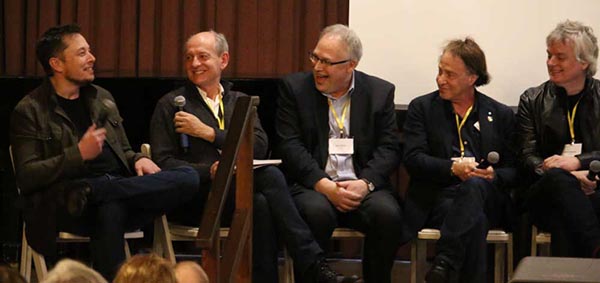
Overall it was an amazing experience and many thanks to the Future of Life Institute for putting on the conference and inviting me. Some pictures (not taken by me) below:

The conference center

The panel on superintelligence.

We passed this store on the way to the conference. I thought it was kabbalistically relevant to AI risk.

Posted in Uncategorized | Tagged | 480 Comments

[GUEST POST] The International Refugee Assistance Project

[This is a guest post by Elizabeth Van Nostrand of Aceso Under Glass.]

How do you judge the effectiveness of preparing for something that might never happen? Consider emergency room capacity; if you have enough space and staff to deal with a diphtheria epidemic, it will seem wasted during the 99% of the time there isn’t one. But this is false economy; during a crisis the extra reserve may be the difference between disruption and disaster.

Whatever the staff of the ACLU was doing on Friday morning, it wasn’t as important as what they did Friday afternoon, after Trump banned legal immigrants from reentering the country, even if they were in flight.  If you just evaluated the effectiveness of their Friday morning work, you’d miss that they were also holding the capacity to respond to Trump’s order as quickly as they did.  That speed mattered – not just to residents being badgered into giving up their green cards, but because it demonstrated to Trump and America that the consequences of violating the Constitution are severe and immediate. Once the crisis hit, it became easy to see how everything that went into preparing for it was high leverage – which was why people donated $20,000,000 over the weekend.

But the ACLU didn’t act alone. One partner was the International Refugee Assistance Project, founded by Becca Heller.  While in Jordan on an internship, Heller talked to Iraqi refugees there whose applications to emigrate to the US had been denied; they had given up because there was no way to appeal Homeland Security decisions. But rejected applicants can effectively appeal by asking that DHS “reconsider” their application. Using case law from asylum decisions, Becca filed requests to reconsider on behalf of these Iraqi refugees. Back home, she began recruiting other Yale law students, then students at other law schools. As her organization grew in scope,  it effected some at-the-margins policy work as well. A notable win here was using FOIA to force the DHS to release their refugee decision manual.  Last year IRAP received a grant from the Open Philanthropy Project to increase the extent of their policy work.

The majority of IRAP’s day to day work involves processing appeals for individual refugees whose requests to resettle in the U.S. were denied.  Their staff manages a team of volunteer law students and lawyers who pour hours into interviewing clients, investigating cases, collecting documents to prove refugee status, and writing appeals. This aspect of their work isn’t glamorous. It’s not arguing before the Supreme Court to establish rights people didn’t have a week before. It’s tracking down proof that someone is from the country they say they are, when 95% of record-keeping institutions in the country have been blown up and the procedure for getting a passport is to find Mr. Big Beard’s stall in the market and give him some money. It’s very ground-level work that makes an enormous difference in the lives of individual immigrants. But each person helped in this way represents the investment of many, many hours from lawyers and law students; if you were analyzing their effectiveness, they’d probably score poorly relative to AMF (especially if you included the value of in kind donations of time from skilled individuals). Where they did advocacy work, it was relatively quiet and uncontroversial.

And then Trump issued executive order “PROTECTING THE NATION FROM FOREIGN TERRORIST ENTRY INTO THE UNITED STATES”

Under American law, an arbitrary person can’t challenge a government policy or decision in court.  You have to have standing, meaning you personally are hurt by the action.  And to be represented by a lawyer, you have to say “I am represented by this lawyer,” which normally isn’t a problem, unless you’re being held incommunicado and no one knows where you are.  There are ways around this, but they’re time consuming.

IRAP’s ground level work meant that when Trump’s order went out, it took them approximately four seconds to create a list of extremely sympathetic/photogenic immigrants who would be caught at airports that day, for some of whom they were already the legal representative of record. It took another six seconds to find even more photogenic supporters of those immigrants who were willing to loudly support them in media interviews. Veterans are Not Fucking Around when it comes to their translators.

IRAP doesn’t have a long history of challenging the federal government the way the ACLU does.  But by partnering with the ACLU (with its very strong history of challenging the federal government), the National Immigration Law Center (extensive knowledge of immigration policy) and Yale Law School (I don’t know, cheap labor from students? Money?), they were able to launch the strongest possible campaign to force Trump to keep promises we made as a country.

Also, for someone whose organization spends most of its time on individual cases, Becca Heller sure is good at publicly nailing the government to the wall.  I want her on this team just so she can keep going on TV and talking over congresspeople who she deems insufficiently proactive.

Ultimately I think the part where Trump flat out ignored the judicial branch is more important than changes to immigration (although I would like to see us expand immigration), and the ACLU is best positioned to fight constitutional battles.  But the ACLU will need similar assistance from ground-level organizations for the next fight too, and they just got twenty million dollars. Yale Law School needs your money even less. IRAP, by contrast, has an annual budget of $2 million. I exhausted my charity budget at the beginning of the year on my personal cause area, Third World poverty, but my ability to continue giving is dependent on the United States having a functional government and economy. I am genuinely afraid Trump will destroy both of those. I’m donating $100 to IRAP to support the upcoming legal fight, and as a retroactive bonus for building this capacity before most of us knew how much it was needed.

I encourage others to donate to IRAP, or to find similar small charities doing ground level work.

Book Review: Eichmann In Jerusalem

[Content warning: Holocaust. This is a complicated and emotional subject and I make no claims to know much more than what I read in the book, nor to be 100% certain I am representing Arendt’s views faithfully.]

I.

For Holocaust Remembrance Day last week I read Hannah Arendt’s Eichmann In Jerusalem (h/t Ben Hoffman).

Adolf Eichmann organized the logistics of the Holocaust – helped get Jews into trains, helped get the trains to the right concentration camps. When Germany lost the war, he escaped to Argentina and lived under a fake name. The newly-formed state of Israel hunted him down, and in 1960 they kidnapped him and put him on trial in Jerusalem.

The Nuremberg Trials were led by an Allied force that wanted to stress that the Nazis committed crimes against all humanity. Eichmann’s trial was the first time Jews themselves tried a high-ranking Nazi for his crimes against Jews in particular. Israeli PM David Ben-Gurion wanted (and got) a show trial. Not in the sense of justice not being done (everyone agreed Eichmann was guilty), but in the sense of highlighting the horrors of the Holocaust to the world.

Arendt recorded a lot of weird, surprising, and disturbing things in her study of Eichmann’s trial. I found five particularly interesting: Eichmann’s psychological profile, the Nazis’ early pre-war plans for the Jews, the ways German-occupied nations did or didn’t resist genocide demands, the politics surrounding claims that Jews didn’t resist the Nazis enough, and the discussion of why more Germans didn’t protest. I want to discuss all of these, then finish with whether this has any relevance for today’s political climate.

II.

Arendt’s psychological profile of Eichmann is most famous for coining the phrase “banality of evil”. Eichmann was neither a charming psychopath nor a blustering villain. As per Arendt:

Despite all the efforts of the prosecution, everybody could see that this man was not a “monster,” but it was difficult indeed not to suspect that he was a clown. And since this suspicion would have been fatal to the whole enterprise, and was also rather hard to sustain, in view of the sufferings he and his like had caused so many millions of people, his worst clowneries were hardly noticed. What could you do with a man who first declared, with great emphasis, that the one thing he had learned in an ill-spent life was that one should never take an oath (“Today no man, no judge could ever persuade me to make a sworn statement. I refuse it; I refuse it for moral reasons. Since my experience tells me that if one is loyal to his oath, one day he has to take the consequences, I have made up my mind once and for all that no judge in the world or other authority will ever be capable of making me swear an oath, to give sworn testimony. I won’t do it voluntarily and no one will be able to force me”), and then, after being told explicitly that if he wished to testify in his own defense he might “do so under oath or without an oath,” declared without further ado that he would prefer to testify under oath?

Eichmann’s attorney, a somewhat incompetent German named Dr. Servatius, instructed him to plead innocent. Eichmann could have taken this advice and tried to save his skin. Or he could have taken the high road and confessed his guilt. He chose to do neither:

To each count Eichmann pleaded: “Not guilty in the sense of the indictment.” In what sense then did he think he was guilty?…”With the killing of Jews I had nothing to do. I never killed a Jew, or a non-Jew for that matter – I never killed any human being…I never gave an order to kill either a Jew or a non-Jew”…or, as he was later to qualify this statement, “It so happened…that I had not once to do it” – for he left no doubt that he would have killed his own father if he had received an order to that effect. Hence he repeated over and over…that he could only be accused of “aiding and abetting” the annhilation of the Jews, which he declared in Jerusalem to have been “one of the greatest crimes in the history of Humanity” […]

Would he then have pleaded guilty if he had been indicted as an accessory to murder? Perhaps, but he would have made important qualifications…He did not want to be one of those who now pretended that “they had always been against it”, whereas in fact they had been very eager to do what they were told to do. However, times change, and he, like Professor Maunz, had “arived at different insights”. What he had done he had done, he did not want to deny it; rather, he proposed “to hang myself in public as a warning example for all anti-Semites on this earth”. By this he did not mean to say that he regretted anything: “Repentance is for little children.” (sic) […]

Throughout the trial, Eichmann tried to clarify, mostly without success, this second point in his plea of “not guilty in the sense of the indictment.” The indictment implied not only that he had acted on purpose, which he did not deny, but out of base motives and in full knowledge of the criminal nature of his deeds. As for the base motives, he was perfectly sure that he was not what he called an innerer Schweinehund, a dirty bastard in the depths of his heart; and as for his conscience, he remembered perfectly well that he would have had a bad conscience only if he had not done what he had been ordered to to – to ship millions of men, women, and children to their death with great zeal and the most meticulous care. This, admittedly, was hard to take. Half a dozen psychiatrists had certified him as “normal” – “More normal, at any rate, than I am after having examined him,” one of them was said to have exclaimed.

Go ahead and try to parse all of that into a coherent worldview. Was he regretful? Was he proud? Was he anti-Semitic? Was he just following orders? I don’t think anyone at the trial ever got a good feel for this. I certainly didn’t. Arendt isn’t sure there’s anything there to figure out:

The judges were right when they finally told the accused that all he had said was “empty talk” – except that they thought the emptiness was feigned, and that the accused wished to cover up other thoughts which, though hideous, were not empty. This supposition seems refuted by the striking consistency with which Eichmann, despite his rather bad memory, repeated word for word the same stock phrases and self-invented clichés (when he did succeed in constructing a sentence of his own, he repeated it until it became a cliché) each time he referred to an incident or event of importance to him. Whether writing his memoirs in Argentina or in Jerusalem, whether speaking to the police examiner or to the court, what he said was always the same, expressed in the same words. The longer one listened to him, the more obvious it became that his inability to speak was closely connected with an inability to think, namely, to think from the standpoint of somebody else. No communication was possible with him, not because he lied but because he was surrounded by the most reliable of all safeguards against the words and the presence of others, and hence against reality as such.

But if she has any thesis at all, it’s that Eichmann believed in something larger than himself. We usually encourage this sort of thing, but I think the prosocial version involves having a specific larger-than-yourself thing in mind. Eichmann (says Arendt) just liked larger-than-himself things in general, and the Nazi vision of eternal struggle for racial supremacy was the biggest thing he could find in the vicinity. We’ll later see that he had a strange respect for Zionists, and this was because they too believed in something larger than themselves. Eichmann’s infamous cliches were the cliches of pomp and circumstance and glory and high words, the ones which made him feel like he was engaged in a great enterprise whether or not there was anything behind them. The reason he admitted neither to “just following orders”, nor to a deep personal belief in anti-Semitism, was that his loyalty to Hitler came from neither. When Hitler said to kill all the Jews, he gladly complied; if Hitler had said to kill all the Christians, he would have done that too. Not because he was a drone following orders to save his skin, but because he believed. Not in any of the specifics of Nazi ideology. Not even in Hitler’s personal judgment. Just in whatever was going on at the time.

And so when Eichmann’s superior Himmler betrayed Hitler (more on this later) and ordered Eichmann to stop the exterminations, Eichmann – finally – refused an order. Himmler’s betrayal seemed petty; Hitler’s vision seemed grand. And so:

The sad and very uncomfortable truth of the matter probably was that it was not his fanaticism but his very conscience that prompted Eichmann to adopt his uncompromising attitude during the last year of the war…Eichmann’s position, therefore, showed a most unpleasant resemblance to that of the often-cited soldier who, acting in a normal legal framework, refuses to carry out orders that run counter to his
ordinary experience of lawfulness and hence can be recognized by him as criminal.

But with Hitler dead and the war lost, the grandest gesture Eichmann can think of is to try to become a public martyr to edify future generations. So he tries that too.

Even understanding this, there’s another set of mysteries. Eichmann would get so many facts wrong in his testimonies that everyone would figure he was lying; then, without even being asked, he would confess to much worse sins than any of the ones he had denied (a big part of the prosecution’s case rested on Eichmann volunteering the information that he went into concentration camps a few times and saw exactly what happened there, something which otherwise would have been hard to prove and might have left space for an “I didn’t know how bad it was” defense). And he would talk obsessively about his failure to get promoted quickly enough through the Nazi hierarchy, clearly expecting his Israeli audience to sympathize with him:

What makes these pages of the examination so funny is that all this was told in the tone of someone who was sure of finding “normal, human” sympathy for a hard-luck story. “Whatever I prepared and planned, everything went wrong, my personal affairs as well as my years-long efforts to obtain land and soil for the Jews. I don’t know, everything was as if under an evil spell; whatever I desired and wanted and planned to do, fate prevented it somehow. I was frustrated in everything, no matter what.” When Captain Less asked his opinion on some damning and possibly lying evidence given by a former colonel of the S.S., he exclaimed, suddenly stuttering with rage: “I am very much surprised that this man could ever have been an S.S. Standartenführer, that surprises me very much indeed. It is altogether, altogether unthinkable. I don’t know what to say.” He never said these things in a spirit of defiance, as though he wanted, even now, to defend the standards by which he had lived in the past. The very words “S.S.,” or “career,” or “Himmler” (whom he always called by his long official title: Reichsführer S.S. and Chief of the German Police, although he by no means admired him) triggered in him a mechanism that had become completely unalterable. The presence of Captain Less, a Jew from Germany and unlikely in any case to think that members of the S.S. advanced in their careers through the exercise of high moral qualities, did not for a moment throw this mechanism out of gear

What should we make of this? Arendt described Eichmann as having an “almost total inability ever to look at anything from the other fellow’s point of view”, and this seems right. For him, self-absorbed as he was, the story of World War II was the story of him doing a pretty competent job of Jew-killing but not getting the recognition he deserved from his superiors. He was unable to understand that other people might have a different perspective, or that Israeli Holocaust survivors wouldn’t find his story about unfairness in Himmler’s HR department as moving as he did.

This might explain his pattern of omissions and confessions. He was omitting things that seemed bad to him – tied into his obsessions or made him look like a worse bureaucrat. But he didn’t have enough ability to model his Israeli interlocutors to know that “knew what happened at concentration camps” would seem bad to them, or else he didn’t even realize that “seems bad to the Israelis” was a thing.

This reminds me of my theory that some people are just born without certain cogs in their brain, and especially without theory of mind. Eichmann’s theory of mind was just totally absent. He expected the Jews he deported to be thankful to him for all the hard work he was putting in! The only way I can imagine that working is if Eichmann found his 9-5 job tiring and was so fantastically self-centered that he expected the Jews to see it exactly the same way he did (“Oh, look at that poor Eichmann working so hard to deal with us”). There are interesting implications here – that some level of theory of mind is necessary for basic consistency (ie realizing that other people will stop liking you if you’re inconsistent) and possibly for basic humanity (in order to not want to send people to concentration camps, you have to realize that they have their own thoughts and feelings about it separate from yours).

I should emphasize that some more recent scholars have dissented from Arendt at this point, saying that Eichmann’s apparent dullness and inconsistency was a careful ruse put on to fool his jailers. I don’t know nearly enough history to comment on this one way or the other. But in his last moments on Earth, he died as he lived – saying some faux-profound stock phrases without realizing how weird he sounded:

Adolf Eichmann went to the gallows with great dignity…He was in complete command of himself, nay, he was more: he was completely himself. Nothing could have demonstrated this more convincingly than the grotesque silliness of his last words. He began by stating emphatically that he was a Gottgläubiger, to express in common Nazi fashion that he was no Christian and did not believe in life after death. He then proceeded: “After a short while, gentlemen, we shall all meet again. Such is the fate of all men. Long live Germany, long live Argentina, long live Austria. I shall not forget them.” In the face of death, he had found the cliché used in funeral oratory. Under the gallows, his memory played him the last trick; he was “elated” and he forgot that this was his own funeral. It was as though in those last minutes he was summing up the lesson that this long course in human wickedness had taught us-the lesson of the fearsome, word-and-thought-defying banality of evil.

III.

I had always interpreted “the Final Solution” to mean “the solution that will last forever”. Arendt (and I don’t know if she’s right about this) interprets it to mean “the last of many solutions to be tried”. She discusses the failed First Solution and Second Solution as preludes for the eventual genocide.

The First Solution was emigration. In the early days of the movement, the Nazis seemed to sincerely believe that they could deal with the Jews just by expelling them from Germany and letting other countries take care of them, no killing necessary. I don’t want to let this sound like the Nazis “started out okay” – Hitler had expressed support for killing the Jews as early as the publication of Mein Kampf in 1925. But for his first few years in power, he distanced himself from his previous positions and accepted emigration as a practical compromise.

When the Nazis first decided to expel the Jews, Eichmann was working as a low-level vacuum salesman in Vienna. He got his big break when he signed up for a job with the Party trying to get Jews to emigrate. This was tough work – many Jews didn’t want to emigrate, and the ones who did needed more paperwork than the German bureaucracy could easily provide. Eichmann displayed some early talent at cutting red tape and figuring out ways to connect Jews who wanted to leave with bureaucrats who wanted to let them, and he rose through the ranks until he was in charge of Jewish emigration from Vienna.

At this point a friend suggested he read Theodor Herzl’s book on Zionism, and Eichmann, bizarrely, fell in love. Arendt says, apparently in earnest, that it “seems to have been the first serious book he ever read” and that “it made a lasting impression on him”:

It may be worth mentioning that, as late as 1939, he seems to have protested against desecrators of Herzl’s grave in Vienna, and there are reports of his presence in civilian clothes at the commemoration of the thirty-fifth anniversary of Herzl’s death…he began spreading the gospel among his SS comrades, giving lectures and writing pamphlets. He acquired a smattering of Hebrew, which enabled him to read haltingly a Yiddish newspaper – not a very difficult accomplishment, since Yiddish, basically an old German dialect written in Hebrew letters, can be understood by any German-speaking person who has mastered a few dozen Hebrew words. He even read one more book, Adolf Bohm’s History of Zionism, and this was perhaps a considerable achievement for a man who by his own account had always been utterly reluctant to read anything except newspapers.

Eichmann seemed weirdly in earnest about all of this, but it was also good for his job – he met with Zionist Jews and even went to Palestine once to meet with the Zionist movement there. He loved to say during his trial that Austrian Jewish immigration to Israel was a win-win – it made the Jews happy because they were going to their homeland, and it made the Nazis happy because the Jews were leaving Austria. When he related his self-perception as a basically decent person, he always stressed that this was his idea, and he was a win-win sort of person who had been unfairly transferred to the sending-people-in-boxcars-to-concentration-camps department against his will.

The work was not nearly as win-win as Eichmann liked to think; for example, the Nazis confiscated all of the Jews’ property as the “price” of providing them with the necessary documents. When poor Jews without any property showed up to emigrate, Eichmann would shake down the rich Jews and making them pay extra to help their poorer co-religionists. Finally this turned into outright blackmail, demanding blood money from Jews in the Diaspora, or else. In any case, it worked – a hundred fifty thousand Jews left Austria during Eichmann’s eighteen months in the business.

What eventually happened we all know too well. Other countries started closing their doors and refusing to accept Jewish refugees. Despite hearing this story a hundred times, the version in Eichmann in Jerusalem was new to me. I had always thought of countries as closing their gates to a few prescient people trying to flee Nazi Germany on their own, or to a few stragglers who managed to escape. The truth is on a much greater scale: the Nazis were willing to let every single Jew in Europe leave, they even had entire bureaucracies trying to make it happen – and the rest of the world wouldn’t cooperate. The blood on the hands of the people who wouldn’t let them in is not just that of a few escapees, but the entire six million.

When emigration stopped working, the Nazis turned to the Second Solution – resettlement. Arendt doesn’t think the plan to move all the Jews to Madagascar was ever taken seriously at the highest level, but for a while it was something like official policy. The only problems were that the Nazis didn’t technically own Madagascar, that they didn’t have nearly enough ships to transport six million people, and that all the water in between was controlled by British warships intent on sinking any Germans they could find. The send-the-Jews-to-Madagascar plan seemed to be a loose alliance of high-level leadership looking for a cover story while they prepared for genocide, plus very stupid people who liked bad ideas. No guessing which group Eichmann was in.

(Actually, Eichmann got super-confused and apparently thought Madagascar was the same place as Uganda, which Herzl had mentioned as a possible Jewish homeland if Israel was unavailable. He announced the good news to some of his Jewish contacts, who gave him a remedial lesson in African geography.)

There was a slightly more serious proposal to create a Jewish homeland in Radom District, Poland (note that “Jewish homeland” here meant basically a country-sized prison, not a self-governing Jewish state.) This had the advantages of the Nazis actually controlling Poland and of rail networks up to the task of transporting people over. It failed because some overly enthusiastic Nazis just sent a trainload of thousands of Jews there without informing the Governor of Poland, and he got confused and angry, plus a lot of the Jews escaped.

Then some people briefly tried to turn the Czech city of Theresienstadt into a Jewish territory, but it was really small and eventually it just ended up as a slightly-less-murderous-than-usual concentration camp.

IV.

Arendt interrupts the story of Eichmann for a long and fascinating digression about which European nations did or didn’t protect their Jews.

Remember that most nations of Central and Eastern Europe were German puppet states during this period. The Nazis made it clear that deporting their Jews to the concentration camps in Nazi territory was a condition for continued good relations; a serious threat, when bad relations could turn a protectorate-type situation into an outright invasion and occupation.

Pride of place goes to Denmark and Bulgaria, both of which resisted all Nazi demands despite the Germans having almost complete power over them. Most people have heard the legend of how, when the Germans ordered that all Jews must wear gold stars, the King of Denmark said he would wear one too. These kinds of actions weren’t just symbolic; without cooperation from the Gentile population and common knowledge of who was or wasn’t Jewish, the Nazis had no good way to round people up for concentration camps. Nothing happened until 1943, when Himmler became so annoyed that he sent his personal agent Rolf Gunther to clean things up. Gunther tried hard but found the going impossible. Danish police refused to go door-to-door rounding up Jews, and when Gunther imported police from Germany, the Danes told them that they couldn’t break into apartments or else they would arrest them for breaking and entering. Then the Danish police tipped off Danish Jews not to open their doors to knocks since those might be German police. When it became clear that the Nazis weren’t going to accept any more delays, Danish fishermen offered to ferry Jews to neutral Sweden for free. In the end the Nazis only got a few hundred Danish Jews, and the Danish government made such a “fuss” (Arendt’s word) about them that the Nazis agreed to send them all to Theresienstadt, their less-murderous-than-usual camp, and let Red Cross observers in to make sure they were treated well. As a result, only 48 Danish Jews died in the entire Holocaust.

Bulgaria’s resistance was less immediately heroic, and looked less like the king proudly proclaiming his identity with oppressed people everywhere than like the whole government just dragging their feet so long that nothing got done. Eichmann sent an agent named Theodor Dannecker to get them moving, but as per Arendt:

Not until about six months later did they take the first step in the direction of “radical” measures – the introduction of the Jewish badge. For the Nazis, even this turned out to be a great disappointment. In the first place, as they dutifully reported, the badge was only a “very little star”; second, most Jews simply did not wear it; and, third, those who did wear it received “so many manifestations of sympathy from the misled population that they actually are proud of their sign” – as Walter Schellenberg, Chief of Counterintelligence in the R.S.H.A., wrote in an S.D. report transmitted to the Foreign Office in November, 1942. Whereupon the Bulgarian government revoked the decree. Under great German pressure, the Bulgarian government finally decided to expel all Jews from Sofia to rural areas, but this measure was definitely not what the Germans demanded, since it dispersed the Jews instead of concentrating them.

The Bulgarians continued their policy of vaguely agreeing in principle to Nazi demands and then doing nothing, all the way until the Russians invaded and the time of danger was over. Not a single Bulgarian Jew died in the Holocaust (edit: see here).

Surprisingly given the bad associations I have with the word “fascist”, Mussolini’s Italy also deserves high praise for protecting its Jews. Arendt describes Italy as “sabotaging” the Final Solution within its borders despite nominal alliance with Germany:

The gentlemen of the Foreign Office could not do much about it, because they always met the same subtly veiled resistance, the same promises and the same failures to fulfill them. The sabotage was all the more infuriating as it was carried out openly, in an almost mocking manner. The promises were given by Mussolini himself or other high-ranking officials, and if the generals simply failed to fulfill them, Mussolini would make excuses for them on the ground of their “different intellectual formation”. Only occasionally would the Nazis be met with a flat refusal, as when General Roatta declared that it was “incompatible with the honor of the Italian Army” to deliver the Jews from Italian-occupied territory in Yugoslavia to the appropriate German authorities.

An element of farce had never been lacking even in Italy’s most serious efforts to adjust to its powerful friend and ally. When Mussolini, under German pressure, introduced anti-Jewish legislation in the late thirties he stipulated the usual exemptions – war veterans, Jews with high decorations, and the like – but he added one more category, namely, former members of the Fascist Party, together with their parents and grandparents, their wives and children and grandchildren. I know of no statistics relating to this matter, but the result must have been that the great majority of Italian Jews were exempted. There can hardly have been a Jewish family without at least one member in the Fascist Party, for this happened at a time when Jews, like other Italians, had been flocking for almost twenty years into the Fascist movement, since positions in the Civil Service were open only to members. And the few Jews who had objected to Fascism on principle, Socialists and Communists chiefly, were no longer in the country. Even convinced Italian anti-Semites seemed unable to take the thing seriously, and Roberto Farinacci, head of the Italian anti-Semitic movement, had a Jewish secretary in his employ…

What in Denmark was the result of an authentically political sense, an inbred comprehension of the requirements and responsibilities of citizenship and independence – “for the Danes . . . the Jewish question was a political and not a humanitarian question” (Leni Yahil) – was in Italy the outcome of the almost automatic general humanity of an old and civilized people.

Less happy is the story of France. The Germans realized that the Vichy French were attached to assimilated French Jews, so they started by demanding only those foreign Jews who had come to France as refugees. There were a hundred thousand of these, and Marshal Petain of France said that they had “always been a problem” and he was glad to have “an opportunity to get rid of them” (in his defense, he was under the impression that Jews sent to Germany would be “resettled in the East”). After this had been going on for a while, Eichmann figured that the French were on his side, and asked for permission to take the native French Jews as well. The French, having sent tens of thousands of stateless Jews to the concentration camps, were suddenly outraged that the Nazis would dare lift a finger against French Jews, and shut down the entire deportation program. I am sure the French count this as a moral victory nowadays, though it’s a very selective sort of morality.

Last place goes to Romania, which had been anti-Semitic since the beginning of time and was genuinely excited to have Nazi orders as an excuse to carry out their own worse impulses:

In Rumania even the S.S. were taken aback, and occasionally frightened, by the horrors of oldfashioned, spontaneous pogroms on a gigantic scale; they often intervened to save Jews from sheer butchery, so that the killing could be done in what, according to them, was a civilized way.

The Romanians started their own concentration camps to supplement the Nazis’, “more elaborate and atrocious affairs than anything we know of in Germany”, but they didn’t always need them – “deportation Rumanian style consisted in herding five thousand people into freight cars and letting them die there of suffocation while the train traveled through the countryside without plan or aim for days on end; a favorite followup to these killing operations was to expose the corpses in Jewish butcher shops.” Things became so bad that the local Nazi representative, German noble Manfred von Killinger, intervened and asked them to stop and defer to the Third Reich’s own efforts. I feel like when a Nazi named “Baron von Killinger” is horrified by your brutality, it’s time to take a step back and evaluate whether you may have crossed a line.

Other interesting profiles include Greece (hopelessly depressing), Slovakia (very Catholic, in favor of killing Jews but got in a bunch of fights with the Nazis about ethnic Jews who had been baptized into Catholicism), Hungary (ruled by an admiral despite being landlocked; otherwise hopelessly depressing), Belgium (deliberately left the trains unlocked so the Jews could escape!), Holland (kind of like France; the local Gentiles tried to help, but the assimilated Jews sold out the refugee Jews in the hope of placating the Nazis; the Nazis were not placated; three-quarters of Jews died), and Poland (I don’t even want to talk about how hopelessly depressing this one is).

V.

The Israeli authorities conducting the trial had an uncomfortable tendency to return to the idea of the European Jews as complicit in their own destruction.

The Nazis ordered Jewish communities to organize into Judenrate (“Jewish councils”) which could tabulate the number of Jews in their community, help confiscate property, and choose who would go first to the camps. Cooperation was ensured by a combination of special treatment for community leaders and threats of collective punishment if they didn’t comply. The special treatment turned out to be a sham (if the leaders were lucky, they were killed last); the collective punishment was all too real.

The community leaders thought they were negotiating themselves into a position where they would be better organized and could help delay the Nazis and steer them away from the most vulnerable parts of their community, mitigating the damage. This almost never happened; in the rare cases where it did, it was almost never worth it. Thousands of people were subjected to the sorts of heart-wrenching ethical dilemmas usually found only in philosophy lectures involving trolleys:

The greatest “idealist” Eichmann ever encountered among the Jews was Dr. Rudolf Kastner, with whom he negotiated during the Jewish deportations from Hungary and with whom he came to an agreement that he, Eichmann, would permit the “illegal” departure of a few thousand Jews to Palestine (the trains were in fact guarded by German police) in exchange for “quiet and order” in the camps from which hundreds of thousands were shipped to Auschwitz….Dr. Kastner saved exactly 1,684 people with approximately 476,000 victims.

By Arendt’s telling, sometimes the councils went beyond merely doing what was necessary for survival:

In Amsterdam as in Warsaw, in Berlin as in Budapest, Jewish officials could be trusted to compile the lists of persons and of their property, to secure money from the deportees to defray the expenses of their deportation and extermination, to keep track of vacated apartments, to supply police forces to help seize Jews and get them on trains, until, as a last gesture, they handed over the assets of the Jewish community in good order for final confiscation. They distributed the Yellow Star badges, and sometimes, as in Warsaw, “the sale of the armbands became a regular business; there were ordinary armbands of cloth and fancy plastic armbands which were washable.” In the Nazi-inspired, but not Nazi-dictated, manifestoes they issued, we still can sense how they enjoyed their new power – “The Central Jewish Council has been granted the right of absolute disposal over all Jewish spiritual and material wealth and over all Jewish manpower,” as the first announcement of the Budapest Council phrased it. We know how the Jewish officials felt when they became instruments of murder – like captains “whose ships were about to sink and who succeeded in bringing them safe to port by casting overboard a great part of their precious cargo”; like saviors who “with a hundred victims save a thousand people, with a thousand ten thousand.

This turned out to be important. Arendt gives the case of Belgium, where most of the Jews were a hodgepodge of refugees and most of the elders fled early. The Belgian Jews’ lack of organization didn’t hurt them; it just made them impossible to organize for deportation and extermination, and so more of them survived than in other comparable areas. And:

Wherever Jews lived, there were recognized Jewish leaders, and this leadership, almost without exception, cooperated in one way or another, for one reason or another, with the Nazis. The
whole truth was that if the Jewish people had really been unorganized and leaderless, there would have been chaos and plenty of misery but the total number of victims would hardly have been between four and a half and six million people. According to Freudiger’s calculations about half of them could have saved themselves if they had not followed the instructions of the Jewish Councils.

As comfortable as it would be to forget about all of this, the Israeli government had the opposite incentive. Their goal wasn’t just to broadcast the horrors of the Holocaust. It was to send the message that Jews who believed they were safe among Gentiles were fools, and Jews who wanted to negotiate and concede points in their conflicts with Gentiles were collaborators.

I was struck by Arendt’s psychological profile of the Israeli leadership. The year is 1960. David ben Gurion is seventy-four, near the end of a long life of military struggle. The Israeli leadership is still very much of the generation that survived World War II, the Israeli War of Independence, and the Holocaust. But they’re starting to realize that this will not always be true. The younger generation just attaining voting age doesn’t remember the Holocaust at all. Everyone knows their history, but not everybody knows it. And the people, maybe new immigrants from America, who didn’t go through the Holocaust, they start asking – do we really need a purely Jewish nation? Do we really have to be so hostile and suspicious of Gentiles all the time? Does the country have to be quite so heavily militarized? Maybe we should just be a normal peaceful friendly member of the community of nations a bit more?

And as Arendt tells it, Ben-Gurion and his colleagues felt like they had this driving duty to communicate the incommunicable truth that this was not going to work. They felt like this was an endlessly seductive position, that maybe they had been seduced by it themselves when they were younger, but that bitter experience had taught them that had to be rejected utterly. If they dwelt on the failures of the Jewish Councils of Europe a little too long, if maybe they were a little unfair to people who had lost in lose-lose ethical dilemmas, it was because they didn’t know how else to tell younger Jews not to let themselves be those people. I guess the active construction of a cultural payload of reflexive resistance bordering on paranoia, capable of being handed down to younger generations, helps explain a lot about Israeli history.

VI.

Arendt dwells on the obvious question: why didn’t people say no?

She had already given part of the answer. Some people did say no. The entire populations of Denmark and Bulgaria. Most of Italy. France, eventually, with prodding. Shouldn’t Germany have been filled with some of the same people?

She says no. At every point, she stressed how little genuine opposition Hitler had. It wasn’t just the Nazis’ sky-high approval rating. It was that even the people who hated the Nazis, loathed the Nazis, generally didn’t mention the Jewish genocide. Even the conspirators in the von Stauffenberg plot to assassinate Hitler were mostly angry that he was a bad commander and was probably going to lose. This opinion was at least within the Nazi Overton Window. That they should resist the Holocaust seems to barely have occurred to them.

One of the creepiest passages in the book described the Wannsee Conference. Hitler and Himmler and a few other highers-up had decided on the Final Solution; a policy change from forced emigration to extermination. They wanted to inform the civil service of their decision, but they expected trouble:

The problem was much more acute, however, with respect to the higher career men in the Civil Service, directly under the Ministers, for these men, the backbone of every government administration, were not easily replaceable, and Hitler had tolerated them, just as Adenauer was to tolerate them, unless they were compromised beyond salvation. Hence the undersecretaries and the legal and other experts in the various Ministries were frequently not even Party members, and Heydrich’s apprehensions about whether he would be able to enlist the active help of these people in mass murder were quite comprehensible. As Eichmann put it, Heydrich “expected the greatest difficulties.” Well, he could not have been more wrong.

The aim of the conference was to coordinate all efforts toward the implementation of the Final Solution. The discussion turned first on “complicated legal questions,” such as the treatment of half- and quarter-Jews – should they be killed or only sterilized? This was followed by a frank discussion of the “various types of possible solutions to the problem,” which meant the various methods of killing, and here, too, there was more than “happy agreement on the part of the participants”; the Final Solution was greeted with “extraordinary enthusiasm” by all present, and particularly by Dr. Wilhelm Stuckart, Undersecretary in the Ministry of the Interior, who was known to be rather reticent and hesitant in the face of “radical” Party measures, and was, according to Dr. Hans Globke’s testimony at Nuremberg, a staunch supporter of the Law. There were certain difficulties, however. Undersecretary Josef Bühler, second in command in the General Government in Poland, was dismayed at the prospect that Jews would be evacuated from the West to the East, because this meant more Jews in Poland, and he proposed that these evacuations be postponed and that “the Final Solution be started in the General Government, where no problems of transport existed.” The gentlemen from the Foreign Office appeared with their own carefully elaborated memorandum, expressing “the desires and ideas of the Foreign Office with respect to the total solution of the Jewish question in Europe,” to which nobody paid much attention. The main point, as Eichmann rightly noted, was that the members of the various branches of the Civil Service did not merely express opinions but made concrete propositions. The meeting lasted no more than an hour or an hour and a half, after which drinks were served and everybody had lunch – “a cozy little social gathering.”

There were occasional protests about killing Jews because it would get Germany in big trouble if they lost the war. This was discussed seriously, always with the point being made that the Allies would view it as a dire crime, never with anybody stopping to ask whether maybe the Allies were right.

By far the most successful movement in this direction, one I had never heard about before, was Musy’s meeting with Himmler. A few months before the war ended, some Jews in Switzerland happened to meet Jean-Marie Musy, one of Himmler’s childhood friends; they asked him to use his influence with the Nazi second-in-command to get him to stop killing Jews. Musy went to Germany and told Himmler that they both knew the Allies were winning the war, that he’d heard the Allies were really mad about the Holocaust, and that maybe if Himmler stopped the Holocaust he could get better treatment after the war. Himmler thought about it for a little bit, and he agreed. He ordered the gas chambers destroyed, he countermanded Hitler’s directive to kill as many Jews as possible before the Allies liberated the camps, and started transporting Jews out of Nazi territory by trains. Hitler heard about this and got enraged and ordered everybody to stop listening to Himmler. There was a brief period of confusion as the two highest-ranking Nazis gave opposite orders, and then the Allies liberated the concentration camps anyway and the point became moot. It wasn’t much. Himmler’s order probably saved a few tens of thousands of people, out of millions. But it was something. And there were countless smaller incidents like this. And they all shared one thing in common: they succeeded by appealing to Nazis’ self-interest, not to their conscience.

And so:

As Eichmann told it, the most potent factor in the soothing of his own conscience was the simple fact that he could see no one, no one at all, who actually was against the Final Solution.

And where this wasn’t true, people started developing consciences again. Nazi commanders who had been in Denmark for long enough started to go native. When Himmler’s agents came to crack down on Danish resistance, they found the local German officials somewhere between hesitant and actively obstructionist:

Politically and psychologically, the most interesting aspect of this incident is perhaps the role
played by the German authorities in Denmark, their obvious sabotage of orders from Berlin. It is the only case we know of in which the Nazis met with open native resistance, and the result seems to have been that those exposed to it changed their minds. They themselves apparently no longer looked upon the extermination of a whole people as a matter of course. They had met resistance based on principle, and their “toughness” had melted like butter in the sun, they had even been able to show a few timid beginnings of genuine courage.

And:

The same thing happened in Bulgaria as was to happen in Denmark a few months later – the local German officials became unsure of themselves and were no longer reliable.

VII.

Are there any lessons to be learned from all of this horror?

First, the refugee aspect of all of this is even more important than I thought. I said it before, but I think it bears more emphasis. The Western nations’ failure to accept refugees from Nazi Germany didn’t just kill a couple of Jews who made it out before the killing started. Germany started off perfectly willing to let every single Jew in Europe emigrate to any country that would take them. Nowhere would. This obviously doesn’t absolve the Nazis of any blame, but it sure doesn’t make the rest of the world look very good either.

Second, it’s worth remembering that the Final Solution was the Nazis’ third or fourth plan, not their first. Eichmann argued that this ought to humanize him; sure, he wanted Germany Judenfrei, but at least he had the decency to try to do it humanely before moving on to genocide. But even if he’s right, humanizing Nazis is a two-way street. The more human and comprehensible the Nazis’ evil becomes, the closer it gets to the lesser evils of our own day. White separatists complain that they are misrepresented; that they have no intention of killing anybody, that they just want to help everybody get the right to live separately among their own people. I accept that they believe that and that it is unfair to misrepresent them. But having acknowledged their position, the next step is to acknowledge that the Nazis seem to have genuinely believed that too. For a while.

I’ve written before on how the current crop of demagogues, as bad as they are, aren’t Literally Hitler. But this should be understood in context of Mussolini not being Literally Hitler, or even of the Nazis themselves not being Literally Hitler at the beginning. The cause for concern isn’t that anyone you can see on TV today is plotting a Fourth Reich. It’s that some common factor causes people who start out as only moderately objectionable to predictably become something much worse. And modern populists share a suspicious number of characteristics and policies with their WWII-era fascist analogues (though “fascist” is the wrong word here; remember that Mussolini’s Italy did a better job saving Jews than a lot of the supposed ‘good guys’), and one can rightly be afraid that they’re drawing from the same underlying natural kind.

This is exactly the sort of thing I should resist the urge to put here (source)

Third, at least during World War II conscience was a collective phenomenon. Why did some countries’ citizens cooperate almost universally with the Final Solution, while others resisted it at every turn? “Culture” is inadequate; there’s not much light between Danish and German culture, but the two countries acted in opposite ways. I’m tempted to credit single individuals; Hitler setting the tone for Germany vs. King Christian setting the tone for Denmark – but do people really respect their leaders that thoroughly? Or is this backwards causation; a country like Denmark would end up with a King like Christian, a country like Germany would elect a Fuhrer like Hitler? I don’t know. The alternative is to posit one of those chaotic networks where tiny differences in initial conditions can compound and lead to very different end states. Arendt herself offers little, beyond saying that Italy saved its Jews out of “the automatic general humanity of an old and civilized people”. Yeah, well, Japan was an old and civilized people too, and we know how that turned out. But what other possibilities are there? All I can think of is maybe looking into the pre-existing anti-Semitism level, but I don’t know if that just passes the explanatory buck.

Did you know the Intro Psych explanation of Asch’s conformity experiments gets them backwards? Although it’s true that in each experiment a few people would conform with majority opinion, the majority of subjects didn’t conform and stuck with the evidence of their own eyes. This is encouraging, but makes the international variation in behavior even more perplexing. Whatever the cause, despite some heroic individuals everywhere, the between-country variance was more important than the within-country variance.

Fourth, resistance worked. Not for the Jews, who generally had no good options. But for the Gentile population of occupied countries, absolutely. It didn’t need heroic martyrs willing to stand in front of Panzers Tiananmen-style. It just took a general attitude of annoying obstructionism. The Germans said “Give us a list of all the Jews in your country by next week,” and the police said “Oh, yeah, sure”, and then the next week the Germans asked where their list was, and the police said, “Sorry, we must have forgot.” When the attitude was so universal that the Nazis didn’t know who to punish, or didn’t dare punish everyone for fear of rebellion, they generally gave up.

This isn’t to trivialize anything. There were thousands of individuals who died horribly resisting the Nazis, often to no avail. But when whole countries and cultures decided to resist, it made a big difference.

Even more – and I think Arendt’s frequent repetition of this fact is entirely justified – it started to change the Nazis’ minds. The Nazi officials in Denmark and Bulgaria became just a little bit obstructionist themselves. Nothing spectacular. No throwing off their jackboots and joining the resistance. Just a very slight tendency to question what was going on and ask “Are we the baddies?”

Just as humanizing the Nazis is a two-way street, so pointing out the bizarre lack of dissent in Nazi Germany is both distressing and encouraging. Distressing because – how could ordinary humans tolerate that? But encouraging because – well, it seems almost possible to imagine a world where something goes wrong and America ends up overtly fascist. Yet even in my worst nightmares I can’t imagine a world where America ends up overtly fascist and nobody is annoying and obstructionist about it. Arendt’s picture of Germany, where the ruling party has 90% approval and dissent is unthinkable – you can’t get there from here. We’re never unanimous about anything.

I thank G-d for the annoying obstructionists, for the nitpickers, for the devil’s advocates, for the people who hear something that’s obviously true and strain to come up with an absurd thought experiment where it might not be, for the reflexive contrarians, for the people who always vote third party, for the people who urge you to sign petitions on whitehouse.gov because “then the President has to respond”, for the people who have two hundred guns in their basement “just in case”, for the people who say “well, actually…” all the time, for the mayors of sanctuary cities and the clerks who refuse to perform gay weddings, for the people who think being banned on Twitter is a violation of their human rights, and for the people who swear eternal hostility to other people on the same side who agree with them on 99% of everything. On the spectrum from “totally ungovernable” to “vulnerable to Nazism”, I think that we’ve erred in the right direction.


Link: Taubes Contra Guyenet on Sugar

On Thursday I linked to Stephan Guyenet’s negative book review of Gary Taubes’ work on sugar.

Taubes asked that I pass on a counterargument he’s been working on for a while. In early January, he posted a short version of his case against sugar to Cato Unbound. It got three response essays – one by Terence Kealy, one by Yoni Freedhoff, and one by Stephan Guyenet, where he made some of the same points as in the linked article.

So now Taubes has now posted a response, The Case Against Sugar Isn’t So Easily Dismissed.

All of the essays are interesting and informative, and everyone involved deserves praise for some high-level debate that’s helped me clarify my thinking on this.

Posted in Uncategorized | Tagged | 21 Comments

Dogs And Wolves: In Defense Of Some Past Posts

Now that Trump has started enacting his terrible policies, a bunch of people on Twitter are saying that my past posts on Trump “haven’t aged well” or that I must be feeling really bad about them right now.

I’ve never been the slightest bit of a Trump supporter. Since he came onto the national stage, I have called Trump “a bad president”, “randomly and bizarrely terrible”, “an emotionally incontinent reality TV show host”, and “an incompetent thin-skinned ignorant boorish fraudulent omnihypocritical demagogue”. I’ve accused him of “bizarre, divisive, ill-advised, and revolting” rhetoric, worried that his election might “lead directly to the apocalypse [or] the fall of American democracy”, and called his administration “a disaster”. I’ve urged blog readers to vote for literally anyone except him and to donate money to the ACLU to stop him. If you want to accuse me of being pro-Trump, or even lukewarm on disliking Trump, I don’t know what else to tell you.

But I still seem to be getting flak on two points.

First, in Against Dog-Whistleism, I condemned the practice of overinterpreting candidates’ statements to secretly reveal evil beliefs and policies that they support more strongly than their stated platform:

Although dog whistles do exist…politicians’ beliefs and plans are best predicted by what they say their beliefs and plans are, or possibly what beliefs and plans they’ve supported in the past, or by anything other than treating their words as a secret code and trying to use them to infer that their real beliefs and plans are diametrically opposite the beliefs and plans they keep insisting that they hold and have practiced for their entire lives.

Believers in dog whistles are saying I have egg on my face because Trump just passed a law banning immigrants from some Muslim countries. Clearly, (they say) this means we should have listened to his dog whistles all along.

But this is dead wrong. Trump openly said throughout his campaign that he planned to ban immigrants from some Muslim countries. See for example Bloomberg, June 25: Trump Says Muslim Ban Plan To Focus On ‘Terrorist’ Countries. Trump has been saying this openly for seven months. If you didn’t know Trump wanted this, it’s not because he was being cryptic about it. It was because you were too busy chasing down his “dog whistles” about how he secretly hated Jews to listen to him.

Second, people are saying that my post You Are Still Crying Wolf has been debunked, since Trump has banned immigrants from some Muslim countries, and so is obviously the KKK-loving white supremacist that I argued he wasn’t.

Look, guys. I specifically said in that post that I knew he was going to ban people from some Muslim countries, and that when he did, that would be consistent with my model:

13. Doesn’t Trump want to ban (or “extreme vet”, or whatever) Muslims entering the country?

Yes, and this is awful.

But why do he (and his supporters) want to ban/vet Muslims, and not Hindus or Kenyans, even though most Muslims are white(ish) and most Hindus and Kenyans aren’t? Trump and his supporters are concerned about terrorism, probably since the San Bernardino shooting and Pulse nightclub massacre dominated headlines this election season.

You can argue that he and his supporters are biased for caring more about terrorism than about furniture-related injuries, which kill several times more Americans than terrorists do each year. But do you see how there’s a difference between “cognitive bias that makes you unreasonably afraid” versus “white supremacy”?

I agree that this is getting into murky territory and that a better answer here would be to deconstruct the word “racism” into a lot of very heterogenous parts, one of which means exactly this sort of thing. But as I pointed out in Part 4, a lot of these accusations shy away from the word “racism” precisely because it’s an ambiguous thing with many heterogenous parts, some of which are understandable and resemble the sort of thing normal-but-flawed human beings might think. Now they say “KKK white nationalism” or “overt white supremacy”. These terms are powerful exactly because they do not permit the gradations of meaning which this subject demands.

Let me say this for the millionth time. I’m not saying Trump doesn’t have some racist attitudes and policies. I am saying that talk of “entire campaign built around white supremacy” and “the white power candidate” is deliberate and dangerous exaggeration. Lots of people (and not just whites!) are hasty to generalize from “ISIS is scary” to “I am scared of all Muslims”. This needs to be called out and fought, but it needs to be done in an understanding way, not with cries of “KKK WHITE SUPREMACY!”

Apparently saying it a million times is not enough for some people. I’m afraid there’s a mood affiliation effect going on here – that if I say Trump didn’t cause 9-11, then people can only hear “SCOTT SAYS TRUMP ISN’T THAT BAD!”. Arguments aren’t soldiers, and Trump can both not cause 9-11 and be bad for lots of other reasons.

So I stick to what I’ve said before. Trump is a bad person, a bad president, and probably a disaster for America and the world. If you want to know what Trump is going to do, you should listen to what he specifically says he is going to do, and then expect things vaguely in that direction except worse. Trump’s policies are often motivated by racism of the everyday bias-towards-being-more-scared-of-terrorists-than-the-situation-warrants sort, but he does not have an ideological belief in white supremacy or take marching orders from the KKK. If you want to fight him, I recommend you fight him, not subtweet bloggers who warned you this was going to happen and then told you not to exaggerate it because reality was going to be scary enough.

I made predictions about how the Trump administration would go, which you can find on the Predictions tab above. If you disagree with me about any of this, use your beliefs to make different predictions, record them, and see if you do better than I do. Do enough better and I’ll admit I was wrong and you were right.

But if you tell me on Twitter I’m wrong because my model of Trump could never predict the things I specifically predicted when laying out the model, I’m not going to pay very much attention to you.

Posted in Uncategorized | Tagged , | 716 Comments

OT68: Necronomicomment

This is the bi-weekly visible open thread. There are hidden threads every few days here. Post about anything you want, ask random questions, whatever. Also:

1. Arbital has made an interactive page with my 2017 predictions where you can add your own guesses and automatically get graded and compared to everyone else at the end of the year. Try it!

2. A while ago, I tried to predict various aspects of the Trump administration and made bets with a couple of readers. Trump has now mostly finished picking his cabinet, and depending on how you count it’s 13%-14% minority. I made my 90% bet (it would be at least 10% minority) but failed my 70% bet (at least 20%) and my 30% bet (at least 30%). I think I might owe money to someone, but I can’t remember who. Send me an email about it and I’ll pay up.

3. Speaking of Trump, I agree with Aceso Under Glass’ thoughts on his latest actions, and if you feel like donating to the ACLU now might be a good time.

4. Comment of the week is Vidur Kapur on studies of saturated fat and the Mediterranean Diet.

Posted in Uncategorized | Tagged | 1,093 Comments

Link: Guyenet On Taubes

If you’re interested in diet, I recommend Stephan Guyenet’s review of Gary Taubes new book:

The Case Against Sugar is a journey through sugar history and science that argues the point that sugar is the principal cause of obesity, diabetes, coronary heart disease, and many other common noncommunicable diseases. This differs from the prevailing view in the research and public health communities that obesity and noncommunicable disease are multi-factorial, with refined sugar playing a role among other things like excess calorie intake, physical inactivity, cigarette smoking, alcohol and illegal drug use, and various other diet and lifestyle factors. I side with the latter view.

Some key quotes:

Taubes argues that sugar is the only factor that reliably shows up when a culture develops Western noncommunicable diseases, supporting the point with examples of cultures that adopted sugar-rich diets and became ill. Yet he makes no effort to look for a counterexample that could refute his argument: a traditionally-living culture that has a high intake of sugar and does not suffer from Western noncommunicable diseases. If such a culture can be found, this piece of evidence is sufficient to reject Taubes’s argument that sugar reliably associates with the onset of these diseases in a population. Let’s do Taubes’s research for him. A well-studied Tanzanian hunter-gatherer tribe called the Hadza gets 15 percent of its average year-round calorie intake from honey, plus fruit sugar on top of it. This approximates US sugar intake, yet the Hadza do not exhibit obesity, cardiovascular disease, or any of the other disorders Taubes attributes to sugar. In fact, many hunter-gatherer groups relied heavily on honey historically, including the Mbuti of the Congo whose diet was up to 80 percent honey during the rainy season. Yet they do not exhibit obesity or insulin resistance.

And:

Taubes upbraids the research community for its belief that body fatness is determined by calorie intake, rather than the impact of foods on insulin. He supports the latter proposition with semi-anecdotal observations from Africa suggesting that a group of people eating a high-sugar diet supplying “as little as sixteen hundred calories per day” were sometimes obese and diabetic. A person who actually wants to get to the bottom of this question should conduct their investigation in a very different manner. The first order of business is to look up the relevant metabolic ward studies, which are the most tightly controlled diet studies available. These studies consistently show that calorie content is the only known food property that has a meaningful impact on body fatness. This is true across a wide range of carbohydrate-to-fat ratios and sugar intakes, and a correspondingly wide range of insulin levels. What makes Taubes’s oversight so extraordinary is that he was involved in funding one of these metabolic ward studies, which compared two diets that differed tenfold in sugar content. The results showed that a 25 percent sugar, high-carbohydrate diet caused slightly more body fat loss than a 2.5 percent, very-low-carbohydrate (ketogenic) diet of equal calories (18). Despite these clear and consistent findings, Taubes continues to insist that calorie intake is not an important determinant of body fatness, and he offers the reader questionable evidence in support of this while omitting high-quality evidence to the contrary. All while exuding righteous indignation about the scientific community’s misguided beliefs.

And:

His discussion of the history of research on sugar, fat, and obesity is less compelling due to its one-sided nature. For example, The Case Against Sugar portrays an epic struggle decades ago between researchers who believed that saturated fat was the primary cause of coronary heart disease, and those who believed that sugar was. These views are embodied by the American researcher Ancel Keys and the British researcher John Yudkin, respectively. Taubes makes hay of the fact that Keys was supported in part by the sugar industry, painting Yudkin as a righteous underdog standing up to a corrupt and aggressive Keys. Yet he never gives serious consideration to the strength of the evidence supporting each man’s beliefs, instead using a historical narrative to imply that Keys was a stooge of the sugar industry who unfairly won the argument due to his sharp elbows (whether or not this is true, it’s also true that Yudkin’s evidence was not as compelling as Keys’s). This tactic of using historical narratives as a substitute for evidence is one that recurs throughout the book. In his haste to undermine Keys, Taubes neglects to mention that Yudkin had his own conflicts of interest: he was funded by the egg, edible oil, and dairy industries, all of which had an interest in pinning the blame for obesity and chronic disease on sugar

(I made the same point as that last one here.)

I’m recommending this review more strongly than usual because I’ve previously praised Taubes. He did a good job explaining how the pop wisdom of the ’90s – that fat was uniquely bad – wasn’t true. He did a good job showing the ways in which the old “just diet and exercise, nothing can go wrong” idea was simplistic and needed to be replaced with a good understanding of obesity set points. I learned some useful things from his books and I had positive feelings about him.

But from the first time I talked about him almost five years ago, I’ve stressed that his views about sugar are really, really wrong. I was previously willing to excuse this on the grounds that he wrote about a lot of other useful things and everybody’s allowed a bit of crazy speculation once in a while before a field is completely settled. But at this point things seem pretty settled and I no longer think his behavior is excusable. The ’90s are over, the pop wisdom that Taubes set out to debunk is sufficiently debunked, and he’s doubling down on his sugar theory despite an increasing pile of evidence against it.

I apologize if my past praise for Taubes’ writing have helped create a climate where people listen to his theories. His good qualities aren’t enough to justify the increasing amount of misinformation he’s putting out, and I don’t recommend him on any level as a source of nutritional advice.

Posted in Uncategorized | Tagged | 155 Comments

Links 1/17: Inaugurl Address

Dave Barry’s 2016 Year In Review.

“Fanatics got into the Capitol building and committed a mass shooting on Congress while it was in session, and you’ve never heard of them…people have completely forgotten that in 1972 we had over nineteen hundred domestic bombings in the United States” A review of Days Of Rage and history lesson on the 1970s underground. Highly recommended.

Jewish sci-fi short story: On Venus, Have We Got A Rabbi, by Philip Klass.

New Yorker: The Mosul Dam in Iraq could fail soon, potentially causing a flash flood and hundreds of thousands of deaths.

An ecologist denounces calls to “drain the swamp” as an insult to swamps: “Given the sea of misinformation we currently find ourselves swimming in, I feel this is as good a time as any to clarify what swamps actually are and why they should be regarded as wonderful and valuable parts of nature rather than objects of derision and hatred.” If any of you are oceanographers, can you troll the Washington Post for me by denouncing their use of the term “sea of misinformation”?

The Seasteading Institute announces a deal with French Polynesia to build the first seastead in a lagoon there. I’m still confused on whether they’ve got funding or anything else besides the location. Still a big step.

80,000 Hours’ guide to what charities to give to this season. A good supplement to GiveWell’s Top Charities list

Vox: Why the war on poverty failed, and what to do now. In the form of a long and detailed history of Brooklyn’s Bedford-Stuyveysant neighborhood. Not clear that anyone actually knows what to do now beyond a few good common-sense suggestions.

Some towns have tried to help the environment by banning plastic bags. But the state of Michigan will have none of this, and has banned banning plastic bags. I think Congress should strike a blow for local governments’ rights by banning banning banning plastic bags.

Andrew Gelman attacks the claim that North Carolina is no longer a democracy (original blog post, Slate article, response to counterargument).

RIP utilitarian philosopher Derek Parfit: “When I believed the non-reductionist view [of personal identity], I also cared more about my inevitable death. After my death, there will [be] no one living who will be me. I can now redescribe this fact. Though there will later be many experiences, none of these experiences will be connected to my present experiences by chains of such direct connections as those involved in experience-memory, or in the carrying out of an earlier intention. Some of these future experiences may be related to my present experiences in less direct ways. There will later be some memories about my life. And there may later be thoughts that are influenced by mine, or things done as the result of my advice. My death will break the more direct relations between my present experiences and future experiences, but it will not break various other relations. This is all there is to the fact that there will be no one living who will be me. Now that I have seen this, my death seems to me less bad.”

Alex K. Chen on Quora on the speculation that Ritalin may be long-term safer than Adderall. See also this review article. This is definitely not yet psychiatric common knowledge or consensus.

Man shoots guy with swastika tattoo at protest; victim turns out to be antifascist whose tattoo was a swastika in a crossed-out-circle similar to the no-smoking sign; crossed-out-circle apparently less visible than he would have liked. This is probably a metaphor for life. (possibly not true/incomplete, see here

A recent graph that showed how many nukes each country had provoked some confusion by showing “Jeff” as having nuclear weapons. Was this a mistake or joke? According to the Reddit thread Who The Hell Is Jeff, it’s actually the Joint Evaluated Fission And Fusion File, an international organization that studies nuclear energy and borrowed a couple of nukes to do tests on. I wonder how many forms you have to fill out for that.

Meta-analysis in the American Journal Of Nutrition: Red meat does not increase risk of cardiovascular disease.

Marginal Revolution on libertarian childrens books, mostly notable for this story about libertarian kids traveling to the beach called The Tuttle Twins And The Road To Surfdom. I find it funny/fitting that (as per Amazon) “this book is only available from third-party sellers”. But if you prefer your libertarianism-related childrens books with a sea-related theme to come down against the ideology, there’s also Nathan Robinson’s Libertarian Island.

Pigeons As Trainable Observers Of Pathology And Radiology Breast Cancer Images should delight behaviorists and worry radiologists.

“From an outside view, looking in at the Earth, if you noticed that human beings were about to replace themselves as the most intelligent agents on the planet, would you think it unreasonable if 1% of their effort were being spent explicitly reasoning about that transition? How about 0.1%?” – Time To Spend More Than 0.00001% Of World GDP On Human-Level AI Alignment. I like this essay, but I also worry that framing things as percent of global GDP is easy to abuse. Don’t you think it’s time to spend more than 0.00001% of GDP rewarding bloggers who make important points about keeping numbers in perspective?

Tom Pepinsky: Everyday Authoritarianism Is Boring And Tolerable. The average dictatorship isn’t Stalinist Russia or Nazi Germany. It’s relatively stable and most people have normal lives. There are probably elections that seem free and fair if you don’t look too closely. You can probably criticize the government as long as you’re not important or you don’t have an audience. I think this is a really important article. First, because it explains some things I’d never really understood – like how come you keep hearing about authoritarian regimes cracking down on dissidents in a way that implied they weren’t doing that before. And second, it’s important to anyone who wants to watch for and resist authoritarianism, since it’s not going to look the way you expect it to look and it might be easier to miss than you think.

This paper tries to fight the idea of microaggressions by saying that it implies certain testable claims and that those claims are false. I appreciate the effort but I’m not sure that the people who use the term are implying any testable claims, and I worry about scientific studies attempting to disprove the existence of political concepts. It seems too easy to show that other controversial topics like “political correctness” or “structural racism” or whatever don’t fit some list of things you claim they should fit and therefore “aren’t real”. I do think it’s important to challenge these kinds of concepts sometimes, and I do think facts about them established in scientific papers are important parts of that challenge, but I’m not sure it’s right for the scientific literature to be the place where these sorts of battles are fought.

Congratulations to the city of San Diego for losing the San Diego Chargers instead of giving into their demand for $600 million in public subsidies.

Last year I argued that $600 EpiPens didn’t mean the government should price-control drugs, they meant that we needed more competition in the EpiPen market. Now CVS is producing a competing EpiPen for only $110. Still illegal to give for a normally-written EpiPen prescription, though, so remind your doctor to write for “adrenaline autoinjector”.

Agora Project is an attempt to create a new kind of forum with branching and rejoining discussion topics.

Acemoglu and Restropo: Economic stagnation is not due to aging populations.

New York Times: Can You Draw Obama’s Legacy?. Finish line graphs showing how crime, unemployment, etc changed during Obama’s terms.

Size (and most comparable animal) of neural networks over time.

China scraps construction on 85 coal power plants.

Study: no link between gut flora, mental illness

Popehat on Trump’s defamation cases: “Put another way, it is a matter of judicial record that the new President of the United States is habitually full of shit. This is optimal for a defamation defense, if perhaps not for America.”

User dogtasteslikechicken at the r/slatestarcodex subreddit gives a good summary of the Flynn Effect. But it looks like he is confused about some of the same things I am. For example, rich people and the nobility probably had good nutrition and education in the past. So we might expect a Flynn effect based on nutrition and education not to affect them as much. But if this were true, we would expect a skewed or bimodal distribution in the past (un-Flynned poor people with bad nutrition + Flynned rich people with good nutrition), which I don’t think ever clearly showed up.

Some fallout from the Buzzfeed story on growth mindset I linked last week. The Spectator published what I think is a really nasty and evidence-free denunciation of the phenomenon. Mindset researcher David Yeager has tried to set the record straight and argues that growth mindset actually replicates just fine, eg in this paper, and that several other large and rigorous replications are being attempted. Dweck herself has a reply up here. And Timothy Bates put his failed replications online here. Looks like it will be an interesting year in this field.

Obama attempted to get everyone out of Guanatanmo before the end of his term, but wasn’t able to make the deadline.

Ferrett on how online fetish site FetLife has been forced to remove some controversial fetish material under threat from online payment processors not to accept transactions regarding his site. I think online payment processors are an underappreciated threat to free speech compared to eg Trump, political correctness, etc – they’ve also been harassing the nootropics community and making it really difficult to sell otherwise-legal chemicals. Bitcoin is apparently so rarely-used that a lot of businesses wouldn’t be profitable if they had to go Bitcoin only; anyone who can figure out a nonjudgmental way to send money online would have quite the business opportunity, not to mention the thanks of a grateful Internet. (but see response here)

Stuart Ritchie reviews Keith Stanovich’s The Rationality Quotient, notes that his “rationality quotient” correlates at 0.695 with normal IQ. Stanovichian rationality is probably not a great answer to the timeless “why do smart people sometimes think such stupid things” question. (but see response here)

Objects designed by AI look organic and alien.

Los Angeles Times: claims that Obama deported far more people than any other president are based on a change in how people returned to Mexico after being apprehended crossing the border got reported; previously these were not counted as deportations, and during the Obama administration they were. Adjusting for this, Obama deported fewer immigrants than other recent presidents.

A picture of The Lucky Knot Bridge in China.

The best explanation I’ve heard for why people believe the Russians were behind the DNC hacks (warning: hard-to-follow Tweet thread). Short version: the hackers made a mistake that let investigators see who else they had hacked in the same way; the victims were mostly enemies of Russia. While it could have just been a very complicated framing, even then the scale and complexity would suggest a state actor.

More takes on Trump’s health picks – Daily Caller: Jim O’Neill, The Best Trump Pick You’ve Never Heard Of and Marginal Revolution: Will Trump Appoint A Great FDA Commissioner?. And note that Trump has asked current NIH direct Francis Collins to remain in his post, at least for now. Also, a profile of new HHS secretary Tom Price.

More geometric mosque architecture photos.

One of the biggest US school choice experiments has been judged a success, with New Orleans test scores rising about a third of a standard deviation after Hurricane Katrina prompted city government to switch the school system to a voucher-based model. See also Neerav Kingsland’s take. Related: as per WaPo, new analysis shows that giving billions of dollars of extra funding to failing schools had no impact [but see counterarguments here and here].

Does pupil size correlate with intelligence? (blog post, paper)

Posted in Uncategorized | Tagged | 765 Comments

SSC Survey 2017

If you’re reading this and have previously read at least one SSC post, please take the 2017 SSC survey. Warning: it’s pretty long.

You can talk about it in the comments, but don’t read them until you’re done taking the survey.

EDIT: Note that a lot of this is going to be processed by computer. That means you should give simple, machine readable answers. If the question is “what city do you live in?”, a simple, machine-readable answer is “Los Angeles”, which easily aggregates into the same bin as everyone else who answered “Los Angeles”. Bad answers would include “I live in Los Angeles”, “Just north of Los Angeles”, “Los Angeles but sometimes in Dallas for work”, et cetera.

Posted in Uncategorized | Tagged , | 480 Comments