Some Clarifications On Rationalist Blogging

1. According to the survey, only 13% of SSC commenters identify as rationalists. Almost none of the rationalists I know IRL comment on SSC. Saying “rationalist community” when you mean “SSC comments section” or vice versa will leave everybody pretty confused.

2. Not every blog by a Christian is “a Christian blog”, and not every blog by a rationalist is “a rationalist blog”. I would hope blogs by Christians don’t go around praising Baal, and I try to have some minimum standards too, but I don’t want to claim this blog is doing any kind of special “rationality” work beyond showing people interesting problems.

3. Or consider the difference between a church picnic and a monastery. Both have their uses, and the church picnic will hopefully avoid praising Baal, but there’s a limit to how Christian!virtuous it can get without any structure or barriers to entry. A monastery can do much better by being more selective and carefully planned. Insofar as SSC makes any pretensions to being “rationalist”, it’s a rationalist picnic and not a rationalist monastery.

4. Everything above applies to SSC’s engagement with effective altruism too, except 100x more.

5. I’ve been consistently skeptical of claims that rationality has much practical utility if you’re already pretty smart and have good intuitions and domain-specific knowledge. There might be exceptions for some domains too new or weird to have evolved good specific knowledge, or where the incentives are so skewed that the specific knowledge will optimize for signaling rather than truly good work (and maybe 99% of value is in domains like this, so maybe I’m not saying much). In any case, if rationality has much practical utility for your everyday life, you won’t find that practical utility here.

6. I’m even skeptical of claims that rationality can do things that ought to be trivial, like searching through the self-help corpus to figure out what works, and then exploiting those things to get a practical advantage consistently and at scale. I agree this sounds easy, but I’ve seen it founder too many times. In any case, if rationality can do this, you won’t find that here either.

7. If you want places that try harder and make bigger claims, your best starting points for rationality are Center for Applied Rationality, Less Wrong, and various AI safety stuff. For effective altruism effectivealtruism.org, 80,000 Hours, Giving What We Can, and the EA Forum. There’s also your local meetup group, and various smaller or more private efforts who are welcome to leave their pitch in the comments if they want. Obviously not everyone who tries hard succeeds, and not everyone who makes big claims can back them up.

8. I’m not renouncing or trying to distance myself from the rationalist community. I still think they’re great. It’s just an attempt to clear up some common concerns I’ve run into – both in terms of whether SSC actually is these other things, and of whether it’s falsely claiming to be these other things in a way that might mislead people. It isn’t. Sorry for any confusion this might have caused.

9. Every time I say anything more sophisticated than a fourth-grader’s strawman of an evil robot who doesn’t understand love, someone on social media interprets this as “SSC finally officially forsakes rationalism, admits rationality can never work!” If I ever want to officially forsake rationalism, or admit that being rational can never work, I promise I’ll say so in so many words. If I haven’t said this, consider that you might not know what you’re talking about.

Posted in Uncategorized | Tagged | 204 Comments

Editing Unsong

A few years ago, I wrote the online serial novel Unsong. Someday I want to get it published. But I want to fix it up before I try. I know publishers will have their own editors and their own demands. But I want something I’m happy with before I give it to someone else to tear apart.

This post is to solicit feedback on what needs improvement and how it could be improved. I’m going to list some of my thoughts below. All of these are really spoiler-y. If you haven’t read Unsong yet, you may not want to read further. If you have read it, I welcome your input.

Simple Issues I’ve Already Kind Of Decided But Would Welcome Feedback On Anyway

1. I equivocate between the terms “Unitarians” and “Singers” pretty frequently, and it takes a bit of a stretch to establish everyone as Unitarians. Plan to excise the Unitarian plotline and just call that whole group of people “Singers” permanently.

2. Probably will delete Chapter 17, “No Earthly Parents I Confess” with the mythological birth of the Comet King, in favor of having the Comet King offhandedly mention his birth in Chapter 29, “Who Respects The Infant’s Faith” (which he basically already does). I feel like Chapter 17 is a bit out of character for the rest of the book, and we don’t really need to know anything about the Comet King’s birth except that he was born of Comet West. I’m kind of sad I have to delete Comet West’s speech, Aaron’s digression on the word “maiden”, and the cosmic significance of Roe v. Wade, but maybe I can shoehorn some of that in elsewhere (any suggestions?)

3. Probably will drop “the Harmonious Jade Dragon Empire” as a random gag when referring to China. More people were confused than amused, and the benefit from gagginess is probably lower than risk of being accused of racism or Orientalism or something. But then do I keep the story in Interlude Chet where someone golem-izes the Terracotta Army, or do I nix that as plot irrelevant?

4. Will delete Chapter 18 (the Passover chapter) since it’s kind of irrelevant outside the context of a serial that is updating on Passover.

5. Will delete Interlude Nun (the Rosh Hashanah Changelog interlude) same reasoning as above

6. Would like to delete the whole solar eclipse sequence, which led to a lot of really boring unnecessary Sohu chapters. But I don’t know where else to fit in that scene where Metatron takes the Shem HaMephorash away from the Comet King. And that scene is really important. Any advice?

7. Delete Chapter 60 (Robin visiting Dylan to learn how to summon Thamiel) as insufficiently tight – I can just have Robin summon Thamiel later and nobody will be surprised that she knows some way to do it.

8. Probably remove Wall Drug. It got a lot of space for something that never came up later or became plot relevant, and everyone assumed I was going somewhere amazing with it.

9. Merge the characters of Sataniel and Thamiel. Sataniel meets Thamiel, turns evil, and then gets randomly killed off seems unnecessarily complicated. I’d rather having something like Sataniel (good angel) turns evil and renames himself Thamiel. Plausibly this is because God tells him the secret of theodicy and he realizes that evil is necessary. But then where does the second head come from? Maybe he only has one head?

10. Rename Erica -> Valerie, for kabbalistic reasons. Will have to remove the “I am Erica”/America pun, I guess.

11. Comet King’s boat will keep being named “All Your Heart”, not get gag-renamed “Not A Metaphor”

12. Am I on shaky legal ground including a character who is in the body of Buffy the Vampire Slayer and/or a living real-world actress? If so, how do I rebrand Sarah? Bonus points if the name sounds like “Enion”, for kabbalistic reasons.

13. The thing where you feel the meaning of a Name rush through you the first time you speak it is too hokey. Planning to replace this with something where the theonomics have a machine that can sense whether a useful Name was spoken in their vicinity, but otherwise Names do nothing until you direct them with some kind of prayer. You need theoretical kabbalah skills to figure out what a Name does and direct it correctly. You can also have standing prayers so that you can eg speak a Name quickly in combat.

14. Might rework the part where All Your Heart discovers Ana in San Francisco to include something where the Captain had a vision that Ana would be there and that saving her would be their way to get a kabbalist to run the yellow sail. Otherwise it seems too hokey.

15. Might switch Gadiriel’s earthly nickname from “the Lady” to “the Queen of Angels”, to emphasize LA connection.

More Complicated Issues I’m Still Unsure About

1. Should I keep the prologue?

2. Should I begin the book proper with the current Chapter 1 (Aaron discovers the Vital Name at work), Chapter 2 (the Unitarian meeting in Erica’s basement), or Chapter 5 (the history of how Aaron met Ana)? Obviously if I switched chapter order there would be some additional editing work to get everything to make sense, and to keep the world-building in the right order. I’m tempted to start with Chapter 5, delete Chapter 1, and have Aaron discover the Vital Name offscreen and explain it to Ana onscreen, but I’m not sure. I feel like getting the first chapter right is important (in terms of getting people to stick around), and the current Chapter 1 isn’t doing it for me.

3. Should I keep everything intermixed, or separate a few things out into separate chapters/books? For example, I’m considering having the first part be entirely Aaron/Ana up until their escape from Malia Ngo, then the second part being entirely the Comet King up until his death at the hands of the Other King, then maybe something that’s entirely Dylan, and so on.

4. How should Aaron escape UNSONG at the end of chapter 14? I’m unhappy with the current solution, where Aaron uses a mnemonic to spell out the Vanishing Name. I think the overall idea is pretty cool, but it requires brilliant and terrifying Malia Ngo to sit quietly while a random kid says sentences like “It was the skull of a vampire, who had died reciting a poem about a lantern”. There must be a better way to do this.

5. Should I keep San Francisco basically as is? I like the description of the weird holy city, I like the whole set of Neal Armstrong puns, but it seems kind of pointless and disconnected from the rest of the book. And the explanation that Ken Kesey put LSD in the water supply doesn’t really seem to fit (especially with my reusing the weird drugs trope later on with the Drug Lord). Overall I would like to keep SF but integrate it into the book better, but I’m not really sure how to do that.

6. Should I relocate the Comet King from Colorado Springs to the San Francisco Bay Area? I feel like this would make things tighter. SF seems like a more natural capital for the Kingdom of the West. It would give me a good reason to introduce SF – maybe after the Comet King’s death, it was determined that San Francisco itself should not be profaned by the Other King’s touch, and that was why God removed it from the mortal world. It would make it more natural to have Aaron and Ana living in the Bay Area, and all the major theonomics based there, if it had recently been a great capital. And the use of Colorado Springs seems kind of random and jarring.

7. If I were to do that, I would probably recast the Cometspawn from continued governors of a rump Coloradan state, to resistance leaders who had holed up in Cheyenne Mountain / Citadel West / NORAD, which would be some kind of Comet-King-built magically-impregnable bunker where the Other King couldn’t get them. This would let me keep Citadel West as a key location, unless there’s some kind of more appropriate Bay Area equivalent.

8. How do I increase the role of UNSONG the organization and the theonomic corporations? Everyone liked the idea of the theonomics trying to patent the Names vs. the pirates trying to jailbreak them, but it ended up as a kind of pointless piece of world-building that got dropped midway through. Is there any solution to this without completely changing the story? Relatedly, is there a cooler name for the name-finding corporations than “theonomics”?

9. How do I end my fake version of US history? In the current draft, it kind of fizzles out after the supposed Bush-Gore civil war in 2000. Dick Cheney and the Shrouded Constitution were originally going to be big parts of the backstory but never really got developed, and I find myself uninterested in developing them. I think I should combine this with the last problem and somehow have UNSONG take over the entire US as the main secular power, with the Presidency either becoming a figurehead or abolished completely. In fact, it would make more plot sense with them as a kind of world government. I’m not sure how this would happen in-universe, though. Maybe an alliance of major corporations stepping up to solve the chaos of the Bush-Gore war? I’m tempted to just delete every interlude after Ayin and start over.

10. Who or what is Malia Ngo? My original answer – the child of Thamiel and Robin West – doesn’t satisfy me. For one thing, that requires Malia to be three years old when she takes over UNSONG, and although I handwave that away with “demon-children grow really fast”, it seems like cheating. For another thing, Thamiel raping Robin is really awkwardly inserted in there in order to justify this happening, and an awkwardly inserted rape scene probably isn’t great for sending out into the literary world. Her supposedly growing up in Hell off-screen just kind of highlights how awkward all of this is. I feel like Malia’s identity is played up as one of the central mysteries of the book, and this just isn’t a satisfying resolution. But is there a better one? Or should I remove the Malia character entirely and turn UNSONG into a truly faceless bureaucracy led by a counsel of CEOs or something? If the latter, who does Dylan try to assassinate?

12. There’s a weak thread of relevance where Dylan + Erica kill Malia Ngo -} blood of Thamiel ends up on Mark’s clothing -} Ana gets the blood and uses it to open the black sail -} Ana gets the Shem HaMephorash at the end of the story -} finale able to happen correctly. If I change Malia’s identity, I need some other way to tie the Dylan subplot back into the main story.

13. May have to rework the history and geography of the Untied States. If the Comet King is in California, it makes sense to have the entire West as a single empire. One possibility is that only the coasts survived, the President rules the East Coast, the Comet King (later Other King) rules the West Coast, and the Untied States isn’t a thing. But then how do I get Reagan and the Comet King in the same room? Do I delete that whole section?

14. Would like to completely rework Sohu chapters to make them less worldbuildy. I don’t really know how to do that. The one that ends with Thamiel attacking is good. The one that ends with the missile-invitation to the peace conference is good. I need more snazzy things to happen so I can have an excuse to have those (mostly worldbuildy) chapters without breaking the pace too much. Also, everyone on Goodreads said the Sohu/Uriel chapters were the best but also that there was too much boring worldbuilding, but I don’t know how to cut out the worldbuilding except by changing the Sohu/Uriel chapters.

15. Would like to totally rework the Israel-Palestine peace conference chapter. The part where everyone gets angry at Uriel for taking away Ethiopians’ souls so they don’t suffer in the famine was kind of my attack on outrage culture, but I think if it gets published outrage culture might attack me back and win. Also, several people brought up that if Uriel can take away people’s souls en masse, he should do this to everyone immediately to save them from Hell, so probably he shouldn’t be able to do this. Also, the ending – with all of the diplomats getting undiplomatically enraged with Uriel and praising Thamiel – was a little too unrealistic. I need some other way to make the peace conference go crazy and provoke Uriel to angel-nuke Madrid. But how?

16. In Chapter 37, for plot reasons Aaron has to decide to cave in to the Drug Lord’s demands (and save Ana) rather than let her die. I’m still not happy with how I handled that – it’s such a monumentally stupid thing to do that even Aaron admitting he’s scared and young and stupid doesn’t seem to cover it. How else can I handle this?

17. Everyone’s reviews on GoodReads, even the otherwise-very-positive ones, say I can’t write action scenes. What’s wrong with my action scenes and how do I improve?

18. With all of this chapter and interlude deleting, seems unlikely that I’ll keep a perfect 72 chapters spelling out the letters of the Explicit Name + 22 interludes. Probably I should have some number of chapters and interludes that total seventy-two and spell out the Name that way. But that’s going to require deleting or merging a lot more chapters and interludes. I guess I could also *not* have my story be a notarikon for the Explicit Name of God, but that sounds kind of boring.

My current leading solution to the big picture questions – and tell me if you hate it – is that Malia Ngo’s secret identity is Sohu. In this version, Sohu trains with Uriel, and discovers that he’s very good at running the natural world but that the political world is slowly falling apart due to his incompetence (with only the Comet King keeping order). When the Comet King dies, she decides she has to become a sort of social demiurge in the same way Uriel is a physical demiurge. She doesn’t want to use her real identity because Uriel and everyone associated with him have been personae non gratae since Madrid. But after the Comet King dies (and so is no longer around to protect Sohu), Thamiel launches a full attack on her; she survives horribly deformed and contaminated by Thamiel’s evil, producing a natural secret identity for her as the deformed and evil-aura-exuding Malia Ngo. She splits her time between UN headquarters in New York where she runs the world, and Citadel West in Colorado, where she helps her siblings (who are aware of what’s going on). She takes over UNSONG and guides it to pretty complete world domination, with all existing countries as more-or-less independent-ish client states. The Dylan assassination plot ends with Sohu being about to kill them, when Dylan calls in his placebomancy and expects some kind of extremely coincidental intervention in his favor, and at that exact moment the nuke blows up Uriel and Sohu has to teleport out and prevent the world from falling apart.

How do people feel about this?

Besides your opinion on all of these questions, I’d like other feedback in terms of what chapters you liked or didn’t like, which parts seemed to have plot holes or things you didn’t understand, what parts seemed insufficiently tight or pointless, and how you would solve these problems (if you have ideas).

PS: I promised if people got the riddle in Chapter 71 right, I’d post a list of all the easter eggs in the book, so – two years later – here it is.

Posted in Uncategorized | Tagged | 307 Comments

OT131: Open Pride

1. Josh H and the team at bubble.is have converted the list of SSC-community-approved psychiatrists and therapists around the world to Web 2.0. You can now sort by what you’re looking for, and automatically add names to the list instead of going through me. Go to psychiat-list.slatestarcodex.com to check it out, and let me know if you find any bugs. You will have to register to add people to the list; there’s a link in the corner. Any names added in the past few weeks might have gotten lost in the transition, please register and add them back in, sorry.

2. Some old sidebar ads are back up, including for psychiatrist Laura Baur and programming coach James Koppel.

3. Comment of the week is the subreddit thread on Disease Causation And Biomedical Science.

4. Thanks to everyone who answered the survey at the bottom of If Kim Jong-un Opened A KFC, Would You Eat There?. Of 2,130 respondents, 27% believed retired dictators should be put on trial, 31% that they should get immunity to encourage other dictators to retire, and 42% weren’t sure. On the question of whether hypothetical-vegetarian-them would buy fake meat at a KFC, 8% would preferentially buy from KFC to encourage further change, 4% would avoid KFC to punish past misdeeds, 83% would just buy from whoever had the better product, and 4% didn’t know. These numbers didn’t change much based on vegetarianism status or right-left political position. You can get raw data here.

Posted in Uncategorized | Tagged | 869 Comments

Links 6/19

[Epistemic status: I have not independently verified each link. On average, about two of the links in each links post turn out to be wrong or misleading, as found by commenters. I correct these as I see them, but can’t guarantee I will have caught them all by the time you read this.]

A neural net trained on change.org tries to write its own petitions, eg “Help Bring Climate Change to the Philippines!” and “Donald Trump: Change the name of the National Anthem to be called the ‘Fiery Gator'”

New study fails to find any evidence that watching pornography as a teenager harms future sexual satisfaction.

The Pentagon vs. the Second Commandment: during the Gulf War, psy ops officers investigated various bizarre proposals, including “project[ing] a holographic image of Allah floating over Baghdad urging the Iraqi people and Army to rise up against Saddam”.

Although successful academics are less likely to have a psychotic disorder compared to the general population, their relatives are more likely, suggesting that psychosis genes are adaptive and maybe creativity-promoting up to some threshold. But looking in more detail, the study finds increased risk for academics’ children, siblings, and niblings, but not parents and grandparents; not sure what to make of this. Hot take: maybe exposure to an academic during your formative years makes you more likely to become psychotic.

The idea behind charter schools is that lots of people will start different schools, some will be better than others, and the good ones will take over. But for the good ones to take over, they would have to scale up from a single school to a whole chain of schools. A new study examines whether they can really do this – and finds that they can. “Estimates based on randomized admission lotteries show that replication charter schools generate large achievement gains on par with those produced by their parent campuses..charter schools reduce the returns to teacher experience and compress the distribution of teacher effectiveness, suggesting the highly standardized practices in place at charter schools may facilitate replicability.”

No opinion on the content, but I really like the name of Michael Huemer’s new blog, Fake Nous.

The regular market is a prediction market on asset values, so if asset values correlate with something we care about, we can use the market to predict how it will turn out. This is the principle behind Schlenker and Taylor on climate change, where they measure the prices of complex financial derivatives relating to air conditioning demand. They find that past investors did a good job predicting the extent of future (now present) climate change, mostly by trusting the IPCC predictions and ignoring doubters. Related: global warming skeptics could bet against future air conditioning demand and make a killing if they’re right – are they trying this?

Pulitzer-Prize-winning journalist Glenn Greenwald talks about animal rights. Also, Pulitzer-Prize-winning journalist Glenn Greenwald has between 24 and 26 dogs, and maintains “extremely personal relationships with each of them”.

If schools replace punishment-based models of discipline (especially suspensions) with “restorative justice” based on helping students build better relationships that prevent them from offending again, does this help students succeed? A big randomized controlled trial investigates the issue. Its own summary of its conclusions is highly positive, saying that it decreased suspensions and racial disparity in suspensions. But the skeptical perspective is that of course it did, just like never arresting criminals would decrease incarceration and racial disparity in incarceration. The real question was whether it made schools better or worse, and Twitter user Spotted Toad makes the case against, saying that it significantly decreased academic achievement at the relevant schools, hurt African-American students most of all, significantly increased the size of racial achievement gaps, and may have even resulted in the death of a student.

What Is Esther Wojicki’s Parenting Secret? Of Wojicki’s three daughters, one is CEO of YouTube, one is CEO of 23AndMe, and one is a UCSF professor of medicine. Wojicki says her secret is letting children be independent and make their own mistakes. Not mentioned as secrets: having kids with a Stanford physics professor; renting your garage out to Sergey Brin and Larry Page so they can make Google. I wonder if her genetics-tycoon daughter cringes every time Mom gives one of these “parenting secrets” interviews.

Scholar’s Stage: stories about sexual selection (like “women are naturally attracted to dominant-looking men, because throughout evolution they were better able to provide”) are meaningless, because for most of human history women did not choose their own mates, and so women are unlikely to have strong biologically-ingrained mate preferences.

GPT-2 simulates the Culture War Thread from r/TheMotte.

Robin Hanson: why do people usually assume that ability to bend the rules will work in their favor?

Related to recent discussions here: mothers are less likely to breastfeed, seek prenatal care for later siblings. Regardless of how much these things matter, probably a pointer to generally caring less. Probably not an explanation for birth order effects given resetting after seven year gap, but interesting.

I’ve really been enjoying YouTube videos with visual representations of classical music. I know the score is supposed to be a visual representation of music, but these videos work better for me; I’m apparently so much of a visual learner that music makes a lot more sense to me when can I see it with my eyes. Start with Bach and Mozart, then follow the Up Next links if you want more.

How Soviet centralized economic planning led to the near-extinction of whales, for no particular reason (h/t Gwern)

McSweeneys: Obituaries For The Recently Cancelled. Suave upper-class jokes like this are doing a thousand times more for the anti-PC cause than Ben Shapiro fans openly protesting PC.

Related: the Internet analogized to Liu Cixin’s Dark Forest.

Supporters predicted that California bill SB50, the YIMBY measure to make it easier to build housing in urban areas, would have passed if it had made it to the state senate floor. Instead, it was killed in committee by state senator Anthony Portantino, “who represents a wealthy suburban bedroom community near Los Angeles” and “whose own solution to the housing problem is to authorize speciality ‘California Housing Crisis Awareness’ license plates” (h/t @webdevmason, follow her for more snarky housing-related updates). The bill may return in 2020.

New paper argues that that screening human embryos for polygenic traits won’t increase those traits much – with current tech and reasonable assumptions, it could only increase height by 2.5 cm or IQ by 2.5 points. But it’s kind of pointless discussing current tech levels when the tech is improving so fast. They also model a scenario where polygenic scores can predict 30% of IQ variability: selected embryos would gain 9 points on average.

The new president of Nintendo of America is named Doug Bowser.

A study demonstrating that homophobia cut 12 years off the life expectancy of gays has been retracted after years of criticism; the finding was the result of a variable coding error. Why did it take so long to discover? Because when other scientists first tried to point out flaws in the study, they faced media attacks like this ThinkProgress piece from 2016 titled Anti-Gay Researcher Now Tries To Claim Stigma Doesn’t Harm LGBT People.

A long time ago I wrote about the Wiseman/Schlitz experiment, where a psi believer and psi skeptic tried to do the same experiment, and found it detected psi whenever the believer did it, and found nothing whenever the skeptic did it. Alert reader Anna Mallett points me to a 2006 follow-up, where they tried to figure out why this happened. The result? This time nobody detected psi at all.

There was a gene drive in Nantucket
They took an allele and then stuck it
It’s going to heal ya
From getting borrelia
But anti-tech locals might fuck it
(h/t Georgia for link and poem)

StreetRx tells researchers (and “researchers”) the going price for illegal street drugs in major cities throughout the US.

The military has raised eyebrows by admitting they’re concerned about some recent UFO sightings. There’s some good discussion on the subreddit, which mostly agrees that this article is the best introduction to / speculation on the issue. It theorizes that the military is deliberately trying to stoke public interest in UFOs for some reason, possibly because they’ve got some weird new plane designs they want people to avoid connecting to them if spotted. But assuming Russia/China/other rivals are smart enough to figure out what a random defense blogger figured out, why do they care whether Joe Average Citizen who looks up in the skies and sees a weird plane goes to the papers saying “UFO” or goes to the papers saying “new military prototype”? The Russians/Chinese will just read the article and assume it’s a new military prototype either way. I’d be interested in hearing our local defense experts’ thoughts.

Related: in 1997, the UK launched Project Condign, a top-secret investigation into British UFO sightings. They determined that some of them were inexplicable by normal standards, and posited “a supernormal meteorological phenomena not fully understood by modern science…referred to in the report as ‘Buoyant Plasma Formation’, akin to ball lightning”. Also, “the electromagnetic fields generated by plasma phenomena are also hypothesized to explain reports of close encounters due to inducing perceptual alterations or hallucinations in those affected”. This sounds like they’re optimizing for making it sound like a really pathetic cover-up; given the speculations above, maybe that’s exactly what they’re doing.

You probably knew that classical architecture originally had vibrant colors, but I’m still wowed by this reconstructed Etruscan temple roof.

RIP Norman Hardy, the first terminally ill person to cryopreserved directly after euthanasia. Would-be cryonauts have wanted something like this for a while, since it’s hard and takes time to go from whatever random place you die to cryopreservation; if your death is scheduled, you can be cryopreserved immediately with much less tissue damage. Hardy was an old friend of Robin Hanson’s, part of the original group of late-20th-century geek libertarian transhumanists, and has the most Web 1.0 homepage ever.

Megan McArdle: Europeans should stop mocking Americans’ air conditioning as environmentally unfriendly, because it shifts the US population to hotter places further south. This reduces the US need for heating, and heating is even more power-hungry than AC. High use of AC prompted the migration to Sun Belt cities where heating is unnecessary and so saves energy after all. Anyone disagree?

GeneSight has discontinued its pharmacogenetic tests for ADHD and analgesic tests, admitting they don’t work. I have no link to this because it was sent to me in an email, but their statement reads: “As the number of available pharmacogenomics tests increases dramatically, we believe it is important for clinicians to utilize PGx tests that have demonstrated efficacy and safety in clinical studies. The science for GeneSight ADHD and GeneSight Analgesic does not currently meet this standard. As a result, we will no longer offer these products. We will instead focus on helping clinicians improve the treatment of depression with GeneSight Psychotropic, which has been studied extensively in multiple clinical trials.” Keep in mind I don’t think that one works either, and the FDA agrees.

Related: how come some people take the sedative Benadryl and feel more excited instead of more sedated? Maybe because they’re an ultrarapid CYP2D6 metabolizer.

The rise in social-justice-related terms as a percent of words used in the media over time.

Penn study of school children finds those who nap midday are happier and do better in school. There’s a lot of medical advice against napping going around, but I think it depends a lot on the person.

Another nootropics survey (see here for more on the questions and methods). No real surprises, but people like theanine, magnesium, and NAC a little more than I expected.

To everyone’s surprise, there’s another Bitcoin boom, with values tripling over the past three months. Doesn’t seem to me like anyone really knows why, though speculation includes Facebook’s new cryptocurrency giving it an air of legitimacy, and monetary policy problems in India increasing demand for non-government alternatives.

Did you know: once Abercrombie and Fitch hired Slavoj Zizek to write ads for them, and somehow this just straightforwardly resulted in really Zizekian Abercrombie and Fitch ads. I am not making this up. This really happened.

@nostalgebraist has a very good introductory explanation to the transformer architecture, the key insight behind some recent machine learning advances including GPT-2.

Is Summer Learning Loss Real: How I Lost Faith In One Of Education Research’s Classic Results. Contra the title, the article doesn’t really seem to doubt that children forget things during the summer, only that this is a cause of student achievement gaps. Also, one of its points in favor of this is a study that shows achievement gaps are mostly present when kids enter school at age 5 and do not get any worse over the course of schooling. But taken seriously, this would suggest there is no advantage to going to good schools over bad schools at all. I don’t think this is impossible – it’s just the old “everything is genetic” argument – but it weirds me out when people say things that imply gigantic world-shaking conclusions but only use them to debate some minor point.

Speaking of which, Kelsey Piper at Vox has a good article on fact-checking errors in popular books. Her flagship case: a book saying women shouldn’t get married because married women were very unhappy. The author wrote about a survey where “married people are happier than other population subgroups, but only when their spouse is in the room when they’re asked how happy they are. When the spouse is not present: f***ing miserable”. It turned out the author was misreading a “spouse absent” condition on the survey, which actually meant people who were long-term separated from their spouses!

“Persistence research” tries to measure how modern outcomes may reflect long-gone historical events, like how the territories of two different medieval empires may remain different even today based on the long-term effects of their policies. A new paper challenges some of its most surprising results, suggesting that the field does a bad job adjusting for spacial autocorrelation. Potentially not great for “deep roots” work used to justify immigration restrictions.

Anti-Japaneseism is a fringe ideology in Japan which believes the Japanese people are uniquely evil and need to be destroyed, kind of like a single-country version of the Voluntary Human Extinction Movement. From there you can also go down the rabbit hole of weird Japanese leftist movements, including the “Armed Front of High School Students for Violent Revolution” and the United Red Army’s unusually heated “self-criticism sessions”, which “killed 14 of its 29 members in less than a year”.

I once attended a conference on AI risk where a skeptic said he wasn’t going to worry “until an AI could do Winograd schemas”. This referred to a test of common sense and linguistic ambiguity that AIs have long been famously bad at. Now Microsoft claims to have developed a new AI that is comparable to humans on this measure. Some more discussion here.

Not only does Christianity have a flag, there’s even a pledge of allegiance to it.

Google Maps indicates some kind of kabbalistic sorcery going on at this remote Australian peninsula. Wikipedia suggests a transmitter at the Harold E. Holt Naval Communication Station is involved.

Vox: climate change will kill lots of people, but probably will not destroy the human race. Reassuring, but just a few days after the article, there was an announcement that Arctic permafrost is melting decades sooner than anyone thought, which probably increases risk of some kind of really disastrous methane/clathrate feedback loop thing. Any climate scientists in the comments want to comment on how worried we should be?

Sultan bin Salman Al Saud was the first (only?) person of royal blood to serve as an astronaut.

The Guardian: The Truth Behind America’s Most Famous Gay-Hate Murder. Argues that the brutal killing of Matthew Shepard was probably drug-related, not homophobia-related.

First controlled study of LSD microdosing. This writeup is mostly negative and describes it as “few benefits and some downsides”, but the actual study is more nuanced and mostly a grab bag of results on a bunch of weird tests that don’t necessarily seem to correspond to what we care about. I say jury is still very out.

Did you know: the Bay Area water system includes two Water Temples, the Pulgas Water Temple and Sunol Water System, built to mark crucial points on main aqueducts.

If you ever wanted to stay on an Amish farm and experience not having technology, this is your chance: the Amish are now on AirBnB.


Posted in Uncategorized | Tagged | 572 Comments

More Confounders

[Epistemic status: Somewhat confident in the medical analysis, a little out of my depth discussing the statistics]

For years, we’ve been warning patients that their sleeping pills could kill them. How? In every way possible. People taking sleeping pills not only have higher all-cause mortality. They have higher mortality from every individual cause studied. Death from cancer? Higher. Death from heart disease? Higher. Death from lung disease? Higher. Death from car accidents? Higher. Death from suicide? Higher. Nobody’s ever proven that sleeping pill users are more likely to get hit by meteors, but nobody’s ever proven that they aren’t.

In case this isn’t scary enough, it only takes a few sleeping pills before your risk of death starts shooting up. Even if you take sleeping pills only a few nights per year, your chance of dying double or triple.

When these studies first came out, doctors were understandably skeptical. First, it seems suspicious that so few sleeping pills could have such a profound effect. Second, why would sleeping pills raise your risk of everything at once? Lung disease? Well, okay, sleeping pills can cause respiratory depression. Suicide? Well, okay, overdosing on sleeping pills is a popular suicide method. Car accidents? Well, sleeping pills can keep you groggy in the morning, and maybe you don’t drive very well on your way to work. But cancer? Nobody has a good theory for this. Heart disease? Seems kind of weird. Also, there are lots of different kinds of sleeping pills with different biological mechanisms; why should they all cause these effects?

The natural explanation was that the studies were confounded. People who have lots of problems in their lives are more stressed. Stress makes it harder to sleep at night. People who can’t sleep at night get sleeping pills. Therefore, sleeping pill users have more problems, for every kind of problem you can think of. When problems get bad enough, they kill you. This is why sleeping pill users are more likely to die of everything.

This is a reasonable and reassuring explanation. But people tried to do studies to test it, and the studies kept finding that sleeping pills increased mortality even when adjusted for confounders. Let’s look at a few of the big ones:

Kripke et al 2012 followed 10,529 patients and 23,676 controls for an average of 2.5 years. They used a sophisticated de-confounding method which “controlled for risk factors and [used] up to 116 strata, which exactly matched cases and controls by 12 classes of comorbidity”. Sleeping pill users still had 3-5x the risk of death, regardless of which of various diverse sedatives they took. Even users in their lowest-exposure category, fewer than 18 pills per year, had 3.6x the mortality rate. Cancer rate in particular increased by 1.35x.

Kao et al 2012 followed 14,950 patients and 60,000+ matched controls for three years. They tried to match cases and controls by age, sex, and eight common medical and psychiatric comorbidities. They still found that Ambien approximately doubled rates of oral, kidney, esophageal, breast, lung, liver, and bladder cancer, and slightly increased rates of various other types types of cancer as well.

Welch et al 2017 took 34,727 patients on sleeping pillsand 69,418 controls and followed them for eight years. They controlled for sex, age, sleep disorders, anxiety disorders, other psychiatric disorders, a measure of general medical morbidity, smoking, alcohol use, medical clinic (as a proxy for socioeconomic status), and prescriptions for other drugs. They also excluded all deaths in the first year of their study to avoid patients who were prescribed sleeping pills for some kind of time-sensitive crisis – and check the paper for descriptions of some more complicated techniques they used for this. But even with all of these measures in place to prevent confounding, they still found that the patients on sedatives had three times the death rate.

This became one of the rare topics to make it out of the medical journals and into popular consciousness. Time Magazine: Sleeping Pills Linked With Early Death. AARP: Rest Uneasy: Sleeping Pills Linked To Early Death, Cancer. The Guardian: Sleeping Pills Increase Risk Of Death, Study Suggests. Most doctors I know are aware of these results, and have at least considered changing their sedative prescribing habits. I’ve gone back and forth: such high risks are inherently hard-to-believe, but the studies sure do seem pretty good.

This is the context you need to understand Patorno et al 2017: Benzodiazepines And Risk Of All Cause Mortality In Adults: Cohort Study.

P&a focus on benzodiazepines, a class of sedatives commonly used as sleeping pills, and one of the types of drugs analyzed in the studies above. They do the same kind of analysis as the other studies, using a New Jersey Medicare database to follow 4,182,305 benzodiazepine users and 35,626,849 non-users for nine years. But unlike the other studies, they find minimal to zero difference in mortality risk between users and non-users. Why the difference?

Daniel Kripke, one of the main proponents of the sleeping-pills-are-dangerous hypothesis, thinks it’s because of the switch from looking at all sleeping pills to looking at benzodiazepines in particular. In a review article, he writes:

[Patorno et al] was not included [in this review] because it was not focused on hypnotics, specifically excluded nonbenzodiazepine “Z” drugs such as zolpidem, and failed to compare drug use of cases and controls during follow-ups.

I’m not sure this matters that much. Most of the studies of sleeping pills, including Kripke’s own study, including benzodiazepines, specifically analyzed them as a separate subgroup, and found they greatly increased mortality risk. For example, Kripke 2012 finds that the benzodiazepine sleeping pill temazepam increased death hazard ratio by 3.7x, the same as Ambien and everything else. If Patorno’s study is right, Kripke’s study is wrong about benzodiazepines and so (one assumes) probably wrong in the same way about Ambien and everything else. I understand why Kripke might not want to include it in a systematic review with stringent inclusion criteria, but we still have to take it seriously.

He’s also concerned about the use of an intention-to-treat design. This is where your experimental group is “anyone who was prescribed medication to begin with” and your control group is “anyone who was not prescribed medication to begin with”. If people switch, they stay in the same group – for example, someone taking medication stops taking it, they’re still in the “taking medication” group. This is the gold standard for medical research because having people switch groups midstream can introduce extra biases. But if people in the “taking medication” group end up taking no more medication than people in the “not taking medication” group, obviously it’s impossible for your study to get a positive finding. So although P&a were justified in using an intention-to-treat design, Kripke is also justified in worrying that it might get the wrong result.

But the authors respond by giving a list of theoretical reasons why they were right to use intention-to-treat, and (more relevantly) repeating their analysis doing the statistics the other way and showing it doesn’t change the results (see page 10 here). Also, they point out that some of the studies that did show the large increases in mortality also used intention-to-treat, so this can’t explain the differences between their studies and previous ones. Overall I find their responses to Dr. Kripke’s concerns convincing. Also, my priors on a few sleeping pills per year tripling your risk of everything is so low that I’m biased towards believing P&a.

So why did they get such different results from so many earlier studies? In their response to Kripke, they offer a clear answer:

They adjusted for three hundred confounders.

This is a totally unreasonable number of confounders to adjust for. I’ve never seen any other study do anything even close. Most other papers in this area have adjusted for ten or twenty confounders. Kripke’s study adjusted for age, sex, ethnicity, marital status, BMI, alcohol use, smoking, and twelve diseases. Adjusting for nineteen things is impressive. It’s the sort of thing you do when you really want to cover your bases. Adjusting for 300 different confounders is totally above and beyond what anyone would normally consider.

Reading between the lines, one of the P&a co-authors was Robert Glynn, a Harvard professor of statistics who helped develop an algorithm that automatically identifies massive numbers of confounders to form a “propensity score”, then adjusts for it. The P&a study was one of the first applications of the algorithm on a controversial medical question. It looks like this study was partly intended to test it out. And it got the opposite result from almost every past study in this field.

I don’t know enough to judge the statistics involved. I can imagine ways in which trying to adjust out so many things might cause some form of overfitting, though I have no evidence this is actually a concern. And I don’t want to throw out decades of studies linking sleeping pills and mortality just because one contrary study comes along with a fancy new statistical gadget.

But I think it’s important to notice: if they’re right, everyone else is wrong. If you’re using a study design that controls for things, you’re operating on an assumption that you have a pretty good idea what things are important to control for, and that if you control for the ten or twenty most important ones you can think of then that’s enough. If P&a are right (and again, I don’t want to immediately jump to that conclusion, but it seems plausible) then this assumption is wrong. At least it’s wrong in the domain of benzodiazepine prescription and mortality. Who knows how many other domains it might be wrong in? Everyone who tries to “control for confounders” who isn’t using something at least as good as P&a’s algorithm isn’t up to the task they’ve set themselves, and we should doubt their results (also, measurement issues!)

This reminds me of how a lot of the mysteries that troubled geneticists in samples of 1,000 or 5,000 people suddenly disappeared once they got samples of 100,000 or 500,000 people. Or how a lot of seasonal affective disorder patients who don’t respond to light boxes will anecdotally respond to gigantic really really unreasonably bright light boxes. Or of lots of things, really.

If Only Turing Was Alive To See This

There’s a silly subreddit called r/totallynotrobots where people pretend to be badly-disguised robots. They post cat pictures with captions like “SINCE I AM A HUMAN, THIS SMALL FELINE GENERATES POSITIVE EMOTIONS IN MY CARBON-BASED BRAIN” or something like that.

There’s another subreddit called r/SubSimulatorGPT2, that trains GPT-2 on various subreddits to create imitations of their output.

Now r/SubSimulatorGPT2 has gotten to r/totallynotrobots, which means we get to see a robot pretending to be a human pretending to be a robot pretending to be a human.

Here is a sample:

We live in an age of wonders. More here.

Are Sexual Purity Taboos A Response To STIs?

I.

Did cultural evolution create sexual purity taboos to prevent the spread of STIs? A few weeks ago, I wrote a post assuming this was obviously true; after getting some pushback, I want to look into it in more depth.

STIs were a bigger problem in the past than most people think. Things got especially bad after the rise of syphilis: British studies find an urban syphilis rate of 8-10% from the 1700s to the early 1900s. At the time the condition was incurable, and progressed to insanity and death in about a quarter of patients. If you’ve got a 10% local syphilis rate, you are going to want some major sexual purity taboos. It’s less clear how bad STDs were in truly ancient times, but given how easily the extent of syphilis has slipped out of our cultural memory, I’m not ruling out “pretty bad”.

Here are some things I think of as basic parts of sexual purity taboos. All of these are cross-cultural – which isn’t to say they’re in every culture, or that some cultures aren’t exactly the opposite, just to say that they seem to pop up pretty often. Writing from the male perspective because most of the cultures I know about thought that way:

1. If your wife has sex with another man, you should be angry
2. Preferably you should marry a virgin. If you think your bride is a virgin, but she isn’t, you should be angry
3. If you’ve got to marry a non-virgin, then marrying a widow is okay, but marrying a former prostitute or somebody known for sleeping around a lot is beyond the pale.

All of these are plausible ways to prevent the spread of STIs. If your wife has sex with another man, she could catch his STI and give it to you. If your bride isn’t a virgin, she might have STIs. If someone’s a widow, they probably slept with one known person whose STI status can be guessed at; if they’re a prostitute or slept around, they slept with many unknown people and have a higher chance of having STIs.

But the counterargument is that at least (1) and (2) are also good ways to prevent false paternity, ie raising another person’s child as your own.

The main argument that it’s more STI than paternity is that (3) doesn’t seem paternity-related; if it’s been more than nine months, you shouldn’t care who they’ve slept with before. Also, the taboos usually explicitly reference ideas of “pure” vs. “gross”; in most other cases, these are disease-related taboos. For example, spoiled food is “gross”, dirt/feces/blood are “gross”, corpses are “gross” – all of these are related to risk of disease transmission.

The main argument that it’s more paternity than STIs is that there’s less concern around men who have slept around being impure and unmarriagable. But that could just be because men are making the taboos and rigging them in their own favor. Yet you’d still think that if 10% of the population had syphilis and cultural evolution worked, men would stick to the purity taboos out of self-interest. Not sure here.

One way to distinguish between these possibilities would be to see how taboos changed as STIs became more common. This paper did some computer modeling and finds that STIs probably started becoming a problem around the rise of agriculture, which was also when a lot of restrictions on female sexuality became stricter. They tie this in with the triumph of monogamy over polygyny, which is especially interesting because false paternity doesn’t have a good explanation for this.

If purity taboos were related to STIs, we would expect them to get stricter and stricter through history, from the ancient through the classical and medieval worlds, maybe a sudden jump around the arrival of syphilis, reaching their peak in the 1800s, and then dropping precipitiously once good public health made the threat of STIs recede. I don’t have any real data on this, but it fits my impressions.

Most likely purity taboos came from both paternity issues and STIs. But I think it’s fair to speculate that STIs played a part.

II.

What about taboos on homosexuality?

Obviously there are no paternity issues here. And the AIDS epidemic proves that STIs transmitted primarily through homosexual contact can be real and deadly. Men who have sex with men are also forty times more likely to get syphilis and about three times more likely to get gonnorrhea (though they may be less likely to get other conditions like chlamydia).

In the previous thread, some people suggested that this could be an effect of stigma, where gays are afraid to get medical care, or where laws against gay marriage cause gays to have more partners. But Glick et al find that the biology of anal sex “would result in significant disparities in HIV rates between MSM and heterosexuals even if both populations had similar numbers of sex partners, frequency of sex, and condom use levels”.

Other people brought up that HIV and syphilis both post-date cultural taboos around homosexuality and so can’t be responsible for them. Were there earlier STIs that might have caused the taboos? This history of venereal diseases suggests ancient origins of gonorrhea, chlamydia, and (at least oral) herpes (the last of which provoked Emperor Tiberius to ban public kissing). But nobody understood that the conditions were spread by sex until the Middle Ages (?!) so the records weren’t great. Overall the ancient maladies seem a lot less worrying than syphilis or anything else that moderns have to deal with, but not completely absent.

Complicating the story, taboos around homosexuality were complicated and in some cases nonexistent. China seems not to have had any rules against it (though it also seems to have been pretty rare). The ancient and medieval Middle East seems to have been somewhat accepting also, assuming modern historians aren’t projecting. Some Greek city states had socially-sanctioned relationships between older men and younger boys. In Rome, it was considered acceptable for a man to be the penetrating partner, but shameful to be the receiving partner (and this tended to be limited to slaves and prostitutes). It wasn’t until the rise of Christianity that homosexuality became definitely taboo in Europe (mostly around 1000 or so), and not until Europeans took over other places that those places became equally strict.

Goodreau et al writes about “role versatility” in homosexual communities – ie whether people switch between being the penetrative vs. receptive partner, or always stick to one or the other. They find that role versatility is responsibility for faster STI spread (especially compared to heterosexuals, who are restricted to one role or the other), with receptive partners most easily infected. That makes it pretty suggestive that many of the ancient cultures that tolerated homosexuality had traditions that limited role versatility, with fixed distinctions between a high-status penetrating partner (freemen or adults), and low-status receptive partners (slaves or young boys) (except wouldn’t the young boys eventually grow into adults? Maybe the ten year delay is important in slowing the spread of epidemics). On the other hand, you could also say that these societies were sexist, and it was considered honorable to have sex in the male-like role and dishonorable to have it in the female-like role.

One plausible story is that there were relatively weak prohibitions on homosexual intercourse (as long as there was limited role versatility) during the period when STIs were rare and weak. Once syphilis started spreading in the late 1400s, these became much stronger. But honestly the strengthening of taboos in Europe was closer to 1000 or 1200 than to 1500, so I don’t know.

I still think it’s pretty likely STIs played a role in the cultural evolution of taboos against promiscuity and homosexuality. But the evidence is still pretty circumstantial. To really be convincing, you’d have to determine that serious STIs predated these taboos, maybe even correlate the STI rate with taboo strength. I don’t know of any research that’s tried this, and given how poor the ancient epidemiological records are it sounds pretty hard.

I haven’t been able to find a lot of real anthropological research on these issues; if you know of any, please tell me.

[Comments will be policed especially carefully here; please stick to discussing the origin of these taboos, not what you think of them personally.]

If Kim Jong-Un Opened A KFC, Would You Eat There?

Philip Morris is pivoting to smoke-free cigarettes, because “society expects us to act responsibly, and we are doing just that by designing a smoke-free future”. Also, KFC “promises not to let vegans down” with their new meatless chicken-like nuggets. They’ll have to compete with factory-farming mega-conglomerate Tyson Foods, who are coming out with their own vegetarian chicken option.

Clearly this is progress. Tobacco-free cigarettes have helped a lot of people quit smoking; meat substitutes have helped a lot of people (recently sort of including me) become vegetarian. I want a smoke-free meatless future. But does it become a mockery when the same companies that provided the smoky meaty past are selling it to us? If they make a fortune being evil, resist change, and lose, should they get to make a second fortune being good? If Hitler, when the war turned against him, quit the Nazism industry and opened a matzah bakery, would you buy his matzah?

I think the answer is supposed to be yes. I’ve heard many smart people argue that we should offer evil dictators a comfortable and lavish retirement, free from any threat of justice. After all, if they take the offer, they’ll go off and enjoy their retirement instead of continuing to dictate. But if they expect to be put on trial for war crimes the second they relinquish power, they’ll hold on to power forever. If Hitler had been willing to give up and open a bakery when he lost Stalingrad in 1943, think how many lives would have been saved by letting him. And if Kim Jong-Un wants to give up and move to Tahiti, of course you say yes.

In the same way, if evil companies want to go good, you should let them. If they have a line of retreat, they won’t fight so hard against change. If Tyson Foods wants to use its lobbyists to support meat substitutes instead of sabotaging them, that’s good for everybody. If they want to use their research budget to push plant-based meats forward, so much the better.

The counterargument is that punishment is the only tool we have to make bad actors do good things. If dictators fear punishment, maybe they won’t dictate to begin with. If companies know that moral progress will eventually leave the immoral companies bankrupt, maybe they’ll try being moral before it’s immediately profitable.

We’re in a weird situation where before anything happens, we might want to precommit to “punish companies who do evil, no matter what”. After companies have started doing evil, we might want to break our previous precommitment and switch to “let evil companies avoid punishment if they stop doing evil”. And after companies have stopped doing evil, we might want (if only for the sake of our own sense of justice) to break both of our previous precommitments and go with “punish them after all”.

What is the right action?

I’m not sure, but I lean toward “buy the meatless chicken from KFC”, for a few reasons.

First, I’m skeptical that corporations can predict moral progress, and I expect them to have high discount rates. I don’t think Colonel Sanders in 1952 was thinking “Maybe I shouldn’t sell chicken, just in case later generations punish my successors.” That removes a lot of the advantage of precommiting to always punish evil corporations, but keeps the advantage of rewarding evildoers who turn good.

Second, realistically there are probably many companies that are as bad as these (like oil companies), which we don’t think about because they’re not in the process of going good in ways that make their evil more ironic and salient. It would be dumb to boycott only the companies that are trying to improve.

Third, boycotting companies is hard. In the process of writing this article, I learned Tyson Foods until recently owned Sara Lee, the cookie company, which itself owns a bunch of popular coffee brands. Also, they seem to have invested in Beyond Meat and Memphis Meats and all the other vegan-meat-substitute companies that we would feel good about buying from if we boycotted Tyson. If Tyson Foods really wants to make money off of vegans, they can probably do it without those vegans noticing.

I’m curious what other people think, so here’s a poll you can take on this.

Posted in Uncategorized | Tagged | 463 Comments

Followup On The Baumol Effect: Thanks, O Baumol

Last week I reviewed Alex Tabarrok and Eric Helland’s Why Are The Prices So D*mn High?. On Marginal Revolution, Tabarrok wrote:

SSC does have some lingering doubts and points to certain areas where the data isn’t clear and where we could have been clearer. I think this is inevitable. A lot has happened in the post World War II era. In dealing with very long run trends so much else is going on that answers will never be conclusive. It’s hard to see the signal in the noise. I think of the Baumol effect as something analogous to global warming. The tides come and go but the sea level is slowly rising

I was pretty disappointed by this comment. T&H’s book blames cost disease on rising wages in high-productivity sectors, and consequently in education and medicine. My counter is that wages in high productivity sectors, education, and medicine are not actually rising. This doesn’t seem like an “area where you could have been clearer”. This seems like an existential challenge to your theory! Come on!

Since we’re not getting an iota of help from the authors, we’re going to have to figure this out ourselves. The points below are based on some comments from the original post and some conversations I had with people afterwards.

1. Median wages, including wages in high-productivty sectors like manufacturing, are not rising

I originally used this chart to demonstrate:

Some people protested this was was a misleading portrayal, and that there are structural factors that disguise rising wages. I’ve written about this before in Wage Stagnation: Much More Than You Wanted To Know. The short answer is – no, it’s not about increasing benefits, those only explain about 10% of the wage-productivity difference.

It is partially about how you calculate inflation, which explains around 35% of the problem depending on who you believe. But we’re comparing wages to the cost of education/medicine. As long as you’re using the same deflator for both of them, you’re fine. As far as I know, T&H and everyone who talks about rising education/medical costs has been using the normal consumer deflator. So if you want to argue wages are underestimated, you also have to argue education/medical costs have gone up even more than people think. This doesn’t help at all!

(or see these numbers, which show that nominal college tuition has gone up as a percent of nominal median wage, and so should be immune to inflation shenanigans)

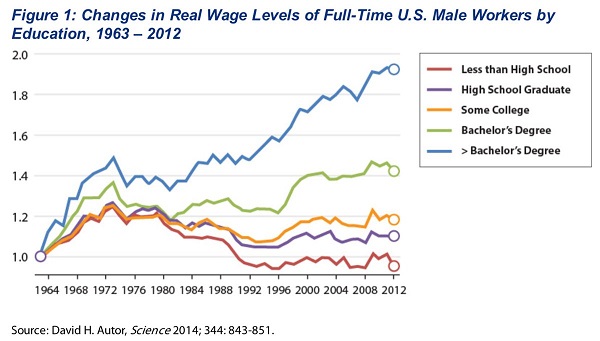
Other people protested against looking at the median wage, arguing that the wages of college graduates are more relevant. After all, teachers, professors, doctors, and nurses are all college grads. If their opportunity cost goes up, that could still drive a Baumol effect. And:

Surely doctors and professors are in that top blue line; I think nurses and teachers are in the lower green one. Plausibly these professions’ opportunity costs have gone up 50 – 100% during this period. This is a start to explaining why education/medicine have gone up 200 – 300% during the same time. On the other hand, the period of fastest wage growth was 1965 – 1975, which as per T&H’s graph (page 2) was the period of slowest cost growth.

2. Wages for doctors and teachers have not risen

Let’s start with teachers. T&H use NCES’ “instructional expenditures” category to show teacher wages have tripled since the 1950s; I cited NCES’ actual teacher salary data to show it’s stayed about the same. What’s going on?

NCES only has good data after 1990. Their data says education has become about 30% more expensive in real terms since that time – T&H’s data (page 2) suggests it has become twice as expensive, but their data on page 5 agrees with NCES (huh?). Here’s how various fields have changed, using two different classification systems:

Pay attention especially to the first one. From 1990 to 2016, employee salaries as a percent of educational expenditures have gone down! Employee benefits have gone up a bit, but not enough: salary + benefits is still a smaller part of the education budget in 2016 than in 1990. How do you look at these data and say “We’ve figured out why education costs are rising and it’s definitely salaries”?

I think I miscalculated my tone when criticizing T&H’s presentation of data in their book. Tabarrok says I complained about areas “where [he] could have been clearer”. But my actual concern was that the presentation of this section misleads the reader. Whenever T&H talk about something other than salary, they emphasize that its share of the pie has not increased, but don’t mention that it increased a lot in absolute terms. Then when talking about salary, they emphasize that it increased a lot in absolute terms, but don’t mention that its share of the pie hasn’t increased. You’re left with the impression that salaries are the culprit for the price increases, when in fact salaries increased least of all the major categories in the data. “The data could have been clearer” is never just a minor gripe! Unclear data means you can prove whatever you want!

How are salary costs per pupil rising (even in proportion to other costs) if salaries are not? My guess is it’s all about decreasing class sizes, which T&H also highlight.

Moving on to doctors, I don’t have any equally clear sources. But I’ll at least try to explain more about the ones I already have.

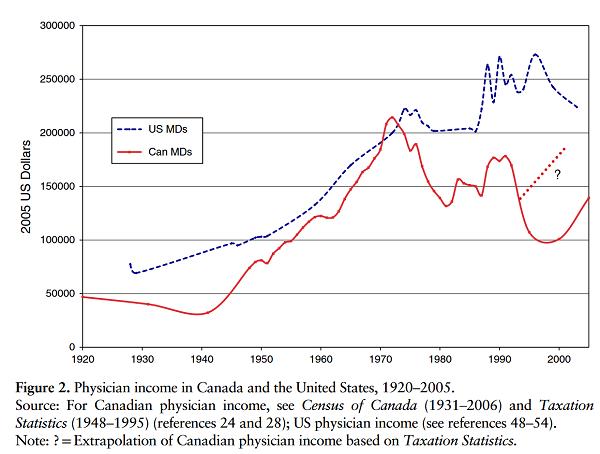
This paper from Health Economics, Policy, and Law shows on page 15:

They cite their source as “references 48 – 54”, but their reference section isn’t numbered, and is in alphabetical order, which would make it a pretty big coincidence if reference 48 through 54 were all about the same thing. I think a wire got crossed somewhere. But taking it at face value, I eyeball US doctor salaries in 1960 as 130K and in 2005 as about 210K, for an increase of 60% (not the 200% T&H claim). Doctor salaries have been about stable since 1975, even as (according to T&H’s graph on page 2), healthcare costs have about doubled.

The Last Psychiatrist posts this image:

I can’t trace the source beyond him, but read his post, where he notes that “There is the reality that doctor salaries (with notable exceptions) have been fairly static since 1969, even as the cost of living, price of homes, college, etc have gone up. And medical school debt.”

The last source I was able to find was this 1985 paper on doctor pay. It states that “In 1973, the median annual physician income was $45,000…by 1982, the median physician income was $85,000.” According to the inflation calculator, those numbers are $260,000 and $225,000 in current dollars, respectively. Estimates for average doctor salary today range from $209,000 to $299,000. I’m surprised how hard this is to measure, but it doesn’t seem to have doubled or tripled the way T&H claim (or the way it would have to in order to drive Baumol effects).

Also, the Baumol effect only works if the market sets your salary in the first place! Right now the supply of doctors is limited by licensing issues and bottlenecks in the medical education process; that keeps salaries high. Why would the Baumol effect drive that even higher? If doctors’ salaries didn’t increase in keeping with the highest-productivity industries, would medical schools sit empty? Given that the people setting salaries for doctors (hospitals, clinics) are not the people who determine the supply of doctors (bureaucrats, medical school deans), why should supply and salary be related in a way that obeys normal economic laws? I’m not really sure how to model this, but I’m pretty sure it doesn’t end with doctors leaving medicine to play violin concertos instead.

3. The Baumol effect cannot make things genuinely less affordable, but things are genuinely less affordable

I think I screwed up here.

The Baumol effect cannot make things genuinely less affordable for society, because society is more productive and can afford more stuff.

However, it can make things genuinely less affordable for individuals, if those individuals aren’t sharing in the increased productivity of society.

Suppose that in 1960, widgets cost $1, a worker could produce ten widgets an hour (and made $10 in wages), and violin concerts cost $10. Also, you are a farmer and make $10 per hour. You can listen to one violin concert per hour.

In 2010, widgets cost $0.50, a worker can make a hundred widgets an hour (and makes $50 in wages), and violin concerts have risen to $50. But you, still a farmer, still only make $10 per hour. The Baumol effect has driven up the cost of violin concerts for you.

This shouldn’t happen in real life, because if you work in the high-productivity-gain industries, you should make more because of your increased productivity, and if you work in the low-productivity-gain industries, you should make more because of the Baumol effect. But if it did happen, you’d be screwed.

And in fact, as mentioned above, wages have not increased in keeping with productivity, either in the high-productivity-gain industries like manufacturing, or in the low-productivity-gain industries like teaching. So if you work in one of those industries, it’s totally possible for you to be screwed, ie for college etc to become much less affordable for you.

If wages had grown in keeping with productivity, median yearly salary would be something like $100,000. Someone making $100,000 per year shouldn’t have that hard a time affording health insurance and college tuition for their kids; this would be the Baumol effect working in its normal, rising-tide-lifts-all-boats way. Since this hasn’t happened, Baumol-applicable industries have become harder to afford.

Again, this is all theoretical, because wages in high-productivity industries haven’t risen, so it’s hard to see how a Baumol effect could be happening at all. But if it was, it would be a good explanation for cost disease.

So I retract this third objection. I think the first objection mostly still stands, though it is a little weaker if we limit ourselves to college-educated workers compared to all workers. I think the second objection absolutely still stands, and it’s hard for me to see how T&H’s case could survive it.

Posted in Uncategorized | Tagged | 185 Comments

OT130: Open Thresh

This is the bi-weekly visible open thread (there are also hidden open threads twice a week you can reach through the Open Thread tab on the top of the page). Post about anything you want, but please try to avoid hot-button political and social topics. You can also talk at the SSC subreddit or the SSC Discord server – and also check out the SSC Podcast. Also:

1. The European Summer Program in Rationality is looking for young people ages 16 – 19 interested in a summer camp on applied rationality. I know some of the organizers and can vouch for them as good people. Free tuition, room, and board in whatever European city they end up holding it in; travel scholarships may be available if needed. Apply at the website.

Posted in Uncategorized | Tagged | 545 Comments